Attitude Adjustment

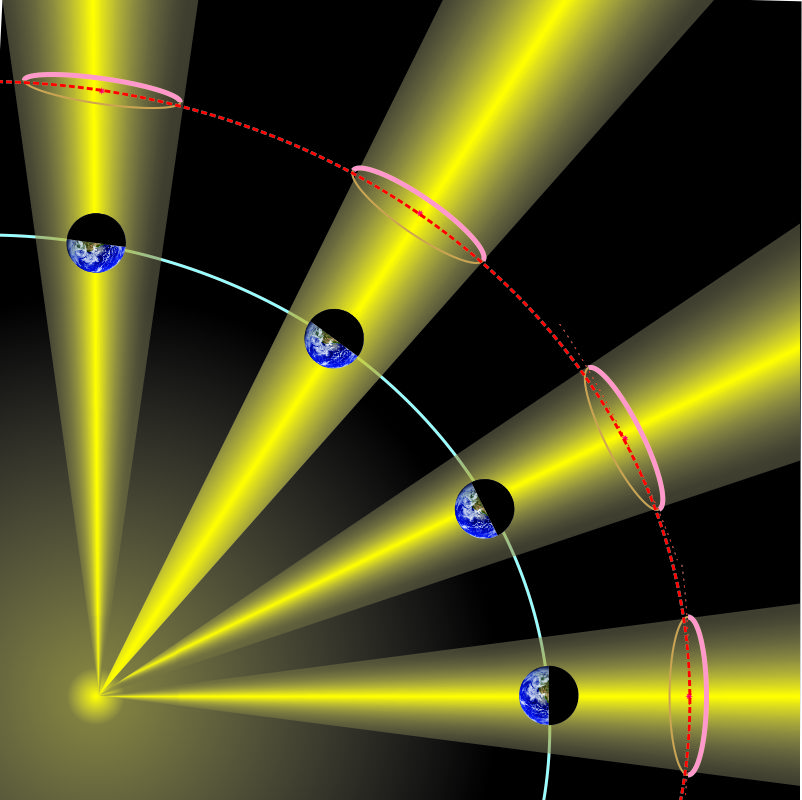
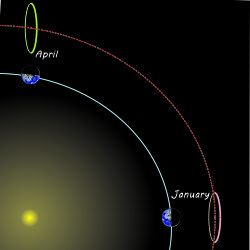
Mr Feder has a snarky grin on his face and a far‑away look in his eye. “Got another one. James Webb Space Telescope flies in this big circle crosswise to the Sun‑Earth line, right? But the Earth doesn’t stand still, it goes around the Sun, right? The circle keeps JWST the same distance from the Sun in maybe January, but it’ll fly towards the Sun three months later and get flung out of position.” <grabs a paper napkin> “Lemme show you. Like this and … like this.”

“Sorry, Mr Feder, that’s not how either JWST or L2 works. The satellite’s on a 6-month orbit around L2 — spiraling, not flinging. Your thinking would be correct for a solid gyroscope but it doesn’t apply to how JWST keeps station around L2. Show him, Sy.”

“Gimme a sec with Old Reliable, Cathleen.” <tapping> “OK, here’s an animation over a few months. What happens to JWST goes back to why L2 is a special point. The five Lagrange points are all about balance. Near L2 JWST will feel gravitational pulls towards the Sun and the Earth, but their combined attraction is opposed by the centrifugal force acting to move the satellite further out. L2 is where the three balance out radially. But JWST and anything else near the extended Sun‑Earth line are affected by an additional blended force pointing toward the line itself. If you’re close to it, sideways gravitational forces from the Sun and the Earth combine to attract you back towards the line where the sideways forces balance out. Doesn’t matter whether you’re north or south, spinward or widdershins, you’ll be drawn back to the line.”

Al’s on refill patrol, eavesdropping a little of course. He gets to our table, puts down the coffee pot and pulls up a chair. “You’re talking about the JWST. Can someone answer a question for me?”

“We can try.”
 ”What’s the question?”
  Mr Feder, not being the guy asking the question, pooches out his lower lip.

“OK, how do they get it to point in the right direction and stay there? My little backyard telescope gives me fits just centering on some star. That’s while the tripod’s standing on good, solid Earth. JWST‘s out there standing on nothing.”

JWST‘s Attitude Control System has a whole set of functions to do that. It monitors JWST‘s current orientation. It accepts targeting orders for where to point the scope. It computes scope and satellite rotations to get from here to there. Then it revises as necessary in case the first‑draft rotations would swing JWST‘s cold side into the sunlight. It picks a convenient guide star from its million‑star catalog. Finally, ACS commands its attitude control motors to swing everything into the new position. Every few milliseconds it checks the guide star’s image in a separate sensor and issues tweak commands to keep the scope in proper orientation.”

“I get the sequence, Sy, but it doesn’t answer the how. They can’t use rockets for all that maneuvering or they’d run out of fuel real fast.”

“Not to mention cluttering up the view field with exhaust gases.”

“Good point, Cathleen. You’re right, Al, they don’t use rockets, they use reaction wheels, mostly.”

“Uh-oh, didn’t broken reaction wheels kill Kepler and a few other missions?”

“That sounds familiar, Mr Feder. What’s a reaction wheel, Sy, and don’t they put JWST in jeopardy?”

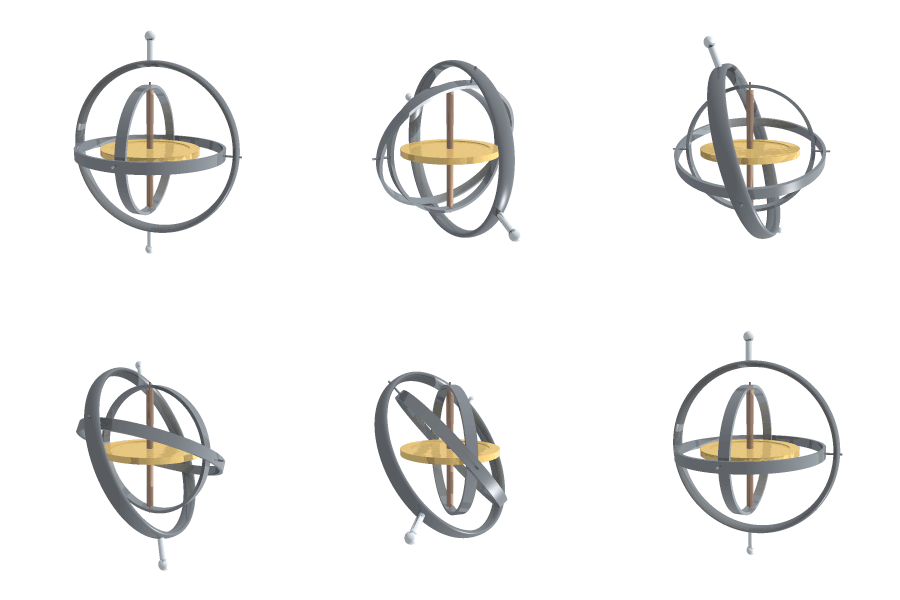
 Gyroscope, image by Lucas Vieira

“A reaction wheel is a massive doughnut that can spin at high speed, like a classical gyroscope but not on gimbals.”

“Hey, Moire, what’s a gimbal?”

“It’s a rotating frame with two pivots for something else that rotates. Two or three gimbals at mutual right angles let what’s inside orient independent of what’s outside. The difference between a classical gyroscope and a reaction wheel is that the gyroscope’s pivots rotate freely but the reaction wheel’s axis is fixed to a structure. Operationally, the difference is that you use a gyroscope’s angular inertia to detect change of orientation but you push against a reaction wheel’s angular inertia to create a change of orientation.”

“What about the jeopardy?”

Kepler‘s failing wheels used metal bearings. JWST‘s are hardened ceramic.”

<whew>

~~ Rich Olcott

Pinks In Space

Mr Feder, of Fort Lee NJ, is outraged. “A pretty pink parasol? NASA spent taxpayer dollars to decorate the James Webb Space Telescope with froufrou like that?”

Astronomer Cathleen stays cool. “Certainly not, Mr Feder. This is no effete Victorian‑era parasol. It’s a big, muscular ‘defender against the Sun,’ which is what the word means when you break it down — para‑sol. Long and wide as a tennis court. Its job is to fight off the Sun’s radiation and keep JWST‘s cold side hundreds of degrees colder than the Sunfacing side. Five layers of highstrength Kapton film, the same kind that helped protect New Horizons against freezing and micrometeorites on its way to Pluto and beyond. Each layer carries a thin coat of aluminum, looks like a space blanket or those Mylar mirror balloons but this is a different kind of plastic.”

“Sounds like a lot of trouble for insulation. Why not just go with firebrick backed up with cinder blocks? That’s what my cousin used for her pottery kiln.”

I cut in, because Physics. “Two reasons, Mr Feder. First one is mass. Did you help your cousin build her kiln?”

“Nah, bad back, can’t do heavy lifting.”

“There you go. On a space mission, every gram and cubic centimeter costs big bucks. On a benefit/cost scale of 1 to 10, cinder blocks rate at, oh, about ½. But the more important reason is that cinder blocks don’t really address the problem.”

“They keep the heat in that kiln real good.”

“Sure they do, but on JWST‘s hot side the problem is getting rid of heat, not holding onto it. That’s the second reason your blocks fail the suitability test. Sunlight at JWST ‘s orbit will be powerful enough to heat the satellite by hundreds of degrees, your choice of Fahrenheit or centigrade. That’s a lot of heat energy to expel. Convection is a good way to shed heat but there’s no air in space so that’s not an option. Conduction isn’t either, because the only place to conduct the heat to is exactly where we don’t want it — the scope’s dish and instrument packages. Cinder blocks don’t conduct heat as well as metals do, but they do it a lot better than vacuum does.”

“So that leaves what, radiating it away?”

“Exactly.”

“Aluminum on the plastic makes it a good radiator, huh?”

“Sort of. The combo’s a good reflector, which is one kind of radiating.”

“So what’s the problem?”

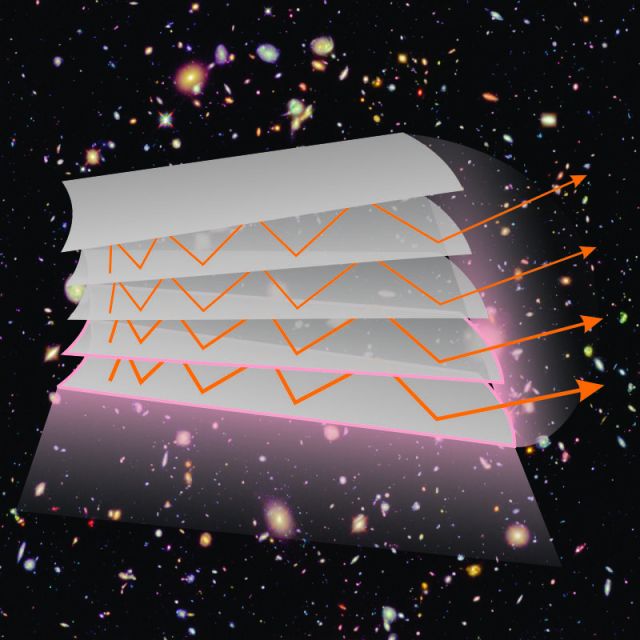
“It’s not a perfect reflector. The challenge is 250 kilowatts of sunlight. Each layer blocks 99.9% but that still lets 0.1% through to heat up what’s behind it. The parasol has radiate away virtually all the incoming energy. That’s why there’s five layers and they’re not touching so they can’t conduct heat to each other.”

“Wait, they can still radiate to each other. Heat bounces back and forth like between two mirrors, builds up until the whole thing bursts into flames. Dumb design.”

“No flames, despite what the Space Wars movies show, because there’s no oxygen in space to support combustion. Besides, the designers were a lot smarter than that. The mirrors are at an angle to each other, just inches apart near the center, feet apart at the edges. Heat in the form of infrared light does indeed bounce between each pair of layers but it always bounces at an angle aimed outwards. The parasol’s edges will probably shine pretty brightly in the IR, but only from the sides and out of the telescope’s field of view.”

“OK, I can understand the aluminum shiny, but why make it pink?”

“That’s a thin extra coat of a doped silicon preparation, just on the outermost two layers. It’s not so good at reflection but when it heats up it’s good at emitting infrared. Just another way to radiate.”

“But it’s pink?”

“The molecules happen to be that color.”

“Why’s it dopey?”

“Doped, not dopey. Pure silicon is an electrical insulator. Mixing in the right amount of the right other atoms makes the coating a conductor so it can bleed off charge coming in on the solar wind.”

“Geez, they musta thought of everything.”

“They tried hard to.”

~~ Rich Olcott

Yardsticks

“Hi, Cathleen, meet Mr Richard Feder, of Fort Lee NJ. He’s got a question that’s more in your Astronomy bailiwick than mine. Have a strawberry scone.”

“Mmm, still warm from Al’s oven. Thanks, Sy. Hello and what’s your question, Mr Feder?”

“Hiya. So if the James Webb Space Telescope is gonna be a million miles behind the Moon, won’t the Moon block its signals to us?”

“Oh dear, he said ‘miles.’ Sy, you’d better get out Old Reliable to look up numbers and do unit conversions. Mr Feder, I don’t think in miles.”

“Huh? What do you use instead, like paces or something?”

“Depends on what objects I’m considering and why I’m thinking about them. There are so many useful ratios out there it’s often easier to use ratios than huge numbers one can’t wrap one’s head around. Jupiter’s radius, for instance, is eleven times Earth’s, and the Sun is ten times wider still. Diameter and circumference follow the same ratios, of course. Square those ratios for relative surface area, cube them for relative volume. Who needs miles or kilometers?”

“Those numbers right, Moire?”

“Mmm … 6371 kilometers or 3959 miles for Earth, 71492 kilometers or 42441 miles for Jupiter, 695700 kilometers or 432300 miles for the Sun. The Jupiter/Earth ratio’s 11.2, the Sun/Jupiter ratio’s 9.73. The lady knows what she’s talking about.”

“Here’s a few fun factoids. The Moon’s distance is 10 times Earth’s Equator which is 100 times the International Space Station’s altitude. For that matter, if you wrapped a string around Earth’s Equator, it’d be just long enough to reach up to a GPS satellite and back. But all those are near‑Earth measurements where it makes sense to think in miles or kilometers. That’s too cumbersome for the bigger picture.”

“What else you got?”

“Within the Solar System I generally use one or the other of two convenient yardsticks. They measure the same distances, of course, but they have different applications. One is the nominal radius of Earth’s orbit, about 150 million kilometers.’

“That’s 93 million miles, Mr Feder.”

“I knew that one, Moire.”

“Anyway, we call that distance an Astronomical Unit. It’s handy for locating bodies relative to the Sun. Parker Solar Probe has gotten within a tenth of an AU of the Sun, for instance, and Neptune’s about 30 AU out. The Oort Cloud begins near 2000 AU and may extend a hundred times as far.”

“I ain’t even gonna ask what the Oort‐thing is, but I’m glad it’s a long way away.”

“We think it’s where long‑period comets come from.”

“Far away is good then. So what’s your other yardstick?”

“Lightspeed.”

“186 thousand miles per second, Mr Feder.”

“Yeah, yeah.”

“It’s also 300 thousand kilometers per second, and one light‑second per second, and one light‑year per year. Within the Solar System my benchmarks are that Earth is 500 light-seconds from the Sun, and Pluto was 4½ light-hours away from us when New Horizons sent back those marvelous images. The Sun’s nearest star system, Alpha Centauri, is 4⅓ light‑years away, and when you compare hours to years that gives you an idea of how small we are on the interstellar scale.”

“Cathleen, when you mentioned New Horizons that reminded me of the JWST. We’ve gotten off the track from Mr Feder’s question. Why isn’t the Moon going to block those signals?”

“Because it’ll never be in the way.” <sketching on a paper napkin> “There’s a bunch of moving parts here so hold on. The Earth orbits the Sun and the Moon orbits the Earth once a month, right? The L2 point doesn’t orbit the Earth. It orbits the Sun, staying exactly behind Earth so yeah, once a month the Moon could maybe get between Earth and L2. But JWST won’t be at L2, it’ll be in a wide orbit around that point and mostly perpendicular to the orbits of the Earth and Moon.”

“How wide?”

“It’ll vary depending on what they need, but it’s big enough to keep the spacecraft’s solar panels in the sunlight.”

“Solar panels? I thought the IR sensors needed cold cold cold.”

“They do. JWST protects its cold side with a hot side featuring a pretty pink Kapton parasol.”

~~ Rich Olcott

A Diamond in The Sky with Lucy

Mid-afternoon coffee-and-scone time. As I step into his coffee shop Al’s quizzing Cathleen about something in one of his Astronomy magazines. “This Lucy space mission they just sent up, how come it looks like they’re shooting at either side of Jupiter instead of hitting it straight-on? And it’s got this crazy butterfly orbit that crosses the whole Solar System a couple of times. What sense does that make?”

Planned path of Lucy‘s mission to study Trojan asteroids (black dots).
After diagrams by NASA and Southwest Research Institute

“It shoots to either side because there’s interesting stuff out there. We think the Solar System started as a whirling disk of dust that gradually clumped together. The gravity from Jupiter’s clump scarfed up the lion’s share of the leftovers after the Sun coalesced. The good news is, not all of Jupiter’s hoard wound up in the planet. Some pieces made it to Jupiter’s orbit but then collected in the Trojan regions ahead and behind it. Looking at that material may teach us about the early Solar System.”

“Way out there? Why not just fall into Jupiter like everything else did?”

I do Physics, I can’t help but cut in. “It’s the many‑body problem in its simplest case, just the Sun, Jupiter and an asteroid in a three‑body interaction—”

Cathleen gives me a look. “Inappropriate physicsplaining, Sy, we’re talking Astronomy here. Al’s magazine is about locating and identifying objects in space. These asteroids happen to cluster in special locations roughly sixty degrees away from Jupiter.”

“But Al’s question was, ‘Why?‘ You told him why we’re sending Lucy to the Trojans, but Physics is why they exist and why that mission map looks so weird.”

“Good point, go ahead. OK with you, Al?”

“Sure.”

I unholster Old Reliable, my tricked‑out tablet, and start sketching on its screen. “OK, orange dot’s Jupiter, yellow dot’s the Sun. Calculating their motion is a two-body problem. Gravity pulls them together but centrifugal force pulls them apart. The forces balance when the two bodies orbit in ellipses around their common center of gravity. Jupiter’s ellipse is nearly a circle but it wobbles because the Sun orbits their center of gravity. Naturally, once Newton solved that problem people turned to the next harder one.”

“That’s where Lucy comes in?”

“Not yet, Al, we’ve still got those Trojan asteroids to account for. Suppose the Jupiter‑Sun system’s gravity captures an asteroid flying in from somewhere. Where will it settle down? Most places, one body dominates the gravitational field so the asteroid orbits that one. But suppose the asteroid finds a point where the two fields are equal.”

“Oh, like halfway between, right?”

“Between, Al, but not halfway.”

“Right, Cathleen. The Sun/Jupiter mass ratio and Newton’s inverse‑square law put the equal‑pull point a lot closer to Jupiter than to the Sun. If the asteroid found that point it would hang around forever or until it got nudged away. That’s Lagrange’s L1 point. There are two other balance points along the Sun‑Jupiter line. L2 is beyond Jupiter where the Sun’s gravity is even weaker. L3 is way on the other side of the Sun, a bit inside Jupiter’s orbit.”

“Hey, so those 60° points on the orbit, those are two more balances because they’re each the same distance from Jupiter and the Sun, right?”

“There you go, Al. L4 leads Jupiter and L5 runs behind. Lagrange published his 5‑point solution to the three‑body problem in 1762, just 250 years ago. The asteroids found Jupiter’s Trojan regions billions of years earlier.”

“We astronomers call the L4 cluster the Trojan camp and the L5 cluster the Greek camp, but that’s always bothered me. It’d be OK if we called the planet Zeus, but Jupiter’s a Roman god. Roman times were a millennium after classical Greece’s Trojan War so the names are just wrong.”

“I hadn’t thought about that, Cathleen, but you’re right. Anyway, back to Al’s diagram of Lucy’s journey. <activating Old Reliable’s ‘Animate’ function> Sorry, Al, but you’ve been misled. The magazine’s butterfly chart has Jupiter standing still. Here’s a stars-eye view. It’s more like the Trojans will come to Lucy than the reverse.”

~~ Rich Olcott

Dark Glasses

My office door THUMPs as Richard Feder barrels in. Vinnie’s half out of his chair with his fists balled up but he settles back down when he sees who it is. “Moire, I gotta question.”

“Afternoon, Mr Feder. What brings you to the 12th floor of the Acme Building?”

“My dentist’s up here. They gave me these really dark glasses for when they aimed a bright light in my mouth to harden something in there so I wondered why’re they so dark an’ what about those glasses that can’t make up their minds?”

“Well, Mr Feder, as usual you’ve asked a jumbled question. Let’s see. The answers all boil down to what light is made of and what the glasses are made of.”

“I thought it was photon particles, Sy. The light, I mean.”

“It is, Vinnie, but photons only act like particles when they’re emitted and when they’re absorbed. In between, they act like waves. Dark glasses are all about photons as waves. The simplest case is the plain dark glasses.”

“Yeah, Moire, simple’s good.”

“They’re black because they’ve been doped with black chemicals. If your glasses are actually made of glass, the manufacturer probably dumped iron and sulfur into the melt. When heated those elements combine to form black iron sulfide particles spread throughout the mass. If the glasses are plastic, the manufacture mixed black dye into the formula. Either way, the more dopant added, the blacker the product and the fewer waves make it through the lens.”

“Great, Sy, but how come the black? I remember that Sun-spectrum poster that Al had up in his shop once. Lotsa sharp dark lines that Cathleen said were from different elements absorbing little slices of that rainbow background. But there were plenty of colors left over to make white.”

“Impressive memory, Vinnie. That was what, three years ago? Anyhow, those absorption lines come from separated atoms floating in the hot gas of the solar atmosphere. Quantum mechanics says that an isolated atom has a characteristic set of electron configurations, each with its own energy level. Say an incoming photon meets a gas atom. If the photon’s energy just matches the difference between the atom’s current configuration and some other configuration, suddenly the atom’s in the new configuration and no more photon. It has to match just right or no absorption. Those sharp lines come from that selectivity, OK?”

“So how do you get total black from selective atoms?”

“You don’t. You get black from less‑selective molecules and larger structures. Atoms right next to each other bring entanglement into the action — which electron is where on which atom? Many more configurations, many more differences between energy level pairs, many more lines that can overlap to make broad absorption bands. Suppose you’ve got some glass or plastic doped to have a single band sucking up everything between orange and green. Shine white light into it. Only red light and blue light come through. We see that as purple, a color that’s not even in the spectrum. Make that band even broader like it is with metals and rocks and iron sulfide; nothing gets through.”

“Then how do they do those glasses that get dark or light depending? The factory can’t put chemicals in but take ’em out temporary‑like when you walk inside.”

“Good point. In fact, the glass composition stays the same, sort of. The factory puts in chemicals that change their structure depending on the light level. If you dope optical glass with silver chloride crystallites, for instance, UV light can energize a chloride’s electron up to where it can leave the chloride and be captured by a silver ion. Do that with enough silver ions in the crystallite and you have a tiny piece of silver metal. Enough pieces and the glass looks gray, at least until heat energy joggles things back to the silver chloride ground state. For plastic lenses they use a subtler strategy — large‑ish molecules with spread‑out electron structures. UV light energizes an electron to another level and the molecule twitches to an opaque alternate form that relaxes when heat shakes it down.”

“Heat, huh? No wonder mine don’t work so good on the beach.”

~~ Rich Olcott

Galaxies Fluffy And Faint

Cathleen’s at the coffee shop’s baked goods counter. “A lemon scone, please, Al.”

I’m next in line. “Lemon sounds good to me, too. It’s a warm day.”

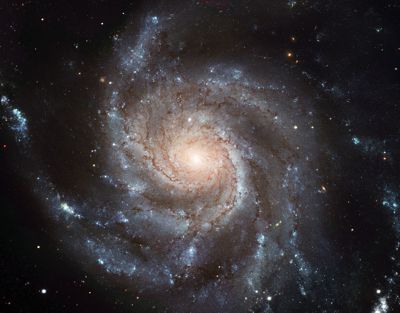
The Pinwheel Galaxy, NGC 5457
Credit: ESA/Hubble

“Sure thing, Sy. Hey, got a question for you, Cathleen, you bein’ an Astronomer and all. I just saw an Astronomy news item about a fluffy galaxy and they mentioned a faint galaxy. Are they the same and why the excitement?”

“Not the same, Al. It’ll be easier to show you in pictures. Sy, may I borrow Old Reliable?”

“Sure, here.”

“Thanks. OK, Al, here’s a classic ‘grand design‘ spiral galaxy, NGC 5457, also known as The Pinwheel. Gorgeous, isn’t it?”

“Sure is. Hey, I’ve wondered — what does ‘NGC‘ stand for, National Galaxy Collection or something?”

“Nope. The ‘G‘ doesn’t even stand for ‘Galaxy‘. It’s ‘New General Catalog‘. Anyway, here’s NGC 2775, one of our prettiest fluffies. Doesn’t look much like the Pinwheel or Andromeda, does it?”

NGC 2775
Credit: NASA / ESA / Hubble / J. Lee / PHANGS-HST Team / Judy Schmidt

“Nah, those guys got nice spiral arms that sort of grow out of the center. This one looks like there’s an inside edge to all the complicated stuff. And it’s got what, a hundred baby arms.”

“The blue dots in those ‘baby arms’ are young blue stars. They’re separated by dark lanes of dust just like the dark lanes in classic spirals. The difference is that these lanes are much closer together. The grand design spirals are popular photography subjects in your astronomy magazines, Al, but they’re only about 10% of all spirals. I’ll bet your news item was about 2775 because we’re just coming to see how mysterious this one is.”

“What’s mysterious about it?”

“That central region. It’s huge and smooth, barely any visible dust lanes and no blue dots. It’s bright in the infra‑red, which is what you’d expect from a population of old red stars. In the ultra‑violet, though, it’s practically empty — just a small dot at the center. UV is high‑energy light. It generally comes from a young star or a recent nova or a black hole’s accretion disk. The dot is probably a super-massive back hole. but its image is just a tiny fraction of the smooth region’s width. With a billion red stars in the way it’s hard to see how the black hole’s gravity field could have cleaned up all the dust that should be in there. Li’l Fluffy here is just begging for some Astrophysics PhD candidates to burn computer time trying to explain it.”

NGC 1052-DF2
Credit: NASA, ESA, and P. van Dokkum (Yale University)

“What about Li’l Faint?”

“That’s probably this one, NGC 1052-DF2. Looks a bit different, doesn’t it?

“I’ll say. It’s practically transparent. Is it a thing at all or just a smudge on the lens?”

“Not a smudge. We’ve got multiple images in different wavelength ranges from multiple observatories, and there’s another similar object, NGC 1052-DF4, in the same galaxy group. We even have measurements from individual stars and clusters in there. The discovery paper claimed that DF2 is so spread out because it lacks the dark matter whose gravity compacts most galaxies. That led to controversy, of course.”

“Is there anything in Science that doesn’t? What’s this argument?”

“It hinges on distance, Sy. The object is about as wide as the Milky Way but we see only 1% as many stars. Does their mass exert enough gravitational force to hold the structure together? There’s a fairly good relationship between a galaxy’s mass and its intrinsic brightness — more stars means more emitting surface and more mass. We know how quickly apparent brightness drops with distance. From other data the authors estimated DF2 is 65 lightyears away and from its apparent brightness they back‑calculated its mass to be just about what you’d expect from its stars alone. No dark matter required to prevent fly‑aways. Another group using a different technique estimated 42 lightyears. That suggested a correspondingly smaller luminous mass and therefore a significant amount of dark matter in the picture. Sort of. They’re still arguing.”

“But why does it exist at all?”

“That’s another question.”

~~ Rich Olcott

  • Thanks to Oriole for suggesting this topic.

An Italianate Mantle Piece

Eddie has set out some tables in the Acme Building’s atrium in front of his pizza place. Mid‑morning as I walk by he’s sitting at one of them, reading a newspaper. “Morning, Eddie. Ready for walk‑in customers now that things are opening up?”

“I sure hope so, Sy. The building’s still half‑empty ’cause of the work‑from‑homers but I got hopes thanks to folks like you comin’ in.”

“I’ll drop down for lunch later. Don’t see many actual print newspapers these days. What’s in there?”

“Oh, this is the weekly from my cousin in Catania. Etna’s acting up again, as usual.”

“Catania?”

“City on the southeast coast of Sicily, about 20 miles away from the volcano. Even with the earthquakes and eruptions Catania’s almost 3000 years old. Funny, in Italy we got Etna and Vesuvius and Stromboli, Greece has Santorini and Methana, there’s a whole bunch strung out through Turkey — wonder why they all line up like that.”

A new voice behind me, but somehow familiar. “Tectonics.”

I turn. It’s the fellow with the dinosaur theory. “Hello, there. I thought you were a paleontologist.”

“Nah, I prefer really old rocks. The Paleontology course was part of my Geology program. You’re Cathleen’s friend Sy, aren’t you?”

“Guilty as charged. If I recall correctly, you’re Kareem who won the Ceremonial Broom?”

“Guilty as charged.”

“Will you guys quit playing games and just answer the question? What’s with those volcanoes?”

“Sorry, Eddie. You know about continental drift, right, that the continents are big slabs that float on top of the Earth’s molten‑metal insides?”

“Sort of, Kareem. Which brings up another question. If the layer underneath is molten metal, how come the volcanoes spit rock instead of metal? Anyway, how do we know it’s not rock all the way down?”

“Go easy on the guy, Eddie, you’re up to three questions already. Let him catch a breath.”

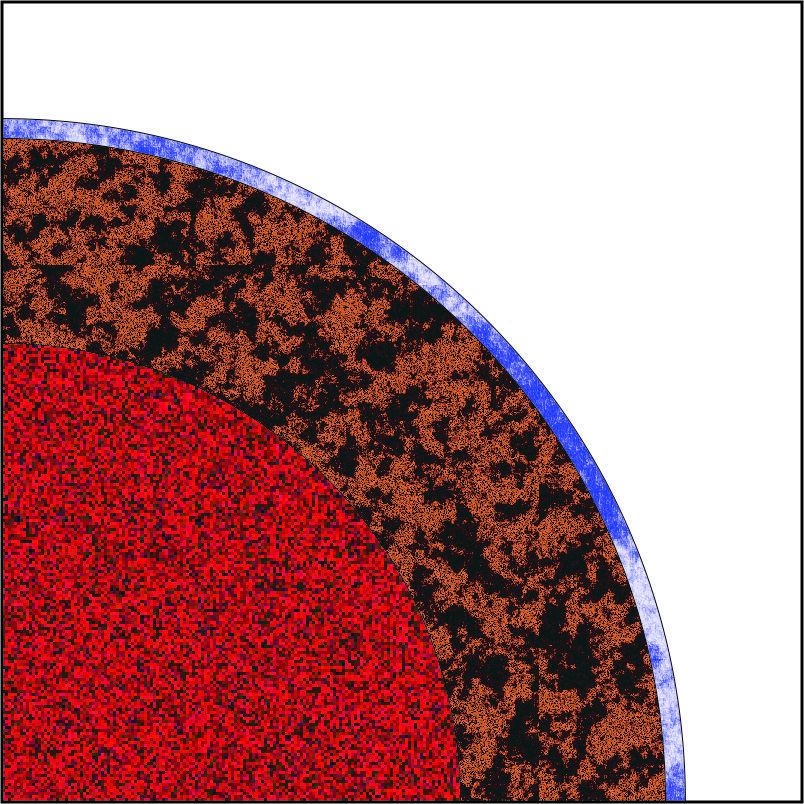
“Thanks, Sy. Last one first — we get a planet’s density from its size and orbit. For Earth it’s about 5.5 megagrams per cubic meter. For comparison, silicate rocks at the surface cluster around 2.7 and iron runs 7.9. Earth is just too heavy to be rock all the way down.”

“Those numbers put Earth almost exactly half-way between rock and iron. That tells me that half the planet’s mass is rocky. Surely the crust isn’t really that thick.”

“You might be surprised, Sy. Remember, volume goes up as the cube of the radius so it doesn’t take much crust thickness to make a large volume. Mind if I use a paper napkin, Eddie?”

“Nah, go ahead.”

“OK, here’s a really simplistic model. Suppose there’s just two layers, core and silicates, and density within each is uniform which means that mass is strictly proportional to volume times density. Let’s guess that core density is twice silicate density. If the core mass is half the planet’s mass, the core radius comes to … 69% of the total and the silicate layer is 1900 kilometers thick. That’s 2/3 of the way down to the bottom of the mantle, Earth’s real middle layer between crust and core. Almost embarrassingly good agreement, considering. Anyway, Eddie, it can’t be rock all the way down and the metallic component is pretty well trapped below megameters of rock. What escapes is the heat that melts the rocks for volcanoes to spit.”

“You started out with metal in the middle of the Earth and then you switched to iron. Which is it and how do you know?”

“It is metallic, mostly iron and nickel. We’ve got four lines of evidence for that. Meteorites are the oldest. Lots of them are stony, but about 6% are a combination of two nickel‑iron alloys. We think those came to us from planetoids that weren’t harvested when the planets were under construction. Second is Earth’s magnetic field, which we think is generated by currents of molten metal deep within the planet. Third is seismic data combined with lab data on how waves travel through different materials at high temperature and pressure. The observed combination’s consistent with a nickel‑iron core. Fourth comes from nuclear theory and astrophysical observation — iron’s by far the most common metallic element in the Universe. Build with what you got.”

“But what about the volcanoes?”

~~ Rich Olcott

Here’s a Different Angle

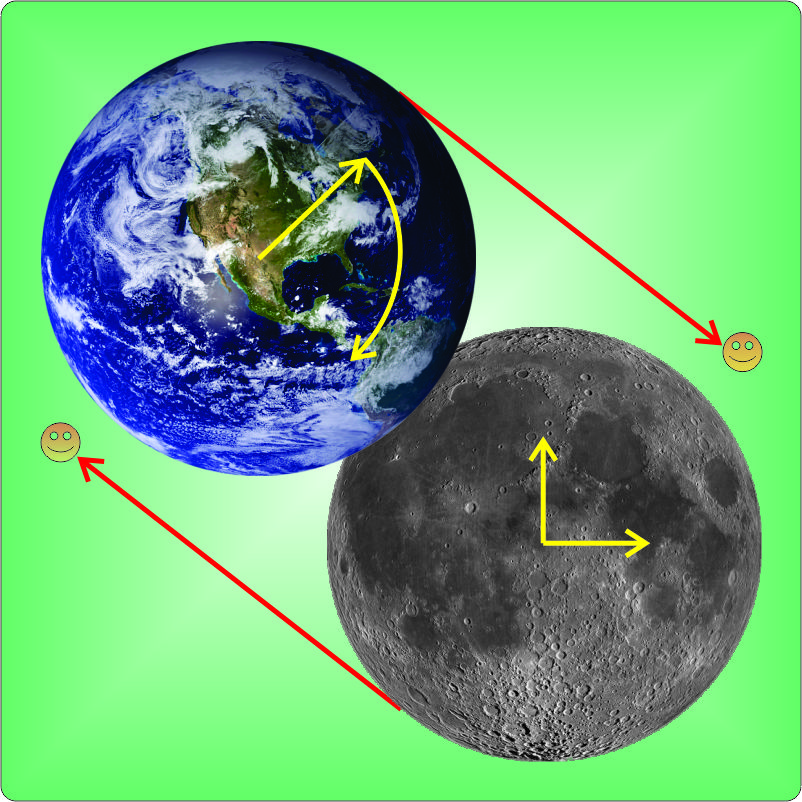
“OK, Sy, so there’s a bulge on the Moon’s side of the Earth and the Earth rotates but the bulge doesn’t and that makes the Moon’s orbit just a little bigger and you’ve figured out that the energy it took to lift the Moon raised Earth’s temperature by a gazillionth of a degree, I got all that, but you still haven’t told Al and me how the lifting works.”

“You wouldn’t accept it if I just said, ‘The Moon lifts itself by its bootstraps,’ would you?”

“Not for a minute.”

“And you don’t like equations. <sigh> OK, Al, pass over some of those paper napkins.”

“Aw geez, Sy.”

“You guys asked the question and this’ll take diagrams, Al. Ante up. … Thanks. OK, remember the time Cathleen and I caught Vinnie here at Al’s shop playing with a top?”

“Yeah, and he was spraying paper wads all over the place.”

“I wasn’t either, Al, it was the top sending them out with centri–…, some force I can never remember whether it’s centrifugal or centripetal.”

“Centrifugal, Vinnie, –fugal– like fugitive, outward‑escaping force. It’s one of those ‘depends on how you look at itfictitious forces. From where you were sitting, the wads looked like they were flying outward perpendicular to the top’s circle. From a wad’s point of view, it flew in a straight line tangent to the circle. It’s like we have two languages, Room and Rotor. They describe the same phenomena but from different perspectives.”

“Hey, it’s frames again, ain’t it?”

“Newton’s inertial frames? Sort‑of but not quite. Newton’s First Law only holds in the Room frame — no acceleration, motion is measured by distance, objects at rest stay put. Any other object moves in a straight line unless its momentum is changed by a force. You can tackle a problem by considering momentum and force components along separate X and Y axes. Both X and Y components work the same way — push twice as hard in either direction, get twice the acceleration in that direction. Nice rules that the Rotor frame doesn’t play by.”

“I guess not. The middle’s the only place an object can stay put, right?”

“Exactly, Al. Everything else looks like it’s affected by weird, constantly‑varying forces that’re hard to describe in X‑Y terms.”

“So that breaks Newton’s physics?”

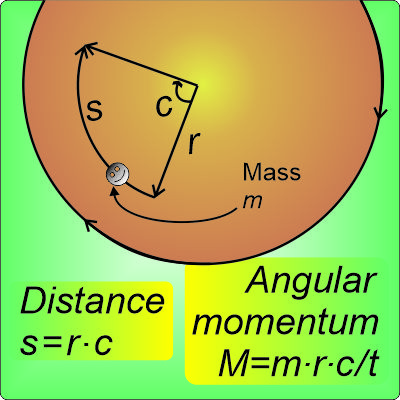
“Of course not. We just have to adapt his F=m·a equation (sorry, Vinnie!) to Rotor conditions. For small movements we wind up with two equations. In the strict radial direction it’s still F=m·a where m is mass like we know it, a is acceleration outward or inward, and F is centrifugal or centripetal, depending. Easy. Perpendicular to ‘radial‘ we’ve got ‘angular.’ Things look different there because in that direction motion’s measured by angle but Newton’s Laws are all about distances — speed is distance per time, acceleration is speed change per time and so forth.”

“So what do you do?”

“Use arc length. Distance along an arc is proportional to the angle, and it’s also proportional to the radius of the arc, so just multiply them together.”

“What, like a 45° bend around a 2-foot radius takes 90 feet? That’s just wrong!”

“No question, Al. You have to measure the angle in the right units. Remember the formula for a circle’s circumference?”

“Sure, it’s 2πr.”

“Which tells you that a full turn’s length is times the radius. We can bridge from angle to arc length using rotational units so that a full turn, 360°, is units. We’ll call that unit a radian. Half a circle is π radians. Your 45° angle in radians is π/4 or about ¾ of a radian. You’d need about (¾)×(2) or 1½ feet of whatever to get 45° along that 2-foot arc. Make sense?”

“Gimme a sec … OK, I’m with you.”

“Great. So if angular distance is radius times angle, then angular momentum which is mass times distance per time becomes mass times radius times angle per time.”

“”Hold on, Sy … so if I double the mass I double the momentum just like always, but if something’s spinning I could also double the angular momentum by doubling the radius or spinning it twice as fast?”

“Couldn’t have put it better myself, Vinnie.”

~~ Rich Olcott

Question Time

Cathleen unmutes her mic. “Before we wrap up this online Crazy Theories contest with voting for the virtual Ceremonial Broom, I’ve got a few questions here in the chat box. The first question is for Kareem. ‘How about negative evidence for a pre-mammal civilization? Played-out mines, things like that.‘ Kareem, over to you.”

“Thanks. Good question but you’re thinking way too short a time period. Sixty‑six million years is plenty of time to erode the mountain a mine was burrowing into and take the mining apparatus with it.

“Here’s a different kind of negative evidence I did consider. We’re extracting coal now that had been laid down in the Carboniferous Era 300 million years ago. At first, I thought I’d proved no dinosaurs were smart enough to dig up coal because it’s still around where we can mine it. But on second thought I realized that sixty-six million years is enough time for geological upthrust and folding to expose coal seams that would have been too deeply buried for mining dinosaurs to get at. So like the Silurian Hypothesis authors said, no conclusions can be drawn.”

“Nice response, Kareem. Jim, this one’s for you. ‘You said our observable universe is 93 billion lightyears across, but I’ve heard over and over that the Universe is 14 billion years old. Did our observable universe expand faster than the speed of light?‘”

“That’s a deep space question, pun intended. The answer goes to what we mean when we say that the Hubble Flow expands the Universe. Like good Newtonian physicists, we’re used to thinking of space as an enormous sheet of graph paper. We visualize statements like, ‘distant galaxies are fleeing away from us‘ as us sitting at one spot on the graph paper and those other galaxies moving like fireworks across an unchanging grid.

“But that’s not the proper post-Einstein way to look at the situation. What’s going on is that we’re at our spot on the graph paper and each distant galaxy is at its spot, but the Hubble Flow stretches the graph paper. Suppose some star at the edge of our observable universe sent out a photon 13.7 billion years ago. That photon has been headed towards us at a steady 300000 kilometers per second ever since and it finally reached an Earth telescope last night. But in the meantime, the graph paper stretched underneath the photon until space between us and its home galaxy widened by a factor of 3.4.

“By the way, it’s a factor of 3.4 instead of 6.8 because the 93 billion lightyear distance is the diameter of our observable universe sphere, and the photon’s 13.7 billion lightyear trip is that sphere’s radius.

“Mmm, one more point — The Hubble Flow rate depends on distance and it’s really slow on the human‑life timescale. The current value of the Hubble Constant says that a point that’s 3×10¹⁹ kilometers away from us is receding at about 70 kilometers per second. To put that in perspective, Hubble Flow is stretching the Moon away from us by 3000 atom‑widths per year, or about 1/1300 the rate at which the Moon is receding because of tidal friction.”

“Nice calculation, Jim. Our final question is for Amanda. ‘Could I get to one of the other quantum tracks if I dove into a black hole and went through the singularity?‘”

“I wouldn’t want to try that but let’s think about it. Near the structure’s center gravitational intensity compresses mass-energy beyond the point that the words ‘particle’ and ‘quantum’ have meaning. All you’ve got is fields fluctuating wildly in every direction of spacetime. No sign posts, no way to navigate, you wouldn’t be able to choose an exit quantum track. But you wouldn’t be able to exit anyway because in that region the arrow of time points inward. Not a sci‑fi story with a happy ending.”

“<whew> Alright, folks, time to vote. Who presented the craziest theory? All those in favor of Kareem, click on your ‘hand’ icon. … OK. Now those voting for Jim? … OK. Now those voting for Amanda? … How ’bout that, it’s a tie. I guess for each of you there’s a parallel universe where you won the virtual Ceremonial Broom. Congratulations to all and thanks for such an interesting evening. Good night, everyone.”

~~ Rich Olcott

Too Many Schrödingers

Cathleen takes back control of the conference software. “Thanks, Jim. OK, the final contestant in our online Crazy Theories contest is the winner of our last face-to-face event where she told us why Spock and horseshoe crabs both have green blood. You’re up, Amanda.”

“Thanks, and hello out there. I can’t believe Jim and I are both talking about parallel universes. It’s almost like we’re thinking in parallel, right?”

<Jim’s mic is muted so he makes gagging motions>

“We need some prep work before I can talk about the Multiverse. I’m gonna start with this heat map of North America at a particular time. Hot in the Texas panhandle, cool in British Columbia, no surprise. You can do a lot with a heat map — pick a latitude and longitude, it tells you the relative temperature. Do some arithmetic on the all numbers and you can get average temperature, highs and lows, front strength in degrees per mile, lots of stuff like that.

“You build this kind of map by doing a lot of individual measurements. If you’re lucky you can summarize those measurements with a function, a compact mathematical expression that does the same job — pick a latitude and longitude, it tells you the value. Three nice things about functions — they take up a lot less space than a map, you can use straightforward mathematical operations on them so getting statistics is less work than with a map, and you can form superpositions by adding functions together.”

Cathleen interrupts. “Amanda, there’s a question in the chat box. ‘Can you give an example of superposition?’

“Sure. You can superpose simple sine‑wave functions to describe chords for sound waves or blended colors for light waves, for instance.

“Now when we get to really small‑scale thingies, we need quantum calculations. The question is, what do quantum calculations tell us? That’s been argued about for a hundred years because the values they generate are iffy superpositions. Twenty percent of this, eighty percent of that. Everybody’s heard of that poor cat in Schrödinger’s box.

“Many researchers say the quantum values are relative probabilities for observing different results in an experiment — but most of them carefully avoid worrying about why the answers aren’t always the same. Einstein wanted to know what Bohr was averaging over to get his averages. Bohr said it doesn’t matter, the percentages are the only things we can know about the system and it’s useless to speculate further.

“Hugh Everett thought bigger. He suggested that the correct quantum function for an observation should include experiment and experimenter. He took that a step further by showing that a proper quantum function would need to include anyone watching the experimenter and so on. In fact, he proposed, maybe there’s just one quantum function for the entire Universe. That would have some interesting implications.

“Remember Schrödinger’s catbox with two possible experimental results? Everett would say that his universal quantum function contains a superposition of two component sub-functions — happy Schrödinger with a live kitty and sad Schrödinger with a disposal problem. Each Schrödinger would be quite certain that he’d seen the definite result of a purely random operation. Two Schrödingers in parallel universes going forward.

“But in fact there’d be way more than two. When Schrödinger’s eye absorbs a photon, or maybe doesn’t, that generates another pair of universes. So do the quantum events that occur as his nerve cells fire, or don’t. Each Schrödinger moves into the future embedded in a dense bundle of parallel universes.”

Cathleen interrupts. “Another question. ‘What about conservation of mass?‘”

“Good question, whoever asked that. Everett doesn’t address that explicitly in his thesis, but I think he assumed the usual superposition math. That always includes a fix‑up step so that the sum of all the pieces adds up to unity. Half a Schrödinger mass on one track and half on the other. Even as each of them splits again and again and again the total is still only one Schrödinger‑mass. There’s other interpretation — each Schrödinger’s universe would be independent of the others so there’s no summing‑up to generate a conservation‑of‑mass problem. Your choice.

“Everett traded quantum weirdness for a weird Universe. Not much of a trade-off, I think.”

~~ Rich Olcott