Now And Then

“Alright, I suppose there’s no going down below the Universe’s Year Zero, but what about the other direction? Do you physics guys have a handle on Time’s Top?”

“That’d be Cosmology, Mr Feder. We physicists avoid theorizing about stuff we can’t check against data. Well, except for string theory. The far past leaves clues that astronomers like Cathleen can gather. Sad to say, though, we barely have a handle on Now.”

Cathleen grins. Al and Mr Feder go, “Whaaat?”

“No, really. One of Einstein’s insights was that two observers randomly and independently flying through space won’t be able to agree on whether two external events occurred simultaneously. They can’t even agree on what time it is now.”

“Oh, yeah, I know about that. I’ve read about how the GPS system needs to make corrections to account for what relativity does to the satellite timings.”

“You’re right, Al, but that’s a different issue. Some of that relativistic correction has to do with space compression because of Earth’s mass. The simultaneity problem is strictly about rapid motion and geometry.”

“Wait — geometry?”

“Relativistic geometry, which is a bit different from the kind that Descartes built.”

“Whoa, Sy, slow down there. Descartes was the ‘I think therefore I am‘ guy, right? What’s that got to do with geometry?”

“I guess I got a little ahead of myself there, didn’t I? OK. Yeah, Al, same Descartes. Grew up Catholic in France, was a professional mercenary soldier in the Thirty Years War, wound up fighting first on the Catholic French side and later on fought on the Protestant Dutch side but cross‑over was common, both directions. He realized he was in an ostensibly religious war that was really about who ruled over whom. That may have had something to do with him becoming a professional philosopher who rejected all religious dogmas in favor of what he could learn solely from logic and his own senses. That’s where his famous mantra came from — he started by proving to himself that he existed.”

“Logic led to geometry, I suppose.”

“Indeed, but a new kind, one that required a few innovations that Descartes developed. On the one hand, mathematicians traditionally expressed algebraic problems in words and some of them were doozies, like saying ‘the zenzizenzizenzic‘ where we’d just say x8. We got that simple but <ahem> powerful notation from Descartes. On the geometry side, he’d ditch all the confusing line-ending markers in a diagram like this one. Instead, he’d label the whole line representing a known quantity with a front-of-the-alphabet letter like a or b or c. A line representing an unknown quantity would get its label from the alphabet-trailers like x, y and z. Then he used the same character conventions and his new power notation to write and manipulate algebraic expressions. Those notational inventions were foundational for his bridge between algebraic and geometrical problems. Draw your problem with lines and curves, transform it to algebraic equations, solve that problem exactly, transform it back to geometry and you’re done. Or vice-versa.”

The mesolabe instrument (in red).

“That goes back to Descartes, huh?”

“Mm-hm. His big innovation, though, arose from a borrow from an early Greek gadget called a mesolabe. He proposed an idealized version that would let someone break a line into exact fractions or compare a length against a unit length. That broke the rules of classical Geometry but setting his mesolabe’s Y‑angle to 90° prompted him to name points by their distance along the x– and y‑axes. That’s the nub of the Cartesian coordinate system — a rectangular grid of numbered straight lines that go on forever. Graph paper, right? Wrap the grid around the Earth and you’ve got latitudes and longitudes. Add more numbered grid lines perpendicular to either grid and you’ve got z‑axis coordinates. Three coordinates let you name any point in space. Newton and all the physicists who came after him until the dawn of the 20th Century assumed Descartes’ nice, stable coordinate system.”

“20th Century — that’s when Einstein came on the scene. He broke that system?”

“Sure did. You’ve heard about bent space?”

“Who hasn’t?”

“Well, fasten your seat belts, it’s going to be a fun ride.”

~~ Rich Olcott
The Bottom of Time

“Cathleen, one of my Astronomy magazines had an article, claimed that James Webb Space Telescope can see back to the Big Bang. That doesn’t seem right, right?”

“You’re right, Al, it’s not quite right. By our present state of knowledge JWST‘s infrared perspective goes back only 98% of the way to the Bang. Not quite the Bottom of Time, but close.”

“Whaddaya mean, ‘Bottom of Time‘? I’ve heard people talking about how weird it musta been before the Big Bang. And how can JWST see back in time anyway? Telescopes look across space, not time.”

“So many questions, Mr Feder, and some hiding behind others. That’s his usual mode, Cathleen. Care to tag-team?”

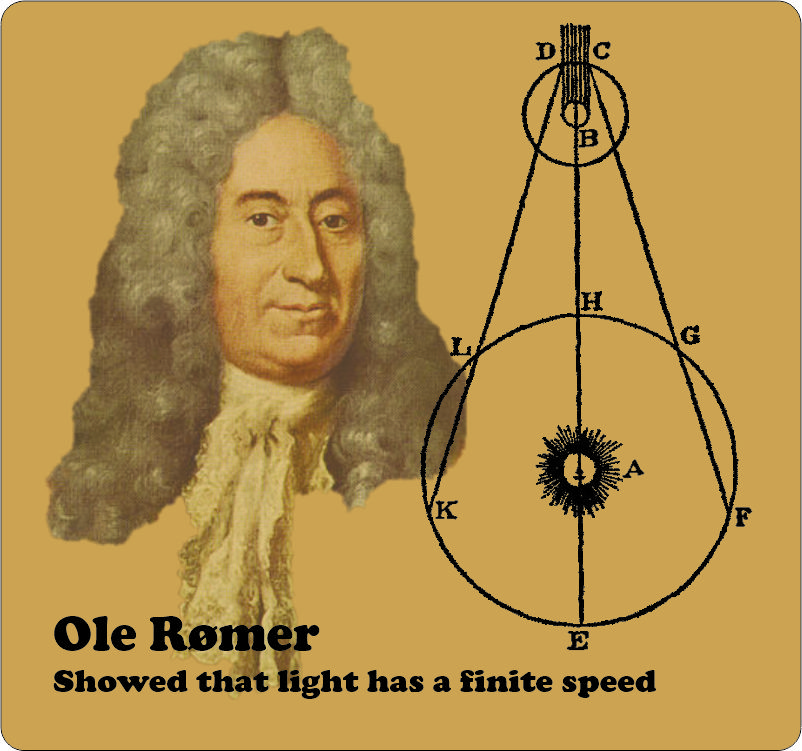
“You’re on, Sy. Well, Mr Feder. The ‘look back in time‘ part comes from light not traveling infinitely fast. We’ve known that for three centuries, ever since Rømer—”

“Roamer?”

“Ole Rømer, a Danish scientist who lived in Newson’s time. Everyone knew that Jupiter’s innermost large moon Io had a dependably regular orbit, circling Jupiter every 49½ hours like clockwork. Rømer was an astronomer when he wasn’t tutoring the French King’s son or being Copenhagen’s equivalent of Public Safety Commissioner. He watched Io closely, kept notes on exactly when she ducked behind Jupiter and when she reappeared on the other side. His observed timings weren’t quite regular, generally off by a few minutes. Funny thing was, the irregularities correlated with the Earth‑Jupiter distance — up to 3½ minutes earlier than expected when Earth in its orbit was closest to Jupiter, similarly late when they were far apart. There was a lot of argument about how that could be, but Rømer, Huygens, even Newton, all agreed that the best explanation was that we only see Io’s passage events after light has taken its time to travel from there to here.”

“Seems reasonable. Why should people argue about that?”

“The major sticking point was the speed that Huygens calculated from Rømer’s data. We now know it’s 186000 miles or 300000 kilometers or one lightsecond per second. Different ways of stating the same quantity. Huygens came up with a somewhat smaller number but still. The establishment pundits had been okay with light transmission being instantaneous. Given definite numbers, though, they had trouble accepting the idea that anything physical could go that fast.”

“Tag, my turn. Flip that distance per time ratio upside down — for every additional lightsecond of distance we’re looking at events happening one second farther into the past. That’s the key to JWST‘s view into the long‑ago. Al, you got that JWST‘s infrared capabilities will beat Hubble‘s vis‑UV ones for distance. Unless there’s something seriously wrong with Einstein’s assumption that lightspeed’s an absolute constant throughout spacetime, we expect JWST to give us visibility to the oldest free photons in the Universe, just 379000 years upward from the Big Bang.”

“Wait, I heard weaseling there. Free photons? Like you gotta pay for the others?”

“Ha, ha, Mr Feder. During those first 379000‑or‑so years, we think the Universe was so hot and so dense that no photon’s wave had much of a chance to spread out before it encountered a charged something and got absorbed. At last, things cooled down enough for atoms to form and stay in one piece. Atoms are neutral. Quantum rules restrict their interaction to only photons that have certain wavelengths. The rest of the photons, and there’s a huge number of them, were free to roam the expanding Universe until they happen to find a suitable absorber. Maybe someone’s eye or if we’re lucky, a sensor on JWST or some other telescope.”

Thanks for this to George Derenburger

“What about before the 300‑and‑something thousand years? Like, before Year Zero? Musta been weird, huh?”

“Well, there’s a problem with that question. You’re assuming there was a Year Minus‑One, but that’s just not the case.”

“Why not? Arithmetic works that way.”

“But the Universe doesn’t. Stephen Hawking came up with a good way to think about it. What on Earth is south of the South Pole?”

“Eeayahh … nope. Can’t get any further south than that.”

“Well, there you are, so to speak. Time’s bottom is Year Zero and you can’t get any further down than that. We think.”

~~ Rich Olcott

The Red Advantage

“OK, Cathleen, I get that JWST and Hubble rate about the same for sorting out things that are close together in the sky, and I get that they look at different kinds of light so it’s hard to compare sensitivity. Let’s get down to brass tacks. Which one can see farther?”

“An excellent question, Mr Feder. I’ve spent an entire class period on different aspects of it.”

“Narrow it down a little, I ain’t got all day.”

“You asked for it — a quick course on cosmological redshift. Fasten your seat belt. You know what redshift is, right?”

“Yeah, Moire yammers on about it a lot. Waves stretch out from something moving away from you.”

I bristle. “It’s important! And some redshifts don’t have anything to do with motion.”

“Right, Sy. Redshift in general has been a crucial tool for studying everything from planetary motion to the large‑scale structure of the Universe. Your no‑motion redshift — you’re thinking of gravitational redshift, right?”

“Mm-hm. From a distance, space appears to be compressed near a massive object, less compressed further away. Suppose we send a robot to take up a position just outside a black hole’s event horizon. The robot uses a green laser to send us its observations. Space dilates along the beam’s path out of the gravity well. The expanding geometry stretches the signal’s wavelength into the red range even though the robot’s distance from us is constant.”

“So, that’s gravitational redshift and there’s the Doppler redshift that Mr Feder referred to—”

“Is that what its name is? With p‘s? I always heard it as ‘doubler’ effect and wondered where that came from.”

“It came from Christian Doppler’s name, Al. Back in the 1840s he was investigating a star. He noticed that its spectrum was the overlap of two spectra slightly shifted with respect to each other. Using wave theory he proposed that the star was a binary and that the shifted spectra arose from one star coming towards us and the other moving away. Later work confirmed his ideas and the rest is history. So it’s Doppler, not doubler, even though the initial observation was of a stellar doublet.”

“So what’s this cosmo thing?”

“Cosmological redshift. It shows up at large distances. On the average, all galaxies are moving away from us, but they’re moving away from each other, too. That was Hubble’s big discovery. Well, one of them..”

“Wait, how can that be? If I move away from Al, here, I’m moving toward Sy or somebody.”

“We call it the expansion of the universe. Have you ever made raisin bread?”

“Nah, I just eat it.”

“Ok, then, just visualize how it’s made. You start with a flat lump of dough, raisins close together, right? The loaf rises as the yeast generates gas inside the lump. The dough expands and the raisins get further apart, all of them. There’s no pushing away from a center, it’s just that there’s an increasing amount of bubbly dough between each pair of neighboring raisins. That’s a pretty good analogy to galactic motion — the space between galaxies is expanding. The general motion is called Hubble flow.”

“So we see their light as redshifted because of their speed away from us.”

“That’s part of it, Al, but there’s also wave‑stretching because space itself is expanding. Suppose some far‑away galaxy, flying away at 30% of lightspeed, sent out a green photon with a 500‑nanometer wavelength. If the Doppler effect were the only one in play, our relative speeds would shift our measurement of that photon out to about 550 nanometers, into the yellow. Space expansion at intermediate stations along its path can cumulatively dilate the wave by further factors out into the infrared or beyond. Comparing two galaxies, photons from the farther one will traverse a longer path through expanding space and therefor experience greater elongation. Hubble spotted one object near its long‑wavelength limit with a recognizable spectrum feature beyond redshift factor 11.”

“Hey, that’s the answer to Mr Feder’s question!”

“So what’s the answer, smart guy?”

JWST will be able to see farther, because its infrared sensors can pick up distant light that’s been stretched beyond what Hubble can handle.”

~~ Rich Olcott

Lord Rayleigh Resolves

Mr Feder just doesn’t quit. “But why did they make JWST so big? We’re getting perfectly good pictures from Hubble and it’s what, a third the size?”

Al’s brought over a fresh pot and he’s refilling our coffee mugs. “Chalk it up to good old ‘because we can.’ Rockets are bigger than in Hubble‘s day, robots can do more remote stuff by themselves, it all lets us make a bigger scope.”

Cathleen smiles. “There’s more to it than that, Al. It’s really about catching photons. You’re nearly correct, Mr Feder, the diameter ratio is 2.7. But photons aren’t captured by a line across the primary mirror, they’re captured by the mirror’s entire area. The important JSWT:Hubble ratio is between their areas. JWST beats Hubble there by a factor of 7.3. For a given source and the same time interval, we’d expect JWST to be that much more sensitive than Hubble.”

“Well,” I break in, “except that the two use photon detectors that are sensitive to different energy ranges. The two scopes often won’t even be looking at the same kinds of object. Hubble‘s specialized for visible and UV light. It’s easy to design detectors for that range because electrons in solid‑state devices respond readily to the high‑energy photons. The infrared light photons that JWST‘s designed for don’t have enough energy to kick electrons around the same way. Not really a fair comparison, although everything I’ve read says that JWST‘s sensitivity will be way up there.”

Mr Feder is derisive. “‘Way up there.’ Har, har, de-har. I suppose you’re proud of that.”

“Not really, it just happened. But Cathleen, I’m surprised that you as an astronomer didn’t bring up the other reason the designers went big for JWST.”

“True, but it’s more technical. You’re thinking of resolution and Rayleigh’s diffraction limit, aren’t you?”

“Bingo. Except Rayleigh derived that limit from the Airy disk.”

“Disks in the air? We got UFOs now? What’re you guys talking about?”

Portrait of Sir George Airy
licensed under the Creative Commons
Attribution 4.0 International license.

“No UFOs, Mr Feder, I’ll try to be non‑technical. Except for the big close objects like the Sun and its planets, telescopes show heavenly bodies as circular disks accompanied by faint rings. In the early 1800s an astronomer named George Airy proved that the patterns are an illusion produced by the telescope. His math showed that even the best possible apparatus will force lightwaves from any small distant light source to converge to a ringed circular disk, not a point. The disk’s size depends on the ratio between the light’s wavelength and the diameter of the telescope’s light‑gathering aperture. How am I doing, Al?”

“Fine so far.”

“Good. Rayleigh took that one step further. Suppose you’re looking at two stars that are very close together in the sky. You’d expect to see two Airy patterns. However, if the innermost ring from one star overlaps the other star’s disk, you can’t resolve the two images. That’s the basis for Rayleigh’s resolvability criterion — the angle between the star images, measured in arc‑seconds, has to be at least 252000 times the wavelength divided by the diameter.”

After a diagram by cmglee
licensed under the Creative Commons
Attribution 3.0 International license.

“But blue light’s got a shorter wavelength than red light. Doesn’t that say that my scope can resolve close-together blue stars better than red stars?”

“Sure does, except stars don’t emit just one color. In visible light the disk and rings are all rimmed with reddish and bluish fuzz. The principle works just fine when you’re looking at a single wavelength. That gets me to the answer to Mr Feder’s question. It’s buried in this really elegant diagram I just happen to have on my laptop. Going across we’ve got the theoretical minimum angle for resolving two stars. Going up we’ve got aperture diameters, running from the pupil of your eye up to radio telescope coalitions that span continents. The colored diagonal bands are different parts of the electromagnetic spectrum. The red bars mark each scope’s sensor wavelength range. Turns out JWST‘s size compared to Hubble almost exactly compensates for the longer wavelengths it reports on.”

~~ Rich Olcott

E Pluribus

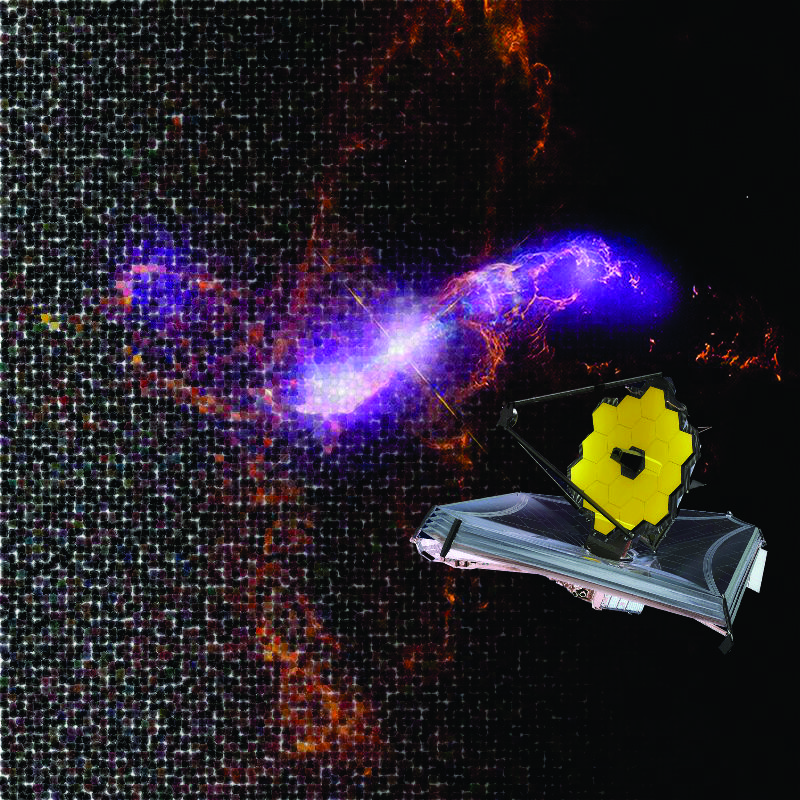
Mr Feder’s a determined fault‑finder. “That gold on James Webb Space Telescope‘s mirror — it’s gonna make all its pictures look funny, yellow‑like instead of whatever the real colors are.”

Cathleen bristles a little. “We astronomers have built our science on recognizing. accounting for and overcoming instrument limitations. Hubble, for instance, went up with a mirror that had been misground so its resolution was a factor of 10 worse than it was supposed to be. It took three years for NASA to install corrective optics. In the meantime we devised a whole catalog of math and computer techniques for pulling usable data out of the mess. Anyway, JWST‘s not designed to make pretty pictures.”

“I thought it was gonna replace Hubble. If it can’t take pictures, what’re we putting it up there for?”

“It’s a successor, not a replacement. JWST is designed to answer a completely different set of questions from the ones that Hubble has been used for. I’m sure we’ll keep using Hubble for as long as it continues to operate. By the way, the Hubble pictures you’ve seen aren’t what Hubble took.”

“Bunk! I’ve seen Hubble shots of the Moon and they look just like what I see through my binocs. Same colors and everything.”

“Not much color in the Moon, Mr Feder. Just different grays except for during a lunar eclipse.”

“That’s true, Al, but the resemblance is no accident. All major telescopes including Hubble, gray‑scale is all they do. Professional and amateur scientists help out by combining and coloring those gray‑scale images.”

“Wait, how do they combine images? Back in the film days I’d forget to wind forward after taking a picture and the double exposures were always a mess.”

“Film and digital are very different technologies, Mr Feder. The sensors in your camera’s film were microscopic silver halide crystals embedded in the coating. Each photon that reached a crystal transformed one silver ion to elemental silver and darkened the image there just a bit. More photons in a particular area, more darkening. There’s no reset, so when you clicked twice on a frame the new darkening supplemented what was already there. Those silver atoms and their location on the film encoded the photos you took.”

<with a sneer> “Wooo — encoded! What’d the processing labs do, count the atoms?”

“In an analog sort of way. Your lab made positive prints by shining light through your negatives onto photosensitive paper that worked the same way as the film. Shadow from the negative’s dark silver atoms prevented silver ion darkening in the corresponding part of the paper. What was bright in the original scene came out bright in the print. And viceversa.”

“But I was taking color photos.”

“Same analog scheme but with fancier chemistry. Your color film had three photosensitive layers. Each layer was designed to record a different set of wavelengths, red, green or blue. Blue photons would darken the bluesensitive layer and so on. From then on the encoding and decoding logic worked the same, color by separate color. Your eyes combine the colors. JWST‘s cameras don’t do any of that.”

“I guess not, it being a million miles away from processing labs.”

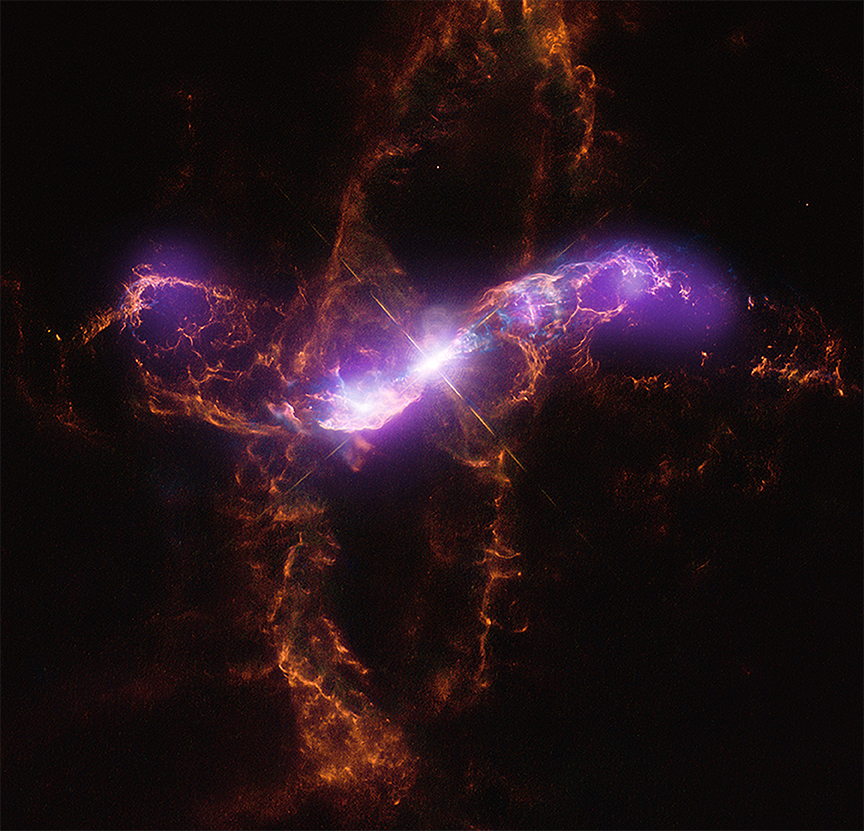
“Right, we can only work with numbers that can be transmitted back to Earth. Modern telescopes use digital sensors, dense grids of transistorsize devices that literally count the photons that strike them. Graph how many photons hit each part of the grid during an interval and you’ve got a picture. Better yet, you can do arithmetic on the counts. That opens up a world of analytical and pictorial opportunities that were tedious or impossible with photographic data.” <opens laptop, taps keys> “Here’s a lovely example I recently received from NASA’s Astronomy Picture of the Day service. Gorgeous, hm?”

Symbiotic R Aquarii” — Image Credit: Optical (red, blue): NASA/ESA/STScI;
X-ray (purple): NASA/CXC/SAO/R. Montez et al.;
Processing: Judy Schmidt (CC BY-NC-SA)

“Wow.”
 ”Wow.”
  ”Wow.”

“Image arithmetic in action. That’s two stars in weird orbits around each other. Ms Schmidt combined two Hubble images with one from Chandra, a separate telescope looking at a different part of the spectrum. Old‑style astrophotography couldn’t do that.”

~~ Rich Olcott

Now You See It, Now You Don’t

Al’s face takes on a far-away smile. “James Webb Space Telescope must look pretty up there — a golden honeycomb on a silver setting, floating in space.”

“Real artistic and all, but how come all that gold? The mirror’s what, 60 feet across. Half of that is 30 for the radius, square it is 900, times 3 plus a little for pi, makes like 3000 square feet. That’s a lot of gold and us taxpayers sent it up to space! Why not make it shiny with something cheaper?”

“Nice on-the-fly math, Mr Feder, but it’s much less gold than you think. Ever play with gold leaf?”

“Yeah, once when my cousin was decorating one of her artsy‑tartsy ceramic pieces. I went to pick up one of her leftover scraps and my breath blew it away.”

“Thin, huh? One of my astronomy magazines had an article, said the gold coating on the JWST‘s dish is only a little thicker than gold leaf, just 1000 atoms top to bottom. They don’t even apply it with a brush like people usually do. Your cousin may have artisan‑level skills but her manual techniques can’t match the precision JWST‘s design demands. The fabricators used a vapor deposition process like the semiconductor people use to make computer chips.”

“So how much gold?”

“Less than three grams per segment. That ring on your finger weighs more. The article said each segment has about $180 worth of gold, pretty small compared to the project’s ten billion dollar price tag.”

“Even so, why gold? Why not something cheaper?”

“I dunno. I see it a lot on different missions. The Insight Mars lander’s below‑deck electronics section was shrouded with gold-covered plastic panels. What’s the story, Sy?”

“Gold’s a special metal, Al. It ranks up with copper and silver for electrical conductivity but unlike them it doesn’t corrode. That’s why so many electrical switches and data cables use a thin layer of it at the contact points. The conductivity comes from the metal’s high concentration of free electrons, like an ocean of them sloshing around the atomic lattice. The free electrons also make gold an efficient reflector for electromagnetic radiation all across the spectrum from UV light way down into the radio range. The engineers for Insight and a lot of other missions put a thin gold layer on those insulation panels to protect the plastic from incoming high‑energy photons that would break up the polymer molecules. JWST needs to send every passing photon into the satellite’s detectors so gold’s high reflectivity made it the obvious candidate for the mirror coating.”

“I wonder if I’ll be able to see that honeycomb through my backyard telescope.”

“We can put numbers to that.” <drawing Old Reliable from its holster and tapping screen‑keys> “Lessee … using the small angle approximation for the sine function, to resolve a grid of 20-foot hexagons a million miles away you’d need an angular resolution of
  (20 feet) / [(106 miles)*(5280 feet/mile)]
   = 3.8×10⁻⁹ radians = 784 micro‑arcseconds

For yellow light’s 570‑nanometer wavelength, Rayleigh’s angular resolution formula gives
  aperture diameter
   =1.22*(wavelength)/(angle in radians) = 1.22*570×10-9/3.8×10-9 = 183 meters.
You’d need a telescope with a 550‑foot front end. If I remember right, Al, that’s almost ten times the width of your yard. You’d need at least a 60‑meter mirror just to see the entire dish as anything more than a yellow speckle.”

“Even with a scope like that Al would have a problem, Sy.”

“What’s that, Cathleen?”

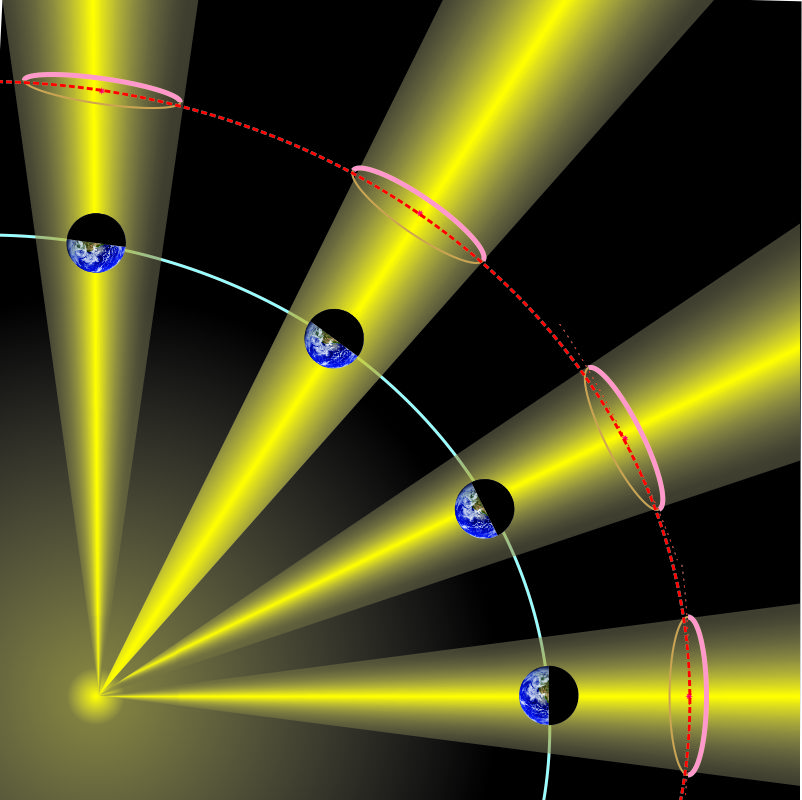
“Viewed from the Sun, JWST‘s orbit looks straightforward — a half‑million‑mile half‑year vertical loop around the Sun‑Earth L2 point that itself circles the Sun once a year. Viewed from Earth, though, it’s a far more complicated motion. Earth’s orbit parallels JWST‘s so half the time JWST leads Earth and half it lags behind. At the extremes, JWST scoots along at twice Earth’s speed or else it appears to stop against the background stars. It’d be a challenging target for a star‑tracker program without a minute‑by‑minute computerized ephemeris.”

“He wouldn’t see the honeycomb even with that scope, Moire. JWST‘s always gonna point away from the Sun and us. The only view we’ll ever get is that pink parasol.”

~~ Rich Olcott

Attitude Adjustment

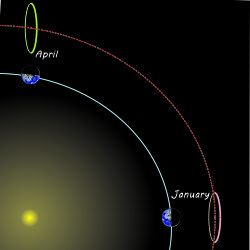
Mr Feder has a snarky grin on his face and a far‑away look in his eye. “Got another one. James Webb Space Telescope flies in this big circle crosswise to the Sun‑Earth line, right? But the Earth doesn’t stand still, it goes around the Sun, right? The circle keeps JWST the same distance from the Sun in maybe January, but it’ll fly towards the Sun three months later and get flung out of position.” <grabs a paper napkin> “Lemme show you. Like this and … like this.”

“Sorry, Mr Feder, that’s not how either JWST or L2 works. The satellite’s on a 6-month orbit around L2 — spiraling, not flinging. Your thinking would be correct for a solid gyroscope but it doesn’t apply to how JWST keeps station around L2. Show him, Sy.”

“Gimme a sec with Old Reliable, Cathleen.” <tapping> “OK, here’s an animation over a few months. What happens to JWST goes back to why L2 is a special point. The five Lagrange points are all about balance. Near L2 JWST will feel gravitational pulls towards the Sun and the Earth, but their combined attraction is opposed by the centrifugal force acting to move the satellite further out. L2 is where the three balance out radially. But JWST and anything else near the extended Sun‑Earth line are affected by an additional blended force pointing toward the line itself. If you’re close to it, sideways gravitational forces from the Sun and the Earth combine to attract you back towards the line where the sideways forces balance out. Doesn’t matter whether you’re north or south, spinward or widdershins, you’ll be drawn back to the line.”

Al’s on refill patrol, eavesdropping a little of course. He gets to our table, puts down the coffee pot and pulls up a chair. “You’re talking about the JWST. Can someone answer a question for me?”

“We can try.”
 ”What’s the question?”
  Mr Feder, not being the guy asking the question, pooches out his lower lip.

“OK, how do they get it to point in the right direction and stay there? My little backyard telescope gives me fits just centering on some star. That’s while the tripod’s standing on good, solid Earth. JWST‘s out there standing on nothing.”

JWST‘s Attitude Control System has a whole set of functions to do that. It monitors JWST‘s current orientation. It accepts targeting orders for where to point the scope. It computes scope and satellite rotations to get from here to there. Then it revises as necessary in case the first‑draft rotations would swing JWST‘s cold side into the sunlight. It picks a convenient guide star from its million‑star catalog. Finally, ACS commands its attitude control motors to swing everything into the new position. Every few milliseconds it checks the guide star’s image in a separate sensor and issues tweak commands to keep the scope in proper orientation.”

“I get the sequence, Sy, but it doesn’t answer the how. They can’t use rockets for all that maneuvering or they’d run out of fuel real fast.”

“Not to mention cluttering up the view field with exhaust gases.”

“Good point, Cathleen. You’re right, Al, they don’t use rockets, they use reaction wheels, mostly.”

“Uh-oh, didn’t broken reaction wheels kill Kepler and a few other missions?”

“That sounds familiar, Mr Feder. What’s a reaction wheel, Sy, and don’t they put JWST in jeopardy?”

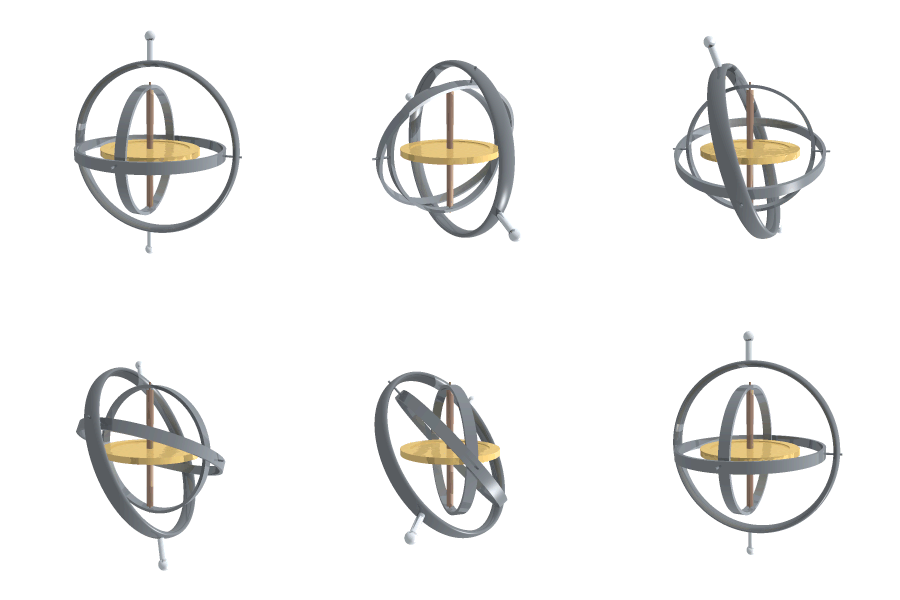
 Gyroscope, image by Lucas Vieira

“A reaction wheel is a massive doughnut that can spin at high speed, like a classical gyroscope but not on gimbals.”

“Hey, Moire, what’s a gimbal?”

“It’s a rotating frame with two pivots for something else that rotates. Two or three gimbals at mutual right angles let what’s inside orient independent of what’s outside. The difference between a classical gyroscope and a reaction wheel is that the gyroscope’s pivots rotate freely but the reaction wheel’s axis is fixed to a structure. Operationally, the difference is that you use a gyroscope’s angular inertia to detect change of orientation but you push against a reaction wheel’s angular inertia to create a change of orientation.”

“What about the jeopardy?”

Kepler‘s failing wheels used metal bearings. JWST‘s are hardened ceramic.”

<whew>

~~ Rich Olcott

Pinks In Space

Mr Feder, of Fort Lee NJ, is outraged. “A pretty pink parasol? NASA spent taxpayer dollars to decorate the James Webb Space Telescope with froufrou like that?”

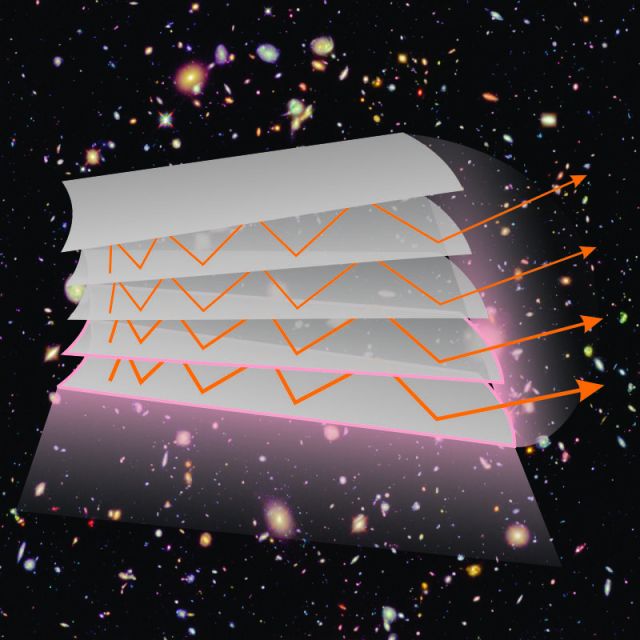
Astronomer Cathleen stays cool. “Certainly not, Mr Feder. This is no effete Victorian‑era parasol. It’s a big, muscular ‘defender against the Sun,’ which is what the word means when you break it down — para‑sol. Long and wide as a tennis court. Its job is to fight off the Sun’s radiation and keep JWST‘s cold side hundreds of degrees colder than the Sunfacing side. Five layers of highstrength Kapton film, the same kind that helped protect New Horizons against freezing and micrometeorites on its way to Pluto and beyond. Each layer carries a thin coat of aluminum, looks like a space blanket or those Mylar mirror balloons but this is a different kind of plastic.”

“Sounds like a lot of trouble for insulation. Why not just go with firebrick backed up with cinder blocks? That’s what my cousin used for her pottery kiln.”

I cut in, because Physics. “Two reasons, Mr Feder. First one is mass. Did you help your cousin build her kiln?”

“Nah, bad back, can’t do heavy lifting.”

“There you go. On a space mission, every gram and cubic centimeter costs big bucks. On a benefit/cost scale of 1 to 10, cinder blocks rate at, oh, about ½. But the more important reason is that cinder blocks don’t really address the problem.”

“They keep the heat in that kiln real good.”

“Sure they do, but on JWST‘s hot side the problem is getting rid of heat, not holding onto it. That’s the second reason your blocks fail the suitability test. Sunlight at JWST ‘s orbit will be powerful enough to heat the satellite by hundreds of degrees, your choice of Fahrenheit or centigrade. That’s a lot of heat energy to expel. Convection is a good way to shed heat but there’s no air in space so that’s not an option. Conduction isn’t either, because the only place to conduct the heat to is exactly where we don’t want it — the scope’s dish and instrument packages. Cinder blocks don’t conduct heat as well as metals do, but they do it a lot better than vacuum does.”

“So that leaves what, radiating it away?”

“Exactly.”

“Aluminum on the plastic makes it a good radiator, huh?”

“Sort of. The combo’s a good reflector, which is one kind of radiating.”

“So what’s the problem?”

“It’s not a perfect reflector. The challenge is 250 kilowatts of sunlight. Each layer blocks 99.9% but that still lets 0.1% through to heat up what’s behind it. The parasol has radiate away virtually all the incoming energy. That’s why there’s five layers and they’re not touching so they can’t conduct heat to each other.”

“Wait, they can still radiate to each other. Heat bounces back and forth like between two mirrors, builds up until the whole thing bursts into flames. Dumb design.”

“No flames, despite what the Space Wars movies show, because there’s no oxygen in space to support combustion. Besides, the designers were a lot smarter than that. The mirrors are at an angle to each other, just inches apart near the center, feet apart at the edges. Heat in the form of infrared light does indeed bounce between each pair of layers but it always bounces at an angle aimed outwards. The parasol’s edges will probably shine pretty brightly in the IR, but only from the sides and out of the telescope’s field of view.”

“OK, I can understand the aluminum shiny, but why make it pink?”

“That’s a thin extra coat of a doped silicon preparation, just on the outermost two layers. It’s not so good at reflection but when it heats up it’s good at emitting infrared. Just another way to radiate.”

“But it’s pink?”

“The molecules happen to be that color.”

“Why’s it dopey?”

“Doped, not dopey. Pure silicon is an electrical insulator. Mixing in the right amount of the right other atoms makes the coating a conductor so it can bleed off charge coming in on the solar wind.”

“Geez, they musta thought of everything.”

“They tried hard to.”

~~ Rich Olcott

Yardsticks

“Hi, Cathleen, meet Mr Richard Feder, of Fort Lee NJ. He’s got a question that’s more in your Astronomy bailiwick than mine. Have a strawberry scone.”

“Mmm, still warm from Al’s oven. Thanks, Sy. Hello and what’s your question, Mr Feder?”

“Hiya. So if the James Webb Space Telescope is gonna be a million miles behind the Moon, won’t the Moon block its signals to us?”

“Oh dear, he said ‘miles.’ Sy, you’d better get out Old Reliable to look up numbers and do unit conversions. Mr Feder, I don’t think in miles.”

“Huh? What do you use instead, like paces or something?”

“Depends on what objects I’m considering and why I’m thinking about them. There are so many useful ratios out there it’s often easier to use ratios than huge numbers one can’t wrap one’s head around. Jupiter’s radius, for instance, is eleven times Earth’s, and the Sun is ten times wider still. Diameter and circumference follow the same ratios, of course. Square those ratios for relative surface area, cube them for relative volume. Who needs miles or kilometers?”

“Those numbers right, Moire?”

“Mmm … 6371 kilometers or 3959 miles for Earth, 71492 kilometers or 42441 miles for Jupiter, 695700 kilometers or 432300 miles for the Sun. The Jupiter/Earth ratio’s 11.2, the Sun/Jupiter ratio’s 9.73. The lady knows what she’s talking about.”

“Here’s a few fun factoids. The Moon’s distance is 10 times Earth’s Equator which is 100 times the International Space Station’s altitude. For that matter, if you wrapped a string around Earth’s Equator, it’d be just long enough to reach up to a GPS satellite and back. But all those are near‑Earth measurements where it makes sense to think in miles or kilometers. That’s too cumbersome for the bigger picture.”

“What else you got?”

“Within the Solar System I generally use one or the other of two convenient yardsticks. They measure the same distances, of course, but they have different applications. One is the nominal radius of Earth’s orbit, about 150 million kilometers.’

“That’s 93 million miles, Mr Feder.”

“I knew that one, Moire.”

“Anyway, we call that distance an Astronomical Unit. It’s handy for locating bodies relative to the Sun. Parker Solar Probe has gotten within a tenth of an AU of the Sun, for instance, and Neptune’s about 30 AU out. The Oort Cloud begins near 2000 AU and may extend a hundred times as far.”

“I ain’t even gonna ask what the Oort‐thing is, but I’m glad it’s a long way away.”

“We think it’s where long‑period comets come from.”

“Far away is good then. So what’s your other yardstick?”

“Lightspeed.”

“186 thousand miles per second, Mr Feder.”

“Yeah, yeah.”

“It’s also 300 thousand kilometers per second, and one light‑second per second, and one light‑year per year. Within the Solar System my benchmarks are that Earth is 500 light-seconds from the Sun, and Pluto was 4½ light-hours away from us when New Horizons sent back those marvelous images. The Sun’s nearest star system, Alpha Centauri, is 4⅓ light‑years away, and when you compare hours to years that gives you an idea of how small we are on the interstellar scale.”

“Cathleen, when you mentioned New Horizons that reminded me of the JWST. We’ve gotten off the track from Mr Feder’s question. Why isn’t the Moon going to block those signals?”

“Because it’ll never be in the way.” <sketching on a paper napkin> “There’s a bunch of moving parts here so hold on. The Earth orbits the Sun and the Moon orbits the Earth once a month, right? The L2 point doesn’t orbit the Earth. It orbits the Sun, staying exactly behind Earth so yeah, once a month the Moon could maybe get between Earth and L2. But JWST won’t be at L2, it’ll be in a wide orbit around that point and mostly perpendicular to the orbits of the Earth and Moon.”

“How wide?”

“It’ll vary depending on what they need, but it’s big enough to keep the spacecraft’s solar panels in the sunlight.”

“Solar panels? I thought the IR sensors needed cold cold cold.”

“They do. JWST protects its cold side with a hot side featuring a pretty pink Kapton parasol.”

~~ Rich Olcott

A Diamond in The Sky with Lucy

Mid-afternoon coffee-and-scone time. As I step into his coffee shop Al’s quizzing Cathleen about something in one of his Astronomy magazines. “This Lucy space mission they just sent up, how come it looks like they’re shooting at either side of Jupiter instead of hitting it straight-on? And it’s got this crazy butterfly orbit that crosses the whole Solar System a couple of times. What sense does that make?”

Planned path of Lucy‘s mission to study Trojan asteroids (black dots).
After diagrams by NASA and Southwest Research Institute

“It shoots to either side because there’s interesting stuff out there. We think the Solar System started as a whirling disk of dust that gradually clumped together. The gravity from Jupiter’s clump scarfed up the lion’s share of the leftovers after the Sun coalesced. The good news is, not all of Jupiter’s hoard wound up in the planet. Some pieces made it to Jupiter’s orbit but then collected in the Trojan regions ahead and behind it. Looking at that material may teach us about the early Solar System.”

“Way out there? Why not just fall into Jupiter like everything else did?”

I do Physics, I can’t help but cut in. “It’s the many‑body problem in its simplest case, just the Sun, Jupiter and an asteroid in a three‑body interaction—”

Cathleen gives me a look. “Inappropriate physicsplaining, Sy, we’re talking Astronomy here. Al’s magazine is about locating and identifying objects in space. These asteroids happen to cluster in special locations roughly sixty degrees away from Jupiter.”

“But Al’s question was, ‘Why?‘ You told him why we’re sending Lucy to the Trojans, but Physics is why they exist and why that mission map looks so weird.”

“Good point, go ahead. OK with you, Al?”

“Sure.”

I unholster Old Reliable, my tricked‑out tablet, and start sketching on its screen. “OK, orange dot’s Jupiter, yellow dot’s the Sun. Calculating their motion is a two-body problem. Gravity pulls them together but centrifugal force pulls them apart. The forces balance when the two bodies orbit in ellipses around their common center of gravity. Jupiter’s ellipse is nearly a circle but it wobbles because the Sun orbits their center of gravity. Naturally, once Newton solved that problem people turned to the next harder one.”

“That’s where Lucy comes in?”

“Not yet, Al, we’ve still got those Trojan asteroids to account for. Suppose the Jupiter‑Sun system’s gravity captures an asteroid flying in from somewhere. Where will it settle down? Most places, one body dominates the gravitational field so the asteroid orbits that one. But suppose the asteroid finds a point where the two fields are equal.”

“Oh, like halfway between, right?”

“Between, Al, but not halfway.”

“Right, Cathleen. The Sun/Jupiter mass ratio and Newton’s inverse‑square law put the equal‑pull point a lot closer to Jupiter than to the Sun. If the asteroid found that point it would hang around forever or until it got nudged away. That’s Lagrange’s L1 point. There are two other balance points along the Sun‑Jupiter line. L2 is beyond Jupiter where the Sun’s gravity is even weaker. L3 is way on the other side of the Sun, a bit inside Jupiter’s orbit.”

“Hey, so those 60° points on the orbit, those are two more balances because they’re each the same distance from Jupiter and the Sun, right?”

“There you go, Al. L4 leads Jupiter and L5 runs behind. Lagrange published his 5‑point solution to the three‑body problem in 1762, just 250 years ago. The asteroids found Jupiter’s Trojan regions billions of years earlier.”

“We astronomers call the L4 cluster the Trojan camp and the L5 cluster the Greek camp, but that’s always bothered me. It’d be OK if we called the planet Zeus, but Jupiter’s a Roman god. Roman times were a millennium after classical Greece’s Trojan War so the names are just wrong.”

“I hadn’t thought about that, Cathleen, but you’re right. Anyway, back to Al’s diagram of Lucy’s journey. <activating Old Reliable’s ‘Animate’ function> Sorry, Al, but you’ve been misled. The magazine’s butterfly chart has Jupiter standing still. Here’s a stars-eye view. It’s more like the Trojans will come to Lucy than the reverse.”

~~ Rich Olcott