The Trough And The Plateau

Particularly potent pepperoni on Pizza Eddie’s special tonight so I dash to the gelato stand. “Two dips of pistachio in a cup, please, Jeremy, and hurry. Hey, why the glum look?”

“The season’s moving so slowly, Mr Moire. I’m a desert kid, used to bright skies. I need sunlight! We’re getting just a few hours of cloudy daylight each day. It seems like we’re never gonna leave this pattern. Here’s your gelato.”

“Thanks. Sorry about the cloudiness, it’s the wintertime usual around here. But you’re right, we’re on a plateau.”

“Nosir, the Plateau’s the Four Corners area, on the other side of the Rockies, miles and miles away from here.”

<chuckle> “Not the Colorado Plateau, the darkness plateau. Or the daylight trough, if you prefer. Buck up, we’ll get a daylight plateau starting in a few months.” <unholstering Old Reliable> “Here’s a plot of daylight hours through the year at various northern latitudes. We’re in between the red and green curves. For folks south of the Equator that’d just turn upside‑down, of course. I added a star at today’s date in mid‑December, see. We’re just shy of the winter solstice; the daylight hours are approaching the minimum. You’re feeling stressed because these curves don’t change much day-to-day near minimum or maximum. In a couple of weeks the curve will bend upwards again. Come the Spring equinox, you’ll be shocked at how rapidly the days lengthen.”

“Yeah, my Mom says I’m too impatient. She says that a lot. Okay, above the Arctic Circle they’ve got months‑long night and then months‑long day, I’ve read about that. I hadn’t realized it was a one‑day thing at the Circle. Hey, look at the straight lines leading up to and away from there. Is that the Summer solstice? Those low‑latitude curves look like sine waves. Are they?”

“Summer solstice in the northern hemisphere, Winter solstice for the southerners. The curves are distorted sines. Ready for a surprise?”

<Looks around the nearly empty eatery.> “With business this slow I’m just sitting here so I’m bored. Surprise me, please.”
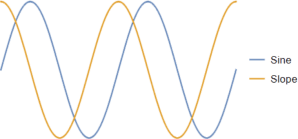
“Sure. One of the remarkable things about a sine wave is, when you graph its slopes you get another sine wave shifted back a quarter. Here, check it out.”

“Huh! When the sine wave’s mid-climb, the slope’s at its peak. When the sine wave’s peaking, the slope’s going through zero on the way down. And they do have exactly the same shape. I see where you’re going, Mr Miore. You’re gonna show me the slopes of the daylight graphs to see if they’re really sine waves.”
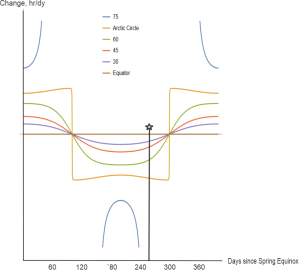
“You’re way ahead of me and Old Reliable, Jeremy.” <frantic tapping on OR’s screen> “There, point‑by‑point slopes for each of the graphs. Sorta sine‑ish near the Equator but look poleward.”

“The slopes get higher and flatter until the the Arctic Circle line suddenly drops down to flip its sign. Those verticals are the solstices, right?”

“Right. Notice that even at the Circle the between‑solstice slopes aren’t quite constant so the straight lines you eye‑balled aren’t quite that. North of the Circle the slopes go nuts because of the abrupt shifts between varying and constant sun.”
“How do you get these curves, Mr Moire?”

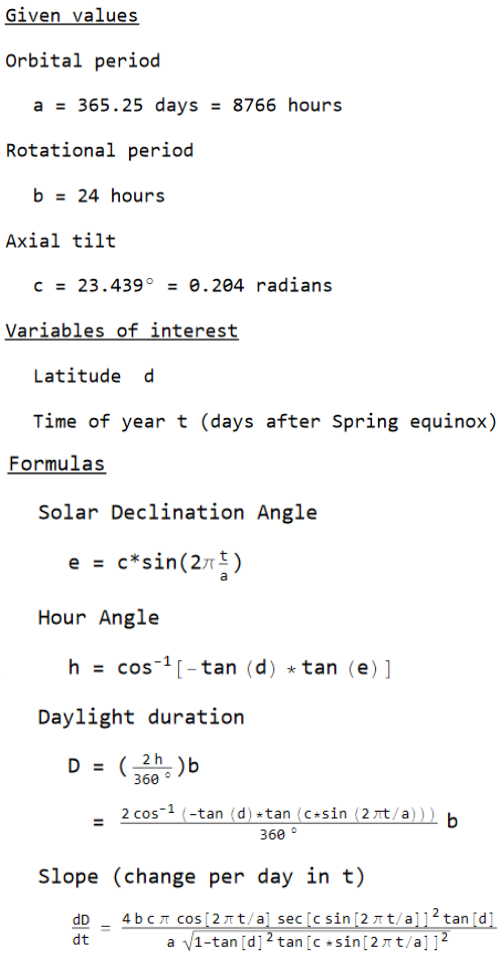
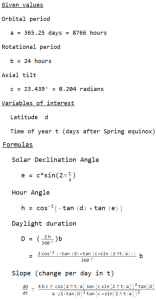
“It’s a series of formulas. Dust off your high school trig. The Solar Declination Angle equation is about the Sun’s height above or below the horizon. It depends on Earth’s year length, its axial tilt and the relative date, t=T‑T0. For these charts I set T0 to the Spring equinox. If the height’s negative the Sun’s below the horizon, okay?”
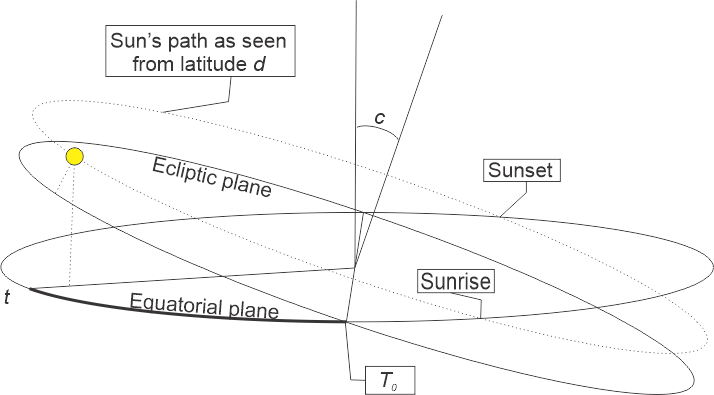
“Sine function is opposite‑over‑hypotenuse and the height’s opposite alright or we’d burn up, yup.”

“The second formula gives the the Hour Angle between your longitude and whichever longitude has the Sun at its zenith.”

“Why would you want that?”

“Because it’s the heart of the duration formula. When you roll all three formulas together you get one big expression that gives daylight duration in terms of Earth’s constants, time of year and your location. That’s what I plotted.”

“How about the slope curves?”

“Calculus, Jeremy, d/dt of that combined duration function. It’s beyond my capabilities but Old Reliable’s up to it.”
~ Rich Olcott
A.I. and The Ouroboros Effect

The Acme Building Science and Pizza Society is meeting again around the big table near the kitchen in Eddie’s Pizza Place. It’s my deal so I set the next topic. “Artificial Intelligence.” There’s some muttering but play starts.

Cal has first honors. “Not my favorite thing. I hadda change my name ’cause of A.I., f’crying out loud.”

Eddie antes up a chip. “But Cal, your astronomy magazines are loaded with new discoveries that some A.I. made rummaging through godzillabytes of big telescope data. Train an A.I. on a few thousand normal galaxies and then let it chase through the godzillabytes. It says ‘Here’s a weird one‘ and the human team gets to publish papers about a square galaxy or something.”

Susan chips in. “What about all the people who’ve been saved from cancer because an A.I. found bad cells while screening histology images?”

Kareem folds. “Not much A.I. in Geology yet. Our biggest Big Data project these days is whole‑Earth tomography. That uses pretty much all the computer time we can get funds for. A.I.’s Large Language Models soak up all the research money.”

Vinnie raises by a chip. “I use autopilot a lot when I’m flying, but that’s up in the air, Great Circle point‑to‑point and no worries about pedestrian traffic. Autopilot in a car? Not for me, thanks — too many variables and I’ve seen too many crazy situations you couldn’t predict. Black ice in the winter, roadwork and bicyclists the rest of the year — I want to be able to steer and brake when I need to.”

Susan grins. “Are you a stick‑shift purist, Vinnie?”

“Naw, automatic transmissions are okay these days and besides my car uses electric motors and doesn’t even have a transmission. Lots of torque at low revs and that’s the way I like it. What about you, Cathleen? Got any A.I. war stories?”

Cathleen calls Vinnie’s raise. “A few. One thing I’ve learned — chatbots have a limited working memory. I once asked a bot to list Jupiter’s 35 biggest moons in decreasing order of size. It got the first 24 in the right order, then some more moons out of order and two of them were moons of Saturn. So ‘trust but verify‘ like the man said. Sy, you do a lot of writing. What’s your experience?”

I call Cathleen’s raise. “Mixed. I’m a generalist so I have to read a lot of papers or at least be aware of them. Summarizer bots do a decent job on some reports but miss badly when it comes to tying together material that’s not already well organized. Probably comes from that working memory limitation you noticed, Cathleen. The other problem I’ve seen doesn’t apply so much to technical work but it’s a killer for essays and fiction that have anything to do with interactions between people.”

“I’ve seen that, too. No soul.”

“Soul’s the word I’ve been looking for, Kareem. The bots are good at picking up styles and ‘who said what‘ surface material, but they fail completely at emotional subtext, the ‘why‘ that’s the actual thread of a conversation. Subtext is why we read good novels. From what I’ve been seeing recently, it’s not going to get any better.”

“Nothing does, I’m starting to think.”

“C’mon, Cal, your coffee’s improved since the city put in better water pipes. On the other hand, you owe the pot a bet.”

“Sorry. I’m still in, okay?” <sound of chips clinking> “So why’s A.I. not gonna get better? I keep reading how different ones passed tougher tests.”

“Well, that’s the thing. If you’re reading about it online, the bots are, too. What they read goes into their training database. Those impressive test scores may just be the result of inadvertent cheating — but the software’s so opaque that its developers simply don’t know whether or not that’s true. Just another case of the Ouroboros Effect.”

Eddie and Susan meet Cal’s bet, then Vinnie goes all‑in and shows his three queens. “Ouroboros, Sy?”

“The Norse World Snake that eats its tail. Bogus A.I.‑generated output used as A.I. input yields worse output. That’s a loss, not a gain. Unlike here where my four kings take the pot.”

“Geez, Sy, again?”

~~ Rich Olcott

New Volcano, Old Crater

Now Eddie’s dealing the cards and the topic choice. “So I saw something on TV about a new volcano on Mars. You astronomy guys have been saying Mars is a dead planet, so what’s with a new volcano? Pot’s open.”

Vinnie’s got nothing, throws down his hand. So does Susan, but Kareem antes a few chips. “I doubt there’s a new volcano, it’s probably an old one that we just realized is there. We find a new old caldera on Earth almost every year. Sy, I’ll bet your tablet knows about it.”

I match Kareem’s bet and fire up Old Reliable. A quick search gets me to the news item. “You’re right, Kareem, it’s a new find of an old volcano. This article’s a puff‑piece but the subject’s in your bailiwick, Cathleen.”

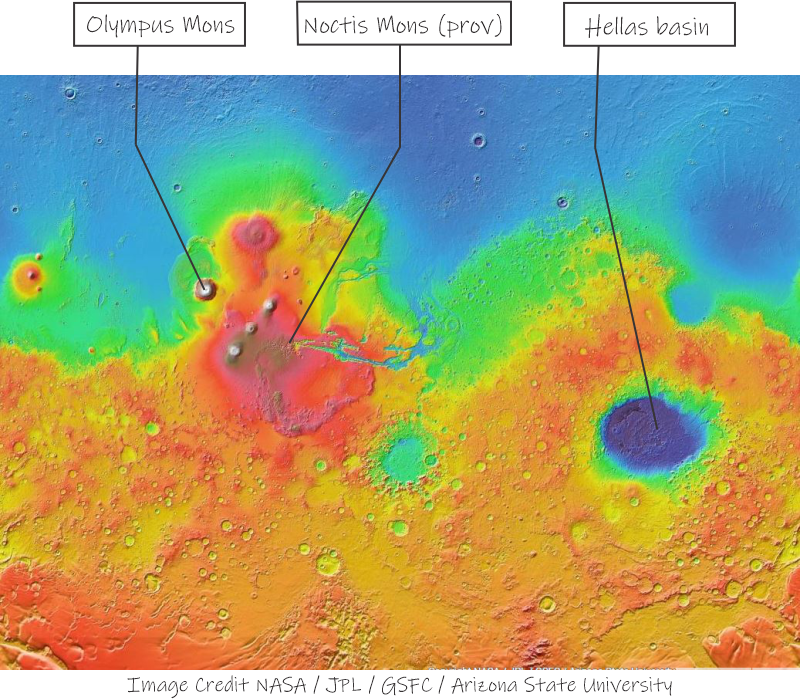
Cathleen puts in her bet and pulls out her tablet. “You’re right, Kareem. It’s a volcano we all saw but no‑one recognized until this two‑person team did. Here’s a wide‑angle view of Mars to get you oriented. North is up top, east is to the right just like usual.”

“Gaah. Looks like a wound!”

“We’ll get to that. The colors code for elevation, purple for lowlands up through the rainbow to red, brown and white. Y’all know about Olympus Mons, the 22‑kilometer tallest volcano in the Solar System, and there’s Valles Marineris, at 4000 kilometers the longest canyon. The Tharsis bulge is red‑to‑pink because it’s higher than most all the rest of the planet’s surface. Do you see the hidden volcano?”

“It’s hard to tell the volcanos from the meteor craters.”

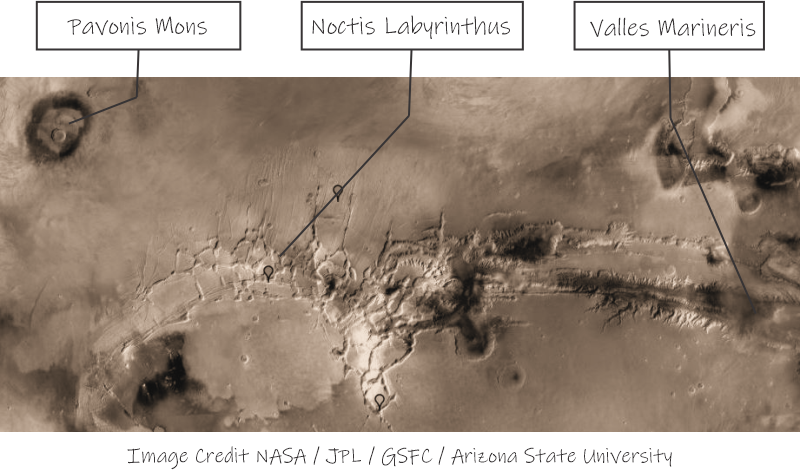
“Understandable. Let me switch to a closer view of the canyon’s western end. This one’s in visible light, no color‑coding games. The middle one of the three Tharsis volcanos is to the left, no ginormous meteor craters in the view. Noctis labyrinthus, ‘the Labyrinth of Night.’ is that badlands region left of center. Lots of crazy canyons that go helter‑skelter.”

“That’s more Mars‑ish, but it’s still unhealthy‑looking.”

“It is a bit rumpled. Do you see the volcano?”

“Mmm, no.”

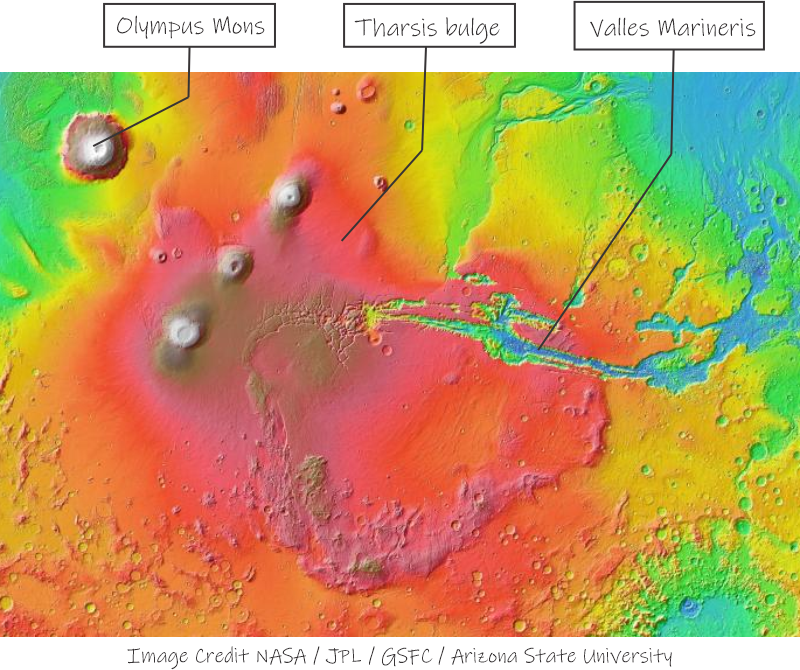
“This should help. It’s a close-up using the elevation colors to improve contrast.”

“Wow, the area inside that circle sure does look like it’s organized around its center, not higgledy-piggledy like what’s west of it. That brown image had something peaky right about there. What’s ‘prov’?”

“Good eye, Susan. The ‘prov’ means ‘provisional‘ because names aren’t real until the International Astronomical Union blesses them. The peak is nine kilometers high, almost half the height of Olympus Mons. The concentric array of canyons and mesas around it certainly make it look like a collapsed and eroded volcano. But IAU demands more evidence than just ‘look like.’ Using detailed spectroscopic data from two different Mars orbiters, the team found evidence of hydrated minerals plus structural indications that their proposed volcano either punched through a glacier or flowed onto one. Better yet, the mesas all tilt away from the peak, and the minerals are what you’d expect from water reacting with fresh lava.”

“Did they use the word ‘ultramafic‘?”

“I don’t think so, Kareem, just ‘mafic‘.”

“From underground but not deep down, then.”

“I suppose.”

Cal bets. “You said we’d get back to wounds. What was that about?”

“Well, just look at all that mess related to the Tharsis bulge — higher than all its surroundings, massive volcanos nearby, the Noctis badlands, Valles Marineris that doesn’t look water‑carved but has that delta at its eastern end. Why is all of that clustered in just one part of the planet? Marsologists have dozens of hypotheses. My own favorite centers on Hellas basin. It’s the third largest meteor strike in the Solar System and just happens to be almost exactly on the opposite side of Mars.”

Eddie looks a bit gobsmacked. “A wallop like that would carry a lot of momentum. Kareem, can a planet’s interior just pass that along in a straight line?”

“Could be, depending. If it’s solid or high‑viscosity, I guess so. If it’s low‑viscosity you’d get a doughnut‑shaped circulatory pattern inside that’d turn the energy into heat and vulcanism. How long was Mars cooling before the hit?”

“We don’t know.”

Cal’s pair of jacks apologetically takes the pot.

~~ Rich Olcott

Sectorial Setbacks

<chirp, chirp> “Moire here.”

“Moire, you were holding out on me. Eddie’s, fifteen minutes.”

“Not so fast, Walt. That wasn’t me holding out, that was you leaving too soon. From now on you’re paying quite a bit more. And it’ll be thirty minutes.”

“So we’re negotiating, hmm?”

“That’s about the size of it. You still interested?”

“My people are, they sent me back here. Oh well. Thirty minutes.”


Thirty-three minutes later I walk into Eddie’s. Walt’s already gotten a table. He beckons, points to the freshly‑served pizza, raises an eyebrow.

“Apology accepted. What made your people unhappy?”

“You told me flat‑out that the Sun’s gravity couldn’t affect those zonal harmonics. Do you have anything to back that up?”

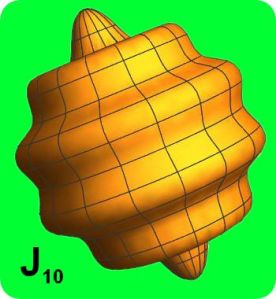
“Symmetry. Zonal harmonics and latitude are about north‑south. Each Jn is a pole‑to‑pole variation pattern. The only way solar gravity can tilt Jupiter’s north‑south axis is to exert torque along the zonal harmonics. Jupiter’s equator is within 3° of edge‑on to the Sun.” <showing an image on Old Reliable’s screen> “Here’s what the Sun sees looking at J10, for instance. Solar pull on any northern zone segment, say, would be counteracted by an equal pull on the corresponding southern segment of the same zone. No net torque, no tilt. J0‘s the only exception. It’s simply a sphere that doesn’t vary across the whole planet. The Sun’s pull along J0‘s arc can’t tilt Jupiter.”

“Okay, so the zonal picture’s too simple. Just one set of waves, running up and down the planet—”

“No, not running. One way to characterize a wave is by how its components change with time. You’re thinking like ocean waves that move from place to place as time goes by. There’s also standing waves like on a guitar string, where individual points move but the peaks and valleys don’t. There’s time‑only waves like how the day length here changes through the year. And there’s static waves where time’s not even in the equation. Jupiter’s stripes don’t move, they’re peaks and valleys in a static wave pattern. By definition, the zonal harmonic system is static like that. But you’re right, it’s only part of the picture.”

“Give me the part the Sun’s gravitational field does play with.”

“That’d be two parts — sectorial and radial harmonics. Sectorial is zonal’s perpendicular twin. Zonal wave patterns show variation along the polar axis; sectorial wave patterns Cm vary around it. I’m keeping it non‑technical for you but Cm‘s actually cos(m*x) where x is the longitude.”

“Just don’t let it go any farther.”

“I’ll try not to. My point is that each sector pattern can be labeled with a positive integer just like we did with the zones.”

“If the Jn arcs aren’t affected by solar gravity, why would I care about these Cms?”

“You wouldn’t, except for the fact that mass distribution across Jupiter’s sectors is probably lumpy. We know the Great Red Spot holds its position in the southern hemisphere and the planet’s magnetic field points way off to the side. Maybe those features mark off‑center mass deficits and concentrations. Suppose a particular sectorial wave’s peak sits directly over a mass lump or hole. Everything under that harmonic’s influence is tugged back and forth by solar gravity each time the wave traverses the day side. Juno in its N‑S path just isn’t an efficient sensor for those tugs. Good sectorial sensing would require an orbiter on an E‑W path, preferably right over the equator.  Any orbital wobbles we’d see could be fed into a sectorial gravity map. Cross that with the zonal map and we’d be able to locate underlying mass variations by latitude and longitude.”

“Not a good idea. Gravity’s not the only field in play. You’ve just mentioned Jupiter’s magnetic field. I’ve read it’s stronger than any other planet’s. If your E‑W orbiter’s built with even a small amount of iron, you’d have a hard time deciding which field was responsible for any observed irregularities.”

“Good point. The idea’s even worse than you think, though. Jupiter’s sulfur‑coated moon—”

“Io. Yes, your induction‑heating idea might even be real. What about it?”

“I haven’t written yet about the high‑voltage Io‑to‑Jupiter bridge made of sulfur, oxygen and hydrogen ions. Jupiter’s magnetism plays a complicated game with them but the result is a chaotic sheet of radiating plasma around the planet’s equator. An E‑W orbiter in there would be tossed about like a paper boat on the ocean.”

~~ Rich Olcott

A Pencil In Space

<chirp, chirp> “Moire here.”

“I have a question I think you’ll find interesting, but it’s best we talk in person. Care for pizza?”

“If you’re buying.”

“Of course. Meet me at Eddie’s, twenty minutes. Bring Old Reliable.”

“Of course.”


Tall fellow, trimmed chevron mustache, erect bearing except when he’s leaning on that cane. “Moire?”

“That’s me. Good to meet you, Mr … ?”

“No names. Call me … Walt.”

We order, find a table away from the kitchen. “So, Walt, what’s this interesting question?”

“Been following this year’s Jupiter series in your blog. Read over the Kaspi paper, too, though most of that was over my head. What I did get was that his conclusions and your conclusions all come from measuring very small orbit shifts which arise from millionths of a g of force. Thing is, I don’t see where any of you take account of the Sun’s gravity. If the Sun’s pull holds Jupiter in orbit, it ought to swamp those micro-g effects. Apparently it doesn’t. Why not?”

“Well. That’s one of those simple questions that entail a complicated answer.”

“I’ve got time.”

“I’ll start with a pedantic quibble but it’ll clarify matters later on. You refer to g as force but it’s really acceleration. The one‑g acceleration at Earth’s surface means velocity changes by 980 meters/second per second of free fall. Drop a one kilogram mass, it’ll accelerate that fast. Drop a 100 kilogram mass, it’ll experience exactly the same acceleration, follow?”

“But the second mass feels 100 times the force.”

“True, but we can’t measure forces, only movement changes. Goes all the way back to Newton defining mass in terms of force and vice‑versa. Anyway, when you’re talking micro‑g orbit glitches you’re talking tiny changes in acceleration. Next step — we need the strength of the Sun’s gravitational field in Jupiter’s neighborhood.”

“Depends on the Sun’s mass and Jupiter’s mass. No, wait, just the Sun’s mass because that’s how it curves spacetime. The force depends on both masses.”

I’m impressed. “And the square of the very large distance between them.” <tapping on Old Reliable’s screen> “Says here the Sun’s field strength out there is 224 nano‑g, which is pretty small.”

“How’s that compare to what else is acting on Juno?”

<more tapping> “Jupiter’s local field strength crushes the Sun’s. At Juno’s farthest point it’s 197 micro‑g but at Juno’s closest point the field’s 22.7 million micro‑g and the craft’s doing 41 km/s during a 30-minute pass. Yeah, the Sun’s field would make small adjustments to Juno’s orbital speed, depending on where everybody is, but it’d be a very slow fluctuation and not the rapid shakes NASA measured.”

“How about side‑to‑side?”

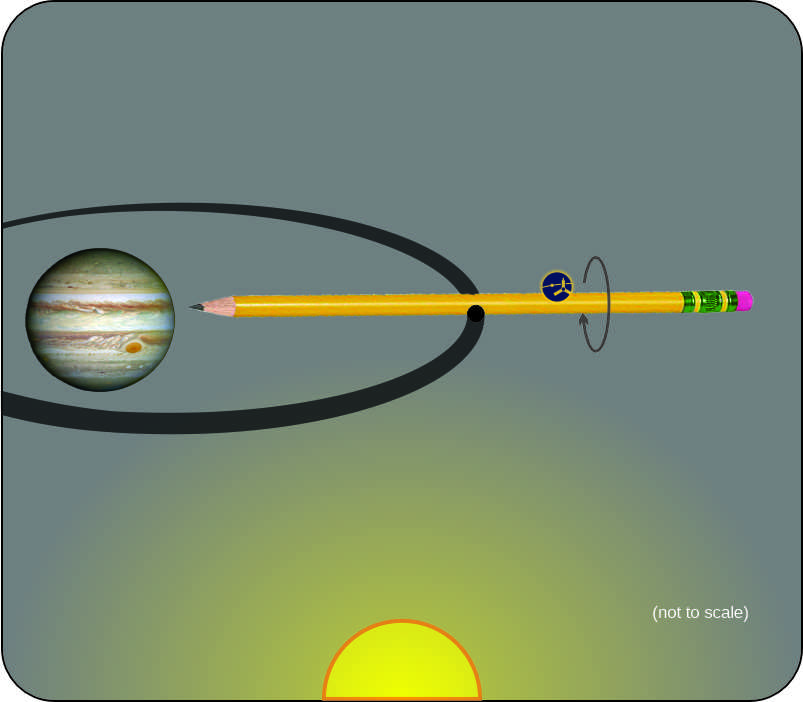
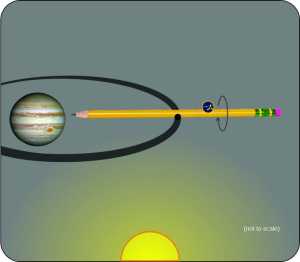
“Good point, but now we’re getting to the structure of Juno’s orbit. Its eccentricity is 98%, a long way from circular. Picture a skinny oval pencil 8 million kilometers long, always pointed at Jupiter while going around it. It’s a polar orbit, rises above Jupiter on the approach, then falls below going away. The Sun’s effect is greatest when the orbit’s at right angles to the Sun‑Jupiter line. The solar field twists the oval away from N‑S on approach, trues it back up on retreat. That changes the angle at which Juno crosses Jupiter’s gravitational wobbles but won’t affect how it experiences the zonal harmonics.”

“Tell me about those zonal things.”

“A zone is a region, like the stripes on Jupiter, that circles a sphere at constant latitude. Technically, zonal harmonic Jn is the nth Legendre polynomial in cos(θ)—”

“Too technical.”

“Gotcha. Okay, each Jn names a shape, a set of gravitational ripples perpendicular to the polar axis. J0‘s a sphere with no ripples. Jupiter’s average field looks like that. A bigger n number means more ripples. Kaspi’s values estimate how much each Jn‘s intensity adds to or subtracts from J0‘s strength at each latitude. The Sun’s field can modify the intensity of J0 but none of the others.”

Walt grabs his cane, stands, drops a C‑note on the table. “This’ll cover the pizza and your time. Forget we had this conversation.” And he’s gone.

“Don’t mention it.”

~~ Rich Olcott

  • Thanks to Will, who asked the question.

The Name’s Not The Same

The regular Thursday night meeting of the Acme Pizza and Science Society around the big circular table at Pizza Eddie’s. Al comes in, hair afire and ready to bite the heads off tenpenny nails. “This is the last straw!” <flings down yet another astronomy magazine>. “Look at this!”

I pick up the issue. “Looks like the lead article’s about the Psyche mission to the Psyche asteroid. You got a problem with that?”

“Nah, that’s just fine, exciting even. Look at the address label.”

“Ah, I see your objection. Instead of your first name it says ‘A. I.’ like those are your initials. Are they?”

“No. Never had a middle initial until the Navy gave me ‘N‘ for ‘No middle initial‘ and I dropped that soon as I got out.”

“So where’d they get the ‘I’?”

“That’s what chafes my cheeks, Vinnie, people messing with my name. All this stuff going on these days about Artificial Intelligence which everybody calls ‘AI’ which looks too flippin’ much like Al. People have been ribbing me about it since ChatGPT hit the street. They come in here asking me for virtual coffee or wanting to know about my ALgorithms. One guy claimed I parked a driverless coffee machine back of the kitchen. But it’s not just jokes. I get calls asking for programming help with languages I never heard of. My checks have my name as Al but the bank lady gives me grief because I don’t sign them with A. I.”

“You’ve got a good point there. When someone chooses a name, that name’s important to them. I know whole families where everyone has a ‘go‑by‘ name. First class I ever taught, I opened by calling the role so I could tie names to faces. I started out calling out first names but quickly learned that most of the men and half the women went by middle names — this was in the South where that’s common but still. Anyway, I called first and middle names until I got to this one kid. He’d gone through three years of college going by ‘C-M’ until I blew his cover by asking which student was named Clyde and it was him. I don’t think he ever forgave me.”

“I know the feeling, Cathleen. None of the teachers could handle my full name. This magazine’s stupid spell‑checker musta corrected me wrong. I want a new name that doesn’t get messed up.”

“Al’s not your full name?”

“No, it’s Aloysius which I don’t like. No-one can spell it, or say it right if they see it written out. I got named after my Mom’s favorite uncle before I could vote against it. I’ve been going by Al ever since I knew better.”

“We need to figure you a new name that looks different but sounds almost the same so you’ll recognize it when we holler at you, right?”

“That’s about it, Vinnie. Whaddaya got?”

“A negative to begin with. We can rule out Hal, the killer computer in the 2001 movie. Don’t want to see our physicist here walk up for a strawberry scone and get ‘I’m afraid I can’t do that, Sy.’ Haw!”

“How about Sal?”

Eddie waves it away. “My Uncle Salvatore’s already got that. One’s enough.”

I read off Old Reliable’s screen. “Baal was a god worshipped by some of the Old Testament enemy tribes, eventually turned into Beelzebub. That won’t do. And ‘mal‘ means ‘bad‘ in Spanish.”

Resident chemist Susan giggles. “I don’t suppose you’d be happy if I greeted you with a cheery, ‘Hey, Gal‘. Oh, wait, I’ve got a Chemistry thing for us. ‘Cal‘ is the standard abbreviation for ‘calorie,’ one of the old‑time measures of heat energy before everybody settled on the joule. What do you think of ‘Cal‘? Hot and cool and rugged enough for you?”

“Hmm… I like it. ‘Cal’s Coffee‘ even has that market‑winner k’‑kuh sound like Krispy Kreme and Captain Crunch and Crispy Critters. It’s official — from now on, Cal is my official go‑by name. Thanks, Susan.”

She grins. “First time I’ve named an adult. Hi, Cal.”
 ”Hi, Cal.”
  ”Hi, Cal.”
   ”Hi, Cal. Now about that magazine article…”

Adapted from a photo by Edward Eyer

~~ Rich Olcott

Why Is Io Hot, Europa Not?

The Acme Pizza and Science Society is back in session at Eddie’s circular table. Al won the last pot so he gets to pick the next topic. “I been reading about Jupiter’s weird moon Io.”

“How’s it any weirder than Ganymede that’s bigger than Mercury?”
  ”Or Europa that’s got geysers and maybe life?”

“Guys, it’s the only yellow moon in the Solar System. You can’t any weirder than that! We got lots of stony moons that are mostly gray, a few water‑ice moons that are white like snow and then there’s Io by itself covered with sulfur.”

“Yellow?”

“Mostly yellow, except where it’s red or dark brown. Or white. They’re all sulfur colors.”

“I’ve seen yellow sulfur, but red?”

“It’s like carbon can be diamond or graphite. Sulfur can be different colors depending on how hot it was when it froze. The article said the white’s probably frozen sulfur dioxide that smells like burning matches.”

“Where’d all that sulfur come from?”

“From inside Io. It’s got like 400 volcanoes that blast out sulfur and stuff. Some of it falls back and that’s why Io is yellow, but a lot gets all the way into space. The article said Io loses a tonne per second. Nothin’ else in the Solar System is that active. Or that dense, probably ’cause it blasted away all its light stuff a long time ago. Anyway, I got a theory.”

“Don’t stop there. What’s the theory?”

“Jupiter’s stripes got all those colors, right, and Sy here wrote astronomers think the brownish bands have sulfur. My theory is that Jupiter got its sulfur from Io. Whaddaya think, Sy?”

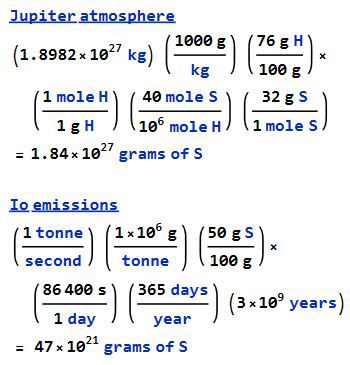
“Interesting idea.” <drawing Old Reliable from its holster> “We need numbers before we can upgrade that to a conjecture.” <screen‑tapping> “So, how much sulfur does Jupiter have, and how much could Io have supplied? … Ah, here’s a chart to get us started. Says for every million hydrogen atoms in Jupiter’s atmosphere there’s 40 sulfurs. This Wikipedia article says that the planet masses 1.898×1027 kilograms. 76% of that is hydrogen which calculates to … 1.8×1027 grams of sulfur.”

“That’s a lot of sulfur.”

“Mm-hm. Now, using your tonne per second loss rate and guessing it’s 50% sulfur and that’s been going on for ¾ of the system’s life so far, I get that Io may have shed about 5×10²² grams of sulfur. That’s short by 4½ powers of 10. Sorry, Al, Io contributed a little to Jupiter’s sulfur stash but not enough to promote your idea to a conjecture.”

Jim tosses some chips into the pot. “It’s worse than that, Sy. Galileo‘s probe fell into a clear hotspot so it sampled Jupiter’s gaseous atmosphere but it totally missed the sulfur tied up in those brown clouds. Jupiter’s got even more sulfur than your calculation shows. But there’s still an open question.”

“What’s open?”

Animation by WolfmanSF, CC0, via Wikimedia Commons

“The inner three Galilean moons are locked into resonant orbits. Laplace explained how their separate gravitational fields continually nudge each other to stay in sync. A 1979 paper supported that explanation but then claimed that the moon‑moon nudges produced enough tidal friction within Io to power volcanoes.”

“What’s wrong with that?”

“It doesn’t tell us why Io’s the only one hot enough to boil off all its water.”

“Io had water?”

“Probably, long ago. All three share the same orbital plane and probably formed from the same disk of gas and dust. Both Europa and Ganymede are water worlds, covered by kilometers of water ice. Io should be wet or the other two would be dry by now. Something’s different with Io and it’s not inter‑moon gravitation.”

“Why not?”

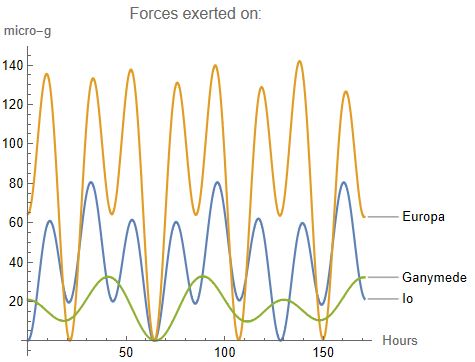
“Numbers. Those moon‑moon interactions are measured in microgravities. Such light impulses can synchronize effectively if repeated often enough, but these just aren’t energetic enough to boil a moon. Besides, Europa stays cool even though it feels a lot more action than Io does.”

“You got a theory?”

“A hypothesis. I’m betting on magnetism. Io’s deep in Jupiter’s lumpy magnetic field which must generate eddy currents in Io’s mostly iron core. I think Io heats up like a pot on an induction stove.”

~~ Rich Olcott

A Tug at The Ol’ Gravity Strings

“Why, Jeremy, you’ve got such a stunned look on your face. What happened? Is there anything I can do to help?”

“Sorry, Mr Moire. I guess I’ve been thinking too much about this science fiction story I just read. Which gelato can I scoop for you?”

“Two dips of mint, in a cup. Eddie went heavy with the garlic on my pizza this evening. What got to you in the story?”

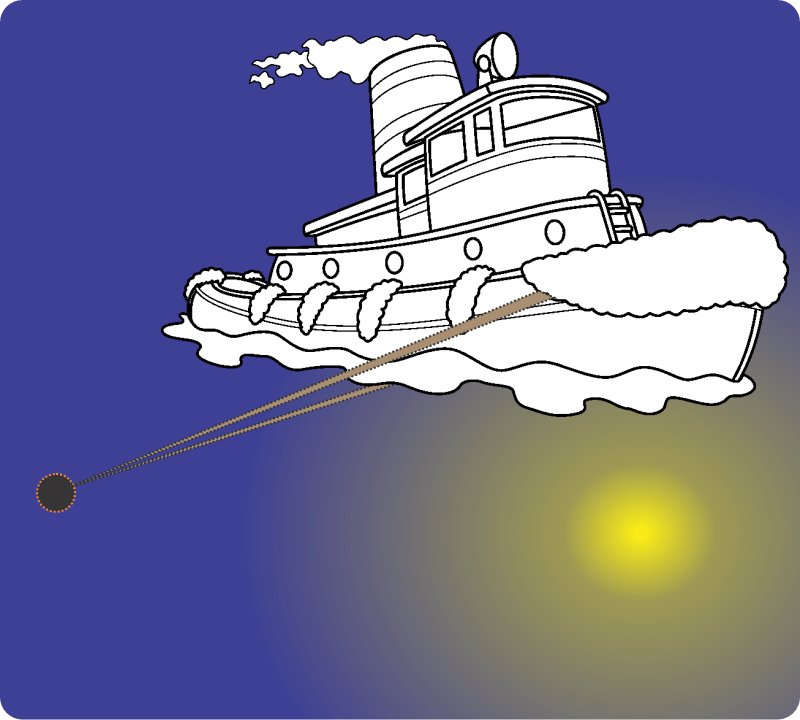
“The central plot device. Here’s your gelato. In the story, someone locates a rogue black hole hiding in the asteroid belt. Tiny, maybe a few thousandths of a millimeter across, but awful heavy. A military‑industrial combine uses a space tug to tow it to Earth orbit for some kind of energy source, but their magnetic grapple slips and the thing falls to Earth. Except it doesn’t just fall to Earth, it’s so small it falls into Earth and now it’s orbiting inside, eating away the core until everything crumbles in. I can’t stop thinking about that.”

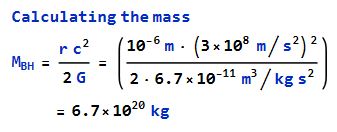
“Sounds pretty bad, but it might help if we run the numbers.” <drawing Old Reliable from its holster> “First thing — Everything about a black hole depends on its mass, so just how massive is this one?” <tapping on Old Reliable’s screen with gelato spoon> “For round numbers let’s say its diameter is 0.002 millimeter. The Schwartzschild ‘radius’ r is half that. Solve Schwartschild’s r=2GM/c² equation for the mass … plug in that r‑value … mass is 6.7×10²⁰ kilograms. That’s about 1% of the Moon’s mass. Heavy indeed. How did they find this object?”

“The story didn’t say. Probably some asteroid miner stumbled on it.”

“Darn lucky stumble, something only a few microns across. Not likely to transit the Sun or block light from any stars unless you’re right on top of it. Radiation from its accretion disk? Depends on the history — there’s a lot of open space in the asteroid belt but just maybe the beast encountered enough dust to form one. Probably not, though. Wait, how about Hawking radiation?”

“Oh, right, Stephen Hawking’s quantum magic trick that lets a black hole radiate light from just outside its Event Horizon. Does Old Reliable have the formulas for that?”

“Sure. From Hawking’s work we know the object’s temperature and that gives us its blackbody spectrum, then we’ve got the Bekenstein‑Hawking equation for the power it radiates. Mind you, the spectrum will be red‑shifted to some extent because those photons have to crawl out of a gravity well, but this’ll give us a first cut.” <more tapping> “Chilly. 170 kelvins, that’s 100⁰C below room temperature. Most of its sub‑nanowatt emission will be at far infrared wavelengths. A terrible beacon. But suppose someone did find this thing. I wonder what’ll it take to move it here.”

“Can you calculate that?”

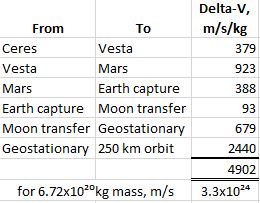
“Roughly. Suppose your space tug follows the cheapest possible flight path from somewhere near Ceres. Assuming the tug itself has negligible mass … ” <more tapping> “Whoa! That is literally an astronomical amount of delta-V. Not anything a rocket could do. Never mind. But where were they planning to put the object? What level orbit?”

“Well, it’s intended to beam power down to Earth. Ions in the Van Allen Belts would soak up a lot of the energy unless they station it below the Belts. Say 250 miles up along with the ISS.”

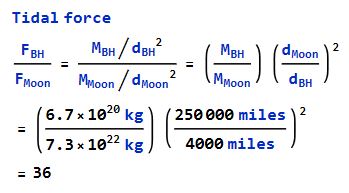
“Hoo boy! A thousand times closer than the Moon. Force is inverse to distance squared, remember. Wait, that’s distance to the center and Earth’s radius is about 4000 miles so the 250 miles is on top of that. 250,000 divided by 4250 … quotient squared … is a distance factor of almost 3500. Put 1% of the Moon that close to the Earth and you’ve got ocean tides 36 times stronger than lunar tides. Land does tides, too, so there’d be earthquakes. Um. The ISS is on a 90‑minute orbit so you’d have those quakes and ocean tides sixteen times a day. I wouldn’t worry about the black hole hollowing out the Earth, the tidal effect alone would do a great job of messing us up.”

“The whole project is such a bad idea that no-one would or could do it. I feel better now.”

~~ Rich Olcott

So Many Lunches

<shudder> “I don’t like Everett’s Many Worlds multiverse, Sy. When I think of all those A‑B entanglements throughout space I just see history as this enormous cable with an exponentially growing number of strands and it keeps getting thicker and more massive. Besides, that’s all about observations at the micro level and I don’t see how it can build up to make two me’s enjoying our different lunches.”

“Most physicists agree with you, Susan, although there have been entire conferences devoted to arguments for, against and about it. His proposal does solve several known problems associated with other interpretations of quantum mechanics but it raises some of its own. To my mind, it just tastes bad. How about another multiverse idea?”

“Is it as cumbersome as that one?”

“Well, it still involves infinity, but probably a smaller one. I think the best way to describe it is to start with black holes. Each one has a region at its geometric center where spacetime is under such stress that we don’t have the physics to understand what’s going on in there. You with me?”

“So far. I’ve read some of your posts about them.”

“Cool. Anyway, one conjecture that’s been floating around is that maybe, especially for the supermassive black holes, the energy stress is so high that Nature relieves it by generating a new blister of spacetime. The blister would be inside the Event Horizon so it’s completely isolated from our Universe. Visualize one of those balloon artists who twists a patch on the surface of a blown-up balloon and suddenly it grows a new bubble there.”

“Like yeast budding new yeastlets?”

“That’s the idea, except these spacetime buds would be rooted inside our Universe like a yeast cell’s internal vesicles rather than budding from the cell’s surface. Because it’s isolated, each bud acts as an independent Universe.”

“But Hubble has shown us a trillion galaxies. If there’s a supermassive black hole at the center of nearly every galaxy…”

“Yup, lots of Universes. But it gets better—”

“I see where you’re going. Each baby Universe can have its own collection of black holes so you can have a cascade of Universes inside Universes like a matryoshka doll. Except the people in each one think theirs is the size of a whole Universe. If there are people there.”

“All of that’s possibly true, assuming there are baby Universes and they have the same physical laws and constants that we do. The speed of light could be different or something. Anyway, I was going to a less exotic scheme. The Observable Universe is the space that contains all the light that’s been directed towards us since the Big Bang 13.7 billion years ago. Thanks to the expansion of the Universe, it’s now a sphere 93 billion lightyears in diameter. Think of it as a big bubble, okay?”

“Mm-hm. You’re thinking about what’s outside that bubble?”

“Mm-hm. Of course light and information from outside haven’t had time to get to us so we have no chance of observing what’s out there and vice‑versa. Do you agree it’s reasonable to assume it’s all just more of the same?”

“Sure.”

“Well then, it must also be reasonable to assume that our observability bubble is surrounded by other observability bubbles and they’re surrounded by more bubbles and so on. The question is, does that go on infinitely far or is there an outermost shell?”

“By definition there’s no way to know for sure.”

“True, but it makes a difference when we’re thinking about the multiverse. If there’s only a finite number of bubbles, even if it’s a big number, then there’s a vanishingly small chance that any of them duplicates ours. No copies of you trying to decide between noodles for lunch or a sandwich. If the number is infinite, though, some cosmologists insist that our bubble in general and you in particular must be duplicated not just once but an infinite number of times. Some of you go for noodles, some for sandwiches, some maybe opt for pizza. All in the same consistent Universe but disconnected from each other by distance and by light’s universal speed limit. Does that count as a multiverse?”

~~ Rich Olcott

The Sky’s The Limit

Another meeting of the Acme Pizza and Science Society, at our usual big round table in Pizza Eddie’s place on the Acme Building’s second floor. (The table’s also used for after‑hours practical studies of applied statistics, “only don’t tell nobody, okay?“) It’s Eddie’s turn to announce the topic for the evening. “This one’s from my nephew, guys. How high up is the sky on Mars?”

General silence ensues, then Al throws in a chip. “Well, how high up is the sky on Earth?”

Being a pilot, Vinnie’s our aviation expert. “Depends on who’s defining ‘sky‘ and why they did that. I’m thinking ‘the sky’s the limit‘ and for me that’s the highest altitude I can get up to legal‑like. Private prop planes generally stay below 10,000 feet, commercial jets aren’t certified above 43,000 feet, private jets aren’t supposed to go above 51,000 feet.”

Eddie counters. “How about the Concorde? And those military high-flyers?”

“They’re special. The SST has, um, had unique engineering to let it go up to 60,000 feet ’cause they didn’t want sonic boom complaints from ground level. But it don’t fly no more anyhow. I’ve heard that the Air Force’s SR-71 could hit 85,000 feet but it got retired, too.”

Al’s not impressed. “All that’s legal stuff. There’s a helicopter flying on Mars but the FAA don’t make the rules there. What else we got?”

Geologist Kareem swallows his last bite of cheese melt. “How about the top of the troposphere? That’s the lowest layer of our atmosphere, the one where most of our weather and sunset colors happen. If you look at clouds in the sky, they’re inside the troposphere.”

“How high is that?”

“It expands with heating, so the top depends where you’re measuring. At the Equator it can be as high as 18½ kilometers; near a pole in local winter the top squeezes down to 6 kilometers or so. And to your next question — above the troposphere we’ve got the stratosphere that goes up to 50 kilometers. What’s that in feet, Sy?”

<drawing Old Reliable and screen-tapping…> “Says about 31.2 miles or 165,000 feet. Let’s keep things in kilometers from here on, okay?”

“Then you’ve got the mesosphere and the exosphere but the light scattering that gives us a blue sky happens below them so I’d say the sky stops at 50 kilometers.”

Al’s been rummaging through his astronomy magazines. “I read somewhere here that you’re not an astronaut unless you’ve gone past either 80 or 100 kilometers, which is weird with two cut‑offs. Who came up with those?”

Vinnie’s back in. “Who came up with the idea was a guy named von Kármán. One of the many Hungarians who came to the US in the 30s to get away from the Nazis. He did a bunch of advanced aircraft design work, helped found Aerojet and JPL. Anyway, he said the boundary between aeronautics and astronautics is how high you are when the atmosphere gets too thin for wings to keep you up with aerodynamic lift. Beyond that you need rockets or you’re in orbit or you fall down. He had equations and everything. For the Bell X‑2 he figured the threshold was around 52 miles up. What’s that in kilometers, Sy?”

“About 84.”

“So that’s where the 80 comes from. NASA liked that number for their astronauts but the Europeans rounded it up to 100. Politics, I suppose. Do von Kármán’s equations apply to Mars as well as Earth?”

“Now we’re getting somewhere, Vinnie. They do, sort of. It’s complicated, because there’s a four‑way tug‑of‑war going on. Your aircraft has gravity pulling you down, lift and centrifugal force pulling you up. Lift depends on the atmosphere’s density and your vehicle’s configuration. The fourth player is the kicker — frictional heat ruining the craft. Lift, centrifugal force and heating all get stronger with speed. Von Kármán based his calculations on the Bell X‑2’s configuration and heat‑management capabilities. Problem is, we’re not sending an X‑2 to Mars.”

“Can you re‑calibrate his equation to put a virtual X‑2 up there?”

“Hey, guys, I think someone did that. This magazine says the Karman line on Mars is 88 kilometers up.”

“Go tell your nephew, Eddie.”

~~ Rich Olcott