Math Poetry

Eddie serves a good pizza. I amble over to the gelato stand for a chaser. “Evening, Jeremy. You’re looking a little distraught.”

“I am, Mr Moire. Just don’t ask me to quantify it! Math is getting me down. Why do they shove so much of it at us? You don’t put much math into your posts and they make sense mostly.”

“Thanks for the mostly. … Do you enjoy poetry?”

“Once I read some poems I liked. Except in English class. They spend too much time classifying genre and rhyme scheme instead of just looking at what the poet wrote. All that gets in the way.”

“Interesting. What is it that you like about poetry?”

“Mmm, part of it is how it can imply things without really saying them, part of it is how compact a really good one is. I like when they cram the maximum impact into the fewest possible words — take out one word and the whole thing falls apart. That’s awesome when it works.”

“Well, how does it work?”

“Oh, there’s lots of techniques. Metaphor’s a biggie — making one thing stand for something else. Word choice, too — an unexpected word or one with several meanings. Sometimes it’s a challenge finding the word that has just the right rhythm and message.”

“Ah, you write, too. When you compose something, do you use English or Navajo?”

“Whichever fits my thought better. Each language is better at some things, worse at others. A couple of times I’ve used both together even though only rez kids would understand the mix.”

“Makes sense. You realize, of course, that we’ve got a metaphor going here.”

“We do? What standing for what?”

“Science and Poetry. I’ve often said that Physics is poetry with numbers. Math is as much a language as English and Navajo. It has its own written and spoken forms just like they do and people do poetry with it. Like them, it’s precise in some domains and completely unable to handle others. Leaning math is like learning a very old language that’s had time to acquire new words and concepts. No wonder learning it is a struggle.”

“Poetry in math? That’s a stretch, Mr Moire.”

“Prettiest example I can think of quickly is rhyming between the circular and hyperbolic trigonometric systems. The circular system’s based on the sine and cosine. The tangent and such are all built from them.”

“We had those in class — I’ll remember ‘opposite over hypotenuse‘ forever and I got confused by all the formulas — but why do you call them circular and what’s ‘hyperbolic‘ about?”

“Here, let me use Ole Reliable to show you some pictures. I’m sure you recognize the wavy sine and cosine graphs in the circular system. The hyperbolic system is also based on two functions, ‘hyperbolic sine‘ and ‘hyperbolic cosine,’ known in the trade as ‘sinh‘ and ‘cosh.’ They don’t look very similar to the other set, do they?”

“Sure don’t.”
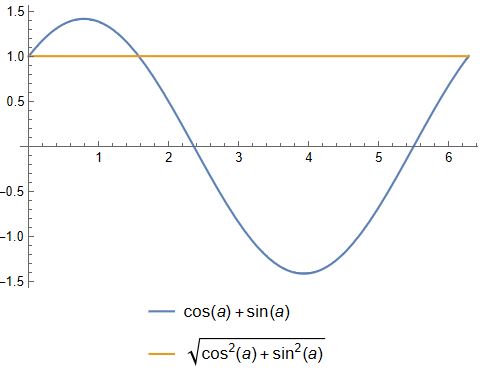
“But for every circular function and formula there’s a hyperbolic partner. Now watch what happens when we combine a sine and cosine. I’ll do it two ways, a simple sum and the Pythagorean sum.”

“Pythagorean?”

“Remember his a2+b2=c2? The orange curve comes from that, see in the legend underneath?”

“Oh, like a right triangle’s hypotenuse. But the orange curve is just a flat straight line.”

“True, as we’ve known since Euler’s day. Are you familiar with polar coordinates?”

“A little. There’s a center, one coordinate is distance from the center, and the other coordinate is the angle you’ve rotated something, right?”

“Good enough. Here’s what the same two combinations look like in polar coordinates..”

“Wow. Two circles. I never would have guessed that.”

“Mm-hm. Check the orange circle, the one that was just a level straight line on the simple graph. It’s centered on the origin. That tells us the sum of the squares is invariant, doesn’t change with the angle.”

“Do the hyperbolic thingies make hyperbolas when you add them that way?”

“Not really, just up-curving lines. The plots for their differences are interesting though. For these guys the Pythagorean difference is invariant. Einstein’s relativity is based on that property.”

“Pretty, like you say.”

~~ Rich Olcott
Symmetrical Eavesdropping

“Wait, Sy, you’ve made this explanation way more complicated than it has to be. All I asked about was the horrible whirling I’d gotten myself into. The three angular coordinates part would have done for that, but you dragged in degrees of freedom and deep symmetry and even dropped in that bit about ‘if measurable motion is defined.’ Why bother with all that and how can you have unmeasurable motion?”

“Curiosity caught the cat, didn’t it? Let’s head down to Eddie’s and I’ll treat you to a gelato. Your usual scoop of mint, of course, but I recommend combining it with a scoop of ginger to ease your queasy.”

“You’re a hard man to turn down, Sy. Lead on.”

<walking the hall to the elevators> “Have you ever baked a cake, Anne?”

“Hasn’t everyone? My specialty is Crazy Cake — flour, sugar, oil, vinegar, baking soda and a few other things but no eggs.”

“Sounds interesting. Well, consider the path from fixings to cake. You’ve collected the ingredients. Is it a cake yet?”

“Of course not.”

“Ok, you’ve stirred everything together and poured the batter into the pan. Is it a cake yet?”

“Actually, you sift the dry ingredients into the pan, then add the others separately, but I get your point. No, it’s not cake and it won’t be until it’s baked and I’ve topped it with my secret frosting. Some day, Sy, I’ll bake you one.”

<riding the elevator down to 2> “You’re a hard woman to turn down, Anne. I look forward to it. Anyhow, you see the essential difference between flour’s journey to cakehood and our elevator ride down to Eddie’s.”

“Mmm… OK, it’s the discrete versus continuous thing, isn’t it?”

“You’ve got it. Measuring progress along a discrete degree of freedom can be an iffy proposition.”

“How about just going with the recipe’s step number?”

“I’ll bet you use a spoon instead of a cup to get the right amount of baking soda. Is that a separate step from cup‑measuring the other dry ingredients? Sifting one batch or two? Those’d change the step‑number metric and the step-by-step equivalent of momentum. It’s not a trivial question, because Emmy Noether’s symmetry theorem applies only to continuous coordinates.”

“We’re back to her again? I thought—”

The elevator doors open at the second floor. We walk across to Eddie’s, where the tail‑end of the lunch crowd is dawdling over their pizzas. “Hiya folks. You’re a little late, I already shut my oven down.”

“Hi, Eddie, we’re just here for gelato. What’s your pleasure, Anne?”

“On Sy’s recommendation, Eddie, I’ll try a scoop of ginger along with my scoop of mint. Sy, about that symmetry theorem—”

“The same for me, Eddie.”

“Comin’ up. Just find a table, I’ll bring ’em over.”

We do that and he does that. “Here you go, folks, two gelati both the same, all symmetrical.”

“Eddie, you’ve been eavesdropping again!”

“Who, me? Never! Unless it’s somethin’ interesting. So symmetry ain’t just pretty like snowflakes? It’s got theorems?”

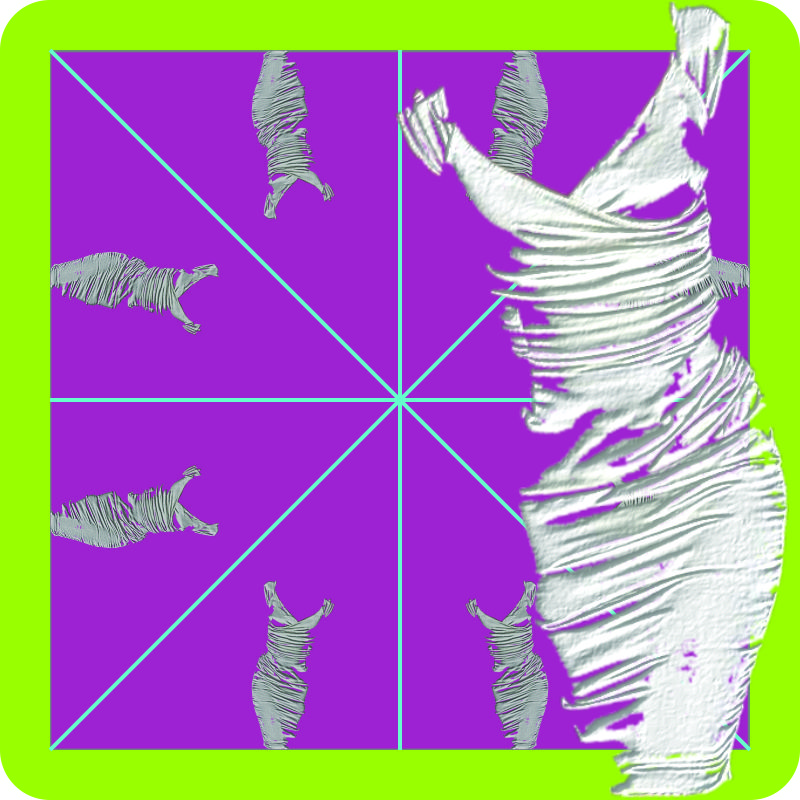
“Absolutely, Eddie. In many ways symmetry appears to be fundamental to how the Universe works. Or we think so, anyway. Here, Anne, have an extra bite of my ginger gelato. For one thing, Eddie, symmetry makes calculations a lot easier. If you know a particular system has the symmetry of a square, for instance, then you can get away with calculating only an eighth of it.”

“You mean a quarter, right, you turn a square four ways.”

“No, eight. It’s done with mirrors. Sy showed me.”

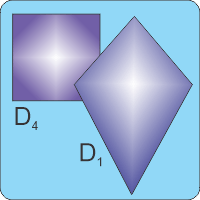
“I’m sure he did, Anne. But Sy, what if it’s not a perfect square? How about if one corner’s pulled out to a kite shape?”

“That’s called a broken symmetry, no surprise. Physicists and engineers handle systems like that with a toolkit of approximations that the mathematicians don’t like. Basically, the idea is to start with some nice neat symmetrical solution then add adjustments, called perturbations, to tweak the solution to something closer to reality. If the kite shape’s not too far away from squareness the adjusted solution can give you some insight onto how the actual thing works.”

“How about if it’s too far?”

“You go looking for a kite‑shaped solution.”

~~ Rich Olcott

Things That Won’t Work

Vinnie gets a far-away look in his eye. I wait. “Ya know, Sy, there oughtta be a way.”

“A way to what?”

“I ain’t giving up on this faster-than-light communication stuff. I know Einstein said it couldn’t happen because it’d flip cause and effect and he didn’t like that, but that feels too much like philosophy books I’ve read that boil down to, ‘This thing can’t be true because I don’t want it to be.’ Maybe there’s something we ain’t thought of yet.”

“Lots of people have played with that challenge for decades. Do you have any fresh ideas?”

“A couple possibles. Lessee if I’ve got this straight. We’ve got two separate message channels going — one that works instant-like for information between entangled quantum thingies, and one for everything else that’s stuck at lightspeed or less. Suppose I’ve got two entangled pizzas— nah, we’re really talking quantum stuff like electrons and photons so I’ll just say particles. Suppose I’ve got two entangled particles that are some ugly mix of red and green but we know when they’re de-linked they’ll be opposite. I send one to you the regular way but they’re still linked. I look at the one I still got and it’s red, say. The same moment, yours instantly went green but you don’t know that yet until you look or you get status information from me through the not‑instant channel. So the problem is getting information to leak between the two channels, right?”

“That’s about the size of it.”

“OK, try this one. How about I use a magnetic field or something to force mine to red? And maybe a set time later I make it green to confirm I’m in control and it’s a real signal.”

“Sorry, as soon as you manipulate properties in part of an entangled system you break the entanglement and the other part is free to do whatever it wants to. Next?”

“Uhh … time synchronization. How about you and me set a certain time for me to look at mine? You can watch yours and when it flips or not you’ll know.”

“All that does is move the manipulation to the other end of the setup. Me looking at my particle resets yours to whatever color mine isn’t and that breaks the entanglement. Next?”

“Maybe something with a bunch of particles all entangled together? How about—”

“Nup, can’t base a strategy on that. Like everything else quantum, entanglement is statistical. There’s no guarantee that even in our two‑particle system I’ll see green if you see red — the odds are high but not 100%. There’s a proven theorem that says if two particles are ‘maximally entangled,’ adding a third to the system reduces the odds that any two will coordinate their behaviors. A bunch of particles would be even less stable. It’s called the monogamy theorem, care to guess why?”

“Physics fun with metaphors again, cute, but I can see this is a good one. You got anything?”

“Not having to do with entanglement, but I have been playing with a different idea, sort of a blank‑sky approach.”

“You mean blue‑sky.”

“Uh-uh, blank. Think about a sky made of dark matter. Dark matter’s subject to gravity but so far as we know it has absolutely no interaction with electromagnetism of any kind — doesn’t play with electrons, light waves, nothing. Einstein based part of his relativity work on Maxwell’s electromagnetism equations. In fact, that’s where the idea came from that ‘c‘ was the speed limit for the Universe. It was a good idea and there’s a huge amount of evidence that he was right. Everything in our Standard Model except the photon is subject to the Lorentz factor. Both light and gravity acting on normal matter travel at c‑speed. Well, maybe the value of c has something to do with how quarks work. Dark matter doesn’t have quarks. What if dark matter has a different speed limit, maybe a lot higher than c or even no limit at all? Maybe we could exploit that property somehow. How about a dark‑matter telegraph?”

“I’m thinking of my Grampa’s recipe for rabbit stew. ‘First you gotta catch your rabbit,’ he used to say,”

~~ Rich Olcott

The Pizza Connection

“Wait a minute, Sy. If Einstein’s logic proves we can’t have faster‑than‑light communication, what about all the entanglement hype I see in my science magazines?”

“Hype’s the right word, Vinnie. Entanglement’s a real effect, but it doesn’t play well as a communication channel.”

“OK, why not?”

“Let’s set the stage. We’re still in our personal spaceships and we’ve just ordered pizza from Eddie. The entanglement relationship is independent of time and distance so I’m going to skip over how fast we’re going and pretend that Eddie’s using transporter delivery technology, ok?”

“Fine with me,”

“Good. You order your usual double pepperoni with extra cheese, I ask for Italian sausage. Two pizza boxes suddenly appear on our respective mess tables. No reflection on Eddie, but suppose he has a history of getting orders crossed. The quantum formalism says because our orders were filled at the same time and in a single operation, the two boxes are entangled — we don’t know which is which. Before we open the boxes, each of us has a 50:50 shot of getting the right order. It’s like we’ve got a pair of Schrödinger pizzas, half one order and half the other until we look, right?”

“Won’t happen, Eddie’s a pro.”

“True, but stay with me here. I open my box and immediately I know which pizza you received, no matter how far away your ship is from mine. Is that instantaneous communication between us?”

“Of course not, I’m not gonna know which pizza either of us got until I open my own box. Then I’ll know what my meal’s gonna be and I’ll know what you’re having, too. Actually, I’m probably gonna know first because I get hungry sooner than you.”

“Good point. Anyway, entanglement doesn’t transmit human‑scale information. The only communication between us in our spaceships is still limited by Einstein’s rules. But this is a good setup for us to dig a little deeper into the quantum stuff. You rightly rejected the Schrödinger pizza idea because pizza’s human‑scale. One of those boxes definitely holds your pizza or else it definitely holds mine. There’s no in‑between mixtures with human‑scale pizzas. Suppose Eddie sent quantum‑scale nanopizzas, though. Now things get more interesting.”

“Eddie doesn’t mess up orders.”

<sigh> “Even Eddie can’t keep things straight if he sends out a pair of quantum‑scale pizzas. What’s inside a specific entangled box is called a local property. John Stewart Bell proved some statistical criteria for whether a quantum system’s properties are local or are somehow shared among the entangled objects. Scientists have applied his tests to everything from entangled photons up to little squares of diamond. They’ve tracked quantum properties from spin states to vibration modes. A lot of work went into plugging loopholes in Bell’s criteria.”

“What’d they find?”

“The results keep coming up non-local. Our quantum pizzas truly do not have separate characteristics hiding inside their boxes unless Eddie marked a box to destroy the symmetry. All the objects in an entanglement share all the applicable quantum property values until one object gets measured. Instantly, all the entangled objects snap into specific individual property values, like which box holds which pizza. They stop being entangled, too. That happens no matter how far apart they are. Those experimental results absolutely rule out the local‑property idea which was the most appealing version of the ‘underlying reality‘ that Einstein and Bohr argued over.”

“Wait, I can’t tell you anything faster than light, but these quantum thingies automatically do that instant‑like?”

“Annoying, isn’t it? But it’s a sparse form of messaging. My quantum pizza box can tell yours only two things, ‘I’ve been opened‘ and ‘I hold Italian sausage pizza.’ They’re one‑time messages at the quantum level and you as an observer can’t hear either one. Quantum theoreticians call the interaction ‘wave function collapse‘ but Einstein called it ‘spooky action at a distance.’ He hated even that limited amount of instantaneous communication because it goes directly against the first principle of Special Relativity. Relativity has been vigorously tested for over a century. It’s stood up to everything they’ve thrown at it — except for this little mouse nibbling at its base.”

~~ Rich Olcott

Speed Limit

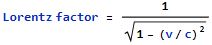
“Wait, Sy, there’s something funny about that Lorentz factor. I’m riding my satellite and you’re in your spaceship to Mars and we compare notes and get different times and lengths and masses and all so we have to use the Lorentz factor to correct numbers between us. Which velocity do we use, yours or mine?”

“Good question, Vinnie. We use the difference between our two frames. We can subtract either velocity from the other one and replace v with that number. Strictly speaking, we’d subtract velocity components perpendicular to the vector between us. If I were to try to land on your satellite I’d have to expend fuel and energy to change my frame’s velocity to yours. When we matched frames the velocity difference would be zero, the Lorentz factor would be 1.0 and I’d see your solar array as a perfect 10×10‑meter square. Our clocks would tick in sync, too.”

“OK, now there’s another thing. That Lorentz formula compares our subtracted speeds to lightspeed c. What do we subtract to get c?”

“Deep question. That’s one of Einstein’s big insights. Suppose from my Mars‑bound spaceship I send out one light pulse toward Mars and another one in the reverse direction, and you’re watching from your satellite. No matter how fast my ship is traveling, Einstein said that you’d see both pulses, forward and backward, traveling at the same speed, c.”

“Wait, shouldn’t that be that your speed gets added to one pulse and subtracted from the other one?”

“Ejected mass works that way, but light has no mass. It measures its speed relative to space itself. What you subtract from c is zero. Everywhere.”

“OK, that’s deep. <pause> But another ‘nother thing—”

“For a guy who doesn’t like equations, you’re really getting into this one.”

“Yeah, as I get up to speed it grows on me. HAW!”

“Nice one, you got me. What’s the ‘nother thing?”

“I remembered how velocity is speed and direction but we’ve been mixing them together. If my satellite’s headed east and your spaceship’s headed west, one of us is minus to the other, right? We’re gonna figure opposite v‑numbers. How’s that work out?”

“You’re right. Makes no difference to the Lorentz factor because the square of a negative difference is the same as the square of its positive twin. You bring up an important point, though — the factor applies to both of us. From my frame, your clock is running slow. From your frame, mine’s the slow one. Einstein’s logic says we’re both right.”

“So we both show the same wrong time, no problem.”

“Nope, you see my clock running slow relative to your clock. I see exactly the reverse. But it gets worse. How about getting your pizza before you order it?”

“Eddie’s good, he ain’t that good. How do you propose to make that happen?”

“Well, I don’t, but follow me here. <working numbers on Old Reliable> Suppose we’re both in spaceships. I’m loafing along at 0.75c relative to Eddie’s pizza place on Earth and your ship is doing 3c. Also, suppose that we can transmit messages and mass much faster than lightspeed.”

“Like those Star Trek transporters and subspace radios.”

“Right. OK, at noon on my personal clock you tell me you’ve ordered pizza so I get one, too. Eddie slaps both our pizzas into his transporter 10 minutes later. The math works out that according to my clock you get your pizza 8.9 minutes before you put in your order. You like that?”

“Gimme a sec … nah, I don’t think so. If I read that formula right with v1 being you and v2 being me, if you run that formula for what I’d see with my velocity on the bottom, that’s a square root of a minus which can’t be right.”

“Yup, the calculation gives an imaginary number, 4.4i minutes, whatever that means. So between us we have two results that are just nonsense — I see effect before cause and you see a ridiculous time. To avoid that sort of thing, Einstein set his speed limit for light, gravity and information.”

“I’m willing to keep under it if you are.”

“Deal.”

~~ Rich Olcott

Neutral

It’s that kind of an afternoon. Finished up one project, don’t feel much like starting another. Spring rain outside so instead of walking to Al’s for coffee I take the elevator down to Pizza Eddie’s on 2. Looks like other folks have the same feeling. “Afternoon, all. What’s the current topic of conversation?”

“Well, Sy, it started out as Star Wars versus Star Trek but then Jim said he could care less and Susan said that meant he did care and he said no, he’s ambivalent and she said that still meant he cared, and—”

“I get it, Eddie. Susan, why does ‘ambivalent‘ mean Jim cares?”

“Chemistry, Sy. ‘Valence‘ means ‘bonding‘ and ‘ambi-‘ means ‘both‘ so ‘ambi‑valent‘ means ‘bonded to both‘.”

“But Susan, ambidextrous means able to use both hands, not unable to use either hand. I want to say I don’t particularly like or dislike either one.”

“It’s like trying to decide between fire ants or hornets. You could say ‘No‑win,’ right?”

“No, that’s not it, either, Eddie. That’s ‘everybody loses.’ I’m smack in the middle.”

“Sounds like absolute neutrality. Hard to get there.”

“Don’t look at Chemistry. If I take an acid solution and add just enough base to get to neutral pH, there’s still tenth‑micromolar concentrations of acid and base in there. I guess we could call that ambivalent.”

“Neutrality’s hard for humans and chemicals, yeah, but that’s where the Universe is.”

“Why do you say that, Jim?”

“Because we’ve got proof right in front of us. Look, planets and stars and people exist as distinct objects, right? They’re not a finely-divided mist.”

“So?”

“So if the Universe were not exactly electrically neutral, then opposite charges repelling would split everything apart.”
 ”Wait, nothing would have a chance to form in the first place.”
   ”Wait, couldn’t you have lumps of like 99 positives and 100 negatives or whatever that just cancel out?”

“Eddie, when you say ‘cancel out’ you’re still talking about being absolutely neutral at the lump level. It’s like this table salt that has positive sodium ions and negative chlorides but the crystals are neutral or we’d get sparks when I pour some out like this.”
 ”Hey, don’t waste the salt. Costs money.”

“I still think it’s weird how all electrons have the same charge and it’s exactly the same as the proton charge. Protons are made of quarks, right, and electrons aren’t. So how can you take three of something and have that add up to exactly one of something different?”

“I can give you Feynman and Wheeler’s answer to part of that, Susan. The electron has an anti‑partner, the positron, which is exactly like the electron in every way except it has the opposite charge. When electron and positron meet they annihilate to produce a burst of high‑energy photons. But there’s a flip side — high‑energy photons sometimes interact to make an electron‑positron pair. Feynman and Wheeler were both jokers. They suggested that a positron could be an electron traveling backward in time. Wheeler said, ‘Maybe they’re all the same electron,’ zig‑zagging across eternity. But that doesn’t account for the quarks. A proton has two up‑quarks, each with a charge of negative 2/3 electron, and one down‑quark with a charge of positive 1/3 electron. Add ’em up — you exactly neutralize one electron. Fun, huh?”

“Fun, Jim, but I’m a chemist. On a two-pan balance I can weigh out equal quantities of molasses and rock dust but I don’t expect them to interact with any simple mathematical relationship. Why should the quark’s charge be any exact multiple or divisor of the electron’s? And why is the electron charge the size it is instead of some other number?”

“Well, there you’ve got me. The quantum chromodynamics Standard Model has been amazingly successful for quantitative predictions, but not so good for explaining things outside of its own terms. The math lays out the relationship between quark and electron charge, but doesn’t give us a physical ‘why.’ The theory has 19 ‘adjustable constants’ but no particular reason why they should have the specific values that fit the observations. Also, the theory doesn’t include gravity. It’s a little embarrassing.”

“Sounds like you’re ambivalent about the theory.”

~~ Rich Olcott

Mineral Winds

“Hey, if you guys are gonna use one of my tables at lunchtime, you oughtta order pizza.”

“Eddie, Eddie, you’re the one asking the questions that kept Kareem here into lunch hour. You owe him, seems to me.”

“Mmm, okayyy, but Sy, you can ante up. What can I get you, Kareem?”

“Nothing, thanks, unless you’ve got a halal oven.”

“Matter of fact I do, sort of. There’s a hotspot on the top left I only use for cheese melts so it should be OK for you. No pork spatters up there ever, that’s for sure.”

“A cheese melt would be fine, thanks.”

“Same for me, Eddie.”


<a few minutes later> “Here ya go, guys, straight outta the hotspot, lightly browned on top. Better let them sit a minute, you don’t wanna burn your mouth.”

“Thanks for the warning, Eddie.”

“Whatcha got there, a map?”

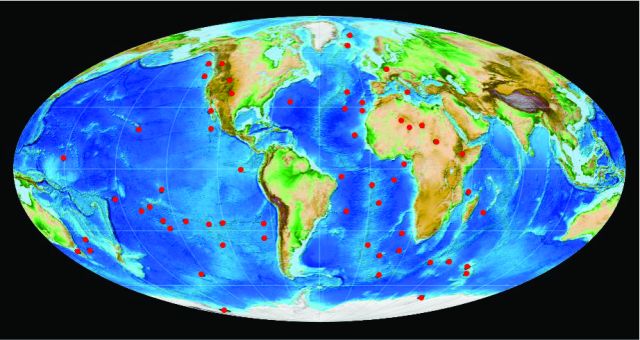
“Mm-hm, red dots for Earth’s sixty confirmed or proposed hotspots. Sy wanted to know more about the one that did a number on India.”

“What’s a hotspot? It’s like a big volcano, right?”

“Related but not quite. Most volcanoes are near where two plates are colliding. The classic case is the volcanoes along the western coastlines of the Americas The continents push westward and ride over Pacific seafloor plates, even break off slabs they shove down into the mantle where the heat melts them. The molten material squeezes up through cracks and escapes through volcanoes. Look where the dots are, though.”

BOW Bowie  COB Cobb
HAW Hawai’i
ANA AnahimYEL Yellowstone

“Most of them aren’t anywhere near the edge of anything. Yellowstone and those guys in Africa are as far from an edge as you can get. And I don’t see any red dots near Japan or the Philippines which are both really active for volcanoes and earthquakes.”

“Right, Sy. The primary criterion for a hot spot is vulcanism far from plate edges. But there’s another characteristic that many share. It’s easiest to see in this close‑up. Start with the Hawai’i, Cobb and Bowie hotspots. Each one is at the head of a straight‑line chain of volcanoes, older to younger as you get closer to the hotspot. The chains even run parallel with each other. The Anahim and Yellowstone hotspots also have parallel chains but they go west‑to‑east which makes sense if the continents are moving westward. It all fits with the idea that hotspots have stable locations in the mantle, and they scribble volcanoes on the plates that move over them. That’s the basis for much of what we know about ocean‑plate motion. But.”

“But?”

“There’s controversy, of course. Magnetism surveys and isotope data seem to show that some hotspots may move or even flutter slowly in some geology‑timescale wind. I just read—”

“Hey, Kareem, I’ve decorated so many pizzas with pepperoni slices I see red‑dot patterns everywhere. Your world map looks like there’s a ring of red dots around Africa and a stripe across the south Pacific. Does that mean anything?”

“We think it does, Eddie, but we’re still figuring out what. A technique called seismic tomography has given us evidence for a pair of huge somethings called LLSVPs deep into the mantle and on opposite sides of the Earth. One, unofficially known as TUZO, underlies much of Africa and that hotspot ring you noticed. The other one, JASON, is below your hotspot stripe in the South Pacific. We know very little about them so far, just that they stick out in the tomograms and they’ve probably been more‑or‑less where they are for a billion years. And no, we have no idea why hotspots appear around the edge of TUZO but along the center of JASON.”

“What else is lurking down there?”

“Who knows? The textbook diagrams show the mantle as this inert homogeneous shell sitting between core and crust. But its upper part is fluid and six times deeper than our atmosphere. The new tech is showing us currents something like winds and objects something like clouds, all at geological sizes and timescales. Classical Geophysics down there has been like doing weather science but ignoring clouds, mountains and oceans. There’s weather beneath us and we’re just beginning to see it.”

~~ Rich Olcott

An Italianate Mantle Piece

Eddie has set out some tables in the Acme Building’s atrium in front of his pizza place. Mid‑morning as I walk by he’s sitting at one of them, reading a newspaper. “Morning, Eddie. Ready for walk‑in customers now that things are opening up?”

“I sure hope so, Sy. The building’s still half‑empty ’cause of the work‑from‑homers but I got hopes thanks to folks like you comin’ in.”

“I’ll drop down for lunch later. Don’t see many actual print newspapers these days. What’s in there?”

“Oh, this is the weekly from my cousin in Catania. Etna’s acting up again, as usual.”

“Catania?”

“City on the southeast coast of Sicily, about 20 miles away from the volcano. Even with the earthquakes and eruptions Catania’s almost 3000 years old. Funny, in Italy we got Etna and Vesuvius and Stromboli, Greece has Santorini and Methana, there’s a whole bunch strung out through Turkey — wonder why they all line up like that.”

A new voice behind me, but somehow familiar. “Tectonics.”

I turn. It’s the fellow with the dinosaur theory. “Hello, there. I thought you were a paleontologist.”

“Nah, I prefer really old rocks. The Paleontology course was part of my Geology program. You’re Cathleen’s friend Sy, aren’t you?”

“Guilty as charged. If I recall correctly, you’re Kareem who won the Ceremonial Broom?”

“Guilty as charged.”

“Will you guys quit playing games and just answer the question? What’s with those volcanoes?”

“Sorry, Eddie. You know about continental drift, right, that the continents are big slabs that float on top of the Earth’s molten‑metal insides?”

“Sort of, Kareem. Which brings up another question. If the layer underneath is molten metal, how come the volcanoes spit rock instead of metal? Anyway, how do we know it’s not rock all the way down?”

“Go easy on the guy, Eddie, you’re up to three questions already. Let him catch a breath.”

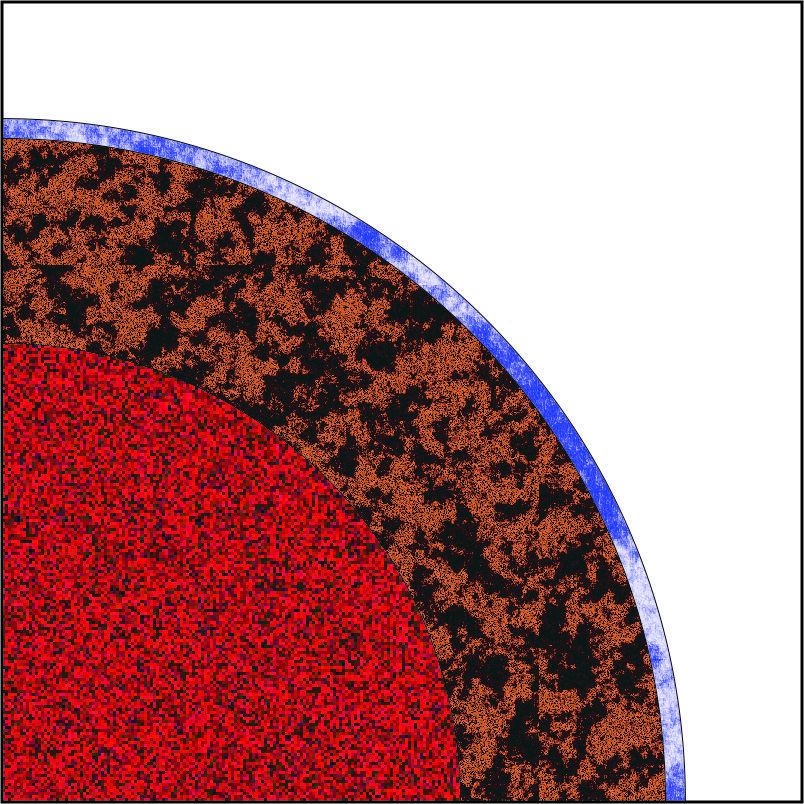
“Thanks, Sy. Last one first — we get a planet’s density from its size and orbit. For Earth it’s about 5.5 megagrams per cubic meter. For comparison, silicate rocks at the surface cluster around 2.7 and iron runs 7.9. Earth is just too heavy to be rock all the way down.”

“Those numbers put Earth almost exactly half-way between rock and iron. That tells me that half the planet’s mass is rocky. Surely the crust isn’t really that thick.”

“You might be surprised, Sy. Remember, volume goes up as the cube of the radius so it doesn’t take much crust thickness to make a large volume. Mind if I use a paper napkin, Eddie?”

“Nah, go ahead.”

“OK, here’s a really simplistic model. Suppose there’s just two layers, core and silicates, and density within each is uniform which means that mass is strictly proportional to volume times density. Let’s guess that core density is twice silicate density. If the core mass is half the planet’s mass, the core radius comes to … 69% of the total and the silicate layer is 1900 kilometers thick. That’s 2/3 of the way down to the bottom of the mantle, Earth’s real middle layer between crust and core. Almost embarrassingly good agreement, considering. Anyway, Eddie, it can’t be rock all the way down and the metallic component is pretty well trapped below megameters of rock. What escapes is the heat that melts the rocks for volcanoes to spit.”

“You started out with metal in the middle of the Earth and then you switched to iron. Which is it and how do you know?”

“It is metallic, mostly iron and nickel. We’ve got four lines of evidence for that. Meteorites are the oldest. Lots of them are stony, but about 6% are a combination of two nickel‑iron alloys. We think those came to us from planetoids that weren’t harvested when the planets were under construction. Second is Earth’s magnetic field, which we think is generated by currents of molten metal deep within the planet. Third is seismic data combined with lab data on how waves travel through different materials at high temperature and pressure. The observed combination’s consistent with a nickel‑iron core. Fourth comes from nuclear theory and astrophysical observation — iron’s by far the most common metallic element in the Universe. Build with what you got.”

“But what about the volcanoes?”

~~ Rich Olcott

Conjunction Function

Author’s note — This was supposed to have been posted on 13 December, a week before the conjunction, but then Arecibo happened. That topic took precedence and two parts. Please pretend you’re reading this before 21 December.

hi, Sy. taking orders for tonite’s delivery. u want pizza? calzone?
Hi, Eddie. How about a veggie stromboli?

sure, no problem. @ your office about 6:45, OK?

That’ll be good. See you then.

btw, question for you about the jupiter-saturn thing coming up

The conjunction? Sure. We can talk when you get here.

<bah-dap-dap> “C’mon in, Eddie, the door’s open.”

“Hiya, Sy. Here’s your stromboli. Sorry I’m a little late. I figured we’d be talking so I took care of my other customers first. I wrapped it real good, is it still hot enough?”

<tasting pause> “Perfect, Eddie. So what’s your question?”

“OK, I been reading on the internet about how Jupiter and Saturn are gonna collide on December 21 and we’re all gonna die so don’t bother about Christmas. But I also read that this happened before like 800 years ago and we’re still here so the ‘all gonna die‘ part don’t sound right.”

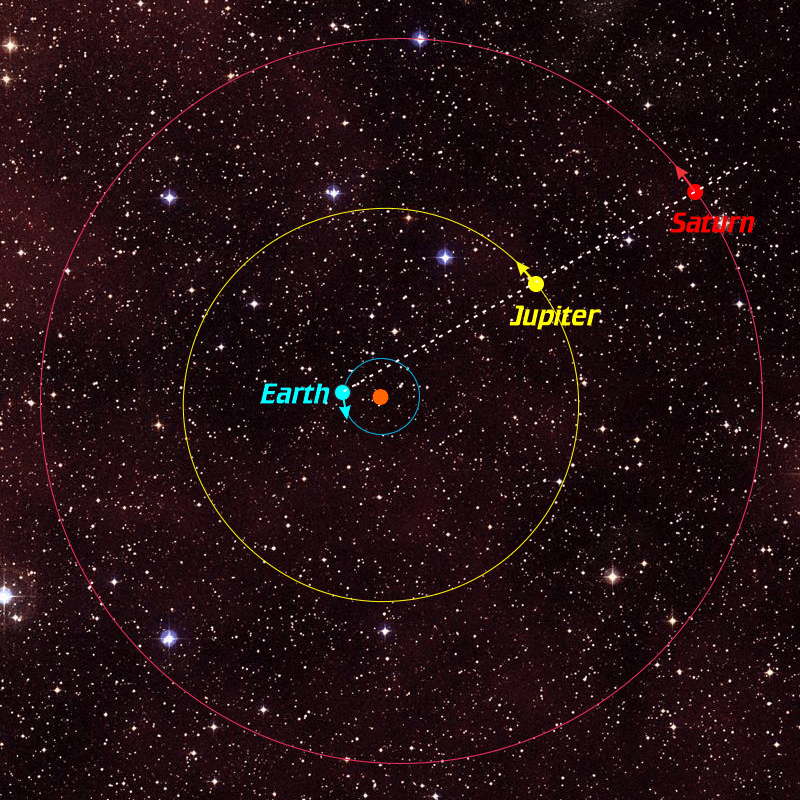
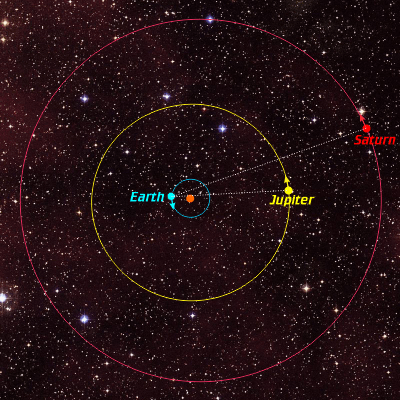
“Good thinking. We’re not going to die, they’re not going to collide, and Great Conjunctions happen way more often than every 800 years. You said you’d be asking about that so I built a couple of diagrams using planet positions I pulled from NASA’s slick Eyes on The Solar System app. OK, let’s start with this south‑facing view of the system as it was a year ago.”

Planetary positions, 15 Dec 2019

“Pretty, kinda, but what’s it mean?”

“That orange dot in the center is the Sun. The circles are planet orbits, and the colored dots show the position of each planet. All the planets and most of their moons go counterclockwise when viewed from Solar north — that’s what the little arrows show.”

“I thought Jupiter was way bigger than Earth.”

“It is. There’s no way you can get planet distances and planet sizes to scale in the same diagram. Distances are too big and even Jupiter’s too small. These distances are about right, but all the dots are just markers.”

“Funny, Sy — you dropped Jupiter half-way between Earth and Saturn.”

“That’s where it is. The distance between each pair of orbits is almost exactly 4½ times the distance between Earth and the Sun. Of course, the distance between the planets themselves depends on where each one is in its orbit and that changes all the time. Earth flies along its path three times faster than Saturn goes. Last December, Earth was 186 million miles further away from Saturn than it was in July.”

“Those dotted lines are sight-lines? That picture says that last December we had a clear view of Saturn but Earth and Jupiter were playing peek-a-boo around the Sun.”

“Exactly, and what a great lead‑in to my second diagram, calculated for next Monday.”

Planetary positions, 21 Dec 2020

“The two sight-lines overlap. They’ll look like just one planet, sorta. So that’s what all the fuss is about? They’re still that huge distance away from each other, not close to us at all.”

“Overlap’s a good word, though the official term is conjunction. The only things close together are images as seen from Earth. That last qualifier is important. What you see depends on where you stand. Our Curiosity rover on Mars won’t see a Great Conjunction like this for another month, on 31 Jan 2021.”

“What makes it a Great Conjunction? Is it brighter or something?”

“In a way. In principle you can have a conjunction of any two visible astronomical bodies. The phrase Great Conjunction only applies to Jupiter‑Saturn events. Of the classical planets Jupiter and Saturn are the slowest‑moving so their conjunction happens least often. They’re also the biggest and reflect more sunlight than Mercury or Mars so, yeah, their conjunctions tend to be especially bright.”

“But you said it happens a lot.”

“About every 20 years. You’re thinking about that 800‑year‑old event. That was the last time the two images were so close, less than a tenth of a degree apart.”

“So anyhow, we’re not all gonna die. Guess I’ll go Christmas shopping after all.”

“You do that, but shop local, OK?”

“That’s my motto now.”

~~ Rich Olcott

The Flight of George’s Dollar

<chirp, chirp> “Moire here.”

“Hi, Sy, it’s Vinnie. Eddie just dropped off my pizza order —”

“What did you get?”

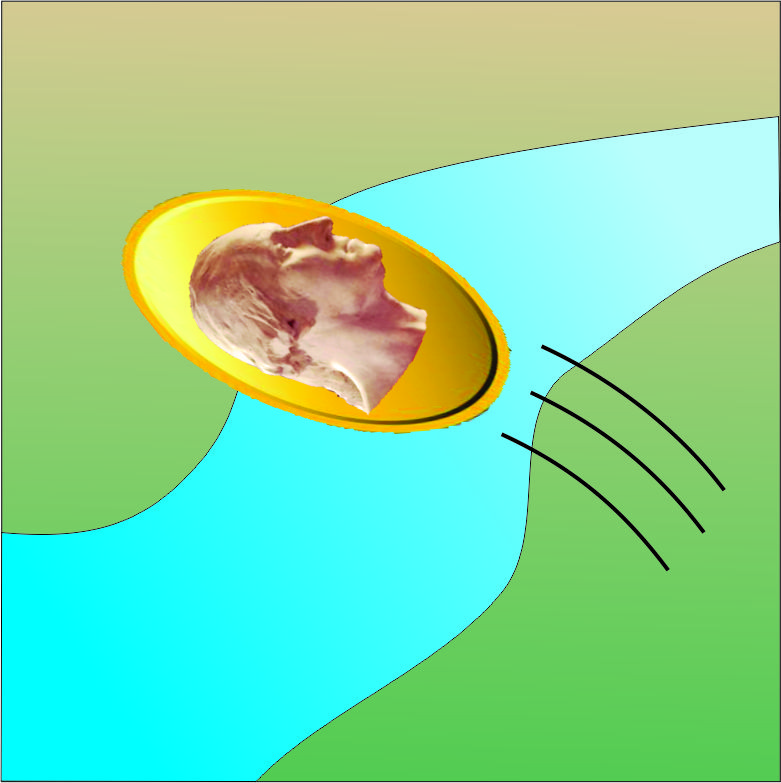
“My usual, large with extra pepperoni. Anyhow, Eddie said you guys were talking about Money Physics which has me curious. I don’t suppose it’s about how young George Washington couldn’t have thrown that silver dollar across the Potomac.”

“It couldn’t have been a US dollar because they didn’t exist yet and it couldn’t have been the Potomac because it’s a mile wide and probably nothing of the sort happened anyway. You’re right, though. What I’m calling Money Physics is about the parallels and differences between Economics and Newtonian Physics. Remember that $20 bill your dice‑playing won from Eddie a while ago and he signed it?”

“Yeah, that was fun. I was hot that night.”

“Well, the other day I used that very same bill to pay Eddie for pizza.”

“How’d you get it?”

“We figured you used the bill to pay down your tab at Al’s —”

“That’s right.”

“And he used it to buy some old astronomy magazines from me. I paid it to Eddie to complete the circle. ‘Whoa,’ I thought. ‘The velocity of money, like in Economics.”

“There’s a word I know from flight school. Velocity’s a vector, combines speed and direction. Speed would be how quick money changes hands, of course, but how do you attach a direction to that and what do you figure from the vectors?”

“Their equivalent to speed isn’t what you think it is and there’s no notion of direction. The ghost that’s left is the concept that ‘velocity of money‘ should describe how often a unit of currency is reused. The problems start popping up when you try to measure that. Economists grew up thinking about first‑purchase productivity so their metrics exclude a lot of what we’d consider economic activity. That traveling $20, for instance. How many transactions would you say it went through?”

“Eddie to me to Al to you to Eddie. Four.”

“Sorry, the productivity right answer is one. Eddie didn’t buy anything from you when he lost those bets. Your debt to Al was already outstanding. Al bought used goods from me. The only transaction that counts in the productivity calculation was my paying for what came fresh from Eddie’s pizza oven.”

“Dice games don’t count? How about bank fees or talking to my lawyer, stuff like that?”

“Oh, there’s lots of controversial questions, especially in view of our economy turning from mostly farm and manufacturing to mostly services and now we’re paying attention to environmental costs. ‘Reuse, repurpose, recycle‘ doesn’t enter into the productivity equation, and neither does installing a pollution control system except for the initial purchase price. Do you own stock, maybe in a pension plan?”

“Not as much as I’d like, especially recently.”

“I know the feeling. When you bought your shares, the brokerage fee counted as services but economists argue about the cost of the shares themselves. There are loads of what-abouts like that. Bottom line is that trying to track money movement at the transaction level just doesn’t work.”

“So what did they do?”

“Fell back to country-level aggregate numbers which are very rough by Physics standards. Add up the total economic traffic in dollars, divide by the size of the money supply, that’s the number of times an average dollar must have changed hands, OK?”

“Gimme a sec … that sounds right.”

“So how do you evaluate each part of the fraction? Some people measure economic activity indirectly by summing up transactions, maybe by looking at sales tax revenue data. That’s the spend side. Or you could look at the income side using payroll or income tax data and supposing that people spend everything they pull in. It’s not a hard think to find holes in both of those, but suppose you come up with a number somehow. That gets divided by the money supply, which we understand a little better but not much. Do the arithmetic and you have a dollars-to-dollars ratio, not somethings-per-time. No physicist would call that a velocity, but what can you do?”

“You got me, but who cares?”

“The Fed cares, because velocity‑based thinking helps drive their policy decisions.”

~~ Rich Olcott