Why Physics Is Complex

“I guess I’m not surprised, Sy.”

“At what, Vinnie?”

“That quantum uses these imaginary numbers — sorry, you’d prefer we call them i‑numbers.”

“Makes no difference to me, Vinnie. Descartes’ pejorative term has been around for three centuries so that’s what the literature uses. It’s just that most people pick up the basic idea more quickly without the woo baggage that the real/imaginary nomenclature carries along. So, yes, it’s true that both i‑numbers and quantum mechanics appear mystical, but really quantum mechanics is the weird one. And relativity.”

“Wait, relativity too? That’s hard to imagine, HAW!”

“Were you in the room for Jim’s Open Mic session where he talked about Minkowski’s geometry?”

“Nope, missed that.”

“Ah, okay. Do you remember the formula for the diagonal of a rectangle?”

“That’d be the hypotenuse formula, c²=a²+b². Told you I was good at Geometry.”

“Let’s use ‘d‘ for distance, because we’re going to need ‘c‘ for the speed of light. While we’re at it, let’s replace your ‘a and ‘b‘ with ‘x‘ and ‘y,’ okay?”

“Sure, why not?”
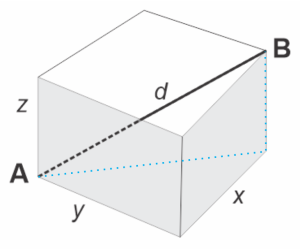
<casting image onto office monitor> “So the formula for the body diagonal of this box is…”

“Umm … That blue line across the bottom’s still √(x²+y²) and it’s part of another right triangle. d‘s gotta be the square root of x²+y²+z².”

“Great. Now for a fourth dimension, time, so call it ‘t.’ Say we’re going for light’s path between A at one moment and B some time t later.”

“Easy. Square root of x²+y²+z²+t².”

“That’s almost a good answer.”

“Almost?”

“The x, y and z are distance but t is a duration. The units are different so you can’t just add the numbers together. It’d be like adding apples to bicycles.”

“Distance is time times speed, so we multiply time by lightspeed to make distance traveled. The formula’s x²+y²+z²+(ct)². Better?”

“In Euclid’s or Newton’s world that’d be just fine. Not so much in our Universe where Einstein’s General Relativity sets the rules. Einstein or Minkowski, no‑one knows which one, realized that time is fundamentally perpendicular to space so it works by i‑numbers. You need to multiply t by ic.”

“But i²=–1 so that makes the formula x²+y²+z²–(ct)².”

“Which is Minkowski’s ‘interval between an event at A and another event at B. Can’t do relativity work without using intervals and complex numbers.”

“Well that’s nice but we started talking about quantum. Where do your i‑numbers come into play there?”

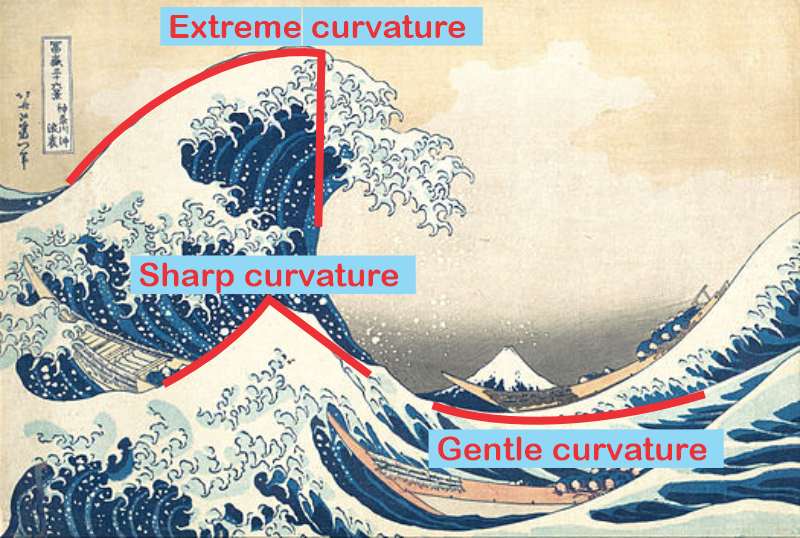
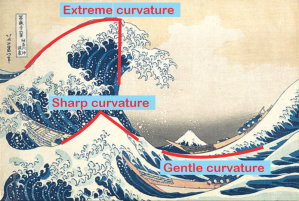
“It goes back to the wave equation— no, I know you hate equations. Visualize an ocean wave and think about describing its surface curvature.”
“Curvature?”

“How abruptly the slope changes. If the surface is flat the slope is zero everywhere and the curvature is zero. Up near the peak the slope changes drastically within a short distance and we say the surface is highly curved. With me?”

“So far.”

“Good. Now, visualize the wave moving past you at some convenient speed. Does it make sense that the slope change per unit time is proportional to the curvature?”

“The pointier the wave segment, the faster its slope has to change. Yeah, makes sense.”

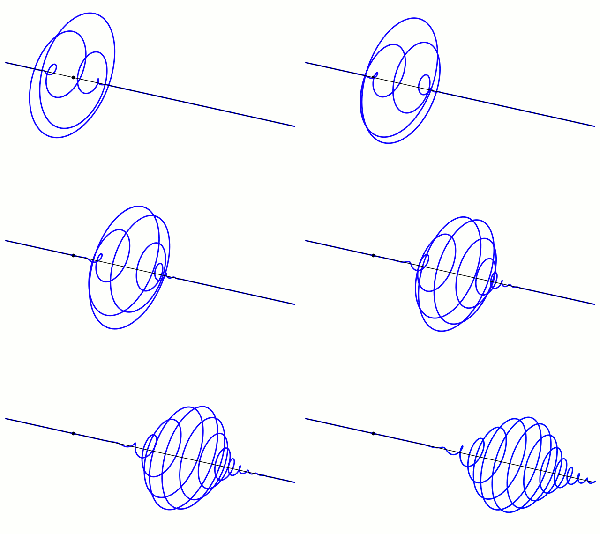
“Which is what the classical wave equation says — ‘time‑change is proportional to space‑change’. The quantum wave equation is fundamental to QM and has exactly the same form, except there’s an i in the proportionality constant and that changes how the waves work.” <casting a video> “The equation’s general solution has a complex exponential factor eix. At any point its value is a single complex number with two components. From the x‑direction, the circle looks like a sine wave. From the i‑direction it also looks like a sine wave, but out of phase with the x‑wave, okay?”
“Out of phase?”

“When one wave peaks, the other’s at zero and vice‑versa. The point is, rotation’s built into the quantum waves because of that i‑component.” <another video> “Here’s a lovely example — that black dot emits a photon that twists and releases the electromagnetic field as it moves along.”

~ Rich Olcott

Cal’s Gallery

“Goodness, Cal, you’ve redone your interior decorations.”

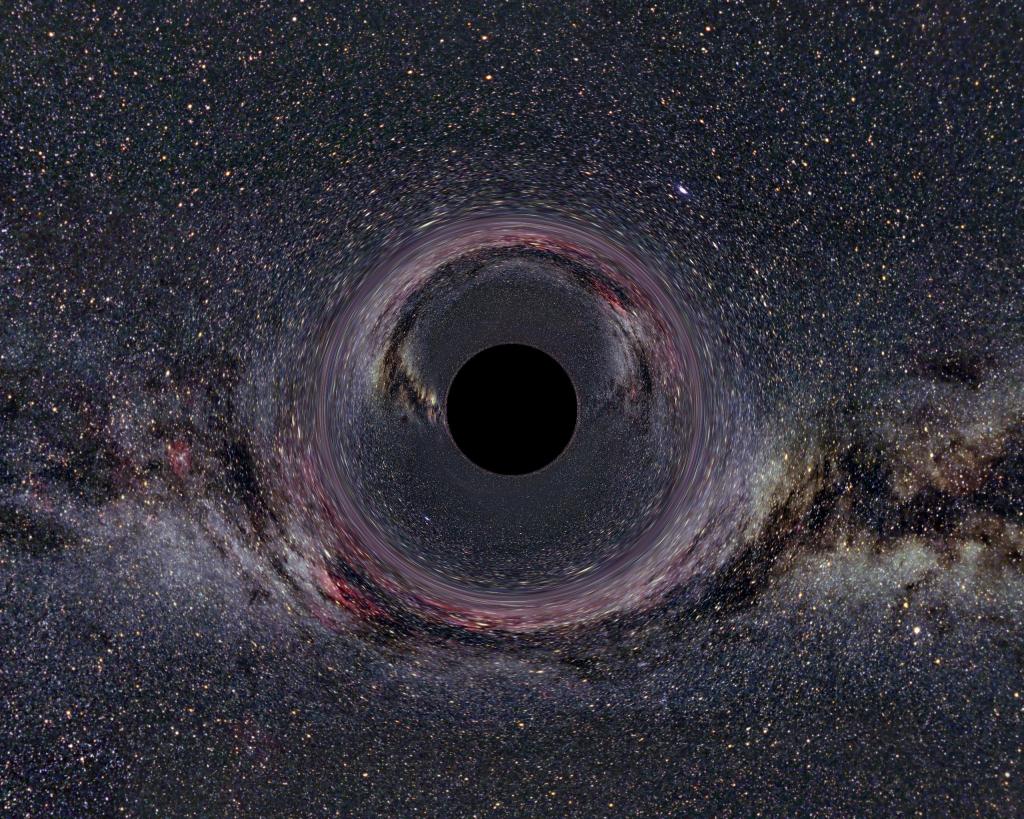
“I got tired of looking at the blank wall opposite the cash register, Sy. Check out the gallery. Way at the end here’s the earliest one I’ve got, goes back to 2005.”

“Yeah, ray-marching each background pixel as it passed through the distorting gravity field. That was heavy-duty computer graphics back then.”


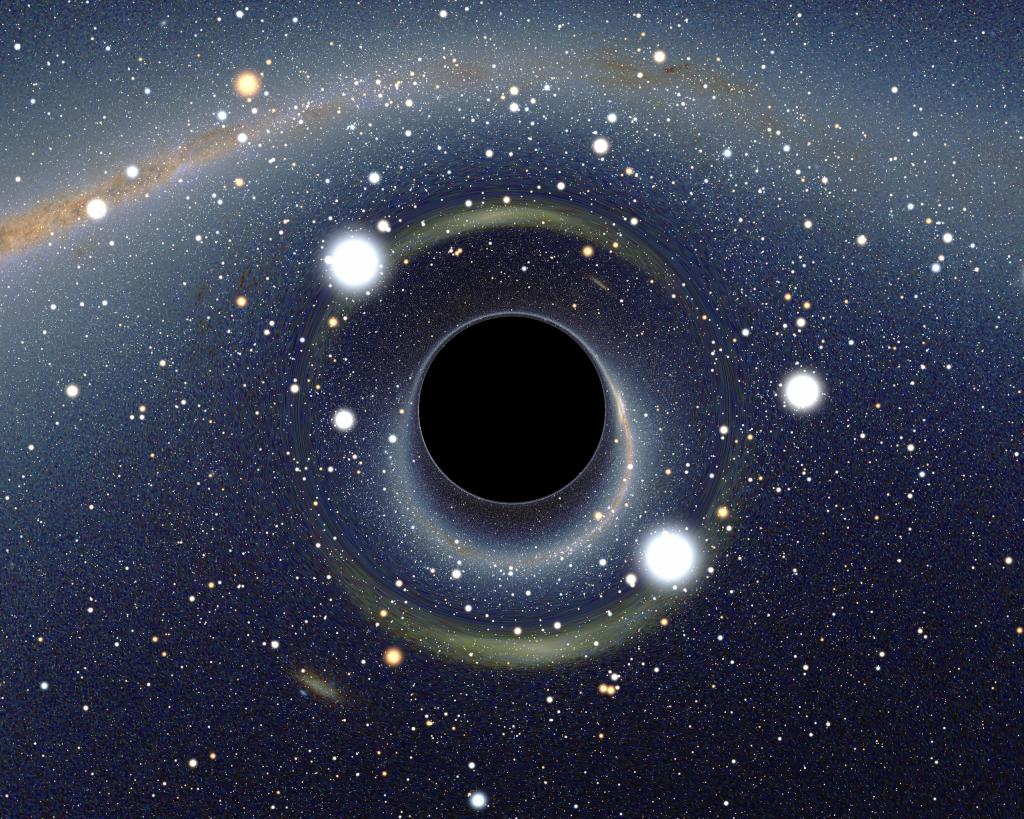
“Here’s another one from a year later. I like it better because you can pair up stars and stuff that show up on both sides of the Einstein ring.”


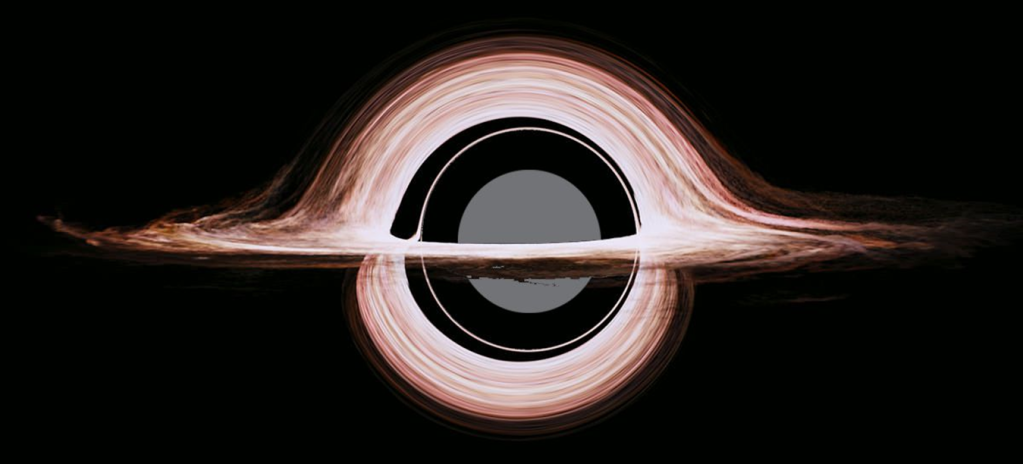
“This one’s famous, comin’ from the Interstellar movie. Funny, I can’t think of any black hole pictures before Interstellar that paid much attention to the accretion disk.”

“There certainly was a lot of that in the specialist literature, but you’re probably right for what leaked out to the pop‑sci press. Most of the published imagery was about how the gravity field distorts the figures behind it. That perpendicular handle was certainly a surprise.”


“This one’s famous, too. It shows what made the first good evidence that black holes are a thing, back in 1965. That ball to the right is a blue supergiant. See how its solar wind is feeding into X-1’s accretion disk? NASA’s picture is from 2017 so it’s not really historical or anything.”


“Now this one is historical, Cal. That image was released in 2019 from data collected in 2017.”

“I knew you’d recognize it, Sy. You’ve written about it enough.”


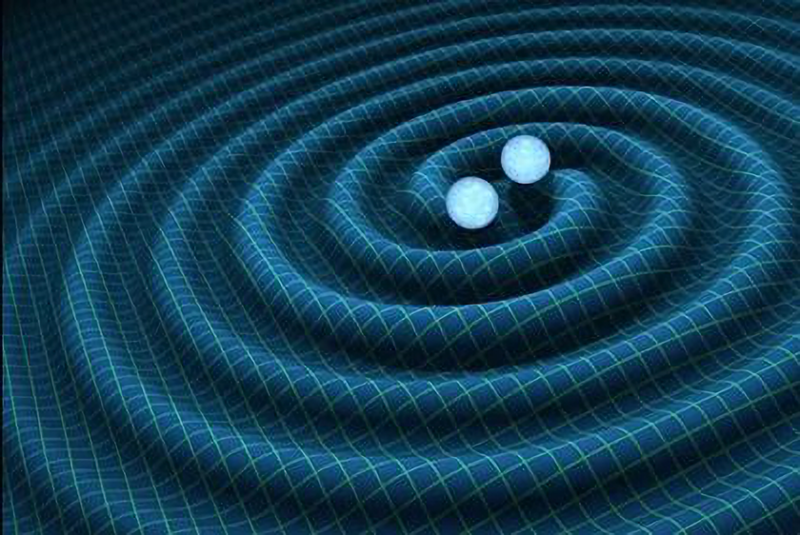
<sly grin> “Whaddya think of this one, Sy, the gravitational waves from those two black holes that LIGO told us about?”

“You knew I wouldn’t like it.”

The final waltz of two black holes” – click for video
Credit: R. Hurt – Caltech / JPL

“It’s just another trampoline picture, right?”

“No, it’s worse than that. Gravitational waves travel at lightspeed. Massive objects like people and 30‑solar‑mass black holes can’t get up to a fraction of a percent of lightspeed without expending an enormous amount of energy. The waves travel outward much faster than objects can orbit each other, even up to the end. Those waves winding outward should be nearly straight.”


“Whoa, Cal, this one isn’t a poster, it’s a monitor screen.”

“I bought a new bigger flat‑screen for home so I brought the old small one here for videos. I like how this movie shows the complicated shape flattening out when you get above the disk. The Interstellar movie made everyone think the disk is some weird double‑handled ring but the handle’s aren’t really there.”

“Mm‑hm, very nice gravity‑lens demonstration. Notice how the ring’s bright in whichever side’s coming toward us whether we’re above or below it?”

Circling over a black hole structure” — Click for video
Credit: NASA’s Goddard Space Flight Center/Jeremy Schnittman

“No, I hadn’t. Cool. How come?”

“It’s called relativistic Doppler beaming. Time distortion is significant in the close‑in parts of the ring. That affects how we see the flow. In the hole’s frame of reference the brightness and rotation speed are the same all around. In our frame the moving‑closer particles look brighter because they emit more photons per unit of our time. Another one of those unexpected phenomena where physicists say, ‘Of course!’ as soon as they see it but not before.”

~~ Rich Olcott

Fields of Dreams

Vinnie takes a slug of his coffee. “So the gravitational field carries the gravitational wave. I suppose Einstein would blame sound waves on some kind of field?”

I take a slug of mine. “Mm-hm. We techies call it a pressure field. Can’t do solar physics without it. The weather maps you use when plotting up a flight plan — they lay three fields on top of the geography.”

“Lessee — temp, wind … and barometer reading. In the old days I’d use that one to calibrate my altimeter. You say those are fields?”

“In general, if a variable has a value at every point in the region of interest, the complete set of values is a field. Temperature and pressure are the simplest type. Their values are just numbers. Each point in a wind field has both speed and direction, two numbers treated as a single value, so you’ve got a field of vector values.”

“Oh, I know vectors, Sy. I’m a pilot, remember? So you’re saying instead of looking at molecules back‑and‑forthing to make sound waves we step back and look at just the pressure no matter the molecules. Makes things simpler, I can see that. Okay, how about the idea those other guys had?”

“Hm? Oh, the other wave carrier idea. Einstein’s gravitational waves are just fine, but the Quantum Field Theorists added a collection of other fields, one for each of the 17 boxes in the Standard Model.”

“Boxes?”

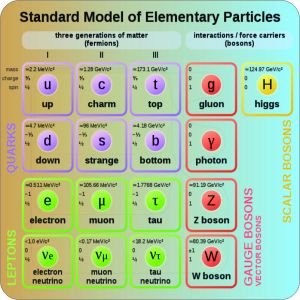
<displaying Old Reliable’s screen> “Here’s the usual graphic. It’s like the chemist’s Periodic Table but goes way below the atomic level. There’s a box each for six kinds of quarks; another half‑dozen for electrons, neutrinos and their kin; four more boxes for mediating electromagnetism and the weak and strong nuclear forces. Finally and at last there’s a box for the famous Higgs boson which isn’t about gravity despite what the pop‑sci press says.”

“What’s in the boxes?”

“Each box holds a list of properties — rest mass, spin, different kinds of charge, and a batch of rules for how to interact with the other thingies.”

“Thingies, Sy? I wouldn’t expect that word from you.”

“I would have said ‘particle‘ but that would violate QFT’s tenets despite the graphic’s headline.”

“Tenets? That word sounds more like you. What’s the problem?”

“That the word ‘particle‘ as we normally use it doesn’t really apply at the quantum field level. Each box names a distinct field that spreads its values and waves all across the Universe. There’s an electron field, a photon field, an up‑quark field, a down‑quark field, and so on. According to QFT, what we’d call a particle is nothing more than a localized peak in its underlying field. Where you find a peak you’ll find all the properties listed in its box. Wherever the field’s value is below its threshold, you find none of them.”

“All or none, huh? I guess that’s where quantum comes in. Wait, that means there could be gazillions of one of them popping up wherever, like maybe a big lump of one kind all right next to each other.”

“No, the rules prevent that. Quarks, for instance, only travel in twos or threes of assorted kinds. The whole job of the gluons is to enforce QFT rules so that, for instance, two up‑quarks and a down‑quark make a proton but only if they have different color charges.”

“Wait, color charge?”

“Not real colors, just quantum values that could as easily have been labeled 1, 2, 3 or A, B, C. There’s also an anti- for each value so the physicists could have used ±1, ±2, ±3, but they didn’t, they used ‘red’ and ‘anti‑red’ and so forth. And ‘color charge‘ is a different property from electric charge. Gluons only interact with color charge, photons only interact with electric charge. The rules are complicated.”

“You said ‘waves.’ Each of these fields can have waves like gravity waves?”

“Absolutely. We can’t draw good pictures of them because they’re 3‑dimensional. And they’re constantly in motion, of course.”

“How fast can those waves travel?”

“The particles are limited to lightspeed or slower; the waves, who knows?”

“Ripples zipping around underneath the quantum threshold could account for entanglement, ya’ know?”

“Maybe.”

~~ Rich Olcott

A Million Times Weaker Than Moonlight

Big Vinnie’s getting downright antsy, which is something to behold. “C’mon, Sy. We get it that sonication ain’t sonification and molecules bumping into each other can carry a sound wave across space if the frequency’s low enough and that can maybe account for galaxies having spiral arms, but you said the Cosmic Hum is a sound, too. That’s a gravity thing, not molecules, right?”

“Not quite what I said, Vinnie. The Hum’s sound‑related, but it’s not ‘sound’ even by our extended definition.”

“Then what’s the connection?”

“Waves.”

“Not frames like always?”

“Not frames, for a change.”

“So it’s waves, but they go though empty space. Can’t happen like sound waves from molecules bumping into each other ’cause molecules are too small to have enough gravity do that when they’re so far apart. What’s carrying the waves?”

“Good question. Einstein figured out one answer. A whole cohort of mid‑20th‑century theoreticians came to a slightly different conclusion.”

“Okay, I’ll bite. What was Einstein’s answer?”

“Relativity, of course. Gravity’s the effect we see from mass deforming nearby space. Moving a mass drives corresponding changes in the shapes of space where it was and where it has moved to. The shape‑changes generate follow‑on gravitational effects that propagate outward over time. Einstein even showed that the gravitational propagation speed is equal to lightspeed.”

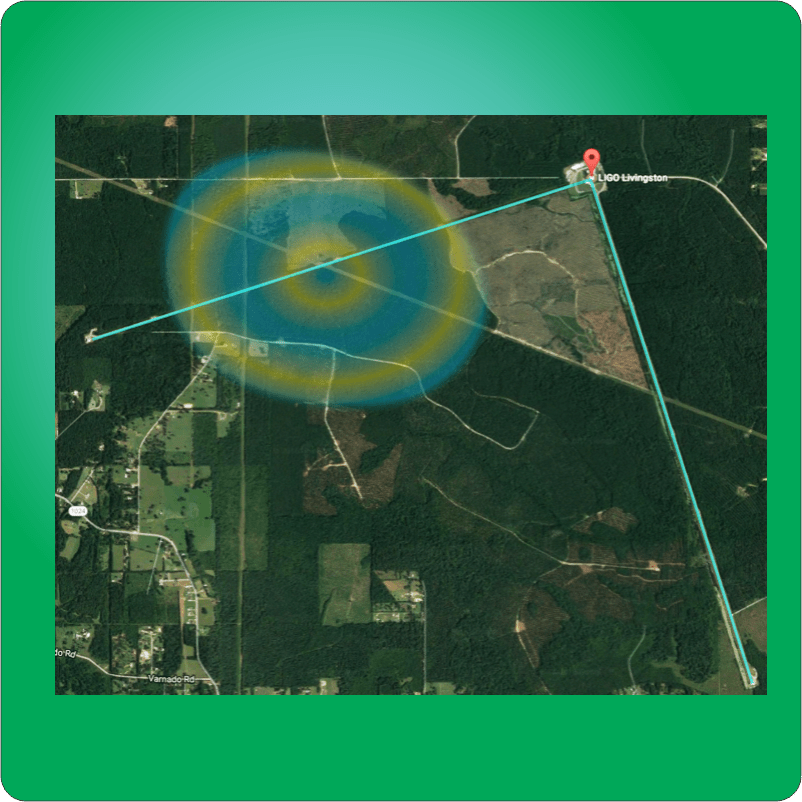
“Gimme a sec … Okay, that black hole collision signal LIGO picked up back in 2015, the holes lost a chunk of their combined mass all of a sudden. Quick drop in the gravity thereabouts. You’re saying it took time for the missing gravity strength to get noticed where we’re at. If I remember right, the LIGO people said the event was something like a billion lightyears away so that tells me it happened about a billion years ago and what the LIGO gadget picked up was space waves, right?”

“Right, but it wasn’t just the mass loss, it was the rapid and intense waggles in the gravitational field as those two enormous bodies, each 30 times as massive as the Sun, whirled around each other multiple times per second. The ever‑faster whirling shook the field with a frequency that swept upward to the ‘POP‘ when your mass‑loss happened. LIGO eventually picked up that signal. Einstein would say there’s no ‘action at a distance‘ in the collision‑LIGO interaction, because the objects acted on the gravitational field which acted on the LIGO system.”

“Like using a towel to pop someone in the locker room. The towel’s just transmi– ulp.”

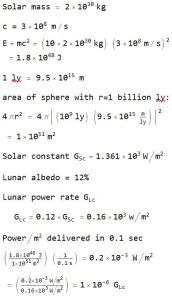
“An admission of guilt if I ever heard one. Yes, like that, except a towel pop carries all the initial energy to its final destination. Gravitational waves spread their energy across the surface of an expanding sphere. The energy per unit area goes down as the square of the distance.” <keying a calculation on Old Reliable> “Suppose the collision releases 10 solar masses worth of energy, we’re a billion lightyears away, and the ‘POP‘ signal is delivered in a tenth of a second. We’d see a signal power … about a millionth as strong as moonlight.”

“Not much there.”

“Right, which is why LIGO and its kin have been such pernickety instruments to build and run. LIGO’s sensors are mirrors roughly a meter across. You get a million times more power sensitivity if your detector’s diameter is a mile across. That was part of the NANOGrav team’s strategy, but they went much bigger.”

“Yeah, that’s the multi-telescope thing, so NANOGrav faked a receiver the size of the Earth, like the Event Horizon Telescope.”

“Much bigger. Their receiver is the entire Milky Way. Instead of LIGO’s mirrors, NANOGrav’s signal generators are neutron stars a dozen or more miles wide scattered across the galaxy.”

“Gotcha, Sy. Two ways. Neutron stars are billions heavier than a LIGO mirror so they’d be less power‑sensitive, not more. Then, power is about moving stuff closer or farther but if I got you right these space waves don’t really do that anyway, right?”

“Right and right, Vinnie, but not relevant. What NANOGrav’s been watching for is pulsar beams being twitched by a gravitational wave. A waltzing black hole pair should generate years‑long or decades‑long wavelengths. NANOGrav may have found one.”

~~ Rich Olcott

LIGO And NANOGrav

Afternoon coffee time, but Al’s place is a little noisier than usual. “Hey, Sy, come here and settle this.”

“Settle what, Al? Hi, Vinnie.”

<waves magazine> “This NANOGrav thing, they claim it’s a brand‑new kind of gravity wave. What’s that about?”

“Does it really say, ‘gravity wave‘? Let me see that. … <sigh> Press release journalism at its finest. ‘Gravity waves’ and ‘gravitational waves’ are two entirely different things.”

“I kinda remember you wrote about that, but it was so long ago I forget how they’re different.”

“Gravity waves happen in a fluid, like air or the ocean. Some disturbance, like a heat spike or an underwater landslide, pushes part of the fluid upward relative to a center of gravity. Gravity acts to pull that part down again but in the meantime the fluid’s own internal forces spread the initial up‑shift outwards. Adjacent fluid segments pull each other up and down and that’s a gravity wave. The whole process keeps going until friction dissipates the energy.”

“Gravitational waves don’t do that?”

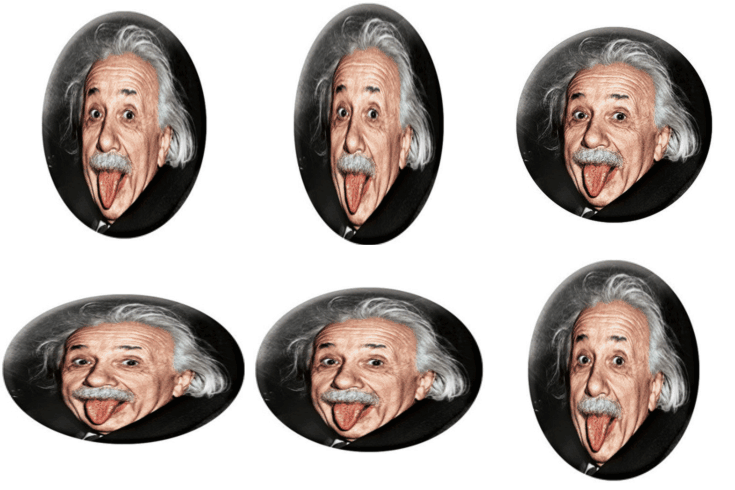
“No, because gravitational waves temporarily modify the shape of space itself. The center doesn’t go up and down, it…” <showing a file on Old Reliable> “Here, see for yourself what happens. It’s called quadrupolar distortion. Mind you, the effects are tiny percentagewise which is why the LIGO apparatus had to be built kilometer‑scale in order to measure sub‑femtometer variations. The LIGO engineers took serious precautions to prevent gravity waves from masquerading as gravitational waves.”

“Alright, so now we’ve almost got used to LIGO machines catching these waves from colliding black holes and such. How are NANOGrav waves different?”

“Is infrared light different from visible light?”

“The Hubble sees visible but the Webb sees infrared.”

“Figures you’d have that cold, Al. What I think Sy’s getting at is they’re both electromagnetic even though we only see one of them. You’re gonna say the same for these new gravitational waves, right, Sy?”

“Got it in one, Vinnie. There’s only one electromagnetic field in the Universe but lots of waves running through it. Visible light is about moving charge between energy levels in atoms or molecules which is how the visual proteins in our eyes pick it up. Infrared can’t excite electrons. It can only waggle molecule parts which is why we feel it as heat. Same way, there’s only one gravitational field but lots of waves running through it. The LIGO devices are tuned to pick up drastic changes like the <ahem> massive energy release from a black hole collision.”

“You said ‘tuned‘. Gravitational waves got frequencies?”

“Sure. And just like light, high frequencies reflect high‑energy processes. LIGO detects waves in the kilohertz range, thousands of peaks per second. NANOGrav’s detection range is sub‑nanohertz, where one cycle can take years to complete. Amazingly low energy.”

“How can they detect anything that slow?”

“With really good clocks and a great deal of patience. The new reports are based on fifteen years of data, half a billion seconds counted out in nanoseconds.”

“Hey, wait a minute. LIGO’s only half‑a‑dozen years old. Where’d they get the extra data from, the future?”

“Of course not. Do you remember us working out how LIGO works? The center sends out a laser pulse along two perpendicular arms, then compares the two travel times when the pulse is reflected back. Light’s distance‑per‑time is constant, right? When a passing gravitational wave squeezes space along one arm, the pulse in that arm completes its round trip faster. The two times don’t match any more and everyone gets excited.”

“Sounds familiar.”

“Good. NANOGrav also uses a timing‑based strategy, but it depends on pulsars instead of lasers. Before you ask, a pulsar is a rotating neutron star that blasts a beam of electromagnetic radiation. What makes it a pulsar is that the beam points away from the rotation axis. We only catch a pulse when the beam points straight at us like a lighthouse or airport beacon. Radio and X‑ray observatories have been watching these beasts for half a century but it’s only in the past 15 years that our clocks have gotten good enough to register timing hiccups when a gravitational wave passes between us and a pulsar.”

~ Rich Olcott
Clouds From Both Sides Now

I don’t usually see Vinnie in a pensive mood. Moody, occasionally, but there he is at his usual table by the door, staring at the astronomy poster behind Al’s cash register. “Have a scone, Vinnie. What’s on your mind?”

“Thanks, Sy. Welcome back, Cathleen. What’s bugging me is the hard edges on that picture of Jupiter. It looks like those stripes are painted on. Everyone says Jupiter’s not really solid so how come the planet looks so smooth?”

“Cathleen, this is definitely in your astronomer baliwick.”

“I suppose. It’s a matter of scale, Vinnie. The white zones mark updrafts. The whiteness is clouds that rise a couple hundred kilometers above a brownish lower layer. The downdraft belts on either side are transparent enough to let us see the next lower layer. ‘A couple hundred kilometers‘ sounds like a lot, but that’s only a tenth of a percent of Jupiter’s radius. If Jupiter were a foot‑wide ball floating in front of us, the altitude difference would be as thin as a piece of tissue paper. You might be able to feel the ridges and valleys but you’d have a hard time seeing them.”

“But why does the updraft stop so sharp? Is there like a cap on the atmosphere?”

“The clouds stop, but the updrafts don’t. The cloud tops aren’t even close to the top of Jupiter’s atmosphere, any more than Earth clouds reach the top of ours. C’mon, Vinnie, you’re a pilot. Surely you’ve noticed that most thunderheads top out at about the same altitude. Isn’t the sky still blue above them?”

“That’s higher than the planes I fly are cleared for, but I wouldn’t want to get above one anyway. I know a guy who flew over one that was just getting started. He said it’s a bumpy ride but yeah, there’s still kind of a dark blue sky above.”

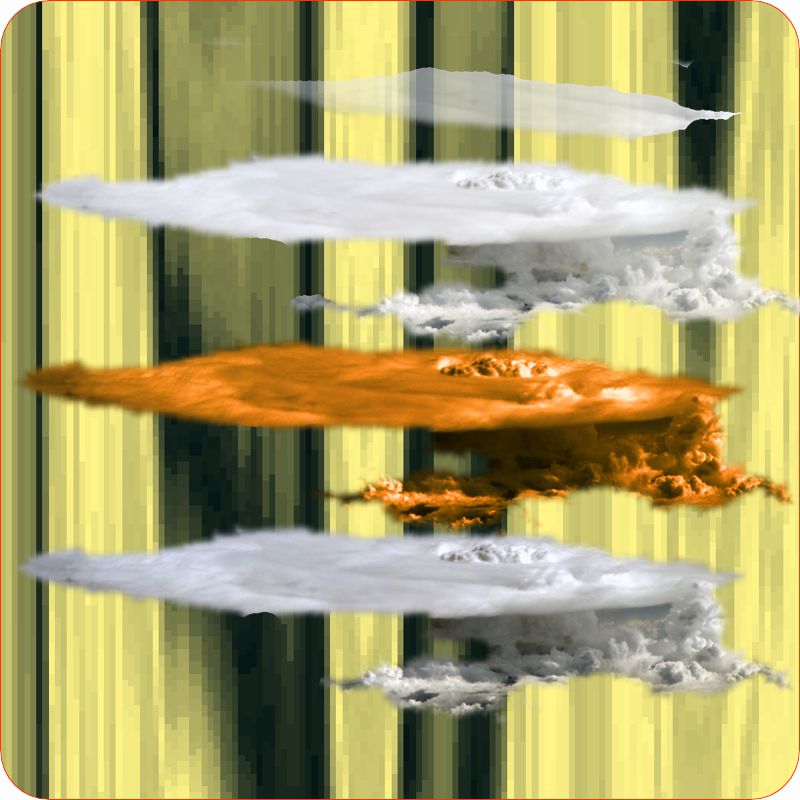
“All of that makes my point — our atmosphere doesn’t stop at the tropospheric boundary where the clouds do. Beyond that you’ve got another 40‑or‑so kilometers of stratosphere. Jupiter’s the same way, clouds go up only partway. For that matter, Jupiter has at least four separate cloud decks.”

“Wait, Cathleen — four? I know how Earth clouds work. Warm humid air rises, expanding and cooling as it goes. When its temperature falls below the dew point or freezing point, its humidity condenses to water droplets or ice crystals and that’s the cloud. I suppose if that same bucketful of air keeps rising far enough the pressure gets so low the water evaporates again and that’s the top of the cloud. How can that happen multiple times?”

“It doesn’t, Sy. In Jupiter’s complicated atmosphere each deck is formed from a different gas. Top layer is a wispy white hydrocarbon fog. The white zone clouds next down are ices of ammonia, which has to get a lot colder than water before it condenses. Water ice probably has a layer much farther down.”

“What’s the brownish layer?”

“There’s one or maybe two of them, each a complex mixture of ammonium ions with various sulfide species. The variety of colors in there make the visible light spectroscopy an opaque muddle.”

“Hey, if the brownish layers block what we can see, how do we even know lower layers are a thing?”

“Good question, Vinnie. Actually, we can do spectroscopy in the middle infrared. That gives us some clues. We’d hoped that the Galileo mission’s deep‑diver probe would sense the lower layers directly but unfortunately it dove into a hot spot where the upwelling heat messes up the layering. Our last resort is modeling. We have an inventory of lab data on thousands of compounds containing the chemical elements we’ve detected on Jupiter. We also have a pretty good temperature‑pressure profile of the atmosphere from the planet’s stratosphere down nearly to the core. Put the two together and we can paint a broad‑brush picture of what compounds should be stable in what physical state at every altitude.”

“Those ‘broad‑brush‘ and ‘should‘ weasel‑words say you’re working with averages like Einstein didn’t like with quantum mechanics. Those vertical winds mix things up pretty good, I’ll bet.”

“Fair objection, Vinnie, but we do what we can.”

~~ Rich Olcott

Reflection, Rotation And Spacetime

“Afternoon, Al.”

“Hiya, Sy. Hey, which of these two scones d’ya like better?”

“”Mm … this oniony one, sorta. The other is too vegetable for me ‑ grass, I think, and maybe asparagus? What’s going on?”

“Experimenting, Sy, experimenting. I’m going for ‘Taste of Spring.’ The first one was spring onion, the second was fiddlehead ferns. I picked ’em myself.”

“Very seasonal, but I’m afraid neither goes well with coffee. I’ll take a caramel scone, please, plus a mug of my usual mud.”

“Aw, Sy, caramel’s a winter flavor. Here you go. Say, while you’re here, maybe you could clear up something for me?”

“I can try. What’s the something?”

“After your multiverse series I got out my astronomy magazines to read up on the Big Bang. Several of the articles said that we’ve gone through several … um, I think they said ‘epochs‘ … separated by episodes of symmetry breaking. What’s that all about?”

“It’s about a central notion in modern Physics. Name me some kinds of symmetry.”

“Mmm, there’s left‑right, of course, and the turning kind like a snowflake has. Come to think — I like listening to Bach and Vivaldi when I’m planet‑watching. I don’t know why but their stuff reminds me of geometry and feels like symmetry.”

“Would it help to know that the word comes from the Greek for ‘same measure‘? Symmetry is about transformations, like your mirror and rotation operations, that affect a system but don’t significantly change to its measurable properties. Rotate that snowflake 60° and it looks exactly the same. Both the geometric symmetries you named are two‑dimensional but the principle applies all over the place. Bach and the whole Baroque era were just saturated with symmetry. His music was so regular it even looked good on the page. Even buildings and artworks back then were planned to look balanced, as much mass and structure on the left as on the right.”

“I don’t read music, just listen to it. Why does Bach sound symmetric?”

“There’s another kind of symmetry, called a ‘translation‘ don’t ask why, where the transformation moves something along a line within some larger structure. That paper napkin dispenser, for instance. It’s got a stack of napkins that all look alike. I pull one off, napkins move up one unit but the stack doesn’t look any different.”

“Except I gotta refill it when it runs low, but I get your drift. You’re saying Bach takes a phrase and repeats it over and over and that sounds like translational symmetry along the music’s timeline.”

“Yup, maybe up or down a few tones, maybe a different register or instrument. The repeats are the thing. Play his Third Brandenberg Concerto next time you’re at your telescope, you’ll see what I mean.”

“Symmetry’s not just math then.”

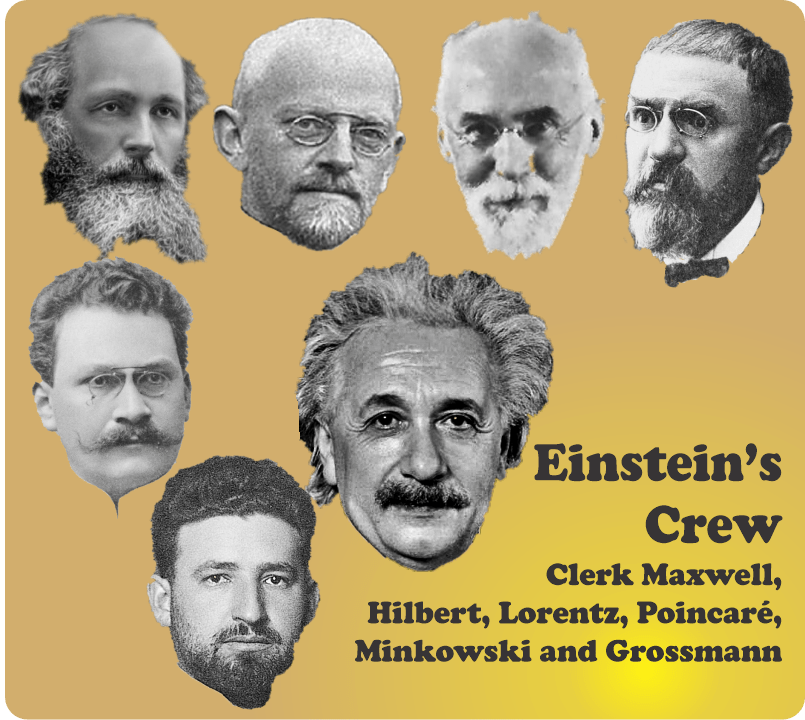
“Like I said, it’s everywhere. You’ve seen diagrams of DNA’s spiral staircase. It combines translation with rotation symmetry, does about 10 translation steps per turn, over and over. The Universe has a symmetry you don’t see at all. No‑one did until Lorentz and Poincaré revised Heaviside’s version of Maxwell’s electromagnetism equations for Minkowski space. Einstein, Hilbert and Grossman used that work to give us and the Universe a new symmetry.”

“Einstein didn’t do the math?”

“The crew I just named were world‑class in math, he wasn’t. Einstein’s strengths were his physical intuition and his ability to pick problems his math buddies would find interesting. Look, Newton’s Universe depends on absolute space and time. The distance between two objects at a given time is always the same, no matter who’s measuring it or how fast anyone is moving. All observers measure the same duration between two incidents regardless. Follow me?”

“Makes sense. That’s how things work hereabouts, anyway.”

“That’s how they work everywhere until you get to high speeds or high gravity. Lorentz proved that the distances and durations you measure depend on your velocity relative to what you’re measuring. Extreme cases lead to inconsistent numbers. Newton’s absolute space and time are pliable. To Einstein such instability was an abomination. Physics needs a firm foundation, a symmetry between all observers to support consistent measurements throughout the Universe. Einstein’s Relativity Theory rescued Physics with symmetrical mathematical transformations that enforce consistency.”

~~ Rich Olcott

Time And The Egg

I unlock my office door and there’s Vinnie in the client chair flipping a coin from hand to hand. If my building ever switches to digital locks he’d take it as a challenge. “Morning, Vinnie.”

“Morning, Sy. Been reading your multiverse series and something you said bothered me.”

“What’s that?”

“Back when you wrote up your anti-Universe idea that some other group had come up with first—”

“Don’t remind me.”

“—you mentioned how time going backwards makes for negative energy, like that’s obvious. It ain’t obvious to me.”

“Okay … Ah. What word keeps coming up in our black hole discussions?”

“Geez, frames again? Universes ain’t black holes.”

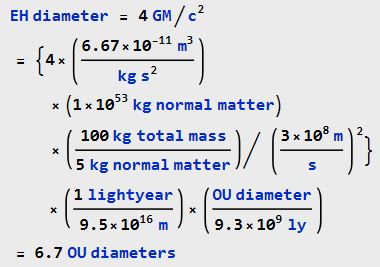
“Don’t be so sure. Suppose there’s a black hole Event Horizon that encloses our entire Observable Universe. An Event Horizon’s diameter depends on how much mass it has inside. Astronomy’s given us an estimate of how much normal matter our Observable Universe contains. I adjusted that number upward to account for the expected quantity of dark matter plus dark energy’s equivalent mass. When I plugged that grand total into Schwarzchild’s formula for the diameter of an Event Horizon, the result was about seven times wider than what we can observe. We could be inside a huge black hole but we’ll never know either way.”

“Whoa! Wouldn’t we notice a drift towards the singularity at its middle?”

“Not if we’re reasonably far out or if the drift rate is tiny compared to the slow chaos of intergalactic space. Mind you, it took us centuries to develop the technology that told us we’re inside the Milky Way and two‑thirds of the way out from the core.”

“We used frames for thinking about going really fast or being outside a black hole. Now we’re inside one or maybe not. How’s frames gonna help us with that?”

“Well, not the inertial frames where we compared relativistic observers, but the idea is similar. A traveler in an intense gravity field experiences slower time in its inertial frame than a distant partner does in theirs. Clocks appear to run weirdly if they’re compared between separate frames whose relative velocities are near lightspeed.”

“Yeah, that’s what we said.”

“Now picture two observational frames, one here in our Universe and one in the anti‑Universe if there is one. Time in the two frames flows in opposite directions away from the Big Bang between them. The two‑frames notion is a convenient way to think about consequences. Negative energy is one.”

“Now we’re getting somewhere. So give.”

“Well, what does energy do?”

“It makes things happen.”

“Negative energy does, too, considered from inside its frame. Looking from our frame, though, negative energy makes things unhappen. This spoon on our table has gravitational potential energy relative to the floor, right?”

“Yeah, you push it over the edge it’ll fall down.”

“But looking from our frame at a similar situation in the anti‑Universe running on anti‑time, an anti‑spoon on its floor has negative gravitational potential energy. We’d see it fall up to its table. Make sense?”

“Gimme a minute.” <pause> “Kinda hard to visualize but I’m starting to get there.” <longer pause> “Alright, you know I hate equations but even I know about Einstein’s E=mc². That is a square so it’s always positive so if E is negative then the mass gotta be negative, too.”

“From our frame all mass in the anti‑Universe looks negative. Negative mass would attract negative mass just like positive mass attracts positive mass here. Gravity in the anti‑Universe would work exactly the same way as our gravity does, so where’s the problem?”

“Gimme another minute.” <more pausing> “Suppose that spoon was an anti‑egg. You’re sayin’ when it goes splat over there, we’re gonna see it unsplat? Unsplatting uses up entropy. How about the ‘Entropy always increases‘ rule?”

“Right on the unsplat, wrong on the other. The full statement of Thermodynamics’ Second Law says that entropy never decreases in an isolated system. You can’t get much more isolated than being a separate Universe — no inputs of energy or matter from our Universe or anywhere else, right? From our frame, it looks like the anti‑Universe flipped the Second Law but that’s only because we’re using the wrong clock.”

~~ Rich Olcott

Noodles or A Sandwich?

“Wait, Sy, your anti-Universe idea says there are exactly two um, sub‑Universes. Even the word ‘multiverse‘ suggests more than that.”

“You’re right, Susan, most of the multiverse proposals go to the other extreme. Maybe the most extreme version grew in reaction to one popular interpretation of quantum theory. Do you know about the ‘Many Worlds‘ notion?”

“Many Worlds? Is that the one about when I decide between noodles for lunch or a sandwich, the Universe splits and there’s one of me enjoying each one?”

“That’s the popular idea. The physics idea is way smaller, far bigger and even harder to swallow. Physicists have been arguing about it for a half‑century.”

“Come again? Smaller AND bigger?”

“Smaller because it’s a quantum‑based idea about microscopic phenomena. Doesn’t say anything about things big enough to touch. Remember how quantum calculations predict statistics, not exact values? They can’t give you anything but averages and spreads. Einstein and Bohr had a couple of marquee debates about that back in the 1930s. Bohr maintained that our only path to understanding observations at the micro‑scale was to accept that events there are random and there’s no point discussing anything deeper than statistics. Einstein’s position was that the very fact that we’re successfully using an average‑based strategy says that there must be finer‑grained phenomena to average over. He called it ‘the underlying reality.’ The string theory folks have chased that possibility all the way down to the Planck‑length scale. They’ve found lots of lovely math but not much else. Hugh Everett had a different concept.”

“With that build‑up, it’d better have something to do with Many Worlds.”

“Oh, it does. Pieces of the idea have been lying around for centuries, but Everett pulled them all together and dressed them up in a quantum suit. Put simply, in his PhD thesis he showed how QM’s statistics can result from averaging over Universes. Well, one Universe per observation, but you experience a sequence of Universes and that’s what you average over.”

“How can you show something like that?”

“By going down the rabbit hole step by step and staying strictly within the formal QM framework. First step was to abstractify the operation of observing. He said it’s a matter of two separate systems, an observer A and a subject B. The A could be a person or electronics or whatever. What’s important is that A has the ability to assess and record B‘s states and how they change. Given all that, the next step is to say that both A and B are quantized, in the sense that each has a quantum state.”

“Wait, EACH has a quantum state? Even if A is a human or a massive NMR machine?”

“That’s one of the hard‑to‑swallows, but formally speaking he’s okay. If a micro‑system can have a quantum state then so can a macro‑system made up of micro‑systems. You just multiply the micro‑states together to get the macro‑state. Which gets us to the next step — when A interrogates B, the two become entangled. We then can only talk about the combined quantum state of the A+B system. Everett referred to an Einstein quote when he wrote that a mouse doesn’t change the Moon by looking at it, but the Moon changes the mouse. The next step’s a doozy so take a deep breath.”

“Ready, I suppose.”

B could have been in any of its quantum states, suppose it’s . After the observation, A+B must be an entangled mixture of whatever A was, combined with each of B‘s possible final states. Suppose B might switch to . Now we can have A+B(#42), separate from a persisting A+B(#10), plus many other possibles. As time goes by, A+B(#42) moves along its worldline independent of whatever happens to A+B(#10).”

“If they’re independent than each is in its own Universe. That’s the Many Worlds thing.”

“Now consider just how many worlds. We’re talking every potential observing macro‑system of any size, entangled with all possible quantum states of every existing micro‑system anywhere in our Observable Universe. We’re a long way from your noodles or sandwich decision.”

“An infinity of infinities.”

“Each in its own massive world.”

“Hard to swallow.”

~~ Rich Olcott

A Nightcap And Secrets

“A coffee nightcap, Sy? It’s decaf so Teena can have some.”

“Sounds good, Sis.”

“Why didn’t Mr Einstein like entanglement, Uncle Sy? Thanks, Mom. A little more cream in it, please.”

“I’ll bet it has to do with the instant-effect aspect, right, Sy?”

“Thanks, Sis, and you’re right as usual. All of Relativity theory rests on the claim that nothing, not light or gravity or causality itself, can travel faster than light in a vacuum. There’s good strong arguments and evidence to support that, but Einstein himself proved that entanglement effects aren’t constrained to lightspeed. Annoyed him no end.”

“Well, your coin story‘s very nice, but it’s just a story. Is there evidence for entanglement?”

“Oh, yes, though it was fifty years after Einstein’s entanglement paper before our technology got good enough to do the experiments. Since then a whole industry of academics and entrepreneurs has grown up to build and apply devices that generate entangled systems.”

“Systems?”

“Mm-hm. Most of the work has been done with pairs of photons, but people have entangled pairs of everything from swarms of ultra‑cold atoms to electrons trapped in small imperfect diamonds. It’s always a matter of linking the pair members through some shared binary property.”

“Binary! I know what that is. Brian has a computer toy he lets me play with. You tell it where to drive this little car and it asks for decisions like left‑right or go‑stop and they’re all yes or no and the screen shows your answer as ‘0’or ‘1’ and that’s binary, right?”

“Absolutely, Teena. The entangled thingies are always created in pairs, remember? Everything about each twin is identical except for that one property, like the two coin metals, so it’s yes, no, or some mixture. Cars can’t do mixtures because they’re too big for quantum.”

“What kinds of properties are we talking about? It’s not really gold and silver, is it?”

“No, you’re right about that, Sis. Transmutation takes way too much power. Entangled quantum states have little or no energy separation which is one reason the experiments are so hard. Photons are the easiest to work with so that’s where most of the entanglement work has been done. Typically the process splits a laser beam into two rays that have contrasting polarizations, say vertical and horizontal. Or the researchers might work with particles like electrons that you can split into right‑ and left‑handed spin. Whatever, call ’em ones and zeroes, you’ve got a bridge between quantum and computing.”

“Brian says binary can do secret codes.”

“He’s right about that. Codes are about hiding information. Entanglement is real good at hiding quantum information behind some strict rules. Rule one is, if you inspect an entangled particle, you break the entanglement.”

“Sounds reasonable. When you measure it you make it part of a big system and it’s not quantum any more.”

“Right, Sis. Rule two, an entanglement only links pairs. No triples or broadcasts. Rule three is for photons — you can have two independent ways to inspect a property, but you need to use the same way for both photons or you’ve got a 50% chance of getting a mismatch.”

“Oho! I see where the hiding comes in. Hmm… From what I’ve read, encryption’s big problem is guarding the key. I think those three rules make a good way to do that. Suppose Rocky and Bullwinkle want to protect their coded messages from Boris Badinoff. They share a series of entangled photon pairs. and they agree to a measurement protocol based on the published daily prices for a series of stocks — for each photon in a series, measure it with Method 1 if the corresponding price is an odd number, Method 2 if it’s even. Rocky measures his photon. If he measures a ‘1’ then Bullwinkle sees a ‘0’ for that photon and he knows Rocky saw a ‘1.’ Rocky encrypts his message using his measured bit string. Bullwinkle flips his bit string and decrypts.”

“Brilliant. Even if Boris knows the proper sequence of measurements, if he peeks at an entangled photon that breaks the entanglement. When Bullwinkle decodes gibberish Rocky has to build another key. Your Mom’s a very smart person, Teena.”

~ Rich Olcott