Think globally, act locally. Electrons do.

“Watcha, Johnnie, you sure ‘at particle’s inna box?”
“O’course ’tis, Jennie!  Why wouldn’t it be?”
“Me Mam sez particles can tunnel outta boxes ’cause they’re waves.”

“Can’t be both, Jessie.”


Double slit experiment
The double-slit experiment.
An electron beam travels from the source at left to a display screen. In between there’s a barrier with two narrow slits.

Maybe it can.

Nobel-winning (1965) physicist Richard Feynman said the double-slit experiment (diagrammed here) embodies the “central mystery” of Quantum Mechanics.

When the bottom slit is covered the display screen shows just what you’d expect — a bright area  opposite the top slit.

When both slits are open, the screen shows a banded pattern you see with waves.  Where a peak in a top-slit wave meets a peak in the bottom-slit wave, the screen shines brightly.  Where a peak meets a trough the two waves cancel and the screen is dark.  Overall there’s a series of stripes.  So electrons are waves, right?

But wait.  If we throttle the beam current way down, the display shows individual speckles where each electron hits.  So the electrons are particles, right?

Now for the spooky part.  If both slits are open to a throttled beam those singleton speckles don’t cluster behind the slits as you’d expect particles to do.  A speckle may appear anywhere on the screen, even in an apparently blocked-off region.  What’s more, when you send out many electrons one-by-one their individual hits cluster exactly where the bright stripes were when the beam was running full-on.

It’s as though each electron becomes a wave that goes through both slits, interferes with itself, and then goes back to being a particle!

By the way, this experiment isn’t a freak observation.  It’s been repeated with the same results many times, not just with electrons but also with light (photons), atoms, and even massive molecules like buckyballs (fullerene spheres that contain 60 carbon atoms).  In each case, the results indicate that the whatevers have a dual character — as a localized particle AND as a wave that reacts to the global environment.

Physicists have been arguing the “Which is it?” question ever since Louis-Victor-Pierre-Raymond, the 7th Duc de Broglie, raised it in his 1924 PhD Thesis (for which he received a Nobel Prize in 1929 — not bad for a beginner).  He showed that any moving “particle” comes along with a “wave” whose peak-to-peak wavelength is inversely proportional to the particle’s mass times its velocity.  The longer the wavelength, the less well you know where the thing is.

I just had to put numbers to de Broglie’s equation.  With Newton in mind, I measured one of the apples in my kitchen.  To scale everything, I assumed each object moved by one of its diameters per second.  (OK, I cheated for the electron — modern physics says it’s just a point, so I used a not-really-valid classical calculation to get something to work with.)

“Particle” Mass, kilograms Diameter, meters Wavelength, meters Wavelength, diameters
Apple 0.2 0.07 7.1×10⁻³³ 1.0×10⁻³¹
Buckyball 1.2×10⁻²⁴ 1.0×10⁻⁹ 0.083 8.3×10+7
Hydrogen atom 1.7×10⁻²⁷ 1.0×10⁻¹⁰ 600 6.0×10+12
Electron 9.1×10⁻³¹ 3.0×10⁻¹⁷ 3.7×10+12 1.2×10+29

That apple has a wave far smaller than any of its hydrogen atoms so I’ll have no trouble grabbing it for a bite.  Anything tinier than a small virus is spread way out unless it’s moving pretty fast, as in a beam apparatus.  For instance, an electron going at 1% of light-speed has a wavelength only a nanometer wide.

Different physicists have taken different positions on the “particle or wave?” question.  Duc de Broglie claimed that both exist — particles are real and they travel where their waves tell them to.  Bohr and Heisenberg went the opposite route, saying that the wave’s not real, it’s only a mathematical device for calculating relative probabilities for measuring this or that value.  Furthermore, the particle doesn’t exist as such until a measurement determines its location or momentum.  Einstein and Schrödinger liked particles.  Feynman and Dirac just threw up their hands and calculated.

Which brings us to the other kind of quantum spookiness — “entanglement.”  In fact, Einstein actually used the word spukhafte (German for “spooky”) in a discussion of the notion.  He really didn’t like it and for good reason — entanglement rudely collides with his own Theory of Relativity.  But that’s another story.

~~ Rich Olcott

Particles and Poetry

“Hoy, Johnny, wotcher got inna box?”
“Hit’s a particle, Jessie.”
“Ooo, lovely for you.  Umm… wot’s a particle then?”
“Me Pap says hit’s sommat you calc’late about wiffout knowin’ wot ’tis.”


Pap’s right.  Newton was a particle guy all the way (he was a strong supporter of the idea that light is composed of particles).  One of his most important insights was that he could simplify gravitational calculations if he replaced an object with an equally massive “particle” located at the object’s center of mass.  Could be a planet, or a moon, or that apple — he could treat each of them as a “particle.”  That worked fine for his purposes, because the distances between his object centers were vastly larger than the object sizes.

Fleas
“Great fleas have little fleas upon their backs to bite ’em / And little fleas have lesser fleas and so on infinitum.” ~~ Augustus De Morgan

It took Roche to work out what happens when the distances get small.  Gravitational forces break the original “particles” into littler particles.  And when two of the little ones approach closely enough they break up, and then those break up…  You get the idea.  Take the process far enough and you get Saturn’s Rings, for instance.

But the analysis can keep going.  Consider one “particle” in Saturn’s A-ring.  It’s probably about 3″ across, made of ice, and contains something like 1024 particles that happen to be molecules of H2O.  Each molecule contains 3 nuclei (2 protons and one oxygen nucleus) and 10 electrons, all 13 of which merit “particle” status if you’re calculating molecules.  They’re all held together by a blizzard of photons carrying the electromagnetic forces between them.  The oxygen nucleus contains 16 nuclear particles, each of which contains 3 quarks.  The quark structures would fly apart except for a host of gluons that pass back and forth transmitting the nuclear strong force.  Hooboy, do we got particles.

“Particle” is a slippery word.  For Newton’s purposes, if an object is small relative to its distance from other objects, that was all he needed to know to treat it as a particle.

One dictionary specifies “a small localized object which has identifiable physical or chemical properties such as volume or mass.”  However, there are theoretical grounds to believe that the classic “particle of light,” the photon, has neither mass nor volume.  Physicists have had long arguments trying to devise a good working definition.  Nobelist (1999) Gerard ‘t Hooft ended one such discussion by saying, “A particle is fundamental when it’s useful to think of it as fundamental.”

It may seem a little strange for a physicist to argue for imprecision.  In fact, ‘t Hooft was arguing for a broad, even poetic but still precise understanding of the word.

Poets use metaphor to help us understand the world.  Part of their art is to pack as much meaning as they can into the minimum number of words.  In the same way, scientists use mathematics to pack observed relationships into a simile called an equation  — a brief bit of math may connect and illuminate many disparate phenomena.

Think of physics as metaphor, with numbers.

Newton’s Law of Gravity works for for galaxies roving through a cluster and for basketball-sized satellites orbiting Earth and for stars circling a black hole (if they don’t get too close).  Maxwell’s Equations, just 30 symbols including parentheses and equal signs, give the speed of light and describe the operation of electric motors.  The particle physicists’ Standard Model makes predictions that match experimental results to more than a dozen decimal places.

Good equations are so successful that Nobelist (1963) Eugene Wigner wrote an influential paper entitled The Unreasonable Effectiveness of Mathematics in the Natural Sciences.

We sometimes get into trouble by confusing metaphor with reality.  Poetic metaphors can be carried too far — Hamlet’s lungs were not in fact filling with water from his “sea of troubles.”

Mathematical models can also be carried too far.  Popular (and practitioner) discussion of quantum mechanics is rife with over-extended metaphors.  QM calculations yield only statistical results — an average position, say, plus or minus so much.  It’s an average, but of what?  The “many worlds” hypothesis is an unnecessarily long jump.  There are simpler, less extravagant ways to account for statistical uncertainty. les Etats Unis

~~ Rich Olcott

Three LIGOs make a Banana Slicer

Ponder for a moment what Space throws at you.  Photons of all sizes, of course —  infra-red ones that warm your skin, visible ones that show you the beach, ultra-violet ones that give you tan and sunburn.  Neutrinos and maybe dark matter particles that pass right through you without even pausing.  All of those act upon you in little bits at little places — gravity pervades you.  You can put up a parasol or step into a cave, but there’s no shielding yourself from gravity.

Gravity’s special character has implications for LIGOs.  A word first about words.  LIGO as a generic noun unwinds to Laser Interferometer Gravitational-Wave Observatory, a class of astronomical instruments. LIGO as a proper noun denotes a project that culminated in the construction of a specific pair of devices that went live in 2002.

That hardware wasn’t sensitive enough to detect the gravitational waves it was created to seek.  To improve the initial LIGO’s power and sensitivity, the LIGO infrastructure and organization morphed into the Advanced LIGO (aLIGO) project.  Concurrently, the LIGO instrument was upgraded and renamed.  No surprise, the instrument’s new name is aLIGO.  An early phase of aLIGO bore uncannily fortunate fruit with the Sept 14 gravitational wave detection.

Four other LIGOs are proposed, under construction or in operation around the world — KARGA in Japan, INDIGO in India, GEO600 in Germany and VIRGO in Italy.  Why so many, and why even consider space-borne LIGOs like LISA Pathfinder and eLISA?

Astronomers ask a series of questions of the Universe:

  • What objects are out there?
  • Where are they?
  • What are they doing?
  • Why are they doing that?

September’s aLIGO incident gave us a gratifyingly unexpected answer to the first question.  To the surprise of theoreticians, the detected event was the collision of two black holes, each of which was in a size range that current theory says shouldn’t be populated.  Even more surprising, such objects are apparently common enough to meet up, form binary pairs and eventually merge.

1 LIGO localizationThe second question is harder.  The best the aLIGO team could do was point to a “banana-shaped region” (their words, not mine) that covers about 1% of the sky.  The team marshaled a world-wide collaboration of observatories to scan that area (a huge search field by astronomical standards), looking for electromagnetic activities concurrent with  the event they’d seen.  Nobody saw any.  That was part of the evidence that this collision involved two black holes.  (If one or both of the objects had been something other than a black hole, the collision would have given off all kinds of photons.)
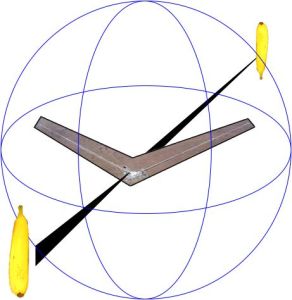
Why such poor localization?  Blame gravity’s pervasive character and Geometry.  With a telescope, any kind of telescope, you know which direction you’re looking.  Telescopes work only with photons that enter through the front; photons aimed at the back of the instrument stop there.

2 LIGO localizationIn contrast, a LIGO facility is (roughly speaking) omni-directional.  When a LIGO installation senses a gravitational pulse, it could be coming down from the visible sky or up through the Earth from the other hemisphere — one signal doesn’t carry the “which way?” information.  The diagram above shows that situation.  (The “chevron” is an image of the LIGO in Hanford WA.)  Models based on the signal from that pair of 4-km arms can narrow the source field to a “banana-shaped region,” but there’s still that 180o ambiguity.

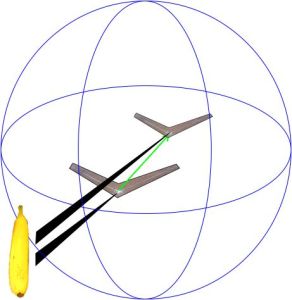
The good news is that the LIGO project built not one but two installations, 2500 miles apart.  With two LIGOs (the second diagram) there’s enough information to resolve the ambiguity.  The two also serve as checks on each other — if one sees a signal that doesn’t show up at the other that’s probably a red herring that can be discarded.

3 LIGO localizationThe great “if only” is that the VIRGO installation in Italy was not recording data when the Hanford WA and Livingston LA saw that September signal.  With three recordings to reconcile, the aLIGO+VIRGO combination would have had enough information to slice that banana and localize the event precisely.

When the European Space Agency puts Evolved LISA (eLISA) in orbit (watch the animation, it’s cool) in 2034, there’ll be a million-kilometer triangle of spacecraft up there, slicing bananas all over the sky.

~~ Rich Olcott

aLIGO and eLISA: Tuning The Instrument

Oh, it’s good to see Big News in hard science get big attention in Big Media.  The LIGO story and Columbia’s Dr Brian Greene even made it to the Stephen Colbert Late Show.  Everyone chuckled at the final “boowee-POP” audio recording (simulation at 7:30 into this clip; get for-real traces and audio from this one).

There’s some serious science in those chirps, not to mention serious trouble for any alien civilization that happened to be too close to the astronomical event giving rise to them.

LIGO trace 3
Adapted from the announcement paper by Abbot et al

The peaks and valleys in the top LIGO traces represent successive spatial compression cycles generated by two massive bodies orbiting each other.  There’s one trace for each of the two LIGO installations.  The spectrograms beneath show relative intensity at each frequency.  Peaks arrived more rapidly in the last 100 milliseconds and the simulated sound rose in pitch because the orbits grew smaller and faster.  The audio’s final POP is what you get from a brief but big disturbance, like the one you hear when you plug a speaker into a live sound system.  This POP announced two black holes merging into one, converting the mass-energy of three suns into a gravitational jolt to the Universe.

Scientists have mentioned in interviews that LIGO has given us “an ear to the Universe.”  That’s true in several different <ahem> senses.  First, we’ve seen in earlier posts that gravitational physics is completely different from the electromagnetism that illuminates every kind of telescope that astronomers have ever used.  Second, black hole collisions generate signals in frequencies that are within our auditory range.  Finally, LIGO was purposely constructed to have peak sensitivity in just that frequency range.

Virtually every kind of phenomenon that physicists study has a characteristic size range and a characteristic frequency/duration range.  Sound waves, for instance, are in the audiophile’s beloved “20 to 20,000” cycles per second (Hz).  Put another way, one cycle of a sound wave will last something between 1/20 and 1/20,000 second (0.05-0.000 05 second).  The speed of sound is roughly 340 meters per second which puts sound’s characteristic wavelength range between 17 meters and 17 millimeters.

No physicist would be surprised to learn that humans evolved to be sensitive to sound-making things in that size range.  We can locate an oncoming predator by its roar or by the snapping twig it stepped on but we have to look around to spot a pesky but tiny mosquito.

So the greenish box in the chart below is all about sound waves.  The yellowish box gathers together the classes of phenomena scientists study using the electromagnetic spectrum.  For instance, we use infra-red light (characteristic time range 10-15-10-12 second) to look at (or cause) molecular vibrations.

RegimesWe can investigate things that take longer than an instrument’s characteristic time by making repeated measurements, but we can’t use the instrument to resolve successive events that happen more quickly than that.  We also can’t resolve events that take place much closer together than the instrument’s characteristic length.

The electromagnetic spectrum serves us well, but it has its limitations.  The most important is that there are classes of objects out there that neither emit nor absorb light in any of its forms.  Black holes, for one.  They’re potentially crucial to the birth and development of galaxies.  However, we have little hard data on them against which to test the plethora of ideas the theoreticians have come up with.

Dark matter is another.  We know it’s subject to gravity, but to our knowledge the only way it interacts with light is by gravitational lensing.  Most scientists working on dark matter wield Occam’s Razor to conclude it’s pretty simple stuff.  Harvard cosmologist Dr Lisa Randall has suggested that there may be two kinds, one of which collects in disks that clothe themselves in galaxies.

That’s where LIGO and its successors in the gray box will help.  Their sensitivity to gravitational effects will be crucial to our understanding of dark objects.  Characteristic times in tens and thousands of seconds are no problem nor are event sizes measured in kilometers, because astronomical bodies are big.

GrWave Detectors
Gravitational instrumentation, from Christopher Berry’s blog and Web page

This is only the beginning, folks, we ain’t seen nothin’ yet.

~~ Rich Olcott

Would the CIA want a LIGO?

So I was telling a friend about the LIGO announcement, going on about how this new “device” will lead to a whole new kind of astronomy.  He suddenly got a far-away look in his eyes and said, “I wonder how many of these the CIA has.”

The CIA has a forest of antennas, but none of them can do what LIGO does.  That’s because of the physics of how it works, and what it can and cannot detect.  (If you’re new to this topic, please read last week’s post so you’ll be up to speed on what follows.  Oh, and then come back here.)

There are remarkable parallels between electromagnetism and gravity.  The ancients knew about electrostatics — amber rubbed by a piece of cat fur will attract shreds of dry grass.  They certainly knew about gravity, too.  But it wasn’t until 100 years after Newton wrote his Principia that Priestly and then Coulomb found that the electrostatic force law, F = ke·q1·q2 / r2, has the same form as Newton’s Law of Gravity, F = G·m1·m2 / r2. (F is the force between two bodies whose centers are distance r apart, the q‘s are their charges and the m‘s are their masses.)

Jim and AlAlmost a century later, James Clerk Maxwell (the bearded fellow at left) wrote down his electromagnetism equations that explain how light works.  Half a century later, Einstein did the same for gravity.
But interesting as the parallels may be, there are some fundamental differences between the two forces — fundamental enough that not even Einstein was able to tie the two together.

One difference is in their magnitudes.  Consider, for instance, two protons.  Running the numbers, I found that the gravitational force pulling them together is a factor of 1036 smaller than the electrostatic force pushing them apart.  If a physicist wanted to add up all the forces affecting a particular proton, he’d have to get everything else (nuclear strong force, nuclear weak force, electromagnetic, etc.) nailed down to better than one part in 1036 before he could even detect gravity.

But it’s worse — electromagnetism and gravity don’t even have the same shape.

Electromagneticwave3D
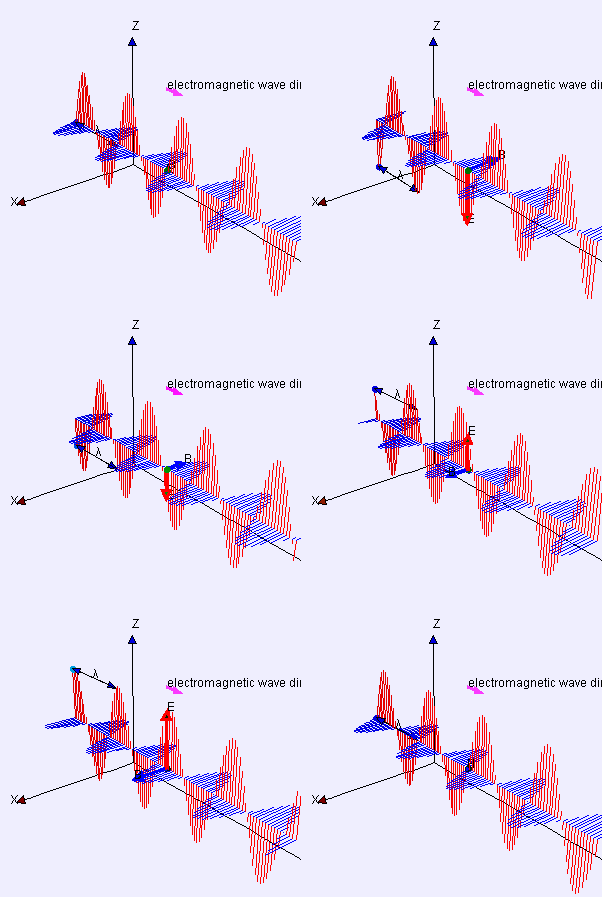
Electric (red) and magnetic (blue) fields in a linearly polarized light wave
(graphic from WikiMedia Commons, posted by Lookang and Fu-Kwun Hwang)

A word first about words.  Electrostatics is about pure straight-line-between-centers (longitudinal) attraction and repulsion — that’s Coulomb’s Law.  Electrodynamics is about the cross-wise (transverse) forces exerted by one moving charged particle on the motion of another one.  Those forces are summarized by combining Maxwell’s Equations with the Lorenz Force Law.  A moving charge gives rise to two distinct forces, electric and magnetic, that operate at right angles to each other.  The combined effect is called electromagnetism.

The effect of the electric force is to vibrate a charge along one direction transverse to the wave.  The magnetic force only affects moving charges; it acts to twist their transverse motion to be perpendicular to the wave.  An EM antenna system works by sensing charge flow as electrons move back and forth under the influence of the electric field.

Gravitostatics uses Newton’s Law to calculate longitudinal gravitational interaction between masses.  That works despite gravity’s relative weakness because all the astronomical bodies we know of appear to be electrically neutral — no electrostatic forces get in the way.  A gravimeter senses the strength of the local gravitostatic field.

Maxwell and EinsteinGravitodynamics is completely unlike electrodynamics.  Gravity’s transverse “force” doesn’t act to move a whole mass up and down like Maxwell’s picture at left.  Instead, as shown by Einstein’s picture, gravitational waves stretch and compress while leaving the center of mass in place. I put “force” in quotes because what’s being stretched and compressed is space itself.  See this video for a helpful visualization of a gravitational wave.

LIGO is neither a telescope nor an electromagnetic antenna.  It operates by detecting sudden drastic changes in the disposition of matter within a “small” region.  In LIGO’s Sept 14 observation, 1031 kilograms of black hole suddenly ceased to exist, converted to gravitational waves that spread throughout the Universe.  By comparison, the Hiroshima explosion released the energy of 10-6 kilograms.

Seismometers do a fine job of detecting nuclear explosions.  Hey, CIA, they’re a lot cheaper than LIGO.

~~ Rich Olcott

LIGO, a new kind of astronomy

Like thousands of physics geeks around the world, I was glued to the tube Thursday morning for the big LIGO (Laser Interferometer Gravitational-Wave Observatory) announcement.  As I watched the for-the-public videos (this is a good one), I was puzzled by one aspect of the LIGO setup.  The de-puzzling explanation spotlit just how different gravitational astronomy will be from what we’re used to.

There are two LIGO installations, 2500 miles apart, one near New Orleans and the other near Seattle.  Each one looks like a big L with steel-pipe arms 4 kilometers long.  By the way, both arms are evacuated to eliminate some sources of interference and a modest theoretical consideration.

LIGO3The experiment consists of shooting laser beams out along both arms, then comparing the returned beams.

Some background: Einstein conquered an apparent relativity paradox.  If Ethel on vehicle A is speeding (like, just shy of light-speed speeding) past Fred on vehicle B, Fred sees that Ethel’s yardstick appears to be shorter than his own yardstick.  Meanwhile, Ethel is quite sure that Fred’s yardstick is the shorter one.

Einstein explained that both observations are valid.  Fred and Ethel can agree with each other but only after each takes proper account of their relative motion.  “Proper account” is a calculation called the Lorenz transformation.   What Fred (for instance) should do is divide what he thinks is the length of Ethel’s yardstick by √[1-(v/c)²] to get her “proper” length.  (Her relative velocity is v, and c is the speed of light.)

Suppose Fred’s standing in the lab and Ethel’s riding a laser beam.  Here’s the puzzle: wouldn’t the same Fred/Ethel logic apply to LIGO?  Wouldn’t the same yardstick distortion affect both the interferometer apparatus and the laser beams?

Well, no, for two reasons.  First, the Lorenz effect doesn’t even apply, because the back-and-forth reflected laser beams are standing waves.  That means nothing is actually traveling.  Put another way, if Ethel rode that light wave she’d be standing as still as Fred.

The other reason is that the experiment is less about distance traveled and more about time of flight.

Suppose you’re one of a pair of photons (no, entanglement doesn’t enter into the game) that simultaneously traverse the interferometer’s beam-splitter mirror.  Your buddy goes down one arm, strikes the far-end mirror and comes back to the detector.  You take the same trip, but use the other arm.

The beam lengths are carefully adjusted so that under normal circumstances, when the two of you reach the detector you’re out of step.   You peak when your buddy troughs and vice-versa.  The waves cancel and the detector sees no light.

Now a gravitational wave passes by (red arcs in the diagram).  In general, the wave will affect the two arms differently.  In the optimal case, the wave front hits one arm broadside but cuts across the perpendicular one.  Suppose the wave is in a space-compression phase when it hits.  The broadside arm, beam AND apparatus, is shortened relative to the other one which barely sees the wave at all.

The local speed of light (miles per second) in a vacuum is constant.  Where space is compressed, the miles per second don’t change but the miles get smaller.  The light wave slows down relative to the uncompressed laboratory reference frame.  As a result, your buddy in the compressed arm takes just a leetle longer than you do to complete his trip to the detector.  Now the two of you are in-step.  The detector sees light, there is great rejoicing and Kip Thorne gets his Nobel Prize.

But the other wonderful thing is, LIGO and neutrino astronomy are humanity’s first fundamentally new ways to investigate our off-planet Universe.  Ever since Galileo trained his crude telescope on Jupiter the astronomers have been using electromagnetic radiation for that purpose – first visible light, then infra-red and radio waves.  In 1964 we added microwave astronomy to the list.  Later on we put up satellites that gave us the UV and gamma-ray skies.

The astronomers have been incredibly ingenious in wringing information out of every photon, but when you look back it’s all photons.  Gravitational astronomy offers a whole new path to new phenomena.  Who knows what we’ll see.

~~ Rich Olcott

The Four-force Model, generalized

The particle physicist’s Standard Model recognizes four fundamental forces

  • the Strong nuclear force, which holds atomic nuclei together
  • the Weak nuclear force, which mediates some kinds of radioactivity
  • Electromagnetism, which holds molecules together
  • Gravity, which holds together planets and stars and galaxies and such

On Terry Pratchett’s Diskworld*, the Druids also recognize four fundamental forces but at a much higher level of emergent structure

  • Charm
  • Persuasiveness
  • Chaos/Uncertainty
  • Bloody-mindedness

I suggest that the seasons presents us with an excellent example of this Druidic principle

  • Springtime is clearly all Charm
  • Summertime uses Persuasion to bring forth crops and lull us to sleep
  • Fall is Chaos, with school terms starting and fallen leaves fluttering everywhere, especially into the gutters
  • Winter — ah, bloody-mindedness in action, both in its effects and in what it takes to get through them.

~~ Rich Olcott

* – The Light Fantastic, halfway down the right-hand page