A No-Charge Transaction

I ain’t done yet, Sy. I got another reason for Dark Matter being made of faster‑then‑light tachyons.”

“I’m still listening, Vinnie.”

“Dark Matter gotta be electrically neutral, right, otherwise it’d do stuff with light and that doesn’t happen. I say tachyons gotta be neutral.”

“Why so?”

“Stands to reason. Suppose tachyons started off as charged particles. The electric force pushes and pulls on charges hugely stronger than gravity pulls—”

“1036 times stronger at any given distance.”

“Yeah, so right off the bat charged tachyons either pair up real quick or they fly away from the slower‑than‑light bradyon neighborhood leaving only neutral tachyons behind for us bradyon slowpokes to look at.”

“But we’ve got un‑neutral bradyon matter all around us — electrons trapped in Earth’s Van Allen Belt and Jupiter’s radiation belts, for example, and positive and negative plasma ions in the solar wind. Couldn’t your neutral tachyons get ionized?”

“Probably not much. Remember, tachyon particles whiz past each other too fast to collect into a star and do fusion stuff so there’s nobody to generate tachyonic super‑high‑energy radiation that makes tachyon ions. No ionized winds either. If a neutral tachyon collides with even a high-energy bradyon, the tachyon carries so much kinetic energy that the bradyon takes the damage rather than ionize the tachyon. Dark Matter and neutral tachyons both don’t do electromagnetic stuff so Dark Matter’s made of tachyons.”

“Ingenious, but you missed something way back in your initial assumptions.”

“Which assumption? Show me.”

“You assumed that tachyon mass works the same way that bradyon mass does. The math says it doesn’t.” <grabbing scratch paper for scribbling> “Whoa, don’t panic, just two simple equations. The first relates an object’s total energy E to its rest mass m and its momentum p and lightspeed c.”

E² = (mc²)² + (pc)²

“I recognize the mc² part, that’s from Einstein’s Equation, but what’s the second piece and why square everything again?”

“The keyword is rest mass.”

“Geez, it’s frames again?”

“Mm‑hm. The (mc²)² term is about mass‑energy strictly within the object’s own inertial frame where its momentum is zero. Einstein’s famous E=mc² covers that special case. The (pc)² term is about the object’s kinetic energy relative to some other‑frame observer with relative momentum p. When kinetic energy is comparable to rest‑mass energy you’re in relativity territory and can’t just add the two together. The sum‑of‑squares form makes the arithmetic work when two observers compare notes. Can I go on?”

“I’m still waitin’ to hear about tachyons.”

“Almost there. If we start with that equation, expand momentum as mass times velocity and re‑arrange a little, you get this formula

E = mc² / √(1 – v²/c²)

The numerator is rest‑mass energy. The v²/c² measures relative kinetic energy. The Lorentz factor down in the denominator accounts for that. See, when velocity is zero the factor is 1.0 and you’ve got Einstein’s special case.”

“Give me a minute. … Okay. But when the velocity gets up to lightspeed the E number gets weird.”

“Which is why c is the upper threshold for bradyons. As the velocity relative to an observer approaches c, the Lorentz factor approaches zero, the fraction goes to infinity and so does the object’s energy that the observer measures.”

“Okay, here’s where the tachyons come in ’cause their v is bigger than c. … Wait, now the equation’s got the square root of a negative number. You can’t do that! What does that even mean?”

“It’s legal, when you’re careful, but interpretation gets tricky. A tachyon’s Lorentz factor contains √(–1) which makes it an imaginary number. However, we know that the calculated energy has to be a real number. That can only be true if the tachyon’s mass is also an imaginary number, because i/i=1.”

“What makes imaginary energy worse than imaginary mass?”

“Because energy’s always conserved. Real energy stays that way. Imaginary mass makes no sense in Newton’s physics but in quantum theory imaginary mass is simply unstable like a pencil balanced on its point. The least little jiggle and the tachyon shatters into real particles with real kinetic energy to burn. Tachyons disintegrating may have powered the Universe’s cosmic inflation right after the Big Bang — but they’re all gone now.”

“Another lovely theory shot down.”

~ Rich Olcott

Squaring The Circle

Vinnie gives me the eye. “That crazy theory of yours is SO bogus, Sy, and there’s a coupla things you said we ain’t heard before.”

“What’s wrong with my Mach’s Principle of Time?”

“If the rest of the Universe is squirting one thing forward along Time, then everything’s squirting everything forward. No push‑back in the other direction. You might as well say that everything’s running away from the Big Bang.”

“That’s probably a better explanation. What are the couple of things?”

“One of them was, ‘geodesic,‘ as in ‘motion along a geodesic.‘ What’s a geodesic?”

“The shortest path between two points.”

“That’s a straight line, Mr Moire. First day in Geometry class.”

“True in Euclid’s era, Jeremy, but things have moved on since then. These days the phrase ‘shortest path’ defines ‘straight line’ rather than the other way around. Furthermore, the choice depends on how you define ‘shortest’. In Minkowski’s spacetime, for instance, do you mean ‘least distance’ or ‘least interval’?”

“How are those different?”

“The word ‘distance’ is a space‑only measurement. Minkowski plotted space in x,y,z terms just like Newton would have if he could’ve brought himself to use René Descartes’ cartesian coordinates. You know Euclid’s a²+b²=c² so you should have no problem calculating 3D distance as d=√(x²+y²+z²).”

“That makes sense. So what’s ‘interval’ about then?”

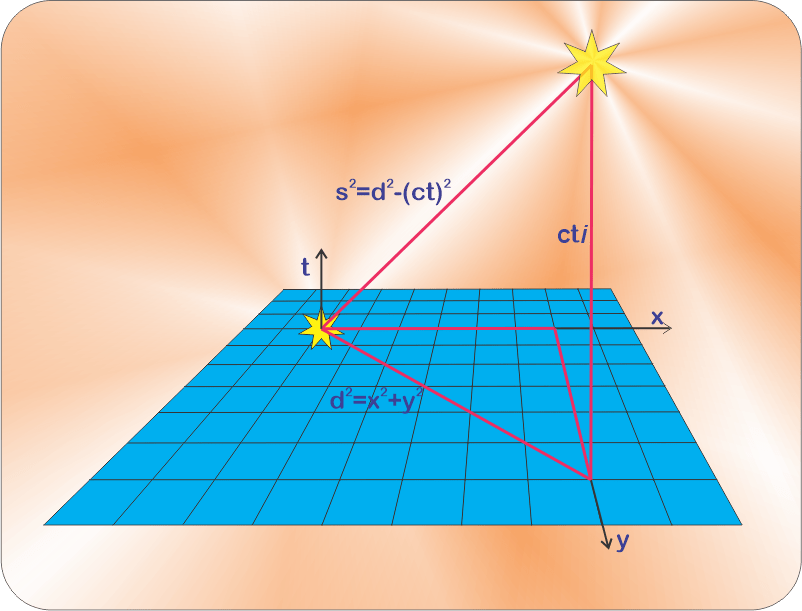
“Time has entered the picture. In Minkowski’s framework you handle two ‘events’ that may be at different locations and different times by using what he called the ‘interval,’ s. It measures the path between events as
s=√[(x²+y²+z²)–(ct)²]. Usually we avoid the square root sign and work with s².”

“That minus sign looks weird. Where’d it come from?”

“When Minkowski was designing his spacetime, he needed a time scale that could be combined with the x,y,z lengths but was perpendicular to each of them. Multiplying time by lightspeed c gave a length, but it wasn’t perpendicular. He could get that if he multiplied by i=√(–1) to get cti as a partner for x,y,z. Fortunately, that forced the minus sign into the sum‑of‑squares
(x²+y²+z²)–(ct)² formula.”

Vinnie’s getting impatient. “What is an actual geodesic, who cares about them, and what do these equations have to do with anything?”

“A geodesic is a path in spacetime. Light always travels along a geodesic. The modern version of Newton’s First Law says that any object not subject to an outside force travels along a geodesic. By definition the geodesic is the shortest path, but you can’t select which path from A to B is the shortest unless you can measure or calculate them. There’s math to tell us how to do that. Time’s a given in a Newtonian Universe, not a coordinate, so geodesics are distance‑only. We calculate d along paths that Euclid would recognize as straight lines. That’s why the First Law is usually stated in terms of straight lines.”

“So the lines can go all curvy?”

“Depends, Vinnie. When you’re piloting an over‑water flight, you fly a steady bearing, right?”

“Whenever ATC and the weather lets me. It’s the shortest route.”

“So according to your instruments you’re flying a straight line. But if someone were tracking you from the ISS they’d say you’re flying along a Great Circle, the intersection of Earth’s surface with some planar surface. You prefer Great Circles because they’re shortest‑distance routes. That makes them geodesics for travel on a planetary surface. Each Circle’s a curve when viewed from off the surface.”

“Back to that minus sign, Mr Moire. Why was it fortunate?”

“It’s at the heart of Relativity Theory. The expression links space and time in opposite senses. It’s why space compression always comes along with time dilation.”

“Oh, like at an Event Horizon. Wait, can’t that s²=(x²+y²+z²)–(ct)² arithmetic come out zero or even negative? What would those even mean?”

“The theory covers all three possibilities. If the sum is zero, then the distance between the two events exactly matches the time it would take light to travel between them. If the sum is positive the way I’ve written it then we say the geodesic is ‘spacelike’ because the distance exceeds light’s travel time. If it’s negative we’ve got a ‘timelike’ geodesic; A could signal B with time to spare.”

~ Rich Olcott

The Time Is Out of Joint

Vinnie galumphs over to our table. “Hi, guys. Hey, Sy, I just read your Confluence post. I thought that we gave up on things happening simultaneous because of Einstein and relativity but I guess that wasn’t the reason.”

“Oh, things do happen simultaneously, no‑one claims they don’t, it’s just that it’s impossible for two widely‑separated observers to have evidence that two widely‑separated events happened simultaneously. That’s a very different proposition.”

“Ah, that makes me feel better. The ‘nothing is simultaneous‘ idea was making me itchy ’cause I know for sure that a good juggler lets go with one hand just as they’re catching with the other. How’s Einstein involved then?”

“Lightspeed’s a known constant. Knowing distance and lightspeed lets you calculate between‑event time, right? The key to simultaneity was understanding why lightspeed is a constant. We’d known lightspeed wasn’t infinite within the Solar System since Rømer’s time, but people doubted his number applied everywhere. Maxwell’s theory of electromagnetism derived lightspeed from the properties of space itself so it’s universal. Only in Newton’s Universe was it possible for two distant observers to agree that two also‑distant events were simultaneous.”

“Why was Newton’s Universe special?

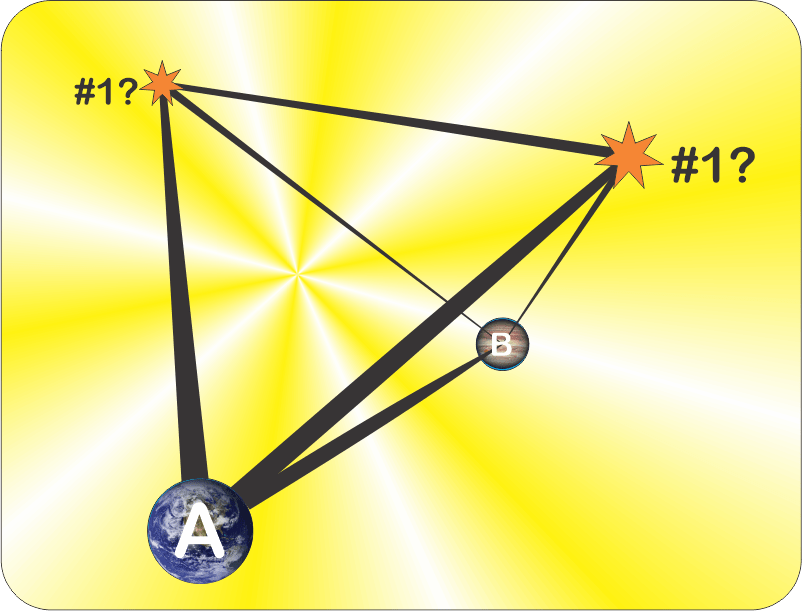
“Space held still and didn’t bend. Astronomers A and B had a stable baseline between them. After measuring the baseline with light they could measure the angles each observed between the events. Some trigonometry let them send each other congratulatory messages on seeing a simultaneous pair of incidents. After Einstein’s work, they knew better.”

“It’s frames again, ain’t it?”

“Of course, Vinnie. A‘s frame is almost certainly moving relative to B‘s frame. Motion puts the Lorentz relativity factor into the game, making each astronomer’s clock run faster than the other’s. Worse, each astronomer sees that the other’s yardsticks are too short.”

Jeremy gives me a confused look.

Space compression goes along with time dilation, Jeremy. Professor Hanneken will explain it all when your class gets to that unit. Bottom line, things can happen simultaneously in Einstein’s Universe, but no‑one can agree on which things.”

“Wait, if every frame has its own time‑rate, how can two spaceships rendezvous for an operation?”

“Good question, Jeremy. Einstein had an answer but complications hide under the covers. He suggested that A start a timer when sending a light pulse to a mirror at B. A waits for the reflection. B starts a timer when they see A‘s pulse. A measures the pulse’s round‑trip time. Each creates a clock that advances one tick for half of the round-trip time. B sets their clock back by one tick. That done, they agree to meet some number of ticks later.”

“Hmm… That should work, but you said there are complications.”

“There are always complications. For instance, suppose B is slingshotting around a black hole so that pulse and reflection travel different pathlengths. Or suppose one frame is rotating edge‑on to the other. In practice the ships would re‑sync repeatedly while approaching the rendezvous point.”

Vinnie erupts. “HAW! Successive approximation again!”

“Indeed. If we could extend the method to more than two participants we’d have a true Universal Coordinated Time.”

“Don’t we have that, Mr Moire? The Big Bang happened 14 billion years ago. Couldn’t we measure time from that?”

“Sort of. Last I looked the number was 13.787 plus‑or‑minus 20 million years. Too much slop for an instantaneous fleet‑level rendezvous like the final battle scene in StarTrek:Picard. But you’ve brought up an interesting question for a Crazy Theories seminar. One of Cosmology’s deepest unsolved questions is, ‘How does inertia work?’ Do you remember Newton’s First Law?”

<closes eyes> “In an inertial reference frame, an object either remains at rest or continues to move at a constant velocity, unless acted upon by a net force.

“Right. In other words, every object resists change to its current steady motion along a geodesic. Why is that? There’s no coherent, well‑founded, well‑tested theory. Einstein liked Mach’s Principle, which says inertia exists because every object is attracted through space to all the mass in the Universe. Suppose there’s a Mach’s Principle for Time, saying that objects squirt up the Time axis because they’re repelled by all the mass in the Universe.”

Vinnie hoots, “Bo-o-o-ohh-GUS!”

~ Rich Olcott

Look, Look Again, Then Think

Cathleen and I are sharing scones and memories when Vinnie trundles up to our table. “Glad I got you two together. I just ran across a couple news items and I need some explanations.”

“Astronomy AND Physics in the same news items? Do tell.”

“They’re only one paragraph each and read like someone wrote ’em before their morning coffee. They’re both about that big black hole they’ve been taking pictures of.”

“The one in our galaxy or the M87* supermassive black hole in the Messier‑87 galaxy?”

“The second one, Cathleen. This item says it shot out a jet traveling faster than light.”

<sigh> “Pop‑sci journalism at its worst, right, Sy? I know the work that’s based on and the academic reports don’t say that. Good observations leading to less flamboyant conclusions.”

“Maybe it was supposed to be a bigger article but the editors cut it down badly. That happens. I’m sure it’s not really a superluminal jet—”

“Superluminal’s faster‑than‑light, right?”

“Right, Vinnie. Sorry to get technical. Anyway, it’s an illusion.”

“Ah geez, it’ll be frames again, right?” <eyes suddenly open wide> “Wait, I got it! I betcha it’s about the time difference. Take a blob in that jet, it’s flying out at near lightspeed. Time dilation happens when relativity’s in the game, me and Sy talked about that, so blob‑frame seconds look like they take longer than ours do. We see the blob cramming a lightsecond of distance traveled into less than one of our seconds and that’s superluminal. Am I right, Sy?”

“Right answer to a different question, I’m afraid. You’re straight on the time dilation but it doesn’t apply to this situation. Something happening within the blob’s frame, maybe a star blowing up or something weird metabolizing in there, Special Relativity’s time distortion hijinks would show us that action taking place in slow motion. But this superluminal blob claim hinges on how the blob’s whole frame moves relative to ours. That motion isn’t superluminal but it can look that way if conditions are right. As I understand it, the M87* jet qualifies. Your bailiwick rather than mine, Cathleen.”

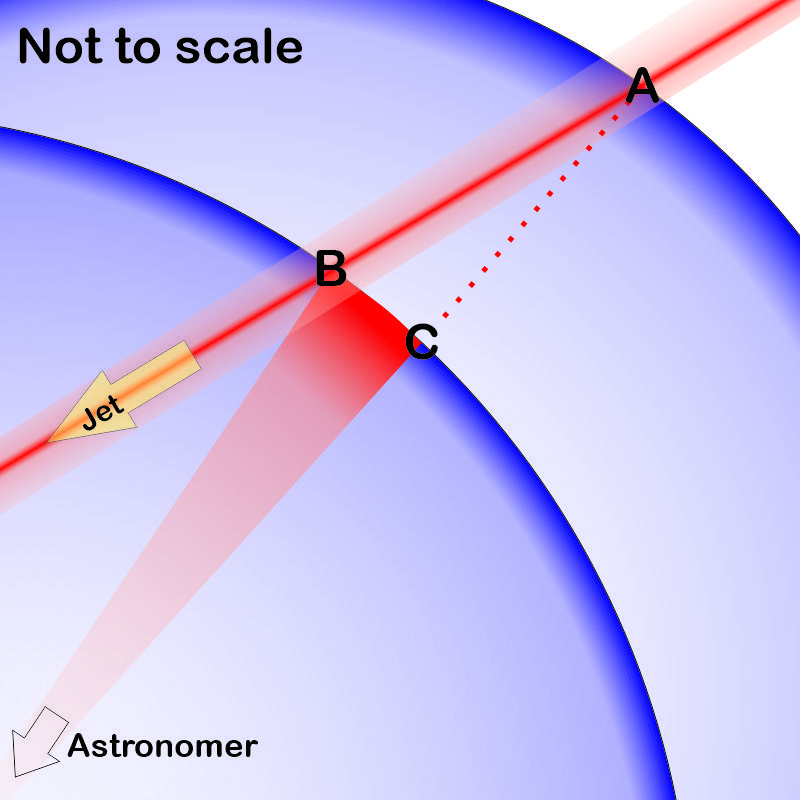
“Actually it is a frames thing, Vinnie, but timeframes, not spacetime. Those blobs move too slowly in our sky to watch in real time. We take snapshot A and then maybe a few years later we take snapshot B and compare. Speed is the ratio of distance to time. We need the A‑B distance in 3‑D space to compare to the known time between snapshots. But we can’t see the blob’s trajectory in 3‑D. All we can capture is its 2‑D arc C‑B across an imaginary spherical shell we call the sky. If the M87* jet were perpendicular to our line of sight the C‑B image on the sky‑sphere would match the 3‑D path. Multiply the image’s angle in radians by the distance to M87* and we’re done.”

“We’re not done?”

“Nope. This jet points only 20° away from our direct line of sight. I’ll spare you the trigonometry and just say that distance A‑B is about 3 times longer than C‑B.”

“So we measure C‑B, triple the angle and multiply by the M87* distance. No problem.”

“Problem. That tripling is what makes the blob’s A‑B journey appear to go faster than light. Three times 0.4c equals 1.2c. But you missed something important. Your arithmetic assumed you could use a simple ‘M87* distance’. Not in this case, because the blob moves towards us at close to lightspeed. Visualize two concentric sky‑spheres. The outer one’s radius runs from us to the blob’s location at A‑time. The inner sphere’s radius runs to the blob’s location at B‑time. The B‑sphere is our reference frame. The light we saw at A‑time had to travel from the outer sphere to the inner one before we could register the C‑B image.”

“Can’t be very far.”

“We’re talking years at lightspeed, so lightyears, so significant. A properly illusion‑free A‑B travel calculation must include the A‑C travel time in the denominator of the distance/time ratio. The true kilometers per second come out well below lightspeed. Oh, and relativity’s not involved.”

“Dang, Cathleen, it was such a cool illusion.”

~ Rich Olcott

Sharpening The Image

“One coffee, one latte and two scones, Cal. Next time is Cathleen’s turn. Hey, you’ve got a new poster behind the cash register. What are we looking at?”

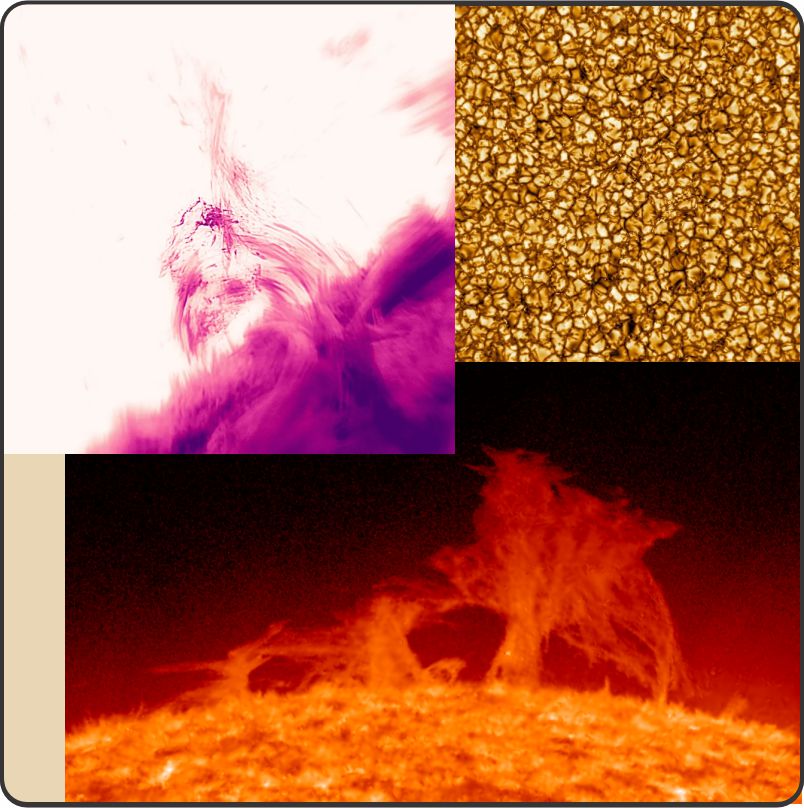
“You like it, Sy? Built the file myself from pics in my astronomy magazines, used the Library’s large‑format printer for the frameable copy. Came out pretty well, didn’t it, Cathleen?”

“Mm‑hm. Sy, you should recognize the pebbly-looking one. It’s granules at the bottom of the Sun’s atmosphere. The image came from the Inouye Solar Telescope at Haleakala Observatory on Maui, probably Earth’s best ground‑based facility for studying the Sun. I showed the image to your niece in that phone call. For scale, those granules of super‑heated rising gas are each about the size of Texas.”

“My magazine article didn’t mention Texas but it said there’s about ten million granules. What it was mostly about was the IST and its resolution. Those edges in the picture are as narrow as 18 miles across. It’s that good ’cause the beast has a 4‑meter mirror, which used to be amazing, but they made it even better with active and adaptive optics.”

“Hmm. It’s obvious that the bigger the mirror, the better it is for catching photons. If someone’s going to build a big mirror they’re going to put it behind a big aperture, which is important for resolving points that are close together. But what are ‘active and adaptive optics’ and why did you say that like they’re two different things?”

” ‘Cause they are two different things, Sy. Different jobs, different time‑scales. Gravity here on Earth can make a big mirror sag, and the sag changes depending on where the machine is pointed and maybe part of it gets the wrong temperature. Active optics is about keeping the whole mirror in the right shape to focus the photons where they’re supposed to go. There’s a bunch of actuators rigged up to give adjustable support at different points behind the mirror. The astronomer tells the system to watch a certain guide point and there’s a computer that directs each actuator’s pushing to sharpen the point’s image.”

“And adaptive optics?”

“That’s about solving a different problem. Stars twinkle, right, and the reason they twinkle is because of the atmosphere. One part refracts light one way, another part maybe warmer or with different humidity sends the light another way. Everything moves second to second. By the time a light‑wave gets down to us it’s been jiggled a lot. Adaptive optics is a small mirror, also with a lot of actuators, placed up in the light path after the primary mirror. Again with a guide point and a computer, the little mirror’s job is to cancel the jiggles so the scope’s sensors see a smooth wave. Adaptive works a lot faster than active, which sounds backwards, but I guess active came first.”

“The granules must be in the Sun’s disk somewhere. The other two images look like they’re on the edge.”

“That’s right, Sy. The bottom one is from the Solar Dynamic Observatory satellite a few years ago. That’s not visible light, it’s EUV—”

“EUV?”

“Extreme UltraViolet, light‑waves too short even for hydrogen so it’s mostly from iron atoms heated to millions of degrees. SDO had to be a satellite to catch that part of the spectrum because the atmosphere absorbs it. Of course, up there there’s no need for active or adaptive optics but imaging EUV has its own problems.”

“How tall is that photogenic tree?”

“It’s a prominence. The article said it’s about twenty times Earth’s diameter.”

“What about the pink one?”

“That’s new, Cathleen, from another Maui telescope. Adaptive optics were in play but there’s a problem. If you’re probing inside the corona there’s no fixed guide point. The team focused their adjustment system on corona features where they were a few seconds ago. The article said the process was ‘tricky,’ but look at the results. The loop is about the size of Earth, and those fine lines are about the width of Vancouver Island. They discovered details no‑one’s ever seen before.”

Top left: Schmidt et al./NJIT/NSO/AURA/NSF;
Top right: NSO/AURA/NSF under CC A4.0 Intl license;
Bottom: NASA/SDO

~ Rich Olcott

Deep Dive

“Sy, I’m trying to get my head wrapped around how the potential‑kinetic energy thing connects with your enthalpy thing.”

“Alright, Vinnie, what’s your cut so far?”

“It has to do with scale. Big things, like us and planets, we can see things moving and so we know they got kinetic energy. If they’re not moving steady in a straight line we know they’re swapping kinetic energy, give and take, with some kind of potential energy, probably gravity or electromagnetic. Gravity pulls things into a circle unless angular momentum gets in the way. How’m I doing so far?”

“I’d tweak that a little, but nothing to argue with. Keep at it.”

“Yeah, I know the moving is relative to whether we’re in the same reference frame and all that. Beside the point, gimme a break. So anyway, down to the quantum level. Here you say heat makes the molecules waggle so that’s kinetic energy. What’s potential energy like down there?”

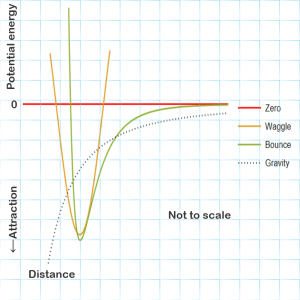
<grabs another paper napkin> “Here’s a quick sketch of the major patterns.”

“Hmm. You give up potential energy when you fall and gravity’s graph goes down from zero to more negative forever, I guess, so gravity’s always attracting.”

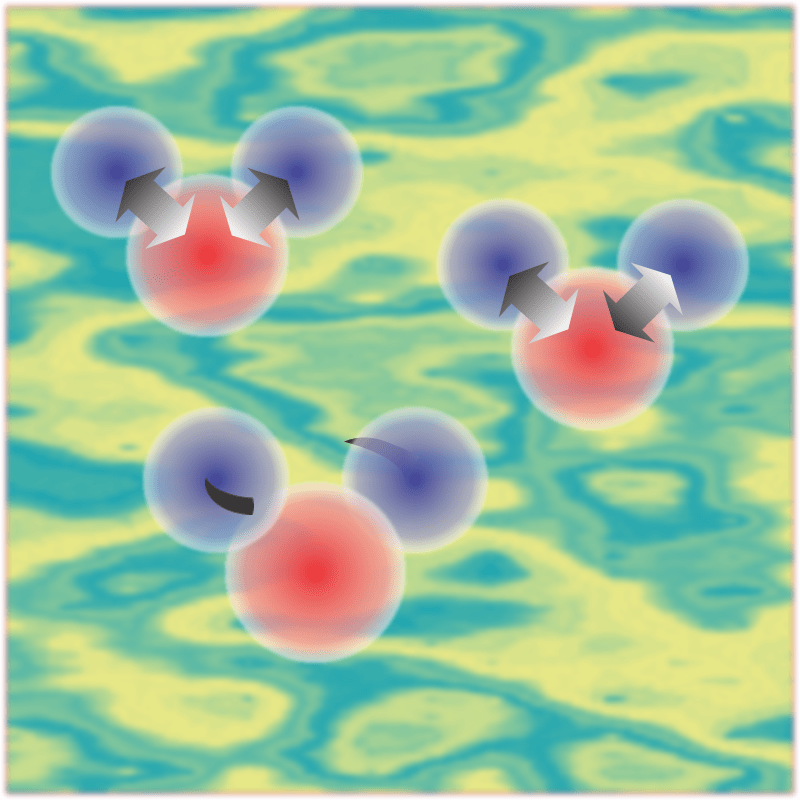
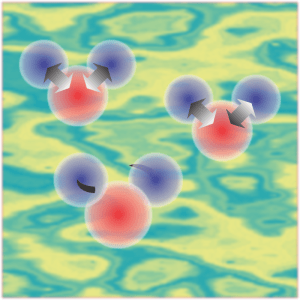
“Pretty much, but at this level we don’t have to bother with gravity at all. It’s about a factor of 1038 weaker than electric interactions. Molecular motions are dominated by electromagnetic fields. Some are from a molecule’s other internal components, some from whatever’s around that brandishes a charge. We’ve got two basic patterns. One of them, I’m labeling it ‘Waggle,’ works like a pendulum, sweeping up and down that U‑shape around some minimum position, high kinetic energy where the potential energy’s lowest and vice‑versa. You know how water’s H‑O‑H molecules have that the V‑shape?”

“Yeah, me you and Eddie talked about that once.”

“Mm‑hm. Well, the V‑shape gives that molecule three different ways to waggle. One’s like breathing, both sides out then both sides in. If the hydrogens move too far from the oxygen, that stretches their chemical bonds and increases their potential energy so they turn around and go back. If they get too close, same thing. Bond strength is about the depth of the U. The poor hydrogens just stretch in and out eternally, swinging up and down that symmetric curve.”

“Awww.”

“That’s a chemist’s picture. The physics picture is cloudier. In the quantum version, over here’s a trio of fuzzy quarks whirling around each other to make a proton. Over there’s a slightly different fuzzy trio pirouetting as a neutron. Sixteen of those roiling about make up the oxygen nucleus plus two more for the hydrogens plus all their electrons — imagine a swarm of gnats. On the average the oxygen cloud and the two hydrogen clouds configure near the minimum of that U‑shaped potential curve but there’s a lot of drifting that looks like symmetrical breathing.”

“What about the other two waggles?”

“I knew you’d ask. One’s like the two sides of a teeterboard, oscillating in and out asymmetrically. The other’s a twist, one side coming toward you and then the other side. Each waggle has its own distinct set of resistance forces that define its own version of waggle curve. Each kind interacts with different wavelengths of infrared light which is how we even know about them. Waggle’s official name is ‘harmonic oscillator.’ More complicated molecules have lots of them.”

“What’s that ‘bounce’ curve about?”

“Officially that’s a Lennard-Jones potential, the simplest version of a whole family of curves for modeling how molecules bounce off each other. Little or no interaction at large distances, serious repulson if two clouds get too close, and a little stickiness at some sweet-spot distance. If it weren’t for the stickiness, the Ideal Gas Law would work even better than it does. So has your head wrapped better?”

“Sorta. From what I’ve seen, enthalpy’s PV part doesn’t apply in quantum. The heat capacity part comes from your waggles which is kinetic energy even if it’s clouds moving. Coming the other way, quantum potential energy becomes enthalpy’s chemical part with breaking and making chemical bonds. Did I bridge the gap?”

“Mostly, if you insist on avoiding equations.”

~ Rich Olcott

EROs Atop A Ladder

“‘That’s where the argument started? That’s right up there with ‘Then the murders began.’ Cathleen Cliff‑hanger strikes again.”

<giggling> “Gotcha, Sy, just like always. Sorry, Kareem, we’ve had this thing since we were kids.”

“Don’t mind me, but do tell him what’s awry with the top of your galactic distance ladder.”

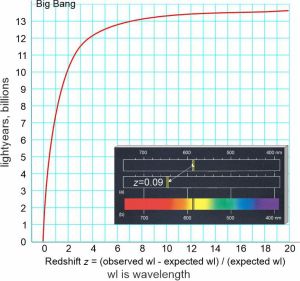
“I need to fill you in first about the ladder’s framework. We know the distances to special ‘standard candles’ scattered across the Universe, but there’s oodles of other objects that aren’t special that way. We can’t know their distances unless we can tie them to the candles somehow. Distance was Edwin Hubble’s big thing. Twenty years after Henrietta Swan Leavitt identified one kind of candle, Hubble studied the light from them. The farthest spectra were stretched more than the closest ones. Better yet, there was a strict relationship between the amount of stretch, we call it the z factor, and the candle’s distance. Turns out that everything at the intergalactic scale is getting farther from everything else. He didn’t call that expansion the Hubble Flow but we do. It comes to about 7% per billion lightyears distance. z connects candle spectrum, object spectrum and object distance. That lets us calibrate successive overlapping steps on the distance ladder, one candle type to the next one.”

“A constant growth rate — that’s exponential, by definition. Like compound interest. The higher it gets, it gets even higher faster.”

“Right, Kareem, except that in the past quarter-century we’ve realized that Hubble was an optimist. The latest data suggests the expansion he discovered is accelerating. We don’t know why but dark energy might have something to do with it. But that’s another story.”

“Cathleen, you said the distance ladder’s top rung had something to do with surface brightness. Surface of what?”

“Galaxies. Stars come at all levels of brightness. You can confirm that visually, at least if you’re in a good dark‑sky area. But a galaxy has billions of stars. When we assess brightness for a galaxy as a whole, the brightest stars make up for the dimmest ones. On the average it’ll look like a bunch of average stars. The idea is that the apparent brightness of some galaxy tells you roughly how many average stars it holds. In turn, that gives you a rough estimate of the galaxy’s mass — our final step up the mass ladder. Well, except for gravitational lensing, but that’s another story.”

“So what’s wrong with that candle?”

“We didn’t think anything was wrong until recently. Do you remember that spate of popular science news stories a year ago about giant galaxies near the beginning of time when they had no business to exist yet?”

“Yeah, there was a lot of noise about we’ll have to revise our theories about how the Universe evolved from the Big Bang, but the articles I saw didn’t have much detail. From what you’ve said so far, let me guess. These were new galaxy sightings, so probably from James Webb Space Telescope data. JWST is good at infra‑red so they must have been looking at severely stretched starlight—”

z-factor near 8″

“— so near 13 billion lightyears old, but the ‘surface brightness’ standard candle led the researchers to claim their galaxies held some ridiculous number of stars for that era, at least according to current theory. How’d I do?”

“Good guess, Sy. That’s where things stood for almost a year until scientists did what scientists do. A different research group looking at even more data as part of a larger project came up with a simpler explanation. Using additional data from JWST and several other sources, the group concentrated on the most massive galaxies, starting with low‑z recent ones and working back to z=9. Along the way they found some EROs — Extremely Red Objects where a blast of infra‑red boosts their normal starlight brightness. The researchers attribute the blast to hot dust associated with a super‑massive black hole at each ERO’s center. The blast makes an ERO appear more massive than it really is. Guess what? The first report’s ‘ridiculously massive’ early galaxies were EROs. Can’t have them in that top rung.”

“Kareem, how about the rungs on your ladder?”

~~ Rich Olcott

One Step After Another

Mid-afternoon, time for a coffee break. As I enter Cal’s shop, I see Cathleen and Kareem chuckling together behind a jumble of Cal’s distinctive graph‑lined paper napkins. “What’s the topic of conversation, guys?”

“Hi, Sy. Kareem and I are comparing ladders.”

I look around, don’t see anything that looks like construction equipment.

“Not that kind, Sy. What’s your definition of a ladder?”

“Getting down to definitions, eh, Kareem? Okay, it’s a framework with steps you can climb up towards something you can’t reach.”

“Well, there you go.”

“Not much help, Cathleen. What are you really bantering about?”

“Each of our fields of study has a framework with steps that let us measure something that’d be way out of reach without it.”

“You’ll appreciate this, Sy — our ladders even use different math. The steps on Cathleen’s ladder are mostly linear, mine are mostly exponential.”

“And they’re both finicky — you have to be really careful when using them.”

“And they’ve both recently had adjustments at the top end.”

“I can see the fun, I think. How about some specifics?”

They exchange a look, Kareem gestures ‘after you‘ and Cathleen opens. “Mine’s in astrometry, Sy, the precise recording of relative positions. Tycho Brahe’s numbers were good to a few dozen arcseconds—”

“Arcsecond?”

1/60 of an arcminute which is 1/60 of a degree which is 1/360 of a full circle around the sky. Good enough in Newton’s day for him to explain planetary orbits, but we’ve come <ahem> a long way since then. The Gaia telescope mission can resolve certain objects down to a few microarcseconds but that’s only half the problem.”

“Let me guess — you have angles but you don’t have distances.”

“Bingo. Distance is astrometry’s biggest challenge.”

“Wait, Newton’s Law of Gravity includes r as the distance between objects. For that matter, Kepler’s Laws use and . Couldn’t you juggle them around to evaluate r?”

“Nope. Kepler did ratios, not absolute values. Newton’s Law has but you can rewrite it as F ² = GMm/r² = G(M/r)(m/r), G times the product of two mass‑to‑distance ratios. Newton’s G is our least‑accurate physical constant and we don’t have good handles on either of those numerators. Before space flight we just had mass ratios like M/m. We only discovered the Moon’s absolute mass when we orbited it with spacecraft of known mass. That’s the lowest rung on our mass ladder. Inside the Solar System we go step by step with orbit ratios. Outside the system everything’s measured relative to Solar mass.”

“I’m getting the ladder idea. So how do you distances?”

“Lowest rung is parallax, like binocular vision. You look at something from two different points a known distance apart. Measure the angle between the sight‑lines. Figure the triangles to get the something’s distance. The earliest example I know of was in the mid‑1700s when astrometers thousands of miles apart on Earth watched Venus cross the Sun’s disk. Each recorded the precise time they saw Venus touch the Sun’s disk. Given the time shift and the on‑Earth distance, some trigonometry gave them the Earth‑Venus distance. That put a scale to Newtonian orbital diagrams. Parallax across the width of Earth’s orbit yielded stellar distances out to thousands of lightyears with Hubble. We expect ten times better from Gaia.”

“That gets you maybe across the Milky Way. What about farther out?”

“Several ingenious variations on the parallax idea, but mostly standard candles.”

“Candles?”

“Suppose you measure the brightness of a candle that’s a known distance away and there’s an equally luminous candle some unknown distance away. Measured brightness falls as the square of the distance, so if the second candle appears half as bright it’s four times the distance and so on. Climbing the cosmic distance ladder is going from one kind of uniformly‑luminous candle to another kind farther away.”

“Such as?”

“We know how brightness relates to bright‑dim‑bright cycle time for several types of variable stars. That gets us out to 30 million lightyears or so. Type I‑a supernovas act as useful candles out to a billion lightyears. Beyond that we can use galaxy surface brightness. That’s where the recent argument started.”

~ Rich Olcott

  • Thanks to Ken Burke for mentioning tellurium‑128’s septillion‑year half‑life.

A Non-political Polarizing Topic

Vinnie gets the deck next, but first thing he does is plop a sheet of paper onto the table. “Topic is black holes, of course. Everybody’s seen this, right?”

“Sure, it’s the new view of the Milky Way’s super-massive black hole with the extra lines. So deal already.”

“Hold your horses, Cal.” <Vinnie starts dealing.> “I’m looking for explanations. Where’d those lines come from? They swirl across the accretion disk like so much rope, right? Why aren’t they just going straight in orderly‑like? The whole thing just don’t make sense to me.”

Susan bets a few chips. “I saw a similar pop‑sci article, Vinnie. It said the lines trace out polarization in the light waves the Event Horizon Telescope captured. Okay, radio waves — same thing just longer wavelength. Polarized radio waves. I’ve measured concentrations of sugar and amino acid solutions by how much the liquid rotates polarized light, but the light first went through a polarizing filter. How does a black hole make polarized waves?”

Kareem matches Susan’s bet. “Mm‑hm. We use polarized light passing through thin sections of the rocks we sample to characterize the minerals in them. But like Susan says, we don’t make polarized light, we use a filter to subtract out the polarization we don’t want. You’re the physicist, Sy, how does the black hole do the filtering?”

Plane‑polarized electromagnetic wave
 Electric (E) field is red
 Magnetic (B) field is blue
(Image by Loo Kang Wee and Fu-Kwun Hwang from Wikimedia Commons)

My hand’s good so I match the current ante. “It doesn’t. There’s no filtering, the light just comes out that way. I’d better start with the fundamentals.” <displaying Old Reliable> “Does this look familiar, Vinnie?”

“Yeah, Sy, you’ve used it a lot. That blue dot in the back’s an electron, call it Alice, bobbing straight up and down. That’s the polarization it’s puttin’ on the waves. The red lines are the force that another electron, call it Bob, feels at whatever distance away. Negative‑negative is repelling that so Bob goes down where the red line goes up but you get the basic idea.”

“The blue lines are important here.”

“I’m still hazy on those. They twist things, right?”

“That’s one way to put it. Hendrik Lorentz put it better when he wrote that Bob in this situation experiences one force with two components. There’s the red‑line charge‑dependent component, plus the blue‑line component that depends on the charge and Bob’s motion relative to Alice. If the two are moving in parallel—”

“The same frame, then. I knew frames would get into this somehow.”

“It’s hard to avoid frames when motion’s the subject. Anyway, if the two electrons are moving in parallel, the blue‑line component has zero effect. If the two are moving in different directions, the blue‑line component rotates Bob’s motion perpendicular to Alice’s red‑line polarization plane. How much rotation depends on the angle between the two headings — it’s a maximum when Bob’s moving perpendicular to Alice’s motion.”

“Wait, if this is about relative motion, then Bob thinks Alice is twisting, too. If she thinks he’s being rotated down, then he thinks she’s being rotated up, right? Action‑reaction?”

“Absolutely, Vinnie. Now let’s add Carl to the cast.”

“Carl?”

Alice and Bob’s electromagnetic interaction
begets motion that generates new polarized light.

“Distant observer at right angles to Alice’s polarization plane. From Carl’s point of view both electrons are just tracking vertically. Charges in motion generate lightwaves so Carl sees light polarized in that plane.”

Cathleen’s getting impatient, makes her bet with a rattle of chips. “What’s all this got to do with the lines in the EHT image?”

“The hole’s magnetic field herds charged particles into rotating circular columns. Faraday would say each column centers on a line of force. Alice and a lot of other charged particles race around some column. Bob and a lot of other particles vibrate along the column and emit polarized light which shows up as bright lines in the EHT image.”

“But why are the columns twisted?”

“Orbit speed in the accretion disk increases toward its center. I’d bet that’s what distorts the columns. Also, I’ve got four kings.”

“That takes this pot, Sy.”

~~ Rich Olcott

A Million Times Weaker Than Moonlight

Big Vinnie’s getting downright antsy, which is something to behold. “C’mon, Sy. We get it that sonication ain’t sonification and molecules bumping into each other can carry a sound wave across space if the frequency’s low enough and that can maybe account for galaxies having spiral arms, but you said the Cosmic Hum is a sound, too. That’s a gravity thing, not molecules, right?”

“Not quite what I said, Vinnie. The Hum’s sound‑related, but it’s not ‘sound’ even by our extended definition.”

“Then what’s the connection?”

“Waves.”

“Not frames like always?”

“Not frames, for a change.”

“So it’s waves, but they go though empty space. Can’t happen like sound waves from molecules bumping into each other ’cause molecules are too small to have enough gravity do that when they’re so far apart. What’s carrying the waves?”

“Good question. Einstein figured out one answer. A whole cohort of mid‑20th‑century theoreticians came to a slightly different conclusion.”

“Okay, I’ll bite. What was Einstein’s answer?”

“Relativity, of course. Gravity’s the effect we see from mass deforming nearby space. Moving a mass drives corresponding changes in the shapes of space where it was and where it has moved to. The shape‑changes generate follow‑on gravitational effects that propagate outward over time. Einstein even showed that the gravitational propagation speed is equal to lightspeed.”

“Gimme a sec … Okay, that black hole collision signal LIGO picked up back in 2015, the holes lost a chunk of their combined mass all of a sudden. Quick drop in the gravity thereabouts. You’re saying it took time for the missing gravity strength to get noticed where we’re at. If I remember right, the LIGO people said the event was something like a billion lightyears away so that tells me it happened about a billion years ago and what the LIGO gadget picked up was space waves, right?”

“Right, but it wasn’t just the mass loss, it was the rapid and intense waggles in the gravitational field as those two enormous bodies, each 30 times as massive as the Sun, whirled around each other multiple times per second. The ever‑faster whirling shook the field with a frequency that swept upward to the ‘POP‘ when your mass‑loss happened. LIGO eventually picked up that signal. Einstein would say there’s no ‘action at a distance‘ in the collision‑LIGO interaction, because the objects acted on the gravitational field which acted on the LIGO system.”

“Like using a towel to pop someone in the locker room. The towel’s just transmi– ulp.”

“An admission of guilt if I ever heard one. Yes, like that, except a towel pop carries all the initial energy to its final destination. Gravitational waves spread their energy across the surface of an expanding sphere. The energy per unit area goes down as the square of the distance.” <keying a calculation on Old Reliable> “Suppose the collision releases 10 solar masses worth of energy, we’re a billion lightyears away, and the ‘POP‘ signal is delivered in a tenth of a second. We’d see a signal power … about a millionth as strong as moonlight.”

“Not much there.”

“Right, which is why LIGO and its kin have been such pernickety instruments to build and run. LIGO’s sensors are mirrors roughly a meter across. You get a million times more power sensitivity if your detector’s diameter is a mile across. That was part of the NANOGrav team’s strategy, but they went much bigger.”

“Yeah, that’s the multi-telescope thing, so NANOGrav faked a receiver the size of the Earth, like the Event Horizon Telescope.”

“Much bigger. Their receiver is the entire Milky Way. Instead of LIGO’s mirrors, NANOGrav’s signal generators are neutron stars a dozen or more miles wide scattered across the galaxy.”

“Gotcha, Sy. Two ways. Neutron stars are billions heavier than a LIGO mirror so they’d be less power‑sensitive, not more. Then, power is about moving stuff closer or farther but if I got you right these space waves don’t really do that anyway, right?”

“Right and right, Vinnie, but not relevant. What NANOGrav’s been watching for is pulsar beams being twitched by a gravitational wave. A waltzing black hole pair should generate years‑long or decades‑long wavelengths. NANOGrav may have found one.”

~~ Rich Olcott