A Matter of Perspective

As I stepped off the escalator by the luggage carousel a hand came down heavy on my shoulder.

“Keep movin’, I gotchur bag.”

That’s Vinnie, always the surprises.  I didn’t bother to ask how he knew which flight I came in on.  What came next was also no surprise.

“You owe me for the pizza.  Now about that kinetic energy –”

“Hold that thought ’til we get to my office where I can draw diagrams.”

We got my car out of the lot, drove to the Acme Building and took the elevator to 12.

As my computer booted up I asked, “When we talked about potential energy, did we ever mention inertial frames?”

“Come to think of it, no, we didn’t.  How come?”

“Because they’ve got nothing to do with potential energy.  Gravitational and electrical potentials are all about intensity at one location in space relative to other locations in space.  The potentials are static so long as the configuration is static.  If something in the region changes, like maybe a mass moves or the charge on one object increases, then the potential field adjusts to suit.”

“Right, kinetic energy’s got to do with things that move, like its name says.  I get that.  But how does it play into LIGO?”

“Let’s stick with our spacecraft example for a bit.  I’ve been out of town for a while, so a quick review’s in order.  Objects that travel in straight lines and constant speed with respect to each other share the same inertial frame.  Masses wrinkle the shape of space.  The paths light rays take are always the shortest possible paths, so we say a light ray shows us what a straight line is.

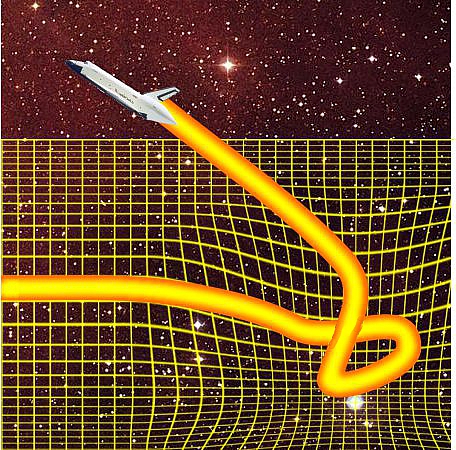
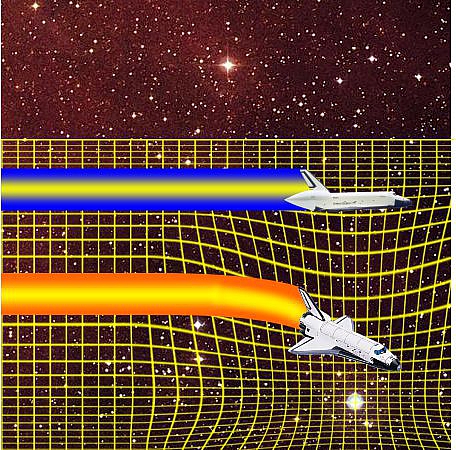
“In our story, we’re flying a pair of space shuttles using identical speed settings along different light-ray navigation beams.  Suddenly you encounter a region of space that’s compressed, maybe by a nearby mass or maybe by a passing gravitational wave.

“That compressed space separates our inertial frames.  In your inertial frame there’s no effect — you’re still following your nav beam and the miles per second you measure hasn’t changed.  However, from my inertial frame you’ve slowed down because the space you’re traveling through is compressed relative to mine.  Does all that ring a bell?”

“Pretty much the way I remember it. Now what?”shuttle-escape-framed

“Do you remember the formula for kinetic energy?”

“Give me a sec… mass times the square of the velocity.”

“Uh-huh.  Mind you, ‘velocity’ is the combination of speed and direction but velocity-squared is just a number.  So, your kinetic energy depends in a nice, simple way on speed.  What happened to your kinetic energy when you encountered that gravity well?”

“Ah, now I see where you’re going.  In my frame my speed doesn’t change so I don’t gain or lose kinetic energy.  In your frame you see me slow down so you figure me as losing kinetic energy.”

“But the Conservation of Energy rule holds across the Universe.  Where’d your kinetic energy go?”

“Does your frame see me gaining potential energy somehow that I don’t see in mine?”

“Nice try, but that’s not it.  We’ve already seen that potential energy doesn’t depend on frames.  What made our frames diverge in the first place?”

“That gravity field curving the space I’d flown into.  Hey, action-reaction!  If the curved space slowed me down, did I speed it up?”

“Now we’re getting there.  No, you didn’t speed up space, ’cause space doesn’t work that way — the miles don’t go anywhere.  But your kinetic energy (that I can see and you can’t) did act to change the spatial curvature (that I can see and you can’t).  I suspect the curvature flattened out, but the math to check that is beyond me.”

“Lemme think…  Right, so back to my original question — what I wasn’t getting was how I could lose both kinetic energy AND potential energy flying into that compressed space.  Lessee if I got this right.  We both see I lost potential energy ’cause I’ve got less than back in flat space.  But only you see that my kinetic energy changed the curvature that only you see.  Good?”

“Good.”

(sound of footsteps)

(sound of door)

“Don’t mention it.”

~~ Rich Olcott

Ya got potential, kid, but how much?

Dusk at the end of January, not my favorite time of day or year.  I was just closing up the office when I heard a familiar footstep behind me.  “Hi, Vinnie.  What’s up?”

“Energy, Sy.”

“Energy?”

“Energy and LIGO.  Back in flight school we learned all about trading off kinetic energy and potential energy.  When I climb I use up the fuel’s chemical energy to gain gravitational potential energy.  When I dive I convert gravitational potential energy into  kinetic energy ’cause I speed up.  Simple.”

“So how do you think that ties in with LIGO?”

“OK, back when we pretended we was in those two space shuttles (which you sneaky-like used to represent photons in a LIGO) and I got caught in that high-gravity area where space is compressed, we said that in my inertial frame I’m still flying at the same speed but in your inertial frame I’ve slowed down.”

“Yeah, that’s what we worked out.”

“Well, if I’m flying into higher gravity, that’s like diving, right, ’cause I’m going where gravity is stronger like closer to the Earth, so I’m losing gravitational potential energy.  But if I’m slowing down I’ve gotta be losing kinetic energy, too, right?  So how can they both happen?  And how’s it work with photons?”

“Interesting questions, Vinnie, but I’m hungry.  How about some dinner?”shuttle-escape-1

We took the elevator down to Eddie’s pizza joint on the second floor.  I felt heavier already.  We ordered, ate and got down to business.

“OK, Vinnie.  Energy with photons is different than with objects that have mass, so let’s start with the flying-objects case.  How do you calculate gravitational potential energy?”

“Like they taught us in high school, Sy, ‘little g’ times mass times the height, and ‘little g’ is some number I forget.”

“Not a problem, we’ll just suppose that ‘little g’ times your plane’s mass is some convenient number, like 1,000.  So your gravitational potential energy is 1000×height, where the height’s in feet and the unit of energy is … call it a fidget.  OK?”

“Saves having to look up that number.”

sfo-to-den
Vinnie’s route, courtesy of Google Earth

“Fine.  Let’s suppose you’re flying over San Francisco Bay and your radar altimeter reads 20,000 feet.  What’s your gravitational potential energy?”

“Uhh… twenty million fidgets.”

“Great.  You maintain level flight to Denver.  As you pass over the Rockies you notice your altimeter now reads 6,000 feet because of that 14,000-foot mountain you’re flying over.  What’s your gravitational potential energy?”

“Six million fidgets.  Or is it still twenty?”

“Well, if God forbid you were to drop out of the sky, would you hit the ground harder in California or Colorado?”

“California, of course.  I’d fall more than three times as far.”

“So what you really care about isn’t some absolute amount of potential energy, it’s the relative amount of smash you experience if you fall down this far or that far.  ‘Height’ in the formula isn’t some absolute height, it’s height above wherever your floor is.  Make sense?”

“Mm-hm.”

“That’s an essential characteristic of potential energy — electric, gravitational, chemical, you name it.   It’s only potential.  You can’t assign a value without stating the specific transition you’re interested in.  You don’t know voltages in a circuit until you put a resistance between two specific points and meter the current through it.  You don’t know gravitational potential energy until you decide what location you want to compare it with.”

“And I suppose a uranium atom’s nuclear energy is only potential until a nuke or something sets it off.”

“You got the idea.  So, when you flew into that high-gravity compressed-space sector, what happened to your gravitational potential energy?”

“Like I said, it’s like I’m in a dive so I got less, right?”

“Depends on what you’re going to fall onto, doesn’t it?”

“No, wait, it’s definitely less ’cause I gotta use energy to fly back out to flat space.”

“OK, you’re comparing here to far away.  That’s legit.  But where’s that energy go?”

“Ahh, you’re finally getting to the kinetic energy side of my question –”

“Whoa, look at the time!  Got a plane to catch.  We’ll pick this up next week.  Bye.”

“Hey, Sy, your tab! …  Phooey, stuck for it again.”

~~ Rich Olcott

Three ways to look at things

A familiar shadow loomed in from the hallway.

“C’mon in, Vinnie, the door’s open.”

“I brought some sandwiches, Sy.”

“Oh, thanks, Vinnie.”

“Don’t mention it.    An’ I got another LIGO issue.”

“Yeah?”

“Ohh, yeah.  Now we got that frame thing settled, how does it apply to what you wrote back when?  I got a copy here…”

The local speed of light (miles per second) in a vacuum is constant.  Where space is compressed, the miles per second don’t change but the miles get smaller.  The light wave slows down relative to the uncompressed laboratory reference frame.

“Ah, I admit I was a bit sloppy there.  Tell you what, let’s pretend we’re piloting a pair of space shuttles following separate navigation beams that are straight because that’s what light rays do.  So long as we each fly a straight line at constant speed we’re both using the same inertial frame, right?”

“Sure.”

“And if a gravity field suddenly bent your beam to one side, you’d think you’re still flying straight but I’d think you’re headed on a new course, right?”

“Yeah, because now we’d have different inertial frames.  I’d think your heading has changed, too.”two-shuttles

“So what does the guy running the beams see?”

“Oh, ground-pounders got their own inertial frame, don’t they?  Uhh… He sees me veer off and you stay steady ’cause the gravity field bent only my beam.”

“Right — my shuttle and the earth-bound observer share the same inertial frame, for a while.”

“A while?”

“Forever if the Earth were flat because I’d be flying straight and level, no threat to the shared frame.  But the Earth’s not flat.  If I want to stay at constant altitude then I’ve got to follow the curve of the surface rather than follow the light beam straight out into space.  As soon as I vector downwards I have a different frame than the guy on the ground because he sees I’m not in straight-line motion.”

“It’s starting to get complicated.”

“No worries, this is as bad as it gets.  Now, let’s get back to square one and we’re flying along and this time the gravity field compresses your space instead of bending it.  What happens?  What do you experience?”

“Uhh… I don’t think I’d feel any difference.  I’m compressed, the air molecules I breath are compressed, everything gets smaller to scale.”

“Yup.  Now what do I see?  Do we still have the same inertial frame?”

“Wow.  Lessee… I’m still on the beam so no change in direction.  Ah!  But if my space is compressed, from your frame my miles look shorter.  If I keep going the same miles per second by my measure, then you’ll see my speed drop off.”

“Good thinking but there’s even more to it.  Einstein showed that space compression and time dilation are two sides of the same phenomenon.  When I look at you from my inertial frame, your miles appear to get shorter AND your seconds appear to get longer.”

“My miles per second slow way down from the double whammy, then?”

“Yup, but only in my frame and that other guy’s down on the ground, not in yours.”

“Wait!  If my space is compressed, what happens to the space around what got compressed?  Doesn’t the compression immediately suck in the rest of the Universe?”

“Einstein’s got that covered, too.  He showed that gravity doesn’t act instantaneously.  Whenever your space gets compressed, the nearby space stretches to compensate (as seen from an independent frame, of course).  The edge of the stretching spreads out at the speed of light.  But the stretch deformation gets less intense as it spreads out because it’s only offsetting a limited local compression.”

“OK, let’s get back to LIGO.  We got a laser beam going back and forth along each of two perpendicular arms, and that famous gravitational wave hits one arm broadside and the other arm cross-wise.  You gonna tell me that’s the same set-up as me and you in the two shuttles?”

“That’s what I’m going to tell you.”

“And the guy on the ground is…”

“The laboratory inertial reference.”

“Eat your sandwich, I gotta think about this.”

(sounds of departing footsteps and closing door)

“Don’t mention it.”

~~ Rich Olcott
A Shift in The Flight

I heard a familiar squeak from the floorboard outside my office.

“C’mon in, Vinnie, the door’s open.  What can I do for you?”

“I still got problems with LIGO.  I get that dark energy and cosmic expansion got nothin’ to do with it.  But you mentioned inertial frame and what’s that about?”

earth-moon“Does the Moon go around the Earth or does the Earth go around the Moon?”

“Huh?  Depends on where you are, I guess.”

“Well, there you are.”

“Waitaminnit!  That can’t be all there is to it!”

“You’re right, there’s more.  It all goes back to Newton’s First Law.”  (showing him my laptop screen)  “Here’s how Wikipedia puts it in modern terms…”

In an inertial reference frame, an object either remains at rest or continues to move at a constant velocity, unless acted upon by a net force.

“That’s really a definition rather than a Law.  If you’re looking at an object and it doesn’t move relative to you or else it’s moving at constant speed in a straight line, then you and the object share the same inertial frame.  If it changes speed or direction relative to you, then it’s in a different inertial frame from yours and Newton’s Laws say that there must be some force that accounts for the difference.”

“So another guy’s plane flying straight and level with me has a piece of my inertial frame?”

“Yep, even if you’re on different vectors.  You only lose that linkage if either airplane accelerates or curves off.”

“So how’s that apply to LIGO’s laser beams?  I thought light always traveled in straight lines.”

“It does, but what’s a straight line?”

“Shortest distance between two points — I been to flight school, Sy.”

“Fine.  So if you fly from London to Mexico City on this globe here you’d drill through the Earth?”mex-atl-jfk-lgw

“Of course not, I’d take the Great Circle route that goes through those two cities.  It’s the shortest flight path.  Hey, how ’bout that, the circle goes through NYC and Atlanta, too.”

“Cool observation, but that line looks like a curve from where I sit.”

“Yeah, but you’re not sittin’ close to the globe’s surface.  I gotta fly in the flight space I got.”

“So does light.  Photons always take the shortest available path, though sometimes that path looks like a curve unless you’re on it, too.  Einstein predicted that starlight passing through the Sun’s gravitational field would be bent into a curve.  Three years later, Eddington confirmed that prediction.”

“Light doesn’t travel in a straight line?”

“It certainly does — light’s path defines what is a straight line in the space the light is traveling through.  Same as your plane’s flight path defines that Great Circle route.  A gravitational field distorts the space surrounding it and light obeys the distortion.”

“You’re getting to that ‘inertial frames’ stuff, aren’t you?”

“Yeah, I think we’re ready for it.  You and that other pilot are flying steady-speed paths along two navigation beams, OK?”

“Navigation beams are radio-frequency.”

“Sure they are, but radio’s just low-frequency light.  Stay with me.  So the two of you are zinging along in the same inertial frame but suddenly a strong gravitational field cuts across just your beam and bends it.  You keep on your beam, right?”

“I suppose so.”

“And now you’re on a different course than the other plane.  What happened to your inertial frame?”

“It also broke away from the other guy’s.”

“Because you suddenly got selfish?”

“No, ’cause my beam curved ’cause the gravity field bent it.”

“Do the radio photons think they’re traveling a bent path?”

“Uh, no, they’re traveling in a straight line in a bent space.”

“Does that space look bent to you?”

“Well, I certainly changed course away from the other pilot’s.”

“Ah, but that’s referring to his inertial frame or the Earth’s, not yours.  Your inertial frame is determined by how those photons fly, right?  In terms of your frame, did you peel away or stay on-beam?”

“OK, so I’m on-beam, following a straight path in a space that looks bent to someone using a different inertial frame.  Is that it?”

“You got it.”

(sounds of departing footsteps and closing door)

“Don’t mention it.”

~~ Rich Olcott

Breathing Space

It was December, it was cold, no surprise.  I unlocked my office door, stepped in and there was Vinnie, standing at the window.  He turned to me, shrugged a little and said, “Morning, Sy.”  That’s Vinnie for you.

“Morning, Vinnie.  What got you onto the streets this early?”

“I ain’t on the streets, I’m up here where it’s warm and you can answer my LIGO question.”

“And what’s that?”

“I read your post about gravitational waves, how they stretch and compress space.  What the heck does that even mean?”

gravwave
An array of coordinate systems
floating in a zero-gravity environment,
each depicting a local x, y, and z axis

“Funny thing, I just saw a paper by Professor Saulson at Syracuse that does a nice job on that.  Imagine a boxful of something real light but sparkly, like shiny dust grains.  If there’s no gravitational field nearby you can arrange rows of those grains in a nice, neat cubical array out there in empty space.  Put ’em, oh, exactly a mile apart in the x, y, and z directions.  They’re going to serve as markers for the coordinate system, OK?”

“I suppose.”

“Now it’s important that these grains are in free-fall, not connected to each other and too light to attract each other but all in the same inertial frame.  The whole array may be standing still in the Universe, whatever that means, or it could be heading somewhere at a steady speed, but it’s not accelerating in whole or in part.  If you shine a ray of light along any row, you’ll see every grain in that row and they’ll all look like they’re standing still, right?”

“I suppose.”

“OK, now a gravitational wave passes by.  You remember how they operate?”

“Yeah, but remind me.”

(sigh)  “Gravity can act in two ways.  The gravitational attraction that Newton identified acts along the line connecting the two objects acting on each other.  That longitudinal force doesn’t vary with time unless the object masses change or their distance changes.  We good so far?”
long-and-transverse-grav
“Sure.”

“Gravity can also act transverse to that line under certain circumstances.  Suppose we here on Earth observe two black holes orbiting each other.  The line I’m talking about is the one that runs from us to the center of their orbit.  As each black hole circles that center, its gravitational field moves along with it.  The net effect is that the combined gravitational field varies perpendicular to our line of sight.  Make sense?”

“Gimme a sec…  OK, I can see that.  So now what?”

“So now that variation also gets transmitted to us in the gravitational wave.  We can ignore longitudinal compression and stretching along our sight line.  The black holes are so far away from us that if we plug the distance variation into Newton’s F=m1m2/r² equation the force variation is way too small to measure with current technology.

“The good news is that we can measure the off-axis variation because of the shape of the wave’s off-axis component.  It doesn’t move space up-and-down.  Instead, it compresses in one direction while it stretches perpendicular to that, and then the actions reverse.  For instance, if the wave is traveling along the z-axis, we’d see stretching follow compression along the x-axis at the same time as we’d see compression following stretching along the y-axis.”

gravwave-2“Squeeze in two sides, pop out the other two, eh?”

“Exactly.  You can see how that affects our grain array in this video I just happen to have cued up.  See how the up-down and left-right coordinates close in and spread out separately as the wave passes by?”

“Does this have anything to do with that ‘expansion of the Universe’ thing?”

“Well, the gravitational waves don’t, so far as we know, but the notion of expanding the distance between coordinate markers is exactly what we think is going on with that phenomenon.  It’s not like putting more frosting on the outside of a cake, it’s squirting more filling between the layers.  That cosmological pressure we discussed puts more distance between the markers we call galaxies.”

“Um-hmm.  Stay warm.”

(sound of departing footsteps and door closing)

“Don’t mention it.”

~~ Rich Olcott
Does a photon experience time?

My brother Ken asked me, “Is it true that a photon doesn’t experience time?”  Good question.  As I was thinking about it I wondered if the answer could have implications for Einstein’s bubble.

When Einstein was a grad student in Göttingen, he skipped out on most of the classes given by his math professor Hermann Minkowski.  Then in 1905 Einstein’s Special Relativity paper scooped some work that Minkowski was doing.  In response, Minkowski wrote his own paper that supported and expanded on Einstein’s.  In fact, Minkowski’s contribution changed Einstein’s whole approach to the subject, from algebraic to geometrical.

But not just any geometry, four-dimensional geometry — 3D space AND time.  But not just any space-AND-time geometry — space-MINUS-time geometry.  Wait, what?Pythagoras1

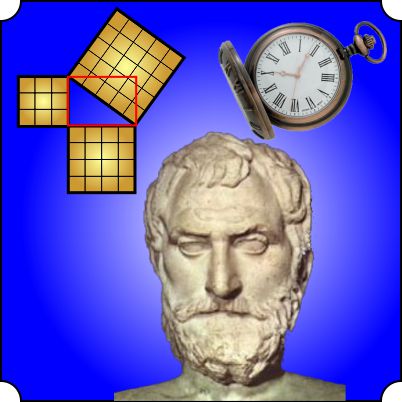
Early geometer Pythagoras showed us how to calculate the hypotenuse of a right triangle from the lengths of the other two sides. His a2+b2 = c2 formula works for the diagonal of the enclosing rectangle, too.

Extending the idea, the body diagonal of an x×y×z cube is √(x2+y2+z2) and the hyperdiagonal  of a an ct×x×y×z tesseract is √(c2t2+x2+y2+z2) where t is time.  Why the “c“?  All terms in a sum have to be in the same units.  x, y, and z are lengths so we need to turn t into a length.  With c as the speed of light, ct is the distance (length) that light travels in time t.

But Minkowski and the other physicists weren’t happy with Pythagorean hyperdiagonals.  Here’s the problem they wanted to solve.  Suppose you’re watching your spacecraft’s first flight.  You built it, you know its tip-to-tail length, but your telescope says it’s shorter than that.  George FitzGerald and Hendrik Lorentz explained that in 1892 with their length contraction analysis.

What if there are two observers, Fred and Ethel, each of whom is also moving?  They’d better be able to come up with the same at-rest (intrinsic) size for the object.

Minkowski’s solution was to treat the ct term differently from the others.  Think of each 4D address (ct,x,y,z) as a distinct event.  Whether or not something happens then/there, this event’s distinct from all other spatial locations at moment t, and all other moments at location (x,y,z).

To simplify things, let’s compare events to the origin (0,0,0,0).  Pythagoras would say that the “distance” between the origin event and an event I’ll call Lucy at (ct,x,y,z) is √(c2t2+x2+y2+z2).

Minkowski proposed a different kind of “distance,” which he called the interval.  It’s the difference between the time term and the space terms: √[c2t2 + (-1)*(x2+y2+z2)].

If Lucy’s time is t=0 [her event address (0,x,y,z)], then the origin-to-Lucy interval is  √[02+(-1)*(x2+y2+z2)]=i(x2+y2+z2).  Except for the i=√(-1) factor, that matches the familiar origin-to-Lucy spatial distance.

Now for the moment let’s convert the sum from lengths to times by dividing by c2.  The expression becomes √[t2-(x/c)2-(y/c)2-(z/c)2].  If Lucy is at (ct,0,0,0) then the origin-to-Lucy interval is simply √(t2)=t, exactly the time difference we’d expect.

Finally, suppose that Lucy departed the origin at time zero and traveled along x at the speed of light.   At any time t, her address is (ct,ct,0,0) and the interval for her trip is √[(ct)2-(ct)2-02-02] = √0 = 0.  Both Fred’s and Ethel’s clocks show time passing as Lucy speeds along, but the interval is always zero no matter where they stand and when they make their measurements.

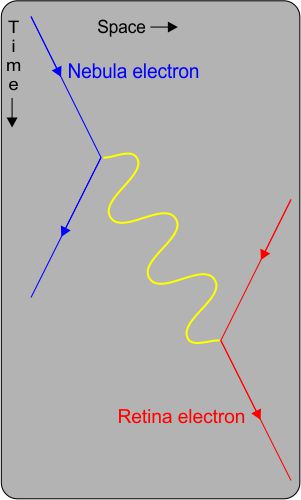
Feynman diagramOne more step and we can answer Ken’s question.  A moving object’s proper time is defined to be the time measured by a clock affixed to that object.  The proper time interval between two events encountered by an object is exactly Minkowski’s spacetime interval.  Lucy’s clock never moves from zero.
So yeah, Ken, a photon moving at the speed of light experiences no change in proper time although externally we see it traveling.

Now on to Einstein’s bubble, a lightwave’s spherical shell that vanishes instantly when its photon is absorbed by an electron somewhere.  We see that the photon experiences zero proper time while traversing the yellow line in this Feynman diagram.  But viewed from any other frame of reference the journey takes longer.  Einstein’s objection to instantaneous wave collapse still stands.

~~ Rich Olcott

Calvin And Hobbes And i

Hobbes 2I so miss Calvin and Hobbes, the wondrous, joyful comic strip that cartoonist Bill Watterson gave us between 1985 and 1995.  Hobbes was a stuffed toy tiger — except that 6-year-old Calvin saw him as a walking, talking man-sized tiger with a sarcastic sense of humor.
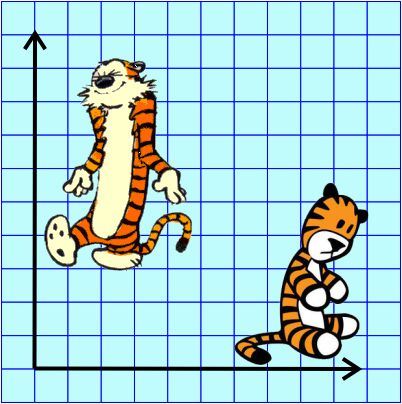
So many things in life and physics are like Hobbes — they depend on how you look at them.  As we saw earlier, a fictitious force disappears when viewed from the right frame of reference.  There’s that particle/wave duality thing that Duc de Broglie “blessed” us with.  And polarized light.

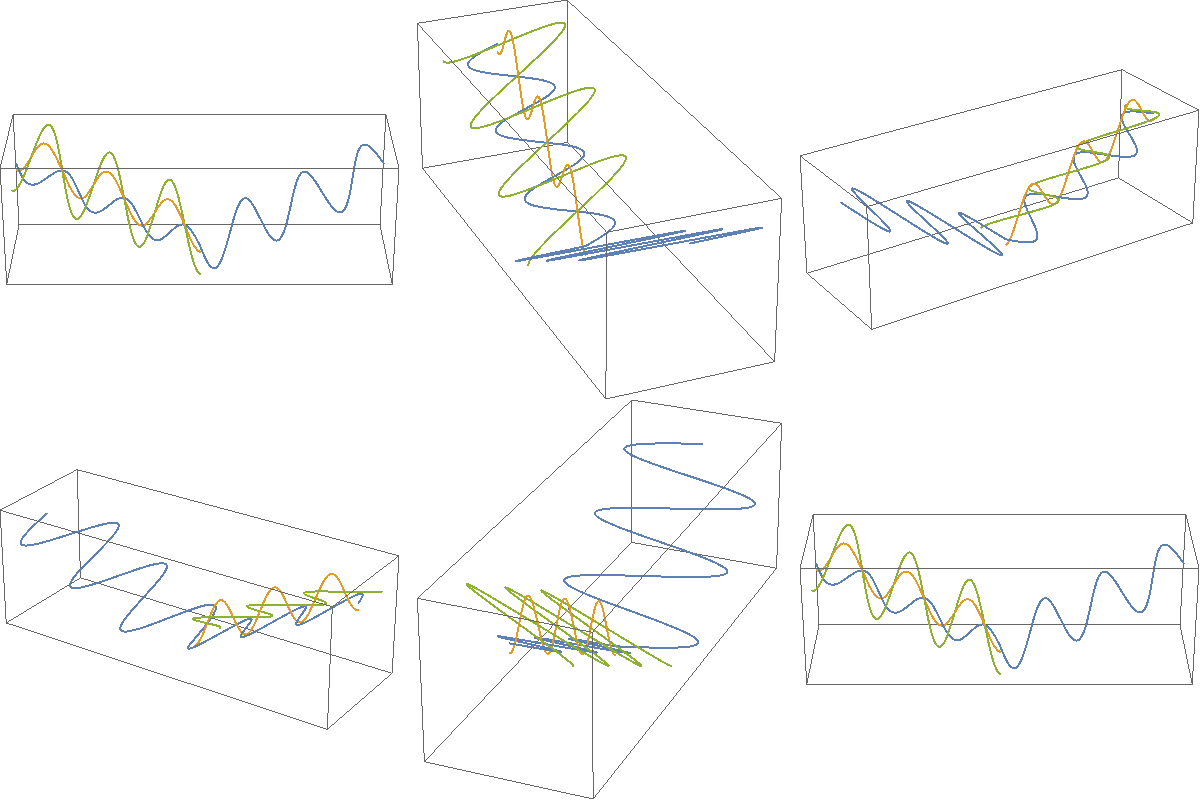
In an earlier post I mentioned that light is polar, in the sense that a single photon’s electric field acts to vibrate an electron (pole-to-pole) within a single plane.
wavesIn this video, orange, green and blue electromagnetic fields shine in from one side of the box onto its floor.  Each color’s field is polar because it “lives” in only one plane.  However, the beam as a whole is unpolarized because different components of the total field direct recipient electrons into different planes giving zero net polarization.  The Sun and most other familiar light sources emit unpolarized light.
When sunlight bounces at a low angle off a surface, say paint on a car body or water at the beach, energy in a field that is directed perpendicular to the surface is absorbed and turned into heat energy.  (Yeah, I’m skipping over a semester’s-worth of Optics class, but bear with me.)  In the video, that’s the orange wave.

At the same time, fields parallel to the surface are reflected.  That’s what happens to the blue wave.

Suppose a wave is somewhere in between parallel and perpendicular, like the green wave.  No surprise, the vertical part of its energy is absorbed and the horizontal part adds to the reflection intensity.  That’s why the video shows the outgoing blue wave with a wider swing than its incoming precursor had.

The net effect of all this is that low-angle reflected light is polarized and generally more intense than the incident light that induced it.  We call that “glare.”  Polarizing sunglasses can help by selectively blocking horizontally-polarized electric fields reflected from water, streets, and that *@%*# car in front of me.

Wave_Polarisation
David Jessop’s brilliant depiction of plane and circularly polarized light

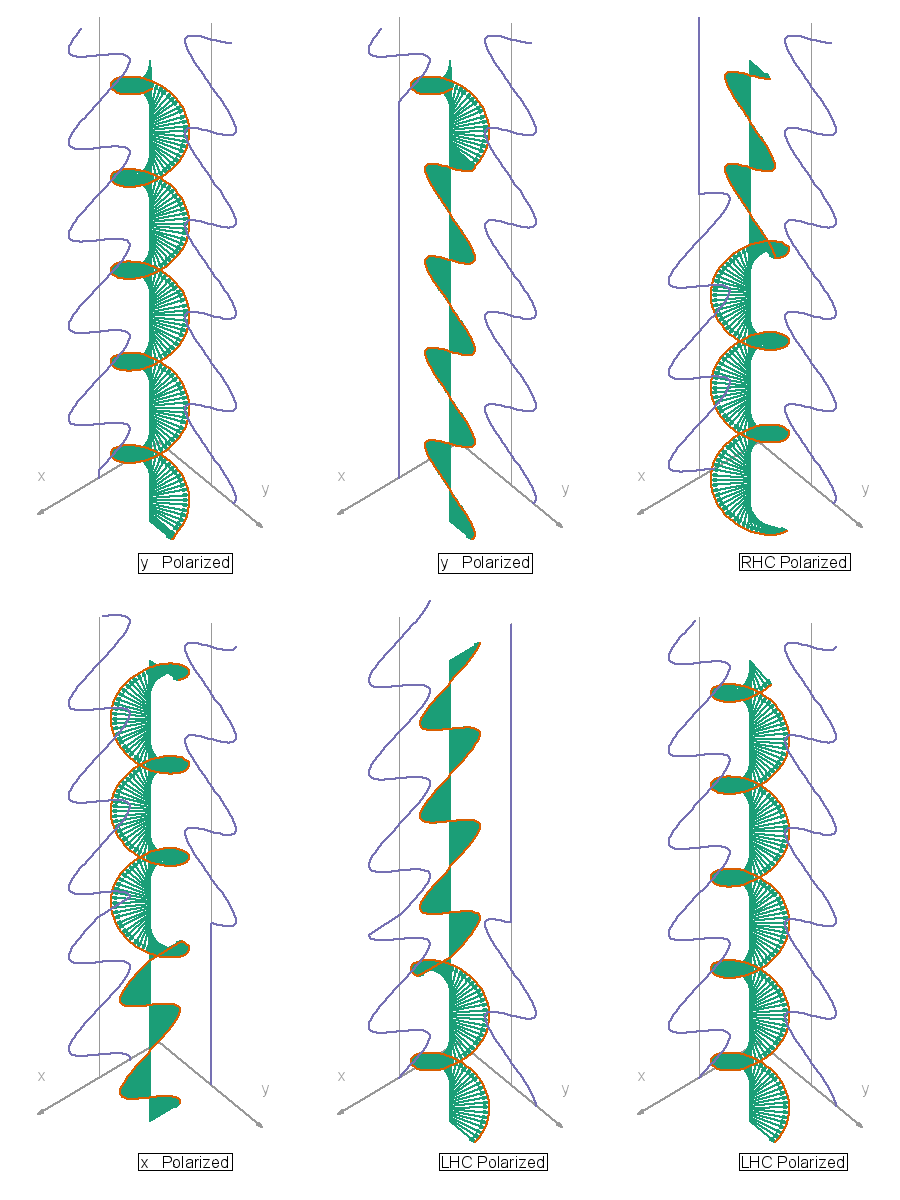
Things can get more complicated. The waves in the first video are all in synch — their peaks and valleys match up (mostly). But suppose an x-directed field and a y-directed field are headed along the same course.  Depending on how they match up, the two can combine to produce a field driving electrons along the x-direction, the y-direction, or in clockwise or counterclockwise circles.  Check the red line in this video — RHC and LHC depict the circularly polarized light that sci-fi writers sometimes invoke when they need a gimmick.

Physicists have several ways to describe such a situation mathematically.  I’ve already used the first, which goes back 380 years to René Descartes and the Cartesian x, y,… coordinate system he planted the seed for.  We’ve become so familiar with it that reading a graph is like reading words.  Sometimes easier.

In Cartesian coordinates we write x– and y-coordinates as separate functions of time t:
x = f1(t)
y = f2(t)
where each f could be something like 0.7·t2-1.3·t+π/4 or whatever.  Then for each t-value we graph a point where the vertical line at the calculated x intersects the horizontal line at the calculated y.

But we can simplify that with a couple of conventions.  Write √(-1) as i, and say that i-numbers run along the y-axis.  With those conventions we can write our two functions in a single line:
x + i y = f1(t) + i f2(t)
One line is better than two when you’re trying to keep track of a big calculation.

But people have a long-running hang-up that’s part theory and part psychology.  When Bombelli introduced these complex numbers back in the 16th century, mathematicians complained that you can’t pile up i thingies.  Descartes and others simply couldn’t accept the notion, called the numbers “imaginary,” and the term stuck.

Which is why Hobbes the way Calvin sees him is on the imaginary axis.

~~ Rich Olcott

Gravity and other fictitious forces

In this post I wrote, “gravitational force is how we we perceive spatial curvature.”
Here’s another claim — “Gravity is like centrifugal force, because they’re both fictitious.”   Outrageous, right?  I mean, I can feel gravity pulling down on me now.  How can it be fictional?

Fictitious triangle
A fictitious triangle

“Fictitious,” not “fictional,” and there’s a difference.  “Fictional” doesn’t exist, but a fictitious force is one that, to put it non-technically, depends on how you look at it.

Newton started it, of course.  From our 21st Century perspective, it’s hard to recognize the ground-breaking impact of his equation F=a.  Actually, it’s less a discovery than a set of definitions.  Its only term that can be measured directly is a, the acceleration, which Newton defined as any change from rest or constant-speed straight-line motion.  For instance, car buffs know that if a vehicle covers a one-mile half-mile (see comments) track in 60 seconds from a standing start, then its final speed is 60 mph (“zero to sixty in sixty”).  Furthermore, we can calculate that it achieved a sustained acceleration of 1.47 ft/sec2.

Both F and m, force and mass, were essentially invented by Newton and they’re defined in terms of each other.  Short of counting atoms (which Newton didn’t know about), the only routes to measuring a mass boil down to

  • compare it to another mass (for instance, in a two-pan balance), or
  • quantify how its motion is influenced by a known amount of force.

Conversely, we evaluate a force by comparing it to a known force or by measuring its effect on a known mass.

Once the F=a. equation was on the table, whenever a physicist noticed an acceleration they were duty-bound to look for the corresponding force.  An arrow leaps from the bow?  Force stored as tension in the bowstring.  A lodestone deflects a compass needle?  Magnetic force.  Objects accelerate as they fall?  Newton identified that force, called it “gravity,” and showed how to calculate it and how to apply it to planets as well as apples.  It was Newton who pointed out that weight is a measure of gravity’s force on a given mass.

Incidentally, to this day the least accurately known physical constant is Newton’s G, the Universal Gravitational Constant in his equation F=G·m1·m2/r2.  We can “weigh” planets with respect to each other and to the Sun, but without an independently-determined accurate mass for some body in the Solar System we can only estimate G.  We’ll have a better value when we can see how much rocket fuel it takes to push an asteroid around.

CoasterBut there are other accelerations that aren’t so easily accounted for.  Ever ride in a car going around a curve and find yourself almost flung out of your seat?  This little guy wasn’t wearing his seat belt and look what happened.  The car accelerated because changing direction is an acceleration due to a lateral force.  But the guy followed Newton’s First Law and just kept going in a straight line.  Did he accelerate?
This is one of those “depends on how you look at it” cases.  From a frame of reference locked to the car (arrows), he was accelerated outwards by a centrifugal force that wasn’t countered by centripetal force from his seat belt.  However, from an earthbound frame of reference he flew in a straight line and experienced no force at all.

Side forceSuppose you’re investigating an object’s motion that appears to arise from a new force you’d like to dub “heterofugal.”  If you can find a different frame of reference (one not attached to the object) or otherwise explain the motion without invoking the “new force,” then heterofugalism is a fictitious force.

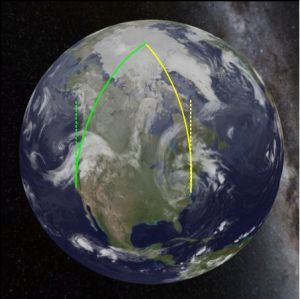
Centrifugal and centripetal forces are fictitious.  The  “force” “accelerating” one plane towards another as they both fly to the North Pole in this tale is actually geometrical and thus also fictitious   So is gravity.

In this post you’ll find a demonstration of gravity’s effect on the space around it.  Just as a sphere’s meridians give the effect of a fictitious lateral force as they draw together near its poles, the compressive curvature of space near a mass gives the effect of a force drawing other masses inward.

~~ Rich Olcott

Another slice of π, wrapped up in a Black Hole crust

Last week a museum visitor wondered, “What’s the volume of a black hole?”  A question easier asked than answered.

Let’s look at black hole (“BH”) anatomy.  If you’ve seen Interstellar, you saw those wonderful images of “Gargantua,” the enormous BH that plays an essential role in the plot.  (If you haven’t seen the movie, do that.  It is so cool.)

A BH isn’t just a blank spot in the Universe, it’s attractively ornamented by the effects of its gravity on the light passing by:

Gargantua 2c
Gargantua,
adapted from Dr Kip Thorne’s book, The Science of “Interstellar”

Working from the outside inward, the first decoration is a background starfield warped as though the stars beyond had moved over so they could see us past Gargantua.  That’s because of gravitational lensing, the phenomenon first observed by Sir Arthur Eddington and the initial confirmation of Einstein’s Theory of General Relativity.

No star moved, of course.  Each warped star’s light comes to us from an altered angle, its lightwaves bent on passing through the spatial compression Gargantua imposes on its neighborhood.  (“Miles are shorter near a BH” — see Gravitational Waves Are Something Else for a diagrammatic explanation.)

Moving inward we come to the Accretion Disc, a ring of doomed particles destined to fall inward forever unless they’re jostled to smithereens or spat out along one of the BH’s two polar jets (not shown).  The Disc is hot, thanks to all the jostling.  Like any hot object it emits light.

Above and below the Disc we see two arcs that are actually images of the Accretion Disc, sent our way by more gravitational lensing.  Very close to a BH there’s a region where passing light beams are bent so much that their photons go into orbit.  The disc’s a bit further out than that so its lightwaves are only bent 90o over (arc A) and under (arc B) before they come to us.

By the way, those arcs don’t only face in our direction.  Fly 360o around Gargantua’s equator and those arcs will follow you all the way.  It’s as though the BH were embedded in a sphere of lensed Disclight.

Which gets us to the next layer of weirdness.  Astrophysicists believe that most BHs rotate, though maybe not as fast as Gargantua’s edge-of-instability rate.  Einstein’s GR equations predict a phenomenon called frame dragging — rapidly spinning massive objects must tug local space along for the ride.  The deformed region is a shell called the Ergosphere.

Frame dragging is why the two arcs are asymmetrical and don’t match up.  We see space as even more compressed on the right-hand side where Gargantua is spinning away from us.  Because the effect is strongest at the equator, the shell should really be called the Ergospheroid, but what can you do?

Inside the Ergosphere we find the defining characteristic of a BH, its Event Horizon, the innermost bright ring around the central blackness in the diagram.  Barely outside the EH there may or may not be a Firewall, a “seething maelstrom of particles” that some physicists suggest must exist to neutralize the BH Information Paradox.  Last I heard, theoreticians are still fighting that battle.

The EH forms a nearly spherical boundary where gravity becomes so intense that the escape velocity exceeds the speed of light.  No light or matter or information can break out.  At the EH, the geometry of spacetime becomes so twisted that the direction of time is In.  Inside the EH and outside of the movies it’s impossible for us to know what goes on.

Finally, the mathematical models say that at the center of the EH there’s a point, the Singularity, where spacetime’s curvature and gravity’s strength must be Infinite.  As we’ve seen elsewhere, Infinity in a calculation is Nature’s was of saying, “You’ve got it wrong, make a better model.”

So we’re finally down to the volume question.  We could simply measure the EH’s external diameter d and plug that into V=(πd3)/6.  Unfortunately, that forthright approach misses all the spatial twisting and compression — it’s a long way in to the Singularity.  Include those effects and you’ve probably got another Infinity.

Gargantua’s surface area is finite, but its volume may not be.

~~ Rich Olcott

LIGO: Gravity Waves Ain’t Gravitational Waves

Sometimes the media get sloppy.  OK, a lot of times, especially when the reporters don’t know what they’re writing about.  Despite many headlines that “LIGO detected gravity waves,” that’s just not so.  In fact, the LIGO team went to a great deal of trouble to ensure that gravity waves didn’t muck up their search for gravitational waves.

Spring2A wave happens in a system when a driving force and a restoring force take turns overshooting an equilibrium point AND the away-from-equilibrium-ness gets communicated around the system.  The system could be a bunch of springs tied together in a squeaky old bedframe, or labor and capital in an economic system, or the network of water molecules forming the ocean surface, or the fibers in the fabric of space (whatever those turn out to be).

If you  were to build a mathematical model of some wavery system you’d have to include those two forces plus quantitative descriptions of the thingies that do the moving and communicating.  If you don’t add anything else, the model will predict motion that cycles forever.  In reality, of course, there’s always something else that lets the system relax into equilibrium.

The something else could be a third force, maybe someone sitting on the bed, or government regulation in an economy, or reactant depletion for a chemical process.  But usually it’s friction of one sort or another — friction drains away energy of motion and converts it to heat.  Inside a spring, for instance, adjacent crystallites of metal rub against each other.  There appears to be very little friction in space — we can see starlight waves that have traveled for billions of years.

Physicists pay attention to waves because there are some general properties that apply to all of them.  For instance, in 1743 Jean-Baptiste le Rond d’Alembert proved there’s a strict relationship between a wave’s peakiness and its time behavior.  Furthermore, Jean-Baptiste Joseph Fourier (pre-Revolutionary France must have been hip-deep in physicist-mathematicians) showed that a wide variety of more-or-less periodic phenomena could be modeled as the sum of waves of differing frequency and amplitude.

Monsieur Fourier’s insight has had an immeasurable impact on our daily lives.  You can thank him any time you hear the word “frequency.”  From broadcast radio and digitally recorded music to time-series-based business forecasting to the mode-locked lasers in a LIGO device — none would exist without Fourier’s reasoning.

Gravity waves happen when a fluid is disturbed and the restoring force is gravity.  We’re talking physicist fluid here, which could be sea water or the atmosphere or solar plasma, anything where the constituent particles aren’t locked in place. Winds or mountain slopes or nuclear explosions push the fluid upwards, gravity pulls it back, and things wobble until friction dissipates that energy.

Gravitational waves are wobbles in gravity itself, or rather, wobbles in the shape of space.  According to General Relativity, mass exerts a tension-like force that squeezes together the spacetime immediately around it.  The more mass, the greater the tension.

Binary BH with AENAn isolated black hole is surrounded by an intense gravitational field and a corresponding compression of spacetime.  A pair of black holes orbiting each other sends out an alternating series of tensions, first high, then extremely high, then high…

Along any given direction from the pair you’d feel a pulsing gravitational field that varied above and below the average force attracting you to the pair.  From a distance and looking down at the orbital plane, if you could see the shape of space you’d see it was distorted by four interlocking spirals of high and low compression, all steadily expanding at the speed of light.

The LIGO team was very aware that the signal of a gravitational wave could be covered up by interfering signals from gravity waves — ocean tides, Earth tides, atmospheric disturbances, janitorial footsteps, you name it.  The design team arrayed each LIGO site with hundreds of “seismometers, accelerometers, microphones, magnetometers, radio receivers, power monitors and a cosmic ray detector.”  As the team processed the LIGO trace they accounted for artifacts that could have come from those sources.

So no, the LIGO team didn’t discover gravity waves, we’ve known about them for a century.  But they did detect the really interesting other kind.

~~ Rich Olcott