Constant’s Companion

“It’s like Mark Twain said, Jeremy — ‘History may not repeat itself, but it rhymes.‘ Newton identified gravity as a force; Einstein proposed the Cosmological Constant. Newton worked the data to develop his Law of Gravity; Friedmann worked Einstein’s theory to devise his model of an exponentially expanding Universe. Newton was uncomfortable with gravity’s ability to act at a distance; Einstein called the Cosmological Constant ‘his greatest blunder.’ The parallels go on.”

“Why didn’t Einstein like the Constant if it explains how the Universe is expanding?”

“It wasn’t supposed to. Expanding Universes weren’t in fashion a century ago when Einstein wrote that paper. At the time everyone including Einstein thought we live in a steady state universe. His first cut at a General Relativity field equation implied a contracting universe so he added a constant term to balance out the contraction even though it made the dynamics look unstable — the Constant had to have just the right value for stability. A decade later Hubble’s data pointed to expansion and Friedman’s equations showed how that can happen.”

“I guess Einstein was embarrassed about that, huh, Mr Moire?”

“Well, he’d thought all along that the Constant was mathematically inelegant. Besides, the Constant isn’t just a number or a term in an equation, it’s supposed to represent a real process in operation. Like Newton’s problem with gravity, Einstein couldn’t identify a mechanism to power the Constant.”

“Power it to do what?”

“Think about universal constants, like the speed of light or the electron charge. Doesn’t matter where you are or how fast you’re traveling in which inertial frame, they’ve got the same values. If the Constant is indeed a constant, it contributes equally to cosmological dynamics from every position in space, whether inside a star or millions of lightyears from any galaxy. Every point must exert the same outward force in every direction or there’d be swirling. And it multiplies — every instant of general expansion makes new points in between the old points and they’ll exert the same force, too.”

“That’s what makes it exponential, right?”

“Good insight. It’s a pretty weak force per unit volume, weaker than gravity. We know that because galaxies and galaxy cluster structures maintain integrity even as they’re drifting apart from each other. Even so, a smidgeon of force from each unit volume in space adds up to a lot of force. Multiply force by distance traveled — that’s a huge amount of energy spent against gravity. The big puzzle is, what’s the energy source? Most of the astrophysics community nominates dark energy to power the Cosmological Constant but that’s not much help.”

“As Dr Prather says in class, Mr Moire, ‘You sound tentative. Please expound.‘ Why wouldn’t dark energy be the power source?”

“In Physics we use the word ‘energy‘ with a very specific meaning. Yes, it gets heavy use with sloppy meanings in everything from show business to crystal therapy, but in hard science nearly every serious research program since the 18th Century has entailed quantitative energy accounting. The First Law of Thermodynamics is conservation of energy. Whenever we see something heating up, a chemical reaction running or a force being applied along a distance, physicists automatically think about the energy being expended and where that energy is coming from. Energy’s got to balance out. But the Constant breaks that rule — we have no idea what process provides that energy. Calling the source ‘dark energy‘ just gives it a name without explaining it.”

“Isn’t the missing energy source evidence against Friedmann’s and Einstein’s equations?”

“That’s a tempting option and initially a lot of researchers took it. Unfortunately, it seems that dark energy is a thing. Or maybe a lot of little things. Several different lines of evidence say that the Constant constitutes twice as much mass‑energy as all normal and dark matter combined. Worse yet, as the Universe expands that share will increase.”

“Wait, will the dark energy invade normal matter and break us up?”

“People argue about that. Normal matter’s held together by electromagnetic forces which are 1038 times stronger than gravity, far stronger yet than dark energy. Dark matter’s gravity helps to hold galaxies together, but who knows what holds dark matter together?”

~~ ROlcott

Three Phases of Ever

“So if the Universe isn’t in a steady state and it’s not heading for a Big Crunch, I guess it’s getting bigger forever, huh?”

“Careful, Jeremy, the Universe expansion could maybe reach a stopping point if it happened to hold exactly the right amount of mass‑energy. The expansion could just stop when forces balance out.”

“What forces, Mr Moire? There’s gravity pulling everything together so what’s pushing them apart?”

“That is an excellent question, one that we don’t yet have an answer for. We’re about where Newton was with gravity. There was a lot of observational evidence, he had a name for it and knew how to calculate its effects, but he didn’t know how it worked. That’s us with Einstein’s Cosmological Constant.”

“Observational evidence — we can actually see things accelerate?”

“Not any one object speeding up. Human lifetimes are too short to measure acceleration in galaxies a hundred thousand lightyears across. No, we use the same strategy that Hubble used — measure many galaxies at different distances from us and graph recession speed against distance. During the century since Hubble we’ve greatly improved our estimates of astronomical speeds and distances. Dividing the known speed of light into a galaxy’s measured distance tells us time since it emitted the photons we see. Our findings confirm Hubble’s general conclusion — on average, older photons come from galaxies that fly away faster. Hubble thought that the relation was linear but our fine‑tuned numbers show otherwise. The data says that after the first few seconds the Universe stretched at a steady rate for only the first ⅔ of its life. The stretch has been accelerating since then.”

“Why wasn’t it accelerating since the beginning? Did someone cut in the afterburner?”

“More like turned one off. The evidence and theory we have so far indicate the Universe has seen a succession of phases dominated by different processes. You’ve probably heard of inflation—”

“Have I? You should see what they want for a burger these days!”

“Not that sort of inflation, but I know how you feel. No, I’m referring to cosmic inflation, very early in the Big Bang sequence, when the Universe expanded by a factor of 1026 within a tiny fraction of a second. It was driven by enormously powerful radiation‑linked effects we don’t understand that finally ran out of steam and let lower‑energy processes take over.”

“How’d that happen?”

“We don’t know. The general principle is that one process so dominates what’s going on in a phase that nothing else matters, until for some reason it stops mattering and we’re in a new phase with a different dominant process. The early Universe was controlled by radiative processes until things cooled off enough for particles to form and persist. That changed the game. Gravity dominated the next 8 billion years. Particles clumped together, atoms then dust then solar systems into larger and larger structures with bigger spaces between them. About 5 billion years ago the game changed again.”

“So early on there weren’t even atoms, huh? Wow. What was the next game‑changer?”

“Thanks to Einstein and Friedmann’s work we’ve got at least a guess.”

“Friedmann?”

“Alexander Friedmann. He was a Russian physicist, used Einstein’s General Relativity results to derive three equations that together model the dynamics of the overall scale of the Universe using just a few estimates for current conditions. His equations give acceleration as the difference of two terms. The positive term is simply proportional to Einstein’s Constant. The negative term depends on both average mass density and pressure. Take a moment to think.”

“Umm… Positive is acceleration, negative is deceleration, density and pressure go down … If the negative term gets smaller than the positive one, acceleration increases, right?”

“It does, and we think the constant term has been increasingly dominant for 5 billion years. Something else to consider — the equation’s result is in terms of scale change divided by current scale. What’s it mean if that ratio’s a positive constant?”

“Change by a constant positive percentage … that’s exponential growth!”

“I thought you’d recognize it. Einstein’s Constant implies the scale of the Universe grows at an exponentially accelerating rate. We’re now in the Cosmological Constant phase.”

In Russian, Aleksandr Aleksandrowitsch Fridman

~~ Rich Olcott

Not Crunch Time

A familiar knock on my office door. “C’mon in, Jeremy, the door’s open.”

“Got a few minutes, Mr Moire?”

The second serious-sounding visitor today. I push my keyboard aside again. “Sure, what’s up?”

“I read your ‘Tops of Time‘ post and then I watched one of Katie Mack’s End of Everything‘ YouTube videos and now I’m confused. And worried.”

“I can understand that. Clearing up the confusion should be easy. Then I’ll do what I can about the worry part, okay?”

“That’d be great, sir.”

“So, imagine an enormous sheet of graph paper, and then imagine Puerto Rico laid down on top of that. You could use the graph paper to describe the latitude and longitude of any place on the island, right?”

“Sure, probably.”

“I happen to know that Playa Jobos is the northernmost point of the island. Does north stop there?”

“Nosir. The island stops there, but north keeps going.”

“Well, there you are.”

“Wait … oh, you’re saying that time by itself keeps going forever but what’s in the Universe might not and that’s what Dr Mack is talking about?”

“That’s the idea. More precisely, the ‘tops‘ I wrote about are different ways that spacetime’s time coordinate could play out in the future, or maybe not. Mack’s ‘end of everything‘ is about the future history of physical stuff laid on top of our mathematical spacetime constructs. Does that clarify things?”

“Mmm, yessir, but what about the ‘maybe not‘ you said?”

“This gets metaphysical, but cosmology often skates on that edge. Descartes and others maintained that space has meaning only when there are separate objects. If there was only one thing in the Universe you’d have nothing to compare sizes against and there’d be no point in measuring distances away from it. That’d be even more the case if there’s nothing. Same thing for time and events. From that perspective, if somehow the Universe emptied out then space and time sort of stop.”

“Just sort‑of stop, like Puerto Rico stops at that Playa place. Really they keep on going, I think, even if no‑one’s there to measure anything.”

“A perfectly reasonable position when there’s no evidence either way. Anyhow, a few of Mack’s scenarios wind up in that situation, right?”

“Umm… there’s the Big Crunch that reverses the Big Bang.”

“That one was popular before we got good data. The idea was that the Big Bang pushed everything apart but eventually gravity will slow outward momentum and pull everything back together again. The notion probably came from humanity’s experience with dirt falling back down after an explosion. The problems with that scheme are that the Big Bang wasn’t an explosion, outward momentum isn’t a thing and besides, we’ve got increasingly good data showing that between‑galaxy distances are getting wider, not shrinking. The last five billion years that’s sped up.”

“Wait, not an explosion? All the videos show it that way.”

“Chalk it up to artistic license. It’s hard to show everything moving away from everything else without making it look like the viewpoint’s simply diving into a static arrangement. No, an explosion comes out of a center and that’s not the Bang. Remember that huge piece of graph paper? Make it a balloon, tack Puerto Ricos all over it, then pump in some air. There’s no center, but every islander thinks their island is the center and every other island is running away from them. Really, all that’s happening is that the stretching rubber is creating new inter‑island space everywhere.”

“And that’s Universe expansion?”

“Mm-hm. Also known as Hubble Flow. We’ve looked very hard for a center of motion, haven’t found one.”

“If everything’s moving, why isn’t that momentum?”

“It is momentum, but only pairwise. For any two galaxies you can calculate mass times speed same as always. For really distant objects you’ve got to use a relativistic version. Anyway, in the cosmological context you’ve got to ask, momentum relative to what? Everyone has this picture that things came from a common center and will fall back there. The way Hubble expansion works, though, there’s no particular go‑back place.”

“Everything’s speeding up and going everywhere so no Big Crunch then.”

“Not on the original model, anyway.”

~~ Rich Olcott

Hyperbolas But Not Hyperbole

Minus? Where did that come from?”

<Gentle reader — If that question looks unfamiliar, please read the preceding post before this one.>

Jim’s still at the Open Mic. “A clever application of hyperbolic geometry.” Now several of Jeremy’s groupies are looking upset. “OK, I’ll step back a bit. Jeremy, suppose your telescope captures a side view of a 1000‑meter spaceship but it’s moving at 99% of lightspeed relative to you. The Lorentz factor for that velocity is 7.09. What will its length look like to you?”

“Lorentz contracts lengths so the ship’s kilometer appears to be shorter by that 7.09 factor so from here it’d look about … 140 meters long.”

“Nice, How about the clocks on that spaceship?”

“I’d see their seconds appear to lengthen by that same 7.09 factor.”

“So if I multiplied the space contraction by the time dilation to get a spacetime hypervolume—”

“You’d get what you would have gotten with the spaceship standing still. The contraction and dilation factors cancel out.”

“How about if the spaceship went even faster, say 99.999% of lightspeed?”

“The Lorentz factor gets bigger but the arithmetic for contraction and dilation still cancels. The hypervolume you defined is always gonna be just the product of the ship’s rest length and rest clock rate.”

His groupies go “Oooo.”

One of the groupies pipes up. “Wait, the product of x and y is a constant — that’s a hyperbola!”

“Bingo. Do you remember any other equations associated with hyperbolas?”

“Umm… Yes, x2–y2 equals a constant. That’s the same shape as the other one, of course, just rotated down so it cuts the x-axis vertically.”

Jeremy goes “Oooo.”

Jim draws hyperbolas and a circle on the whiteboard. That sets thoughts popping out all through the crowd. Maybe‑an‑Art‑major blurts into the general rumble. “Oh, ‘plus‘ locks x and y inside the constant so you get a circle boundary, but ‘minus‘ lets x get as big as it wants so long as y lags behind!”

Another conversation – “Wait, can xy=constant and x2–y2=constant both be right?”
  ”Sure, they’re different constants. Both equations are true where the red and blue lines cross.”

A physics student gets quizzical. “Jim, was this Minkowski’s idea, or Einstein’s?”

“That’s a darned good question, Paul. Minkowski was sole author of the paper that introduced spacetime and defined the interval, but he published it a year after Einstein’s 1905 Special Relativity paper highlighted the Lorentz transformations. I haven’t researched the history, but my money would be on Einstein intuitively connecting constant hypervolumes to hyperbolic geometry. He’d probably check his ideas with his mentor Minkowski, who was on the same trail but graciously framed his detailed write‑up to be in support of Einstein’s work.”

One of the astronomy students sniffs. “Wait, different observers see the same s2=(ct)2d2 interval between two events? I suppose there’s algebra to prove that.”

“There is.”

“That’s all very nice in a geometric sort of way, but what does s2 mean and why should we care whether or not it’s constant?”

“Fair questions, Vera. Mmm … you probably care that intervals set limits on what astronomers see. Here’s a Minkowski map of the Universe. We’re in the center because naturally. Time runs upwards, space runs outwards and if you can imagine that as a hypersphere, go for it. Light can’t get to us from the gray areas. The red lines, they’re really a hypercone, mark where s2=0.”

From the back of the room — “A zero interval?”

“Sure. A zero interval means that the distance between two events exactly equals lightspeed times light’s travel time between those events. Which means if you’re surfing a lightwave between two events, you’re on an interval with zero measure. Let’s label Vera’s telescope session tonight as event A and her target event is B. If the A–B interval’s ct difference is greater then its d difference then she can see Bif the event is in our past but not beyond the Cosmic Microwave Background. But if a Dominion fleet battle is approaching us through subspace from that black dot, we’ll have no possible warning before they’re on us.”

Everyone goes “Oooo.”

~~ Rich Olcott

Thinking in Spacetime

The Open Mic session in Al’s coffee shop is still going string. The crowd’s still muttering after Jeremy stuck a pin in Big Mike’s “coincidence” balloon when Jim steps up. Jim’s an Astrophysics post‑doc now so we quiet down expectantly. “Nice try, Mike. Here’s another mind expander to play with. <stepping over to the whiteboard> Folks, I give you … a hypotenuse. ‘That’s just a line,’ you say. Ah, yes, but it’s part of some right triangles like … these. Say three different observers are surveying the line from different locations. Alice finds her distance to point A is 300 meters and her distance to point B is 400. Applying Pythagoras’ Theorem, she figures the A–B distance as 500 meters. We good so far?”

A couple of Jeremy’s groupies look doubtful. Maybe‑an‑Art‑Major shyly raises a hand. “The formula they taught us is a2+b2=c2. And aren’t the x and y supposed to go horizontal and vertical?”

“Whoa, nice questions and important points. In a minute I’m going to use c for the speed of light. It’s confusing to use the same letter for two different purposes. Also, we have to pay them extra for double duty. Anyhow, I’m using d for distance here instead of c, OK? To your next point — Alice, Bob and Carl each have their own horizontal and vertical orientations, but the A–B line doesn’t care who’s looking at it. One of our fundamental principles is that the laws of Physics don’t depend on the observer’s frame of reference. In this situation that means that all three observers should measure the same length. The Pythagorean formula works for all of them, so long as we’re working on a flat plane and no-one’s doing relativistic stuff, OK?”

Tentative nods from the audience.

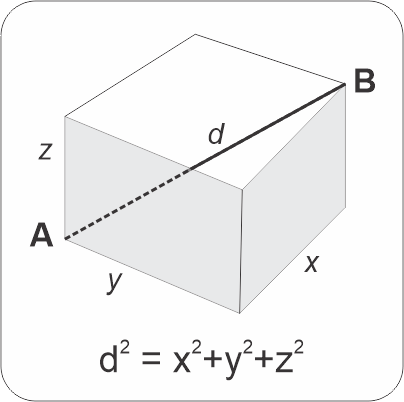
“Right, so much for flat pictures. Let’s up our game by a dimension. Here’s that same A–B line but it’s in a 3D box. <Maybe‑an‑Art‑Major snorts at Jim’s amateur attempt at perspective.> Fortunately, the Pythagoras formula extends quite nicely to three dimensions. It was fun figuring out why.”

Jeremy yells out. “What about time? Time’s a dimension.”

“For sure, but time’s not a length. You can’t add measurements unless they all have the same units.”

“You could fix that by multiplying time by c. Kilometers per second, times seconds, is a length.” His groupies go “Oooo.”

“Thanks for the bridge to spacetime where we have four coordinates — x, y, z and ct. That makes a big difference because now A and B each have both a where and a when — traveling between them is traveling in space and time. Computationally there’s two paths to follow from here. One is to stick with Pythagoras. Think of a 4D hypercube with our A–B line running between opposite vertices. We’re used to calculating area as x×y and volume as x×y×z so no surprise, the hypercube’s hypervolume is x×y×z×(ct). The square of the A–B line’s length would be b2=(ct)2+d2. Pythagoras would be happy with all of that but Einstein wasn’t. That’s where Alice and Bob and Carl come in again.”

“What do they have to do with it?”

“Carl’s sitting steady here on good green Earth, red‑shifted Alice is flying away at high speed and blue‑shifted Bob is flashing toward us. Because of Lorentz contractions and dilations, they all measure different A–B lengths and durations. Each observer would report a different value for b2. That violates the invariance principle. We need a ruggedized metric able to stand up to that sort of punishment. Einstein’s math professor Hermann Minkowski came up with a good one. First, a little nomenclature. Minkowski was OK with using the word ‘point‘ for a location in xyz space but he used ‘event‘ when time was one of the coordinates.”

“Makes sense, I put events on my calendar.”

“Good strategy. Minkowski’s next step quantified the separation between two events by defining a new metric he called the ‘interval.’ Its formula is very similar to Pythagoras’ formula, with one small change: s2=(ct)2–d2. Alice, Bob and Carl see different distances but they all see the same interval.”

Minus? Where did that come from?”

~~ Rich Olcott

Maybe It’s Just A Coincidence

Raucous laughter from the back room at Al’s coffee shop, which, remember, is situated on campus between the Physics and Astronomy buildings. It’s Open Mic night and the usual crowd is there. I take a vacant chair which just happens to be next to the one Susan Kim is in. “Oh, hi, Sy. You just missed a good pitch. Amanda told a long, hilarious story about— Oh, here comes Cap’n Mike.”

Mike’s always good for an offbeat theory. “Hey, folks, I got a zinger for you. It’s the weirdest coincidence in Physics. Are you ready?” <cheers from the physicists in the crowd> “Suppose all alone in the Universe there’s a rock and a planet and the rock is falling straight in towards the planet.” <turns to Al’s conveniently‑placed whiteboard> “We got two kinds of energy, right?”

Potential Energy    Kinetic Energy

Nods across the room except for Maybe-an-Art-major and a couple of Jeremy’s groupies. “Right. Potential energy is what you get from just being where you are with things pulling on you like the planet’s gravity pulls on the rock. Kinetic energy is what potential turns into when the pulls start you moving. For you Physics smarties, I’m gonna ignore temperature and magnetism and maybe the rock’s radioactive and like that, awright? So anyway, we know how to calculate each one of these here.”

PE = GMm/R    KE = ½mv²

“Big‑G is Newton’s gravitational constant, big‑M is the planet’s mass, little‑m is the rock’s mass, big‑R is how far apart the things are, and little‑v is how fast the rock’s going. They’re all just numbers and we’re not doing any complicated calculus or relativity stuff, OK? OK, to start with the rock is way far away so big‑R is huge. Big number on the bottom makes PE’s fraction tiny and we can call it zero. At the same time, the rock’s barely moving so little‑v and KE are both zero, close enough. Everybody with me?”

More nods, though a few of the physics students are looking impatient.

“Right, so time passes and the rock dives faster toward the planet Little‑v and kinetic energy get bigger. Where’s the energy coming from? Gotta be potential energy. But big‑R on the bottom gets smaller so the potential energy number gets, wait, bigger. That’s OK because that’s how much potential energy has been converted. What I’m gonna do is write the conversion as an equation.

GMm/R=½mv²

“So if I tell you how far the rock is from the planet, you can work the equation to tell me how fast it’s going and vice-versa. Lemme show those straight out…”

v=(2GM/R)    R=2GM/v²

Some physicist hollers out. “The first one’s escape velocity.”

“Good eye. The energetics are the same going up or coming down, just in the opposite direction. One thing, there’s no little‑m in there, right? The rock could be Jupiter or a photon, same equations apply. Suppose you’re standing on the planet and fire the rock upward. If you give it enough little‑v speed energy to get past potential energy equals zero, then the rock escapes the planet and big‑R can be whatever it feels like. Big‑R and little‑v trade off. Is there a limit?”

A couple of physicists and an astronomy student see where this is going and start to grin.

“Newton physics doesn’t have a speed limit, right? They knew about the speed of light back then but it was just a number, you could go as fast as you wanted to. How about we ask how far the rock is from the planet when it’s going at the speed of light?”

R=2GM/

Suddenly Jeremy pipes up. “Hey that’s the Event Horizon radius. I had that in my black hole term paper.” His groupies go “Oooo.”

“There you go, Jeremy. The same equation for two different objects, from two different theories of gravity, by two different derivations.”

“But it’s not valid for lightspeed.”

“How so?”

“You divided both sides of your conversion equation by little‑m. Photons have zero mass. You can’t divide by zero.”

Everyone in the room goes “Oooo.”

~~ Rich Olcott

Moon Shot

<chirp, chirp> “Moire here.”

“Hi, Mr Moire, it’s Jeremy. Hey, I’ve been reading through some old science fiction stories and I ran across some numbers that just don’t look right.”

“Science fiction can be pretty clunky. Some Editors let their authors play fast and loose on purpose, just to generate Letters to The Editor. Which author and what story?”

“This is Heinlein, Mr Moire. I know his ideas about conditions on Mars and Venus were way off but that was before we had robot missions that could go there and look. When he writes about space navigation, though, he’s always so specific it looks like he’d actually done the calculations.”

“OK, which story and what numbers?”

“This one’s called, let me check, Gentlemen, Be Seated. It’s about these guys who get trapped in a tunnel on the Moon and there’s a leak letting air out of the tunnel so they seal the leak when one of the guys —”

“I know the story, Jeremy. I’ve always wondered if it was Heinlein or his Editor who got cute with the title. Anyway, which numbers bothered you?”

“I kinda thought the title came first. Anyway, everybody knows that the Earth’s gravity is six times the Moon’s, but he says that the Earth’s mass is eighty times the Moon’s and that’s why the Earth raises tides on the Moon except they’re rock tides, not water tides, and the movement makes moonquakes and one of them might have caused the leak. So why isn’t the Earth’s gravity eighty times the Moon’s, not six?”

“Read me the sentence about eighty.”

“Umm … here it is, ‘Remember, the Earth is eighty times the mass of the Moon, so the tidal stresses here are eighty times as great as the Moon’s effect on Earth tides.‘ I checked the masses in Wikipedia and eighty is about right.”

“I hadn’t realized the ratio was that large, I mean that the Moon is that small. One point for Heinlein. Anyway, you’re comparing north and east. The eighty and the six both have to do with gravity but they’re pointing in different directions.”

“Huh? I thought gravity’s pull was always toward the center.”

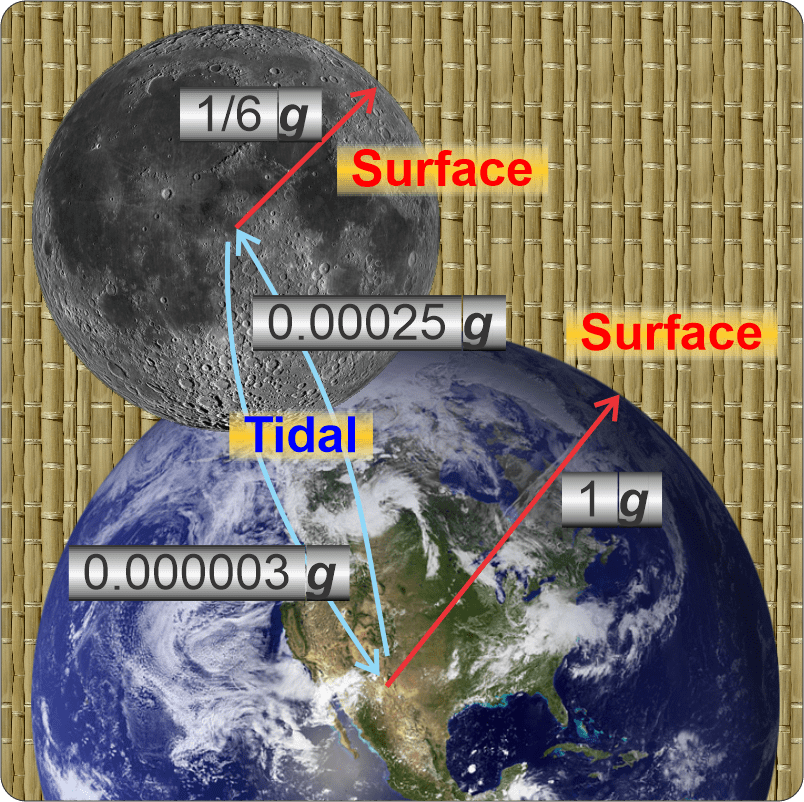
“It is, but it makes a difference where you are and which center you’re thinking about. You’re standing on the Earth so the closest center to you is Earth’s and most of the gravity you feel is the one-gravity pull from there. Suppose you’re standing on the Moon —”

“One-sixth, I know, Mr Moire, but why isn’t it one‑eightieth?”

“Because on the Moon you’re a lot closer to the center of the Moon than you were to the center of the Earth back on Earth. Let’s put some numbers to it. Got a calculator handy?”

“Got my cellphone.”

“Duh. OK, Newton showed us that an object’s gravitational force is proportional to the object’s mass divided by the square of the distance to the center. Earth’s radius is about 4000 miles and the Moon’s is about a quarter of that, so take the mass as 1/80 and divide by 1/4 squared. What do you get?”

“Uhh … 0.2 gravities.”

“One-fifth g. Close enough to one-sixth. If we used accurate numbers we’d be even closer. See how distance makes a difference?”

“Mm-hm. What about Heinlein’s tidal stuff?”

“Ah, now that’s looking in the other direction, where the distance is a lot bigger. Earth-to-Moon is about 250,000 miles. Standing on the Moon, you’d feel Earth’s one‑g gravity diminished by a factor of 4000/250000 squared. What’s that come to?”

“Umm… the distance factor is (4000/250000)² … I get 250 microgravities. Not much. Heinlein made a good bet with his characters deciding that the leak was caused by a nearby rocket crash instead of a moonquake.”

“How about Heinlein’s remark about the Moon’s effect on Earth?”

“Same distance but one eightieth the mass so I divide by 80 — three microgravities. Wow! That can’t possibly be strong enough to raise tides here.”

“It isn’t, though that’s the popular idea. What really happens is that the Moon’s field pulls water sideways from all directions towards the sub‑Lunar point. Sideways motion doesn’t fight Earth’s gravity, it just makes the water pile up in the center.”

“Hah, piled-up water. Weird. Well, I feel better about Heinlein now.”

~~ Rich Olcott

A Star’s Tale

It’s getting nippy outside so Al’s moved his out‑front coffee cart into his shop. Jeremy’s manning the curbside take‑out window but I’m walking so I step inside. Limited seating, of course. “Morning, Al. Here’s my hiking mug, fill ‘er up with high‑test and I’ll take a couple of those scones — one orange, one blueberry. Good news that the Governor let you open up.”

“You know it, Sy. Me and my suppliers have been on the phone every day. Good thing we’ve got long‑term relationships and they’ve been willing to carry me but it gets on my conscience ’cause they’re in a crack, too, ya know?”

“Low velocity of money hurts everybody, Al. Those DC doofuses and their political kabuki … but don’t get me started. Hey, you’ve got a new poster over the cash register.”

“You noticed. Yeah, it’s a beaut. Some artist’s idea of what it’d look like when a star gets spaghettified and eaten by a black hole. See, it’s got jets and a dust dusk and everything.”

“Very nice, except for a few small problems. That’s not spaghettification, the scale is all wrong and that tail-looking thing … no.”

Artist’s impression of AT2019qiz. Credit: ESO/M. Kornmesser
Under Creative Commons Attribution 4.0 International License

“Not spaghettification? That’s what was in the headline.”

“Sloppy word choice. True spaghettification acts on solid objects. Gravity’s force increases rapidly as you approach the gravitational center. Suppose you’re in a kilometer-long star cruiser that’s pointing toward a black hole from three kilometers away. The cruiser’s tail is four kilometers out. Newton’s Law of Gravity says the black hole pulls almost twice as hard on the nose as on the tail. If the overall field is strong enough it’d stretch the cruiser like taffy. Larry Niven wrote about the effect in his short story, Neutron Star.”

“The black hole’s stretching the star, right?”

“Nup, because a star isn’t solid. It’s fluid, basically a gas held together by its own gravity. You can’t pull on a piece of gas to stretch the whole mass. Your news story should have said ‘tidal disruption event‘ but I guess that wouldn’t have fit the headline space. Anyhow, an atom in the star’s atmosphere is subject to three forces — thermal expansion away from any gravitational center, gravitational attraction toward its home star and gravitational attraction toward the black hole. The star breaks up atom by atom when the two bodies get close enough that the black hole’s attraction matches the star’s surface gravity. That’s where the scale problem comes in.”

Al looks around — no waiting customers so he strings me along. “How?”

“The supermassive black hole in the picture, AT2019qiz, masses about a million Suns‑worth. The Sun‑size star can barely hold onto a gas atom at one star‑radius from the star’s center. The black hole can grab that atom from a thousand star‑radii away, about where Saturn is in our Solar System. The artist apparently imagined himself to be past the star and about where Earth is to the Sun, 100 star‑radii further out. Perspective will make the black hole pretty small.”

“But that’s a HUGE black hole!”

“True, mass‑wise, not so much diameter‑wise. Our Sun’s about 864,000 miles wide. If it were to just collapse to a black hole, which it couldn’t, its Event Horizon would be about 4 miles wide. The Event Horizon of a black hole a million times as massive as the Sun would be less than 5 times as wide as the Sun. Throw in the perspective factor and that black circle should be less than half as wide as the star’s circle.”

“What about the comet‑tail?”

“The picture makes you think of a comet escaping outward but really the star’s material is headed inward and it wouldn’t be that pretty. The disruption process is chaotic and exponential. The star’s gravity weakens as it loses mass but the loss is lop‑sided. Down at the star’s core where the nuclear reactions happen the steady burn becomes an irregular pulse. The tail should flare out near the star. The rest should be jagged and lumpy.”

“And when enough gets ripped away…”

“BLOOEY!”

~~ Rich Olcott

  • Thanks to T K Anderson for suggesting this topic.
  • Link to Technical PS — Where Do Those Numbers Come From?.

Traffic Control

Jeremy Yazzie @jeremyaz
hi @symoire, this is jeremy. ive been reading about the osiris‑rex mission to astrroid bennu and how they’re bringing back a sample – so complicated – fancy robot arm, n2 squirter, air‑cleaner thingy – y not just vacuum the dust or pick up a rock?


Sy Moire @symoire
@jeremyaz – quick answer is that Bennu and OSIRIS-REx are already surrounded by the vacuum of space. Sample collectors can’t suck any harder that that. I’ll email you a more complete answer later


Hi, Sy, can you believe this weather? Temps last week were twice today’s high.

Not to a physicist, Sis.
Those 90s and today’s 45 are just Fahrenheit
scale numbers.
Can’t do ratios between them, “twice” does not compute.
I don’t suppose it would help if we went centigrade and said last week’s highs were around 35 and today it’s 5?

No, that’s worse, today’s down by 85% from last week.

Centigrade’s another scale you can’t do ratio arithmetic in. Kelvins is the way to go.
Temp in K tracks the average molecular kinetic energy.
Starts at zero where nothing’s moving and rises in proportion.
Last week’s highs ran around 308 K, today is 278 K.
Today we’re only 10% cooler than last week.

Physicists! Grrrr. However you measure the weather, it still feels cold. No picnic this weekend ;^(


From: Sy Moire <sy@moirestudies.com>
To: Jeremy Yazzie <jeremyaz@college.edu>
Subj: OSIRIS-REx

Jeremy –

OK, now I’m back at the office I’ve got better tech for writing long answers.

First, the “grab a rock” idea has several issues

  • If you pick up a rock, you only have that rock, says nothing about any of its neighbors or the subsurface material it might have smacked into. Dust should be a much better representation of the whole asteroid.
  • The rock might not be willing to be picked up. When the scientists and engineers were planning the OSIRIS‑REx mission, they didn’t know Bennu’s texture — could be one solid rock or a bunch of middle‑size rocks firmly cemented together or a loose “rubble pile” of all‑size rocks and dust held together by gravity alone, or anything in between.
  • Have you ever played one of those arcade games where you try to pick up a toy with a suspended claw gadget and all you’ve got is a couple of control knobs and a button? Picking up a specific rock, even a willing one, is hard when you’re a robot operating 15 light‑minutes away from the home office.

So dust it is, but how to plan dust collection in low gravity when you know nothing about the texture? Something like a whisk broom and dust pan would work unless the surface is too uneven. Something like a drill or disk sander would be good, except to use either one you need a solid footing to work from or else you go spinning one way when the tool spins the other. (That was a problem on the International Space Station.) The Hayabusa2 mission to asteroid Ryugu used a high‑velocity impactor to create dust, but a bad ricochet or shrapnel could kill the OSIRIS‑REx mission. The planners decided that best alternative was puff‑and‑grab.

So why not an astronautical Roomba that just sucks in the dust? The thing about vacuum is that it’s a place where gas molecules aren’t. Suppose you’re a gas molecule. You’re surrounded by your buddies, all in motion and bouncing off of each other like on a crowded 3‑D dance floor. You stay more‑or‑less in place because you’re being hit more‑or‑less equally from every direction. Suddenly there’s a vacuum to one side. You’re not hit as much over there so that’s the direction you and a bunch of your buddies move. If you encounter a dust particle, it picks up your momentum and moves toward the emptiness where it could be trapped in somebody’s filter.

The planners decided to capture dust particles by entraining them in a flow of gas molecules through a filter. To make gas flow you need more gas on one side then the other. Gas molecules being few and far between in space, the obvious place to put your pusher gas is inside the filter. Hence the nitrogen squirt technique and the “air‑cleaner thingy.”

— Sy

Diagram of TAGSAM in operation
Adapted from asteroidmission.org/?attachment_id=1699
Credit: University of Arizona

~~ Rich Olcott

Flattening The Curve

<chirp chirp> My phone’s non-business ring-tone. “Moire here.”

“Hi, Mr Moire, it’s me, Jeremy, again. Sorry for the hold-up. My phone’s on the charger now so we can keep going about the Logistics Curve and all.”

“Logistic Curve, Jeremy, singular. Logistics plural has to do with managing the details of a military or business operation. That’s quite different from population growth which is what the Logistic Curve is about. Though come to think of it, these days we’re seeing a tie‑in. So where were we?”

“We had that S-shaped Logistic Curve with exponential growth at the beginning but then it plateaus and you showed me a humpy curve that’s the slope of the other one and you said the humpy curve is like R = K*S*(N‑S) if N is everybody and S is how many are susceptible to the virus. But you kind of skipped over K.”

“True and I’ll get to K, but that ‘humpy’ curve is important. In the context of the pandemic, it’s people per day — how many catch the virus, how many show up for medical care, how many need ventilators or even mortuary care — there’s a different K for each question. The hump is what we’re trying to get control of. The K factors summarize a whole pipeline of ifs and maybes. Some of them are knobs that we may be able to use to flatten the hump.”

“We can do that? How?”

“Good question. Here, let me send your phone another image. Let me know when you receive it.”

“It’s here, Mr Moire. Looks like you’ve got three Logistic Curves but they’re stretched out different amounts.”

“Stretched out on the time axis, and that’s crucial. I generated those three plots by using different values for K. Sooner or later in all three models everyone catches the bug. In the blue-line case, though, that happens over a much longer time interval than in the red-line case. If you’re a public health official or hospital administrator you pray for the blue-line case — the slow initial rise gives you a heads-up and more time to get ready for future incoming cases. Better yet, because the cases-per-day peak is flatter you don’t need as many masks and ventilators to take of the patients and your front-line people are less likely to be over‑extended. Assuming you’ve hired enough in the first place.”

“So the government wants to reduce the K numbers to get to the blue-line case.”

“Absolutely. Keep in mind, K is such a complicated summary of things that realistic models are complex. Experienced modelers know that the more factors you put into a model, the riskier the predictions become. Anyway some of the things that go into K we can’t control, we can only measure or estimate them and try to account for what’d happen if something changes.”

“Like what?”

“Suppose you’re exposed to the virus. What’s the probability that you’ll come down with symptoms bad enough to need medical care? Current data suggests those odds depend a lot on uncontrollable things like your age and medical history. A model for a retirement community almost certainly needs a different set of K-values then a model for a college town full of teens and twenty-somethings. But that gets into a different cluster of factors.”

“That’s for sure. My grandparents are a lot more careful about their health than my crew is.”

“Which gets us into the K-factors we can at least try to manage. Simple example — you can’t catch the virus if you’re not exposed to it. That’s what Social Distancing is all about and that’s why you’re staying at home, thank you very much. Typically, models gauge that piece by surveying what fraction of the population is complying with the stay-at-home, masking and 6-feet-away rules. We need to get to 70% or better to keep the patients-per-day rate down to what the hospitals can cope with. A vaccine, when we get one, will have the same effect but that’s a year away.”

“Yeah, and if someone invents a good treatment so people don’t have to go on ventilators, that’d help the K for that end of the pipeline.”

“Get to work on it, Jeremy.”

~~ Rich Olcott