A Disk of Heat And Violence

Susan suddenly sits bolt upright. “WOW! Kareem, that Chicxulub meteor that killed off the dinosaurs — paleontologists found iridium from it all over the world, right?”

“Right, the famous K‑T or K‑Pg boundary So?”

“It’d take a lot of iridium to cover the world. Iridium’s deep in the Periodic Table’s Soft Siderophile territory. Iron’s Soft. When Earth was molten, iron would extract and concentrate iridium. That’s why there’s so little iridium in Earth’s crust ’cause it’s all gone to the core. That iridium‑carrying meteorite must have been the iron kind.”

“Probably.”

Vinnie guffaws. “HAW! Earth’s Hard and crunchy on the outside, Soft and chewy in the inside, just like a good cookie.”

“Or an armored knight, from the dragon’s viewpoint. But how did Earth get that way, Cathleen?”

“Long story, Sy. The academics are still arguing about the details.”

“I love a good story, especially if it ends up explaining asteroid Psyche.”

“It starts 4½ billion years ago, when the Solar System was a rotating disk of galactic debris, clouds of hydrogen plus heavier dust and grit spewed out by energetic stars. Some of the atoms in that grit were important, right, Kareem?”

“Yup. Iron and nickel for planetary cores, silicon and oxygen for the crusts, radioactive isotopes of potassium, uranium and thorium but especially the short‑lived radioactives like aluminum‑26. Half‑life for that one’s only a million years.”

Al, Eddie and Vinnie erupt.
 ”If the short‑timers are gone, how come you say they were important?”
  ”How do we know they were even there?”
   ”If it’s such a short‑timer, is that stuff even a thing any more?”

Kareem’s not used to such a barrage but Cathleen’s a seasoned teacher. “Aluminum‑26 definitely is still a thing, because it’s continually produced by cosmic rays colliding with silicon atoms that aren’t too deeply buried. The production rate is so steady that Kareem’s colleagues estimate how long a meteorite was exposed to cosmic rays from its load of aluminum‑26 decay products compared to its related stable isotopes. We know aluminum‑26 was in the early debris because we’ve found its decay products on Earth. We even know how much — about 50 atoms per million stable aluminum atoms.”

Kareem regains his footing. “As to why it’s important, molten silicate droplets in the early system became chondrules when they aggregated to form chondritic meteorites. The droplets couldn’t have stayed that hot just from nuclear fission by their long‑lived radioactives. The short‑timers, especially aluminum‑26, must have supplied the extra heat early on. If short‑timers could keep the droplets molten, they certainly could have kept the newly‑forming planets molten for a while. Being fluid’s important because that’s the only state where Susan’s Hard‑Soft phase separation can happen.”

Cathleen nods. “The radioactives were just part of the story, though. The early system was a chaotic place. Forget notions of everything smoothly whirling around like the rings of Saturn. Except for the biggest objects, the idea of an orbit was just silly. Each object was gravitationally influenced by beaucoodles of other objects of all sizes that didn’t even all go in the same direction. There was crashing, lots of crashing. Every smash‑up converted kinetic energy to heat, lots of heat. Each collision could generate fragments which would cascade on to other collisions, maybe even become meteorites. Large objects would accumulate mass and heat energy in violent mergers with smaller objects. A protoplanet’s atom‑level Hard‑Hard and Soft‑Soft interactions would have plenty of chemical opportunities to assemble cohesive masses rising or sinking through the liquid melt just because of buoyancy and there you’ve got your layers.”

“But collisions didn’t have to be violent, Cathleen. Fragments could hang together through gravity or surface stickiness. That’s how the Bennu and Ryugu rubble pile asteroids formed.”

“Good point, Kareem, and that brings us to Psyche. We know its density is higher than stone but less than iron. The asteroid could be part of a planetoid’s interior, surviving after violent collisions chipped away the surface rock. It could be a rubble pile of loose metallic bits. It could be a mix of metal and rock like the Museum’s pallasite slice. Or an armored shell. We just won’t know until the Psyche mission gets there.”

~~ Rich Olcott
Planetary Chemistry

The deal’s gone round to Susan. “Another thing, Kareem — your assumption ignores Chemistry.”

“Didn’t Cathleen take care of that with her nuclear reactions in the star’s core?”

“Not even close. Nuclear reactions in general are literally a million or more times more energetic than chemical ones. Your classic AA alkaline battery is 1½ volts, right, but the initial step in Cathleen’s proton‑to‑helium process would net 1½ megavolts if we could set it up in a battery. Regular chemistry just re‑arranges atoms, doesn’t have a chance when nuclear’s going on.”

“Like trying to carve a cameo with dynamite, huh?”

“Not quite. If nuclear is dynamite, then bench chemistry is a bandsaw. I’d say the analog for carving a cameo would be cell biology. That operates at the millivolt level.”

Cathleen holds up her tablet again. “Speaking of abundance graphs, here’s another one I built for my Astronomy class. I divided each element’s atom count in Earth’s crust by its atom count in the Universe. I color-coded the points according to Goldschmidt’s classification scheme. The lines mark the average ratio for each class. Compared to the Universe, oxide‑formers are ten times more concentrated in the crust than sulfide‑formers are, 150 times more concentrated than iron‑mixers, 900 times more than gases. I see the numbers but I don’t feel comfortable with them. Kareem, what do I tell my students?”

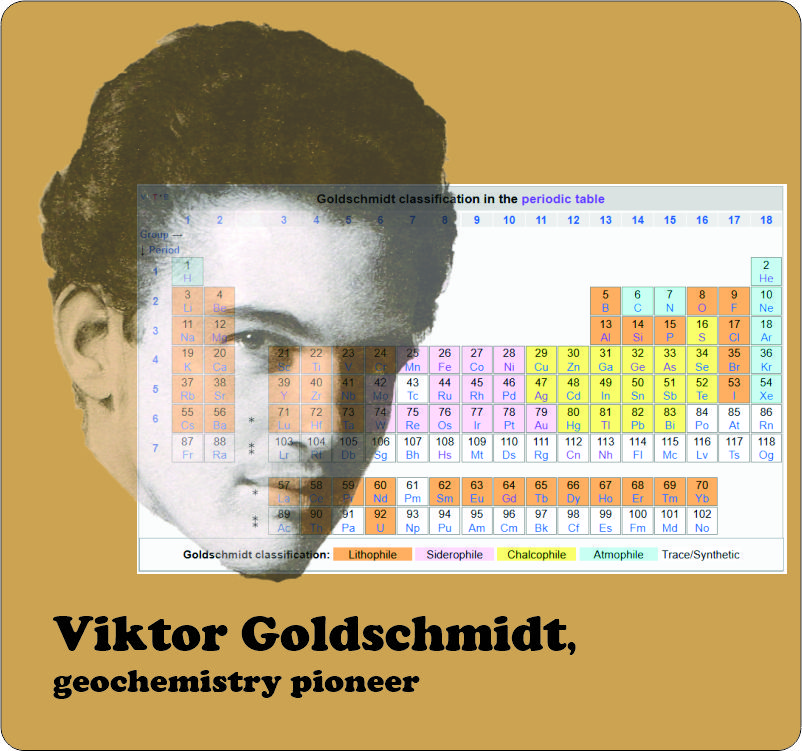
“Happy to explain the what, but Susan will have to explain the why. Goldschmidt started as a mineralogist, invented Geochemistry while bouncing around between Sweden, Norway and Germany until he barely escaped from the Nazis and was smuggled into England. He pioneered using crystallographic and thermodynamic analysis in geology. His scheme slotted each chemical element into one of those five classes. For example, he lumped the five lightest inert gases together with hydrogen, nitrogen and carbon into what he called the Atmophile class because they mostly stay in the atmosphere.”

“Carbon?”

“Yeah, that one’s iffy because coal and limestone. His reasoning involved carbon monoxide, carbon dioxide and methane which don’t show up in rocks. There are other edge cases, like radon which ought to count as a gas but shows up in rocks and basements because it’s locked where it was generated as part of uranium’s decay sequence. We mostly find uranium in oxide minerals so Goldschmidt put it and radon into his Lithophile class of metals that occur in oxides. That’s opposed to mercury, silver and a dozen or so other elements that generally show up in sulfide minerals — that’s his Chalcophile class. There’s another dozen or so that dissolve into molten iron so they’re Siderophiles. We don’t see much of those in Earth’s crust because they were swept down to the core as the molten planet differentiated. Finally, there’s a whole batch of radioactives that huddle together as Other. But why those elements do those things, I dunno. Susan, your turn.”

“It’s a lovely application of Pearson’s Hard‑Soft Acid‑Base theory. Hard chemical thingies have a high charge‑to‑volume ratio. Also, their charge is tightly bound so it doesn’t polarize. Oxide, carbonate and fluoride ions are Hard, and so are alkali and alkali metal ions like sodium and calcium. Uranium’s Hard when it’s at high oxidation state like in a uranyl ion UO22+. (Eddie, stop snickering, that’s its proper name.) Soft thingies are just the reverse — big thingies with mushy electron clouds. Iodide is Soft and so are mercury, silver and gold ions. Bulk metals are extremely Soft, chemically speaking, because their electron clouds are so diffuse. The point is, Hard thingies combine best with Hard thingies, Soft thingies with Soft.”

“So the Lithophiles are Hard metals that make Hard‑Hard stony oxides. I suppose that extends to fluorides and carbonates?”

“Sure.”

“Then the sulfide ores, Goldschmidt’s Chalcogens, are Soft‑Soft compounds. The Siderophile metals combine with each other better than anyone else, and the Atmophiles don’t combine with anything. Cool.”

“Ah‑HAH! Then on my graph the Hard oxides are most common in the crust because they’re light and so float above the heavier Soft sulfides and the ultra‑Soft metals that sink to the core. Our planet is layered by Hardness.”

“Does the same logic apply to asteroids?”

“Sort of.”

~~ Rich Olcott

The Road to Gold

Cathleen and Susan share a look.
 ”A conclusion way too far, Kareem.”
  ”Yep, you’ve overbounded your steps.”

Kareem tosses in a couple of chips. “Huh? What did I skip over? Where?”

Cathleen sees his bet and raises. “When you said that the Psyche asteroid’s gold content would be similar to what we dig up on Earth, you skipped many orders of magnitude in applying the Cosmological Principle.”

“I didn’t realize I’d done that. What’s the Cosmological Principle?”

“There’s several ways to state it, but they boil down to, ‘We’re not special in the Universe.‘ We think that fundamental constants and physical laws determined here on Earth have the same values and work the same way everywhere. Astrophysics just wouldn’t work as well as it does if the electron charge or Newton’s Laws of Motion were different a million lightyears away from us.”

“Wait, what about that galaxy that’s going to collide with us even though everything’s supposed to be flying away?”

“Fair question. The un‑boiled Principle includes some qualification clauses, especially the one that says, ‘when averaged over a large enough volume.’ How big a volume depends on what you’re studying. For motions of galaxies and such you have to average over a couple hundred million lightyears. Physical constants measured locally seem to be good out to the edge of the Observable Universe. Elemental abundances are somewhere in‑between — the very oldest, farthest‑away galaxies have less of the heavy stuff than we do around here. <pulls her tablet from her purse> Which brings me to this chart I built for one of my classes.”

“You’re going to have to explain that.”

“Sure. Both graphs are about element abundance. We get the numbers from stellar and galactic spectra so we’re averaging the local Universe out to a few hundred thousand lightyears. Left‑to‑right we’ve got hydrogen, helium, lithium and so on out to uranium in the big graph, out to iron in the small one. Up‑and‑down we’ve got atom count for each element, divided by the number of iron atoms so iron scores at 1.0. The range is huge, 31 000 hydrogens per single iron atom, all the way down to 17 rhenium atoms per billion irons. I needed this logarithmic scale to make the points I wanted to make in class.”

Vinnie sweetens the pot. “You’ve got that nice zig‑zag going in the little graph, Cathleen, but things get weird around iron and the big graph has that near‑constant series starting around 60. Why the differences?”

<lays down Q‑J‑10‑9‑8, all hearts, pulls in the chips> “Perfect straight line, Vinnie. The different behaviors come from nuclear cookery at different stages of a star’s life. Most new‑born stars start by fusing hydrogen nuclei, protons, to produce helium nuclei, alpha particles. Those two swamp everything else. As the star evolves to higher temperatures, proton‑addition processes generate successively more massive nuclei. Carbon starts a new pattern, because alpha‑addition processes it initiates generate the sawtooth pattern you picked up on — an alpha has two protons so each alpha fusion contributes to the atomic number peak two units along the line.”

“What happens with iron?”

“What happens when you put a blow torch to a red‑hot metal ball?”

“The ball melts.”

“Why?”

“Cause the extra energy’s too much for what holds the ball together.”

“Well, there you go. The forces that hold an atomic nucleus together have their limits, too. Iron and its next‑but‑one neighbor nickel are right on the edge of stability for alpha reactions. The alpha process in the core of a normal star can’t make anything heavier.”

“So how do we get the heavy guys?”

“Novas, supernovas and beyond. Those events are so energetic and so chaotic there’s non‑zero probability for any kind of atom to form and evolve to something stable before it can break down. Massive atoms just have a lower probability so there’s less of them when things settle down. Gold, for instance, at only 330 atoms per billion atoms of iron. The explosions spray heavy atoms throughout their neighborhood.”

Kareem antes the next pot. “So you’re saying my mistake was to assume that asteroid Psyche’s composition would match whole‑Universe heavy‑element statistics?”

“Well, that was his first mistake, right, Susan?”

~~ Rich Olcott

GOLD! GOLD! GOLD! Not.

“Ya think there’s water on the Psyche asteroid, Kareem?”

“No more than a smidgeon, Cal.”

“Why so little? They’ve found hundreds of tons of it on the Moon.”

“Wait, water found on the moon? I’d heard about the Chinese rover finding sulfur but I didn’t think anybody’s gotten into a shadowy area that may be icy because sunlight never heats it.”

“Catch up, Eddie. We’ve known about hydrogen on the Moon since the Lunar Reconnaissance Orbiter almost 15 years ago. We just weren’t sure any of it was water‑ice. Could be hydroxyls coating the outside of oxide and silicate moon rocks, or water of crystallization locked into mineral structures.”

“That’s the kind of caveat I’d expect from a chemist, Susan, throwing chemical complexity into the mess.”

“Well, sure, Sy. Silicate chemistry is a mess. Nature rarely gives us neat lab‑purified materials. The silicon‑oxygen lattice in a silicate can host almost any combination of interstitial metal ions. On top of that, the solar wind showers the Moon with atomic and ionic hydrogens eager to bond with surface oxygens and maybe even migrate further into the bulk. The Apollo astronauts found plagioclase rocks, right? That name covers a whole range of aluminum‑silicate compositions from calcium‑rich like we find in meteorites to sodium‑rich that are common in Earth rocks. The astronauts’ rocks were dry, dry, dry, but that collecting was done where the missions landed, near the Moon’s equator. What’s got the geologists all excited is satellite data from around the Moon’s south pole. The spectra suggest actual water molecules at or just below the surface there. Lots of water.”

“Mm-hm, me and a lot of other Earth‑historians would love to compare that water’s isotopic break‑out against Earth and the asteroids and comets.”

“Understood, Kareem. but why so down on Psyche having water?”

“Two arguments. Attenuation, for one. Psyche is 2½ times farther from the Sun than the Earth‑Moon system. Per unit area at the target, stuff coming out of the Sun thins out as the square of the distance. The solar wind near Psyche is at least 85% weaker than what the Moon gets. If Psyche’s built up any watery skin it’s much thinner than the Moon’s. And that’s assuming that they’re both covered with the same kind of rocks.”

“The other argument?”

“Depends on Psyche’s density which we’re still zeroing in on.”

“This magazine article says it’s denser than iron. That’s why they’re shouting ‘GOLD! GOLD! GOLD!‘ like Discworld Dwarfs, ’cause gold is heavier than iron.”

“Shouldn’t that be ‘dwarves‘?”

“Not according to Terry Pratchett. He ought to know ’cause he wrote the books about them.”

“True. So’s saying gold and a lot of the other precious metals are much denser than iron. Unfortunately, it now looks like Psyche isn’t. An object’s density is its mass divided by its volume. You measure an asteroid’s mass by how it affects the orbits of nearby asteroids. That’s hard to do when asteroids average as far apart as the Moon and the Earth. Early mass estimates were as much as three times too big. Also, Psyche’s potato‑shaped. Early size studies just happened to have worked from images taken when the asteroid was end‑on to us. Those estimates had the volume too small. Divide too‑big by too‑small you get too‑big squared.”

“So we still don’t know the density.”

“As I said, we’re zeroing in. Overall Psyche seems to be a bit denser than your average stony meteorite but nowhere near as dense as iron, let alone gold or platinum. We’re only going to get a good density value when our spacecraft of known mass orbits Psyche at close range.”

“No gold?”

“I wouldn’t say none. Probably about the same gold/iron ratio that we have here on Earth where you have to process tonnes of ore to recover grams of gold. Your best hope as an astro‑prospector is that Psyche’s made of solid metal, but in the form of a rubble‑pile like we found Ryugu and Bennu to be. That would bring the average density down to the observed range. It’d also let you mine the asteroid chunk‑wise. Oh, one other problem…”

“What’s that?”

“Transportation costs.”

Adapted from a NASA illustration
Credit: NASA/JPL-Caltech/ASU

~~ Rich Olcott

Comets, Asteroids And Water

“So what about the article, Cal?”

“What article?”

“The article about NASA’s Psyche mission to Psyche, the article in the magazine that you came in here ranting about. What did it say?”

“Not much, actually. It was mostly gee‑whizzery about how the Psyche asteroid is solid metal and probably worth trillions because of its gold and stuff. It’s a new mag, probably desperate for eyeball grabbers so I’m not making bets on it but is any of that possible?”

Kareem, our geologist, takes the bait. “You guys know I specialize in old rocks because they tell us Earth’s early geochemistry. I want to identify when in our history liquid water gave life a chance to start up. That’s why I keep up with asteroid news. Asteroids are the oldest rocks around, far older than what we’ve been able to dig up from the ancient cratons in Canada and Australia. Cratonic rocks max out at around 4 billion years but asteroids and Earth as a planet go back a half‑billion years more. We’ve learned a lot from asteroid‑sourced meteorites, but they’re just a tease. The cooking they get on their way through the atmosphere can burn out part of any water they had. That’s why I followed the Hayabusa2 and OSIRIS‑REx missions so closely — they brought us fresh samples from asteroids that should date back to the Solar System’s birth.”

“How about comets, Kareem? They’re ice‑balls. Those gorgeous tails they spout when they warm up, they’re all water and CO2 and like that. Earth coulda got our water from comets.”

“Good point, Al — sorry, I mean Cal — except for two things. First, asteroids are a lot closer to Earth than comets. The densest part of the asteroid belt courses twice as wide as Earth’s orbit, about a hundred million miles outward from us. Short‑period comets generally drop in from the Kuiper Belt, which is about fifteen times wider. Long‑period comets hang out a thousand times farther out.”

“Yeah, but they do head in our direction every so often and a billion years is a long time. What’s your second thing?”

“Isotopes. You know about light hydrogen and heavy hydrogen, right? They’re both hydrogen, one proton and one electron, but the heavy kind carries a neutron along with the proton in its nucleus. Their chemistry is the same unless speed is a factor. At any given temperature, the lighter atom moves about 40% faster than its heavier cousin. Water molecules containing only light hydrogens evaporate faster than their heavier neighbors because the speedy atoms are primed to rip their molecule loose from the surrounding liquid or ice.”

“Wait, water evaporates from ice?”

“Mm-hm, except technically it’s called sublimation when ice is involved. That was a crucial process in the Solar System’s history. Five billion years ago we were this big disk of gas and dust. When the Sun finally got dense enough to light up, its radiated heat energy baked volatile components like water and such out of the metals and silicates in the rocky inner system. That’s why Earth had to import our water once we cooled off. Volatility is relative, of course. Eventually the volatiles condensed back to solid form in the ice belts near and beyond Uranus and Neptune. That’s your cometary ice balls.”

“But now you’re gonna say that ancient ice evap–, sublimated, too.”

“Sure. It’s a continual process. Sometimes a released molecule docks back on again, but mostly not. Anyhow, the light water molecules happily bounced off into the Universe whenever they could. The heavy ones stayed put. Cometary ice gradually became roughly twice as heavy‑enriched as the rest of the Solar System including us.”

“So when you look at Earth water…”

“It can’t have come from comets which is why we’re looking at asteroids.”

“Ah, but does asteroid water match Earth’s?”

“Mostly, Sy. We’ve found a few meteorites with a high heavy‑hydrogen content, but so few that they’d be <ahem> swamped by the water from all the other meteorites. Most meteorite isotopes match what we have on Earth. You’re drinking asteroid water.”

Comet Hale-Bopp Credit: E. Kolmhofer, H. Raab; Johannes-Kepler-Observatory, Linz, Austria, CC BY-SA 3.0, Wikimedia Commons
Asteroid Bennu Credit: NASA/Goddard/University of Arizona

~~ Rich Olcott

Eclipse Vectors

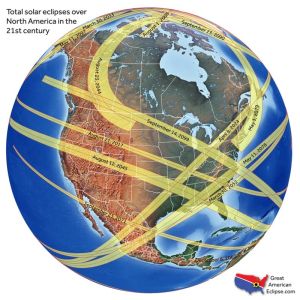
“I think I understand why we have eclipse seasons, Dr O’Meara, but why do the two eclipses in a season travel in such different directions?”

“Put this question on top of Teena’s, Cathleen. Everyone knows the Sun rises in the East because the Earth rotates towards the East. But it seems like eclipses fly eastward even faster than the Earth turns. If that’s true, why?”

“As an Astronomy educator, Sy, I wish ‘everyone’ were truly everyone. You wouldn’t believe the arguments I get from some students when I’m trying to teach 21st Century material. Why are they even in my class?”

“We can only wonder. You and the Flatties, Kareem and the 6000‑year Earthers, poor Jennifer over in Public Health having to cope with the anti‑vaxxers; these contrarians seem to be everywhere. They’re excellent models of Orwellian doublethink — they happily use their science‑dependent smart phones, internet and GPS while they’re trashing Science. Split brains? I dunno.”

“C’mon, Uncle Sy, that’s boring grown‑up stuff. What about my eclipses? Why do they go north or south like that? Does it have to do with those angles that were drawn too big?”

“Sorry, sweetie. Dr O’Meara showed us that the Moon can only make an eclipse if it’s near the Solar System’s plane where Earth’s center stays. The angle of the Moon’s orbital plane only matters when the Moon is away from there.”

“Earth’s center is the Equator! All the eclipses should go on the Equator. But they don’t. That’s wrong.”

“The Equator’s around Earth’s center, Teena, but so are other circles. Think of your globe at home. Does the North Pole point straight up?”

“Noo‑oh … you mean the tilt? Mom said that was about Winter and Summer.”

“Well, she’s not wrong. In the northern hemisphere we have Summer when the North Pole tilts toward the Sun, Winter when it tilts away. That’s only part of the story, though. In Spring and Fall the tilt is broadside to the Sun. Not as hot as Summertime, not as cold as Winter. Those three gyroscopes give us eclipse seasons. But they do more. Look at these diagrams.”

“Sorry, I don’t understand what you’re showing me.”

“No worries. In the upper one, the Earth’s in the rear. The North Pole is the green arrow. The Equator’s the yellow band. Pole and Equator are both tilted 23°. The Sun is in front, shining at the Earth. The Earth orbits the Sun counterclockwise so it’s moving to our left. Moving in that direction gives the northern hemisphere more and more daylight so it’s northern Springtime going towards Summer. Okay?”

“Yyyes….”

“Good. The sketch shows eclipse conditions, when the Moon and its shadow are in Earth’s orbital plane. The only places on Earth that can see the eclipse are on the red band. That’s another circle where the plane intersects the Earth’s surface. What direction does that band point on Earth?”

<chortle> “It goes northeast, just like I noticed on that map! Okay, let me think about the other picture… The North Pole’s a gyroscope and doesn’t change direction so we’re looking at us from the other side … Yeah! That red band goes southeast on Earth. Perfect! … Umm, everything’s upside‑down for Bindi in Australia, so does she … Wait, in the upper picture when it’s Springtime for us it’s Autumn for her so her Autumn eclipses go northeast, just like our Springtime ones do! And her Spring’s the bottom picture and her Springtime eclipses go southeast like our Autumn ones, right?”

“Smart girl! I’m going to tell your Mom about your thinking and she’ll be so proud of you. Now, Cathleen, how about speedy eclipses going east faster than the Earth does?”

“It’s not the eclipse going fast, Sy, it’s the Moon. Relative to the Sun‑Earth line, the Moon in its orbit is traveling eastward at just under 3700 kilometers per hour. Meanwhile, a point on Earth’s Equator is heading in the same direction at just under 1700 kph. Places away from the Equator move even slower. The Moon and its shadow win the race going away.”

~~ Rich Olcott

  • Thanks again to Naomi Pequette for her expertise and eclipse‑related internet links.

Three Feet High And Rising

“Bless you, Al, for your air conditioning and your iced coffee.”

“Hiya, Susan. Yeah, you guys do look a little warm. What’ll you have, Sy and Mr Feder?”

“Just my usual mug of mud, Al, and a strawberry scone. Put Susan’s and my orders on Mr Feder’s tab, he’s been asking us questions.”

“Oh? Well, I suppose, but in that case I get another question. Cold brew for me, Al, with ice and put a shot of vanilla in there.”

“So what’s your question?”

“Is sea level rising or not? I got this cousin he keeps sending me proofs it ain’t but I’m reading how NYC’s talking big bucks to build sea walls around Manhattan and everything. Sounds like a big boondoggle.” <pulling a crumpled piece of paper from his pocket and smoothing it out a little> “Here’s something he’s sent me a couple times.”

“That’s bogus, Mr Feder. They don’t tell us moon phase or time of day for either photo. We can’t evaluate the claim without that information. The 28‑day lunar tidal cycle and the 24‑hour solar cycle can reinforce or cancel each other. Either picture could be a spring tide or a neap tide or anything in‑between. That’s a difference of two meters or more.”

“Sy. the meme’s own pictures belie its claim. Look close at the base of the tower. The water in the new picture covers that sloping part of the base that was completely above the surface in the old photo. A zero centimeter rise, my left foot.”

“Good point, Susan. Mind if I join the conversation from a geologist’s perspective? And yes, we have lots of independent data sources that show sea levels are rising in general.”

“Dive right in, Kareem, but I thought you were an old‑rocks guy.”

“I am, but I study old rocks to learn about the rise and fall of land masses. Sea level variation is an important part of that story. It’s way more complicated than what that photo pretends to deny.”

“Okay, I get that tides go up and down so you average ’em out over a day, right? What’s so hard?”

“Your average will be invalid two weeks later, Mr Feder, like Sy said. To suppress the the Sun’s and Moon’s cyclic variations you’d have to take data for a full year, at least, although a decade would be better.”

“I thought they went like clockwork.”

“They do, mostly, but the Earth doesn’t. There’s several kinds of wobbles, a few of which may recently have changed because Eurasia weighs less.”

“Huh?”
 ”Huh?”
  ”Huh?”

“Mm-hm, its continental interior is drying out, water fleeing the soil and going everywhere else. That’s 10% of the planet’s surface area, all in the Northern hemisphere. Redistributing so much water to the Southern hemisphere’s oceans changes the balance. The world will spin different. Besides, the sea’s not all that level.”

“Sea level’s not level?”

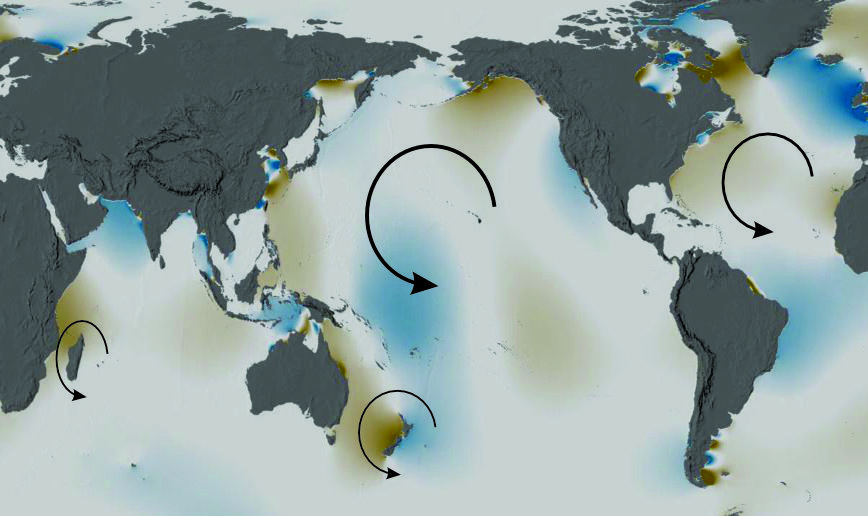
“Nope. Surely you’ve sloshed water in a sink or bathtub. The sea sloshes, too, counterclockwise. Galileo thought sloshing completely accounted for tides, but that was before Newton showed that the Moon’s gravity drives them. NASA used satellite data to build a fascinating video of sea height all over the world. The sea on one side of New Zealand is always about 2 meters higher than on the opposite side but the peak tide rotates. Then there’s storm surges, tsunamis, seiche resonances from coastal and seafloor terrain, gravitational irregularities, lots of local effects.”

Adapted from a video by NASA’s Scientific Visualization Studio

Susan, a chemist trained to consider conservation of mass, perks up. “Wait. Greenland and Antarctica are both melting, too. That water plus Eurasia’s has to raise sea level.”

“Not so much. Yes, the melting frees up water mass that had been locked up as land-bound ice. But on the other hand, it also counteracts sea rise’s major driver.”

“Which is?”

“Expansion of hot water. I did a quick calculation. The Mediterranean Sea averages 1500 meters deep and about 15°C in the wintertime. Suppose it all warms up to 35°C. Its sea level would rise by about 3.3 meters, that’s 10 feet! Unfortunately, not much of Greenland’s chilly outflow will get past the Straits of Gibraltar.”

~~ Rich Olcott

The Sky’s The Limit

Another meeting of the Acme Pizza and Science Society, at our usual big round table in Pizza Eddie’s place on the Acme Building’s second floor. (The table’s also used for after‑hours practical studies of applied statistics, “only don’t tell nobody, okay?“) It’s Eddie’s turn to announce the topic for the evening. “This one’s from my nephew, guys. How high up is the sky on Mars?”

General silence ensues, then Al throws in a chip. “Well, how high up is the sky on Earth?”

Being a pilot, Vinnie’s our aviation expert. “Depends on who’s defining ‘sky‘ and why they did that. I’m thinking ‘the sky’s the limit‘ and for me that’s the highest altitude I can get up to legal‑like. Private prop planes generally stay below 10,000 feet, commercial jets aren’t certified above 43,000 feet, private jets aren’t supposed to go above 51,000 feet.”

Eddie counters. “How about the Concorde? And those military high-flyers?”

“They’re special. The SST has, um, had unique engineering to let it go up to 60,000 feet ’cause they didn’t want sonic boom complaints from ground level. But it don’t fly no more anyhow. I’ve heard that the Air Force’s SR-71 could hit 85,000 feet but it got retired, too.”

Al’s not impressed. “All that’s legal stuff. There’s a helicopter flying on Mars but the FAA don’t make the rules there. What else we got?”

Geologist Kareem swallows his last bite of cheese melt. “How about the top of the troposphere? That’s the lowest layer of our atmosphere, the one where most of our weather and sunset colors happen. If you look at clouds in the sky, they’re inside the troposphere.”

“How high is that?”

“It expands with heating, so the top depends where you’re measuring. At the Equator it can be as high as 18½ kilometers; near a pole in local winter the top squeezes down to 6 kilometers or so. And to your next question — above the troposphere we’ve got the stratosphere that goes up to 50 kilometers. What’s that in feet, Sy?”

<drawing Old Reliable and screen-tapping…> “Says about 31.2 miles or 165,000 feet. Let’s keep things in kilometers from here on, okay?”

“Then you’ve got the mesosphere and the exosphere but the light scattering that gives us a blue sky happens below them so I’d say the sky stops at 50 kilometers.”

Al’s been rummaging through his astronomy magazines. “I read somewhere here that you’re not an astronaut unless you’ve gone past either 80 or 100 kilometers, which is weird with two cut‑offs. Who came up with those?”

Vinnie’s back in. “Who came up with the idea was a guy named von Kármán. One of the many Hungarians who came to the US in the 30s to get away from the Nazis. He did a bunch of advanced aircraft design work, helped found Aerojet and JPL. Anyway, he said the boundary between aeronautics and astronautics is how high you are when the atmosphere gets too thin for wings to keep you up with aerodynamic lift. Beyond that you need rockets or you’re in orbit or you fall down. He had equations and everything. For the Bell X‑2 he figured the threshold was around 52 miles up. What’s that in kilometers, Sy?”

“About 84.”

“So that’s where the 80 comes from. NASA liked that number for their astronauts but the Europeans rounded it up to 100. Politics, I suppose. Do von Kármán’s equations apply to Mars as well as Earth?”

“Now we’re getting somewhere, Vinnie. They do, sort of. It’s complicated, because there’s a four‑way tug‑of‑war going on. Your aircraft has gravity pulling you down, lift and centrifugal force pulling you up. Lift depends on the atmosphere’s density and your vehicle’s configuration. The fourth player is the kicker — frictional heat ruining the craft. Lift, centrifugal force and heating all get stronger with speed. Von Kármán based his calculations on the Bell X‑2’s configuration and heat‑management capabilities. Problem is, we’re not sending an X‑2 to Mars.”

“Can you re‑calibrate his equation to put a virtual X‑2 up there?”

“Hey, guys, I think someone did that. This magazine says the Karman line on Mars is 88 kilometers up.”

“Go tell your nephew, Eddie.”

~~ Rich Olcott

Listen to The Rock Music

“Kareem, how did we learn this stuff about the Earth’s insides? I mean, clouds and winds hundreds of miles down?”

“Fair question, Eddie. Jules Verne’s Voyage to The Center of The Earth couldn’t happen, because hollow volcanic tubes don’t go near far enough down. Drilling’s not useful for exploring the mantle — we’ve only gotten about six miles through the seafloor crust and that’s still probably a dozen miles up from where the mantle starts. Forget what you’ve seen in the comics or a movie, we won’t in our lifetimes have a sub‑like vehicle that can melt through rock, withstand million‑atmosphere pressures and swim through superheated lava. So what we do is oscillate, triangulate and calulate.”

“I’ll bite. Oscillate? Triangulate?”

“How we do earthquake chasing, Sy. For thousands of years, humanity experienced a quake as a local jolt. It wasn’t until the 1850s that we realized each quake incident has multiple components: a sudden rupture somewhere, the resulting shock that travels through the Earth to other locations, and maybe aftershocks from follow‑on ruptures. The shock is a whole train of waves. We used to record them on those big cylindrical seismograph drums with oscillating pens, but most stations have gone digital since the early 90s. More accurate data, easier to handle but less picturesque.”

“True. The TV weather guys love pics of the big cylinder with all the wiggly lines. How about the triangulations?”

“Suppose you feel an earthquake shock. How do you find out where the rupture occurred and how big it was?”

“Hard to do from one location. A really big one far away would give you the same blip as a small one close by. And you probably wouldn’t know how deep it was or what direction it came from. I guess you’d need to compare notes with some far‑away observers. The one closest to the rupture would have received the strongest signal.”

“Yeah, Sy, and if everybody kept track of when they felt the jolt then you could draw a map with the different times and that’d zero in on it. Uhh … three places and you’ve got it.”

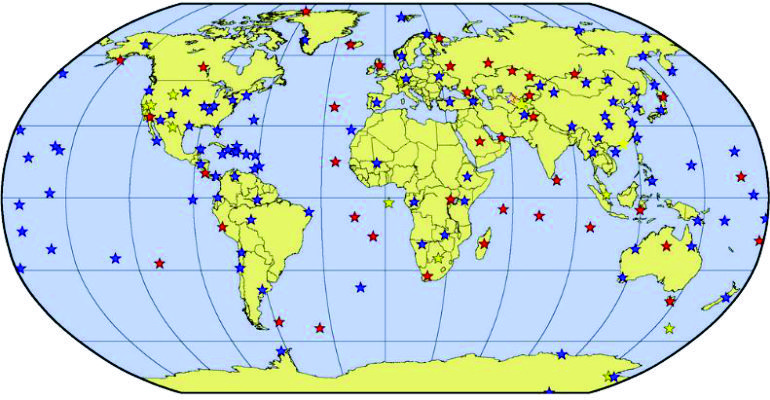
The IRIS Global Seismic Network as of 2021.

“Three points makes a triangle, Eddie, you’ve just described triangulation. It’s a general principle — the more points of view you have to work with, the better the image. Seismic tomography is all about merging well‑characterized data from lots of stations. That’s why we built an international Global Seismic Network, 152 identically‑equipped stations. Here’s a map.”

“How ’bout that, Sy? Lotsa triangles, all over the world.”

“Reminds me of Feynman’s insight that an electron doesn’t take just one path from A to B, it takes all possible paths. Earthquake shocks must go around the Earth and through the Earth, so each of those stations could hear multiple wave trains from a strong‑enough earthquake. These days it’s all digital, I suppose, and tied together with high‑precision time‑ticks. Kareem, they must be able to localize within a millimeter.”

“Not really, Sy. There’s a complication the early seismologists discovered even with primitive timing and recording equipment. The waves don’t all travel at the same speed. Depending on what’s in the way some of them even stop.”

“Wait, these shocks are basically sound waves. Does sound go fast or slow or stop depending on where it is in the Earth?”

“Sonic physics, Sy. The stiffer the material the faster sound travels. About 1½ kilometer/second in water, 3 in stone and 6 in metals but those numbers vary with composition, temperature and pressure. Especially pressure, like millions of atmospheres near the center. In the early 1900s Mohorovičić saw two signals from the same quake. One P‑wave/S‑wave pair came direct through the crust, the second followed a bent path through some different material. That was our first clue that crust and mantle are distinct but they’re both solid.”

P‑wave? S‑wave?”

“Like Push‑wave and Shake‑wave, Eddie. S‑waves shake side‑to‑side but fluids don’t shake so they block S‑waves. P‑waves pass right through. S‑waves traversing the LLSVP ‘clouds’ mean the regions are probably solid, but the waves don’t go as fast as a solid should carry them. It’s a strange world down there.”

~~ Rich Olcott

Mineral Winds

“Hey, if you guys are gonna use one of my tables at lunchtime, you oughtta order pizza.”

“Eddie, Eddie, you’re the one asking the questions that kept Kareem here into lunch hour. You owe him, seems to me.”

“Mmm, okayyy, but Sy, you can ante up. What can I get you, Kareem?”

“Nothing, thanks, unless you’ve got a halal oven.”

“Matter of fact I do, sort of. There’s a hotspot on the top left I only use for cheese melts so it should be OK for you. No pork spatters up there ever, that’s for sure.”

“A cheese melt would be fine, thanks.”

“Same for me, Eddie.”


<a few minutes later> “Here ya go, guys, straight outta the hotspot, lightly browned on top. Better let them sit a minute, you don’t wanna burn your mouth.”

“Thanks for the warning, Eddie.”

“Whatcha got there, a map?”

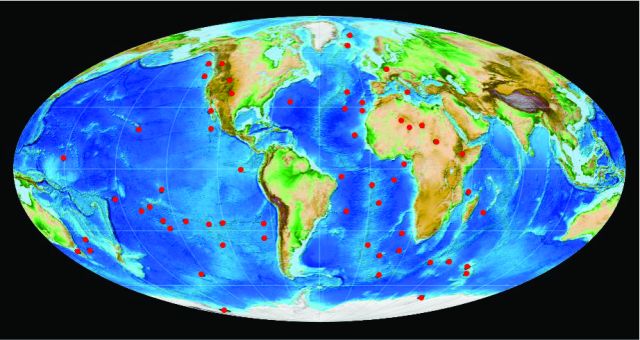
“Mm-hm, red dots for Earth’s sixty confirmed or proposed hotspots. Sy wanted to know more about the one that did a number on India.”

“What’s a hotspot? It’s like a big volcano, right?”

“Related but not quite. Most volcanoes are near where two plates are colliding. The classic case is the volcanoes along the western coastlines of the Americas The continents push westward and ride over Pacific seafloor plates, even break off slabs they shove down into the mantle where the heat melts them. The molten material squeezes up through cracks and escapes through volcanoes. Look where the dots are, though.”

BOW Bowie  COB Cobb
HAW Hawai’i
ANA AnahimYEL Yellowstone

“Most of them aren’t anywhere near the edge of anything. Yellowstone and those guys in Africa are as far from an edge as you can get. And I don’t see any red dots near Japan or the Philippines which are both really active for volcanoes and earthquakes.”

“Right, Sy. The primary criterion for a hot spot is vulcanism far from plate edges. But there’s another characteristic that many share. It’s easiest to see in this close‑up. Start with the Hawai’i, Cobb and Bowie hotspots. Each one is at the head of a straight‑line chain of volcanoes, older to younger as you get closer to the hotspot. The chains even run parallel with each other. The Anahim and Yellowstone hotspots also have parallel chains but they go west‑to‑east which makes sense if the continents are moving westward. It all fits with the idea that hotspots have stable locations in the mantle, and they scribble volcanoes on the plates that move over them. That’s the basis for much of what we know about ocean‑plate motion. But.”

“But?”

“There’s controversy, of course. Magnetism surveys and isotope data seem to show that some hotspots may move or even flutter slowly in some geology‑timescale wind. I just read—”

“Hey, Kareem, I’ve decorated so many pizzas with pepperoni slices I see red‑dot patterns everywhere. Your world map looks like there’s a ring of red dots around Africa and a stripe across the south Pacific. Does that mean anything?”

“We think it does, Eddie, but we’re still figuring out what. A technique called seismic tomography has given us evidence for a pair of huge somethings called LLSVPs deep into the mantle and on opposite sides of the Earth. One, unofficially known as TUZO, underlies much of Africa and that hotspot ring you noticed. The other one, JASON, is below your hotspot stripe in the South Pacific. We know very little about them so far, just that they stick out in the tomograms and they’ve probably been more‑or‑less where they are for a billion years. And no, we have no idea why hotspots appear around the edge of TUZO but along the center of JASON.”

“What else is lurking down there?”

“Who knows? The textbook diagrams show the mantle as this inert homogeneous shell sitting between core and crust. But its upper part is fluid and six times deeper than our atmosphere. The new tech is showing us currents something like winds and objects something like clouds, all at geological sizes and timescales. Classical Geophysics down there has been like doing weather science but ignoring clouds, mountains and oceans. There’s weather beneath us and we’re just beginning to see it.”

~~ Rich Olcott