Mushy stuff

“Amanda! Amanda! Amanda!”

“All right, everyone, settle down for our final Crazy Theorist. Jim, you’re up.”

“Thanks, Cathleen. To be honest I’m a little uncomfortable because what I’ve prepared looks like a follow-on to Newt’s idea but we didn’t plan it that way. This is about something I’ve been puzzling over. Like Newt said, black holes have mass, which is what everyone pays attention to, and charge, which is mostly unimportant, and spin. Spin’s what I’ve been pondering. We’ve all got this picture of a perfect black sphere, so how do we know it’s spinning?”

Voice from the back of the room — “Maybe it’s got lumps or something on it.”

“Nope. The No-hair Theorem says the event horizon is mathematically smooth, no distinguishing marks or tattoos. Question, Jeremy?”

“Yessir. Suppose an asteroid or something falls in. Time dilation makes it look like it’s going slower and slower as it gets close to the event horizon, right? Wouldn’t the stuck asteroid be a marker to track the black hole’s rotation?”

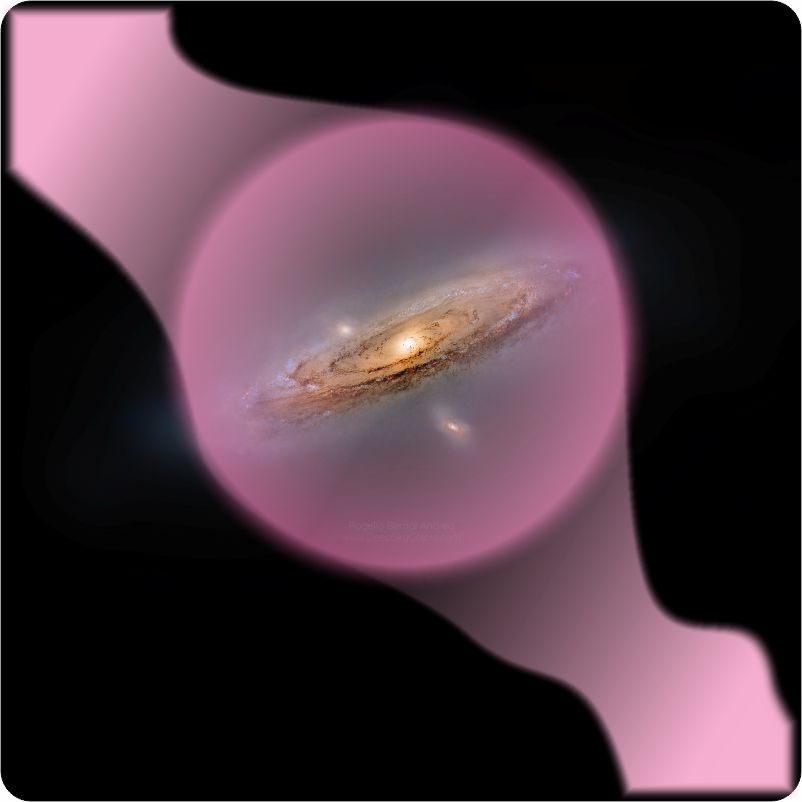
“Excellent question.” <Several of Jeremy’s groupies go, “Oooh.”> “Two things to pay attention to here. First, if we can see the asteroid, it’s not yet inside the horizon so it wouldn’t be a direct marker. Beyond that, the hole’s rotation drags nearby spacetime around with it in the ergosphere, that pumpkin‑shaped region surrounding the event horizon except at the rotational poles. As soon as the asteroid penetrates the ergosphere it gets dragged along. From our perspective the asteroid spirals in instead of dropping straight. What with time dilation, if the hole’s spinning fast enough we could even see multiple images of the same asteroid at different levels approaching the horizon.”

Jeremy and all his groupies go, “Oooh.”

“Anyhow, astronomical observation has given us lots of evidence that black holes do spin. I’ve been pondering what’s spinning in there. Most people seem to think that once an object crosses the event horizon it becomes quantum mush. There’d be this great mass of mush spinning like a ball. In fact, that was Schwarzchild’s model for his non-rotating black hole — a simple sphere of incompressible fluid that has the same density throughout, even at the central singularity.”

VBOR — “Boring!”

“Well yeah, but it might be correct, especially if spaghettification and the Firewall act to grind everything down to subatomic particles on the way in. But I got a different idea when I started thinking about what happened to those two black holes that LIGO heard collide in 2015. It just didn’t seem reasonable that both of those objects, each dozens of solar masses in size, would get mushed in the few seconds it took to collide. Question, Vinnie?”

“Yeah, nice talk so far. Hey, Sy and me, we talked a while ago about you can’t have a black hole inside another black hole, right, Sy?”

“That’s not quite what I said, Vinnie. What I proved was that after two black holes collide they can’t both still be black holes inside the big one. That’s different and I don’t think that’s where Jim’s going with this.”

“Right, Mr Moire. I’m not claiming that our two colliders retain their black hole identities. My crazy theory is that each one persists as a high‑density nubbin in an ocean of mush and the nubbins continue to orbit in there as gravity propels them towards the singularity.”

VBOR —”Orbit? Like they just keep that dance going after the collision?”

“Sure. What we can see of their collision is an interaction between the two event horizons and all the external structures. From the outside, we’d see a large part of each object’s mass eternally inbound, locked into the time dilation just above the joined horizon. From the infalling mass perspective, though, the nubbins are still far apart. They collide farther in and farther into the future. The event horizon collision is in their past, and each nubbin still has a lot of angular momentum to stir into the mush. Spin is stirred-up mush.”

Cathleen’s back at the mic. “Well, there you have it. Amanda’s male-pattern baldness theory, Newt’s hyper‑planetary gear, Kareem’s purple snowball or Jim’s mush. Who wins the Ceremonial Broom?”

The claque responds — “Amanda! Amanda! Amanda!”

~ Rich Olcott

Virial Yang And Yin

“But Mr Moire, how does the Virial Equation even work?”

“Sometimes it doesn’t, Jeremy. There’s an ‘if’ buried deep in the derivation. It only works for a system in equilibrium. Sometimes people use the equation as a test for equilibrium.”

“Sorry, what does that mean?”

“Let’s take your problem galaxy cluster as an example. Suppose the galaxies are all alone in the Universe and far apart even by astronomical standards. Gravity’s going to pull them together. Galaxy i and galaxy j are separated by distance Rij. The potential energy in that interaction is Vij = G·mi·mj / Rij. The R‘s are very large numbers in this picture so the V attractions are very small. The Virial is the average of all the V’s so our starting Virial is nearly zero.”

“Nearly but not quite zero, I get that. Wait, if the potential energy starts near zero when things are far apart, and a falling‑in object gives up potential energy, then whatever potential energy it still has must go negative.”

“It does. The total energy doesn’t change when potential energy converts to kinetic energy so yes, we say potential energy decreases even though the negative number’s magnitude gets larger. It’d be less confusing if we measured potential energy going positive from an everything-all-together situation. However, it makes other things in Physics much simpler if we simply write (change in potential energy)+(change in kinetic energy)=0 so that’s the convention.”

“The distances do eventually get smaller, though.”

“Sure, and as the objects move closer they gain momentum and kinetic energy. Gaining momentum is gaining kinetic energy. You’re used to writing kinetic energy as T=m·v²/2, but momentum is p=m·v so it’s just as correct to write T=p²/2m. The two are different ways of expressing the same quantity. When a system is in equilibrium, individual objects may be gaining or losing potential energy, but the total potential energy across the system has reached its minimum. For a system held together by gravity or electrostatic forces, that’s when the Virial is twice the average kinetic energy. As an equation, V+2T=0.”

“So what you’re saying is, one galaxy might fall so far into the gravity well that its potential energy goes more negative than –2T. But if the cluster’s in equilibrium, galaxy‑galaxy interactions during the fall‑in process speed up other galaxies just enough to make up the difference. On the flip side, if a galaxy’s already in deep, other galaxies will give up a little T to pull it outward to a less negative V.”

“Well stated.”

“But why 2? Why not or some other number?”

“The 2 comes from the kinetic energy expression’s ½. The multiplier could change depending on how the potential energy varies with distance. For both gravity and electrostatic interactions the potential energy varies the same way and 2 is fine the way it is. In a system with a different rule, say Hooke’s Law for springs and rubber bands, the 2 gets multiplied by something other than unity.”

“All that’s nice and I see how the Virial Equation lets astronomers calculate cluster‑average masses or distances from velocity measurements. I suppose if you also have the masses and distances you can test whether or not a collection of galaxies is in equilibrium. What else can we do with it?”

“People analyze collections of stars the same way, but Professor Hanneken’s a physicist, not an astronomer. He wouldn’t have used class time on the Virial if it weren’t good for a broad list of phenomena in and outside of astronomy. Quantum mechanics, for instance. I’ll give you an important example — the Sun.”

“One star, all by itself? Pretty trivial to take its average.”

“Not averaging the Sun as an object, averaging its plasma contents — hydrogen nuclei and their electrons, buffeted by intense heat all the way down to the nuclear reactions that run near the Sun’s core. It’s gravitational potential energy versus kinetic energy all over again, but at the atomic level this time. The Virial Theorem still holds, even though turbulence and electromagnetic effects generate a complicated situation.”

“I’m glad he didn’t assign that as a homework problem.”

“The semester’s not over yet.”

~~ Rich Olcott

Viral, Virial, What’s The Difference?

A young man’s knock at my office door, eager yet a bit hesitant. “C’mon in, Jeremy, the door’s open.”

“Hi, Mr Moire. Got a minute?”

“It’s slow season, Jeremy. What can I do for you?”

“It’s my physics homework, sir. Professor Hanneken asked a question that I don’t understand.”

“John’s a bit of a joker but asking unsolvable questions isn’t usually one of his things. Well, except for that one about how long it would take to play Mahler’s Piano Quartet if you had only two musicians because of budget restrictions. What’s the question?”

“He wants us to use something called ‘the viral theorem‘ to deduce things about a certain galaxy cluster. I know what viral memes are but I don’t think I’ve ever heard of a theorem that spreads like a virus. I’ve done searches on my class notes and online textbook — nothing. So what is it and how am I supposed to use it?”

“Do you have the question with you?”

“Yessir, it’s #4 on this sheet.”

“Ah, just as I thought. Read it again. The word is ‘virial,’ not ‘viral.’ Big difference.”

“I suppose, but what’s a virial then?”

“We need some context. Imagine a cluster of free‑floating objects bound together by mutual forces of attraction. No central attractor, just lots of pairwise pulling, okay?”

“What kind of forces?”

“That’s the thing, it doesn’t matter. Gravitational, electrostatic, rubber bands even. The only restriction is that the force between each pair of objects follows the same force‑distance rule. For rubber bands it’s mostly just 1/distance until you get near the elastic limit. For gravity and electrostatics the rule is that force runs as 1/distance2. Got that picture?”

<grin> “It’d be tricky rigging up those rubber bands to not get tangled. Anyhow, instead of planets around the Sun you want me to think of stars held in a cluster by each other’s gravity. Do they all have to be the same size or the same distance apart?”

“No, because of what happens next. You’re thinking right — a heavier star pulls harder than a lighter one, and two stars close together feel more mutual force than stars far apart. We account for that variation by taking an average. Multiply force times distance for every possible pairing, then divide the total by the number of objects. The averaged number is the Virial, symbol V.”

“Wait, force times distance. That’s the Physics definition of work, like pulling something up against gravity.”

“Exactly. Work is directed energy. What we’re talking about here is the amount of energy required to pull all those objects away from the center of mass or charge or whatever, out to their current positions. The Virial is the average energy per object. It’s average potential energy because it depends on position, not motion.”

“They’d release all that energy if they just fell together so why don’t … wait, they’re going all different directions so momentum won’t let them, right?”

“You’re on your way. Motion’s involved.”

“Umm … Kepler’s Law — the closer any two of them get, the faster they orbit each other … OH! Kinetic energy! When things fall, potential energy’s converted to kinetic energy. Is there an average kinetic energy that goes up to compensate for the Virial getting smaller?”

“Bingo. When you say ‘average kinetic energy‘ what quantity springs to mind?”

“Temperature. But that’s only for molecules.”

“No reason we can’t define a galactic analog. In fact, Eddington did that back in 1916 when he brought the notion from gas theory over to astrophysics. He even used ‘T‘ for the kinetic average, but remember, this T refers to kinetic energy of stars moving relative to each other, not the temperatures of the stars themselves. Anyhow, the Virial Theorem says that a system of objects is in gravitational or electrostatic equilibrium when the Virial is T/2. Clausius’ ground‑breaking 1870 proof for gases was so general that the theorem’s been used to study everything from sub‑atomic particles to galaxies and dark matter.”

<bigger grin> “With coverage like that, the Virial’s viral after all. Thanks, Mr Moire.”

~~ Rich Olcott

  • Thanks to Dr KaChun Yu for helpful pointers to the literature. Naturally, any errors in this post are my own.

Little Strings And Big Ones

It’ll be another hot day so I’m walking the park early. No geese in the lake — they’ve either flown north or else they’re attacking a farmer’s alfalfa field. A familiar voice shatters the quiet. “Wait up, Moire, I got questions.”

“Good morning, Mr Feder. First question, but please pick up your pace, I want to get back to the air conditioning.”

“I thought string theory was about little teeny stuff but this guy said about cosmic strings. How can they be teeny and cosmic?”

“They can’t. Totally different things, probably. Next question.”

“C’mon, Moire, that wasn’t even an answer, just opened up a bunch more questions.”

“It’s a tangled path but the track mostly started in the late 18th Century. Joseph Fourier derived the equation for how heat progresses along a uniform metal bar. Turned out the equation’s general solution was the sum of an infinite series of sine waves.”

“Sign waves? Like a protest rally?”

“Haha. No, s‑i‑n‑e, a mathematical function where something regularly and smoothly deviates about some central value. Anyhow, mathematicians soon realized that Fourier’s cute trick for his heat equation could be applied to equations for everything from sound waves to signal processing to pretty much all of Physics. Economics, even. Any time you use the word ‘frequency‘ you owe something to Fourier.”

“If he ain’t got it in writing from the Patent Office, I ain’t paying nothing.”

“It’s not the kind of thing you can patent, and besides, he lived in France and died almost two centuries ago. Be generous with your gratitude, at least. Let’s move on. Fourier’s Big Idea was already <ahem> in the air early in the 20th Century when Bohr and the Physics gang were looking at atoms. No surprise, they extended the notion to describe how electronic charge worked in there.”

“I’m waiting for the strings.”

“The key is that an atom’s a confined system like a guitar string that only vibrates between the bridge and whatever fret you’re pressing on. Sound waves traveling in open space can have any wavelength, but if you pluck a confined guitar string the only wavelengths you can excite are whole number multiples of its active length. No funny fractions like π/73 of the length no matter how hard or soft you pluck the string. Atoms work the same way — charge is confined around the nucleus so only certain wave sizes and shapes are allowed.”

“You said ‘strings.’ We getting somewhere finally?”

“Closing in on it. String theory strings aren’t just teeny. If your body were suddenly made as large as the Observable Universe, string theory is about what might happen inside a box a billion times smaller than your size now.”

“Really tight quarters, got it, so only certain vibrations are allowed.”

“Mm-hm, except it’s not really vibration, it would be something that acts mathematically like vibration. Go back to your guitar string. Plucking gives it up‑down motion, strumming moves it side‑to‑side. Two degrees of freedom. The math says whatever’s going on in a string theory box needs 8 or 11 or maybe 25 degrees of freedom, depending on the theory. At the box‑size scale if there’s structure at all it looks nothing like a string.”

“Then how about the big cosmic strings? What’s confining them?”

“Nothing, and I mean that literally. If they exist they’re bounded by different flavors of empty space. It goes back to what we think happened right after the Big Bang during rapid space expansion. Whatever forces drove the process were probably limited by lightspeed. Local acceleration in one region wouldn’t immediately affect events in regions lightyears away. Nearly adjacent parts of the Universe could have been evolving at very different rates. Have you ever watched the whirlpools that form when a fast‑moving stream of water meets a slower‑moving one?”

“Fort Lee had a storm‑sewer pipe that let into the Hudson River. You got crazy whirlpools there after a hard rain.”

“Whirlpools are one kind of topological defect. They die away in water because friction dissipates the angular momentum. Hiding behind a whole stack of ifs and maybes, some theorists think collisions between differently‑evolving spacetime structures might generate long‑lived defects like cosmic strings or sheets.”

~~ Rich Olcott

Inspecting A Pulsar

“C’mon, Sy, LIGO detects those black hole collisions by tracking how its mirrors move when a gravitational wave passes by. How can NANOGrav detect those waves from pulsar twinkles?”

“Not twinkles, Vinnie, definitely not twinkles. Astronomers hate twinkles. That shifting, wavering light we find so charming messes up the precise measurements they want to make. We didn’t get really good astrometry and light curves until we lifted observatories into orbit where atmospheric turbulence can’t distort the starlight. Fortunately there’s less twinkling at longer wavelengths down in the radio range. When a grad student named Jocelyn Bell discovered pulsars glinting in the radio range half a century ago everyone panicked.”

“What’s so scary about stars acting funny? They’re a long way away.”

“True, but it was how they acted funny. The glints were so regular that everyone first thought they were man‑made signals and probably from Russia or one of their allies. This was back in the 1960s, during the Cold War, a decade after Sputnik and right after the Cuban Missile Crisis. Lots of paranoia. But then Bell and her thesis adviser found that the first two signals were definitely coming from two different but consistent points up in the sky and that ruled out Earth‑centered sources.”

“Aliens?”

“Yeah, that was one of the hypotheses. In fact, the researchers even called the first source LGM‑1 for ‘Little Green Men.'”

“HAW!”

“Hey, astronomers make jokes, too. But when they found the second source that idea pretty much went away except that the conspiracy crowd still loves it.”

“What do the signals look like?”

“Just the question I’d expect from a telescope hobbyist like you, Al. They look like flashes from an airport beacon — nothing, then a blink then more nothing until another blink. Typically the blink intervals for different sources range between milliseconds and tens of seconds. Early researchers determined that each star’s blinks are regular to well within a millisecond which was the best we could do for accurate timing back then. Until we got really good laser clock tech, the pulsars were the steadiest timepieces we knew of.”

“What’s a blink look like?”

“That was a critical question. Bell had to scan literally miles of high‑speed strip‑chart paper to get a good handle on it. In general the plots of signal strength against time were triangles, about 40 milliseconds wide at half‑height. Bell’s first pulsar’s triangles used 3% of her strip‑chart recorder’s output, which meant that 97% of the paper was wasted space but research works that way sometimes.”

“Couldn’t be something with a bright side and a dark side, then, or you’d get half and half.”

“Exactly, Vinnie. The pulsar’s shiny spot must be a small fraction of its circumference. Another number from Bell’s charts gave us an additional clue to the spot’s size. LGM-1 blinks every 1.3373 seconds, regular as clockwork. That’s about a million times faster than the Sun spins, but suppose LGM-1 is a star about the Sun’s size. If the spot’s at the star’s equator, it’d have to be moving eleven times faster than light.”

“Not likely.”

“Mm-hm. So this pulsar and all the others that blink at anything near that rate must be made of collapsed matter, probably a neutron star.”

“Wait, why can’t it be something smaller like a shiny planet or something?”

“Gyroscopes, Al. The heavier the spinner, the better it maintains a constant spin. Earth’s pretty big, by our standards, but we need to adjust civil time by a leap second every few years to match our planet’s speed‑ups and slow‑downs. These guys don’t do that, they just slow a few nanoseconds or less per year. Rapid rotation says that pulsars must have small geometry but nanosecond regularity says they must have enormous mass. Neutron stars meet both qualifications because they pack a solar mass into the volume of a small planet.”

“Okay, but why do they spin so fast?”

Angular momentum, Vinnie, radius times speed — always conserved, right? Say a star with a month‑long rotational period collapses. Its radius shrinks about a million‑fold. Every atom in that collapsing star now runs a tighter travel radius and must speed up to compensate. The whole star spins up.”

~~ Rich Olcott

The Frame Game

A familiar footstep outside my office, “C’mon in, Vinnie, the door’s open.”

“Hi, Sy, how ya doin’?”

“Can’t complain. Yourself?”

“Fine, fine. Hey, I been thinking about something you said while Al and us were talking about rockets and orbits and such. You remember that?”

“We’ve done that in quantity. What statement in particular?”

“It was about when you’re in the ISS, you still see like 88% of Earth’s gravity. But I seen video of those astronauts just floating around in the station. Seems to me those two don’t add up.”

“Hah! We’re talking physics of motion here. What’s the magic word?”

“You’re saying it’s frames? I thought black holes did that.”

“Black holes are an extreme example, but frame‑thinking is an essential tool in analyzing any kind of relative motion. Einstein’s famous ‘happy thought‘ about a man in a free‑falling elevator—”

“Whoa, why is that a happy thought? I been nervous about elevators ever since that time we got stuck in one.”

“At least it wasn’t falling, right? Point is, the elevator and whoever’s in it agree that Newton’s First Law of Motion is valid for everything they see in there.”

“Wait, which Law is that?”

“‘Things either don’t move or else they move at a steady pace along a straight line.’ Suppose you’re that guy—”

“I’d rather not.”

“… and the elevator is in a zero‑gravity field. You take something out of your pocket, put it the air in front of you and it stays there. You give it a tap and it floats away in a straight line. Any different behavior means that your entire frame — you, the elevator and anything else in there — is being accelerated by some force. Let’s take two possibilities. Case one, you and the elevator are resting on terra firma, tightly held by the force of gravity.”

“I like that one.”

“Case two, you and the elevator are way out in space, zero‑gravity again, but you’re in a rocket under 1-g acceleration. Einstein got happy because he realized that you’d feel the same either way. You’d have no mechanical way to distinguish between the two cases.”

“What’s that mean, mechanical?”

“It excludes sneaky ways of outside influence by magnetic fields and such. Anyhow, Einstein’s insight was key to extending Newton’s First Law to figuring acceleration for an entire frame. Like, for instance, an orbiting ISS.”

“Ah, you’re saying that floating astronauts in an 88% Earth-gravity field is fine because the ISS and the guys share the frame feeling that 88% but the guys are floating relative to that frame. But down here if we could look in there we’d see how both kinds of motion literally add up.”

“Exactly. It’s just much easier to think about only one kind at a time.”

“Wait. You said the ISS is being accelerated. I thought it’s going a steady 17500 miles an hour which it’s got to do to stay 250 miles up.”

“Is it going in a straight line?”

“Well, no, it’s going in a circle, mostly, except when it has to dodge some space junk.”

“So the First Law doesn’t apply. Acceleration is change in momentum, and the ISS momentum is constantly changing.”

“But it’s moving steady.”

“But not in a straight line. Momentum is a vector that points in a specific direction. Change the direction, you change the momentum. Newton’s Second Law links momentum change with force and acceleration. Any orbiting object undergoes angular acceleration.”

“Angular acceleration, that’s a new one. It’s degrees per second per second?”

“Yup, or radians. There’s two kinds, though — orbiting and spinning. The ISS doesn’t spin because it has to keep its solar panels facing the Sun.”

“But I’ve seen sci-fi movies set in something that spins to create artificial gravity. Like that 2001 Space Odyssey where the guy does his running exercise inside the ship.”

“Sure, and people have designed space stations that spin for the same reason. You’d have a cascade of frames — the station orbiting some planet, the station spinning, maybe even a ballerina inside doing pirouettes.”

“How do you calculate all that?”

“You don’t. You work with whichever frame is useful for what you’re trying to accomplish.”

“Makes my head spin.”

~~ Rich Olcott

Climbing Out Of A Well

Al can’t contain himself. “Wait, it’s gravity!”

Vinnie and I are puzzled. “Come again?”

“Sy, you were going on about how much speed a rocket has to shed on the way to some special orbit around Mars, like that’s a big challenge. But it’s not. The rocket’s fighting the Sun’s gravity all the way. That’s where the speed goes. The Earth’s gravity, too, a little bit early on, but mostly the Sun’s, right?”

“Good point, Al. Sun gravity’s what bends the rocket onto a curve instead of a straight line. Okay, Sy, you got a magic equation that accounts for the shed speed? Something’s gotta, ’cause we got satellites going around Mars.”

“Good point, Vinnie, and you’re right, there is an equation. It’s not magic, you’ve already seen it and it ties kinetic energy to gravitational potential energy.”

“Wait, if I remember right, kinetic energy goes like mass times velocity squared. How can you calculate that without knowing how big the rocket is?”

“Good question. We get around that by thinking things through for a unit mass, one kilogram in SI units. We can multiply by the rocket’s mass when we’re done, if we need to. The kinetic energy per unit mass, we call that specific kinetic energy, is just ½v². Look familiar?”

“That’s one side of your v²=2GM/R equation except you’ve got the 2 on the other side.”

“Good eye, Al. The right-hand side, except for the 2, is specific gravitational potential energy, again for unit mass. But we can’t use the equation unless we know the kinetic energy and gravitational potential are indeed equal. That’s true if you’re in orbit but we’re talking about traveling between orbits where you’re trading kinetic for potential or vice versa. One gains what the other loses so Al’s right on the money. Traveling out of a gravity well is all about losing speed.”

Al’s catching up. “So how fast you’re going determines how high you are, and how high you are says how fast you have to be going.”

Vinnie frowns a little. “I’m thinking back to in‑flight refueling ops where I’m coming up to the tanker from below and behind while the boom operator directs me in. That doesn’t sound like it’d work for joining up to a satellite.”

“Absolutely. If you’re above and behind you could speed up to meet the beast falling, or from below and ahead you could slow down to rise. Away from that diagonal you’d be out of luck. Weird, huh?”

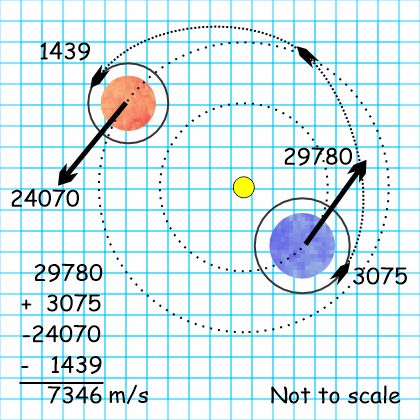
“Yeah. Which reminds me, now we’re talking about this ‘deeper means faster‘ stuff. How does the deep‑dive maneuver work? You know, where they dive a spacecraft close to a planet or something and it shoots off with more speed than it started with. Seems to me whatever speed it gains it oughta give up on the way out of the well.”

“It’s a surprise play, alright, but it’s actually two different tricks. The slingshot trick is to dive close enough to capture a bit of the planet’s orbital momentum before you fly back out of the well. If you’re going in the planet’s direction you come out going faster than you went in.”

“Or you could dive in the other direction to slow yourself down, right?”

“Of course, Al. NASA used both options for the Voyager and Messenger missions. Vinnie, I know what you’re thinking and yes, theoretically stealing a planet’s orbital momentum could affect its motion but really, planets are huge and spacecraft are teeny. DART hit the Dimorphos moonlet head-on and slowed it down by 5%, but you’d need 66 trillion copies of Dimorphos to equal the mass of dinky little Mercury.”

“What’s the other trick?”

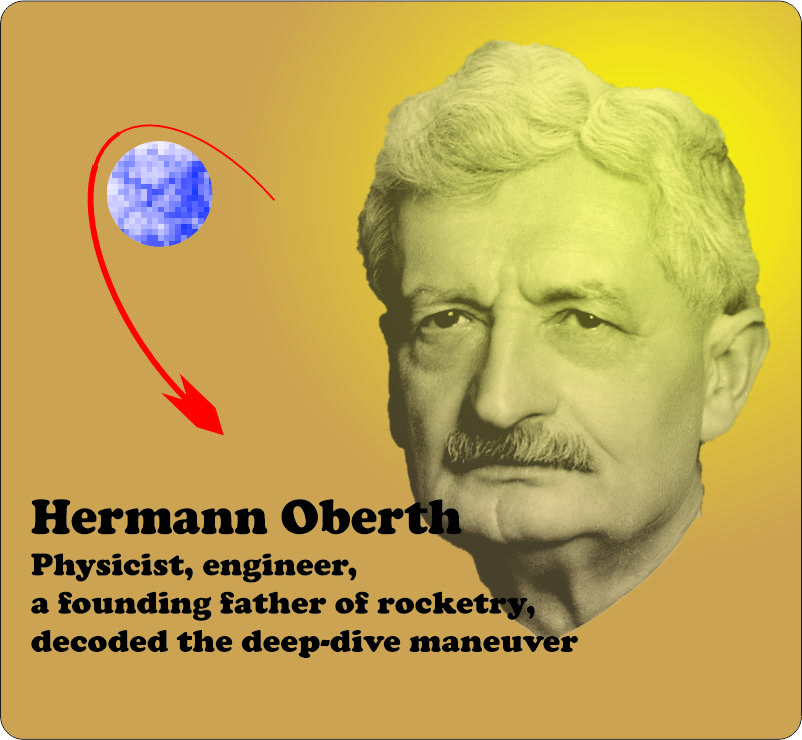
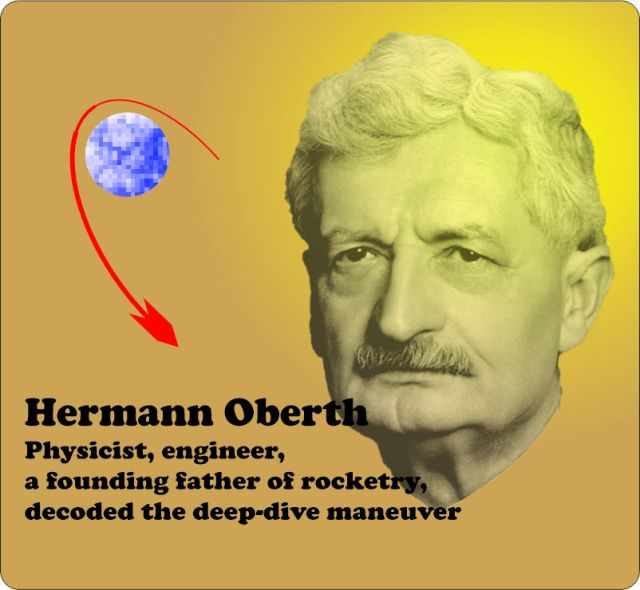
“Dive in like with the slingshot, but fire your rocket engine when you’re going fastest, just as the craft approaches its closest point to the planet. Another German rocketeer, Hermann Oberth, was the first to apply serious math to space navigation. This trick’s sometimes called the Oberth effect, though he didn’t call it that. He showed that rocket exhaust gets more effective the faster you’re going. The planet’s gravity helps you along on that, for free.”

“Free help is good.”

~~ Rich Olcott

Carefully Considered Indirection

“C’mon, Vinnie, you’re definitely doing Sy stuff. I ask you a question about how come rockets can get to the Moon easier than partway and you go round the barn with ballistics and cruisers. Stop dodging.”

“Now, Al, Vinnie’s just giving you background, right. Vinnie?”

“Right, Sy, though I gotta admit a lot of our talks have gone that way. So what’s your answer?”

“Nice try, Vinnie. You’re doing fine, so keep at it.”

“Okay. <deep breath> It has to do with vectors, Al, combination of amount and direction, like if you’re going 3 miles north that’s a vector. You good with that?”

“If you say so.”

“I do. Then you can combine vectors, like if you’re going 3 miles north and at the same time 4 miles east you’ve gone 5 miles northeast.”

“That’s a 3-4-5 right triangle, even I know that one. But that 5 miles northeast is a vector, too, right?”

“You got the idea. Now think about fueling a rocket going up to meet the ISS.”

“Sy said it’s 250 miles up, so we need enough fuel to punch that far against Earth’s gravity.”

“Not even close. If the rocket just went straight up, it’d come straight down again. You need some sideways momentum, enough so when you fall you miss the Earth.”

“Miss the Earth? Get outta here!”

“No, really. Hey, Sy, you tell him.”

“Vinnie’s right, Al. That insight goes back to Newton. He proposed a thought experiment about building a powerful cannon to fire horizontally from a very tall mountain. <sketching on paper napkin> A ball shot with a normal load of powder might hit the adjacent valley. Shoot with more and more powder, balls would fly farther and farther before hitting the Earth. Eventually you fire with a charge so powerful the ball flies far enough that its fall continues all around the planet. Unless the cannon blows up or the ball shatters.”

“That’s my point, Al. See, Newton’s cannon balls started out going flat, not up. To get up and into orbit you need up and sideways velocity, like on the diagonal. You gotta calculate fuel to do both at the same time.”

“So what’s that got to do with easier to get to the Moon than into orbit?”

“‘S got everything to do with that. Not easier, though, just if you aim right the vectors make it simpler and cheaper to carry cargo to the Moon than into Earth orbit.”

“So you just head straight for the Moon without going into orbit!”

“Not quite that simple, but you got the general idea. Remember when I brought that kid’s top in here and me and Sy talked about centrifugal force?”

“Do I? And I made you clean up all those spit-wads.”

“Yeah, well, suppose that cannon’s at the Equator <adding dotted lines to Sy’s diagram> and aimed with the Earth’s spin and suppose we load in enough powder for the ball to go straight horizontal, which is what it’d do with just centrifugal force.”

“If I’m standing by the cannon it’d look like the ball’s going sideways.”

“Yup. Basically, you get the up‑ness for free. We’re not talking about escape velocity here, that’s different. We’re talking about the start of a Hohmann orbit.”

“Who’s Hohmann?”

“German engineer. When he was a kid he read sci‑fi like the rest of us and that got him into the amateur rocketry scene. Got to be a leader in the German amateur rocket club, published a couple of leading‑edge rocket science books in the 1920s but dropped out of the field when the Nazis started rolling and he figured they’d build rocket weapons. Anyhow, he invented this orbit that starts off tangent to a circle around one planet or something, follows an ellipse to end tangent to a circle around something else. Smooth transitions at both ends, cheapest way you can get from here to there. Kinks in the routing cost you fuel and cargo capacity to turn. Guy shoulda patented it.”

“Wait, an orbit’s a mathematical abstraction, not a thing.”

“Patent Office says it’s a business method, Sy. Check out PAS-22, for example.”

“Incredible.”

~ Rich Olcott

  • Thanks to Ken, who asked another question.

Chocolate, Mint And Notation

“But calculus, Mr Moire. Why do they insist we learn calculus? You said that Newton and Leibniz started it but why did they do it?”

“Scoop me a double-dip chocolate-mint gelato, Jeremy, and I’ll tell you about an infamous quarrel. You named Newton first. I expect most Europeans would name Leibniz first.”

“Here’s your gelato. What does geography have to do with it?”

“Thanks. Mmm, love this combination. Part of the geography thing is international history, part of it is personality and part of it is convenience. England and continental Europe have a history of rivalry in everything from the arts to trade to outright warfare. Each naturally tends to favor its own residents and institutions. Some people say that the British Royal Society was founded to compete with the French philosophical clubs. Maybe England’s king appointed Newton as the society’s President to upgrade the rivalry. Dicey choice. From what I’ve read, Newton’s didn’t hate everybody, he just didn’t like anybody. But somehow he ran that group effectively despite his tendency to go full‑tilt against anyone who disagreed with his views.”

“Leibniz did the same thing on the European side?”

“No, quite the opposite. There was no pre‑existing group for him to head up and he didn’t start one. Instead, he served as a sort of Information Central while working as diplomat and counselor for a series of rulers of various countries. He carried on a lively correspondence with pretty much everyone doing science or philosophy. He kept the world up to date and in the process inserted his own ideas and proposals into the conversation. Unlike Newton, Leibniz was a friendly soul, constantly looking for compromise. Their separate calculus notations are a great example.”

“Huh? Didn’t everyone use the same letters and stuff?”

“The letters, yeah mostly, but the stuff part was a long time coming. What’s calculus about?”

“All I’ve seen so far is proofs and recipes for integrating different function types. Nothing about what it’s about.”

Newton approximates arc ABCDEF.

<sigh> “That’s because you’re being taught by a mathematician. Calculus is about change and how to handle it mathematically. That was a hot topic back in the 1600s and it’s still central to Physics. Newton’s momentum‑acceleration‑force perspective led him to visualize things flowing with time. His Laws of Motion made it easy to calculate straight‑line flows but what to do about curves? His solution was to break the curve into tiny segments he called fluxions. He considered each fluxion to be a microscopic straight line that existed for an infinitesimal time interval. A fluxion’s length was its time interval multiplied by the velocity along it. His algebraic shorthand for ‘per time‘ was to put a dot over whatever letter he was using for distance. Velocity along x was . Acceleration is velocity change per time so he wrote that with a double dot like . His version of calculus amounted to summing fluxion lengths across the total travel time.”

“But that only does time stuff. What about how, say, potential energy adds up across a distance?”

“Excellent question. Newton’s notation wasn’t up to that challenge, but Leibniz developed something better.”

“He copied what Newton was doing and generalized it somehow.”

“Uh, no. Newton claimed Leibniz had done that but Leibniz swore he’d been working entirely independently. Two lines of evidence. First, Newton was notoriously secretive about his work. He held onto his planetary orbit calculations for years before Halley convinced him to publish. Second, Leibniz and other European thinkers came to the problem with a different strategy. Descartes invented Cartesian coordinates a half‑century before. That invention naturally led the Europeans to plot anything against anything. Newton’s fluxions combined tiny amounts of distance and time; Leibniz and company split the two dimensions, one increment along each component. Leibniz tried out a dozen different notations for the increment. After much discussion he finally settled on a simple d. The increment along x is dx, but x could be anything quantitative. dy/dx quantifies y‘s change with x.”

“Ah, the increments are the differentials we see in class. But those all come from limit processes.”

“Leibniz’ d symbol and its powerful multi‑dimensional extensions carry that implication. More poetry.”

~~ Rich Olcott

DARTing to A Conclusion

The park’s trees are in brilliant Fall colors, the geese in the lake dabble about as I walk past but then, “Hey Moire, I gotta question!”

“Good morning, Mr Feder. What can I do for you?”

“NASA’s DART mission to crash into Diddy’s mos’ asteroid—”

“The asteroid’s name is Didymos, Mr Feder, and DART was programmed to crash into its moon Dimorphos, not into the asteroid itself.”

“Whatever. How’d they know it was gonna hit the sunny side so we could see it? If it hits in the dark, nobody knows what happened. They sent that rocket up nearly a year ago, right? How’d they time that launch just right? Besides, I thought we had Newton’s Laws of Motion and Gravity to figure orbits and forces. Why this big‑dollar experiment to see if a rocket shot would move the thing? Will it hit us?”

“You’re in good form today, Mr Feder.” <unholstering Old Reliable> “Let me pull some facts for you. Ah, Didymos’ distance from the Sun ranges between 1.01 and 2.27 astronomical units. Earth’s at 1.00 AU or 93 million miles, which means that the asteroid’s orbit is 930 000 miles farther out than ours, four times our distance to the Moon. That’s just orbits; Earth is practically always somewhere else than directly under Didymos’ point of closest approach. Mm… also, DART flew outward from Earth’s orbit so if the impact has any effect on the Didymos‑Dimorphos system it’ll be to push things even farther away from the Sun and us. No, I’m not scared, are you?”

“Who me? I’m from Jersey; scare is normal so we just shrug it off. So why the experiment? Newton’s not good enough?”

“Newton’s just fine, but collisions are more complicated than people think. Well, people who’ve never played pool.”

“That’s our national sport in Jersey.”

“Oh, right, so you already know about one variable we can’t be sure of. When the incoming vector doesn’t go through the target’s center of mass it exerts torque on the target.”

“We call that ‘puttin’ English on it.'”

“Same thing. If the collision is off‑center some of the incoming projectile’s linear momentum becomes angular momentum in the target object. On a pool table a simple Newtonian model can’t account for frictional torque between spinning balls and the table. The balls don’t go where the model predicts. There’s negligible friction in space, you know, but spin from an off‑center impact would still waste linear momentum and reduce the effect of DART’s impact. But there’s another, bigger variable that we didn’t think much about before we actually touched down on a couple of asteroids.”

“And that is…?”

“Texture. We’re used to thinking of an asteroid as just a solid lump of rock. It was a surprise when Ryugu and Bennu turned out to be loose collections of rocks, pebbles and dust all held together by stickiness and not much gravity. You hit that and surface things just scatter. There’s little effect on the rest of the mass. Until we do the experiment on a particular object we just don’t know whether we’d be able to steer it away from an Earth‑bound orbit.”

“Okay, but what about the sunny‑side thing?”

“Time for more facts.” <tapping on Old Reliable> “Basically, you’re asking what are the odds the moonlet is in eclipse when DART arrives on the scene. Suppose its orbit is in the plane of the ecliptic. Says here Dimorphos’ orbital radius is 1190 meters, which means its orbit is basically a circle 3740 meters long. The thing is approximately a cylinder 200 meters long and 150 meters in diameter. Say the cylinder is pointed along the direction of travel. It occupies (200m/3740m)=5% of its orbit, so there’s a 5% chance it’s dark, 95% chance it’s sunlit.”

“Not a bad bet.”

“The real odds are even better. The asteroid casts a shadow about 800 meters across. Says here the orbital plane is inclined 169° to the ecliptic so the moonlet cycles up and down. At that tilt and 1190 meters from Didymos, 200‑meter Dimorphos dodges the shadow almost completely. No eclipses. DART’s mission ends in sunlight.”

~~ Rich Olcott

  • Thanks to my brother Ken, who asked the question but more nicely.