Galaxies Sing In A Low Register

Jeremy gets a far‑away look. ”It’s gotta be freakin’ noisy inside the Sun.” just as our resident astronomer steps into Cal’s Coffee.

“Wouldn’t bet that, Jeremy. Depends on where you are in the Sun and on how you define noise.”

Vinnie booms, quietly. ”We just defined it, Cathleen. Atoms or molecules bumping each other in compression waves. Oh, wait, that’s ‘sound,’ you said ‘noise.’ Is that different?”

Susan slurps the last of her chocolate latte. ”Depends on your mood, I guess. All noise is sound, but some sound can be signal. Some people don’t like my slurping so for them it’s noise but Cal hears it as an order for another which makes him happy.”

“Comin’ up, Susan. Hey, Cathleen, maybe you can slap down Sy. He said spiral galaxies have something to do with sound which don’t make sense. Set him straight, okay?”

“Sy, have you all settled that sound isn’t limited to what humans hear?”

“Sure. Everybody’s agreed that infrasound and ultrasound are sound, and that Bishop Berkeley’s fallen tree made a sound even though nobody heard it. That’s probably what got Jeremy thinking about sound inside the Sun.” Jeremy nods.

“Then Vinnie’s definition is too limited and Sy’s statement is correct. Probably.”

That gets a reaction from everyone, though mine is a smile. ”Let ’em have it, Cathleen.”

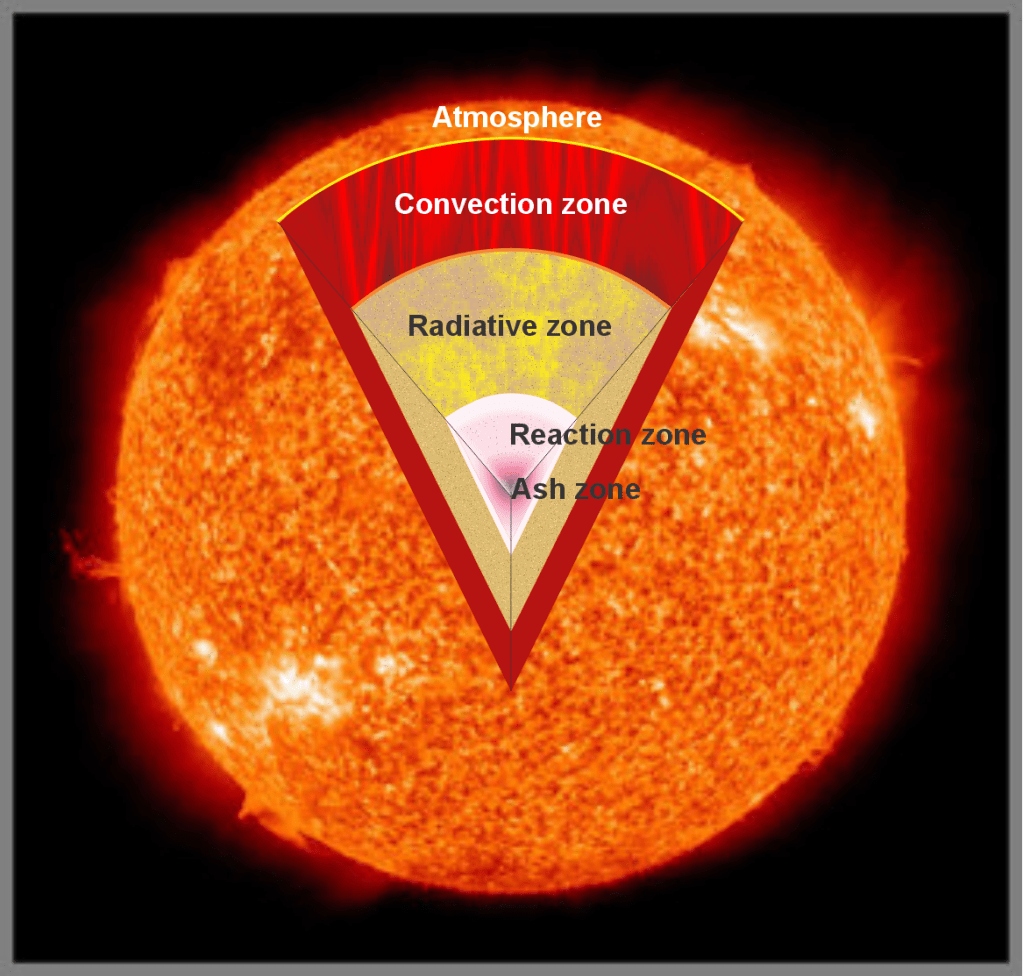
“Okay. Let’s take Jeremy’s idea first and then we’ll get to galaxies.” <fetches her tablet from her purse and a display on her tablet> “Here’s a diagram of the Sun I did for class. If you restrict ‘sound‘ to mean only coherent waves borne by atoms and molecules, there’s no sound in the innermost three zones. The only motion, if Sy grants I can call it that, is photons and subnuclear particles randomly swapping between adjacent nuclei that are basically locked into position by the pressure. Not much actual atomic motion until you’re up in the Convection Zone where rising turbulence is the whole game. Even there most of the particles are ions and electrons rather than neutral atoms. Loud? You might say so but it’d be a continuous random crackle‑buzz, not anything your ears would recognize. Sound waves as such don’t happen until you reach the atmospheric layers. Up there, oh yes, Jeremy, it’s loud.”

Geologist Kareem is a quiet guy, normally just sits and listens to our chatter, but Cathleen’s edging onto his turf. ”How about seismic waves? If there’s a big flare or CME up top, won’t that send vibrations all the way through?”

“Good point, Kareem. Yes, the Sun has p and s waves just like Earth does, but they travel no deeper than the Convection Zone. A different variety we may not have, g waves, would involve the core. Unfortunately, theory says g waves are so weak that the Convection Zone’s chaos swamps them. Anyway, the Sun’s s, p and g waves wouldn’t contribute to what Jeremy would hear because their frequencies are measured in hours or days. Can I get to galaxies now?”

“Please do.”

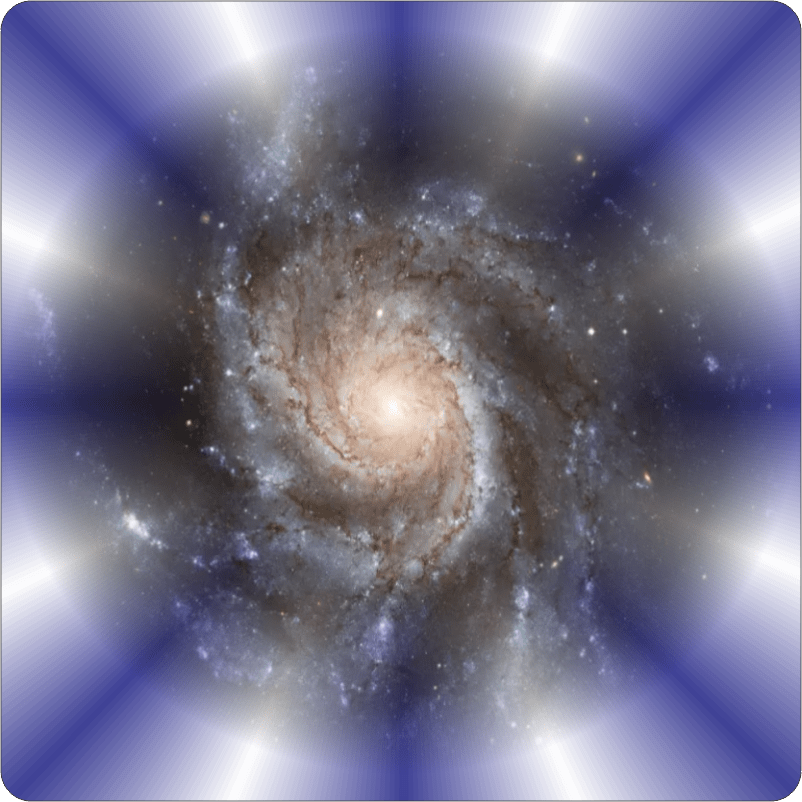
“Thanks.” <another display on her tablet> “Here’s a classic spiral galaxy. Gorgeous, huh? The obvious question is, is it winding in or spraying out? The evidence says ‘No‘ to both. The stars are neither pulled into a whirlpool nor flung out from a central star‑spawner. By and large, the stars or clusters of them are in perfectly good Newtonian orbits around the galactic center of gravity. So why are they collected into those arms? Here’s a clue — most of the blue stars are in the arms.”

“What’s special about blue stars?”

“In general, blue stars are large, hot and young. Our Sun is yellow, about halfway through a 10‑million‑year lifetime. The blue guys burn through their fuel and go nova in a tenth of that time. Blue stars out there tell us that the arms serve as stellar nurseries. It’s not stars gathering into arms, it’s galaxy‑wide rotating waves of gas birthing stars there. There’s argument about whether the wave rotation is intrinsic or whether there’s feedback as each wave is pulled along by star formation at the leading edge and pushed by novae at the trailing edge. Sy’s point, though, is that an arm‑dwelling old red star would experience the spinning gas density pattern as a basso profundo sound wave with a frequency even lower than the million‑year range. Right, Sy?”

“As always, Cathleen.”

~~ Rich Olcott

  • More thanks to Alex.

A Pencil In Space

<chirp, chirp> “Moire here.”

“I have a question I think you’ll find interesting, but it’s best we talk in person. Care for pizza?”

“If you’re buying.”

“Of course. Meet me at Eddie’s, twenty minutes. Bring Old Reliable.”

“Of course.”


Tall fellow, trimmed chevron mustache, erect bearing except when he’s leaning on that cane. “Moire?”

“That’s me. Good to meet you, Mr … ?”

“No names. Call me … Walt.”

We order, find a table away from the kitchen. “So, Walt, what’s this interesting question?”

“Been following this year’s Jupiter series in your blog. Read over the Kaspi paper, too, though most of that was over my head. What I did get was that his conclusions and your conclusions all come from measuring very small orbit shifts which arise from millionths of a g of force. Thing is, I don’t see where any of you take account of the Sun’s gravity. If the Sun’s pull holds Jupiter in orbit, it ought to swamp those micro-g effects. Apparently it doesn’t. Why not?”

“Well. That’s one of those simple questions that entail a complicated answer.”

“I’ve got time.”

“I’ll start with a pedantic quibble but it’ll clarify matters later on. You refer to g as force but it’s really acceleration. The one‑g acceleration at Earth’s surface means velocity changes by 980 meters/second per second of free fall. Drop a one kilogram mass, it’ll accelerate that fast. Drop a 100 kilogram mass, it’ll experience exactly the same acceleration, follow?”

“But the second mass feels 100 times the force.”

“True, but we can’t measure forces, only movement changes. Goes all the way back to Newton defining mass in terms of force and vice‑versa. Anyway, when you’re talking micro‑g orbit glitches you’re talking tiny changes in acceleration. Next step — we need the strength of the Sun’s gravitational field in Jupiter’s neighborhood.”

“Depends on the Sun’s mass and Jupiter’s mass. No, wait, just the Sun’s mass because that’s how it curves spacetime. The force depends on both masses.”

I’m impressed. “And the square of the very large distance between them.” <tapping on Old Reliable’s screen> “Says here the Sun’s field strength out there is 224 nano‑g, which is pretty small.”

“How’s that compare to what else is acting on Juno?”

<more tapping> “Jupiter’s local field strength crushes the Sun’s. At Juno’s farthest point it’s 197 micro‑g but at Juno’s closest point the field’s 22.7 million micro‑g and the craft’s doing 41 km/s during a 30-minute pass. Yeah, the Sun’s field would make small adjustments to Juno’s orbital speed, depending on where everybody is, but it’d be a very slow fluctuation and not the rapid shakes NASA measured.”

“How about side‑to‑side?”

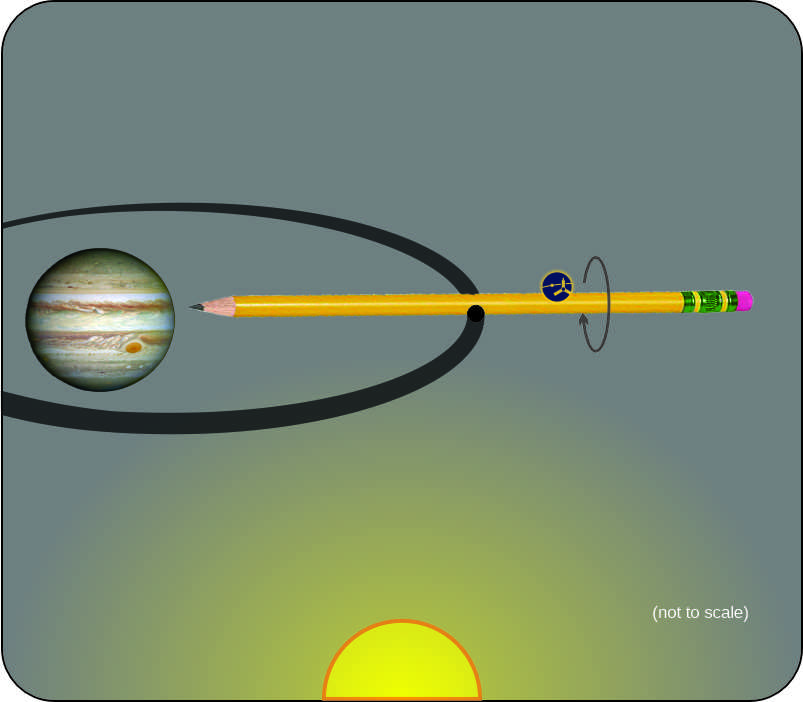
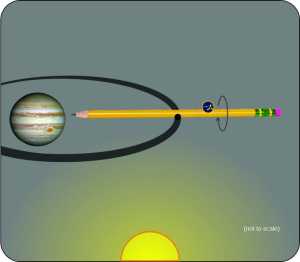
“Good point, but now we’re getting to the structure of Juno’s orbit. Its eccentricity is 98%, a long way from circular. Picture a skinny oval pencil 8 million kilometers long, always pointed at Jupiter while going around it. It’s a polar orbit, rises above Jupiter on the approach, then falls below going away. The Sun’s effect is greatest when the orbit’s at right angles to the Sun‑Jupiter line. The solar field twists the oval away from N‑S on approach, trues it back up on retreat. That changes the angle at which Juno crosses Jupiter’s gravitational wobbles but won’t affect how it experiences the zonal harmonics.”

“Tell me about those zonal things.”

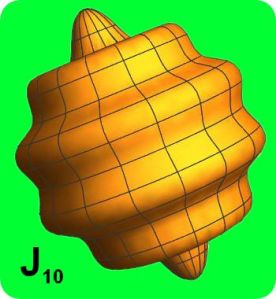
“A zone is a region, like the stripes on Jupiter, that circles a sphere at constant latitude. Technically, zonal harmonic Jn is the nth Legendre polynomial in cos(θ)—”

“Too technical.”

“Gotcha. Okay, each Jn names a shape, a set of gravitational ripples perpendicular to the polar axis. J0‘s a sphere with no ripples. Jupiter’s average field looks like that. A bigger n number means more ripples. Kaspi’s values estimate how much each Jn‘s intensity adds to or subtracts from J0‘s strength at each latitude. The Sun’s field can modify the intensity of J0 but none of the others.”

Walt grabs his cane, stands, drops a C‑note on the table. “This’ll cover the pizza and your time. Forget we had this conversation.” And he’s gone.

“Don’t mention it.”

~~ Rich Olcott

  • Thanks to Will, who asked the question.

The Road to Gold

Cathleen and Susan share a look.
 ”A conclusion way too far, Kareem.”
  ”Yep, you’ve overbounded your steps.”

Kareem tosses in a couple of chips. “Huh? What did I skip over? Where?”

Cathleen sees his bet and raises. “When you said that the Psyche asteroid’s gold content would be similar to what we dig up on Earth, you skipped many orders of magnitude in applying the Cosmological Principle.”

“I didn’t realize I’d done that. What’s the Cosmological Principle?”

“There’s several ways to state it, but they boil down to, ‘We’re not special in the Universe.‘ We think that fundamental constants and physical laws determined here on Earth have the same values and work the same way everywhere. Astrophysics just wouldn’t work as well as it does if the electron charge or Newton’s Laws of Motion were different a million lightyears away from us.”

“Wait, what about that galaxy that’s going to collide with us even though everything’s supposed to be flying away?”

“Fair question. The un‑boiled Principle includes some qualification clauses, especially the one that says, ‘when averaged over a large enough volume.’ How big a volume depends on what you’re studying. For motions of galaxies and such you have to average over a couple hundred million lightyears. Physical constants measured locally seem to be good out to the edge of the Observable Universe. Elemental abundances are somewhere in‑between — the very oldest, farthest‑away galaxies have less of the heavy stuff than we do around here. <pulls her tablet from her purse> Which brings me to this chart I built for one of my classes.”

“You’re going to have to explain that.”

“Sure. Both graphs are about element abundance. We get the numbers from stellar and galactic spectra so we’re averaging the local Universe out to a few hundred thousand lightyears. Left‑to‑right we’ve got hydrogen, helium, lithium and so on out to uranium in the big graph, out to iron in the small one. Up‑and‑down we’ve got atom count for each element, divided by the number of iron atoms so iron scores at 1.0. The range is huge, 31 000 hydrogens per single iron atom, all the way down to 17 rhenium atoms per billion irons. I needed this logarithmic scale to make the points I wanted to make in class.”

Vinnie sweetens the pot. “You’ve got that nice zig‑zag going in the little graph, Cathleen, but things get weird around iron and the big graph has that near‑constant series starting around 60. Why the differences?”

<lays down Q‑J‑10‑9‑8, all hearts, pulls in the chips> “Perfect straight line, Vinnie. The different behaviors come from nuclear cookery at different stages of a star’s life. Most new‑born stars start by fusing hydrogen nuclei, protons, to produce helium nuclei, alpha particles. Those two swamp everything else. As the star evolves to higher temperatures, proton‑addition processes generate successively more massive nuclei. Carbon starts a new pattern, because alpha‑addition processes it initiates generate the sawtooth pattern you picked up on — an alpha has two protons so each alpha fusion contributes to the atomic number peak two units along the line.”

“What happens with iron?”

“What happens when you put a blow torch to a red‑hot metal ball?”

“The ball melts.”

“Why?”

“Cause the extra energy’s too much for what holds the ball together.”

“Well, there you go. The forces that hold an atomic nucleus together have their limits, too. Iron and its next‑but‑one neighbor nickel are right on the edge of stability for alpha reactions. The alpha process in the core of a normal star can’t make anything heavier.”

“So how do we get the heavy guys?”

“Novas, supernovas and beyond. Those events are so energetic and so chaotic there’s non‑zero probability for any kind of atom to form and evolve to something stable before it can break down. Massive atoms just have a lower probability so there’s less of them when things settle down. Gold, for instance, at only 330 atoms per billion atoms of iron. The explosions spray heavy atoms throughout their neighborhood.”

Kareem antes the next pot. “So you’re saying my mistake was to assume that asteroid Psyche’s composition would match whole‑Universe heavy‑element statistics?”

“Well, that was his first mistake, right, Susan?”

~~ Rich Olcott

Three Feet High And Rising

“Bless you, Al, for your air conditioning and your iced coffee.”

“Hiya, Susan. Yeah, you guys do look a little warm. What’ll you have, Sy and Mr Feder?”

“Just my usual mug of mud, Al, and a strawberry scone. Put Susan’s and my orders on Mr Feder’s tab, he’s been asking us questions.”

“Oh? Well, I suppose, but in that case I get another question. Cold brew for me, Al, with ice and put a shot of vanilla in there.”

“So what’s your question?”

“Is sea level rising or not? I got this cousin he keeps sending me proofs it ain’t but I’m reading how NYC’s talking big bucks to build sea walls around Manhattan and everything. Sounds like a big boondoggle.” <pulling a crumpled piece of paper from his pocket and smoothing it out a little> “Here’s something he’s sent me a couple times.”

“That’s bogus, Mr Feder. They don’t tell us moon phase or time of day for either photo. We can’t evaluate the claim without that information. The 28‑day lunar tidal cycle and the 24‑hour solar cycle can reinforce or cancel each other. Either picture could be a spring tide or a neap tide or anything in‑between. That’s a difference of two meters or more.”

“Sy. the meme’s own pictures belie its claim. Look close at the base of the tower. The water in the new picture covers that sloping part of the base that was completely above the surface in the old photo. A zero centimeter rise, my left foot.”

“Good point, Susan. Mind if I join the conversation from a geologist’s perspective? And yes, we have lots of independent data sources that show sea levels are rising in general.”

“Dive right in, Kareem, but I thought you were an old‑rocks guy.”

“I am, but I study old rocks to learn about the rise and fall of land masses. Sea level variation is an important part of that story. It’s way more complicated than what that photo pretends to deny.”

“Okay, I get that tides go up and down so you average ’em out over a day, right? What’s so hard?”

“Your average will be invalid two weeks later, Mr Feder, like Sy said. To suppress the the Sun’s and Moon’s cyclic variations you’d have to take data for a full year, at least, although a decade would be better.”

“I thought they went like clockwork.”

“They do, mostly, but the Earth doesn’t. There’s several kinds of wobbles, a few of which may recently have changed because Eurasia weighs less.”

“Huh?”
 ”Huh?”
  ”Huh?”

“Mm-hm, its continental interior is drying out, water fleeing the soil and going everywhere else. That’s 10% of the planet’s surface area, all in the Northern hemisphere. Redistributing so much water to the Southern hemisphere’s oceans changes the balance. The world will spin different. Besides, the sea’s not all that level.”

“Sea level’s not level?”

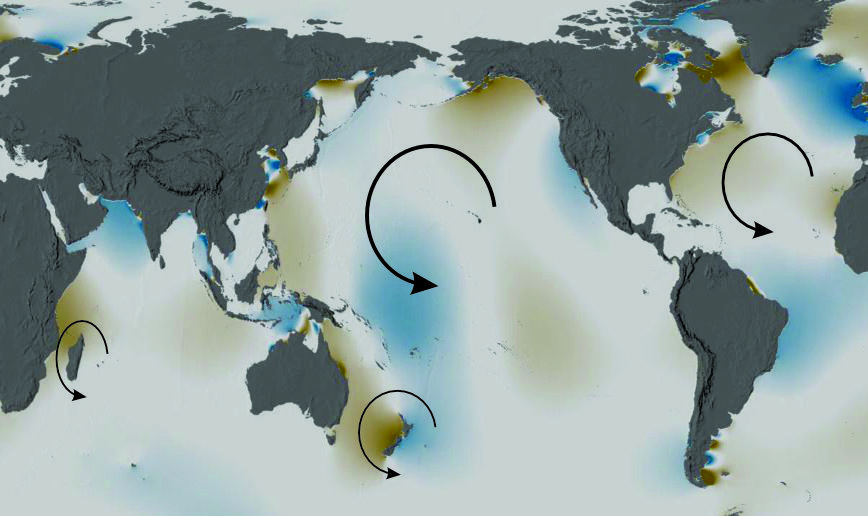
“Nope. Surely you’ve sloshed water in a sink or bathtub. The sea sloshes, too, counterclockwise. Galileo thought sloshing completely accounted for tides, but that was before Newton showed that the Moon’s gravity drives them. NASA used satellite data to build a fascinating video of sea height all over the world. The sea on one side of New Zealand is always about 2 meters higher than on the opposite side but the peak tide rotates. Then there’s storm surges, tsunamis, seiche resonances from coastal and seafloor terrain, gravitational irregularities, lots of local effects.”

Adapted from a video by NASA’s Scientific Visualization Studio

Susan, a chemist trained to consider conservation of mass, perks up. “Wait. Greenland and Antarctica are both melting, too. That water plus Eurasia’s has to raise sea level.”

“Not so much. Yes, the melting frees up water mass that had been locked up as land-bound ice. But on the other hand, it also counteracts sea rise’s major driver.”

“Which is?”

“Expansion of hot water. I did a quick calculation. The Mediterranean Sea averages 1500 meters deep and about 15°C in the wintertime. Suppose it all warms up to 35°C. Its sea level would rise by about 3.3 meters, that’s 10 feet! Unfortunately, not much of Greenland’s chilly outflow will get past the Straits of Gibraltar.”

~~ Rich Olcott

Not Silly-Season Stuff, Maybe

“Keep up the pace, Mr Feder, air conditioning is just up ahead.”

“Gotta stop to breathe, Moire, but I got just one more question.”

“A brief pause, then. What’s your question?”

“What’s all this about LK99 being a superconductor? Except it ain’t? Except maybe it is? What is LK99, anyway, and how do superconductors work? <puffing>”

“So many question marks for just one question. Are you done?”

“And why do news editors care?”

“There’s lots of ways we’d put superconductivity to work if it didn’t need liquid‑helium temperatures. Efficient electric power transmission, portable MRI machines, maglev trains, all kinds of advances, maybe even Star Trek tricorders.”

“Okay, I get how zero‑resistance superconductive wires would be great for power transmission, but how do all those other things have anything to do with it?”

“They depend on superconductivity’s conjoined twin, diamagnetism.”

Dia—?”

“Means ‘against.’ It’s sort of an application of Newton’s Third Law.”

“That’s the one says, ‘If you push on the Universe it pushes back,’ right?”

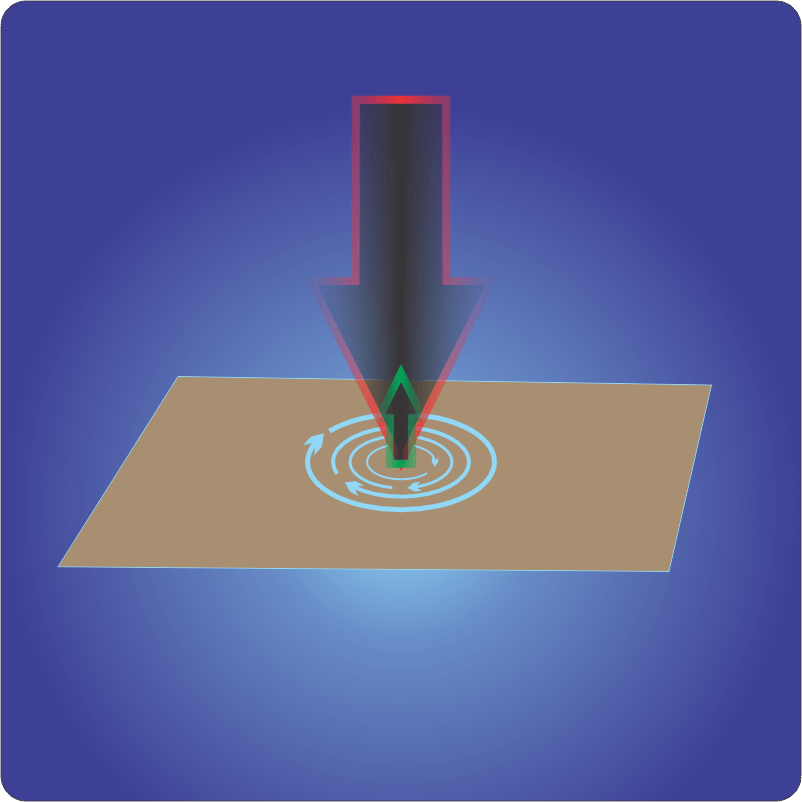
“Very good, Mr Feder. In electromagnetism that’s called Lenz’ Law. Suppose you bring a magnet towards some active conductor, say a moving sheet of copper. Or maybe it’s already carrying an electric current. Either way, the magnet’s field makes charge carriers in the sheet move perpendicular to the field and to the prevailing motion. That’s an eddy current.”

“How come?”

“Because quantum and I’m not about to get into that in this heat. Emil Lenz didn’t propose a mechanism when he discovered his Law in 1834 but it works. What’s interesting is what happens next. The eddy current generates its own magnetic field that opposes your magnet’s field. There’s your push‑back and it’s called diamagnetism.”

“I see where you’re going, Moire. With a superconductor there’s zero resistance and those eddy currents get big, right?”

“In theory they could be infinite. In practice they’re exactly strong enough to cancel out any external magnetic field, up to a limit that depends on the material. A maglev train’s superconducting pads would float above its superconducting track until someone loads it too heavily.”

“What about portable MRI you said? It’s not like someone’s gonna stand on one.”

“A portable MRI would require a really strong magnet that doesn’t need plugging in. Take that superconducting sheet and bend it into a doughnut. Run your magnet through the hole a few times to start a current. That current will run forever and so will the magnetic field it generates, no additional power required. You can make the field as strong as you like, again within a limit that depends on the material.”

“Speaking of materials, what’s the limit for that LK99 stuff?”

“Ah, just in time! Ahoy, Susan! Out for a walk yourself, I see. We’re on our way to Al’s for coffee and air conditioning. Mr Feder’s got a question that’s more up your Chemistry alley than my Physics.”

“LK99, right? It’s so newsy.”

“Yeah. What is it? Does it superconduct or not?”

“Those answers have been changing by the week. Chemically, it’s basically lead phosphate but with copper ions replacing some of the lead ions.”

“They can do that?”

“Oh yes, but not as neatly as we’d like. Structurally, LK99’s an oxide framework in the apatite class — a lattice of oxygens with phosphorus ions sitting in most of the holes in the lattice, lead ions in some of the others. Natural apatite minerals also have a sprinkling of hydroxides, fluorides or chlorides, but the reported synthesis doesn’t include a source for any of those.”

“Synthesis — so the stuff is hand‑made?”

“Mm‑hm, from a series of sold‑state reactions. Those can be tricky — you grind each of your reactants to a fine powder, mix the powders, seal them in a tube and bake at high temperature for hours. The heat scrambles the lattices. The atoms can settle wherever they want, mostly. I think that’s part of the problem.”

“Like maybe they don’t?”

“Maybe. There are uncontrollable variables — grinding precision, grain size distribution, mixing details, reaction tube material, undetected but critical impurities — so many. That’s probably why other labs haven’t been able to duplicate the results. Superconductivity might be so structure‑sensitive that you have to prepare your sample j‑u‑s‑t right.”

~~ Rich Olcott

SPLASH Splish plink

<chirp, chirp, chirp, chirp> “Moire here. This’d better be good.”

“Hello, Mr Moire. I’m one of your readers.”

“Do you have any idea what time it is?”

“Afraid not, I don’t know what time zone you’re in.”

“It’s three o’clock in the morning! Why are you calling me at this hour?”

“Oh, sorry, it’s mid-afternoon here. Modern communications tech is such a marvel. No matter, you’re awake so here’s my question. I’ve been pondering that micro black hole you’ve featured in the last couple of posts. You convinced me it would have a hard time hitting Earth but then I started thinking about it hitting the Sun. The Sun’s diameter is 100 times Earth’s so it presents 10,000 times more target area, yes? Further, the Sun’s 300,000 times more massive than Earth so it has that much more gravity. Surely the Sun is a more effective black hole attractor than Earth is.”

“That’s a statement, not a question. Worse yet, you’re comparing negligible to extremely negligible and neither one is worth losing sleep over which is what I’m doing now.”

“Wait on, I’ve not gotten to my question yet which is, suppose a black hole did happen to collide with the Sun. What would happen then?”

<yawn> “Depends on the size of the black hole. If it’s supermassive, up in the billion‑sun range, it wouldn’t hit the Sun. Instead, the Sun would hit the black hole but there’d be no collision. The Sun would just sink quietly through the Event Horizon.”

“Wouldn’t it rip apart?”

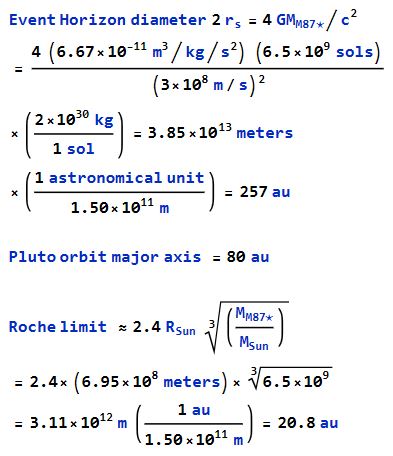
“You’re thinking of those artistic paintings showing great blobs of material being torn away by a black hole’s gravity. Doesn’t work that way, at least not at this size range.” <grabbing Old Reliable from my nightstand and key‑tapping> “Gravitational forces are distance‑dependent. Supermassives are large even by astronomical standards. The M87* black hole, the first one ESA got an image of, has the mass of 6 billion Suns and an Event Horizon three times wider than Pluto’s orbit. The tidal ripping‑apart you’re looking for only happens when the mass centers of two objects approach within Roche’s limit. Suppose a Sun‑sized star flew into M87*’s Event Horizon. Their Roche limit would be 100 astronomical units inside the Event Horizon. If any ripping happened, no evidence could escape to us.”

“Another illusion punctured.”

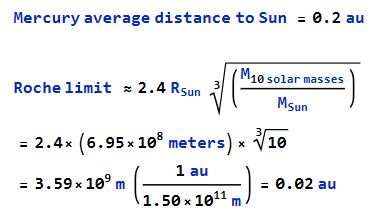
“Don’t give up hope. The next‑smaller size category have masses near our Sun’s. The Event Horizon of a 10‑solar‑mass black hole would be only about 60 kilometers wide. The Roche Zone for an approaching Sun is a million times wider. There’s plenty of opportunity for ferocious ripping on the way in.”

“Somehow that’s a comfort, but my question was about even smaller black holes — micro‑size flyspecks such as you wrote about. What effect would one have on the Sun?”

“You’d think it’d be a simple matter of the micro‑hole, let’s call it Mikey, diving straight to the Sun’s center while gobbling Sun‑stuff in a gluttonous frenzy, getting exponentially bigger and more voracious every second until the Sun implodes. Almost none of that would happen. The Sun’s an incredibly violent place. On initial approach Mikey’d be met with powerful, rapidly moving magnetic fields. If he’s carrying any charge at all they’d give him whip‑crack rides all around the Sun’s mostly‑vacuum outer layers. He might not ever escape down to the Convection Zone.”

“He’d dive if he escaped there or he’s electrically neutral.”

“Mostly not. The Convection Zone’s 200,000-kilometer depth takes up two‑thirds of the Sun’s volume and features hyper‑hurricane winds roaring upward, downward and occasionally sideward. Mikey would be a very small boat in a very big forever storm.”

“But surely Mikey’s density would carry him through to the core.”

“Nope, the deeper you go, the smaller the influence of gravity. Newton proved that inside a massive spherical shell, the net gravitational pull on any small object is zero. At the Sun’s core it’s all pressure, no gravity.”

“Then the pressure will force‑feed mass into Mikey.”

“Not so much. Mikey has jets and and an accretion disk. Their outward radiation pressure sets an upper limit on Mikey’s gobbling speed. The Sun will nova naturally before Mikey has any effect.”

“No worries then.”

~~ Rich Olcott

Reflection, Rotation And Spacetime

“Afternoon, Al.”

“Hiya, Sy. Hey, which of these two scones d’ya like better?”

“”Mm … this oniony one, sorta. The other is too vegetable for me ‑ grass, I think, and maybe asparagus? What’s going on?”

“Experimenting, Sy, experimenting. I’m going for ‘Taste of Spring.’ The first one was spring onion, the second was fiddlehead ferns. I picked ’em myself.”

“Very seasonal, but I’m afraid neither goes well with coffee. I’ll take a caramel scone, please, plus a mug of my usual mud.”

“Aw, Sy, caramel’s a winter flavor. Here you go. Say, while you’re here, maybe you could clear up something for me?”

“I can try. What’s the something?”

“After your multiverse series I got out my astronomy magazines to read up on the Big Bang. Several of the articles said that we’ve gone through several … um, I think they said ‘epochs‘ … separated by episodes of symmetry breaking. What’s that all about?”

“It’s about a central notion in modern Physics. Name me some kinds of symmetry.”

“Mmm, there’s left‑right, of course, and the turning kind like a snowflake has. Come to think — I like listening to Bach and Vivaldi when I’m planet‑watching. I don’t know why but their stuff reminds me of geometry and feels like symmetry.”

“Would it help to know that the word comes from the Greek for ‘same measure‘? Symmetry is about transformations, like your mirror and rotation operations, that affect a system but don’t significantly change to its measurable properties. Rotate that snowflake 60° and it looks exactly the same. Both the geometric symmetries you named are two‑dimensional but the principle applies all over the place. Bach and the whole Baroque era were just saturated with symmetry. His music was so regular it even looked good on the page. Even buildings and artworks back then were planned to look balanced, as much mass and structure on the left as on the right.”

“I don’t read music, just listen to it. Why does Bach sound symmetric?”

“There’s another kind of symmetry, called a ‘translation‘ don’t ask why, where the transformation moves something along a line within some larger structure. That paper napkin dispenser, for instance. It’s got a stack of napkins that all look alike. I pull one off, napkins move up one unit but the stack doesn’t look any different.”

“Except I gotta refill it when it runs low, but I get your drift. You’re saying Bach takes a phrase and repeats it over and over and that sounds like translational symmetry along the music’s timeline.”

“Yup, maybe up or down a few tones, maybe a different register or instrument. The repeats are the thing. Play his Third Brandenberg Concerto next time you’re at your telescope, you’ll see what I mean.”

“Symmetry’s not just math then.”

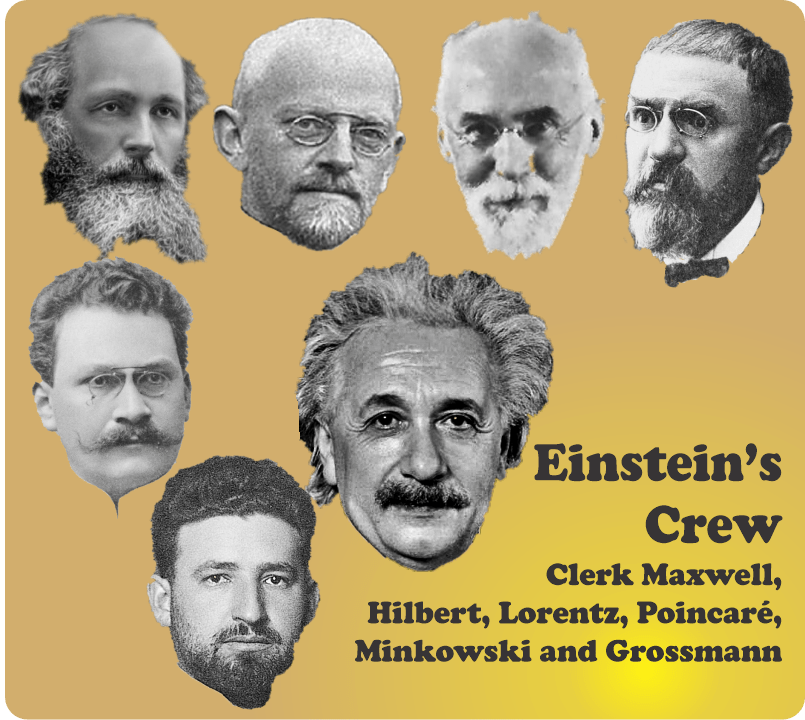
“Like I said, it’s everywhere. You’ve seen diagrams of DNA’s spiral staircase. It combines translation with rotation symmetry, does about 10 translation steps per turn, over and over. The Universe has a symmetry you don’t see at all. No‑one did until Lorentz and Poincaré revised Heaviside’s version of Maxwell’s electromagnetism equations for Minkowski space. Einstein, Hilbert and Grossman used that work to give us and the Universe a new symmetry.”

“Einstein didn’t do the math?”

“The crew I just named were world‑class in math, he wasn’t. Einstein’s strengths were his physical intuition and his ability to pick problems his math buddies would find interesting. Look, Newton’s Universe depends on absolute space and time. The distance between two objects at a given time is always the same, no matter who’s measuring it or how fast anyone is moving. All observers measure the same duration between two incidents regardless. Follow me?”

“Makes sense. That’s how things work hereabouts, anyway.”

“That’s how they work everywhere until you get to high speeds or high gravity. Lorentz proved that the distances and durations you measure depend on your velocity relative to what you’re measuring. Extreme cases lead to inconsistent numbers. Newton’s absolute space and time are pliable. To Einstein such instability was an abomination. Physics needs a firm foundation, a symmetry between all observers to support consistent measurements throughout the Universe. Einstein’s Relativity Theory rescued Physics with symmetrical mathematical transformations that enforce consistency.”

~~ Rich Olcott

Tiramisu And Gemstones

“Sis, you say there’s dessert?”

“Of course there is, Sy. Teena, please bring in the tray from the fridge.”

“Tiramisu! You did indeed go above and beyond. Thank you, Teena. Your Mom’s question must be a doozey.”

“I’ll let you enjoy a few spoonfulls before I hit you with it.” <minutes with spoon noises and yumming> “Okay. tell me about entanglement.”

“Whoa! What brought that on?”

“I’ve seen the word bandied about in the popular science press—”

“And pseudoscience—”

“Well, yes. I’m writing something where the notion might come in handy if it makes sense.”

“How can you tell what’s pseudoscience?”

“Good question, Teena. I look for gee-whiz sentences, especially ones that include weasely words like ‘might‘ and ‘could.’ Most important, does the article make or quote big claims that can’t be disproven? I’d want to see pointers to evidence strong enough to match the claims. A respectable piece would include comments from other people working in the same field. Things like that.”

“What your Mom said, and also has the author used a technical term like ‘energy‘ or ‘quantum‘ but stretched it far away from its home base? Usually when they do that and you have even an elementary idea what the term really means, it’s pretty clear that the author doesn’t understand what they’re writing about. That goes double for a lot of what you’ll see on YouTube and social media in general. It’s just so easy to put gibberish up there because there’s no‑one to contradict a claim, or if there is, it’s too late because the junk has already spread. ‘Entanglement‘ is just the latest buzzword to join the junk‑science game.”

“So what can you tell us about entanglement that’s non‑junky?”

“First thing is, it’s strictly a microscopic phenomenon, molecule‑tiny and smaller. Anything you read about people or gemstones being entangled, you can stop reading right there unless it’s for fun.”

“Weren’t Rapunzel and the prince entangled?

“They and all the movie’s other characters were tangled up in the story, yes, but that’s not the kind of entanglement your Mom’s asking about. This kind seems to involve something that Einstein called ‘spooky action at a distance‘. He didn’t like it.”

“‘Seems to‘?”

“Caught me, Sis, but it’s an important point. You make a system do something by acting on it, right? We’re used to actions where force is transmitted by direct contact, like hitting a ball with a bat. We’ve known how direct contact works with solids and fluids since Newton. We’ve extended the theory to indirect contact via electric and other fields thanks to Maxwell and Einstein and a host of other physicists. ‘Action at a distance‘ is about making something happen without either direct or indirect contact and that’s weird.”

“Can you give us an example?”

“How about an entanglement story? Suppose there’s a machine that makes coins, nicely packaged up in gift boxes. They’re for sweethearts so it always makes the coins in pairs, one gold and one silver. These are microscopic coins so quantum rules apply — every coin is half gold and half silver until its box is opened, at which point it becomes all one pure metal.”

“Like Schrödinger’s asleep‑awake kitty‑cat!”

“Exactly, Teena. So Bob buys a pair of boxes, keeps one and gives the other to Alice before he flies off in his rocket to the Moon. Quantum says both coins are both metals. When he lands, he opens his box and finds a silver coin. What kind of coin does Alice have?”

“Gold, of course.”

“For sure. Bob’s coin‑checking instantly affected Alice’s coin a quarter‑million miles away. Spooky, huh?”

“But wait a minute. Alice’s coin doesn’t move. It’s not like Bob pushed on it or anything. The only thing that changed was its composition.”

“Sis, you’ve nailed it. That’s why I said ‘seems to‘. Entanglement’s not really action at a distance. No energy or force is exerted, it’s simply an information thing about quantum properties. Which, come to think of it, is why there’s no entanglement of people or gemstones. Even a bacterium has billions and billions of quantum‑level properties. Entanglement‑tweaking one or two or even a thousand atoms won’t affect the object as a whole.”

~~ Rich Olcott

The Frame Game

A familiar footstep outside my office, “C’mon in, Vinnie, the door’s open.”

“Hi, Sy, how ya doin’?”

“Can’t complain. Yourself?”

“Fine, fine. Hey, I been thinking about something you said while Al and us were talking about rockets and orbits and such. You remember that?”

“We’ve done that in quantity. What statement in particular?”

“It was about when you’re in the ISS, you still see like 88% of Earth’s gravity. But I seen video of those astronauts just floating around in the station. Seems to me those two don’t add up.”

“Hah! We’re talking physics of motion here. What’s the magic word?”

“You’re saying it’s frames? I thought black holes did that.”

“Black holes are an extreme example, but frame‑thinking is an essential tool in analyzing any kind of relative motion. Einstein’s famous ‘happy thought‘ about a man in a free‑falling elevator—”

“Whoa, why is that a happy thought? I been nervous about elevators ever since that time we got stuck in one.”

“At least it wasn’t falling, right? Point is, the elevator and whoever’s in it agree that Newton’s First Law of Motion is valid for everything they see in there.”

“Wait, which Law is that?”

“‘Things either don’t move or else they move at a steady pace along a straight line.’ Suppose you’re that guy—”

“I’d rather not.”

“… and the elevator is in a zero‑gravity field. You take something out of your pocket, put it the air in front of you and it stays there. You give it a tap and it floats away in a straight line. Any different behavior means that your entire frame — you, the elevator and anything else in there — is being accelerated by some force. Let’s take two possibilities. Case one, you and the elevator are resting on terra firma, tightly held by the force of gravity.”

“I like that one.”

“Case two, you and the elevator are way out in space, zero‑gravity again, but you’re in a rocket under 1-g acceleration. Einstein got happy because he realized that you’d feel the same either way. You’d have no mechanical way to distinguish between the two cases.”

“What’s that mean, mechanical?”

“It excludes sneaky ways of outside influence by magnetic fields and such. Anyhow, Einstein’s insight was key to extending Newton’s First Law to figuring acceleration for an entire frame. Like, for instance, an orbiting ISS.”

“Ah, you’re saying that floating astronauts in an 88% Earth-gravity field is fine because the ISS and the guys share the frame feeling that 88% but the guys are floating relative to that frame. But down here if we could look in there we’d see how both kinds of motion literally add up.”

“Exactly. It’s just much easier to think about only one kind at a time.”

“Wait. You said the ISS is being accelerated. I thought it’s going a steady 17500 miles an hour which it’s got to do to stay 250 miles up.”

“Is it going in a straight line?”

“Well, no, it’s going in a circle, mostly, except when it has to dodge some space junk.”

“So the First Law doesn’t apply. Acceleration is change in momentum, and the ISS momentum is constantly changing.”

“But it’s moving steady.”

“But not in a straight line. Momentum is a vector that points in a specific direction. Change the direction, you change the momentum. Newton’s Second Law links momentum change with force and acceleration. Any orbiting object undergoes angular acceleration.”

“Angular acceleration, that’s a new one. It’s degrees per second per second?”

“Yup, or radians. There’s two kinds, though — orbiting and spinning. The ISS doesn’t spin because it has to keep its solar panels facing the Sun.”

“But I’ve seen sci-fi movies set in something that spins to create artificial gravity. Like that 2001 Space Odyssey where the guy does his running exercise inside the ship.”

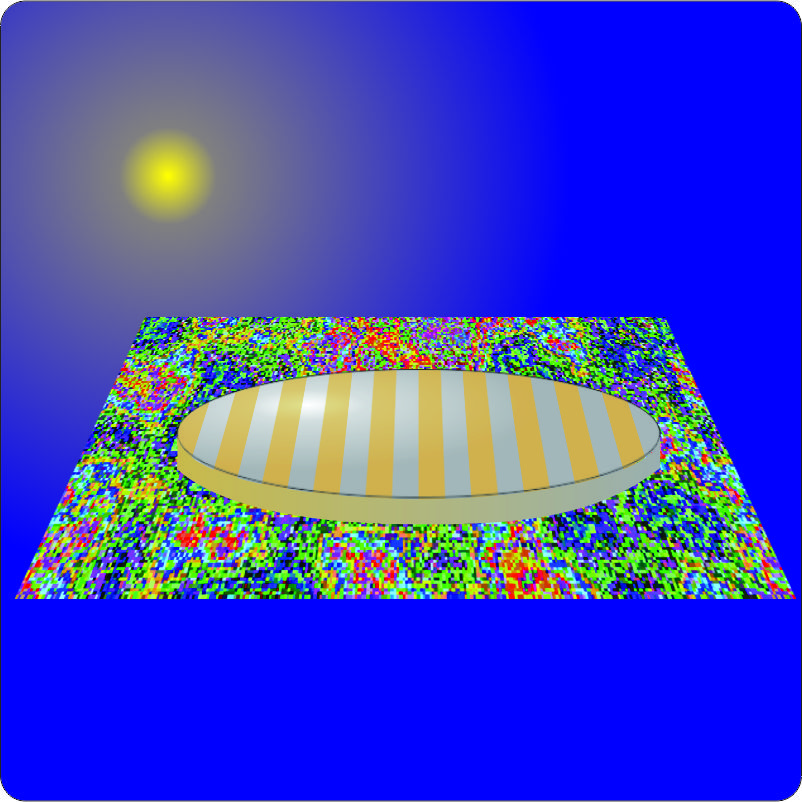
“Sure, and people have designed space stations that spin for the same reason. You’d have a cascade of frames — the station orbiting some planet, the station spinning, maybe even a ballerina inside doing pirouettes.”

“How do you calculate all that?”

“You don’t. You work with whichever frame is useful for what you’re trying to accomplish.”

“Makes my head spin.”

~~ Rich Olcott

Not Too Fast, Not Too Slow

“Vinnie, those nifty-looking transfer orbits that Hohmann invented but didn’t get to patent — you left something out.”

“What’s that, Sy?”

“The geometry looks lovely — a rocket takes off tangent to its orbit around one planet or something and inserts along a tangent to an orbit around something else. Very smooth and I can see how that routing avoids having to spend fuel to turn corners. But that ignores speeds.”

“What difference does that make?”

“It makes a difference whether or not you can get into the orbit you’re aiming for. Any orbit is a trade-off between gravity’s pull and the orbiter’s kinetic energy. Assuming you’re going for a circular orbit, there’s a strict relationship between your final height and your approach speed when you’re finally flying on the horizontal. You don’t want to come in too fast or too slow.”

“First thing I learned in pilot school. But that relationship’s an equation, ain’t it?”

“A couple, actually, but they’re simple. Let’s back into the problem. Say your mission is to put a communications relay satellite into lunastationary orbit around the Moon—”

“Lunastationary?”

“Like geostationary, but with the Moon. The satellite’s supposed to hover permanently above one spot on the Moon’s equator, so its orbital period has to equal the Moon’s ‘day,’ <pulling out Old Reliable, tapping> which is 27.322 days. Your satellite must loop around the Moon in exactly that much time. Either it’s scooting at low altitude or it’s ambling along further up. If we knew the speed we could find the radius, and if we knew the radius we could find the speed. We need some math.”

“I knew it. You’re gonna throw calculus at me.”

“Relax, Vinnie, it’s only algebra and we’re only going to combine two formulas and you already know one of them. The one you don’t know connects the speed, which I’m calling v, with the radius, R. They’re tied together by the Moon’s mass, M and Newton’s gravitational constant G. The formula is v2=2G×M/R. You can handle that, right?”

“Lessee … that says if I either double the mass or cut the distance by two, the speed has to be four times larger. Makes sense ’cause that’s about being in a deeper gravity well or getting closer in. Am I on track?”

“Absolutely. Next formula is the one you know, the circumference of a circle or in this case, the distance around that orbit.”

“That’s easy, 2πR.”

“And that’s also speed times the time, T so I’ll set those equal. <tapping on Old Reliable> Okay, the first formula says v2 so I square the circumference equation and solve that for v2 . You still with me?”

“You’re gonna set those two v-squareds equal, I suppose.”

“You’re still on track. Yup and then I gather the Rs on one side and everything else on the other. That gives me something in R3 but that’s okay. Plug in all the numbers, take the cube root and we get that you need to position that satellite 111 megameters out from the Moon’s center, flying at 296 meters per second. Think you can manage that?”

“Given the right equipment, sure. Seventy thousand miles out from the Moon … pretty far.”

“It’s about ¾ of the way to the Moon from Earth.”

“Cool. Does that R3 formula work for the planets?”

“Sure. Works for the Sun, too, but that’s so massive and spins so fast the sol‑stationary orbit’s half way to Mercury. An orbiter would have to fly 205 000 miles an hour to keep up with an equatorial sunspot. Flying something‑stationary over other planets offers problems beyond targeting the orbit, though.”

“Besides how long the trip would be?”

“Well, that, yes, but here’s another one. Suppose you’re going to Mars, aiming at an ares‑stationary orbit. It’ll be 20 megameters, 12500 miles from the center. You need to make your tangential injection at a Mars‑relative speed of 1439 meters per second. Problem is, you left Earth from a geostationary orbit at 3075 m/s relative to Earth. At the classic Hohmann positions, Earth’s going 5710 m/s relative to Mars, Somehow you’re going to have to shed 7346 m/s per second of excess speed.”

~~ Rich Olcott