There’s Always An Angle

“No, Moire, when I said the glasses get dark or light depending I was talking about those glasses that just block out shiny, like from windows across the street when the Sun hits ’em just wrong.”

“I got this, Sy. That’s about polarized light, Feder, and polarized sunglasses. Sy and me, we talked about that when we were thinkin’ Star Trek weapons.”

“You guys talk about everything, Vinnie.”

“Pretty much. Anyhow, it goes back to how electrons make light. Electrons got charge and that makes an electric field around them, right? When you jiggle an electron up and down the field jiggles and sooner or later that’ll make some other electron jiggle like maybe in your eye and you see that as light. How’m I doing, Sy?”

“You’re on a roll. Keep it going.”

“Okay, so the electron doesn’t have to jiggle only up and down, it can do side‑to‑side if it feels like it or anything in between and the field goes along with all of that. When you got a lot of electrons doing that together, different‑angle waves go out and that poor second electron gets shoved all around the compass, right?”

“Hey, don’t all those jiggles just cancel each other out?”

“Nah, ’cause their timing’s off. They’re not in sync or nothing so the jiggles push in every direction random‑like.”

“How about lasers? I thought their waves all marched in sync.”

“They’re in sync strong‑and‑weak, but I guess whether they’re up‑and‑down in sync depends on the technology, right, Sy?”

“Right, Vinnie. Simple diode laser beams usually aren’t polarized, but special-purpose lasers may be designed with polarization in the package. Of course, any beam can be polarized if it’s bounced off something at just the right angle.”

“What’s the angle got to do with it, Moire?”

“I bet I know. Sy. Is that bounce angle connected to the prism stuff?”

“Nice shot, Vinnie. Carry on.”

“Ok, Feder, follow me ’cause this is a little complicated. Sy, can I borrow your whiteboard?”

“Sure.”

“Thanks. All right, this thick green wiggle is a regular light ray’s electric field, coming in at a low angle and jiggling in all directions. It hits a window or something, that’s the black line, and some of it gets reflected, that’s the red wiggle, and some gets through but not as much which is why the second green line is skinny. The fast‑slow marks are about wave speeds but it’s why the skinny wiggle runs at that weird angle. We good?”

“Mostly, I guess, but where does the polarization come in?”

“I’m gettin’ there. That’s what the dots are about. I’m gonna pretend that all those different polarization directions boil down to either up‑and‑down, that’s the wiggles, and side to side, that’s the dots. Think of the dots as wiggle coming out and going back in cross‑ways to the up‑and‑down. It’s OK to do that, right, Sy?”

“Done in the best families, Vinnie. Charge on.”

“So anyway, the up‑and‑down field can sink into the window glass and mess around with the atoms in there. They pass some of the energy down through the glass but the rest of it gets gets thrown back out like I show it.”

“But there’s no dots going down.”

“Ah-HAH! The side‑to‑side field doesn’t sink into the glass at all ’cause the atoms ain’t set up right for that. That side‑to‑side energy bounces back out and hits you in the eyes which is why you use those polarizing sunglasses.”

“But how do those glasses work is what I asked to begin with.”

“That’s all I got, Sy, your turn.”

“Nice job, Vinnie. How they cut the glare, Mr Feder, is by blocking only Vinnie’s side‑to‑side waves. Glare is mostly polarized light reflected off of horizontal surfaces like water and roadway. Block that and you’re happy. How they work is by selective absorption. The lenses are made of long, skinny molecules stretched out in parallel and doped with iodine molecules. Iodine’s a big, mushy atom with lots of loosely-held electrons, able to absorb many frequencies but only some polarizations. If a light wave passes by jiggling in the wrong direction, its energy gets slurped. No more glare.”

~~ Rich Olcott

Dark Glasses

My office door THUMPs as Richard Feder barrels in. Vinnie’s half out of his chair with his fists balled up but he settles back down when he sees who it is. “Moire, I gotta question.”

“Afternoon, Mr Feder. What brings you to the 12th floor of the Acme Building?”

“My dentist’s up here. They gave me these really dark glasses for when they aimed a bright light in my mouth to harden something in there so I wondered why’re they so dark an’ what about those glasses that can’t make up their minds?”

“Well, Mr Feder, as usual you’ve asked a jumbled question. Let’s see. The answers all boil down to what light is made of and what the glasses are made of.”

“I thought it was photon particles, Sy. The light, I mean.”

“It is, Vinnie, but photons only act like particles when they’re emitted and when they’re absorbed. In between, they act like waves. Dark glasses are all about photons as waves. The simplest case is the plain dark glasses.”

“Yeah, Moire, simple’s good.”

“They’re black because they’ve been doped with black chemicals. If your glasses are actually made of glass, the manufacturer probably dumped iron and sulfur into the melt. When heated those elements combine to form black iron sulfide particles spread throughout the mass. If the glasses are plastic, the manufacture mixed black dye into the formula. Either way, the more dopant added, the blacker the product and the fewer waves make it through the lens.”

“Great, Sy, but how come the black? I remember that Sun-spectrum poster that Al had up in his shop once. Lotsa sharp dark lines that Cathleen said were from different elements absorbing little slices of that rainbow background. But there were plenty of colors left over to make white.”

“Impressive memory, Vinnie. That was what, three years ago? Anyhow, those absorption lines come from separated atoms floating in the hot gas of the solar atmosphere. Quantum mechanics says that an isolated atom has a characteristic set of electron configurations, each with its own energy level. Say an incoming photon meets a gas atom. If the photon’s energy just matches the difference between the atom’s current configuration and some other configuration, suddenly the atom’s in the new configuration and no more photon. It has to match just right or no absorption. Those sharp lines come from that selectivity, OK?”

“So how do you get total black from selective atoms?”

“You don’t. You get black from less‑selective molecules and larger structures. Atoms right next to each other bring entanglement into the action — which electron is where on which atom? Many more configurations, many more differences between energy level pairs, many more lines that can overlap to make broad absorption bands. Suppose you’ve got some glass or plastic doped to have a single band sucking up everything between orange and green. Shine white light into it. Only red light and blue light come through. We see that as purple, a color that’s not even in the spectrum. Make that band even broader like it is with metals and rocks and iron sulfide; nothing gets through.”

“Then how do they do those glasses that get dark or light depending? The factory can’t put chemicals in but take ’em out temporary‑like when you walk inside.”

“Good point. In fact, the glass composition stays the same, sort of. The factory puts in chemicals that change their structure depending on the light level. If you dope optical glass with silver chloride crystallites, for instance, UV light can energize a chloride’s electron up to where it can leave the chloride and be captured by a silver ion. Do that with enough silver ions in the crystallite and you have a tiny piece of silver metal. Enough pieces and the glass looks gray, at least until heat energy joggles things back to the silver chloride ground state. For plastic lenses they use a subtler strategy — large‑ish molecules with spread‑out electron structures. UV light energizes an electron to another level and the molecule twitches to an opaque alternate form that relaxes when heat shakes it down.”

“Heat, huh? No wonder mine don’t work so good on the beach.”

~~ Rich Olcott

Chutes And Landers

From: Robin Feder <rjfeder@fortleenj.com>
To: Sy Moire <sy@moirestudies.com>
Subj: Questions

Hello again, Mr Moire. Kalif and I have a question. We were talking about falling out of stuff and we wondered how high you have to fall out of to break every bone in your body. We asked our science teacher Mr Higgs and he said it was something that you or Randall Munroe could answer and besides he (Mr Higgs) had to get ready for his next online. Can you tell us? Sincerely, Robin Feder


From: Sy Moire <sy@moirestudies.com>
To: Robin Feder <rjfeder@fortleenj.com>
Subj: Re: Questions

Hello again, Robin. You do take after your Dad, don’t you? Please give my best to him and to Mr Higgs, who has a massive job. Mr Munroe may already have answered your question somewhere, but I’ll give it a shot.

You’ve assumed that the higher the fall, the harder the hit and the more bones broken. It’s not that simple. Suppose, for instance, that your fall is onto the Moon, whose gravity is 1/6 that of Earth. For any amount of impact, however high the fall would have been on Earth, it’d be six times higher on the Moon. So the answer depends where you’re falling.

But the Moon doesn’t have an atmosphere worth paying attention to. That’s important because atmospheres impose a speed limit, technically known as terminal velocity, that depends on a whole collection of things

  • the Mass of the falling object
  • the local strength of Gravity
  • the Density of the atmosphere
  • the object’s cross‑sectional Area in the direction of fall

The first two produce the downward pull of gravity, the others produce the upward push of air resistance. Fun fact — in Galileo’s “All things fall alike” experiments, he always used spheres in order to cancel the effects of air resistance in his comparisons.

Let’s put some numbers to it. Suppose someone’s at Earth’s “edge of space” 100 kilometers up. From the PE=m·g·h formula for gravitational potential energy and dividing out their mass which I don’t know, they have 9.8×10⁵ joules/kilogram of potential energy relative to Earth’s surface. Now suppose they convert that potential to kinetic energy by falling to the surface with no air resistance. Using KE=m·v² I calculate they’d hit at about 1000 meters/second. But in real life, the terminal velocity of a falling human body is about 55 meters/second.

That Area item is why parachutes work. Make a falling object’s area larger and it’ll have to push aside more air molecules on its way down. Anyone wanting to survive a fall wants as much area as they can get. A parachute’s fabric canopy gives them a huge area and a big help. Parachute drops normally hit at about 5 meters/second. Trained people walk away from that all the time. Mostly.

Which gets to the matter of how you land. Parachute training schools and martial arts dojos give you the same advice — don’t try to stop your fall, just tuck in your chin and twist to convert vertical kinetic energy to rolling motion. Rigid limbs lead to bones breaking, ligaments tearing and joints going out of joint.

So let’s talk bones. Adults have about 210 of them, about 90 fewer than when they were a kid. Bones start out as separate bony patches embedded in cartilage. The patches eventually join together as boney tissue and the cartilage proportion decreases with age. Bottom line — kid bones are bendy, old bones snap more easily. For your question, breaking “every bone in your body” is a bigger challenge if you’re young.

But all bones aren’t equal — some are more vulnerable than others. Sesamoid bones, like the ones at the base of your thumb, are millimeter‑sized and embedded in soft tissue that protects them. The tiny “hammer, anvil and stirrup” ear bones are buried deep in hard bony tissue that protects them, too. Thanks to bones and soft tissues that would absorb nearly all the energy of impact, these small bones are almost invulnerable.

To summarize, no matter how high up from Earth you fall from, you can’t fall fast enough to hit hard enough to break every bone in your body. Be careful anyhow.

Regards,
Sy Moire.

~~ Rich Olcott

  • Thanks to Xander and Lucas for their input.

To Swerve And Project

A crisp Fall dawn, crisp fallen leaves under my feet as I jog the path by the park’s lake.

“Hey! Moire! How about these red sunrises and sunsets? Remind you of Mars?”

“Morning, Mr Feder. Not much, and definitely not dawn or dusk. Those tend more to blue, as a matter of fact.”

“Waitaminnit, Moire. I seen that Brad Pitt Martian movie, him driving hisself all alone across that big plain — the place is blood‑red.”

“Think a minute, Mr Feder. If he was all alone, who was running the cameras?”

“Uhhh, right. Movie. Yeah, they were really on Earth so they could director the lighting and all. But they said they’d scienced the … heck out of it.”

“Oh they did, better than most movies, but artistic license took over in a couple of places. People expect Mars to be red, not mostly clay colored like it really is, so the producers served up red.”

“Wait, I remember the conversation about Earth is blue because of the oceans and Mars is red because of its rusty atmosphere. So what’s with the sky colors?”

“Looking up at sunlight through an atmosphere is very different from looking down at the surface. It all has to do with how what’s in the atmosphere interacts with sunlight. Take Earth’s blue sky, for instance.”

“My favorite color.”

“Sure it is. OK, the Sun’s disk takes up much less than 1% of the sky but that’s enough to give us all our sunlight photons. A fraction of them run into something on the way down to Earth’s surface. What happens depends on how big the something is compared to the photon wavelength. Much larger things, maybe an airplane, completely block the photons and we get a shadow.”

“Obviously.”

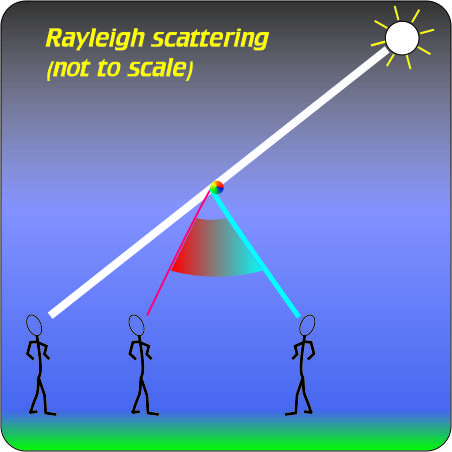
“Yeah, but life’s more interesting for smaller somethings. For things like air molecules and dust particles that are much smaller than the the wavelength of visible light, the waves generally swerve around the particle. How much they swerve depends on the wavelength — extreme blue light bends about ten times more than extreme red light for the same scattering particle. So suppose there’s a kid a few miles away from us looking at the sky while we’re looking at it here. There’s a sunbeam with a rainbow‑load of photons headed for the kid, but there are dust particles in the way. Get the picture?”

“Sure, sure, get on with it.”

“So some of the light swerves. The red swerves a little but the blue light swerves ten times as much, enough that it heads straight for us. What color do we see when we look in that direction?”

“Blue, of course.”

“Blue everywhere in the lit‑up sky except when we look straight at the Sun.”

“What about these pretty red sunsets and the red skies over the wildfires?”

“Two different but related phenomena. Sunsets first. An incoming photon with just the right wavelength may simply be absorbed by a molecule. Doesn’t happen often, but there’s lots of molecules. Turns out that oxygen and ozone absorb blue light more strongly than red light. When we’re looking horizontally towards a sunset we’re looking through many more oxygen molecules than when we look vertically. We see the red part of a blue‑filtered version of that swerve rainbow.”

“And the fire skies?”

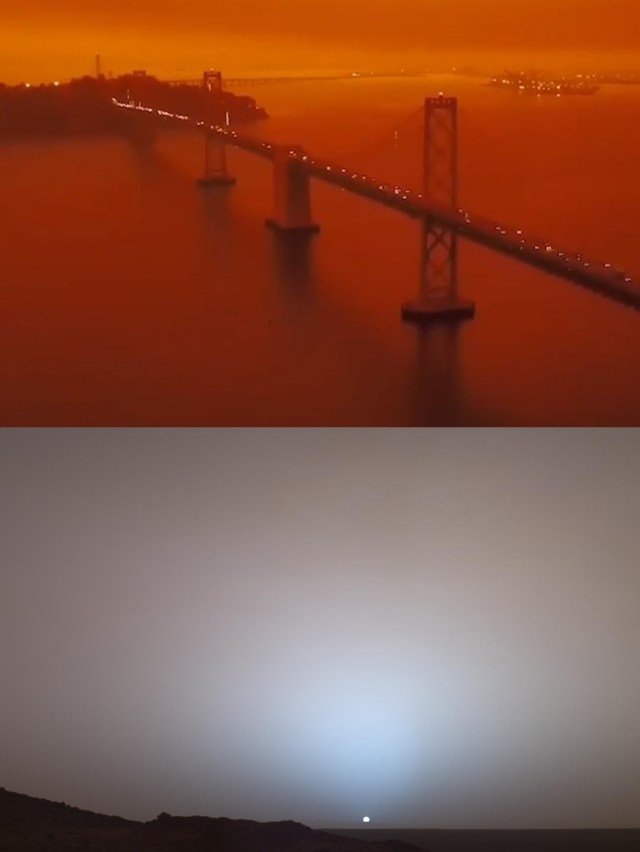
“The fires released huge amounts of fine smoke particles, just the right size for color‑scattering. Blue light swerves again and again until it’s either absorbed or shot out to space. Red light survives.”

Upper image – Golden Gate Bay under fiery skies, Sept 2020
Lower image – Sunset from Gusev Crater, Mars
Credit: NASA/JPL/Texas A&M/Cornell

“So what’s different about Mars?”

“Three things — Mars dust is different from Earth’s, its atmosphere is a lot thinner, and there’s practically no atmospheric water or oxygen. Rusty Mars dust is the size of smoke particles. With no rain or snow to settle out the dust, it stays aloft all the time. Rust is red because it absorbs blue light and reflects only the red part. With less diffused sunlight, Mars’ sky is basically the black of space overlaid with a red tint. Sunsets are blue‑ish because what blue light there is can travel further.”

“Earth skies are better.”

~~ Rich Olcott

Free Energy, or Not

From: Richard Feder <rmfeder@fortleenj.com>
To: Sy Moire <sy@moirestudies.com>
Subj: Questions

What’s this about “free energy”? Is that energy that’s free to move around anywhere? Or maybe the vacuum energy that this guy said is in the vacuum of space that will transform the earth into a wonderful world of everything for free for everybody forever once we figure out how to handle the force fields and pull energy out of them?


From: Sy Moire <sy@moirestudies.com>
To: Richard Feder <rmfeder@fortleenj.com>

Subj: Re: Questions

Well, Mr Feder, as usual you have a lot of questions all rolled up together. I’ll try to take one at a time.

It’s clear you already know that to make something happen you need energy. Not a very substantial definition, but then energy is an abstract thing it took humanity a couple of hundred years to get our minds around and we’re still learning.

Physics has several more formal definitions for “energy,” all clustered around the ability to exert force to move something and/or heat something up. The “and/or” is the kicker, because it turns out you can’t do just the moving. As one statement of the Second Law of Thermodynamics puts it, “There are no perfectly efficient processes.”

For example, when your car’s engine burns a few drops of gasoline in the cylinder, the liquid becomes a 22000‑times larger volume of hot gas that pushes the piston down in its power stroke to move the car forward. In the process, though, the engine heats up (wasted energy), gases exiting the cylinder are much hotter than air temperature (more wasted energy) and there’s friction‑generated heat all through the drive train (even more waste). Improving the drive train’s lubrication can reduce friction, but there’s no way to stop energy loss into heated-up combustion product molecules.

Two hundred years of effort haven’t uncovered a usable loophole in the Second Law. However, we have been able to quantify it. Especially for practically important chemical reactions, like burning gasoline, scientists can calculate how much energy the reaction product molecules will retain as heat. The energy available to do work is what’s left.

For historical reasons, the “available to do work” part is called “free energy.” Not free like running about like ball lightning, but free in the sense of not being bound up in jiggling heated‑up molecules.

Vacuum energy is just the opposite of free — it’s bound up in the structure of space itself. We’ve known for a century that atoms waggle back and forth within their molecules. Those vibrations give rise to the infrared spectra we use for remote temperature sensing and for studying planetary atmospheres. One of the basic results of quantum mechanics is that there’s a minimum amount of motion, called zero‑point vibration, that would persist even if the molecule were frozen to absolute zero temperature.

There are other kinds of zero‑point motion. We know of two phenomena, the Casimir effect and the Lamb shift, that can be explained by assuming that the electric field and other force fields “vibrate” at the ultramicroscopic scale even in the absence of matter. Not vibrations like going up and down, but like getting more and less intense. It’s possible that the same “vibrations” spark radioactive decay and some kinds of light emission.

Visualize space being marked off with a mesh of cubes. In each cube one or more fields more‑or‑less periodically intensify and then relax. The variation strength and timing are unpredictable. Neighboring squares may or may not sync up and that’s unpredictable, too.

The activity is all governed by yet another Heisenberg’s Uncertainty Principle trade‑off. The stronger the intensification, the less certain we can be about when or where the next one will happen.

What we can say is that whether you look at a large volume of space (even an atom is ultramicroscopicly huge) or a long period of time (a second might as well be a millennium), on the average the intensity is zero. All our energy‑using techniques involve channeling energy from a high‑potential source to a low‑potential sink. Vacuum energy sources are everywhere but so are the sinks and they all flit around. Catching lightning in a jar was easy by comparison.

Regards,
Sy Moire.

~~ Rich Olcott

Wave As You Go By

A winter day, a bit nippy and windy enough to raise scattered whitecaps on the park lake. Apparently neither the geese nor Mr Richard Feder (of Fort Lee, NJ) enjoy that — the geese are standing on the shore and he’s huddled down on a bench as I pass. “Hey Moire, I gotta question.”

“Mr Feder. I’m trying to keep warm. If you want answers you’ll have to jog along.”

“Oh, alright <oof>. OK, watching those waves got me thinking. They keep going because the wind pushes on ’em, right? So what pushes on sound waves and light waves? If something pushes hard enough on a sound wave does it speed up enough to be a light wave?”

“So many questions. Are you sure you’ve got enough wind?”

“Ha, ha. I’ve been working out a little.”

“We’ll see. Well, first, nothing needs to push on a wave once it’s started. They travel on their own momentum.”

“Then why do these waves die away when the wind stops?”

“You’ve got two things going on there, on different time scales. When the wind stops blowing it stops making new waves. Actually, winds rarely stop all at once, they taper off. It looks like waves are dying away but really you just see smaller and smaller waves. Inside a single wave, though, friction takes its toll.”

“Friction? Waves rub against each other? That’s not what’s going on here — they keep their distance unless different groups run crosswise and then they all just keep going.”

Turbulence in a water wave

“Not friction between waves, friction within a wave. There’s a lot of turbulence inside a water wave — the wind piles up surface molecules on one side, gravity and surface tension move the other side’s molecules downward, and the ones inside are pulled in every direction. All that helter-skelter motion randomizes the wave’s momentum and converts the wave’s energy to heat. When that’s gone, the wave’s gone.”

“So how’s sound different from that?”

“Lots of ways. To begin with, wind and gravity move molecules up and down perpendicular to the wave’s direction of travel. Sound waves aren’t affected by gravity. They move molecules back and forth parallel to the wave’s direction.”

“But they still die out, right? Turn to heat and all that?”

“Absolutely, Mr Feder. How fast a wave dies out depends on what heat-conversion processes are in play. In a water wave gravity and surface tension work together to smooth things out. Neither’s active in sound waves. The only way a sound wave can lose energy is through random collisions between molecules that aren’t in sync with the wave. Could be the wave hits a mushy object or maybe it just gets buried in other waves.”

“Like at a football game, when everyone’s shouting but all you hear is the roar.”

“Pretty good example, Mr Feder.”

“So how’s a light wave different?”

“Light waves don’t even need molecules. The electromagnetic field near a particle is the net effect of all the attractions and repulsions it feels from all other charged particles everywhere in the Universe. When some charged particle somewhere moves, that changes the field. The change is transmitted throughout the field as a wave traveling at the speed of light.”

“What makes it die away?”

“It doesn’t. On a dark, clear night your eyes can see stars a quintillion miles away. Astronomers with their instruments can detect objects millions of times further away.”

“No smoothing out? How come?”

“That’s a very deep question, Mr Feder, one that really bothered Einstein. You’d think a photon’s wave would get fainter the further it spreads. In fact, it delivers all its energy to the first charged particle it can interact with, no matter how far it had traveled. Weird, huh?”

“Weird, all right. So we got these three very different things — they start different, they push different, they got different speeds, they die different, but we call them all waves. Why’s that?”

“They’re all waves because they’re all patterns that transmit energy and momentum across space. Physicists have found general rules that apply to the patterns, whatever the wave type. Equations that work for one kind work for many others, too.”

Gravity waves?”

“And gravitational waves.”

~~ Rich Olcott

Never Chuck Muck at A Duck

Mr Richard Feder of Fort Lee NJ is in terrible shape. Barely halfway into our walk around the park’s lake, he flops onto a bench to catch his breath. The geese look on unsympathetically. “<puff, puff> I got another question, Moire. <wheeze> Why is water wet?”

He’s just trying to make conversation while his heart slows down but I take him up on it. “Depends on what you mean by ‘wet‘ — that’s a slippery word, can be a verb or an adjective or a noun. If you wet something, you’ve got a wet something. If there’s wet weather you go out in the wet. If you live in a wet jurisdiction you can buy liquor if you’re old enough. You can even have wet and dry molecules. Which are you asking about?”

That’s gotten him thinking, always a good sign. “Let’s start with the verb thing. Seems like that’s the key to the others.”

“So we’re asking, ‘Does water wet?‘ The answer is, ‘Sometimes,‘ and that’s where things get interesting. That duck over there, diving for something on the bottom, but when it comes back up again the water rolls off it like –“

“Don’t say it — ‘like water off a duck’s back‘ — yeah, I know, but I’m sweating over here and that ain’t rolling off. Why the difference?”

“Blame it on the Herence twins, Co and Addie.”

“Come again?”

“A little joke, has to do with two aspects of stickiness. Adherence is … you know adhesive tape?”

“Adhe — you playin’ word games, Moire?”

“No, really, adhesive and adherence are both about sticking together things that are chemically different, like skin and tape. Coherence is about stickiness between things that are chemically similar, like sweat and skin.”

“What makes things ‘chemically similar’?”

“Polarity. I don’t want to get into the weeds here –“

“Better not, the ground’s squishy over there.”

“– but there are certain pairs of atoms, like oxygen and hydrogen, where one atom pulls a small amount of electron charge away from the other and you wind up with part of a molecule being plus-ish and another part being minus-ish. That makes the molecule polar. Other pairings, like carbon and hydrogen, are more evenly matched. You don’t get charge separation from them and we call that being non-polar. Charge variation in polar molecules forces them to cluster together positive-to-negative. The electrostatic gang crowds out any nearby non-polar molecules.”

“What’s all that got to do with wetting?”

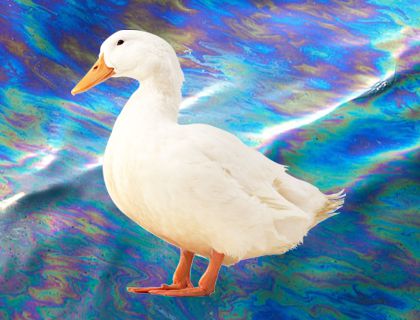
“Water’s all oxygen and hydrogen and quite polar. Water coheres to itself. If it didn’t you’d get rain-smear instead of raindrops. It also adheres to polar materials like skin and hair and bricks, so raindrops wet them. But it doesn’t adhere to non-polar materials like oil and wax. Duck feathers are oily so they shed water.”

“So that’s why the duck doesn’t get wet!”

“Not unless you throw detergent on him, like they have to do with waterfowl after an oil spill. Detergent molecules have a polar end and a non-polar end so they can bridge the electro divide. Rubbing detergent into a dirty bird’s sludgy oil coating lets water sink into the mess and break it up so you can rinse it off. The problem is that the detergent also washes off the good duck oil. If you let a washed-off duck go swimming too soon after his bath the poor thing will sink. You have to give him time to dry off and replenish his natural feather-oil.”

“Hey, you said ‘wet-and-dry molecules.’ How can they be both?”

“Because they’re really big, thousands of atoms if they’re proteins, even bigger for other kinds of polymers. Anything that large can have patches that are polar and other patches that are oily. In fact, patchwise polarity is critical to how proteins get their 3-D structure and do their jobs. A growing protein strand wobbles around like a spring-toy puzzle until positive bits match up with negative bits and oily meets up with oily. Probably water molecules sneak into the polar parts, too. The configuration’s only locked down when everything fits.”

“So water’s wet because water wets water. Hah!”

~~ Rich Olcott

  • Thanks to Museum visitor Jessie for asking this question.

Eyes on The Size

An excellent Fall day, perfect for a brisk walk around the park’s goose-governed lake. Suddenly there’s a goose-like yawp behind me. “Hey Moire, wait up, I got a question!”

“Afternoon, Mr Feder. What’s your question today?”

“You know how the Moon’s huge just after it gets over the horizon but then it gets small? How do they make it do that?”

“Well, ‘they’ is you, Mr Feder, except that nothing physically changes.”

“Whaddaya mean, I seen it change size every time there’s a full moon.”

“That’s what it looks like, but think it through. We’re here in the Midwest, two hours away from your folks back home in Fort Lee. Back when you lived there, did the Moon ever suddenly grow and then shrink when it was two hours up into the sky?”

“Um, no, just at the horizon. So you’re saying it’s one of them optical delusions?”

“Something like that. Here, I’ve got a video on Old Reliable. See how the disk stays the same size but it looks bigger in comparison to the railroad tracks? Your brain expects the tracks to be parallel lines despite the perspective, right, so it compensates by thinking the Moon must be wider when it’s next to them. In the real world you’ve looking at the Moon past trees or buildings, but the false perspective principle applies whether the horizon’s relatively close or far away.”

“Whaddaya mean, close or far horizon? It’s the edge of how far I can see and that’s always the same.”

“Oh, hardly, Mr Feder. You ever visit the Empire State Building’s observation deck?”

“Sure.”

“How about deep-sea fishing, out of sight of land?”

“Aw, that’s a blast, when you hook one of those big guys and you’re –“

“I’m sure you enjoyed it, but did you look around while you were waiting for a strike?”

“Yeah, nothin’ else to do but yammer and drink beer.”

“Mm-hm. So could you see as far from the boat’s deck as you could from the building’s deck?”

“Hey, you’re right. A lot farther from high up. They say on a clear day you can see 80 miles from the Empire State Building — nowhere near that from the boat, believe me. ‘S why they put those decks up there, I guess. How far up do I gotta be to see the whole world, I wonder.”

“Quick answer is, infinitely far away.”

“Wait, those astronauts got that ‘Blue Marble’ picture from the Moon and it showed the whole day side.”

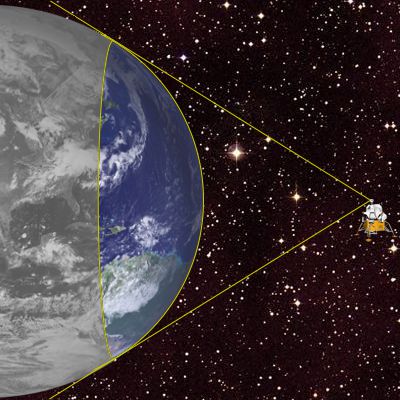
“Take a closer look someday. It shows Antarctica but essentially nothing north of the 45th parallel. The limit’s set by the points on the planet where lines from your eye just graze the planet’s surface. The astronauts in this LEM, for instance, are about an Earth-radius away. They’d be able to see the Atlantic Ocean and a little bit of Brazil, but neither of the poles and no part of the USA.”

“Gimme a sec … yeah, I see how that works. So that ‘how high up you are‘ thing keeps going all the way out into space. There’s probably some complicated formula for it, right?”

“Not that complicated, just d=(h²+2Rh), where h is your height above the surface and R is the radius of the planet you’re looking at. Plug in the numbers and d gives you your distance to the horizon. For that LEM, for example, h is one Earth radius and R is one radius, so those straight lines are 3=1.73 Earth radii long.”

“How about the line on top of the ocean?”

“That’s a little more complicated.” <more tapping on Old Reliable> “Says here that line stretches exactly one-third of the Earth’s circumference.”

“You can do that with other planets?”

“Sure. Mars, for instance. It has the tallest volcano in the Solar System, Olympus Mons. Depending on where you’re measuring from it’s about 22 kilometers high. I’ll put that into the formula with Mars’ radius, 3389 kilometers, and … OK, if you’re standing on top, your horizon is 387 kilometers away. That’s like looking halfway across France. Mars’ big canyon Vallis Marinaris has 7-kilometer cliffs. There are places where the opposite wall is way beyond the cliff-top’s 96-mile horizon.”

“That beats the Empire State Building.”

~~ Rich Olcott

Why So Big?

“How come so big, kid?”

“Beg pardon, Mr Feder?”

“Mars has the biggest volcanoes and all, like that canyon you can’t even see across.  Earth’s bigger than Mars, right?  How come we don’t have stuff like that?”

“Maybe we do but we’ve not found it yet.  Earth’s land area is only 4% greater than the surface area of Mars.  Our ocean floor and what’s beneath the Greenland and Antarctic ice sheets are like a whole second planet twice as big as the land we’ve explored so far.  Some people refer to the Mid-Atlantic Ridge as a 10000-mile-long volcano.  No-one knows for sure what-all else is down there.  Even on land we’ve probably had enormous landforms like Alba Mons but on the geologic timescale they don’t last long here.”

“So like I said, how come?”

“Because of what we have that Mars doesn’t.  Massive forces of erosion — wind, water, Goldilocks temperatures — that grind down landforms something fierce.”

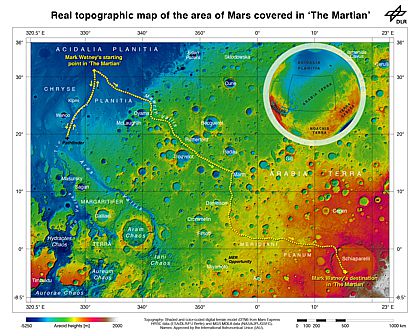
Watney_s route 420
Mark Watney’s travel route in The Martian.
Image by ESA/DLR/FU Berlin
under Creative Commons license

“Wait, Mars has winds.  What about those dust storms, and that windstorm that damn near destroyed Watney’s spaceship?”

“Um, Watney’s a fictional character.  The dust storms do exist, though —  one of them created a blackout that may have killed the Opportunity rover’s solar power.  But Martian dust grains are about the size of smoke particles.  Doesn’t take much of a wind to get those grains into the air and keep them there even in Martian atmosphere that’s only 1% as thick as Earth’s.  A 120-mph wind on Earth would blow you over, but one on Mars would just give you a gentle push.  Martian winds can barely roll a sand grain along the ground.  They definitely can’t sandblast a volcano like Earth winds can.  Which, by the way is why planetologists panned that storm scene in your The Martian movie.  Couldn’t happen.  The film production team admitted that.  The rest of the science was pretty good, though.”

“OK then, water.  You talking like dripping water can wear a hole in a rock?”

“More like water in quantity — glaciers carving off mountaintops and rivers digging canyons and ocean waves smashing shorelines to sandy powder.  Dripping water works, too — water’s corrosive enough even at low temperatures that it can dissolve most kinds of rock if you give it enough time.  But Mars has no glaciers or rivers or oceans.  Probably no dripping water, either”

“You were kidding about Goldilocks, right?  Talk about fictional characters!”

“Not in this case.  To planetologists, ‘Goldilocks’ is a technical term.  You know, ‘not too cold, not too warm…”

“‘Just right,’ yeah, yeah.  But just right for what?  What’s Mars got that’s Goldilocks-ish?”

“Sorry, it’s Earth that has the Goldilocks magic, not Mars, and what’s just right is that we’re in the right temperature range for water to exist in gas and liquid and solid forms.  Mars’ surface is way too cold for liquid water.”

“Wait, I read that they’d found liquid water there.”

“Not on the surface.  The radar experiment aboard European Space Agency’s Mars Express spacecraft found an indication of liquid water, but it’s a kilometer below the surface.  Twenty kilometers wide, maybe a meter thick — more of a pond than the ‘lake’ the media were talking about.”

“Why should it make a difference that Earth’s Goldilocks-ish?  I mean, we’re comfortable but we’re not rocks.  What’s that got to do with the volcanoes?”

“Recycling, Mr Feder, recycling.  On Mars, if enough gaseous water molecules could get together to make rain, which they can’t, they’d freeze to the ground and stay there for a long, long time.  On Earth, though, most rain stays liquid and you get ground water or run-off which eventually evaporates and rains down again.  The same molecules get many, many chances to grind down a mountain.”

“But Earth water can freeze, too.”

“Remember we’re Goldilocks-ish.  Liquid water soaks into a cracked rock where it freezes, expands to pry off a chip or two, and thaws to freeze again.  Water’s freeze-thaw cycle can do a lot of damage if it gets to repeat often enough.”

“So Mars has big stuff because…”

“The planet’s too cold to wear it away.”

~~ Rich Olcott

Raindrops landing in a red-brown puddle
Adapted image from Clipart-library.com

The Big Splash? Maybe.

You’ve not seen half of it, Mr Feder.  Mars has the Solar System’s tallest volcano, most massive volcano, biggest planetary meteor strike, deepest and longest  canyon…”

“Wait, kid, I’ve been to the Grand Canyon.  Thing is … BIG!  What’d they say?  A mile deep, 18 miles wide, 250 miles long.  No way Mars can beat that.”

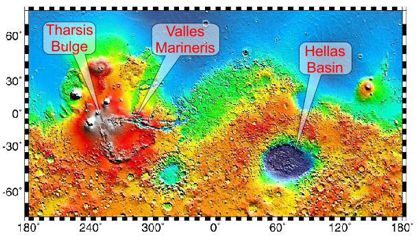
“Valles Marineris is 4½ miles deep, 120 miles wide and 2500 miles long.  The Grand Canyon meanders, packing its length into only 150 miles of bee-line distance.  Marineris stretches straight as a string.  No river carved that formation, but the planetologists can’t agree on what did.”

Labeled Mars map 2 420
Mars map from NASA/JPL/GSFC

“They got evidence, don’t they?”

“Not enough.  Different facts point in different directions and no overall theory has won yet.  Most of it has to do with the landforms.  Start with the Tharsis Bulge, big as a continent and rising kilometers above Mars’ average altitude.  Near the Bulge’s highest point, except for the volcanoes, is a fractured-looking region called Noctis Labyrinthus.  Starting just west of  the Labyrinth a whole range of wrinkly highlands and mountains arcs around south and then east to point towards the eastern end of Marineris.  Marineris completes the arc by meeting the Labyrinth to its west.  Everything inside that arc is higher than everything else around it.  Except for the volcanoes, of course.”

“Looks like something came up from underneath to push all that stuff up.”

“Mm-hm, but we don’t know what, or what drove it, or even how fast everything happened.  There are theories all over the place”

“Like what?”

“Well, maybe it’s upwellng from a magma hotspot, like the one under the Pacific that’s been creating Hawaiian Islands one at a time for the past 80 million years.  Some people think the upwelling mostly lifted the existing crust like expanding gas bubbles push up the crust of baking bread.  Other people think that the upwelling’s magma broke through the crust to form enormous lava flows that covered up whatever had been there before.”

“You said ‘maybe.'”

“Yeah.  Another group of theories sees a connection between Tharsis and Hellas Basin, which is almost exactly on the other side of the planet.  Hellas is the rock-record of a mega-sized meteorite strike, the third largest confirmed one in the Solar System.  Before you ask, the other two are on the Moon.  Like I said, it’s a group of theories.  The gentlest one, if you can call it that, is that energy from the impact rippled all around the planet to focus on the point opposite the impact.  That would have disrupted the local equilibrium between crustal weight and magma’s upward pressure.  An imbalance like that would encourage uplift, crustal cracking and, ultimately, Valles Marineris.”

“Doesn’t sound very gentle.”

“It wouldn’t have been but it might even have been nastier.  Another possibility is that the meteorite may not have stopped at the crust.  It could have hit hard enough, and maybe with enough spin, to drill who knows how far through the fluid-ish body of the planet, raising the Bulge just by momentum and internal slosh.  Worst case, some of Tharsis’ rock might even have come from the intruder.”

Realistic Orange-red Liquid Splash Vector
Adapted from an image by Vecteezy

“Wow, that would have been a sight to see!”

“Yeah, from a distance.  Any spacecraft flying a Mars orbit would be in jeopardy from rock splatter.  We’ve found meteors on Earth that we know originated on Mars because they have bubbles holding trapped gas that matches the isotope signature of Martian atmosphere.  A collision as violent as the one I just described could certainly have driven rocky material past escape velocity and on its way to us.  Oh, by the way and speaking of sights — you’d be disappointed if you actually visited Valles Marineris.”

“How could anything that ginormous be a disappointment?”

“You could look down into it but you probably couldn’t see the far side.  Mars is smaller than Earth and its surface curves downward more rapidly.  Suppose you stood on one side of the valley’s floor where it’s 4 miles deep.  The opposite wall, maybe 100 miles away, would be beyond your 92-mile horizon limit for an object that tall.”

“Aw, phooey!”

~~ Rich Olcott