Holes in The Ground — Big Ones

Al’s stacking chairs on tables, trying to close his coffee shop, but Mr Richard Feder (of Fort Lee, NJ) doesn’t let up on Jim.  “What’s all this about Gale Crater or Mount Sharp that Curiosity‘s running around?  Is it a crater or a mountain?  How about it’s a volcano?  How do you even tell the difference?”

That’s a lot of questions but Jim’s got game.  “Gale is an impact crater, about three and a half billion years old.  The impacting meteorite must have hit hard, because Mount Sharp’s in the middle of Gale.”
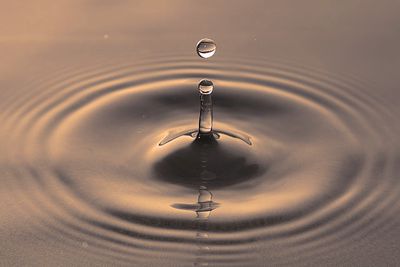
Mud drop
Adapted from a photo
by Davide Restivo, Aarau, Switzerland
[CC BY-SA 2.0] via Wikimedia Commons
“How’s that follow?”

“Have you ever watched a rain drop hit a puddle?  It forces the puddle water downward and then the water springs back up again to form a peak.  The same general process  happens when a meteorite hits a rocky surface except the solid peak doesn’t flatten out like water does.  We know that’s the way many meteor craters on the Moon and here on Earth were formed.  We’re pretty sure it’s what happened at Gale — the core of Mount Sharp (formal astronomers call it Aeolis Mons) is probably that kind of peak.”

“Only the core?  What about the rest of it?”

“That’s what Curiosity has been digging into.”  <I have to smile — Jim’s not one to do puns on purpose.>  “The rover’s found evidence that the core’s wrapped up in lots of sedimentary clays, sulfates, hematites and other water-derived minerals of a sort that wouldn’t be there unless Gale had once been a lake like Oregon’s Crater Lake.  That in turn says that Mars once had liquid water on its surface.  That’s why everyone got so excited when those results came in.”

“Oregon’s Crater Lake was from a meteorite?”

“Oops, bad example.  No, that one’s a water-filled volcanic caldera.”

“How do you know?  Any chance its volcano will blow?”

“The best evidence, of course, is the mineralogy.  Volcanoes are made of igneous rocks — lava, tefra and everything in between.  Impact craters are made of whatever was there when the meteorite hit, although the heat and the pressure spike transform a lot of it into some metamorphic form.”

“But you can’t check for that on Mars or the Moon.”

“Mostly not, you’re right, so we have to depend on other clues.  Most volcanoes, for instance, are above the local landscape; most impact structures are below-level.  There are other subtler tests, like the pattern and distance that ejecta were thrown away from the event.  In general we can be 95-plus percent sure whether we’re looking at a volcano or an impact crater.  And no, it won’t any time soon.”

“What won’t do what?”

“You asked whether Crater Lake’s volcano will erupt.  Mount Mazama blew up 7700 years ago and it’s essentially been dormant ever since.”

“There’s some weasel-wording back there — most volcanoes do this, most impacts do that.  What about the exceptions?”

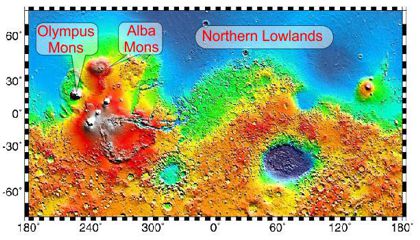
“Those generally have to do with size.  The really enormous features are often hard to even recognize, much less classify.  On Mars, for instance the Northern Lowlands region is significantly smoother than most of the rest of the planet.  Some people think that’s because it’s a huge lava flow that obliterated older impact structures.  Other people think the Lowlands is old sea bottom, smooth because meteorites would have splashed water instead of raising rocky craters.”
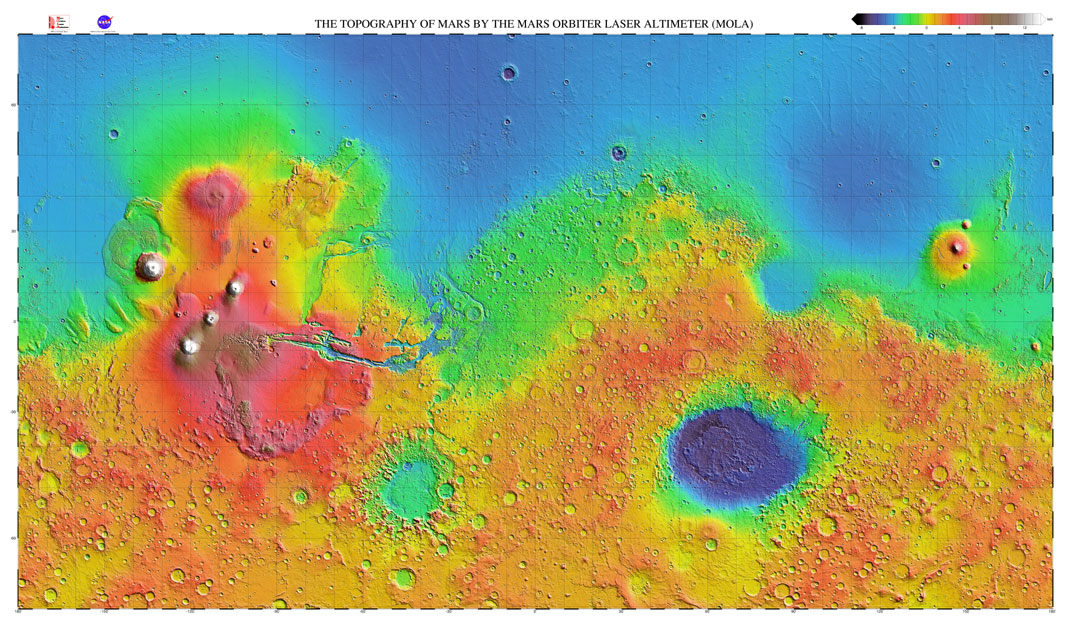
Labeled Mars map 420
Mars map from NASA/JPL/GSFC

“I’ll bet ocean.”

“There’s more.  You’ve heard about Olympus Mons on Mars being the Solar System’s biggest volcano, but that’s really only by height.  Alba Mons lies northeast of Olympus and is far huger by volume — 600 million cubic miles of rock but it’s only 4 miles high.  Average slope is half a degree — you’d never notice the upward grade if you walked it.  Astronomers thought Alba was just a humungous plain until they got detailed height data from satellite measurements.”

“The other one’s more than 4 miles high?”

“Oh, yeah.  Olympus Mons rises about 13.5 miles from the base of its surrounding cliffs.  That’s more than the jump from the bottom of the Mariana Trench to the top of Mount Everest.”

“Things on Mars are big, alright.”

~~ Rich Olcott


Why Is Mars Red But Earth Is Blue?

The grad students’ Crazy Theory Contest event at Al’s coffee shop is breaking up.  Amanda’s flaunting the Ceremonial Broom she won with her ‘Spock and the horseshoe crabs‘ theory.  Suddenly a voice from behind me outroars the uproar.  “Hey, Mars guy, I got questions.”

Jim looks up and I look around.  Sure enough, it’s Mr Richard Feder.  I start with the introductions but he barrels right along.  “People call Mars the Red Planet, but I seen NASA pictures and it’s brown, right?  All different kinds of brown, with splotches.  There’s even one picture with every color in the rainbow.  What’s with that and what color is Mars really?”

Jim’s a newly-fledged grad student so I step in to give him a chance to think.  “That rainbow picture, Mr Feder, did it have a circular purple spot about a third of the way up from the bottom and was it mostly blue along the top?”

“Yeah, sounds about right.”

“That’s a NASA topographic map, color-coded for relative elevations, purple for low areas to red high-up.  The blue area is the Northern Lowlands surrounding the North Pole, and that purple spot is Hellas Basin, a huge meteor crater billions of years old.  It’s about 5 miles deep which is why they did it in purple.  The map colors have nothing to do with the color of the planet.”

“About your question, Mr …. Feder is it?”

“Yeah, kid, Richard Feder, Fort Lee, New Jersey.”

“Good to meet you, sir.  The answer to your question is, ‘It depends.’  Are you looking down from space or looking around on the surface?  And where are you looking?  Come to think of it, when are you looking?”

“All I’m asking is, is it red or not?  Why make it so complicated?”

“Because it is complicated.  A few months ago Mars had a huge dust storm that covered the whole planet.  At the surface it was far darker than a cloudy moonless night on Earth.  From space it was a uniform butterscotch color, no markings at all.”

“OK, say there’s no dust in the air.”

“Take away all the floating dust and it almost wouldn’t be Mars any more.  The atmosphere’s only 1% of Earth’s and most of that is CO2 — clear and colorless.”

“So what would we see looking down at the surface?”

“Uh … you’re from New Jersey, right?  What color is New Jersey’s surface?”

<a little defensively> “We got a lot of trees and farms, once you get away from all the buildings along the coast and the Interstates, so it’s green.”

“Mars doesn’t have trees, farms, buildings or roads.  What color is New Jersey underneath all that?”

“The farmland soil’s black of course, and the Palisades cliffs near me are, too.  Down-state to the south we got sand-colored sand on the beaches and clay-colored clay.”

“Mars has clay, the Curiosity rover confirmed that, and it’s got basalt like your cliffs, but it has no soil.”

“Huh? How could it not have soil?  That’s just ground-up rocks, right, and Mars has rocks.”

“Soil’s way more then that, Mr Feder.  If all you have is ground-up rocks, it’s regolith.  The difference is the organic material that soil has and regolith doesn’t — rotted vegetable matter, old roots, fungus, microorganisms.  All that makes the soil black and helps it hold moisture and generally be hospitable to growing things.  So far as we know, Mars has none of that.  We’ve found igneous, sedimentary and metamorphic rocks just like on Earth; we’ve found clays, hematites and gypsum that had to have been formed in a watery environment.  But so far no limestone — no fossilized shelly material like that would indicate life.”

“What you’re saying is that Mars colors look like Earth colors except no plants.  So why do astronomers call Earth a ‘pale blue marble’ but Mars is ‘the red planet’?”

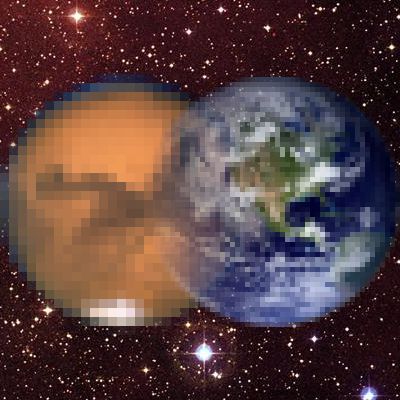
“Earth looks pale blue from space.  The blue is the dominant color reflected from the 70% of Earth’s surface that’s ocean-covered.  It’s pale because of white light reflected from our clouds of water vapor.  Mars lacks both.  What Mars does have is finely-divided iron oxide dust, always afloat above the surface.”

“Mars looks red ’cause it’s atmosphere is rusty?”

“Yessir.”Earth and Mars

~~ Rich Olcott

A Three-dog Night Would Be So Cool

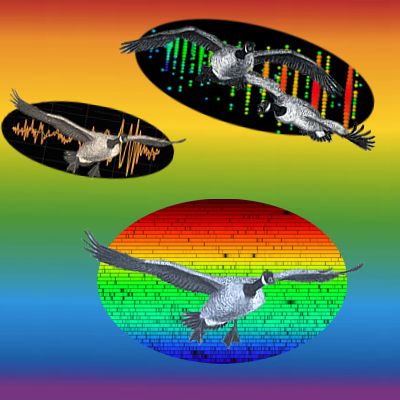
“So we’ve got three fundamentally different messengers from the stars, Mr Feder.  The past couple of years have given us several encouraging instances of receiving two messengers from the same event.  If we ever receive all three messengers from the same event, that might give us what we need to solve the biggest problem in modern physics.”

“That’s a pretty deep statement, Moire.  Care to unpack it?  The geese here would love to hear about it.”

“Lakeside is a good place for thoughts like this.  The first messenger was photons.  We’ve been observing starlight photons for tens of thousand of years.  Tycho Brahe and Galileo took it to a new level a few centuries ago with their careful observation, precision measurements and Galileo’s telescope.”

“That’s done us pretty good, huh?”

“Oh sure, we’ve charted the heavens and how things move, what we can see of them.  But our charts imply there’s much we can’t see.  Photons only interact with electric charge.  Except for flat-out getting absorbed if the wavelength is right, photons don’t care about electrically neutral material and especially they don’t care about dark matter.”

“So that’s why we’re interested in the other messengers.”

“Exactly.  Even electrically neutral things have mass and interact with the gravitational field.  You remember the big news a few years ago, when our brand-new LIGO instruments caught a gravitational wave signal from a couple of black holes in collision.  Black holes don’t give off photons, so the gravitational wave messenger was our only way of learning about that event.”

“No lightwave signal at all?”

“Well, there was a report of a possible gamma-ray flare in that patch of sky, but it was borderline-detectable.  No observatory using lower-energy light saw anything there.  So, no.”

“You’re gonna tell me and the geese about some two-messenger event now, right?”

“That’s where I’m going, Mr Feder.  Photons first.  Astronomers have been wondering for decades about where short, high-energy gamma-ray bursts come from.  They seem to happen randomly in time and space.  About a year ago the Fermi satellite’s gamma-ray telescope detected one of those bursts and sent out an automated ‘Look HERE’ alert to other observatories.  Unfortunately, Fermi‘s resolution isn’t wonderful so its email pointed to a pretty large patch of sky.  Meanwhile back on Earth and within a couple of seconds of Fermi‘s moment, the LIGO instruments caught an unusual gravitational wave signal that ran about a hundred times slower than the black-hole signals they’d seen.  Another automated ‘Look HERE’ alert went out.  This one pointed to a small portion of that same patch of sky.  Two messengers.”

“Did anyone find anything?”

“Seventy other observatories scrutinized the overlap region at every wavelength known to Man.  They found a kilonova, an explosion of light and matter a thousand times brighter than typical novae.  The gravitational wave evidence indicated a collision between two neutron stars, something that had never before been recorded.  Photon evidence from the spewed-out cloud identified a dozen heavy elements theoreticians hadn’t been able to track to an origin.  Timing details in the signals gave cosmologists an independent path to resolving a problem with the Hubble Constant.  And now we know where those short gamma-ray bursts come from.”

“Pretty good for a two-messenger event.  Got another story like that?”

“A good one.  This one’s neutrinos and photons, and the neutrinos came in first.  One neutrino.”

One neutrino?”

“Yup, but it was a special one, a super-high-powered neutrino whose incoming path our IceCube observatory could get a good fix on.  IceCube sent out its own automated ‘Look HERE’ alert.  The Fermi team picked up the alert and got real excited because the alert’s coordinates matched the location of a known and studied gamma-ray source.  Not a short-burster, but a flaring blazar.  That neutrino’s extreme energy is evidence for blazars being one of the long-sought sources of cosmic rays.”

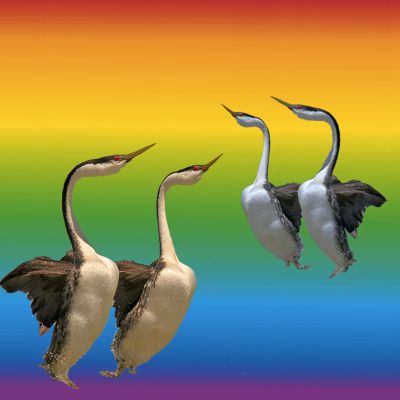
“Puzzle solved, maybe.  Now what you said about a three-messenger signal?”grebe messenger pairs“Gravitational waves are relativity effects and neutrinos are quantum mechanical.  Physicists have been struggling for a century to bridge those two domains.  Evidence from a three-messenger event could provide the final clues.”
“I’ll bet the geese enjoyed hearing all that.”

“They’re grebes, Mr Feder.”

~~ Rich Olcott

Heavenly Messengers

A gorgeous Fall day, a little bit cool-ish, perfect for a brisk walk in the park.  I’m striding along the lake-bound path when there’s a breathless shout behind me.  “Hey, Moire, wait up!  I got questions!”

“Hello, Mr Feder.  What’s the topic this time?  And keep up, please, I’ve got geese to watch.”

“I been reading in the business pages <puff, puff> about all the money different countries are putting into ‘multi-messenger astronomy.’  <puff>  What’s that about, anyway?  Who’s sending messages and ain’t the Internet good enough?”

“It’s not who, Mr Feder, it’s what — stars, galaxies, black holes, the Universe.  And the messages are generally either ‘Here I am‘ or ‘Something interesting just happened‘.  The Internet just doesn’t reach that far and besides, no kitten pictures.”

“Pretty simple-sounding messages, so why the big bucks for extra message-catchers?”

“Fair question.  It has to do with what kind of information each messenger carries.  Photons, for instance.”

“Yeah, light-waves, the rainbow.”

“Way more than the rainbow.  Equating light-waves to just the colors we see is like equating sound-waves to just the range from A4 through F4# on a piano.”

“Hey, that’s less than an octave.”

“Yup, and electromagnetism’s scale is hugely broader than that.  Most of the notes, or colors, are way out of our range.  A big tuba makes a deep, low-frequency note but a tiny piccolo makes a high note.  Photon characteristics also scale with the size of where they came from.  Roughly speaking, the shorter the light’s wave-length, the smaller the process it came out of and the smaller its target will be.  Visible light, for instance, is sent and received by loosely-held charge sloshing inside an atom or molecule.  Charge held tight to a nucleus gives rise to higher-energy photons, in the ultra-violet range or beyond.”

“Like how beyond?”

“X-rays can rip electrons right out of a molecule.  Gamma rays are even nastier and involve charge activity inside a nucleus, like during a nuclear reaction.”

“How about in the other direction?  Nothing?”

“Hardly.  Going that way is going to bigger scales.  Infra-red is about parts of molecules vibrating against each other, microwave is about whole molecules rotating.  When your size range gets out to feet-to-miles you’re looking at radio waves that probably originated from free electrons or ions slammed back and forth by electric or magnetic fields.”

“So these light ranges are like messengers that clue us in on what’s going on out there?  Different messengers, different kindsa clues?”

“You got the idea.  Add in that what happens to the light on the way here is also important.  Radio and microwave photons with their long wavelengths swerve around dust particles that block out shorter-wavelength ones.  Light that traversed Einstein-bent space lets us measure the masses of galaxies.  Absorption and polarization at specific wavelengths tell us what species are out there and what they’re doing.  Blue-shifts and red-shifts tell us how fast things are moving towards and away from us.  And of course, atmospheric distortions tell us we’ve got to put satellite observatories above the atmosphere to see better.”

“One messenger, lots of effects.”

“Indeed, but in the past few years we’ve added two more, really important messengers.  Photons are good, but they’re limited to just one of the four fundamental forces.”

“Hey, there’s gotta be more than that.  This is a complicated world.”

“True, but physicists can account for pretty much everything at the physical and chemical level with only four — electromagnetism, gravity, the strong force that holds nuclei together and the weak force that’s active in nuclear transformation processes.  Photons do electromagnetism and that’s all.”

“So you’re saying we’ve got a line on two of the others?”

“Exactly.  IceCube and its kin record the arrival of high-energy neutrinos.  In a sense they are to the weak force what photons are to electromagnetism.  We don’t know whether gravitation works through particles, but LIGO and company are sensitive to changes in the gravitational field that’s always with us.  Each gives us a new perspective on what’s happening out there.”

“So if you get a signal from one of the new messengers at the same time you get a photon signal…”

“Oh, look, the geese are coming in.”

Heavenly messengers

~~ Rich Olcott

On Gravity, Charge And Geese

A beautiful April day, far too nice to be inside working.  I’m on a brisk walk toward the lake when I hear puffing behind me.  “Hey, Moire, I got questions!”

“Of course you do, Mr Feder.  Ask away while we hike over to watch the geese.”

“Sure, but slow down , will ya?  I been reading this guy’s blog and he says some things I wanna check on.”

I know better but I ask anyhow.  “Like what?”

“Like maybe the planets have different electrical charges  so if we sent an astronaut they’d get killed by a ginormous lightning flash.”

“That’s unlikely for so many reasons, Mr Feder.  First, it’d be almost impossible for the Solar System to get built that way.  Next, it couldn’t stay that way if it had been.  Third, we know it’s not that way now.”

“One at a time.”

“OK.  We’re pretty sure that the Solar System started as a kink in a whirling cloud of galactic dust.  Gravity spanning the kink pulled that cloud into a swirling disk, then the swirls condensed to form planets.  Suppose dust particles in one of those swirls, for whatever reason, all had the same unbalanced electrical charge.”

“Right, and they came together because of gravity like you say.”

I pull Old Reliable from its holster.  “Think about just two particles, attracted to each other by gravity but repelled by their static charge.  Let’s see which force would win.  Typical interstellar dust particles run about 100 nanometers across.  We’re thinking planets so our particles are silicate.  Old Reliable says they’d weigh about 2×10¹⁸ kg each, so the force of gravity pulling them together would be …  oh, wait, that’d depend on how far apart they are.  But so would the electrostatic force, so let’s keep going.  How much charge do you want to put on each particle?”

“The minimum, one electron’s worth.”

“Loading the dice for gravity, aren’t you?  Only one extra electron per, umm, 22 million silicon atoms.    OK, one electron it is …  Take a look at Old Reliable’s calculation.gravity vs electrostatic calculation Those two electrons push their dust grains apart almost a quintillion times more strongly than gravity pulls them together.  And the distance makes no difference — close together or far apart, push wins.  You can’t use gravity to build a planet from charged particles.”

“Wait, Moire, couldn’t something else push those guys together — magnetic fields, say, or a shock wave?”

“Sure, which is why I said almost impossible.  Now for the second reason the astronaut won’t get lightning-shocked — the solar wind.  It’s been with us since the Sun lit up and it’s loaded with both positive- and negative-charged particles.  Suppose Venus, for instance, had been dealt more than its share of electrons back in the day.  Its net-negative charge would attract the wind’s protons and alpha particles to neutralize the charge imbalance.  By the same physics, a net-positive planet would attract electrons.  After a billion years of that, no problem.”

“All right, what’s the third reason?”

“Simple.  We’ve already sent out orbiters to all the planets.  Descent vehicles have made physical contact with many of them.  No lightning flashes, no fried electronics.  Blows my mind that our Cassini mission to Saturn did seven years of science there after a six-year flight, and everything worked perfectly with no side-trips to the shop.  Our astronauts can skip worrying about high-voltage landings.”

“Hey, I just noticed something.  Those F formulas look the same.”  He picks up a stick and starts scribbling on the dirt in front of us.  “You could add them up like F=(Gm1m2+k0q1q2)/r2.  See how the two pieces can trade off if you take away some mass but add back some charge?  How do we know we’ve got the mass-mass pull right and not mixed in with some charge-charge push?”

Geese and ducks“Good question.  If protons were more positive than electrons, electrostatic repulsion would always be proportional to mass.  We couldn’t separate that force from gravity.  Physicists have separately measured electron and proton charge.  They’re equal (except for sign) to 10 decimal places.  Unfortunately, we’d need another 25 digits of accuracy before we could test your hypothesis.”
“Aw, look, the geese got babies.”

“The small ones are ducks, Mr Feder.”

~~ Rich Olcott

Gravity from Another Perspective

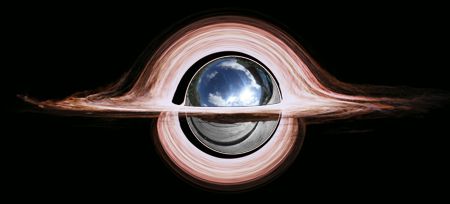
“OK, we’re looking at that robot next to the black hole and he looks smaller to us because of space compression down there.  I get that.  But when the robot looks back at us do we look bigger?”

We’re walking off a couple of Eddie’s large pizzas.  “Sorry, Mr Feder, it’s not that simple.  Multiple effects are in play but only two are magnifiers.”

“What isn’t?”

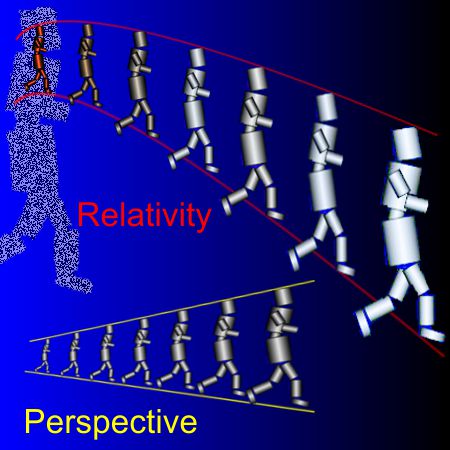
“Perspective for one.  That works the same in both directions — the image of an object shrinks in direct proportion to how far away it is.  Relativity has nothing to do with that principle.”

“That makes sense, but we’re talking black holes.  What does relativity do?”

“Several things, but it’s complicated.”

“Of course it is.”

“OK, you know the difference between General and Special Relativity?”

“Yeah, right, we learned that in kindergarten.  C’mon.”

“Well, the short story is that General Relativity effects depend on where you are and Special Relativity effects depend on how fast you’re going.  GR says that the scale of space is compressed near a massive object.  That’s the effect that makes our survey robot appear to shrink as it approaches a black hole.  GR leaves the scale of our space larger than the robot’s.  Robot looks back at us, factors out the effect of perspective, and reports that we appear to have grown.  But there’s the color thing, too.”

“Color thing?”

“Think about two photons, say 700-nanometer red light, emitted by some star on the other side of our black hole.  One photon slides past it.  We detect that one as red light.  The other photon hits our robot’s photosensor down in the gravity well.  What color does the robot see?”

“It’s not red, ’cause otherwise you wouldn’t’ve asked me the question.”

“Check.”

“Robot’s down there where space is compressed…  Does the lightwave get compressed, too?”

“Yup.  It’s called gravitational blue shift.  Like anything else, a photon heading towards a massive object loses gravitational potential energy.  Rocks and such make up for that loss by speeding up and gaining kinetic energy.  Light’s already at the speed limit so to keep the accounts balanced the photon’s own energy increases — its wavelength gets shorter and the color shifts blue-ward.  Depending on where the robot is, that once-red photon could look green or blue or even X-ray-colored.”

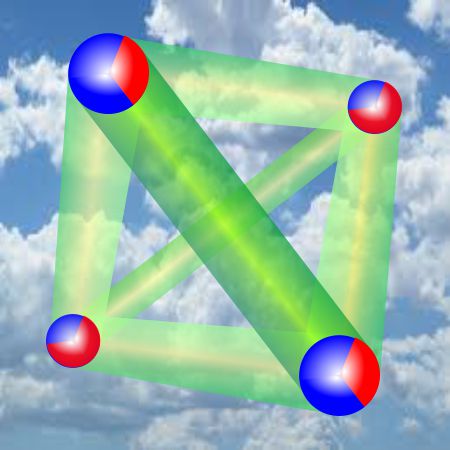
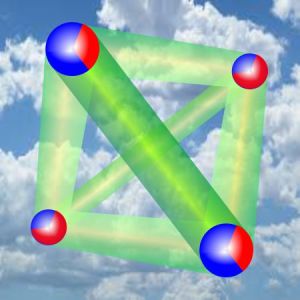
“So the robot sees us bigger and blue-ish like.”Robots and perspective and relativity 2“But GR’s not the only player.  Special Relativity’s in there, too.”

“Maybe our robot’s standing still.”

“Can’t, once it gets close enough.  Inside about 1½ diameters there’s no stable orbit around the black hole, and of course inside the event horizon anything not disintegrated will be irresistibly drawn inward at ever-increasing velocity.  Sooner or later, our poor robot is going to be moving at near lightspeed.”

“Which is when Special Relativity gets into the game?”

“Mm-hm.  Suppose we’ve sent in a whole parade of robots and somehow they maintain position in an arc so that they’re all in view of the lead robot.  The leader, we’ll call it RP-73, is deepest in the gravity well and falling just shy of lightspeed.  Gravity’s weaker further out — trailing followers fall slower.  When RP-73 looks back, what will it see?”

“Leaving aside the perspective and GR effects?  I dunno, you tell me.”

“Well, we’ve got another flavor of red-shift/blue-shift.  Speedy RP-73 records a stretched-out version of lightwaves coming from its slower-falling followers, so so it sees their colors shifted towards the red, just the opposite of the GR effect.  Then there’s dimming — the robots in the back are sending out n photons per second but because of the speed difference, their arrival rate at RP-73 is lower.  But the most interesting effect is relativistic aberration.”

“OK, I’ll bite.”

“Start off by having RP-73 look forward.  Going super-fast, it intercepts more oncoming photons than it would standing still.”

“Bet they look blue to it, and really bright.”

“Right on.  In fact, its whole field of view contracts towards its line of flight.  The angular distortion continues all the way around.  Rearward objects appear to swell.”

“So yeah, we’d look bigger.”

“And redder.  If RP-73 is falling fast enough.”

~~ Rich Olcott

  • Thanks to Timothy Heyer for the question that inspired this post.

A Perspective on Gravity

“I got another question, Moire.”

“Of course you do, Mr Feder.”

“When someone’s far away they look smaller, right, and when someone’s standing near a black hole they look smaller, too.  How’s the black hole any different?”

“The short answer is, perspective depends on the distance between the object and you, but space compression depends on the distance between the object and the space-distorting mass.  The long answer’s more interesting.”

“And you’re gonna tell it to me, right?”

“Of course.  I never let a teachable moment pass by.  Remember the August eclipse?”

“Do I?  I was stuck in that traffic for hours.”

“How’s it work then?”

“The eclipse?  The Moon gets in front of the Sun and puts us in its shadow. ‘S weird how they’re both the same size so we can see the Sun’s corundum and protuberances.”

“Corona and prominences.  Is the Moon really the same size as the Sun?”

“Naw, I know better than that.  Like they said on TV, the Moon’s about ¼ the Earth’s width and the Sun’s about 100 times bigger than us.  It’s just they look the same size when they meet up.”

“So the diameter ratio is about 400-to-1.  Off the top of your head, do you know their distances from us?”

“Millions of miles, right?”

“Not so much, at least for the Moon.  It’s a bit less than ¼ of a million miles away.  The Sun’s a bit less than 100 million miles away.”

“I see where you’re going here — the distances are the same 400-to-1 ratio.”

“Bingo.  The Moon’s actual size is 400 times smaller than the Sun’s, but perspective reduces the Sun’s visual size by the same ratio and we can enjoy eclipses.  Let’s try another one.  To keep the arithmetic simple I’m going to call that almost-100-million-mile distance an Astronomical Unit.  OK?”

“No problemo.”

“Jupiter’s diameter is about 10% of the Sun’s, and Jupiter is about 5 AUs away from the Sun.  How far behind Jupiter would we have to stand to get a nice eclipse?”

“Oh, you’re making me work, too, huh?  OK, I gotta shrink the Sun by a factor of 10 to match the size of Jupiter so we gotta pull back from Jupiter by the same factor of 10 times its distance from the Sun … fifty of those AUs.”

“You got it.  And by the way, that 55 AU total is just outside the farthest point of Pluto’s orbit.  It took the New Horizons spacecraft nine years to get there.  Anyhow, perspective’s all about simple ratios and proportions, straight lines all the way.  So … on to space compression, which isn’t.”

“We’re not going to do calculus, are we?”

“Nope, just some algebra.  And I’m going to simplify things just a little by saying that our black hole doesn’t spin and has no charge, and the object we’re watching, say a survey robot, is small relative to the black hole’s diameter.  Of course, it’s also completely outside the event horizon or else we couldn’t see it.  With me?”

“I suppose.”

“OK, given all that, suppose the robot’s as-built height is h and it’s a distance r away from the geometric center of an event horizon’s sphere.  The radius of the sphere is rs.  Looking down from our spaceship we’d see the robot’s height h’ as something smaller than h by a factor that depends on r.  There’s a couple of different ways to write the factor.  The formula I like best is h’=h√[(r-rs)/r].”

“Hey, (r-rs) inside the brackets is the robot’s distance to the event horizon.”

“Well-spotted, Mr Feder.  We’re dividing that length by the distance from the event horizon’s geometric center.  If the robot’s far away so that r>>rs, then (r-rs)/r is essentially 1.0 and h’=h.  We and the robot would agree on its height.  But as the robot closes in, that ratio really gets small.  In our frame the robot’s shrinking even though in its frame its height doesn’t change.”

“We’d see it getting smaller because of perspective, too, right?”

“Sure, but toward the end relativity shrinks the robot even faster than perspective does.”

“Poor robot.”

~~ Rich Olcott

  • Thanks to Carol, who inspired this post by asking Mr Feder’s question but in more precise form.

Water, Water Everywhere — How Come?

Lunch time, so I elbow my way past Feder and head for the elevator.  He keeps peppering me with questions.

“Was Einstein ever wrong?”

“Sure. His equations pointed the way to black holes but he thought the Universe couldn’t pack that much mass into that small a space.  It could.  There are other cases.”

We’re on the elevator and I punch 2.  “Where you going?  I ain’t done yet.”

“Down to Eddie’s Pizza.  You’re buying.”

“Awright, long as I get my answers.  Next one — if the force pulling an electron toward a nucleus goes as 1/r², when it gets to where r=0 won’t it get stuck there by the infinite force?”

“No, because at very short distances you can’t use that simple force law.  The electron’s quantum wave properties dominate and the charge is a spread-out blur.”

The elevator stops at 7.  Cathleen and a couple of her Astronomy students get on, but Feder just peppers on.  “So I read that everywhere we look in the Solar System there’s water.  How come?”

I look over at Cathleen.  “This is Mr Richard Feder of Fort Lee, NJ.  He’s got questions.  Care to take this one?  He’s buying the pizza.”

“Well, in that case.  It all starts with alpha particles, Mr Feder.”

The elevator door opens on 2, we march into Eddie’s, order and find a table.  “What’s an alpha particle and what’s that got to do with water?”

Alpha particle
Two protons and two neutrons, assembled as an alpha particle

“An alpha particle’s a fragment of nuclear material that contains two protons and two neutrons.  99.999% of all helium atoms have an alpha particle for a nucleus, but alphas are so stable relative to other possible combinations that when heavy atoms get indigestion they usually burp alpha particles.”

“And the water part?”

“That goes back to where our atoms come from — all our atoms, but in particular our hydrogen and oxygen.  Hydrogen’s the simplest atom, just a proton in its nucleus.  That was virtually the only kind of nucleus right after the Big Bang, and it’s still the most common kind.  The first generation of stars got their energy by fusing hydrogen nuclei to make helium.  Even now, that’s true for stars about the size of the Sun or smaller.  More massive stars support hotter processes that can make heavier elements.  Umm, Maria, do you have your class notes from last Tuesday?”

“Yes, Professor.”

“Please show Mr Feder that chart of the most abundant elements in the Universe.  Do you see any patterns in the second and fourth columns, Mr Feder?”

Element Atomic number Mass % *103 Atomic weight Atom % *103
Hydrogen 1 73,900 1 92,351
Helium 2 24,000 4 7,500
Oxygen 8 1,040 16 81
Carbon 6 460 12 48
Neon 10 134 20 8
Iron 26 109 56 2
Nitrogen 7 96 14 <1
Silicon 14 65 32 <1

“Hmm…  I’m gonna skip hydrogen, OK?  All the rest except nitrogen have an even atomic number, and all of ’em except nitrogen the atomic weight is a multiple of four.”

“Bravo, Mr Feder.  You’ve distinguished between two of the primary reaction paths that larger stars use to generate energy.  The alpha ladder starts with carbon-12 and adds one alpha particle after another to go from oxygen-16 on up to iron-56.  The CNO cycle starts with carbon-12 and builds alphas from hydrogens but a slow step in the cycle creates nitrogen-14.”

“Where’s the carbon-12 come from?”

“That’s the third process, triple alpha.  If three alphas with enough kinetic energy meet up within a ridiculously short time interval, you get a carbon-12.  That mostly happens only while a star’s going nova, simultaneously collapsing its interior and spraying most of its hydrogen, helium, carbon and whatever out into space where it can be picked up by neighboring stars.”

“Where’s the water?”

“Part of the whatever is oxygen-16 atoms.  What would a lonely oxygen atom do, floating around out there?  Look at Maria’s table.  Odds are the first couple of atoms it runs across will be hydrogens to link up with.  Presto!  H2O, water in astronomical quantities.  The carbon atoms can make methane, CH4; the nitrogens can make ammonia, NH3; and then photons from Momma star or somewhere can help drive chemical reactions  between those molecules.”

“You’re saying that the water astronomers find on the planets and moons and comets comes from alpha particles inside stars?”

“We’re star dust, Mr Feder.”

~~ Rich Olcott

Shopping The Old Curiosity

“Still got questions, Moire.”

“This’ll be your last shot this year, Mr Feder.  What’s the question?”

“They say a black hole absorbs all the light that falls on it. But the theory of blackbody radiation says a perfect absorber is also a perfect radiator. Emission should be an exact opposite flow to the incoming flow in every direction. Wouldn’t a black hole be shiny like a ball bearing?”Black hole as ball bearing 1
“A perfectly good question, but with crucial imperfections. Let’s start with the definition of a perfect absorber — it’s an object that doesn’t transmit or reflect any light. Super-black, in other words. So by definition it can’t be a mirror.”

“OK, maybe not a mirror, but the black hole has to send out some kind of exact opposite light to balance the arriving light.”

“Yes, but not in the way you think. Blackbody theory does include the assumption that the object is in equilibrium, your ‘exact opposite flow.’ The object must indeed send out as much energy as it receives, otherwise it’d heat up or cool down. But the outbound light doesn’t necessarily have to be at the same frequencies as the inbound light had. In fact, it almost never will.”

“How come not?”

“Because absorption and emission are two different processes and they play by different rules. If we’re including black holes in the discussion there are four different processes. No, five.  Maybe six.”

“I’m listening.”

“Good. Blackbody first. When a photon is absorbed by regular matter, it affects the behavior of some electron in there. Maybe it starts spending more time in a different part of the molecule, maybe it moves faster — one way or another, the electron configuration changes and that pulls the atomic nuclei away from where they were and the object’s atoms wobble differently. So the photon raises the object’s internal kinetic energy, which means raising its temperature, and we’ve got energy absorption, OK?”

“Yeah, and…?”

“At some later time, to keep things in equilibrium that additional energy has to be gotten rid of. But you can’t just paint one bit of energy red, say it’s special and follow it until it’s emitted. The whole molecule or crystal or whatever has excess energy as the result of all the incoming photons. When the total gets high enough, something has to give.  The object emits some photons to get rid of some of the excess. The only thing you can say about the outbound photons is that they generally have a lower energy than the incoming ones.”

“Why’s that?”

“Think of a bucket that’s brim-full and you’re dumping in cupfuls of water. Unless you’re pouring slowly and carefully, the dribbles escaping over the bucket’s rim will generally be many small amounts sloshing out more often than those cupfuls come in.  For light that’s fluorescence.”

“I suppose. What about the black hole?”

“The problem with a black hole is the mystery of what’s inside its event horizon. It probably doesn’t contain matter in the form of electrons and nuclei but we don’t know. There are fundamental reasons why information about what’s inside can’t leak out to us. All we can say is that when a light wave encounters a black hole, it’s trapped by the intense gravity field and its energy increments the black hole’s mass.  The mechanism … who knows?”

“Like I said, it gets absorbed. And gets emitted as Hawking radiation.”

“Sorry, that’s exactly what doesn’t happen. Hawking radiation arises from a different pair of processes. Process 1 generates pairs of virtual particles, which could be photons, electrons or something heavier. That happens at a chaotic but steady rate throughout the Universe.  Usually the particle pairs get back together and annihilate.  However, right next to the black hole’s event horizon there’s Process 2, in which one member of a virtual pair flies inward and the other member flies outward as a piece of Hawking radiation. Neither process even notices incoming photons. That’s not mirroring or even fluorescence.”

“Phooey, it was a neat idea.”

“That it was, but facts.”

~~ Rich Olcott

  • Thanks to lifeisthermal for inspiring this post.
  • Thus endeth a full year of Sy Moire stories.  I hope you enjoyed them.  Here’s to a new year and new ideas for all.
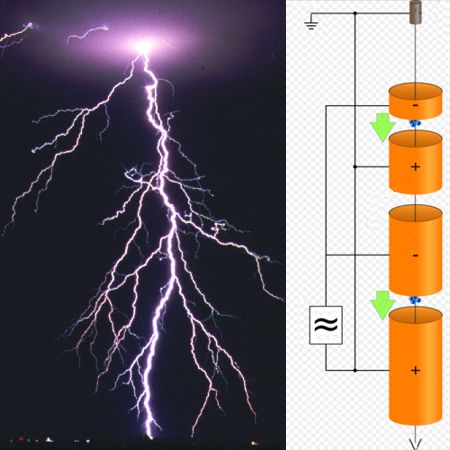
Lighting and a diagram of a linac

Curiosity in The Internet Market

“I got another question, Moire.”

“Of course you do, Mr Feder.  Let’s hear it.”

“I read on the Internet that there’s every kind of radioactivity coming out of lightning bolts.  So is that true, how’s it happen and how come we’re not all glowing in the dark?”

“Well, now, like much else you read on the Internet there’s a bit of truth in there, and a bit of not-truth, all wrapped up in hype.  The ‘every kind of radioactivity’ part, for instance, that’s false.”

“Oh yeah?  What’s false about that?”

“Kinds like heavy-atom fission and alpha-particle ejection.  Neither have been reported near lightning strikes and they’re not likely to be.  Lightning travels through air.  Air is 98% nitrogen and oxygen with a sprinkling of light atoms.  Atoms like that don’t do those kinds of radioactivity.”

“So what’s left?”

“There’s only two kinds worth worrying about — beta decay, where the nucleus spits out an electron or positron, and some processes that generate gamma-rays.  Gamma’s a high-energy photon, higher even than X-rays.  Gamma photons are strong enough to ionize atoms and molecules.”

“You said ‘worth worrying about.’  I like worrying.  What’s in the not-worth-it bucket?”

“Neutrinos.  They’re so light and interact so little with matter that many physicists think of them as just an accounting device.  Trillions go through you every second and you don’t notice and neither do they.  Really, don’t worry about them.”

“Easy for you to say.  Awright, so how does lightning make the … I guess the beta and gamma radioactivity?”

“We know the general outlines, although a lot of details have yet to be filled in.  What do you know about linear accelerators?”

“Not a clue.  What is one?”

Lighting and a diagram of a linac
Linac diagram adapted from
Sgbeer – Own work, CC BY-SA 3.0

“It’s a technology for making high-energy electrons and other charged particles.  Picture a straight evacuated pipe equipped with ring electrodes at various distances from the source end.  The source could be an electron gun or maybe a rig that spits out ions of some sort.  Voltages between adjacent electrodes downstream of a particle will give it a kick when it passes en route to the target end.  By using the right voltages at the right times you can boost an electron’s kinetic energy into the hundred-million-eV range.  That’s a lot of kinetic energy.  Got that picture?”

“Suppose that I do.  Then what?”

“Lightning is the same thing but without the pipe and it’s not straight.  The electrons have an evacuated path, because plasma formation drives most of the molecules out of there.  Activity inside the clouds gives them high voltages, up to a couple hundred megavolts.  But on top of that there’s bremsstrahlung.”

“Brem…?”

Bremsstrahlung — German for braking radiation.  You know how your car’s tires squeal when you make a turn at speed?”

“One of my favorite sounds, ‘specially when … never mind.  What about it?”

“That’s your tires converting your forward momentum into sound waves.  Electrons do that, too, but with electromagnetism.  The lightning path zigs and zags.  An electron’s path has to follow suit.  At each swerve, the electron throws off some of its kinetic energy as an electromagnetic wave, otherwise known as a photon.  Those can be very high-energy photons, X-rays or even gamma-rays.”

“So that’s where the gammas come from.”

“Yup.  But there’s more.  Remember those nitrogen atoms?  Ninety-nine-plus percent of them are nitrogen-14, a nice, stable isotope with seven protons and seven neutrons.  If a sufficiently energetic gamma strikes a nitrogen-14, the atom’s nucleus can kick out a neutron and turn into unstable nitrogen-13.  That nucleus emits a positron to become stable carbon-13.  So you’ve got free neutrons and positrons to add to the radiation list.”

“With all that going on, how come I’m not glowing in the dark?”

“‘Because the radiation goes away quickly and isn’t contagious.  Most of the neutrons are soaked up by  hydrogen atoms in passing water molecules (it’s raining, remember?).  Nitrogen-13 has a 10-minute half-life and it’s gone.  The remaining neutrons, positrons and gammas can ionize stuff, but that happens on the outsides of molecules, not in the nuclei.  Turning things radioactive is a lot harder to do.  Don’t worry about it.”

“Maybe I want to.”

“Your choice, Mr Feder.”

~~ Rich Olcott