The Prints of Darkness

There’s a commotion in front of Al’s coffee shop. Perennial antiestablishmentarian Change-me Charlie’s set up his argument table there and this time the ‘establishment’ he’s taking on is Astrophysics. Charlie’s an accomplished chain-yanker and he’s working it hard. “There’s no evidence for dark matter, they’ve never found any of the stuff and there’s tons of no-dark-matter theories to explain the evidence.”

Big Cap’n Mike’s shouts from the back of the crowd. “What they’ve been looking for and haven’t found is particles. By my theory dark matter’s an aspect of gravity which ain’t particles so there’s no particles for them to find.”

Astronomer-in-training Jim spouts off right in Charlie’s face. “Dude, you can’t have it both ways. Either there’s no evidence to theorize about, or there’s evidence.”

Physicist-in-training Newt Barnes takes the oppo chair. “So what exactly are we talking about here?”

“That’s the thing, guy, no-one knows. It’s like that song, ‘Last night I saw upon the stair / A little man who wasn’t there. / He wasn’t there again today. / Oh how I wish he’d go away.‘ It’s just buzzwords about a bogosity. Nothin’ there.”

I gotta have my joke. “Oh, it’s past nothing, it’s a negative.”

“Come again?”

“The Universe is loaded with large rotating but stable structures — solar systems, stellar binaries, globular star clusters, galaxies, galaxy clusters, whatever. Newton’s Law of Gravity accounts nicely for the stability of the smallest ones. Their angular momentum would send them flying apart if it weren’t for the gravitational attraction between each component and the mass of the rest. Things as big as galaxies and galaxy clusters are another matter. You can calculate from its spin rate how much mass a galaxy must have in order to keep an outlying star from flying away. Subtract that from the observed mass of stars and gas. You get a negative number. Something like five times more negative than the mass you can account for.”

“Negative mass?”

“Uh-uh, missing positive mass to combine with the observed mass to account for the gravitational attraction holding the structure together. Zwicky and Rubin gave us the initial object-tracking evidence but many other astronomers have added to that particular stack since then. According to the equations, the unobserved mass seems to form a spherical shell surrounding a galaxy.”

“How about black holes and rogue planets?”

Newt’s thing is cosmology so he catches that one. “No dice. The current relative amounts of hydrogen, helium and photons say that the total amount of normal matter (including black holes) in the Universe is nowhere near enough to make up the difference.”
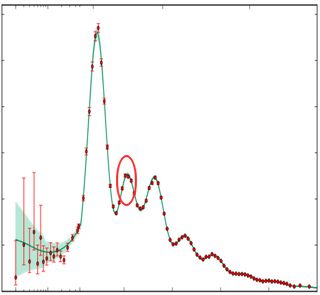
“So maybe Newton’s Law of Gravity doesn’t work when you get to big distances.”

“Biggest distance we’ve got is the edge of the observable Universe. Jim, show him that chart of the angular power distribution in the Planck satellite data for the Cosmological Microwave Background.” <Jim pulls out his smart-phone, pulls up an image.> “See the circled peak? If there were no dark matter that peak would be a valley.”

Charlie’s beginning to wilt a little. “Ahh, that’s all theory.”
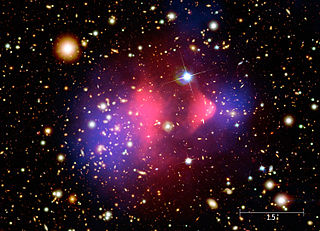
The Bullet Cluster ( 1E 0657-56 )

<Jim pulls up another picture.> “Nope, we’ve got several kinds of direct evidence now. The most famous one is this image of the Bullet Cluster, actually two clusters caught in the act of colliding head-on. High-energy particle-particle collisions emit X-rays that NASA’s Chandra satellite picked up. That’s marked in pink. But on either side of the pink you have these blue-marked regions where images of further-away galaxies are stretched and twisted. We’ve known for a century how mass bends light so we can figure from the distortions how much lensing mass there is and where it is. This picture does three things — it confirms the existence of invisible mass by demonstrating its effect, and it shows that invisible mass and visible mass are separate phenomena. I’ve got no pictures but I just read a paper about two galaxies that don’t seem to be associated with dark matter at all. They rotate just as Newton would’ve expected from their visible mass alone. No surprise, they’re also a lot less dense without that five-fold greater mass squeezing them in.”

“You said three.”

“Gotcha hooked, huh?

~~ Rich Olcott

The Shapes of Fuzziness

Egg murmuration 1“That was a most excellent meat loaf, Sis.  Flavor balance was perfect.”

“Glad you liked it, Sy.  Mom’s recipe, of course, with the onion soup mix.”

“Yeah, but there was an extra tang in there.”

“Hah, you caught that!  I threw in some sweet pickle relish to brighten it some.”

“Mommy, Uncle Sy told me about quantum thingies and how they hide behind barriers and shoot rainbows at us.”

Sis gives me that What now? look so I must defend myself.  “Whoa, Teena, that’s not even close to what I said.”

“I know, Uncle Sy, but it’s more fun this way.  Little thingies going, ‘Pew! Pew! Pew!’

“Hey, get me out of trouble with your Mom, here.  What did I say really?”

<sigh> “Everything’s made of these teeny-weeny quantum thingies, smaller even than a water-bear egg — so small — and they have to obey quantum rules.  One of the rules is, um, if a lot of them get together to make a big thing, the big thing has to follow big-thing rules even though the little things follow quantum rules.”

“Nicely put, Sweetie.”

“And sometimes the quantum thingies act like waves and sometimes they act like real things and no-one knows how they do that.  And, uh, something about barriers making forbidden places that colors come out of and I’m mixed up about that.”

“Excellent summary, young lady.  That deserves an extra —” <sharp look from Sis who has a firm ‘No rewarding with food!‘ policy> “— chase around the block the next time we go scootering.”

“Yay!  But can you unconfuse me about the forbidden areas and colors?”

“Well, I can try.  Tell you what, bring your toy box over by the stairway, OK?  We’ll pick it all up when we’re done, Sis, I promise.  Ready, Teena?”

“Ready!”

“OK, put your biggest marble on the bottom step. Yes, it is pretty.  Now put a tennis ball and that dumbbell-shaped thing on the second step.  Oh, it’s a yo-yo?  Cool.  And that ring-toss ring, put it on the second step, too.  Now for the third step.  Put the softball there and … umm … take some of those Legos and make a little ring inside a big ring.  Thanks, Sis, just half a cup.  Ready, Teena?”

“Just a sec… ready!”

“Perfect.  Oh, Teena, you forgot to tell Mommy about the murmuration.”

“Oh, she’s seen them.  You know, Mommie, thousands of birds flying in a big flock and they have rules so they keep together but not too close and they make big pictures in the sky.”

“Yes, I have, sweetheart, but what does that have to do with quantum, Sy?”

“How would you describe their shapes?”

“Oh, they make spirals, and swirls… I’ve seen balls and cones and doughnuts and wide flowing sheets, and other shapes we simply don’t have names for.”

“These shapes on the stairs are the first few letters in science’s alphabet for describing complex shapes like atoms.  It’s like spelling a word.  That ball on the first step is solid.  The tennis ball is a hollow shell.  Pretend the softball is hollow, too, with a hollow ping-pong ball at its center.  If you pretend that each of these is a murmuration, Teena, does that make you think of anything?”

“Mmm..  There aren’t any birds flying outside of the marble, or outside or inside of the tennis ball.  And I guess there aren’t any flying between the layers in the ping-softball.  Are those forbidden areas?”

“C’mere for a high-five!  That’s exactly where I’m going with this.  The marble has one forbidden region infinitely far away.  The tennis ball has that one plus a second one at its middle.  The softball-ping-pong combo has three and so on.  We can describe any spherical fuzziness by mixing together shapes like that.”Combining shapes

“So what about the rings and that dumbbell yo-yo?”

“That’s the start of our alphabet for fuzziness that isn’t perfectly round.  Math has given us a toolkit of spheres, dumbbells, rings and fancier figures that can describe any atom.  Plain and fancy dumbbells stretch the shape out, rings bulge its equator, and so on.  Quantum scientists use the shapes to describe atoms and molecules.”

“Why the stairsteps?”

“What about my colors?”

~ Rich Olcott

Symphony for Rubber Ruler

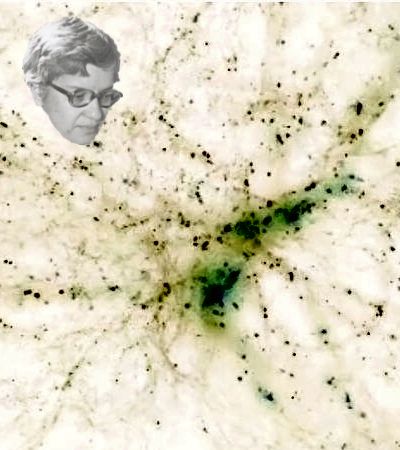
“But Mr Moire, first Vera Rubin shows that galaxies don’t spread out like sand grains on a beach…”

“That’s right, Maria.”

“And then she shows that galaxy streams flow like rivers through the Universe…”

“Yes.”

“And then she finds evidence for dark matter!  She changed how we see the Universe and still they don’t give her the Nobel Prize??!?”

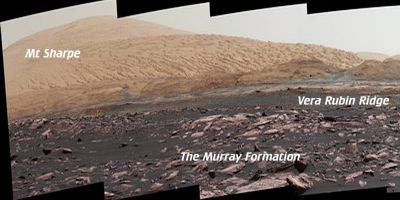
“All true, but there’s a place on Mars that’s named for her and it’ll be famous forever.”

“Really?  I didn’t know about that.  Where is it and why did they give it her name?”

“What do you know about dark matter?”

Rubin inspecting dark matter“Not much.  We can’t see it, and they say there is much more of it than the matter we can see.  If we can’t see it, how did she find it?  That’s a thing I don’t understand, what I came to your office to ask.”
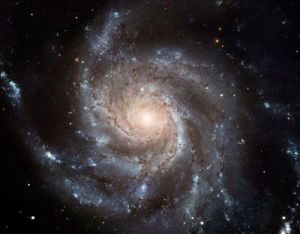
“It all has to do with gravity.  Rubin’s studies of dozens of galaxies showed that they really shouldn’t exist, at least on the basis of the physics we knew about at the time.  She’d scan across a galaxy’s image, measuring how its red-shifted spectrum changed from the coming-toward-us side to the going-away-from-us side.  The red-shift translates to velocity.  The variation she found amazed the people she showed it to.”Pinwheel Galaxy NGC 5457 reduced

“What was amazing about it?”

“It was a flat line.  Look at the galaxy poster on my wall over there.”

“Oh, la galaxia del Molinete.  It’s one of my favorites.”

“We call it the Pinwheel Galaxy.  Where would you expect the stars to be moving fastest?”

“Near the center, of course, and they must move slower in those trailing arms.”

“That’s exactly what Rubin didn’t find.  From a couple of reasonable assumptions you can show that a star’s speed in a rotating galaxy composed only of other stars should be proportional to 1/√R, where R is its distance from the center.  If you pick two stars, one twice as far out as the other, you’d expect the outermost star to be going 1/√2 or only about 70% as fast as the other one.”

“And she found…?”

“Both stars have the same speed.”

“Truly the same?”

“Yes!  It gets better.  Most galaxies are embedded in a ball of neutral hydrogen atoms.  With a different spectroscopic technique Rubin showed that each hydrogen ball around her galaxies rotates at the same speed its galaxy does,  even 50% further out than the outermost stars.  Everything away from the center is traveling faster than it should be if gravity from the stars and gas were the only thing holding the galaxy together.  Her galaxies should have dispersed long ago.”

“Could electrical charge be holding things together?”

“Good idea — electromagnetic forces can be stronger than gravity.  But not here.  Suppose the galaxy has negative charge at its center and the stars are all positive.  That’d draw the stars inward, sure, but star-to-star repulsion would push them apart.  Supposing that neighboring stars have opposite charges doesn’t work, either.  And neutral hydrogen atoms don’t care about charge, anyway.  The only way Rubin and her co-workers could make the galaxy be stable is to assume it’s surrounded by an invisible spherical halo with ten times as much mass as the matter they could account for.”

“Mass that doesn’t shine.  She found ‘dark matter’ with gravity!”

“Exactly.”

“What about planets and dust?  Couldn’t they add up to the missing mass?”

“Nowhere near enough.  In out Solar System, for instance, all the planets add up to only 0.1% of the Sun’s mass.”

“Ah, ‘planets’ reminds me.  Why is Vera Rubin’s name on Mars?”

“Well, it’s not strictly speaking on Mars, yet, but it’s on our maps of Mars.  You know the Curiosity rover we have running around up there?”

“Oh yes, it’s looking for minerals that deposit from water.”

“Mm-hm.  One of those minerals is an iron oxide called hematite.  Sometimes it’s in volcanic lava but most of the time it’s laid down in a watery environment.  And get this — it’s often black or dark gray.  Curiosity found a whole hill of the stuff.”

Vera Rubin Ridge labeled
Adopted from a Curiosity Mastcam image from NASA

“Yes, so…?”

“What else would the researchers name an important geologic feature made of darkish matter?”

~~ Rich Olcott

Quartetto for Rubber Ruler

Suddenly Al’s standing at our table.  “Hey guys, I heard you talking about spectroscopy and stuff and figured you could maybe ‘splain something I read.  Here’s some scones and I brought a fresh pot of coffee..”

“Thanks, Al.  What’s the something?  I’m sure Cathleen can ‘splain.”

“Syyy…”

“It’s this article talking about some scientists going down to Australia to use really old light to look for younger light and it’s got something to do with dark matter and I’m confused.”

“You’re talking about the EDGES project, right?”

“Yeah, I’m pretty sure they said ‘EDGES’ in the article.”

“OK, first we need some background on the background, that really old light you mentioned.  The Cosmic Microwave Background is the oldest light in the Universe, photons struggling out of the white-hot plasma fog that dominated most of the first 377,000 years after the Big Bang.”

“Wait a minute, ‘plasma fog’?”

“Mm-hm.  In those early years the Universe was all free electrons and nuclei colliding with photons and each other.  No photon could travel more than a few centimeters before being blocked by some charged particle.  The Universe had to expand and cool down to 4,000K or so before electrons and nuclei could hold together as atoms and the fog could lift.”

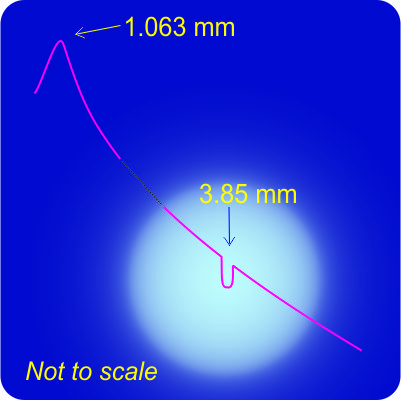
“Cathleen showed me an intensity-frequency plot for those suddenly-free photons.  It was a virtually perfect blackbody curve, identical within a couple parts per million everywhere in the sky.  The thing is, the curve corresponds to a temperature of only 2.73K.  Its peak is in the microwave region, hence the CMB moniker, nestled in between far infrared and HF radio.”

“I thought she said that the fog lifted at 4,000K, Sy.  That’s a lot different from 2-whatever.”

Wavelength-stretching, Vinnie, remember?  Universe expansion stretches the photon waves we measure temperatures with, the further the longer just like Hubble said.  The CMB’s the oldest light in the Universe, coming to us from 13.4 billion lightyears away.  The stretch factor is about 1100.”

“Vinnie, that 2.7K blackbody radiation is the background to the story.  Think of it as a spherical shell around the part of the Universe we can see.  There are younger layers inside that shell and older layers beyond it.”

“What could be outside the Universe, Cathleen?”

“Hey, Al, I carefully said, ‘the part of the Universe we can see.’  I’m quite sure that the Universe extends beyond the spatial volume we have access to, but light from out there hasn’t had a chance to get to us yet.  Going outward from our CMB sphere there’s that 337,000-year-deep shell of electron-nucleus fog.  Beyond that, 47,000 years-worth of quark soup and worse, out to the Big Bang itself.  Coming inward from the CMB we see all the things we know of that have to do with atoms.”

“Like galaxies?”

“Well, not immediately, they took a billion years to build up.  First we had to get through the Dark Ages when there weren’t any photons in the visible light range.  We had huge clouds of hydrogen and helium atoms but virtually all of them were in the ground state.  The CMB photons running around were too low-energy to get any chemistry going, much less nuclear processes.  The Universe was dark and cooling until gravitational attraction made clumps of gas dense enough to light up and become stars.  That’s when things got going.”

“How’d that make a difference?”Blackbody spectrum with notch

“A ground state hydrogen atom’s lowest available empty energy level is way above what a CMB photon could supply.  Those Dark Age atoms were essentially transparent to the prevailing electromagnetic radiation.  But when starlight came along it excited some atoms so that they could also absorb CMB light.  See the notch on the long-wavelength side of this blackbody curve?  It marks the shadow of starlit hydrogen clouds against the CMB’s glow.  The notch wavelength indicates when the absorption started.  Its position suggests that some stars lit up as early as 180 million years after the Big Bang.”

“Suggests, huh?”

“Mm-hm.  There are other interpretations.  That’s where the fun comes in, both on the theory side and the get-more-data side.  Like looking at different times.”

“Different times?”

“Every wavelength represents a different stretch factor and a different depth into the past.”

~~ Rich Olcott

Far out, man

Egg in the UniverseThe thing about Al’s coffee shop is that there’s generally a good discussion going on, usually about current doings in physics or astronomy.  This time it’s in the physicist’s corner but they’re not writing equations on the whiteboard Al put up over there to save on paper napkins.  I step over there and grab an empty chair.

“Hi folks, what’s the fuss about?”

“Hi, Mr Moire, we’re arguing about where the outer edge of the Solar System is.  I said it’s Pluto’s orbit, like we heard in high school — 325 lightminutes from the Sun.”

The looker beside him pipes up.  “Jeremy, that’s just so bogus.”  Kid keeps scoring above his level, don’t know how he does it.  “Pluto doesn’t do a circular orbit, it’s a narrow ellipse so average distance doesn’t count.  Ten percent of the time Pluto’s actually closer to the Sun than Neptune is, and that’s only 250 lightminutes out.”

Then the looker on his other side chimes in.  Doing good, kid.  “How about the Kuiper Belt?  A hundred thousand objects orbiting the Sun out to maybe twice Neptune’s distance, so it’s 500 lightminutes.”

Third looker, across the table.  You rock, Jeremy.  “Hey, don’t forget the Scattered Disk, where the short-period comets drop in from.  That goes out to 100 astronomical units, which’d be … 830 lightminutes.”

One of Cathleen’s Astronomy grad students can’t help diving in despite he’s only standing nearby, not at the table.  “Nah, the edge is at the heliopause.”

<several voices> “The what?”

“You know about the solar wind, right, all the neutral and charged particles that get blown out of the Sun?  Mass-density-wise it’s a near-vacuum, but it’s not nothing.  Neither is the interstellar medium, maybe a few dozen hydrogen and helium atoms per cubic meter but that adds up and they’re not drifting on the same vector the Sun’s using.  The heliopause is the boundary where the two flows collide.  Particles in the solar wind are hot, relatively speaking, compared to the interstellar medium.  Back in 2012, our outbound spacecraft Voyager 1 detected a sharp drop in temperature at 121 astronomical units.  You guys are talking lightminutes so that’d be <thumb-pokes his smartphone> how about that? almost exactly 1000 lightminutes out.  So there’s your edge.”

Now Al’s into it.  “Hold on, how about the Oort Cloud?”

“Mmm, good point.  Like this girl said <she bristles at being called ‘girl’>, the short-period comets are pretty much in the ecliptic plane and probably come in from the Scattered Disk.  But the long-period comets seem to come in from every direction.  That’s why we think the Cloud’s a spherical shell.  Furthermore, the far points of their orbits generally lie in the range between 20,000 and 50,000 au’s, though that outer number’s pretty iffy.  Call the edge at 40,000 au’s <more thumb-poking> that’d be 332,000 lightminutes, or 3.8 lightdays.”

“Nice job, Jim.”  Cathleen speaks up from behind him.  “But let’s think a minute about why that top number’s iffy.”

“Umm, because it’s dark out there and we’ve yet to actually see any of those objects?”

“True.  At 40,000 au’s the light level is 1/40,000² or 1/1,600,000,000 the sunlight intensity we get on Earth.  But there’s another reason.  Maybe that ‘spherical shell’ isn’t really a sphere.”

I have to ask.  “How could it not be?  The Sun’s gravitational field is spherical.”

“Right, but at these distances the Sun’s field is extremely weak.  The inverse-square law works for gravity the same way it does for light, so the strength of the Sun’s gravitational field out there is also 1/1,600,000,000 of what keeps the Earth on its orbit.  External forces can compete with that.”

“Yeah, I get that, Cathleen, but 3.8 lightdays is … over 400 times closer than the 4½ lightyear distance to the nearest star.  The Sun’s field at the Cloud is stronger than Alpha Centauri’s by at least a factor of 400 squared.”

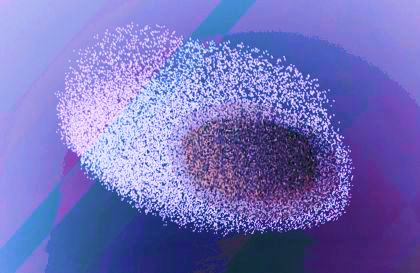
“Think bigger, Sy.  The galactic core is 26,000 lightyears away, but it’s the center of 700 billion solar masses.  I’ve run the numbers.  At Jim’s Oort-Cloud ‘edge’ the Galaxy’s field is 11% as strong as the Sun’s.  Tidal forces will pull the outer portion of the Cloud into an egg shape pointed to the center of the Milky Way.”

Jeremy’s agog.  “So the edge of the Solar System is 1,000 times further than Pluto?  Wow!”

“About.”

“Maybe.”

~~ Rich Olcott

Three atop A Crosshatch

“Hey, Sy, what you said back there, ‘three and a fraction‘ ways to link atoms together…”

“Yeah, Vinnie?”

“What’s that about?  How do fractions come in when you’re counting?”

“Well, I was thinking about how atoms in separate molecules can interact short of reacting and forming new molecular orbitals.  I figure that as a fraction.”

Charge sharing ain’t the whole story?”

“It would be except that sharing usually isn’t equal.  It depends on where the atoms are in the Periodic Table.”

“What’s it got to do with the Periodic Table?”

“The Table’s structure reflects atom structures — how many shells are active in a base-state atom of each element and how many units of charge are in its outermost shell.  Hydrogen and Helium are in Row 1 because the 1-node shell is the only active one in those atoms.  The atoms from Lithium to Neon in Row 2 have charge activating both the 1-node shell and the 2-node shell, and so on.”

“What’s that get us?”

“It gets us a feel for how the atoms behave.  You know I’m all about dimensions, right?”

“Ohhh, yeah.”

“OK, we’ve got a two-dimensional table here.  Going across, each atom’s nucleus has one more proton than its buddy to the left.  What’s that going to do to the electronic charge?”

“Gonna pull it in closer.”

“Wait, Vinnie, there’s an extra electron in there, too.  Won’t that cancel out the proton, Sy?”

“Good thinking, Eddie.  Yes, it does, but only partially.  The atoms do get smaller as you go across, but it’s irregular because negative-negative repulsion within a shell works to expand it almost as much as negative-positive attraction contracts it.”

“Bet things get bigger as you go down the Table, though.”

“Mostly, Vinnie, because each row down adds a shell that’s bigger than the shrinking inner shells.”

“Mostly?”

“The bigger shells with more nodes have more complex charge patterns than just balls and dumbbells.  Those two rows below the main table actually squinch into the lowest two boxes in the third column.  In those elements, some of the activated patterns barely shield the nucleus.  The atoms to their right in the main table are almost identical in size to the elements above them.”

“So I can guess an atom’s size.  So what?”

“So that and the charge give you a handle on the element’s properties and chemistry.  Up there in the top right corner you’ve got the atoms with the highest ratio of nuclear charge to size.  If given the opportunity to pull charge from atoms to their left and below them, what do you suppose happens?”

“You get lop-sided bonds, I guess.”

“Exactly.  In water, for instance, the Oxygen pulls charge towards itself and away from the Hydrogen atoms.  That makes each O-H bond a little dipole, positive-ish at the hydrogen end and negative-ish at the oxygen end.”

“Won’t the positive-ish ends pull on the negative-ish parts of next-door molecules?”

“You’ve just invented hydrogen bonding, Eddie.  That’s exactly what happens in liquid water.  Each molecule can link up like that with many adjacent ones and build a huge but floppy structure.  It’s floppy because hydrogen bonds are nowhere near as strong as orbital-sharing bonds.  Even so, the energy required to move through liquid H2O or to vaporize it is much greater than for liquid methane (CH4), ammonia (NH3) or any similar molecule.”

“Can that pull-away action go all the way?”

“You’ve just invented ionic bonding, Vinnie.  The elements in the Oxygen and Fluorine columns can extract charge completely away from many of those far to the left and below them.  Fluorine steals charge from Lithium, for instance.  Fluoride ions are net negative, lithium ions are net positive.  Opposites attract, same as always, but now it’s  entire ions that attract each other and you get crystals.”

“That’s your and-a-fraction?”

“Not quite, Vinnie.  There’s one more, Van der Waals forces.  They come from momentary polarizations as electron chaos sloshes back and forth in neighboring molecules.  They’re why solids are solid even without ionic or hydrogen bonding.”

“Geez, look at the time.  Rosalie’s got my dinner waiting.  Bye, guys, everybody out!”

~~ Rich Olcott

The Mastery of The Pyramids

“Hard to believe, Sy.”

“What’s hard to believe, Vinnie?”

“What you said back there, about all molecules being tetrahedron-shaped.”

“Whoa, that’s not what I said.  What I did say was that the tetrahedron is the fundamental structural building block for most of the Universe’s molecules. To put a finer point on it, it’s the building block for most kinds of molecules.”

“What kinds are you leaving out?”

“Molecular hydrogen, for instance.  It’s probably the most common molecule in the Universe but it’s got only two atoms and two electrons and it doesn’t do tetrahedra.  I was talking about almost all the other flavors.  Molecules can have all kinds of shapes, from spherical to long and skinny.  Say, Eddie, do your kids play with Legos?”

“Geez, yes.  My feet find blocks all over the house.  Only thing worse is glitter.”

“You can build just about any shape from those rectangular blocks, right?  Pegs on one block plug into holes on other blocks and pretty soon you’ve got a rocket ship or something.  Atoms can work the same way.  Four bonding orbitals pointing out to those pyramid corners, ready to share with whatever comes along.”

“Not just with hydrogen like with that CH4 stuff?”

“Depends on the atom, but in general, yeah.  Except for the outermost columns of the Periodic Table, most of the elements in the upper rows can be persuaded to share at least one bond with most of the others.  Carbon’s the champ that links with practically everything.”Tetrahedral bonding

“Even carbon?”

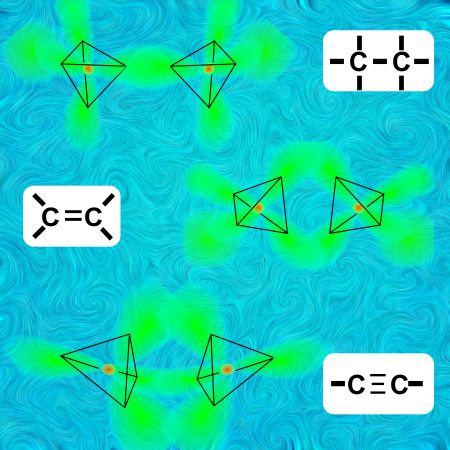
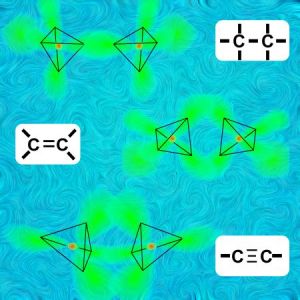
“Especially carbon, Vinnie.  Linking to carbon is carbon’s best thing.  It’s even got three and a fraction different ways to do it.  Here’s a sketch.  It boils down to the different ways you can have two tetrahedra match up points.”

“Lemme look at this for a minute… OK, that point-to-point one at the top —”

“It’s called a single bond.”

“Whatever, you’re saying that could be like two –CH3 pieces tied together.”

“Mm-hm.  The –CH3‘s are methyl groups, and with two of them you’ve got ethane.  Or link a methyl to a –CH2CH3 and you’ve got propane, or link it to an –OH to get methyl alcohol.  At least in principle you can pop a methyl onto any other atom or molecule that started off with only one unit of charge in an unshared orbital.”

“So it’s like my daughter’s bead necklace where she can pop it apart and add all different kinds of beads.”

“Exactly, Eddie, except her beads probably have their two links in a straight line.  These atoms support four links at 109° angles to each other.”

“That picture reminds me of one of my kids’ toys that’s like a top spinning on top of another top.  Is there anything that locks the two sides together so they can’t do that?”

“One way is if the two sides are each linked to bulky groups that get in each other’s way.  Hydrogens don’t much.  Scientists have measured methyl group rotation rates above 10 million cycles per second.”

“Hey, I’m still looking over here.  These other diagrams say that the tetrahedron things can link along an edge —”

“That’d be a double bond, Vinnie.”

“Looks to me like those double-bond shapes are locked in.  No rotation there, right?”

“Right.  In fact, rotational stability across a double bond is so strong that different arrangements operate like different compounds.  Switching A\B:C\D to A\B:D\C can be the difference between a useful med and something that’s inert or even toxic.”

“And I suppose when they match up whole triangles that’s a triple bond?”

“You got it.”

“Well, that can’t spin, for sure.”

“Nah, Vinnie, that’s like the atom-in-a-field thing, no difference between x- and y- axes.  Spinning like crazy except you can’t see it.”

“Eddie’s right, Vinnie.  The four atoms in a triple-bond structure are in a line.  The charge of three electron pairs mushes into a barrel-shaped region between the two carbons.”

“All that pent-up charge, I bet it’s reactive as hell.”

“Uh-huh.  With hydrogen atoms at both ends that’s acetylene gas.  Let that stuff touch copper and you get explosive decomposition.”

“So that’s why they say don’t run acetylene through copper tubing or brass fittings.”

“Believe it, Vinnie.  Believe it.”

~~ Rich Olcott

The Shape of Water

Amazing what you can do with mozzarella drips and crumbled pizza edges.  Vinnie’s rolling his crumbs into decent-sized marbles.  (Pizza-maker Eddie’s giving him a look.)  He adds a fourth ball to his triangle to make a square.  “So anyway, what you’re telling us is that Bohr’s 8-electron shell isn’t that far off.”

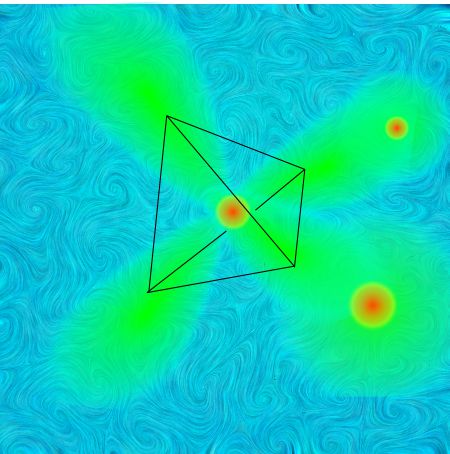
“Oh, it is far off.  Bohr put his electrons in a plane like your square there.  Try putting that fourth ball on top of the others to make a triangular pyramid.  See that?  Counting the bottom it’s a four-sided figure called a tetrahedron.  It’s the fundamental structural building block for most of the Universe’s molecules.”Water molecule“Hey, that’s the alpha-particle shape that the protons and neutrons get themselves into.”

“Good point, Vinnie.  Mind you, though, an alpha particle doesn’t have a central attractor, and it’s a quarter-million times smaller than an atom’s electron cloud.  Got that pyramid shape in mind?”

“Sure.”

“OK, put those balls back in your square. … Put a finger on the north ball and another on the south one.  Now roll them both up into contact on top of the line between the east and west ones.”

“Hey, it’s that tetra-thing again.”

“Right, Eddie.  Any time you have four objects each the same distance from all the others, you’ve got a tetrahedron.  If the ‘objects’ are clouds of electron charge all attracted to the nucleus and all repelled by the other clouds, that’s the shape they’ll take.  It’s no accident that an equal mix of an atom’s spherical and three dumbbell orbitals in a shell makes four equivalent orbitals pointing to the corners of a tetrahedron.”

“Cute, but what’s it get us?”

“It gets us to the chemists’ trick for thinking about molecular structures without doing all the quantum mechanics.  The key is that 8-electron shell.  Forget electrons racing in a ring or electron pairs in a square.  When you see a chemical diagram with four lines coming out of a central atom, think of them in a tetrahedron.  Here’s an example.  Guess what’s the commonest atom in the Universe.”

“Helium.”

“Hydrogen.”

“Eddie’s win with hydrogen — 923,000 atoms out of a million.  Carbon’s the fourth most common, 480 atoms per million.  Think of a carbon atom, floating around in space with four of its six units of electronic charge in its 2-shell.  And it’s surrounded by hydrogen atoms with electrons just begging to pair up with something.  No surprise, there’s suddenly a lot of electron pairing and you’ve got a molecule of methane, CH4.  What’s its shape?  Any hydrogen-hydrogen chains in there?”

“With this build-up, I gotta guess they’re all on the carbon and that they’re splayed out tetrahedron-like, hydrogen centers trying to get away from the other ones and shared charge clouds trying to get away from each other, too.”

“Couldn’t put it better myself, Vinnie.”

“Hey, water’s H2O, right?  You can’t make a tetrahedron from only three atoms.”

“True, Eddie, but an oxygen atom comes with two more electrons than carbon has.  We’ve still got a tetrahedron, but only two of its corners carry a hydrogen.  The other two orbitals stick out their own directions, each loaded with negative charge.  The chemists call that unshared kind of orbital a lone pair.  They often show it as a double-dot on the structure diagram. That’s basically just a bookkeeping device to keep track of electron counts.  All the charge is really spread around throughout all the molecular orbitals just like with atomic orbitals, only it’s not spread evenly.”

“Why do they bother to keep track like that?”

“Lone pairs affect the molecule’s structure.  If it weren’t for them, the water molecule would be a straight line.  In fact, a lone pair orbital crowds the space a bit more than a bonding pair — the H–O–H angle is about 5º smaller than a perfect tetrahedron.”

“Makes sense when you think about it, like you can wave a stick all over the place unless someone grabs the other end.”

“Mm-hm.  The big reason chemists care, though, is that lone pairs can be active centers during a chemical reaction.  All that negative charge just waiting for something positive-ish to come along.”

“Like a really good tip,” grumbles Eddie.

~~ Rich Olcott


To Bond Or Not To Bond, That Is The Question

Vinnie’s pushing pizza crumbs around his plate, watching them clump together.  “These molecular orbitals gotta be pretty complicated.  How do you even write them down?”

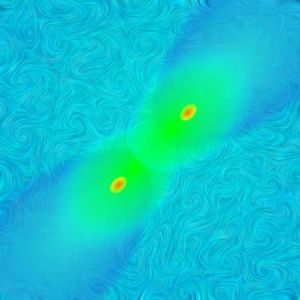
“Combinations.  There’s a bunch of different strategies, but they all go back to Laplace’s spherical harmonics.  Remember, he showed that every possible distribution around a central attractor could be described as a combination of his patterns.  Turn on a field, like from another atom, and you just change what combination is active.  Here’s a sketch of the simplest case, two hydrogen atoms — see how the charge on each one bulges toward the other?  The bulge is a combination of a spherical orbital and a dumbbell one.  The molecular orbitals are combinations of orbitals from both atoms, describing how the charges overlap, or not.”Hydrogen molecule

“What’s that blue in the other direction?”

“Another possible combination.  You can combine atomic orbitals with pluses or minuses.  The difference is that the minus combination will always have an additional node in between.  Extra nodes mean higher energy, harder to activate. When the molecule’s in the lowest energy state, charge will be between the atoms where that extra node isn’t.”

“So the overlapped charge here is negative, right, and it pulls the two positive nucleusses —”

“Nuclei”

“Whatever, it pulls ’em together.  Why don’t they just merge?”

“Positive-positive repulsion counts, too.  At the equilibrium bond distance, the nuclei repel each other exactly as much as the shared charge pulls them together.”

Eddie’s still hovering by our table.  “You said that there’s this huge number of possible atomic orbitals.  Wouldn’t there be an even huger number of molecular orbitals?”

“Sure.  The trick is in figuring out which of them are lowest-energy and activated and how that relates to the molecule’s configuration.  Keep track of your model’s total energy as you move the atoms about, for instance, and you can predict the equilibrium distance where the energy is a minimum.  In principle you can calculate configuration changes as two molecules approach each other and react.”

“Looks like a lot of work.”

“For sure, Eddie.  Even a handful of atoms has lots of atomic orbitals to keep track of.  That can burn up acres of compute time.”

Vinnie pushes three crumbs into a triangle.  “You got three distances, you can figure their angles.  So you got the whole shape of the thing.”

“Right, but like Eddie said, that’s a lot of computer work.  Chemists had to come up with shortcuts.  As a matter of fact, they had the shortcuts way before the computers came along.”

“They used, like, abacuses?”

“Funny, Vinnie.  No, no math at all.  And it’s why they still show school-kids those Bohr diagrams.”

“Crazy Eights.”

“Eddie, you got games on the brain.  But yeah, eights.  Or better, quartets of pairs.  One thing I’ve not mentioned yet is that even though they’ve got the same charge, electrons are willing to pair up.”

“How come?”

“That’s the thing of it, Vinnie.  There’s a story about Richard Feynman, probably the foremost physicist of the mid-20th Century.  Someone asked him to explain the pairing-up without using math.  Feynman went into his office for a week, came back out and said he couldn’t do it.  The math demands pairing-up, but outside of the math all we can say is experiments show that’s how it works.”

“HAH, that’s the reason for the ‘two charge units per orbital’ rule!”

“Exactly, Eddie.  It’s how charge can collect in that bonding molecular orbital in the first place.  It’s also the reason that helium doesn’t form molecules at all.  Imagine two helium atoms, each with two units of charge.  Suppose they come close to each other like those hydrogens did.  Where would the charge go?”

“OK, you got two units going into that in-between space, ahh, and the other two activating that blue orbital and pulling the two atoms apart.  So that adds up to zero?”

“Uh-huh.  They just bounce off and away.”

“Cool.”

“Hey, I got a question.  Your sketch has a ball orbital combining with a dumbbell.  But they’ve got different node counts, one and two.  Can you mix things from different shells?”

“Sure, Vinnie, if there’s enough energy.  The electron pair-up can release that much.”

“Cool.”

~~ Rich Olcott

  • A friend pointed out that I’m doing my best to avoid saying the word “electron.” He’s absolutely right.  At least in this series I’m taking Bohr’s side in his debate with Einstein — electrons in atoms don’t act like little billiard balls, they act like statistical averages, smeared-out ones at that.  It’s closer to reality to talk about where the charge is so that’s how I’m writing it.

The Shell You Say

Everyone figures Eddie started his pizza place because he likes to eavesdrop.  No surprise, he wanders over to our table.  “I heard you guys talking about atoms and stuff and how Sy here don’t like Bohr’s model of electrons in atoms even though Bohr’s model and the shell model both account for hydrogen’s spectrum.  Why’s the shell model better?”

Vinnie comes back quick.  “Because it’s not physically impossible, for one thing.”

I’m on it.  “Because the shell model extends smoothly to atoms and ions in an electric or magnetic field.  Better yet, shell methods can be applied to molecules.”

“What do fields have to do with it?”

“It’ll help to know that some of those electron patterns come in sets.  The 2-node shell has three dumbbell shapes, for instance — one each along the x, y and z axes. Think about an atom all alone in space with no fields around.  How does it know which way z goes?””

“It don’t.  Everything’s gotta be in all directions, like spherical.”

Vinnie’s back in.  “I’m seeing an atom in an electric field, say up-to-down, it’s going to pull charge in one direction, say down.  So now the atom don’t look like no ball no more, right?”

orbital in a field
Vertical field on the right

“Right.  Once the atom’s got a special direction, those three dumbbells stop being equivalent.  We say that the field mixes together the spherical pattern (in atoms we’d call it an s-orbital) with that direction’s dumbbell (we’d call it a p-orbital) to make two combination orbitals.  One combination has a lump of charge stretched downwards and the other combination has a bowl of diminished charge stretched upwards.  The stronger the field, the wider the energy split between those two.”

“What about the other two dumbbells?”

“They’re still equivalent, Eddie.  If there’s charge in them it’s spread evenly around the equator like a doughnut.  Energy-wise they’re in between the two s±p combinations.”

IF there’s charge, like maybe there ain’t?”

“Ever suspicious, eh, Vinnie?  You’re right, and that’s a good point.  Orbitals are only a way to describe the chaos inside the atom, like notes are a way to describe music.  There are 3-node orbitals and 47-node orbitals, all the way up, but most of the time they’re not charge-activated just like a piano’s top note hardly ever gets played.”

“How do we know whether an orbital’s activated?”

“We’ve got rules for that, Eddie.  Maximum of two units of charge per orbital, lowest energy first.  Unless some light wave has deactivated a deeper orbital and activated a higher one.”

“You’re being careful again, not saying an electron’s here or an electron’s there.”

“Darn right, Vinnie.  It’s that chaos thing — charge is smeared all over the atom like air molecules jiggle all over the place to carry a sound wave.  Chemists and physicists may talk about ‘the electron in the 2s-orbital’ but that’s shorthand.  They know it’s really not like that.”

“I’m doing arithmetic over here.  So there’s two electrons, OK, call it two units of charge for that 1-node ball orbital, plus two units for the 2-node ball, plus two units each for the three dumbbells, uses up five orbitals.  That’s the same 2+8 stable mix that Bohr came up with.”

“Yeah, Eddie, but that field Sy talked about could be any strength.  Run the energy  equations backwards and the astronomers get a way to check a star’s fields.”

“Exactly, Vinnie.  Transitions involving combination orbitals have slightly different energy jumps than the ones we see in isolated atoms.  Electric and magnetic fields split each line in an element’s spectrum into multiplets.  Measure their splittings and you can work back to the field strengths that caused them.  The shell theory offers more predictions and more scientific insights than Bohr’s model ever dreamed of.”

“You said shell theory can handle molecules, too.  How’s that work?”

“Same as that electric field, but a lot messier.  Every nucleus exerts a field, mostly electric, on the rest of the molecule.  So does all the electron charge, but it’s more diffuse and includes more magnetism.  Molecular orbitals span the whole thing.  Works like atoms but much harder to calculate.”

“Figuring tips is easier,” hints Eddie.

~~ Rich Olcott