
Abstract Horses

It was a young man’s knock, eager and a bit less hesitant than his first visit.

“C’mon in, Jeremy, the door’s open.”

“Hi, Mr Moire, it’s me, Jerem…  How did ..?  Never mind.  Ready for my black hole questions?”

“I’ll do what I can, Jeremy, but mind you, even the cosmologists are still having a hard time understanding them.  What’s your first question?”

“I read where nothing can escape a black hole, not even light, but Hawking radiation does come out because of virtual particles and what’s that about?”

“That’s a very lumpy question.  Let’s unwrap it one layer at a time.  What’s a particle?”

“A little teeny bit of something that floats in the air and you don’t want to breathe it because it can give you cancer or something.”

“That, too, but we’re talking physics here.  The physics notion of a particle came from Newton.  He invented it on the way to his Law of Gravity and calculating the Moon’s orbit around the Earth.  He realized that he didn’t need to know what the Moon is made of or what color it is.  Same thing for the Earth — he didn’t need to account for the Earth’s temperature or the length of its day.  He didn’t even need to worry about whether either body was spherical.  His results showed he could make valid predictions by pretending that the Earth and the Moon were simply massive points floating in space.”

Accio abstractify!  So that’s what a physics particle is?”

“Yup, just something that has mass and location and maybe a velocity.  That’s all you need to know to do motion calculations, unless the distance between the objects is comparable to their sizes, or they’ve got an electrical charge, or they move near lightspeed, or they’re so small that quantum effects come into play.  All other properties are irrelevant.”

“So that’s why he said that the Moon was attracted to Earth like the apple that fell on his head was — in his mind they were both just particles.”

“You got it, except that apple probably didn’t exist.”

“Whatever.  But what about virtual particles?  Do they have anything to do with VR goggles and like that?”

“Very little.  The Laws of Physics are optional inside a computer-controlled ‘reality.’  Virtual people can fly, flow of virtual time is arbitrary, virtual electrical forces can be made weaker or stronger than virtual gravity, whatever the programmers decide will further the narrative.  But virtual particles are much stranger than that.”

“Aw, they can’t be stranger than Minecraft.  Have you seen those zombie and skeleton horses?”Horses
“Yeah, actually, I have.  My niece plays Minecraft.  But at least those horses hang around.  Virtual particles are now you might see them, now you probably don’t.  They’re part of why quantum mechanics gave Einstein the willies.”

“Quantum mechanics comes into it?  Cool!  But what was Einstein’s problem?  Didn’t he invent quantum theory in the first place?”

“Oh, he was definitely one of the early leaders, along with Bohr, Heisenberg, Schrödinger and that lot.  But he was uncomfortable with how the community interpreted Schrödinger’s wave equation.  His row with Bohr was particularly intense, and there’s reason to believe that Bohr never properly understood the point that Einstein was trying to make.”

“Sounds like me and my Dad.  So what was Einstein’s point?”

“Basically, it’s that the quantum equations are about particles in Newton’s sense.  They lead to extremely accurate predictions of experimental results, but there’s a lot of abstraction on the way to those concrete results.  In the same way that Newton reduced Earth and Moon to mathematical objects, physicists reduced electrons and atomic nuclei to mathematical objects.”

“So they leave out stuff like what the Earth and Moon are made of.  Kinda.”

“Exactly.  Bohr’s interpretation was that quantum equations are statistical, that they give averages and relative probabilities –”

“– Like Schrödinger’s cat being alive AND dead –”

“– right, and Einstein’s question was, ‘Averages of what?‘  He felt that quantum theory’s statistical waves summarize underlying goings-on like ocean waves summarize what water molecules do.  Maybe quantum theory’s underlying layer is more particles.”

“Are those the virtual particles?”

“We’re almost there, but I’ve got an appointment.  Bye.”

“Sure.  Uhh… bye.”

~~ Rich Olcott

Wikipedia Skillz

A young man’s knock, eager yet a bit hesitant.

“C’mon in, the door’s open.”

Tall kid, glasses, hoodie thrown back.

“Hi, Mr Moire, can I ask you some questions?  I’m doing a term paper on black holes and I’ve read up on in Wikipedia but there’s things I don’t understand and besides Ms Plenum said not to trust Wikipedia.”

“Hold on, son, let’s get acquainted first.  You are…?”

“My name’s Jeremy Yazzie, sir, and I’m like Richard Feynman’s archetypical intelligent high school student he wanted to explain things to except he gave up on particle spin.”

“Well, you have done your homework, though you’ve muddled a couple of his quotes.  But about Wikipedia — Ms Plenum’s mostly right but in my experience the technical articles are pretty dependable.  Those writers are usually more interested in explaining than convincing.  Have you checked Wikipedia’s Talk pages?”

“There’s, like, comments?”

“Sort of, except Talk pages lie behind articles and target what’s right or wrong and what should be changed to make the article better.  I often learn as much from the technical discussion as I do from the article itself.”

wikieyes
A riff on Wikipedia’s logo, original in Wikimedia Commons

“I’ve never seen those pages.  How do I get to them?”

“You need a desktop view.  That’s the standard view when you use a desktop or laptop computer, but you can only maybe get to it on a handheld device.  Depends on the device, the browser, and even their maintenance levels.  Do you have a handheld in that backpack?”

“Yeah, an iPad.”

“Safari, Firefox and Chrome can all show that other view.”

“I’ve got all three.”

“Great, pull up Chrome, get to Wikipedia and look up ‘Black hole.'”

… “Got it.  Uhh… don’t see anything about a Talk page.”

“You’re looking at ‘mobile mode.’  See that three-dots icon at the top right?  Tap on it and check the pop-up menu.”

“Hah, here’s one that says, Request Desktop Site.  I’ll tap on that.  Hey, now I’ve got tabs above the text, one says Article and another that says Talk.  Whoa, here’s one that says View Source.  Whups, now there’s a box that says I can start editing.  Better not, huh?  How do I get out of that?”

“Tap your browser’s backup button.  By the way, even though in principle anyone can edit any article, the Wikipedia moderators have locked down some of the most popular or controversial just to prevent update wars.  This article’s one of those.”

“Yeah, I just backed up then tried View Source again and it says I’m not an established registered user.  No duh, right?  OK, lessee what’s in the Talk page.  Umm, how-to stuff and then organization stuff and then, huh! ‘this article has been rated GA-class on the quality scale.’ People come around and, like, check your work?”

“Absolutely, which is why I think Ms Plenum’s advice is a little too pessimistic.  Trust but verify — if you see something you’d like to quote but you don’t want to look foolish, double-check with another source.  But on the whole I’ve found the science, math and other technical articles to be trustworthy.”

“Aha, the first set of comments is about my questions, Hawking radiation and how black holes evaporate and what are virtual particles and like that.”

“So many questions, so little time.  Let’s finish off with the browser issue before we dive into physics.  Bring up your Firefox browser on that iPad.”

“All right.  Mmm, I’m going to Wikipedia, and I’m searching for ‘Black hole’ … got it, but the display doesn’t have tabs or a three-dot icon.”

“Firefox has two ways to get to desktop mode.  One way is to tap the three-bar icon at the top right…”

“YESS! the pop-up menu has half-a-dozen options and there’s Request Desktop Site.  Hey, it toggles, I can flip modes back and forth.  Sweet!  What’s the other way?”

“Press-and-hold the reload circle-arrow in the address bar.”

“A-hah, that opens a Request Desktop Site button right under the arrow.  Cool, that’s a toggle, too.  How does Safari handle this stuff?”

“They use the reload circle-arrow ploy, same as Firefox, dunno who did it first.”

“Oops, late for class.  Seeya.”

“Don’t mention it.”

~~ Rich Olcott

Questions, Meta-questions and Answers

<We rejoin Sy and Vinnie in the library stacks…> “Are you boys discussing me?”

<unison> “Oh, hi, Ramona.”

“Actually no, Ramona, we were discussing relativistic time dilation.”

“I know that, Sy, I’ve been reading your posts. Now I’ve got a question.”

“But how…?  Never mind.  Guess I’d better watch my writing.  What can I do for you?”

“You and Vinnie have been going on about kinetic time dilation and gravitational time dilation like they’re two separate things, right?”

“That’s how we’ve treated them, right, but the textbooks do the same.  The velocity-dependent time-stretch equation, tslow/tfast = √[1-(v²/c²)], comes out of Einstein’s Special Theory of Relativity. The gravity-dependent equation, tslow/tfast = √[1-(2G·M/r·c²)], came from his General Theory of Relativity.”

“But there’s no rule that says an object can’t be moving rapidly while it’s in a gravitational field, is there?  That Endurance spacecraft orbiting the black hole in the Interstellar movie certainly seemed to be in that situation.”

“No question, Ramona.  General Relativity’s just more, er, general.”

“Fine, but shouldn’t they work together?”

That got Vinnie started.  “Yeah, Sy, I started this with LIGO and gravity but you and those space shuttles got me into this speed thing.  How do you bridge ’em?”

“Not easily.  Einstein set the rules of the game when he wrote down his fundamental equations.  Physicists and mathematicians have been trying to solve them ever since.  Schwarzchild found the first solution within a year after the equations hit the streets, but he did the simplest possible system — a non-rotating spherical object with no electrical charge and alone in the Universe.  It took another half-century before Kerr and friends figured out how to handle rotating spheres with an electric charge, but even those objects are assumed to be isolated from all other masses.  Mm … how do you figure velocity, Vinnie?”

“Distance divided by time, easy.”

“Not quite that easy.  The equations say that if you’re close to a massive object, space gets compressed, time gets stretched, and the time and space dimensions get scrambled.  Literally.  Time near a Schwarzchild object points inward as you approach the sphere’s center, and don’t ask me how to visualize that.  A Kerr object has a belt around its equator where time runs backwards.  Craziness.”

“Well, how about if I’m not that close?”

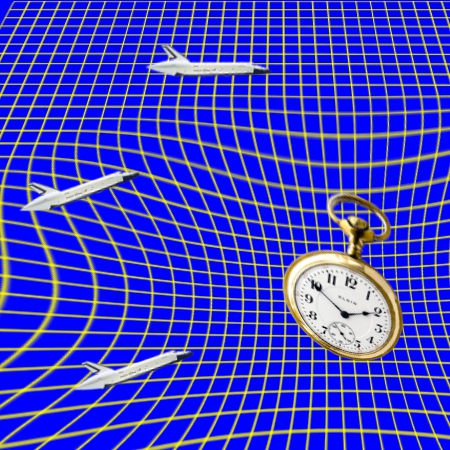
“That’s easier to answer, Ramona.  Suppose the three of us are each flying at safe distances from some heavy object with mass M.  I’m farthest away so I’m holding the fastest clock.  We’ll compare Vinnie’s and your clocks to mine.  OK?”3-clocks

“Sure, why not?”

“Fine.  Now, Vinnie, you’re closer in, resting on the direct line between me and the object.  You’re at distance r from it.  How fast does your clock run?”

“Uhhh…  We’re both on that same radial line so we’re in the same inertial frame, no kinetic effect.  I suppose you see it ticking slower because of the gravitational effect.”

“M-hm, and my clock ticks how often between ticks of yours?”

“You want the equation, huh?  All right, it’s tvinnie/tsy = √[1-(2G·M/r·c²)].”

“You’re reading my mind with those subscripts.  Now, Ramona, you’re at that same distance from the object but you’re in orbit around it.  Measured against Vinnie’s position you’ve got velocity v.  How fast is his clock ticking compared to yours?”

“Mmm…  We’re at the same level in the gravity field, so the gravitational thing makes no difference.  So … tramona/tvinnie = √[1-(v²/c²)].  Aaand, he’d see my clock running slow by the same amount. That’s weird.”

“Weird but true.  Last step — Ramona, you’re deeper in the gravitational field and you’re speeding away from me, so tramona/tsy=(tramona/tvinnie)*(tvinnie/tsy)=√[1-(2G·M/r·c²)]*√[1-(v²/c²)] covers both.”

“OK, that’s settled.  Back to Vinnie’s original question.  LIGOs are set in concrete, their velocities are zero so LIGO signals are all about gravity, right?”

“Right.”

Ramona links arms with him.  “Let’s go dancing.”  Then she gives me the eye.  “Sugarlumps, Sy?  Really?”

On the 12th floor of the Acme Building, high above the city, one man still tries to answer the Universe’s persistent questions — Sy Moire, Physics Eye.

~~ Rich Olcott

Weight And Wait, Two Aspects of Time

I was deep in the library stacks, hunting down a journal article so old it hadn’t been digitized yet.  As I rounded the corner of Aisle 5 Section 2, there he was, leaning against a post and holding a clipboard.

“Vinnie?  What are you doing here?”

“Waiting for you.  You weren’t in your office.”

“But how…?  Never mind.  What can I do for you?”

“It’s the time-dilation thing.  You said that there’s two kinds, a potential energy kind and a kinetic energy kind, but you only told me about the first one.”

“Hey, Ramona broke up that conversation, don’t blame me.  You got blank paper on that clipboard?”

“Sure.  Here.”

“Quick review — we said that potential energy only depends on where you are.  Suppose you and a clock are at some distance r away from a massive object like that Gargantua black hole, and my clock is way far away.  I see your clock ticking slower than mine.  The ratio of their ticking rates, tslow/tfast = √[1-(2G·M/r·c²)], only depends on the slow clock’s position.  Suppose you move even closer to the massive object.  That r-value gets smaller, the fraction inside the parentheses gets closer to 1, the square root gets smaller and I see your clock slow down even more.  Sound familiar?”

“Yeah, but what about the kinetic thing?”time-and-the-rovers

“I’m getting there.  You know Einstein’s famous EEinstein=m·c² equation.  See?  The formula contains neither a velocity nor a position.  That means EEinstein is the energy content of a particle that’s not moving and not under the influence of any gravitational or other force fields.  Under those conditions the object is isolated from the Universe and we call m its rest mass.  We good?”

“Yeah, yeah.”

“OK, remember the equation for gravitational potential energy?”

E=G·M·m/r.

“Let’s call that Egravity.  Now what’s the ratio between gravitational potential energy and the rest-mass energy?”

“Uh … Egravity/EEinstein = G·M·m/r·m·c² = G·M/r·c². Hey, that’s exactly half the fraction inside the square root up there. tslow/tfast = √[1-(2 Egravity/EEinstein)].  Cool.”

“Glad you like it.  Now, with that under our belts we’re ready for the kinetic thing.  What’s Newton’s equation for the kinetic energy of an object that has velocity v?”

E=½·m·v².

“I thought you’d know that.  Let’s call it Ekinetic.  Care to take a stab at the equation for kinetic time dilation?”

“As a guess, tslow/tfast = √[1-(2 Ekinetic/EEinstein)]. Hey, if I plug in the formulas for each of the energies, the halves and the mass cancel out and I get tslow/tfast = √[1-2(½m·v²/m·c²)] = √[1-(v²/c²)].  Is that it?”

“Close.  In Einstein’s math the kinetic energy expression is more complicated, but it leads to the same formula as yours.  If the velocity’s zero, the square root is 1.0 and there’s no time-slowing.  If the object’s moving at light-speed (v=c), the square root is zero and the slow clock is infinitely slow.  What’s interesting is that an object’s rest energy acts like a universal energy yardstick — both flavors of time-slowing are governed by how the current energy quantity compares to EEinstein.”

“Wait — kinetic energy depends on velocity, right, which means that it’ll look different from different inertial frames.  Does that mean that the kinetic time-slowing depends on the frames, too?”

“Sure it does.  Best case is if we’re both in the same frame, which means I see you in straight-line motion.  Each of us would get the same number if we measure the other’s velocity.  Plug that into the equation and each of us would see the same tslow for the other’s clock.  If we’re not doing uniform straight lines then we’re in different frames and our two dilation measurements won’t agree.”

“… Ramona doesn’t dance in straight lines, does she, Sy?”

“That reminds me of Einstein’s quote — ‘Put your hand on a hot stove for a minute, and it seems like an hour. Sit with a pretty girl for an hour, and it seems like a minute. That’s relativity.‘  You’re thinking curves now, eh?”

“Are you boys discussing me?”

<unison> “Oh, hi, Ramona.”

~~ Rich Olcott