The Biggest Telescope in The Universe

Vinnie rocks back in his chair.  “These gravitational lenses, Cathleen.  How do you figure their apertures and f-numbers, space being infinite and all?”

She takes a breath to answer, but I cut in.  “Whoa, I never got past a snapshot camera.  How about you explain Vinnie’s question before you answer it?”Bird and lenses

“You’re right, Sy, most people these days just use their cellphone camera and have no clue about what it does inside.  Apertures and f-numbers are all just simple geometry.  Everything scales with the lens’ focal length.”

“That’s how far away something is that you’re taking a picture of?”

“No, it’s a characteristic of the lens itself.  It’s the distance between the midpoint of the lens and its focal plane, which is where you’d want to put the sensor chip or film in a camera.  The aperture is the diameter of the light beam entering the lens.  The optimal aperture, the image size, even the weight of the lens, all scale to the lens focal length.”

“I can see image size thing — the further back the focal plane, the bigger the image by the the time it gets there.  It’s like a lever.”

“Sort of, Vinnie, but you’ve got the idea.”

“The aperture scales to focal length?  I’d think you could make a lens with any diameter you like.”

“Sure you could, Sy, but remember you’d be using a recording medium of some sort and it’s got an optimum input level.  Too much light and you over-expose, too little and you under-expose.  To get the right amount of light when you take the shot the aperture has to be right compared to the focal length.”

“Hey, so that’s the reason for the old ‘Sunny 16‘ rule.  Didn’t matter if I had a 35mm Olympus or a big ol’ Rollei, if it was a sunny day I got good pictures with an f/16 aperture.  ‘Course I had to balance the exposure time with the film’s speed rating but that was easy.”

“Exactly, Vinnie.  If I remember right, the Rollei’s images were about triple the size of the little guy’s.  Tripled focal length meant tripled lens size.  You could use the same speed-rated film in both cameras and use the same range of f-stops.  The rule still works with digital cameras but you need to know your sensor’s ISO rating.”

“Ya got this, Sy?  Can we move on to Cathleen’s gravity lenses?”

“Sure, go ahead.”

“Well, they’re completely different from … I’ll call them classical lenses. That kind has a focal plane and a focal length and an aperture and only operates along one axis.  Gravitational lenses have none of that, but they have an infinite number of focal lines and rings.”

Gravitational lens and galaxy“Infinite?”

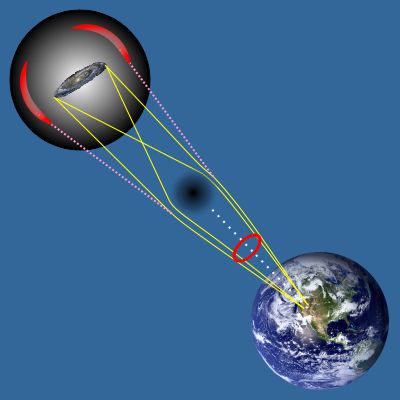
“At least in principle.  Any observation point in the Universe has a focal line running to a massive object’s center of gravity.  At any point along the line, you could look toward an object and potentially see all or part of a ring composed of light from some bright object behind it.  Einstein showed that a completed ring’s  visual angle depends on the deflector’s mass and the three distances between the observer, the deflector and the bright object.”

“The way you said that, there could be a bunch of rings.”

“Sure, one for each bright object shining onto the lens.  For that matter, the deflector itself could be complex — the gravity of a whole cluster of galaxies rather than the single black hole we’ve been assuming as an example.”

“That diagram reminds me of Galileo’s telescope, just a three-foot tube with an objective lens at the far end and an eyepiece lens to look through.  But it was enough to show him the rings of Saturn and the moons of Jupiter.”

“Right, Sy.  His objective lens was maybe a couple of inches across.  If its focal point was halfway down the tube, his scope’s light-gathering power would match an f/9 camera lens.  Gravitational lenses don’t have apertures so not an issue.”

“So here we are like Galileo, with a brand new kind of telescope.”

“Poetic, Vinnie, and so right.  It’s already shown us maybe the youngest galaxy, born 13 billion years ago.  We’re just getting started.”

~~ Rich Olcott
The Fellowship of A Ring

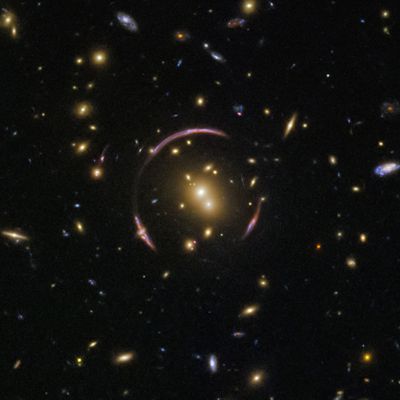
Einstein ring 2018
Hubble photo from NASA’s Web site

Cathleen and I are at a table in Al’s coffee shop, discussing not much, when Vinnie comes barreling in.  “Hey, guys.  Glad I found you together.  I just saw this ‘Einstein ring’ photo.  They say it’s some kind of lensing phenomenon and I’m thinking that a lens floating out in space to do that has to be yuuuge.  What’s it made of, and d’ya think aliens put it there to send us a message?”

Astronomer Cathleen rises to the bait.  I sit back to watch the fun.  “No, Vinnie, I don’t.  We’re not that special, the rings aren’t signals, and the lenses aren’t things, at least not in the way you’re thinking.”

“There’s more than one?”

“Hundreds we know of so far and it’s early days because the technology’s still improving.”

“How come so many?”

“It’s because of what makes the phenomenon happen.  What do you know about gravity and light rays?”

Me and Sy talked about that a while ago.  Light rays think they travel in straight lines past a heavy object, but if you’re watching the beam from somewhere else you think it bends there.”

I chip in.  “Nice summary, good to know you’re storing this stuff away.”Gravitational lens 1

“Hey, Sy, it’s why I ask questions is to catch up.  So go on, Cathleen.”

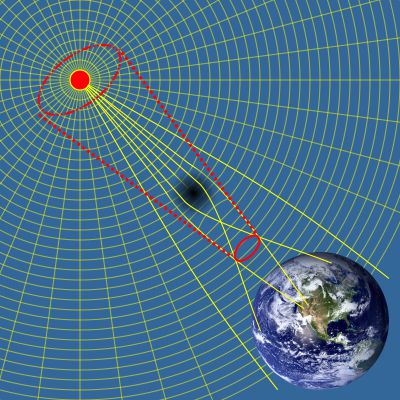
She swings her laptop around to show us a graphic.  “So think about a star far, far away.  It’s sending out light rays in every direction.  We’re here in Earth and catch only the rays emitted in our direction.  But suppose there’s a black hole exactly in the way of the direct beam.”

“We couldn’t see the star, I get that.”

“Well, actually we could see some of its light, thanks to the massive black hole’s ray-bending trick. Rays that would have missed us are bent inward towards our telescope.  The net effect is similar to having a big magnifying lens out there, focusing the star’s light on us.”

“You said, ‘similar.’  How’s it different?”Refraction lens

“In the pattern of light deflection.  Your standard Sherlock magnifying lens bends light most strongly at the edges so all the light is directed towards a point.  Gravitational lenses bend light most strongly near the center.  Their light pattern is hollow.  If we’re exactly in a straight line with the star and the black hole, we see the image ‘focused’ to a ring.”

“That’d be the Einstein ring, right?”

“Yes, he gets credit because he was the one who first set out the equation for how the rays would converge.  We don’t see the star, but we do see the ring.  His equation says that the angular size of the ring grows as the square root of the deflecting object’s mass.  That’s the basis of a widely-used technique for measuring the masses not only of black holes but of galaxies and even larger structures.”

“The magnification makes the star look brighter?”

“Brighter only in the sense that we’re gathering photons from a wider field then if we had only the direct beam.  The lens doesn’t make additional photons, probably.”

Suddenly I’m interested.  “Probably?”

“Yes, Sy, theoreticians have suggested a couple of possible effects, but to my knowledge there’s no good evidence yet for either of them.  You both know about Hawking radiation?”

“Sure.”

“Yup.”

“Well, there’s the possibility that starlight falling on a black hole’s event horizon could enhance virtual particle production.  That would generate more photons than one would expect from first principles.  On the other hand, we don’t really have a good handle on first principles for black holes.”

“And the other effect?”

“There’s a stack of IFs under this one.  IF dark matter exists and if the lens is a concentration of dark matter, then maybe photons passing through dark matter might have some subtle interaction with it that could generate more photons.  Like I said, no evidence.”

“Hundreds, you say.”

“Pardon?”

“We’ve found hundreds of these lenses.”

“All it takes is for one object to be more-or-less behind some other object that’s heavy enough to bend light towards us.”

“Seein’ the forest by using the trees, I guess.”

“That’s a good way to put, it, Vinnie.”

~~ Rich Olcott

On Gravity, Charge And Geese

A beautiful April day, far too nice to be inside working.  I’m on a brisk walk toward the lake when I hear puffing behind me.  “Hey, Moire, I got questions!”

“Of course you do, Mr Feder.  Ask away while we hike over to watch the geese.”

“Sure, but slow down , will ya?  I been reading this guy’s blog and he says some things I wanna check on.”

I know better but I ask anyhow.  “Like what?”

“Like maybe the planets have different electrical charges  so if we sent an astronaut they’d get killed by a ginormous lightning flash.”

“That’s unlikely for so many reasons, Mr Feder.  First, it’d be almost impossible for the Solar System to get built that way.  Next, it couldn’t stay that way if it had been.  Third, we know it’s not that way now.”

“One at a time.”

“OK.  We’re pretty sure that the Solar System started as a kink in a whirling cloud of galactic dust.  Gravity spanning the kink pulled that cloud into a swirling disk, then the swirls condensed to form planets.  Suppose dust particles in one of those swirls, for whatever reason, all had the same unbalanced electrical charge.”

“Right, and they came together because of gravity like you say.”

I pull Old Reliable from its holster.  “Think about just two particles, attracted to each other by gravity but repelled by their static charge.  Let’s see which force would win.  Typical interstellar dust particles run about 100 nanometers across.  We’re thinking planets so our particles are silicate.  Old Reliable says they’d weigh about 2×10¹⁸ kg each, so the force of gravity pulling them together would be …  oh, wait, that’d depend on how far apart they are.  But so would the electrostatic force, so let’s keep going.  How much charge do you want to put on each particle?”

“The minimum, one electron’s worth.”

“Loading the dice for gravity, aren’t you?  Only one extra electron per, umm, 22 million silicon atoms.    OK, one electron it is …  Take a look at Old Reliable’s calculation.gravity vs electrostatic calculation Those two electrons push their dust grains apart almost a quintillion times more strongly than gravity pulls them together.  And the distance makes no difference — close together or far apart, push wins.  You can’t use gravity to build a planet from charged particles.”

“Wait, Moire, couldn’t something else push those guys together — magnetic fields, say, or a shock wave?”

“Sure, which is why I said almost impossible.  Now for the second reason the astronaut won’t get lightning-shocked — the solar wind.  It’s been with us since the Sun lit up and it’s loaded with both positive- and negative-charged particles.  Suppose Venus, for instance, had been dealt more than its share of electrons back in the day.  Its net-negative charge would attract the wind’s protons and alpha particles to neutralize the charge imbalance.  By the same physics, a net-positive planet would attract electrons.  After a billion years of that, no problem.”

“All right, what’s the third reason?”

“Simple.  We’ve already sent out orbiters to all the planets.  Descent vehicles have made physical contact with many of them.  No lightning flashes, no fried electronics.  Blows my mind that our Cassini mission to Saturn did seven years of science there after a six-year flight, and everything worked perfectly with no side-trips to the shop.  Our astronauts can skip worrying about high-voltage landings.”

“Hey, I just noticed something.  Those F formulas look the same.”  He picks up a stick and starts scribbling on the dirt in front of us.  “You could add them up like F=(Gm1m2+k0q1q2)/r2.  See how the two pieces can trade off if you take away some mass but add back some charge?  How do we know we’ve got the mass-mass pull right and not mixed in with some charge-charge push?”

Geese and ducks“Good question.  If protons were more positive than electrons, electrostatic repulsion would always be proportional to mass.  We couldn’t separate that force from gravity.  Physicists have separately measured electron and proton charge.  They’re equal (except for sign) to 10 decimal places.  Unfortunately, we’d need another 25 digits of accuracy before we could test your hypothesis.”
“Aw, look, the geese got babies.”

“The small ones are ducks, Mr Feder.”

~~ Rich Olcott

The Speeds of Light

“I don’t give up easy, Sy.”

“I know that, Vinnie.  Still musing about lightwaves and how they’re all an electron’s fault?”

“Yeah.  Hey, can your OVR app on Old Reliable grab a shot from this movie running on my smartphone?”

“We can try … got it.  Now what?”

“I wanna try mixing that with your magnetic field picture.”

“I’ll bring that up … Here, have at it.”

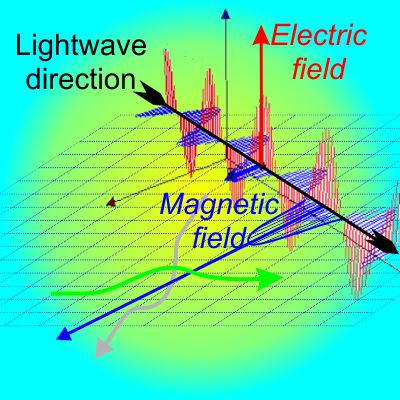
“Umm … Nice app, works very intuitive-like …  OK, see this?”Electrons and lightwave

“Ah.  It’s a bit busy, walk me through what’s in there.”

“OK. First we got the movie’s lightwave.  The ray’s running along that black arrow, see?  Some electron back behind the picture is going up and down to energize the ray and that makes the electric field that’s in red that makes other electrons go up and down, right?”

“That’s the red arrow, hmm?”

“Yeah, that electron got goosed ’cause it was standing in the way.  It follows the electric field’s direction.  Now help me out with the magnetic stuff.”

“Alright.  The blue lines represent the lightwave’s magnetic component.  A lightwave’s magnetic field lines are always perpendicular to its electric field.  Magnetism has no effect on uncharged particles or motionless charged particles.  If you’re a moving charged particle, say an electron, then the field deflects your trajectory.”

“This is what I’m still trying to wrap my head around.  You say that the field’s gonna push the particle perpendicular to the field and to the particle’s own vector.”

“That’s exactly what happens.  The green line, for instance, could represent an electron that crossed the magnetic field.  The field deflected the electron’s path upwards, crossways to the field and the electron’s path.  Then I suppose the electron encountered the reversed field from the lightwave’s following cycle and corrected course again.”

“And the grey line?”

“That’d be an electron crossing more-or-less along the field.  According to the Right Hand Rule it was deflected downward.”

“Wait.  We’ve got two electrons on the same side of the field and they’re deflected in opposite directions then correct back.  Doesn’t that average out to no change?”

“Not quite.  The key word is mostly.  Like gravity fields, electromagnetic fields get weaker with distance.  Each up or down deflection to an electron on an outbound path will be smaller than the previous one so the ‘course corrections’ get less correct.  Inbound electrons get deflected ever more strongly on the way in, of course, but eventually they become outbound electrons and get messed up even more.  All those deflections produce an expanding cone of disturbed electrons along the path of the ray.”

“Hey, but when any electron moves that changes the fields, right?  Wouldn’t there be a cone of disturbed field, too?”

“Absolutely.  The whole process leads to several kinds of dispersion.”

“Like what?”

“The obvious one is simple geometry.  What had been a simple straight-line ray is now an expanding cone of secondary emission.  Suppose you’re an astronomer looking at a planet that’s along that ray, for instance.  Light’s getting to you from throughout the cone, not just from the straight line.  You’re going to get a blurred picture.”

“What’s another kind?”

“Moving those electrons around extracts energy from the wave.  Some fraction of the ray’s original photons get converted to lower-energy ones with lower frequencies.  The net result is that the ray’s spectrum is spread and dispersed towards the red.”

“You said several kinds.”

“The last one’s a doozy — it affects the speeds of light.”

“‘Speeds,’ plural?”ripples in a wave

“There’s the speed of field’s ripples, and there’s the speed of the whole signal, say when a star goes nova.  Here’s a picture I built on Old Reliable.  The gold line is the electric field — see how the ripples make the red electron wobble?  The green dots on the axis give you comparison points that don’t move.  Watch how the ripples move left to right just like the signal does, but at their own speed.”

“Which one’s Einstein’s?”

“The signal.  Its speed is called the group velocity and in space always runs 186,000 mph.  The ripple speed, technically it’s the phase velocity, is slower because of that extracted-and-redistributed-energy process.  Different frequencies get different slowdowns, which gives astronomers clues about the interstellar medium.”

“Clues are good.”

~~ Rich Olcott

They Went That-away. But Why?

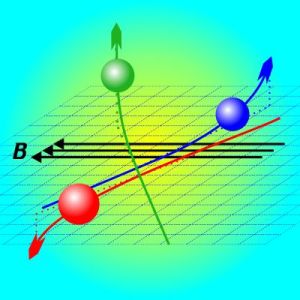
“It’s worse than that, Vinnie.”  I pull out Old Reliable, my math-monster tablet.  “Let me scan in that three-electron drawing of yours.”3 electrons in B-field

“Good enough to keep a record of it?”

“Nope, I want to exercise a new OVR app I just bought.”

“You mean OCR.”

“Uh-uh, this is Original Vector Reconstruction, not Optical Character Recognition.    OCR lets you read a document into a word processor so you can modify it.  OVR does the same thing but with graphics.  Give me a sec … there.  OK, look at this.”3 electrons in B-field revisited

“Cool, you turned my drawing 180°, sort of.  Nice app.  Oh, and you moved the red electron’s path so it’s going opposite to the blue electron instead of parallel to the magnetic field.  Why’d you bother?”

“See the difference between blue and red?”

“Well, yeah, one’s going up, one’s going down.  That’s what I came to you about and you shot down my theory.  Those B-arrows in the magnetic field are going in completely the wrong direction to push things that way.”

“Well, actually, they’re going in exactly the right direction for that, because a magnetic field pushes along perpendiculars.  Ever hear of The Right Hand Rule?”

“You mean like ‘lefty-loosey, righty-tighty’?”

“That works, too, but it’s not the rule I’m talking about.  If you point your thumb in the direction an electron is moving, and your index finger in the direction of the magnetic field, your third finger points in the deflection direction.  Try it.”

“Hurts my wrist when I do it for the blue one, but yeah, the rule works for that.  It’s easier for the red one.  OK, you got this rule, fine, but why does it work?”

“Part of it goes back to the vector math you don’t want me to throw at you.  Let’s just say that there are versions of a Right Hand Rule all over physics.  Many of them are essentially definitions, in the same way that Newton’s Laws of Motion defined force and mass.  Suppose you’re studying the movements directed by some new kind of force.  Typically, you try to define some underlying field in such a way that you can write equations that predict the movement.  You haven’t changed Nature, you’ve just improved our view of how things fit together.”

“So you’re telling me that whoever made that drawing I copied drew the direction those B-arrows pointed just to fit the rule?”

“Almost.  The intensity of the field is whatever it is and the lines minus their pointy parts are wherever they are.  The only thing we can set a rule for is which end of the line gets the arrowhead.  Make sense?”Spiraling electron

“I suppose.  But now I got two questions instead of the one I come in here with.  I can see the deflection twisting that electron’s path into a spiral.  But I don’t see why it spirals upward instead of downward, and I still don’t see how the whole thing works in the first place.”

“I’m afraid you’ve stumbled into a rabbit hole  we don’t generally talk about.  When Newton gave us his Law of Gravity, he didn’t really explain gravity, he just told us how to calculate it.  It took Einstein and General Relativity to get a deeper explanation.  See that really thick book on my shelf over there?  It’s loaded with tables of thermodynamic numbers I can use to calculate chemical reactions, but we didn’t start to understand those numbers until quantum mechanics came along.  Maxwell’s equations let us calculate electricity, magnetism and their interaction — but they don’t tell us why they work.”

“I get the drift.  You’re gonna tell me it goes up because it goes up.”

“That’s pretty much the story.  Electrons are among the simplest particles we know of.  Maxwell and his equations gave us a good handle on how they behave, nothing on why we have a Right Hand Rule instead of a Left Hand Rule.  The parity just falls out of the math.  Left-right asymmetry seems to have something to do with the geometry of the Universe, but we really don’t know.”

“Will string theory help?”

“Physicists have spent 50 years grinding on that without a testable result.  I’m not holding my breath.”

~~ Rich Olcott