A Force-to-Force Meeting

The Crazy Theory contest is still going strong in the back room at Al’s coffee shop. I gather from the score board scribbles that Jim’s Mars idea (one mark-up says “2 possible 2 B crazy!“) is way behind Amanda’s “green blood” theory.  There’s some milling about, then a guy next to me says, “I got this, hold my coffee,” and steps up to the mic.  Big fellow, don’t recognize him but some of the Physics students do — “Hey, it’s Cap’n Mike at the mic.  Whatcha got for us this time?”

“I got the absence of a theory, how’s that?  It’s about the Four Forces.”

Someone in the crowd yells out, “Charm, Persuasiveness, Chaos and Bloody-mindedness.”

“Nah, Jennie, that’s Terry Pratchett’s Theory of Historical Narrative.  We’re doing Physics here.  The right answer is Weak and Strong Nuclear Forces, Electromagnetism, and Gravity, with me?  Question is, how do they compare?”

Another voice from the crowd. “Depends on distance!”

“Well yeah, but let’s look at cases.  Weak Nuclear Force first.  It works on the quarks that form massive particles like protons.  It’s a really short-range force because it depends on force-carrier particles that have very short lifetimes.  If a Weak Force carrier leaves its home particle even at the speed of light which they’re way too heavy to do, it can only fly a small fraction of a proton radius before it expires without affecting anything.  So, ineffective anywhere outside a massive particle.”

It’s a raucous crowd.  “How about the Strong Force, Mike?”

.  <chorus of “HOO-wah!”>

“Semper fi that.  OK, the carriers of the Strong Force —”

.  <“Naa-VY!  Naaa-VY!”>

.  <“Hush up, guys, let him finish.”>

“Thanks, Amanda.  The Strong Force carriers have no mass so they fly at lightspeed, but the force itself is short range, falls off rapidly beyond the nuclear radius.  It keeps each trio of quarks inside their own proton or neutron.  And it’s powerful enough to corral positively-charged particles within the nucleus.  That means it’s way stronger inside the nucleus than the Electromagnetic force that pushes positive charges away from each other.”

“How about outside the nucleus?”

“Out there it’s much weaker than Electromagnetism’s photons that go flying about —”

.  <“Air Force!”>

.  <“You guys!”>

“As I was saying…  OK, the Electromagnetic Force is like the nuclear forces because it’s carried by particles and quantum mechanics applies.  But it’s different from the nuclear forces because of its inverse-square distance dependence.  Its range is infinite if you’re willing to wait a while to sense it because light has finite speed.  The really different force is the fourth one, Gravity —”

.  <“Yo Army!  Ground-pounders rock!”>

“I was expecting that.  In some ways Gravity’s like Electromagnetism.  It travels at the same speed and has the same inverse-square distance law.  But at any given distance, Gravity’s a factor of 1038 punier and we’ve never been able to detect a force-carrier for it.  Worse, a century of math work hasn’t been able to forge an acceptable connection between the really good Relativity theory we have for Gravity and the really good Standard Model we have for the other three forces.  So here’s my Crazy Theory Number One — maybe there is no connection.”

.  <sudden dead silence>

“All the theory work I’ve seen — string theory, whatever — assumes that Gravity is somehow subject to quantum-based laws of some sort and our challenge is to tie Gravity’s quanta to the rules that govern the Standard Model.  That’s the way we’d like the Universe to work, but is there any firm evidence that Gravity actually is quantized?”

.  <more silence>

“Right.  So now for my Even Crazier Theories.  Maybe there’s a Fifth Force, also non-quantized, even weaker than Gravity, and not bound by the speed of light.  Something like that could explain entanglement and solve Einstein’s Bubble problem.”

.  <even more silence>

“OK, I’ll get crazier.  Many of us have had what I’ll call spooky experiences that known Physics can’t explain.  Maybe stupid-good gambling luck or ‘just knowing’ when someone died, stuff like that.  Maybe we’re using the Fifth Force in action.”

.  <complete pandemonium>
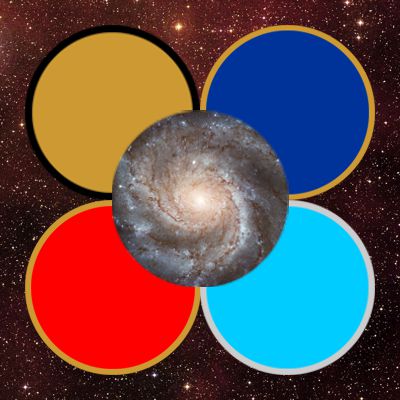
four forces plus 1

~ Rich Olcott


Note to my readers with connections to the US National Guard, Coast Guard, Merchant Marine and/or Public Health Service — Yeah, I know, but one can only stretch a metaphor so far.

Atoms are solar systems? Um, no…

Suddenly there’s a hubbub of girlish voices to one side of the crowd.  “Go on, Jeremy, get up there.”  “Yeah, Jeremy, your theory’s no crazier than theirs.”  “Do it, Jeremy.”

Sure enough, the kid’s here with some of his groupies.  Don’t know how he does it.  He’s a lot younger than the grad students who generally present at these contests, but he’s got guts and he grabs the mic.

“OK, here’s my Crazy Theory.  The Solar System has eight planets going around the Sun, and an oxygen atom has eight electrons going around the nucleus.  Maybe we’re living in an oxygen atom in some humongous Universe, and maybe there are people living on the electrons in our oxygen atoms or whatever.  Maybe the Galaxy is like some huge molecule.  Think about living on an electron in a uranium atom with 91 other planets in the same solar system and what happens when the nucleus fissions.  Would that be like a nova?”

There’s a hush because no-one knows where to start, then Cathleen’s voice comes from the back of the room.  Of course she’s here — some of the Crazy Theory contest ring-leaders are her Astronomy students.  “Congratulations, Jeremy, you’ve joined the Honorable Legion of Planetary Atom Theorists.  Is there anyone in the room who hasn’t played with the idea at some time?”

No-one raises a hand except a couple of Jeremy’s groupies.

“See, Jeremy, you’re in good company.  But there are a few problems with the idea.  I’ll start off with some astronomical issues and then the physicists can throw in some more.  First, stars going nova collapse, they don’t fission.  Second, compared to the outermost planet in the Solar System, how far is it from the Sun to the nearest star?”

A different groupie raises her hand and a calculator.  “Neptune’s about 4 light-hours from the Sun and Alpha Centauri’s a little over 4 light-years, so that would be … the 4’s cancel, 24 hours times 365 … about 8760 times further away than Neptune.”

“Nicely done.  That’s a typical star-to-star distance within the disk and away from the central bulge.  Now, how far apart are the atoms in a molecule?”

“Aren’t they pretty much touching?  That’s a lot closer than 8760 times the distance.”

“Yes, indeed, Jeremy.  Anyone else with an objection?  Ah, Maria.  Go ahead.”

“Yes, ma’am.  All electrons have exactly the same properties, ¿yes? but different planets, they have different properties.  Jupiter is much, much heavier than Earth or Mercury.”

Astrophysicist-in-training Jim speaks up.  “Different force laws.  Solar systems are held together by gravity but at this level atoms are held together by electromagnetic forces.”

“Carry that a step further, Jim.  What does that say about the geometry?”

“Gravity’s always attractive.  The planets are attracted to the Sun but they’re also attracted to each other.  That’ll tend to pull them all into the same plane and you’ll get a flat disk, mostly.  In an atom, though, the electrons or at least the charge centers repel each other — four starting at the corners of a square would push two out of the plane to form a tetrahedron, and so forth.  That’s leaving aside electron spin.  Anyhow, the electronic charge will be three-dimensional around the nucleus, not planar.  Do you want me to go into what a magnetic field would do?”

“No, I think the point’s been made.  Would someone from the Physics side care to chime in?”

“Synchrotron radiation.”

“Good one.  And you are …?”

“Newt Barnes.  I’m one of Dr Hanneken’s students.”

“Care to explain?”

“Sure.  Assume a hydrogen atom is a little solar system with one electron in orbit around the nucleus.  Any time a charge moves it radiates waves into the electromagnetic field.  The waves carry forces that can compel other charged objects to move.  The distance an object moves, times the force exerted, equals the amount of energy expended by the wave.  Therefore the wave must carry energy and that energy must have come from the electron’s motion.  After a while the electron runs out of kinetic energy and falls into the nucleus.  That doesn’t actually happen, so the atom’s not a solar system.”

Jeremy gets general applause when he waves submission, then the crowd’s chant resumes…

.——<“Amanda! Amanda! Amanda!”>Bohr and Bohr atom

~~ Rich Olcott

Helios versus Mars, Planetary Version

Al waves me over the moment I step through the door of his coffee shop.  “Sy, ya gotta squeeze into the back room.  The grad students are holding another Crazy Theory contest and they’re having a blast.  I don’t know enough science to keep up with ’em but you’d love it.  Here’s your coffee.”

“Thanks, Al.  I’ll see what’s going on.”

The Crazy Theory contest is a hallowed Al’s Coffee Shop tradition — a “seminar” where grad students present their weirdest ideas in competition.  Another tradition (Al is strong on this one) is that the night’s winner has to sweep up the thrown spitballs and crumpled paper napkins at the end of the presentations.  I weave my way in just as the girl at the mic finishes her pitch with, “… and that’s why Spock and horseshoe crabs both have green blood!”

Some in the crowd start chanting “Amanda!  Amanda!  Amanda!”  She’s already reaching for the Ceremonial Broom when Jim steps up to the mic and waves for quiet.  “Wanna hear how the Sun oxidized Mars and poisoned it for us?”

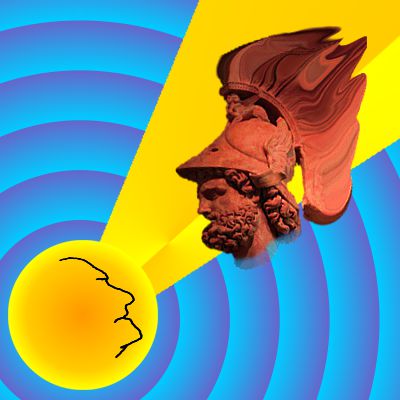
Helios and Mars
Helios and Mars
Mars image adopted from photo by Mark Cartwright
Creative Commons license
Attribution-NonCommercial-ShareAlike

Voice from the crowd — <“The Sun did what?”>

“You remember titration from school chem lab?”

.——<“Yeah, you put acid in a beaker and you drip in a base until the solution starts to turn red.”>

“What color is Mars?”

.——<“Red!”>

“Well, there you are.”

.——<“Horse-hockey!  What’s that got to do with the Sun or what you said about poison?”>

“Look at what our rovers and orbiters found on Mars — atmosphere only 1% of Earth’s but even that’s mostly CO2, no liquid water at the surface, rust-dust everywhere, soil’s loaded with perchlorate salts.  My Crazy Theory can explain all of that.”

.——<“Awright, let’s hear it!”>

“Titration’s all about counting out chemical species.  Your acid-base indicator pinked when you’d neutralized your sample’s H+ ions by adding exactly the right number of OH ions to turn them all into H2O, right?  So think about Mars back in the day when it had liquid water on the ground and water vapor in the atmosphere.  Along comes solar radiation, especially the hard ultra-violet that blows apart stratospheric H2O molecules.  ZOT!  Suddenly you’ve got two free hydrogen atoms and an oxygen floating around.  Then what happens?”

It’s a tough crowd.  <“We’re dying to hear!  Get on with it!”>

“The hydrogens tie up as an H2 molecule.  The escape velocity on Mars is well below the speed of H2 molecules at any temperature above 40K, so those guys abandon Mars for the freedom of Space.  Which leaves the oxygen atom behind, hungry for electrons and ready to oxidize anything it can get close to.”

They’re starting to come along.  <“Wouldn’t the oxygen form O2 and fly away too?”>

“Nowhere near as quickly.  An O2 molecule is 16 times heavier than an H2 molecule.  At a given temperature it moves 1/4 as fast and mostly stays on-planet where it can chew up the landscape.”

.——<“How could an atom do that?”>

“It’s a chain process.  First step for the O is to react with something else in the atmosphere — make an oxidizing molecule like ozone or hydrogen peroxide.  That diffuses down to ground level where it can eat rocks.”

.——<“Wait, ‘eat rocks’!!?!  How does that happen?”>

“Look, most rocks are basically lattices of double-negative oxide ions with positive metal ions tucked in between to balance the charge.  Surface oxide ions can’t be oxidized by an ozone molecule, but they can transmit electron demand down to the metal ions immediately underneath.  An iron2+ ion gets oxidized to iron3+, one big step towards rust-dust.  The charge change disrupts the existing oxide lattice pattern and that piece of the rock erodes a little.”

.——<“What about the poison?”>

“Back when Mars had oceans, they had to have lots of chloride ions floating around to be left behind when the ocean dried up.  Ozone converts chloride to perchlorate, ClO4, which is also a pretty good oxidizer.  Worse, it’s the right size and charge to sneak into your thyroid gland and mess it up.  Poison for sure.  Chemically, solar radiation raised the oxidation state of the whole planet.”

One lonely voice — “Nice try, Jim” — but then the chant returns…

.——<“Amanda!  Amanda!  Amanda!”>

~~ Rich Olcott

Schroeder’s Magic Kittycat

“Bedtime, Teena.”

“Aw, Mommie, I had another question for Uncle Sy.  And I’m not sleepy yet anyhow.”

“Well, if we’re just sitting here relaxing, I suppose.  Sy, make your answer as boring as possible.”

“You know me better than that, Sis, but I’ll try.  What’s your question, Teena?”

“You said something once about quantum and Schroeder’s famous kittycat.  Why is it famous?  If it’s quantum it must be a very, very small cat.  Is it magic?”

“???… Oh, Schrödinger’s Cat.  It’s a pretend cat, not a real one, but it’s famous because it’s both asleep and awake.”

“I see what you did there, Sy.”

“Yeah, Sis, but it’s for a good cause, right?”

“But Uncle Sy, how can you tell?  Sometimes Tommie our kittycat looks sound asleep but he’s not really because he can hear when Mommie opens the cat-food can.”

“Schrödinger’s Cat is special.  Whenever he’s awake his eyes are wide open and whenever he’s asleep his eyes are shut.  And he’s in a box.”

“Tommie loves to sit in boxes.”

“Schrödinger’s Cat’s box is sealed tight.  You can’t see into it.”

“So how do you know whether he’s asleep?”

“That was Mr Schrödinger’s point.  We can’t know, so we have to suppose it’s both.  Many people have made jokes about that.  Mr. Schrödinger said the usual interpretation of quantum mechanics is ridiculous and his cat story was his way of proving that.  The cat doesn’t even have to be quantum-small and the story still works.”

“How could it be halfway?  Either his eyes are open or they’re … wait, sometimes Tommie squints, is that it?”

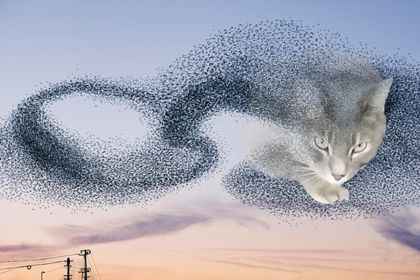
“Nice try, but no.  Do you remember when we were looking at the bird murmuration and I asked you to point to its middle?”

“Oh, yes, and it was making a beautiful spiral.  Mommie, you should have seen it!”

“Were there any birds right at its middle?”

“Um, no-o.  All around the middle but not right there.”

“Birds to the left, birds to the right, but no birds in the middle.  But if I’d I asked you to point to the place where the birds were, you’d’ve pointed to the middle.”

“Uh-huh.”

“You see how that’s like Mr Schrödinger’s cat’s situation?  It’s really asleep or maybe it’s really awake, but if we’re asked for just one answer we’d have to say ‘halfway between.’  Which is silly just like Mr Schrödinger said — by the usual quantum calculation we’d have to consider his cat to be half awake.  That was part of the long argument between Mr Einstein and the other scientist.”

“Wait, Sy, I didn’t hear that part of you two’s conversation on the porch.  What argument was that?”

“This was Einstein’s big debate with Niels Bohr.  Bohr maintained that all we could ever know about the quantum world are the probabilities the calculations yielded.  Einstein held that the probabilities had to result from processes taking place in some underlying reality.  Cat reality here, which we can resolve by opening the box, but the same issue applies across the board at the quantum level.  The problem’s more general than it appears, because much the same issue appears any time you can have a mixture of two or more states.  Are you asleep yet, Sweetie?”

“Nnn, kp tkng.”

“OK.  Entanglement, for instance.  Pretty much the same logic that Schrödinger disparaged can also apply to quantum particles on different paths through space.  Fire off any process that emits a pair of particles, photons for instance.  The wave function that describes both of them together persists through time so if you measure a property for one of them, say polarization direction, you know what that property is for the other one without traveling to measure it.  So far, so good.  What drove Einstein to deplore the whole theory is that the first particle instantaneously notifies the other one that it’s been measured.  That goes directly counter to Einstein’s Theory of Relativity which says that communication can’t go any faster than the speed of light.  Aaand I think she’s asleep.”

“Nice job, Sy, I’ll put her to bed.  We may discuss entanglement sometime.  G’night, Sy.”

“G’night, Sis.  Let me know the next time you do that meatloaf recipe.”

Cat emerging from murmuration~~ Rich Olcott