Engineering A Black Hole

<bomPAH-dadadadaDEEdah> That weird ringtone on Old Reliable again. Sure enough, the phone function’s caller-ID display says 710‑555‑1701.  “Ms Baird, I presume?”

A computerish voice, aggressive but feminine, with a hint of desperation. “Commander Baird will be with you shortly, Mr Moire. Please hold.”

A moment later, “Hello, Mr Moire.”

“Ms Baird. Congratulations on the promotion.”

“Thank you, Mr Moire. I owe you for that.”

“How so?”

“Your posts about phase-based weaponry got me thinking. I assembled a team, we demonstrated a proof of concept and now Federation ships are being equipped with the Baird‑Prymaat ShieldSaw. Works a treat on Klingon and Romulan shielding. So thank you.”

“My pleasure. Where are you now?”

“I’m on a research ship called the Invigilator. We’re orbiting black hole number 77203 in our catalog. We call it ‘Lonesome‘.”

“Why that name?”

“Because there’s so little other matter in the space nearby. The poor thing barely has an accretion disk.”

“Sounds boring.”

“No, it’s exciting, because it’s so close to a theoretical ideal. It’s like the perfectly flat plane and the frictionless pulley — in real life there are always irregularities that the simple equations can’t account for. For black holes, our only complete solutions assume that the collapsed star is floating in an empty Universe with no impinging gravitational or electromagnetic fields. That doesn’t happen, of course, but Lonesome comes close.”

“But if we understand the theoretical cases and it nearly matches one, why bother with it at all?”

“Engineering reasons.”

“You’re engineering a black hole?”

“In a way, yes. Or at least that’s what we’re working on. We think we have a way to extract power from a black hole. It’ll supply inexhaustible cheap energy for a new Star Fleet anti‑matter factory. “

“I thought the only thing that could escape a black hole’s Event Horizon was Hawking radiation, and it cheats.”

“Gravity escapes honestly. Its intense field generates some unexpected effects. Your physicist Roger Penrose used gravity to explain the polar jets that decorate so many compact objects including black holes. He calculated that if a comet or an atom or something else breakable shatters when it falls into a spinning compact object’s gravitational field, some pieces would be trapped there but under the right conditions other pieces would slingshot outward with more energy than they had going in. In effect, the extra energy would come from the compact object’s angular momentum.”

“And that’s what you’re planning to do? How are you going to trap the expelled pieces?”

“No, that’s not what we’re planning. Too random to be controlled with our current containment field technology. We’re going pure electromagnetic, turning Lonesome into a giant motor‑generator. We know it has a stable magnetic field and it’s spinning rapidly. We’ll start by giving Lonesome some close company. There’s enough junk in its accretion disk for several Neptune‑sized planets. The plan is to use space tugs to haul in the big stuff and Bussard technology for the dust, all to assemble a pair of Ceres-sized planetoids. W’re calling them Pine and Road. We’ll park them in a convenient equatorial orbit in a Lagrange‑stable configuration so Pine, Road and Lonesome stay in a straight line.”

“Someone’s been doing research on old cinema.”

“The Interstellar Movie Database. Anyhow, when the planetoids are out there we string conducting tractor beams between them. If we locate Pine and Road properly, Lonesome’s rotating magnetic field lines will cross the fields at right angles and induce a steady electric current. Power for the anti‑matter synthesizers.”

“Ah, so like Penrose’s process you’re going to drain off some of Lonesome‘s rotational kinetic energy. Won’t it run out?”

Lonesome‘s mass is half again heavier than your Sun’s, Mr Moire. It’ll spin for a long, long time.”

“Umm … that ‘convenient orbit.’ Lonesome‘s diameter is so small that orbits will be pretty speedy. <calculating quickly with Old Reliable> Even 200 million kilometers away you’d circle Lonesome in less than 15 minutes. Will the magnetic field that far out be strong enough for your purposes?”

“Almost certainly so, but the gravimagnetodynamic equations don’t have exact solutions. We’re not going to know until we get there.”

“That’s how research works, all right. Good luck.”

~~ Rich Olcott

The Edges of The Universe

<chirp, chirp> “Moire here.”

“Um, Uncle Sy?”

“Hi, Teena! I didn’t know you knew my phone number. It’s past your bedtime. How are you? Is everything OK?”

“I’m fine. Mommie dialed you for me. I had a question she said you could answer better than her and that would be my bedtime story.”

“Your Mommie’s a very smart person in several ways. What’s your question?”

“Where’s the edge of the Universe?”

“Whoa! Where’d that question come from?”

“Well, I was lying on my bed and I thought, the edge of me is my skin and the edge of my room is the walls and the edge of our block is the street but I don’t know what any of the bigger edges are so I asked Mommie and she said to ask you. She’s writing something.”

“Of course she is. One answer is you’re smack on an edge, but some people think that’s a wrong answer so let’s talk about all the edges, OK?”

“On an edge??!? I’m in the middle of my bed.”

“Hey, I heard you sit up. Lie back down, this is supposed to be a bedtime story so we’re supposed to be calm, OK? All right, now. Once upon a time —”

“Really?”

“Yes, really. Now hush and let me start. Once upon a time, people thought that the sky was a solid bowl or maybe a curtain that came down all the way to meet the Earth just over the horizon, and that was the edge of the Universe. But then people started traveling and they realized that the horizon moved when they did.”

“Like rainbows.”

“Exactly like rainbows. Eventually they’d traveled everywhere they could walk. As they went they made maps. According to the maps, the world they knew about was surrounded by ocean so the edge of the Universe was the ocean.”

“Except for Moana’s people that crossed the ocean.”

“Right, but even they only went from island to island. Their version of a map was as flat as the paper maps the European and Chinese explorers used.”

“But the world is really round like my world ball.”

“Yes, it is. It took humans a long time to accept that, because it meant their world couldn’t be all there is. A round world would have to float in space. Think about this — what’s the edge of our world?”

“Umm … the air?”

“Very good, sweetie. Way up, 60 miles high, the air gets so thin that we call that height the Edge of Space.”

“That’s the inside edge of space. Where’s the outside edge of space?”

“It’s moved outward as our astronomers have gotten better at looking far away. For a long time they thought that the outermost stars in our Milky Way galaxy marked the edge of the Universe. Then an astronomer named Edwin Hubble—”

“Oh, like the Hubble Space Telescope that made the pretty pictures in my ‘Stronomy book!”

“Mm-hm, the Hubble was named for him because he did such important work. Anyway, he showed that what people thought were stardust clouds inside the Milky Way were actually other galaxies like ours but far, far away. With the Hubble and other telescopes we’ve pushed out our known Universe to … I don’t even know the name of such a big number.”

“So that’s the edge?”

“We don’t think so, but we don’t know. Maybe space and galaxies go on forever, maybe galaxies peter out but space goes on, maybe something weird. But there’s a special ‘direction’ that we think does have an edge, maybe two.”

<yawn> “What’s that?”

“Time. One edge was the Big Bang, fourteen billion years ago. We’re pretty sure of that one. The scientists and philosophers argue about whether there’s another edge.”

“Wouldn’t jus’ be f’rever?”

“Mr Einstein thought it would. In fact, he thought that the future is as solidly real as the past is and we’re just watching from the windows of a train rolling along the time tracks.”

“Don’ like that, wanna do diffren’ things.”

“Me, too, sweetie. I prefer the idea that the future doesn’t exist yet; we’re on the front edge of time, building as we go. Dream about that, OK?”

“Okayyyyyy

~~ Rich Olcott

To Swerve And Project

A crisp Fall dawn, crisp fallen leaves under my feet as I jog the path by the park’s lake.

“Hey! Moire! How about these red sunrises and sunsets? Remind you of Mars?”

“Morning, Mr Feder. Not much, and definitely not dawn or dusk. Those tend more to blue, as a matter of fact.”

“Waitaminnit, Moire. I seen that Brad Pitt Martian movie, him driving hisself all alone across that big plain — the place is blood‑red.”

“Think a minute, Mr Feder. If he was all alone, who was running the cameras?”

“Uhhh, right. Movie. Yeah, they were really on Earth so they could director the lighting and all. But they said they’d scienced the … heck out of it.”

“Oh they did, better than most movies, but artistic license took over in a couple of places. People expect Mars to be red, not mostly clay colored like it really is, so the producers served up red.”

“Wait, I remember the conversation about Earth is blue because of the oceans and Mars is red because of its rusty atmosphere. So what’s with the sky colors?”

“Looking up at sunlight through an atmosphere is very different from looking down at the surface. It all has to do with how what’s in the atmosphere interacts with sunlight. Take Earth’s blue sky, for instance.”

“My favorite color.”

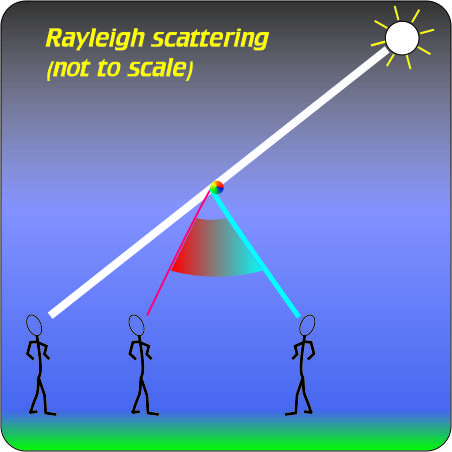
“Sure it is. OK, the Sun’s disk takes up much less than 1% of the sky but that’s enough to give us all our sunlight photons. A fraction of them run into something on the way down to Earth’s surface. What happens depends on how big the something is compared to the photon wavelength. Much larger things, maybe an airplane, completely block the photons and we get a shadow.”

“Obviously.”

“Yeah, but life’s more interesting for smaller somethings. For things like air molecules and dust particles that are much smaller than the the wavelength of visible light, the waves generally swerve around the particle. How much they swerve depends on the wavelength — extreme blue light bends about ten times more than extreme red light for the same scattering particle. So suppose there’s a kid a few miles away from us looking at the sky while we’re looking at it here. There’s a sunbeam with a rainbow‑load of photons headed for the kid, but there are dust particles in the way. Get the picture?”

“Sure, sure, get on with it.”

“So some of the light swerves. The red swerves a little but the blue light swerves ten times as much, enough that it heads straight for us. What color do we see when we look in that direction?”

“Blue, of course.”

“Blue everywhere in the lit‑up sky except when we look straight at the Sun.”

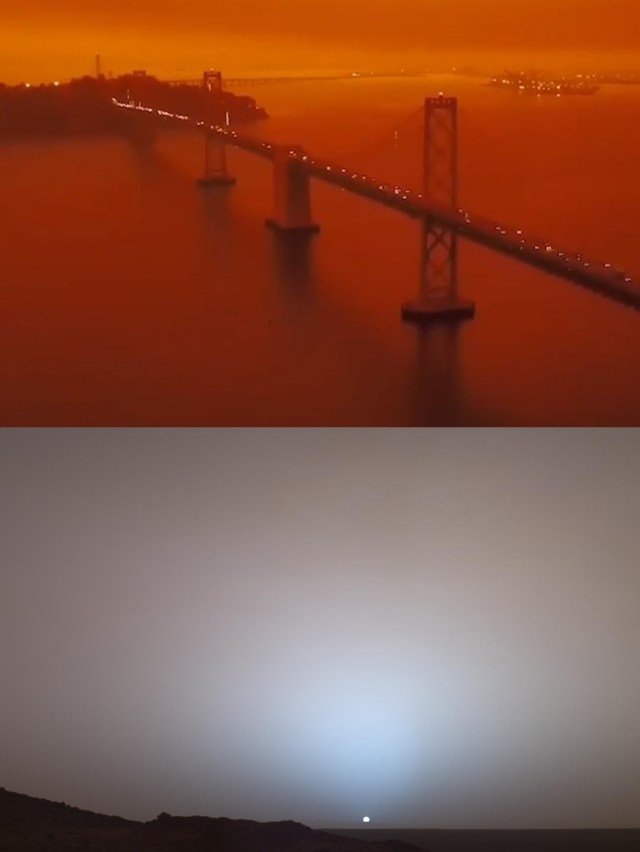
“What about these pretty red sunsets and the red skies over the wildfires?”

“Two different but related phenomena. Sunsets first. An incoming photon with just the right wavelength may simply be absorbed by a molecule. Doesn’t happen often, but there’s lots of molecules. Turns out that oxygen and ozone absorb blue light more strongly than red light. When we’re looking horizontally towards a sunset we’re looking through many more oxygen molecules than when we look vertically. We see the red part of a blue‑filtered version of that swerve rainbow.”

“And the fire skies?”

“The fires released huge amounts of fine smoke particles, just the right size for color‑scattering. Blue light swerves again and again until it’s either absorbed or shot out to space. Red light survives.”

Upper image – Golden Gate Bay under fiery skies, Sept 2020
Lower image – Sunset from Gusev Crater, Mars
Credit: NASA/JPL/Texas A&M/Cornell

“So what’s different about Mars?”

“Three things — Mars dust is different from Earth’s, its atmosphere is a lot thinner, and there’s practically no atmospheric water or oxygen. Rusty Mars dust is the size of smoke particles. With no rain or snow to settle out the dust, it stays aloft all the time. Rust is red because it absorbs blue light and reflects only the red part. With less diffused sunlight, Mars’ sky is basically the black of space overlaid with a red tint. Sunsets are blue‑ish because what blue light there is can travel further.”

“Earth skies are better.”

~~ Rich Olcott

Traffic Control

Jeremy Yazzie @jeremyaz
hi @symoire, this is jeremy. ive been reading about the osiris‑rex mission to astrroid bennu and how they’re bringing back a sample – so complicated – fancy robot arm, n2 squirter, air‑cleaner thingy – y not just vacuum the dust or pick up a rock?


Sy Moire @symoire
@jeremyaz – quick answer is that Bennu and OSIRIS-REx are already surrounded by the vacuum of space. Sample collectors can’t suck any harder that that. I’ll email you a more complete answer later


Hi, Sy, can you believe this weather? Temps last week were twice today’s high.

Not to a physicist, Sis.
Those 90s and today’s 45 are just Fahrenheit
scale numbers.
Can’t do ratios between them, “twice” does not compute.
I don’t suppose it would help if we went centigrade and said last week’s highs were around 35 and today it’s 5?

No, that’s worse, today’s down by 85% from last week.

Centigrade’s another scale you can’t do ratio arithmetic in. Kelvins is the way to go.
Temp in K tracks the average molecular kinetic energy.
Starts at zero where nothing’s moving and rises in proportion.
Last week’s highs ran around 308 K, today is 278 K.
Today we’re only 10% cooler than last week.

Physicists! Grrrr. However you measure the weather, it still feels cold. No picnic this weekend ;^(


From: Sy Moire <sy@moirestudies.com>
To: Jeremy Yazzie <jeremyaz@college.edu>
Subj: OSIRIS-REx

Jeremy –

OK, now I’m back at the office I’ve got better tech for writing long answers.

First, the “grab a rock” idea has several issues

  • If you pick up a rock, you only have that rock, says nothing about any of its neighbors or the subsurface material it might have smacked into. Dust should be a much better representation of the whole asteroid.
  • The rock might not be willing to be picked up. When the scientists and engineers were planning the OSIRIS‑REx mission, they didn’t know Bennu’s texture — could be one solid rock or a bunch of middle‑size rocks firmly cemented together or a loose “rubble pile” of all‑size rocks and dust held together by gravity alone, or anything in between.
  • Have you ever played one of those arcade games where you try to pick up a toy with a suspended claw gadget and all you’ve got is a couple of control knobs and a button? Picking up a specific rock, even a willing one, is hard when you’re a robot operating 15 light‑minutes away from the home office.

So dust it is, but how to plan dust collection in low gravity when you know nothing about the texture? Something like a whisk broom and dust pan would work unless the surface is too uneven. Something like a drill or disk sander would be good, except to use either one you need a solid footing to work from or else you go spinning one way when the tool spins the other. (That was a problem on the International Space Station.) The Hayabusa2 mission to asteroid Ryugu used a high‑velocity impactor to create dust, but a bad ricochet or shrapnel could kill the OSIRIS‑REx mission. The planners decided that best alternative was puff‑and‑grab.

So why not an astronautical Roomba that just sucks in the dust? The thing about vacuum is that it’s a place where gas molecules aren’t. Suppose you’re a gas molecule. You’re surrounded by your buddies, all in motion and bouncing off of each other like on a crowded 3‑D dance floor. You stay more‑or‑less in place because you’re being hit more‑or‑less equally from every direction. Suddenly there’s a vacuum to one side. You’re not hit as much over there so that’s the direction you and a bunch of your buddies move. If you encounter a dust particle, it picks up your momentum and moves toward the emptiness where it could be trapped in somebody’s filter.

The planners decided to capture dust particles by entraining them in a flow of gas molecules through a filter. To make gas flow you need more gas on one side then the other. Gas molecules being few and far between in space, the obvious place to put your pusher gas is inside the filter. Hence the nitrogen squirt technique and the “air‑cleaner thingy.”

— Sy

Diagram of TAGSAM in operation
Adapted from asteroidmission.org/?attachment_id=1699
Credit: University of Arizona

~~ Rich Olcott