SPLASH Splish plink

<chirp, chirp, chirp, chirp> “Moire here. This’d better be good.”

“Hello, Mr Moire. I’m one of your readers.”

“Do you have any idea what time it is?”

“Afraid not, I don’t know what time zone you’re in.”

“It’s three o’clock in the morning! Why are you calling me at this hour?”

“Oh, sorry, it’s mid-afternoon here. Modern communications tech is such a marvel. No matter, you’re awake so here’s my question. I’ve been pondering that micro black hole you’ve featured in the last couple of posts. You convinced me it would have a hard time hitting Earth but then I started thinking about it hitting the Sun. The Sun’s diameter is 100 times Earth’s so it presents 10,000 times more target area, yes? Further, the Sun’s 300,000 times more massive than Earth so it has that much more gravity. Surely the Sun is a more effective black hole attractor than Earth is.”

“That’s a statement, not a question. Worse yet, you’re comparing negligible to extremely negligible and neither one is worth losing sleep over which is what I’m doing now.”

“Wait on, I’ve not gotten to my question yet which is, suppose a black hole did happen to collide with the Sun. What would happen then?”

<yawn> “Depends on the size of the black hole. If it’s supermassive, up in the billion‑sun range, it wouldn’t hit the Sun. Instead, the Sun would hit the black hole but there’d be no collision. The Sun would just sink quietly through the Event Horizon.”

“Wouldn’t it rip apart?”
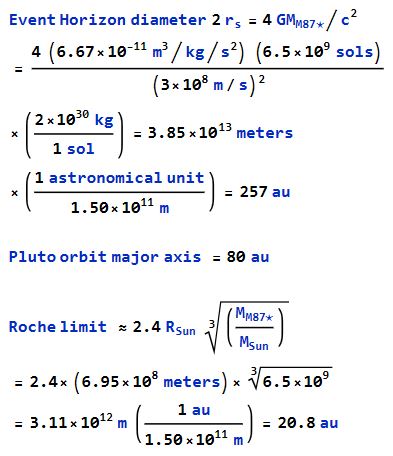
“You’re thinking of those artistic paintings showing great blobs of material being torn away by a black hole’s gravity. Doesn’t work that way, at least not at this size range.” <grabbing Old Reliable from my nightstand and key‑tapping> “Gravitational forces are distance‑dependent. Supermassives are large even by astronomical standards. The M87* black hole, the first one ESA got an image of, has the mass of 6 billion Suns and an Event Horizon three times wider than Pluto’s orbit. The tidal ripping‑apart you’re looking for only happens when the mass centers of two objects approach within Roche’s limit. Suppose a Sun‑sized star flew into M87*’s Event Horizon. Their Roche limit would be 100 astronomical units inside the Event Horizon. If any ripping happened, no evidence could escape to us.”

“Another illusion punctured.”
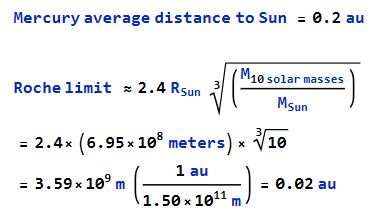
“Don’t give up hope. The next‑smaller size category have masses near our Sun’s. The Event Horizon of a 10‑solar‑mass black hole would be only about 60 kilometers wide. The Roche Zone for an approaching Sun is a million times wider. There’s plenty of opportunity for ferocious ripping on the way in.”

“Somehow that’s a comfort, but my question was about even smaller black holes — micro‑size flyspecks such as you wrote about. What effect would one have on the Sun?”

“You’d think it’d be a simple matter of the micro‑hole, let’s call it Mikey, diving straight to the Sun’s center while gobbling Sun‑stuff in a gluttonous frenzy, getting exponentially bigger and more voracious every second until the Sun implodes. Almost none of that would happen. The Sun’s an incredibly violent place. On initial approach Mikey’d be met with powerful, rapidly moving magnetic fields. If he’s carrying any charge at all they’d give him whip‑crack rides all around the Sun’s mostly‑vacuum outer layers. He might not ever escape down to the Convection Zone.”

“He’d dive if he escaped there or he’s electrically neutral.”

“Mostly not. The Convection Zone’s 200,000-kilometer depth takes up two‑thirds of the Sun’s volume and features hyper‑hurricane winds roaring upward, downward and occasionally sideward. Mikey would be a very small boat in a very big forever storm.”

“But surely Mikey’s density would carry him through to the core.”

“Nope, the deeper you go, the smaller the influence of gravity. Newton proved that inside a massive spherical shell, the net gravitational pull on any small object is zero. At the Sun’s core it’s all pressure, no gravity.”

“Then the pressure will force‑feed mass into Mikey.”

“Not so much. Mikey has jets and and an accretion disk. Their outward radiation pressure sets an upper limit on Mikey’s gobbling speed. The Sun will nova naturally before Mikey has any effect.”

“No worries then.”

~~ Rich Olcott

Hiding Among The Hill Spheres

Bright Spring sunlight wakes me earlier than I’d like. I get to the office before I need to, but there’s Jeremy waiting at the door. “Morning, Jeremy. What gets you here so soon after dawn?”

“Good morning, Mr Moire. I didn’t sleep well last night, still thinking about that micro black hole. Okay, I know now that terrorists or military or corporate types couldn’t bring it near Earth, but maybe it comes by itself. What if it’s one of those asteroids with a weird orbit that intersects Earth’s orbit? Could we even see it coming? Aren’t we still in danger of all those tides and quakes and maybe it’d hollow out the Earth? How would the planetary defense people handle it?”

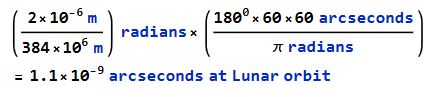
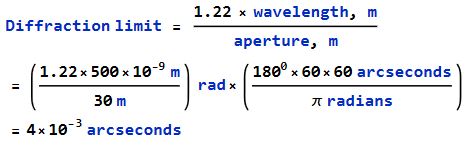
“For so early in the day you’re in fine form, Jeremy. Let’s take your barrage one topic at a time, starting with the bad news. We know this particular object would radiate very weakly and in the far infrared, which is already a challenge to detect. It’s only two micrometers wide. If it were to cross the Moon’s orbit, its image then would be about a nanoarcsecond across. Our astrometers are proud to resolve two white‑light images a few milliarcseconds apart using a 30‑meter telescope. Resolution in the far‑IR would be about 200 times worse. So, we couldn’t see it at a useful distance. But the bad news gets worse.”

“How could it get worse?”

“Suppose we could detect the beast. What would we do about it? Planetary defense people have proposed lots of strategies against a marauding asteroid — catch it in a big net, pilot it away with rocket engines mounted on the surface, even blast it with A‑bombs or H‑bombs. Black holes aren’t solid so none of those would work. The DART mission tried using kinetic energy, whacking an asteroid’s moonlet to divert the moonlet‑asteroid system. It worked better than anyone expected it to, but only because the moonlet was a rubble pile that broke up easily. The material it threw away acted as reaction mass for a poorly controlled rubble rocket. Black holes don’t break up.”

“You’re not making getting to sleep any easier for me.”

“Understood. Here’s the good news — the odds of us encountering anything like that are gazillions‑to‑one against. Consider the probabilities. If your beast exists I don’t think it would be an asteroid or even from the Kuiper Belt. Something as exotic as a primordial black hole or a mostly‑evaporated stellar black hole couldn’t have been part of the Solar System’s initial dust cloud, therefore it wouldn’t have been gathered into the Solar System’s ecliptic plane. It could have been part of the Oort cloud debris or maybe even flown in on a hyperbolic orbit from far, far away like ‘Oumuamua did. Its orbit could be along any of an infinite number of orientations away from Earth’s orbit. But it gets better.”

“I’ll take all the improvement you can give me.”

“Its orbital period is probably thousands of years long or never.”

“What difference does that make?”

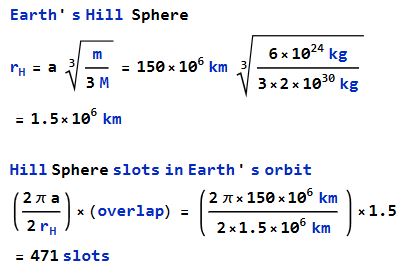
“You’ve got to be in the right place at the right time to collide. Earth is 4.5 billion years old. Something with a 100‑year orbit would have had millions of chances to pass through a spot we happen to occupy. An outsider like ‘Oumuamua would have only one. We can even figure odds on that. It’s like a horseshoe game where close enough is good enough. The object doesn’t have to hit Earth right off, it only has to pierce our Hill Sphere.”

“Hill Sphere?”

“A Hill Sphere is a mathematical abstract like an Event Horizon. Inside a planet’s Sphere any nearby object feels a greater attraction to the planet than to its star. Velocities permitting, a collision may ensue. The Sphere’s radius depends only on the average planet–star distance and the planet and star masses. Earth’s Hill Sphere radius is 1.5 million kilometers. Visualize Hill Spheres crowded all along Earth’s orbit. If the interloper traverses any Sphere other than the one we’re in, we survive. It has 1 chance out of 471 . Multiply 471 by 100 spheres sunward and an infinity outward. We’ve got a guaranteed win.”

“I’ll sleep better tonight.”

~~ Rich Olcott

A Tug at The Ol’ Gravity Strings

“Why, Jeremy, you’ve got such a stunned look on your face. What happened? Is there anything I can do to help?”

“Sorry, Mr Moire. I guess I’ve been thinking too much about this science fiction story I just read. Which gelato can I scoop for you?”

“Two dips of mint, in a cup. Eddie went heavy with the garlic on my pizza this evening. What got to you in the story?”

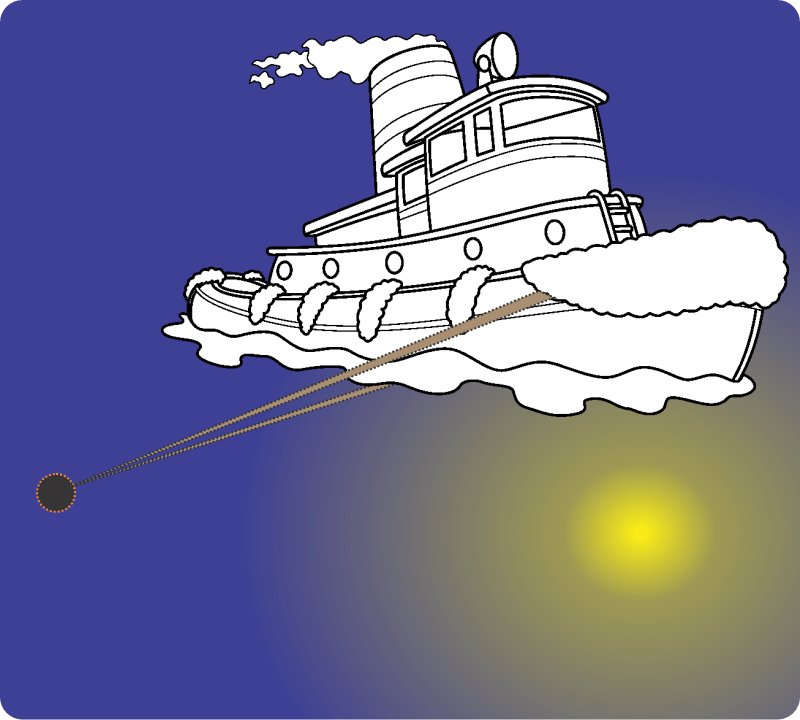
“The central plot device. Here’s your gelato. In the story, someone locates a rogue black hole hiding in the asteroid belt. Tiny, maybe a few thousandths of a millimeter across, but awful heavy. A military‑industrial combine uses a space tug to tow it to Earth orbit for some kind of energy source, but their magnetic grapple slips and the thing falls to Earth. Except it doesn’t just fall to Earth, it’s so small it falls into Earth and now it’s orbiting inside, eating away the core until everything crumbles in. I can’t stop thinking about that.”

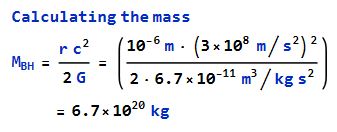
“Sounds pretty bad, but it might help if we run the numbers.” <drawing Old Reliable from its holster> “First thing — Everything about a black hole depends on its mass, so just how massive is this one?” <tapping on Old Reliable’s screen with gelato spoon> “For round numbers let’s say its diameter is 0.002 millimeter. The Schwartzschild ‘radius’ r is half that. Solve Schwartschild’s r=2GM/c² equation for the mass … plug in that r‑value … mass is 6.7×10²⁰ kilograms. That’s about 1% of the Moon’s mass. Heavy indeed. How did they find this object?”

“The story didn’t say. Probably some asteroid miner stumbled on it.”

“Darn lucky stumble, something only a few microns across. Not likely to transit the Sun or block light from any stars unless you’re right on top of it. Radiation from its accretion disk? Depends on the history — there’s a lot of open space in the asteroid belt but just maybe the beast encountered enough dust to form one. Probably not, though. Wait, how about Hawking radiation?”

“Oh, right, Stephen Hawking’s quantum magic trick that lets a black hole radiate light from just outside its Event Horizon. Does Old Reliable have the formulas for that?”

“Sure. From Hawking’s work we know the object’s temperature and that gives us its blackbody spectrum, then we’ve got the Bekenstein‑Hawking equation for the power it radiates. Mind you, the spectrum will be red‑shifted to some extent because those photons have to crawl out of a gravity well, but this’ll give us a first cut.” <more tapping> “Chilly. 170 kelvins, that’s 100⁰C below room temperature. Most of its sub‑nanowatt emission will be at far infrared wavelengths. A terrible beacon. But suppose someone did find this thing. I wonder what’ll it take to move it here.”

“Can you calculate that?”

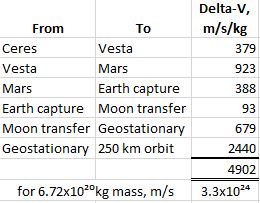
“Roughly. Suppose your space tug follows the cheapest possible flight path from somewhere near Ceres. Assuming the tug itself has negligible mass … ” <more tapping> “Whoa! That is literally an astronomical amount of delta-V. Not anything a rocket could do. Never mind. But where were they planning to put the object? What level orbit?”

“Well, it’s intended to beam power down to Earth. Ions in the Van Allen Belts would soak up a lot of the energy unless they station it below the Belts. Say 250 miles up along with the ISS.”

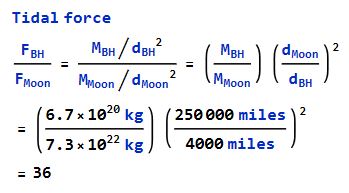
“Hoo boy! A thousand times closer than the Moon. Force is inverse to distance squared, remember. Wait, that’s distance to the center and Earth’s radius is about 4000 miles so the 250 miles is on top of that. 250,000 divided by 4250 … quotient squared … is a distance factor of almost 3500. Put 1% of the Moon that close to the Earth and you’ve got ocean tides 36 times stronger than lunar tides. Land does tides, too, so there’d be earthquakes. Um. The ISS is on a 90‑minute orbit so you’d have those quakes and ocean tides sixteen times a day. I wouldn’t worry about the black hole hollowing out the Earth, the tidal effect alone would do a great job of messing us up.”

“The whole project is such a bad idea that no-one would or could do it. I feel better now.”

~~ Rich Olcott

The Situation of The Gravity

<bomPAH-dadadadaDEEdah> It’s been a while since Old Reliable blared that unregistered ringtone. Sure enough, the phone function’s caller‑ID display says 710‑555‑1701.  “Commander Baird, I presume? Long time no hear.”

<downcast tone with a hint of desperation> “It’s Lieutenant now.”

“Sorry to hear that. What happened?”

Project Lonesome was a bust. It took us years to assemble those two planetoids but getting them into the right orbits around the black hole was more of a challenge than we planned for. Planetoid Pine got away from us and fell down through the Event Horizon. One big blast of inforon radiation and no more project. We lost a few robot space tugs but all carbon‑based personnel survived. Medical Bay just now pronounced me healthy — it’s amazing what they can do about pervasive sub‑cellular damage these days. The Board of Inquiry decided no‑one was at fault but they down‑ranked me because I was primary advocate for a jinxed project.”

“Well, those 15-minute orbits were a gamble all along. So why this phone call?”

“You know how it is, sitting in Med Bay with nothing much to do. I was poking around and happened to read a few of the files you’re working on—”

“Which ones?”

“The Projects directory.”

“But those are client files I’ve encrypted with the latest technology.”

“Oh, please, Mr Moire, I am calling from the 24th Century. Upton’s algorithm for zeta‑function decryption is ancient history. Don’t worry, your client’s secrets are safe, although one of your clients may not be.”

“Whoa, say what? Which one? What kind of danger? They all seem healthy, look both ways before crossing the street, that sort of thing.”

“One of those projects is extremely dangerous.”

“Which one? The biometrically‑lockable archery bow shouldn’t cause any problems. The electric yoga outfit? I triple‑checked the wiring and insulation specs, they’re safe and reliable. The robot rabbit? Surely not. Does this involve lethal spy‑craft of some sort? I try to avoid military work.”

“No, it’s the perpetual motion machine.”

“Ralphie’s project? Laws of Thermodynamics and all, I told him that’s just not going to work. He insisted I check his blueprints to make sure nothing’s going to blow up. I gave them a quick glance, didn’t see anything dicey.”

“It wouldn’t be obvious, especially not in view of your primitive science—”

“Hey!”

“No offense intended, Mr Moire, but it is primitive from my perspective. Two hundred years make a difference. Consider the state of Earth’s science in 1723 — Graham was still perfecting the pendulum clock.”

“Point taken, reluctantly. So what should I look for, and why?”

The Prime Directive applies across time periods, too, so I can’t go into detail with you. I’ll just say it’s not any one component, it’s the overall physical arrangement and what will happen when he powers up. Move the boxy bits closer together or further apart by two centimeters and the danger’s gone.”

“But what’s the danger? I can’t just tell him to reconfigure for no reason.”

“Directed gravity, Mr Moire, the sculpting of spacetime. It’s the reason we don’t need safety belts on a starship — we manufacture local gravity that always pulls toward the deck. In fact, directed gravity’s at the heart of warp drive technology. Cochrane stumbled on the effect accidentally but fortunately his lab was in a reinforced hard‑rock tunnel so damage was limited.”

“Anti-gravity? Oh, that’d be so cool. Flying cars at last, and sky‑cycles. Okay, there’d be problems and we’d need an AI-boosted Air Traffic Control agency. The military would be all over the idea. But all that’s way down the road, so to speak. I don’t understand how that puts Ralphie in immediate danger and why would a tunnel help?”

“Not anti-gravity, directed gravity. Gravity’s built into the structure of spacetime. Gravity can’t be blocked, but it can be shifted. The only way to weaken it in one location is to make it stronger somewhere else. Suppose Cochrane had first powered‑up his device on the ground in the open air. Depending on which way it was pointed, either he’d have been crushed between rising magma and down‑falling air, or…”

“I’ll tell Ralphie to re‑configure his gadget. Thanks for the warning.”

~~ Rich Olcott

  • Thanks, Alex, for inspiring this.

Symmetry And The Loopholes

“So, we’ve got geometry symmetry and relativity symmetry. Is that it, Sy?”

“Hardly, Al. There’s scores of them. Mathematics has a whole branch devoted to sorting and classifying the operations and how they group together. Shall I list a few dozen?”

“Ah, no, don’t bother, thanks. You got one I’d recognize?”

“How about charge symmetry? Flip an electron’s negative charge and you’ve got a positron that has exactly the same mass and the same interaction with light waves. OK, positrons move opposite to electrons in a magnetic field which is how their existence was confirmed, but charge is s a fundamental symmetry for normal matter.”

“Oh, right, charge is a piece of that CPT symmetry you hung your anti‑Universe story on. Which reminds me, you never said what the ‘P’ stands for.”

“Parity, as in Charge‑Parity‑Time. Before you ask, ‘parity‘ is left-right symmetry. Parity symmetry says you can replace ‘clockwise‘ with ‘counterclockwise‘ in a system and the equations describing the system will give perfectly good predictions. Time symmetry is about time running forward or backward. The equations are happy either way. The CPT theorem says the three symmetries are solidly tied together — you can’t flip one without the other two tagging along. If some process emits particle X with clockwise spin, there’s some equivalent process that soaks up an anti-X if it’s spinning counterclockwise. Very firm theorem, lots of laboratory evidence for it from electromagnetism and the nuclear strong force. But.”

“But?”

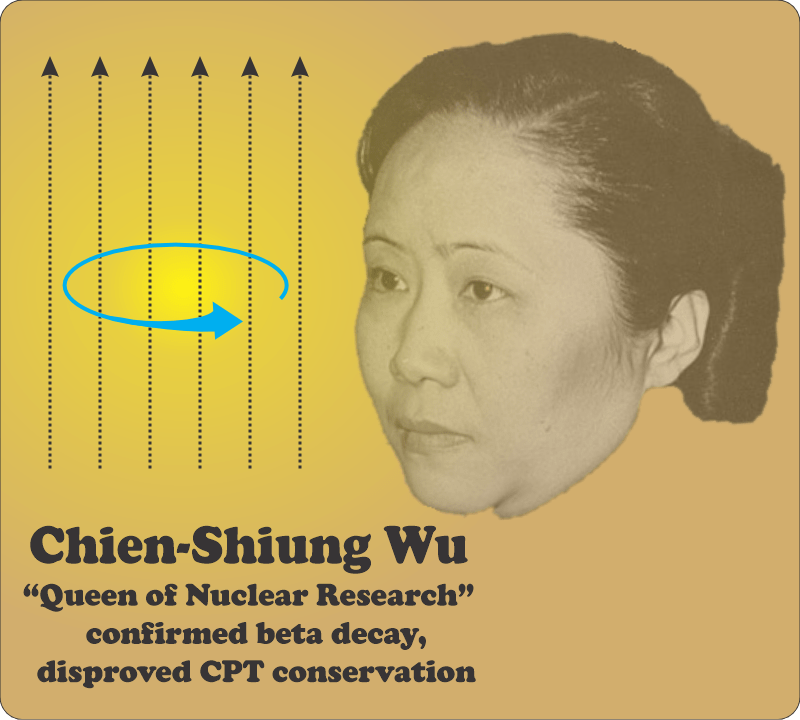
“But Chien‑Shiung Wu did an experiment that showed the nuclear weak force doesn’t always obey CPT rules. Her worked proved we live in a handed Universe. She should have gotten a Nobel for that, but it was last century and the Nobel Committee was men‑only. Two theory guys copped the prize that should have gone to the three of them. The theory guys protested but the Committee ignored Wu anyway. Sometimes things aren’t fair.”

“Tell me about it. So the theory’s got a loophole?”

“Apparently, but to my knowledge no‐one’s found it. Some string theories claim to hint at an explanation but that’s not much help, considering.”

“Huh. Could the loophole maybe be an example of symmetry breaking?”

“Very good question. I think it’s a qualified probably but that’s a guess.”

“Sy, I think that’s the wishy-washiest you’ve ever been.”

“One of my rules is, when you’re going out on a limb be sure you’re properly roped to the tree. In this case I’m generalizing from a single sample.”

“You’re gonna tell me, right?”

   Professor Higgs presents
       the Higgs Bozo.

“Just the bare outline because I don’t want to get into the deep weeds. Back in the 1960s Physics was in trouble because the nuclear strong force particles that bind the nucleus together were found to have mass and move slowly. Strong‑force theory at the time said they should be massless and move at lightspeed. The theory depended on part of the potential energy varying with the symmetry of a circle. Then Higgs—”

“The Higgs Boson guy?”

“That’s him. Anyway, he published a three‑page paper showing that those binding particles aren’t controlled solely by the nuclear strong force. Because they have a charge they also engage with the electromagnetic field. Electromagnetism is a lot weaker than the strong force, but it’s strong enough to deform the theory’s circle into an ellipse. Breaking the circular symmetry in effect gives the particles mass and slows them down.”

“So where’s the boson come in? I thought it’s what makes mass for everything.”

“Absolutely not, probably. The protons and neutrons have plenty of mass on their own, thank you very much. It’s only those strong-force particles that gain mass, less than 1% of the nucleus total. But the whole story is a great example of how making a system less symmetrical, even a little bit, can completely change how it operates. We think that’s what drove the Big Bang’s story. The early Universe was so dense and hot it was a perfectly symmetrical quark soup — chaos all the way down. Space expansion opened successive symmetry loopholes that permitted layers of structure formation.”

<looking at hands> “I don’t feel unsymmetrical.”

“Trust me, deep down you are.”

~~ Rich Olcott