<chirp, chirp> I recognize the caller’s number. “Afternoon, Walt. Weren’t you going to trash that phone?”
“Afternoon, Moire. I decided to keep it, just for you.”
“Aww.”
“Don’t get cute. My people have a follow-on question for you. The neutronium chunk that might or might not rearrange our Solar System — how much lead time do we have between when we detect it and when things go sour?”
“So many unknowns. The object’s size, its speed, what signal we’re monitoring, even what you mean by ‘go sour’.”
“Yes, yes, very uncertain. Make some assumptions.”
“Big assignment. I’ll start with size. The smallest neutron star we’ve ever seen is about 1.3 solar masses, but Oppenheimer’s calculations say smaller chunks could be stable. Suppose it’s near the theoretical minimum, say about a quarter of a solar mass, maybe 20‑25 kilometers in diameter.”
“A whole neutron star’s about that diameter. This chunk would be a small cast‑off.”
“No, the cast‑off could be wider than its parent. It’s only a fraction of the star’s mass, so there’d be less gravity squeezing its component particles together. Anyway, it’s a reasonable size for calculating the telescopic detection limit.”
“Walk me through that.”
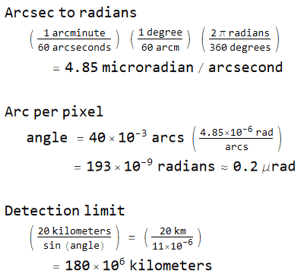
“Sure. Our sharpest telescopes, the Hubble and the Webb, both use detectors that span about about 40 milliarcseconds per pixel‑width.”
” ‘Milli-‘ I get; that’s one one‑thousandth. ‘Arcseconds’?”
“Works like a clock. Sixty arcseconds to an arcminute, sixty arcminutes to a degree. While I’m at it, 360 degrees is full circle is 2π radians. Put it all together, one of those pixels covers about 0.2 microradian across the sky. Now visualize a triangle. One side spans the chunk; the angle opposite it is at Hubble’s detector.”
“A long, pointy triangle.”
“Pointy enough that the angle in radians is essentially equal to its sine and we can do trigonometry. Your question boils down to, how close does the chunk have to be so its light spans a Hubble pixel?” <keyboard clatter> “You’re not going to like this. A 20‑kilometer object casting a one‑pixel figure can’t be more than 180 million kilometers away. That’s already well inside the Solar System, closer to us than the Asteroid Belt. Just a one‑pixel ‘image,’ not a portrait, from our best telescope for visible light.”
“How about another part of the spectrum?”
“I wouldn’t bet on it. The chunk probably radiated X‑rays early on, but it’s had millions of years in interstellar space to cool off.”
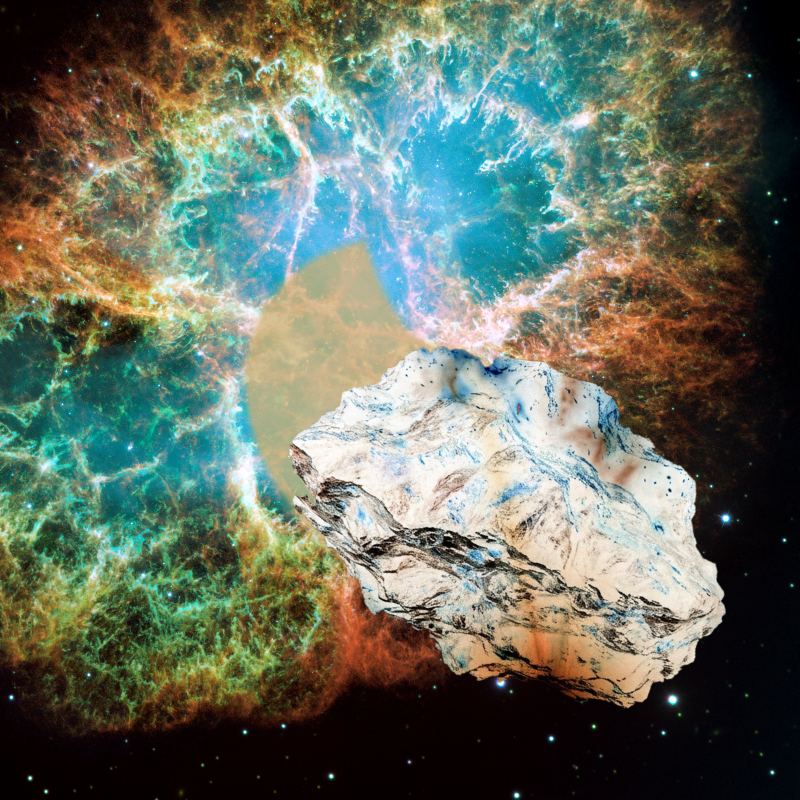
“How is it millions? The Crab Nebula hosts a neutron star and its supernova looks pretty random to me. The Nebula could have flung a chunk at us and it’s only 6500 lightyears away.”
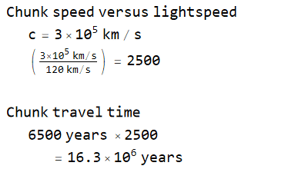
“The fastest interstellar traveler we’ve seen so far is 3I/Atlas, got here from who knows where with a base velocity of 58 kilometers per second. I’ll give you a factor of two — say the Crab flung your chunk at 120 km/sec. That’s still 2500 times slower than lightspeed. At that rate it’d take 16 million years to arrive here. The Crab supernova’s light got here only 970‑some years ago so no chance for an IR‑bright Crab chunk any time soon.”
“Neutrinos?”
“The IceCube Neutrino Observatory detects a million cosmic‑ray muons for every neutrino it sees. Tough odds.”
“Telescopic surveillance isn’t an option. Observing neutrinos is a crapshoot. How about gravitational messing with planet orbits?”
“Something subtler would appear first. Imagine a spherical shell where the inward pull of the Sun’s gravity just equals the outward pull of everything outside.”
“That’d be the outer edge of the Oort Cloud.”
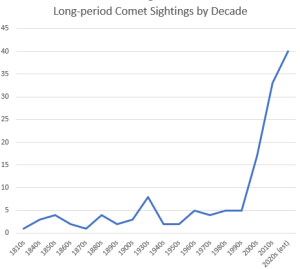
“Pretty much. The chunk will carry its own gravity sphere. Where the two spheres intersect, the opposing gravity fields fight. Some Oort objects fly outward, many drop inward to become long‑period comets. The chunk‑detection signal would be a drastic rise in long‑period comet sightings. Typical long‑period comets take hundreds of years to get down to where we can see them. Nonetheless, we’ve had an upward spike recently.”
“Because of improved technology?”
“Or improved financing. Congress is interested in finding Earth‑threatening asteroids. Look for asteroids, maybe find comets.”
“Lead time in centuries, opening bell may have rung. Bye”
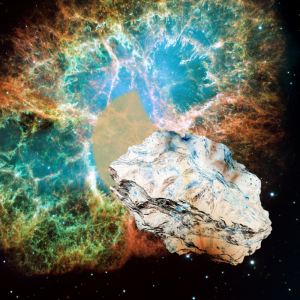
being expelled from the Crab Nebula.
~ Rich Olcott

