Walt is not amused. ” ‘Not likely but probably’ — what kind of answer is that, Moire? You going for Pratchett’s ‘million-to-one chances crop up nine times out of ten’?”
“You asked me two questions, I gave you two answers. I won’t even bill you for one of them.”
“You know my opinion about lagniappes. We’ll pay for both, but only if we get value.”
“Your first question was, could a nova have flung a chunk of neutronium that’ll hit our Solar System?” <starts tapping on Old Reliable’s screen> “I assume your people are worried about protecting Earth.”
“I neither confirm nor deny that assumption.”
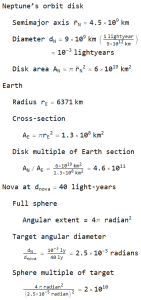
“Either way, by geometry alone the likelihood’s negligible. All our System’s planets and most of the satellites and asteroids and comets are within a few degrees of the Plane of the Ecliptic. Think of everything from Neptune’s orbit inward as a thin flat disk. From above, Earth’s cross‑section area is almost a trillionth of the disk’s area. Suppose your nova is 10 times as far away as our nearest star. Worst case is the nova hanging directly above the Ecliptic. Our disk would be a circular patch in the nova’s sky. If the nova throws a neutronium chunk, it can choose randomly from 20 billion patches the same size as ours; Earth is only a trillionth of one of them. Best case is the nova’s located edge-on to our disk; the odds of a hit would be far smaller. A neutronium chunk striking Earth is a framazillion times less likely than a hit from one of our own near‑Earth asteroids.”
“‘Framazillion.’ I’m going to quote you on that.”
“No extra charge. Now for your second question, whether we could detect a neutronium interloper. Yes, if we’re looking in the right direction with the right detectors.”
“Needs a full-sky survey, obviously, because we have no clue where it’s coming from. What kind of detectors? It’s got to be warmer than empty space. Infrared?”
“Mm-hm. The chunk’s free electrons would shine with black‑body radiation.at all wavelengths but IR’s your best choice.”
“Free electrons? I thought the thing was made of neutrons.”
“Sorry, that’s pop‑sci simplification. The neutrons in a neutronium object are stabilized by gravitational compression, but the gravity field tapers off near the surface. Deep inside you’ve got neutron soup, possibly superfluid, but the particles further up aren’t crowded quite as tightly and have ways of freezing up. There’s a slushy lower crust of nuclear pasta, then an atomic upper crust of iron and its transition‑metal relatives plus some hydrogen and helium. Finally there’s a free‑electron ‘atmosphere’.”
“Wait — nuclear pasta?”
“Technical term, believe it or not. Liquid water and ice make a slush, right, one ingredient occurring in two phases. Water has about 20 different phases—”
“Ice-nine, in Vonnegut’s book.”
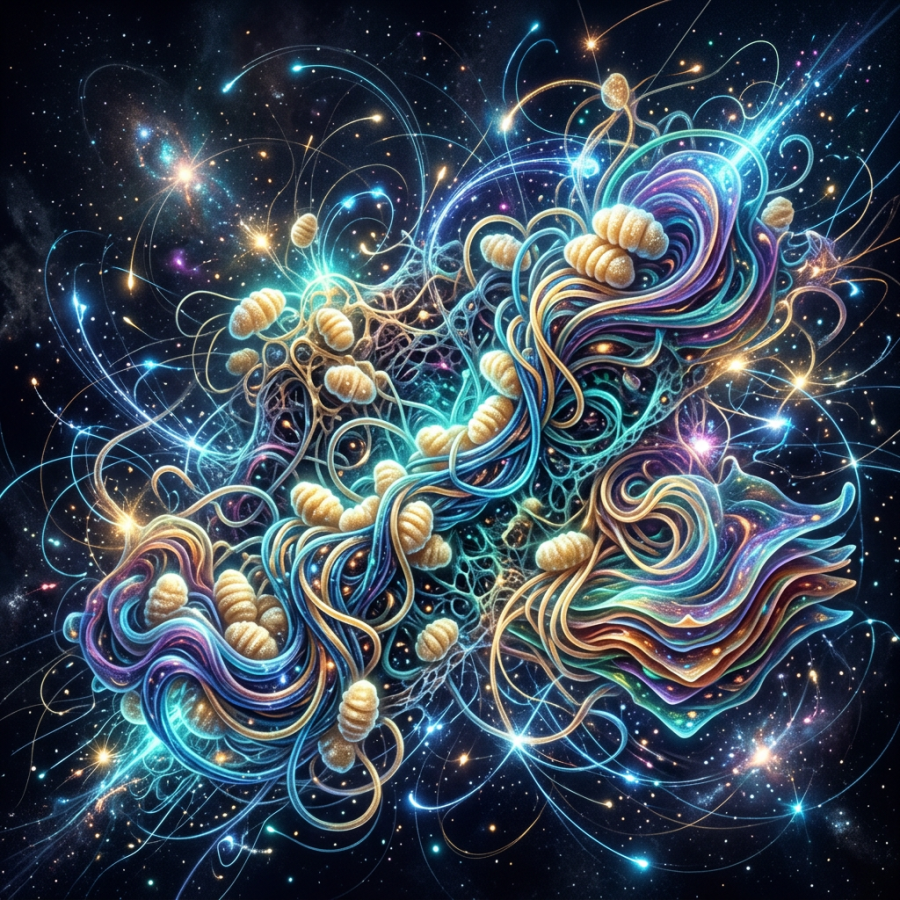
“That’s a plot device, I’m talking real ice here. You get different ices at different temperatures and pressures because the microscopic‑level components re‑arrange. We think neutronium does the same. Near the top of a neutron star’s lower crust, the pressure’s low enough that neutrons and protons can clump together as monster nuclei with a high neutron/proton ratio. Theorists depict them as ‘gnocci‘ (or ‘meatballs’) floating in the uncrystallized neutron phase. Down below where the pressure’s higher, the gnocci phase breaks up to form long thin strands of ‘spaghetti.’ Even further down you get sheets of ‘lasagna’ and so on. Physicists can have fun, too. Anyway, IR detectors would be best because the star’s gravity field redshifts UV and visible black‑body emissions to longer wavelengths. But your problem is, that’s not neutronium‑specific.”
“Right, any warm rock would emit IR. Is there something else?”
“Yes, there is, and we already have the right observatories in place and operating.”
“What do they detect?”
“Neutrinos, the lightest particles we know of, about a millionth the mass of an electron. Every time a proton absorbs an electron and converts to a neutron, neutrinos are emitted. That happens a lot in neutronium; a chunk of it ought to be a bright neutrino source. We’ve got a dozen neutrino telescopes in operation all over the world. If they spot something, you’ll hear about it.”
“Bye.”
“Don’t mention it.”
~ Rich Olcott

