He grabs his cane and makes to leave my office. “Wait, Walt, you’ve missed my point.”
“That your red‑dot long‑term comets are an illusion? I got that.”
“No, the illusion is that they signal something moving toward our Solar System. You’ve dismissed those comets as an eddy in the Oort Cloud. Buy why is there an eddy at all?”
“Why wouldn’t there be?”
“Entropy. The Solar System’s been around 4.5 billion years, plenty of time for small‑body positions to average out. Look at Saturn’s rings. A moon or something broke up maybe a hundred million years ago and now billions of particles orbit the same plane making perfect circles. The only disruptions are gravitational perturbations from shepherd moons embedded in the same plane. Averaging implies smooth distribution everywhere on the Oort Cloud’s spherical shells. The red‑dot comets break that model.”
He lets go of his cane and settles back in his chair. “You’ve got something better than that illusion?”
I cast a chart from Old Reliable to my wall screen. “Ooh, yeah, but it’ll take some background. We started with the hypothesis that something—”
“A chunk of neutronium.”
“The effect I’m seeing is too small for even a minimal chunk of that stuff. Something heavy, but not that heavy. Anyway, if there is something plowing through the Oort Cloud and tossing long‑period comets at the Sun, it won’t disrupt the whole Cloud. Gravity’s force falls off with the distance squared. Distances are huge that far out. Any effects would be local. A comet’s aphelion is where it’s farthest away from the Sun and potentially closest to the interloper if there is one. Localized aphelion weirdness would be an interloper beacon. I gathered published orbit data on 149 long‑period comets.”
“The ones in that all‑sky map you showed me.”
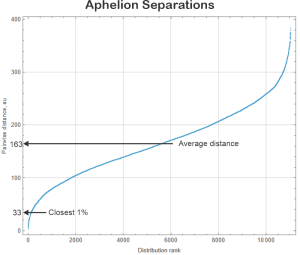
“Those plus the ones reported from 1950 back to 1900. I asked Old Reliable to calculate the separation between each comet’s aphelion and the corresponding points for all of its 148 cousins, and do that for every comet in the list. Sorting the numbers from smallest to largest gave me this plot.”
“A lot of work.”
“Indeed, 11026 pairs. The average distance was 163 astronomical units.”
“Is that a lot?”
“Depends what you compare it to. Neptune’s orbit is 60 au wide. The Voyager 1 spacecraft’s one‑lightday milestone is 173 au out from the Sun. So yeah, I’d say 163 au is a long walk. But some aphelions are a lot closer together than that. I picked out comet pairs in the bottom 1%, distances less than 33 au. Within that set, I asked for the comets who had multiple close neighbors.”
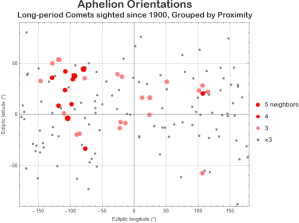
“You looked for clumps.”
“Exactly. Old Reliable found a group where every member had four or five close companions. Ten comets all falling out of the same patch of sky. Imagine my excitement when I checked this sky map.”
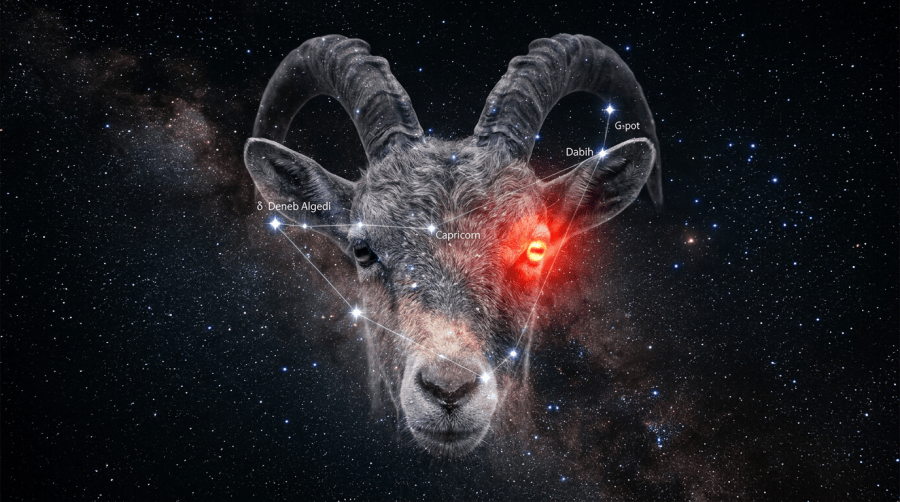
“Right in your Capricorn patch. Did a little happy dance, I’ll bet.”
“No, I just grinned very broadly. But it gets better. Here’s a map of that group in x‑y‑z coordinates.”
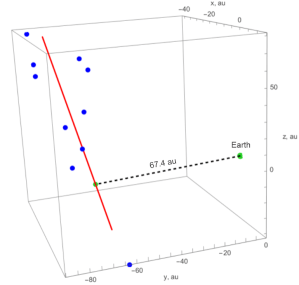
“That red line threading the points. It says that at the worst, your heavy object gets no closer to us than Neptune. Mmm, is the line a timeline? Which way is it headed?”
“No, the red line is definitely NOT a timeline. It’s pure geometry, the best straight line u through those ten points in x‑y‑z space. A standard process called Principal Component Analysis is designed to optimize lines through points. Basically, the process adjusts a line’s position and tilt to minimize perpendicular point‑to‑line distance summed over all the points. Completely space‑based; time has nothing to do with it. However….”
“All right, let the other shoe drop.”
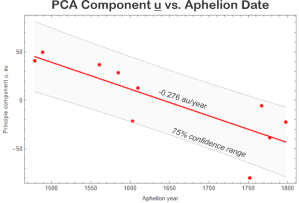
“Line u correlates pretty well with the successive dates when each comet was at its aphelion. Here’s where the aphelions lie along u, plotted against the year each comet was there. Apparently, something heavy is diving ¼ au per year almost straight south through the inner Oort Cloud. Not Pluto — wrong vector, wrong distance, wrong part of the sky, but maybe about that size. Pretty cool, huh?”
He grabs his cane again. “Bye.”
~ Rich Olcott