Little Strings And Big Ones

It’ll be another hot day so I’m walking the park early. No geese in the lake — they’ve either flown north or else they’re attacking a farmer’s alfalfa field. A familiar voice shatters the quiet. “Wait up, Moire, I got questions.”

“Good morning, Mr Feder. First question, but please pick up your pace, I want to get back to the air conditioning.”

“I thought string theory was about little teeny stuff but this guy said about cosmic strings. How can they be teeny and cosmic?”

“They can’t. Totally different things, probably. Next question.”

“C’mon, Moire, that wasn’t even an answer, just opened up a bunch more questions.”

“It’s a tangled path but the track mostly started in the late 18th Century. Joseph Fourier derived the equation for how heat progresses along a uniform metal bar. Turned out the equation’s general solution was the sum of an infinite series of sine waves.”

“Sign waves? Like a protest rally?”

“Haha. No, s‑i‑n‑e, a mathematical function where something regularly and smoothly deviates about some central value. Anyhow, mathematicians soon realized that Fourier’s cute trick for his heat equation could be applied to equations for everything from sound waves to signal processing to pretty much all of Physics. Economics, even. Any time you use the word ‘frequency‘ you owe something to Fourier.”

“If he ain’t got it in writing from the Patent Office, I ain’t paying nothing.”

“It’s not the kind of thing you can patent, and besides, he lived in France and died almost two centuries ago. Be generous with your gratitude, at least. Let’s move on. Fourier’s Big Idea was already <ahem> in the air early in the 20th Century when Bohr and the Physics gang were looking at atoms. No surprise, they extended the notion to describe how electronic charge worked in there.”

“I’m waiting for the strings.”

“The key is that an atom’s a confined system like a guitar string that only vibrates between the bridge and whatever fret you’re pressing on. Sound waves traveling in open space can have any wavelength, but if you pluck a confined guitar string the only wavelengths you can excite are whole number multiples of its active length. No funny fractions like π/73 of the length no matter how hard or soft you pluck the string. Atoms work the same way — charge is confined around the nucleus so only certain wave sizes and shapes are allowed.”

“You said ‘strings.’ We getting somewhere finally?”

“Closing in on it. String theory strings aren’t just teeny. If your body were suddenly made as large as the Observable Universe, string theory is about what might happen inside a box a billion times smaller than your size now.”

“Really tight quarters, got it, so only certain vibrations are allowed.”

“Mm-hm, except it’s not really vibration, it would be something that acts mathematically like vibration. Go back to your guitar string. Plucking gives it up‑down motion, strumming moves it side‑to‑side. Two degrees of freedom. The math says whatever’s going on in a string theory box needs 8 or 11 or maybe 25 degrees of freedom, depending on the theory. At the box‑size scale if there’s structure at all it looks nothing like a string.”

“Then how about the big cosmic strings? What’s confining them?”

“Nothing, and I mean that literally. If they exist they’re bounded by different flavors of empty space. It goes back to what we think happened right after the Big Bang during rapid space expansion. Whatever forces drove the process were probably limited by lightspeed. Local acceleration in one region wouldn’t immediately affect events in regions lightyears away. Nearly adjacent parts of the Universe could have been evolving at very different rates. Have you ever watched the whirlpools that form when a fast‑moving stream of water meets a slower‑moving one?”

“Fort Lee had a storm‑sewer pipe that let into the Hudson River. You got crazy whirlpools there after a hard rain.”

“Whirlpools are one kind of topological defect. They die away in water because friction dissipates the angular momentum. Hiding behind a whole stack of ifs and maybes, some theorists think collisions between differently‑evolving spacetime structures might generate long‑lived defects like cosmic strings or sheets.”

~~ Rich Olcott
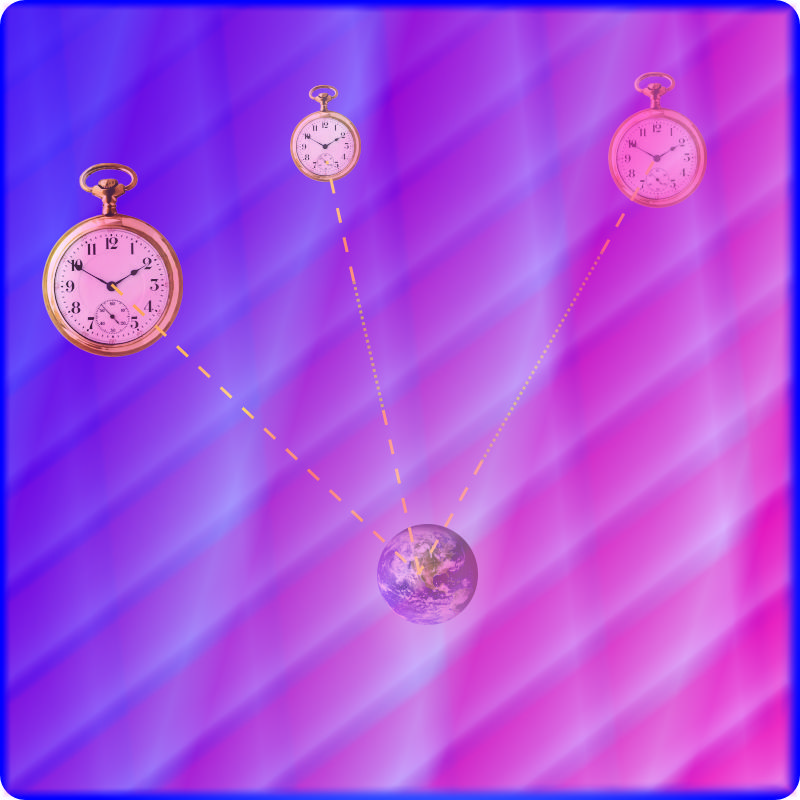
White Noise And Red

“That point’s kinda weak, Sy. The NANOGrav team says 15 years of pulsar timing data let them hear the Universe humming. What’s the difference if they call it a hum or a rumble or a warble?”

“Not much, Vinnie. Matter of taste and scale, I guess. As a human I think of a ‘hum‘ as something in the auditory range, roughly 60‑120 cycles per second. Whatever these folks have found, it rumbles in years per cycle. Scaled to the Sun’s ten‑billion‑year lifetime I suppose that’d be a supersonic screech.”

“Whatever they’ve found? We don’t know?”

“Not yet, Al. The team likes one hypothesis but it’ll take years to collect enough data for firm support or refutation.”

“In addition to the 15 years‑worth they’ve got already? Why not just add more antennas?”

“What they’re following changes so slowly they need a long baseline to have confidence that jiggles they see are real. Part of this paper is about conclusions the team reached after they stuck a few extra years of old data onto the front of their time series.”

“You can do that?”

“Sure. The series is just a big database, like a spreadsheet with a page for each pulsar and a row on that page for each blink. The row captures the recorded time for the blink’s peak, but also a bunch of other data like measures related to pulse width and asymmetry, the corrected peak time, identifiers for the reporting observatory and reference time standard—”

Corrected time? Looks suspicious. What did they correct for?”

“Of course you’re suspicious, Vinnie, but so are they and so are other astronomers. You don’t want to make a big announcement like this unless you’ve checked everything for error sources. For instance, Earth moving around the Sun means we’re a little closer to a particular pulsar at one time of year, further away six months later.”

“So you correct the timings to what they’d be at the Sun’s center, right?”

“That’s just for starters. Jupiter and the Sun orbit around their common center of gravity on an 11.8‑year cycle. The researchers had to pull data from the Juno mission to correct for the Sun’s personal waltz. Of course the Solar System is moving relative to the stellar background, another correction. Then maybe the pulsar itself is part of a binary, happens a lot, and it’s probably moving through the sky, too — lots of careful corrections. That’s step one.”

“Then what?”

“Use each pulsar’s corrected timings to build a mathematical model of its idealized behavior. Once you know what’s ‘normal‘, you can start talking about jiggles that deviate from normal.”

“Reminds me of the ephemeris trick — sort of build an artificial pulsar to compare against.”

“Exactly the same idea, Vinnie, and by the way, ephemerides are still used but not to define the length of a second. Step three is statistical analysis: compare all possible deviation histories, every pulsar against every other pulsar.”

“Sounds like a lot of work, even for a computer. So what did they find?”

“Well, what they observed was that the pulsar timings we received weren’t as absolutely regular as they would have been with a static gravitational field. The overall picture resembled fog in a noisy room, waves of every size skittering in every direction and messing up reception. When the researchers broke that picture down by frequency, the waves shorter than 21 months or so added up to just white noise, complete randomness.”

“A hiss, not a hum. What about the longer waves?”

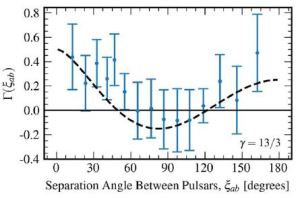
Fig 1(c) from Agazie, el al (2023).

“Red noise — jiggles heavy‑loaded on longer wavelengths out to the 16‑year maximum their data’s good for so far. But that’s not all. When they plotted jiggle correlation between pulsars separated at different angles across the sky, the curve mostly matched a prediction for the gravitational wave pattern that would be generated by a large number of randomly distributed independent sources.”

“Lots of sources, which would be…?”

“We don’t know. One hypothesis is that they’re pairs of supermassive black holes orbiting each other at the centers of merged galaxies. But I’ve read another paper giving a dozen other explanations. Everyone’s waiting for more data.”

~~ Rich Olcott

Not A Hum, A Rumble

Vinnie taps on the magazine. “Sy, you’ve done it again. We ask you one question, you spend a lot of time talking about something else entire. They got this article here” <tap> “says the NANOGrav team captured the hum of the Universe. Al and me, we ask you about that and you get us discussing pulsars. Seems to me,” <tap tap> “that if you got a pulsar and the pulses got only a 3% duty cycle they’d sound more like clicks and,” <taptaptaptap> “if it’s a 10 millisecond pulsar that’s a hundred per second and they’d be more like a low‑pitched buzz, nothing like a hum.”

“One more short detour, Vinnie, sorry. Remember when we discussed the VLA, the Very Large Array of radio telescopes in northern New Mexico?”

“Sorta. I do remember visiting the place, out in the desert miles away from anywhere. They’ve got a couple dozen dish antennas each as wide as a four‑lane road, all spread out along railroad tracks. Big dishes for catching weak signals I understand, but I forget why there’s lots of dishes instead of one huge one or how that even works.”

“One reason is simple mechanics. A huge dish would try to sail away in the desert wind. VLA admins even have to safe‑mount those 25‑meter ones when things get gusty. But the real reason goes to how the array works as one big instrument. Here’s a hint — the dishes can be miles apart and lightspeed isn’t infinite.”

“Ah, that joggled my memory. It’s about when a signal comes in from some nova or something, each dish registers it with a slightly different arrival time and then the computers play match‑up games with all the time differences to figure exactly what angle the signal came from, right?”

“Roughly. The VLA’s multi‑dish design is about being able to resolve signal sources that are close together in the sky so yeah, slightly different angles. The Event Horizon Telescope team used the same strategy and a collection of radio dishes all over the world to produce those orange‑ring images of supermassive black holes. NANOGrav and the other Pulsar Timing Arrays sort of the flip the strategy.”

“At last we get to NANOGrav. Wait, they use lots of antennas to send signals to a star?”

“Nothing like that, Al. No, they use just a few antennas but they track the timing of many pulsars. About 70 at last count.”

“But we know what the timing is, to nanoseconds you said.”

“One word, Vinnie. ‘Frames‘.”

“Aw geez, Sy. Again?”

“Mm-hm. In the pulsar’s frame, it’s majestically rotating at a steady pace, tens or hundreds of times per second relative to its neighbors. Its beam proudly announces its presence on an absolutely regular schedule save for a small but steady slow‑down. In our frame, though, things can happen to a pulse as it heads our way.”

“Like what?”

“It might pass through a molecular cloud. We know those exist. Photons in the right wavelength ranges could interact with cloud components. That’d delay them, stretch the pulse, might even create interference between successive pulses. On the theory side, some cosmologists think the Universe may hold objects like cosmic strings or curvature‑induced domain walls that could delay, deflect or otherwise mess up a pulse. The best possibility, though, is that a gravitational wave could cross the path of a pulse en route to us.”

“Why is that a good thing?”

“Because they’d interact to alter that pulse’s timing. Gravitational waves stretch and squeeze time as they squeeze and stretch space. If a wave crosses a traveling pulse, the pulse will get here either early or late depending. Better yet, if we track enough pulsars scattered across the sky we might even see a parade of offset timings as the wave encounters different pulse beams. Hasn’t happened yet, though. The NANOGrav reports so far are about the background variation as waves from everywhere traverse the paths we’re watching.”

“The article says a hum.”

“Hum sounds come in waves per second. The gravitational background happens in waves per decade, such a low frequency even elephants couldn’t hear it.”

“OK, it’s rumble, not a hum. But why either one?”

~~ Rich Olcott

Inspecting A Pulsar

“C’mon, Sy, LIGO detects those black hole collisions by tracking how its mirrors move when a gravitational wave passes by. How can NANOGrav detect those waves from pulsar twinkles?”

“Not twinkles, Vinnie, definitely not twinkles. Astronomers hate twinkles. That shifting, wavering light we find so charming messes up the precise measurements they want to make. We didn’t get really good astrometry and light curves until we lifted observatories into orbit where atmospheric turbulence can’t distort the starlight. Fortunately there’s less twinkling at longer wavelengths down in the radio range. When a grad student named Jocelyn Bell discovered pulsars glinting in the radio range half a century ago everyone panicked.”

“What’s so scary about stars acting funny? They’re a long way away.”

“True, but it was how they acted funny. The glints were so regular that everyone first thought they were man‑made signals and probably from Russia or one of their allies. This was back in the 1960s, during the Cold War, a decade after Sputnik and right after the Cuban Missile Crisis. Lots of paranoia. But then Bell and her thesis adviser found that the first two signals were definitely coming from two different but consistent points up in the sky and that ruled out Earth‑centered sources.”

“Aliens?”

“Yeah, that was one of the hypotheses. In fact, the researchers even called the first source LGM‑1 for ‘Little Green Men.'”

“HAW!”

“Hey, astronomers make jokes, too. But when they found the second source that idea pretty much went away except that the conspiracy crowd still loves it.”

“What do the signals look like?”

“Just the question I’d expect from a telescope hobbyist like you, Al. They look like flashes from an airport beacon — nothing, then a blink then more nothing until another blink. Typically the blink intervals for different sources range between milliseconds and tens of seconds. Early researchers determined that each star’s blinks are regular to well within a millisecond which was the best we could do for accurate timing back then. Until we got really good laser clock tech, the pulsars were the steadiest timepieces we knew of.”

“What’s a blink look like?”

“That was a critical question. Bell had to scan literally miles of high‑speed strip‑chart paper to get a good handle on it. In general the plots of signal strength against time were triangles, about 40 milliseconds wide at half‑height. Bell’s first pulsar’s triangles used 3% of her strip‑chart recorder’s output, which meant that 97% of the paper was wasted space but research works that way sometimes.”

“Couldn’t be something with a bright side and a dark side, then, or you’d get half and half.”

“Exactly, Vinnie. The pulsar’s shiny spot must be a small fraction of its circumference. Another number from Bell’s charts gave us an additional clue to the spot’s size. LGM-1 blinks every 1.3373 seconds, regular as clockwork. That’s about a million times faster than the Sun spins, but suppose LGM-1 is a star about the Sun’s size. If the spot’s at the star’s equator, it’d have to be moving eleven times faster than light.”

“Not likely.”

“Mm-hm. So this pulsar and all the others that blink at anything near that rate must be made of collapsed matter, probably a neutron star.”

“Wait, why can’t it be something smaller like a shiny planet or something?”

“Gyroscopes, Al. The heavier the spinner, the better it maintains a constant spin. Earth’s pretty big, by our standards, but we need to adjust civil time by a leap second every few years to match our planet’s speed‑ups and slow‑downs. These guys don’t do that, they just slow a few nanoseconds or less per year. Rapid rotation says that pulsars must have small geometry but nanosecond regularity says they must have enormous mass. Neutron stars meet both qualifications because they pack a solar mass into the volume of a small planet.”

“Okay, but why do they spin so fast?”

Angular momentum, Vinnie, radius times speed — always conserved, right? Say a star with a month‑long rotational period collapses. Its radius shrinks about a million‑fold. Every atom in that collapsing star now runs a tighter travel radius and must speed up to compensate. The whole star spins up.”

~~ Rich Olcott

LIGO And NANOGrav

Afternoon coffee time, but Al’s place is a little noisier than usual. “Hey, Sy, come here and settle this.”

“Settle what, Al? Hi, Vinnie.”

<waves magazine> “This NANOGrav thing, they claim it’s a brand‑new kind of gravity wave. What’s that about?”

“Does it really say, ‘gravity wave‘? Let me see that. … <sigh> Press release journalism at its finest. ‘Gravity waves’ and ‘gravitational waves’ are two entirely different things.”

“I kinda remember you wrote about that, but it was so long ago I forget how they’re different.”

“Gravity waves happen in a fluid, like air or the ocean. Some disturbance, like a heat spike or an underwater landslide, pushes part of the fluid upward relative to a center of gravity. Gravity acts to pull that part down again but in the meantime the fluid’s own internal forces spread the initial up‑shift outwards. Adjacent fluid segments pull each other up and down and that’s a gravity wave. The whole process keeps going until friction dissipates the energy.”

“Gravitational waves don’t do that?”

“No, because gravitational waves temporarily modify the shape of space itself. The center doesn’t go up and down, it…” <showing a file on Old Reliable> “Here, see for yourself what happens. It’s called quadrupolar distortion. Mind you, the effects are tiny percentagewise which is why the LIGO apparatus had to be built kilometer‑scale in order to measure sub‑femtometer variations. The LIGO engineers took serious precautions to prevent gravity waves from masquerading as gravitational waves.”

“Alright, so now we’ve almost got used to LIGO machines catching these waves from colliding black holes and such. How are NANOGrav waves different?”

“Is infrared light different from visible light?”

“The Hubble sees visible but the Webb sees infrared.”

“Figures you’d have that cold, Al. What I think Sy’s getting at is they’re both electromagnetic even though we only see one of them. You’re gonna say the same for these new gravitational waves, right, Sy?”

“Got it in one, Vinnie. There’s only one electromagnetic field in the Universe but lots of waves running through it. Visible light is about moving charge between energy levels in atoms or molecules which is how the visual proteins in our eyes pick it up. Infrared can’t excite electrons. It can only waggle molecule parts which is why we feel it as heat. Same way, there’s only one gravitational field but lots of waves running through it. The LIGO devices are tuned to pick up drastic changes like the <ahem> massive energy release from a black hole collision.”

“You said ‘tuned‘. Gravitational waves got frequencies?”

“Sure. And just like light, high frequencies reflect high‑energy processes. LIGO detects waves in the kilohertz range, thousands of peaks per second. NANOGrav’s detection range is sub‑nanohertz, where one cycle can take years to complete. Amazingly low energy.”

“How can they detect anything that slow?”

“With really good clocks and a great deal of patience. The new reports are based on fifteen years of data, half a billion seconds counted out in nanoseconds.”

“Hey, wait a minute. LIGO’s only half‑a‑dozen years old. Where’d they get the extra data from, the future?”

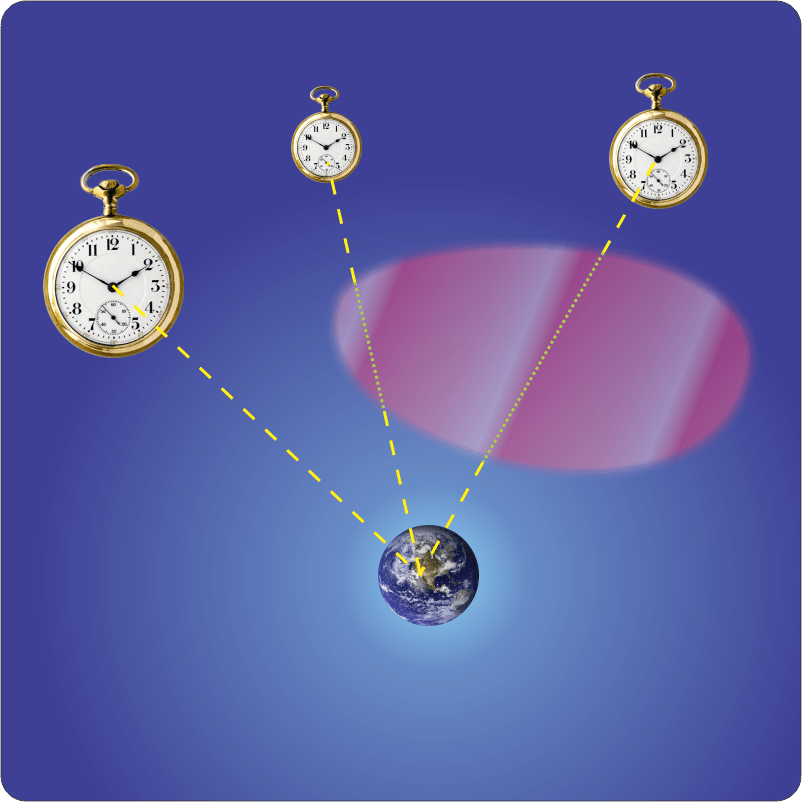
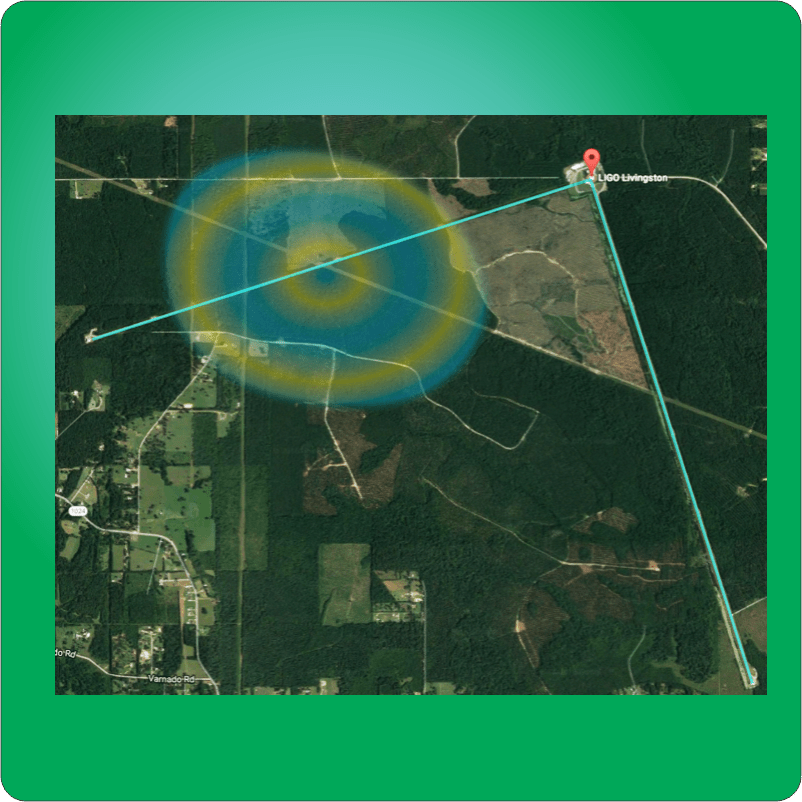
“Of course not. Do you remember us working out how LIGO works? The center sends out a laser pulse along two perpendicular arms, then compares the two travel times when the pulse is reflected back. Light’s distance‑per‑time is constant, right? When a passing gravitational wave squeezes space along one arm, the pulse in that arm completes its round trip faster. The two times don’t match any more and everyone gets excited.”

“Sounds familiar.”

“Good. NANOGrav also uses a timing‑based strategy, but it depends on pulsars instead of lasers. Before you ask, a pulsar is a rotating neutron star that blasts a beam of electromagnetic radiation. What makes it a pulsar is that the beam points away from the rotation axis. We only catch a pulse when the beam points straight at us like a lighthouse or airport beacon. Radio and X‑ray observatories have been watching these beasts for half a century but it’s only in the past 15 years that our clocks have gotten good enough to register timing hiccups when a gravitational wave passes between us and a pulsar.”

~ Rich Olcott

Y2K plus 25 plus 2½

Mike reminded me of the task we took on mid‑year in 1997, 27½ years ago. If I recall correctly, that’s when the IT department we worked for got serious about New Year’s Day 2000.

This was an outgrowth of our disaster preparedness project. Some context: large corporation, HQ and most of the manufacturing in New Jersey, the rest in Memphis. The good news: the IT center was in Memphis where I lived. The bad news: Memphis is on the eastern edge of Tornado Alley’s range from Oklahoma across central Arkansas. Most of the twisters seem to dodge north or south around the city, but you never know.

True story — The Memphis plant had an Uninterruptible Power Supply (UPS) facility housed in a separate structure behind the computer room. The UPS held a ton of lead‑acid batteries and power conditioning equipment, plus an automated diesel generator outside. One thunderstormy afternoon a lightning bolt took out the power line to the building. Everything went dark. The UPS kicked in within milliseconds and our IT equipment kept running just fine — until a second lightning bolt took out the generator. The utility’s linemen, bless ’em, had us powered back up a few hours later and just minutes before Management’s deadline for declaring a disaster.

“Declare a disaster” means you kick over to your spare copy “in The Cloud,” right? Not in those days. The Cloud (which really is market‑ese for “somebody else’s computer”) isn’t a viable operation without telecomm speeds a hundred times faster than the comm lines we had in the 1990s. Back then Disaster Recovery (DR) was a multi-step process:

  • Backup your essential programs and data onto tape
  • Truck the tapes to a secure distant storage vault
  • When/if a disaster is declared, move operations to an offsite DR center that offers comparable IT facilities (computers, data storage, network connections, etc.)
    • Truck the tapes to the DR center. People, too, if necessary.
    • Read the tapes onto DR center storage.
    • Pray that your backups in fact had all the stuff you need and that the data’s sufficiently up‑to‑date for business requirements.

Clunky, huh? But the process gave us practice in cloning our systems and thinking about risks. That’s where our Y2K prep started.

The real “Y2K problem” wasn’t the 2‑digit‑year design flaw, it was the impossibility of doing reliable date logic or calculations when the dates in question might be in either century. Did “X” happen before or after a deadline? No way to know when “12” is all you’ve got to work with. Fixing the problem was a multi‑prong challenge:

  • Revise the data structure to hold a four‑digit year.
  • Revise the stored data with the right four‑digit year numbers.
  • Revise the programs that handle the data but…
  • Don’t break the programs that you revise.

Most of the program updates weren’t particularly challenging, it’s just that there were so many of them. Some enterprises knew their own software well enough that they did that work in‑house. Others shipped the work overseas, a tremendous boon to India’s fledgling software industry. Still others said, “Our competitive advantage is our product line and marketing team, not our home‑grown programs. We’ll convert to an industry‑standard replacement even though we’ll have to change how we’ve been doing business.”

Whichever strategy was chosen, the devil was in the testing. No way could new code or data structures be checked out with live data on our production system.

We needed a testbed, a sandbox, “System 2K,” whatever you want to call it, that was isolated from the live systems we made our money from. It had to have no‑leaks portals for programmer access, code revisions and artificial test‑case data. Most importantly, its system clock had to be adjustable to any future date.

That’s where my team came in. Using what we’d learned from our DR practice runs, we cloned our running system and bolted on some tricksy infrastructure. Don’t ask about technical details, that’s a quarter‑century ago and I don’t remember them.

But I’m proud to say that New Year’s Day 2000 was boring.

~ Rich Olcott

  • Thanks to Mike Newsom, whose comment inspired this post, and to Bob, Susie, Ralph, Tom, Doug, Mick, Don, Roy and the rest of the project team.

The Big Skip?

Suddenly Vinnie gets a grin all over his face. “Tell me something, Cathleen. Suppose I’m a pilot in a shuttle craft like in Star Trek. Tell me how conditions change as I dive down into Jupiter.”

“Hmm .. okay. Mind you, it’ll be a dangerous flight. You’ll fly through an atmosphere that’s mostly molecular hydrogen which is notorious for sneaking into metallic materials and weakening them. I recommend investing in a Starfleet‑grade force shield to keep the atmosphere completely away from your hull. While you’re in the stratosphere high above the cloud decks you’ll see a deep blue sky pretty much the same as Earth’s stratosphere. Try to avoid the thin gray clouds in the upper troposphere — their greasy hydrocarbons will fog your windshield. You want to stick to clear air as much as possible so dodge around the white ammonia‑ice zones. You can drop a couple hundred kilometers more before you hit the top of a brownish ammonium sulfides band.”

“Once I’m that deep there’s clear air underneath the white deck, right?”

“We just don’t know. Unlikely, but if you do want to fly beneath a zone you’ll have to traverse the jetstream separating it from your band. Pick the pole‑ward zone — jetstreams on that side seem to host fewer thunderstorms. Strap in for the jump, because the jetstreams sustain windspeeds 2‑3 times what we get in a Category 5 hurricane. Things’ll get muddier when you drop beneath the brown clouds.”

“Brown as mud, uh-huh.”

“No, I mean literal mud, maybe. First there’s a water‑ice layer and below that there may be a layer of clay‑ish or silicate droplets which may include water of crystallization. I like to visualize clouds of opal, but of course there’d be no sunlight to see them by. A bit lower and you’ll fly through helium rain. Get past all that and you’re about 20% of the way down, about two Earth diameters.”

“That’s where I bump into something?”

“No, that’s the transition zone where heat and pressure convert molecular H₂ into a metallic fluid of protons embedded in a conducting ocean of electrons. Sy, how do you suppose that would affect Vinnie’s aerodynamics?”

“Destructively. If his shuttle’s skin doesn’t rupture he’d be floating rather than sinking. Net density of an intact hull and everything inside would be less than the prevailing density outside where protons are crammed together. Even powered descent would be tough.”

“Sy, that’s exactly what my crazy idea needs! Cathleen, when’s your next Crazy Theory seminar?”

“Not until next term, some time in the Fall. C’mon, Vinnie, out with it!”

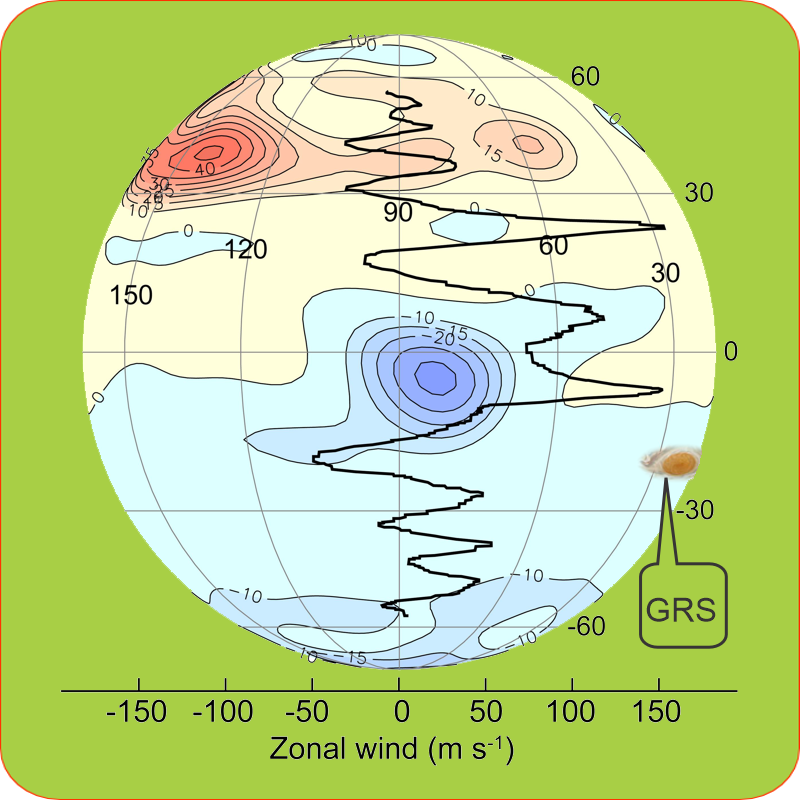
Magnetism and wind map by NASA/JPL-Caltech/SwRI/John E. Connerney. Great Red Spot image added by the author.

“All right. That diagram you showed us with the red and blue spots in Jupiter’s off‑center magnetic field? It got me thinking. You get magnetism from moving charge, right, and they say Earth’s field comes from swirls in the molten iron deep underneath our crust. Jupiter doesn’t have iron so much, but you say it’s got electrons in liquid metallic hydrogen and that oughta be able to swirl, too. Maybe Jupiter has a shallow major swirl on that one side.”

“And just what do you suggest would cause a swirl like that?”

“Al was talking the other day about ‘the grand tack hypothesis‘ where Jupiter waltzed in across the inner Solar System before it waltzed back out and settled down where it’s at. Suppose while it was waltzing it hit a planetoid, maybe the size of Io. The little guy couldn’t sink and wouldn’t stick because metallic hydrogen’s liquid so it’d skip across the surface and shoot away and maybe became a moon. That’d raise a swirl like I’m talking about. See, on the map a line crossing the line between the magnetic red and blue spots could be the skip path.”

<silence>

“Hey, and the Great Red Spot, see how it’s like opposite to where I guess the hit was, that’d be like a through-planet resonance like on Mars where that Hellas meteor strike is opposite the Tharsis Bulge.”

<long pause>

“I dunno, Cathleen, Io’s so weird, do you suppose…”

“I dunno, Sy. Io has that magnetic bridge to Jupiter…”

~ Rich Olcott

Stripes And Solids

“Any other broad-brush Jupiter averages, Cathleen?”

“How about chemistry, Vinnie? Big picture, 84% of Jupiter’s atoms are hydrogen, 16% are helium.”

“Doesn’t leave much room for asteroids and such that fall in.”

“Less than a percent for all other elements. Helium doesn’t do chemistry, so from a distant chemist’s perspective Jupiter and Saturn both look like a dilute hydrogen‑helium solution of every other element. But the solvent’s not a typical laboratory liquid.”

“Hard to think of a gas as a solvent.”

“True, Sy, but chemistry gets strange under high temperatures and pressures.”

“Hey, I always figured Jupiter to be cold ’cause it’s farther from the Sun than us.”

“Good logic, Vinnie, but Jupiter generates its own heat. That’s one reason its weather is different from ours. Earth gets more than 99% of its energy budget from sunlight, especially in the infrared. There’s year‑long solar heating at low latitudes but only half‑years of that near the Poles. The imbalance is behind the temperature disparities that drive our prevailing weather patterns.”

“Jupiter’s not like that?”

“Nope. It gets 30 times less energy from the Sun than Earth does and actually gives off more heat than it receives. Its poles and equator are at virtually the same chilly temperature. There’s a small amount of heat flow from equator to poles, but most of Jupiter’s heat migrates spherically from a 24,000 K fever near its core to its outer layers.”

“What could generate all that heat?”

“Probably several contributors. The dominant one is gravitational potential energy from everything falling inward and banging into everything else. Random rock or atom collisions generate heat. Entropy rules.”

“Sounds reasonable. What’s another?”

“Radioactives. Half of Earth’s internal heating comes from gravity, same mechanism as Jupiter though on a smaller scale. The rest comes from unstable isotopes like uranium, thorium and potassium‑40. Also aluminum‑26, back in the early years, but that’s all gone now. Jupiter undoubtedly ate from the same dinner table. Those fissionable atoms split and release heat whenever they feel like it whether or not they’re collected in one place like in a reactor or bomb. Whatever the origin, Jupiter ferries that heat to the surface and dumps it as infrared radiation.”

“Yeah or else it’d explode or something.”

“Mm-hm. The question is, what are the heat‑carrying channels? They must thread their way through the planet’s structure.”

“It’s just a big ball of gas, how can it have structure?”

“I can help with that, Vinnie. Remember a few years back I wrote about high‑pressure chemistry? Hydrogen gets weird at a million bars‑‑‑”

“Anyone’d get weird after that many bars, Sy.” <heh, heh>

“Ha ha, Vinnie. A bar is pressure equal to one Earth atmosphere. Pressures deep inside Jupiter get into hundreds of megabars. Hydrogen molecules down there are crammed so close together that their electron clouds merge and you have a collection of protons floating in a sea of electron charge. They call it metallic hydrogen, but it’s fluid like mercury, not crystalline. Cathleen, when you refer to Jupiter’s structure you’re thinking layers?”

“That’s right, Sy, but the layers may or may not be arranged like Earth’s crust, mantle, core scheme. A lot of the Juno data is consistent with that — a shell of the atmosphere we see, surrounding a thick layer of increasingly compressed hydrogen‑helium over a core of heavy stuff suspended in metallic hydrogen. About 20% down we think the helium is squeezed out and falls like rain, only to evaporate again at a lower level. The core’s metallic hydrogen may even be solid despite thousand‑degree temperatures — we just don’t know how hydrogen behaves in that regime.”

“What other kind of layering can there be?”

“Experiments have demonstrated that under the right conditions a rapidly spinning fluid can self-organize into a series of concentric rotating cylinders. Maybe Jupiter and the other gas planets follow that model and the stripes show where the cylinders intersect with gravity’s spherical imperative. Coaxial cylinders would account for the equator and poles rotating at different rates. Juno data indicates that Jupiter’s equatorial zone has more ammonia than the rest of its atmosphere. Maybe between‑cylinder winds trap the ammonia and prevent it from mixing with the next deeper cylinder.”

~ Rich Olcott

Red And Blue Enigmas

“All that cloud stuff goes on in Jupiter’s tissue-paper outer layer. What’s the rest of the planet doing, Cathleen?”

“You’re not going to like this, Vinnie, but all we’ve got so far is broad‑brush averages. The Galileo atmosphere probe penetrated less than 0.2% of the way to the center. The good news is that the Juno probe has been sending us oodles of data about Jupiter’s gravity and magnetic fields. That’s great for planet‑wide theorizing, not quite as useful for weather prediction.”

“Can the data explain the Great Red Spot?”

“Well, it ruled out some ideas. Back in the day we thought the Spot was a deep whirlpool opening a view into the interior. Nope. Juno‘s measurements revealed that the Spot is actually a dome rising hundreds of kilometers above the white cloud‑tops. When one window closes, another one opens, I suppose. The fact that the Spot’s a dome says down below there’s an immense energy source lifting the gases above it. We don’t know what it is or why it’s there or how for two centuries it’s mostly held position in a completely fluid environment.”

“Weird. You’d expect something like that at a special location, like at one of the poles, but the Spot isn’t even on the planet’s equator.”

“Right, Sy. Its latitude is 22° south.”

“Hey, that’s the Tropic of Capricorn.”

“Almost, Vinnie, but not relevant. Earth’s two Tropics are at 23½° north and south. If the Earth’s rotational axis were perpendicular to its solar orbit, the Sun’s highest position would always be directly over the Equator. But Earth’s axis is tilted at 23½° to our orbital plane. To see the noon Sun at the zenith you’d have to be 23½° north of the Equator in June, 23½° south of the Equator in December. Jupiter’s rotational axis is tilted, too, but by only 3°. That rules out significant seasonality on Jupiter, but it also says that on Jupiter there’s nothing special about 22° except that it’s where the Spot hangs out.”

“How about longitude?”

“Longitude on Jupiter is an embarrassing topic. Zero longitude on Earth, our Prime Meridian, runs through Greenwich Observatory in London, right? I don’t want to get into the history behind that. On a completely gaseous planet like Jupiter, there’s no stable physical object to tag with a zero. Jupiter’s cloud‑tops rotate faster near its equator than at its poles. Neither rotation syncs with Jupiter’s magnetic field which is like Earth’s except it’s much more intense and it points in the opposite direction. Oh, and it’s offset from the center of the planet and it’s lumpy. For lack of a better alternative, astronomers arbitrarily thumbtacked Jupiter’s Prime Meridian to its magnetic field. They selected the magnetic longitudinal line that pointed directly towards Earth at a particular moment in 1965. Given a good clock and the field’s rate of rotation you can calculate where that line will be at any other time.”

“Sounds like that ephemeris strategy Sy told me about in our elevator adventure. Why’s that embarrassing?”

“Well, back in 1965 the tool of choice for studying Jupiter’s rotating magnetic field was radio spectroscopy. Technology wasn’t as good as we have now and they … didn’t get a completely accurate rate of rotation. We’re stuck with a standard coordinate system where the Prime Meridian slips about 3° every year relative to the magnetic field. Even the Great Red Spot slips a little.”

“Cathleen, I’ve read that Juno uncovered a region of particularly intense magnetic activity they’re calling Jupiter’s Great Blue Spot. Does it have any connection to the Red Spot?”

Magnetism and wind map by NASA/JPL-Caltech/SwRI/John E. Connerney. Great Red Spot image added by the author.

“Probably not, Sy, the Red Spot’s 15° south and 60° east of the Blue. But with Jupiter who knows?”

“Got any other interesting averages?”

“Extreme wind speeds. There’s a jet stream between each pair of Jupiter’s stripes, eastbound on the poleward side of a white zone, westbound in the other side. Look at the zig‑zag graph on this chart. 75 meters/second is 167 miles per hour is a Category 5 hurricane here on Earth. At latitudes near Jupiter’s equator average winds are double that.”

~~ Rich Olcott

Clouds From Both Sides Now

I don’t usually see Vinnie in a pensive mood. Moody, occasionally, but there he is at his usual table by the door, staring at the astronomy poster behind Al’s cash register. “Have a scone, Vinnie. What’s on your mind?”

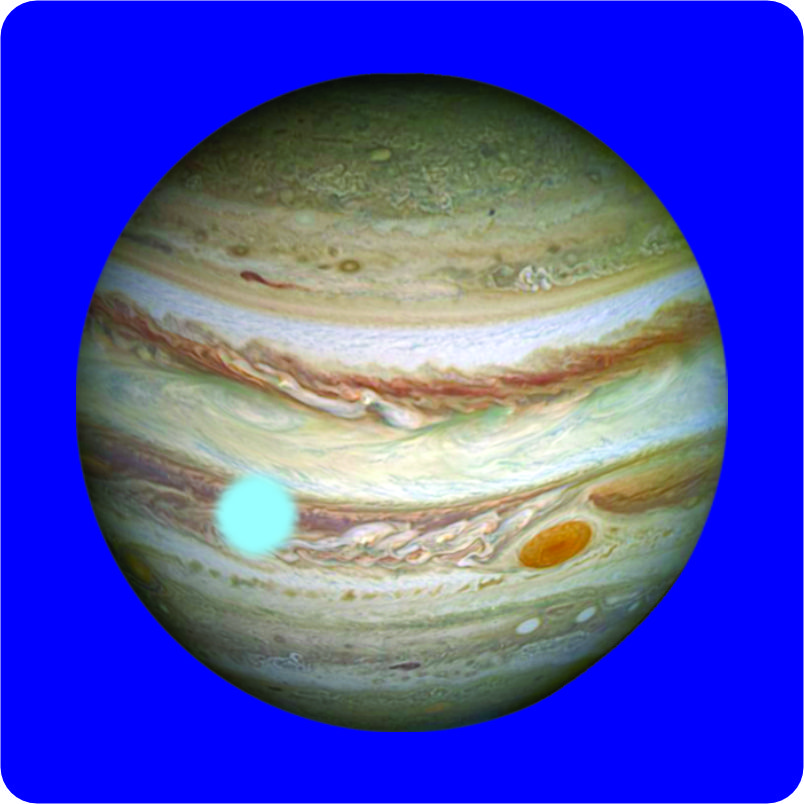
“Thanks, Sy. Welcome back, Cathleen. What’s bugging me is the hard edges on that picture of Jupiter. It looks like those stripes are painted on. Everyone says Jupiter’s not really solid so how come the planet looks so smooth?”

“Cathleen, this is definitely in your astronomer baliwick.”

“I suppose. It’s a matter of scale, Vinnie. The white zones mark updrafts. The whiteness is clouds that rise a couple hundred kilometers above a brownish lower layer. The downdraft belts on either side are transparent enough to let us see the next lower layer. ‘A couple hundred kilometers‘ sounds like a lot, but that’s only a tenth of a percent of Jupiter’s radius. If Jupiter were a foot‑wide ball floating in front of us, the altitude difference would be as thin as a piece of tissue paper. You might be able to feel the ridges and valleys but you’d have a hard time seeing them.”

“But why does the updraft stop so sharp? Is there like a cap on the atmosphere?”

“The clouds stop, but the updrafts don’t. The cloud tops aren’t even close to the top of Jupiter’s atmosphere, any more than Earth clouds reach the top of ours. C’mon, Vinnie, you’re a pilot. Surely you’ve noticed that most thunderheads top out at about the same altitude. Isn’t the sky still blue above them?”

“That’s higher than the planes I fly are cleared for, but I wouldn’t want to get above one anyway. I know a guy who flew over one that was just getting started. He said it’s a bumpy ride but yeah, there’s still kind of a dark blue sky above.”

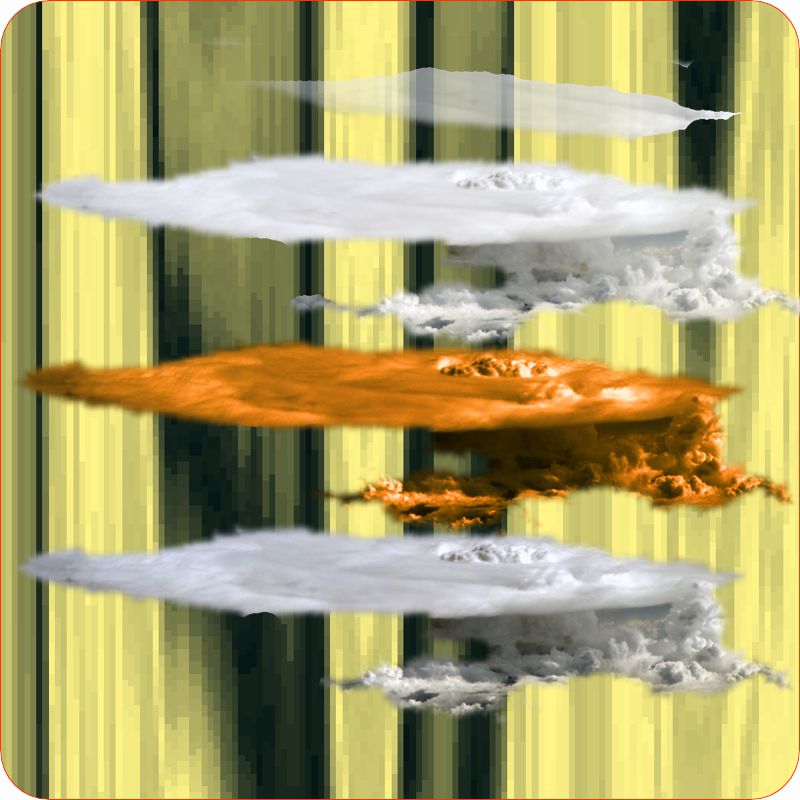
“All of that makes my point — our atmosphere doesn’t stop at the tropospheric boundary where the clouds do. Beyond that you’ve got another 40‑or‑so kilometers of stratosphere. Jupiter’s the same way, clouds go up only partway. For that matter, Jupiter has at least four separate cloud decks.”

“Wait, Cathleen — four? I know how Earth clouds work. Warm humid air rises, expanding and cooling as it goes. When its temperature falls below the dew point or freezing point, its humidity condenses to water droplets or ice crystals and that’s the cloud. I suppose if that same bucketful of air keeps rising far enough the pressure gets so low the water evaporates again and that’s the top of the cloud. How can that happen multiple times?”

“It doesn’t, Sy. In Jupiter’s complicated atmosphere each deck is formed from a different gas. Top layer is a wispy white hydrocarbon fog. The white zone clouds next down are ices of ammonia, which has to get a lot colder than water before it condenses. Water ice probably has a layer much farther down.”

“What’s the brownish layer?”

“There’s one or maybe two of them, each a complex mixture of ammonium ions with various sulfide species. The variety of colors in there make the visible light spectroscopy an opaque muddle.”

“Hey, if the brownish layers block what we can see, how do we even know lower layers are a thing?”

“Good question, Vinnie. Actually, we can do spectroscopy in the middle infrared. That gives us some clues. We’d hoped that the Galileo mission’s deep‑diver probe would sense the lower layers directly but unfortunately it dove into a hot spot where the upwelling heat messes up the layering. Our last resort is modeling. We have an inventory of lab data on thousands of compounds containing the chemical elements we’ve detected on Jupiter. We also have a pretty good temperature‑pressure profile of the atmosphere from the planet’s stratosphere down nearly to the core. Put the two together and we can paint a broad‑brush picture of what compounds should be stable in what physical state at every altitude.”

“Those ‘broad‑brush‘ and ‘should‘ weasel‑words say you’re working with averages like Einstein didn’t like with quantum mechanics. Those vertical winds mix things up pretty good, I’ll bet.”

“Fair objection, Vinnie, but we do what we can.”

~~ Rich Olcott