A Diamond in The Sky with Lucy

Mid-afternoon coffee-and-scone time. As I step into his coffee shop Al’s quizzing Cathleen about something in one of his Astronomy magazines. “This Lucy space mission they just sent up, how come it looks like they’re shooting at either side of Jupiter instead of hitting it straight-on? And it’s got this crazy butterfly orbit that crosses the whole Solar System a couple of times. What sense does that make?”

Planned path of Lucy‘s mission to study Trojan asteroids (black dots).
After diagrams by NASA and Southwest Research Institute

“It shoots to either side because there’s interesting stuff out there. We think the Solar System started as a whirling disk of dust that gradually clumped together. The gravity from Jupiter’s clump scarfed up the lion’s share of the leftovers after the Sun coalesced. The good news is, not all of Jupiter’s hoard wound up in the planet. Some pieces made it to Jupiter’s orbit but then collected in the Trojan regions ahead and behind it. Looking at that material may teach us about the early Solar System.”

“Way out there? Why not just fall into Jupiter like everything else did?”

I do Physics, I can’t help but cut in. “It’s the many‑body problem in its simplest case, just the Sun, Jupiter and an asteroid in a three‑body interaction—”

Cathleen gives me a look. “Inappropriate physicsplaining, Sy, we’re talking Astronomy here. Al’s magazine is about locating and identifying objects in space. These asteroids happen to cluster in special locations roughly sixty degrees away from Jupiter.”

“But Al’s question was, ‘Why?‘ You told him why we’re sending Lucy to the Trojans, but Physics is why they exist and why that mission map looks so weird.”

“Good point, go ahead. OK with you, Al?”

“Sure.”

I unholster Old Reliable, my tricked‑out tablet, and start sketching on its screen. “OK, orange dot’s Jupiter, yellow dot’s the Sun. Calculating their motion is a two-body problem. Gravity pulls them together but centrifugal force pulls them apart. The forces balance when the two bodies orbit in ellipses around their common center of gravity. Jupiter’s ellipse is nearly a circle but it wobbles because the Sun orbits their center of gravity. Naturally, once Newton solved that problem people turned to the next harder one.”

“That’s where Lucy comes in?”

“Not yet, Al, we’ve still got those Trojan asteroids to account for. Suppose the Jupiter‑Sun system’s gravity captures an asteroid flying in from somewhere. Where will it settle down? Most places, one body dominates the gravitational field so the asteroid orbits that one. But suppose the asteroid finds a point where the two fields are equal.”

“Oh, like halfway between, right?”

“Between, Al, but not halfway.”

“Right, Cathleen. The Sun/Jupiter mass ratio and Newton’s inverse‑square law put the equal‑pull point a lot closer to Jupiter than to the Sun. If the asteroid found that point it would hang around forever or until it got nudged away. That’s Lagrange’s L1 point. There are two other balance points along the Sun‑Jupiter line. L2 is beyond Jupiter where the Sun’s gravity is even weaker. L3 is way on the other side of the Sun, a bit inside Jupiter’s orbit.”

“Hey, so those 60° points on the orbit, those are two more balances because they’re each the same distance from Jupiter and the Sun, right?”

“There you go, Al. L4 leads Jupiter and L5 runs behind. Lagrange published his 5‑point solution to the three‑body problem in 1762, just 250 years ago. The asteroids found Jupiter’s Trojan regions billions of years earlier.”

“We astronomers call the L4 cluster the Trojan camp and the L5 cluster the Greek camp, but that’s always bothered me. It’d be OK if we called the planet Zeus, but Jupiter’s a Roman god. Roman times were a millennium after classical Greece’s Trojan War so the names are just wrong.”

“I hadn’t thought about that, Cathleen, but you’re right. Anyway, back to Al’s diagram of Lucy’s journey. <activating Old Reliable’s ‘Animate’ function> Sorry, Al, but you’ve been misled. The magazine’s butterfly chart has Jupiter standing still. Here’s a stars-eye view. It’s more like the Trojans will come to Lucy than the reverse.”

~~ Rich Olcott

The Gelato Model

“Eddie, this ginger gelato’s delicious — not too sweet and just the right amount of ginger bite.”

“Glad you like it, Anne.”

On the way down here, Sy was telling me about how so many things in the Universe run on the same mathematics if you look at them with the right coordinate system. Sy, how do you pick ‘the right coordinate system?”

“The same way you pick the right property to serve as a momentum in Newton’s Equation of Motion — physical intuition. You look for things that fit the system. Sometimes that puts you on the road to understanding, sometimes not. Eddie, you keep track of your gelato sales by flavor. How are they doing?”

“Pistachio’s always a good seller, Sy, but ginger has been coming on strong this year.”

“In motion terns, pistachio’s momentum is constant but ginger is gaining momentum, right?”

“S’what I said.”

“Measured in dollars or trayfuls?”

“In batches. I make it all in-house. I’m proud of that. Dollars, too, of course, but that’s just total for all flavors.”

“Batches all the same size?”

“Some are, some not, depending. If I had a bigger machine I could make more but I do what I can.”

“There you go, Anne, each gelato flavor is like a separate degree of freedom. Eddie’s tracked sales since he started so we can take that date as the origin. Measuring change along any degree in either batches or dollars we have perfectly respectable coordinates although the money view of the system is fuzzier. Velocity is batches per unit time, there’s even a speed limit, and ginger has accelerated. Sound familiar?”

“Sounds like you’re setting up a Physics model.”

“Call it gelato trend physics, but I don’t think I can push the analogy much further. The next step would be to define a useful momentum like Newton did with his Law of Motion.”

F=ma? That’s about acceleration, isn’t it?”

“Probably not in Newton’s mind. Back in his day they were arguing about which was conserved, energy or momentum. It was a sloppy argument because no‑one agreed on crisp definitions. People could use words like ‘quantity of motion‘ to refer to energy or momentum or even something else. Finally Newton defined momentum as ‘mass times velocity‘, but first he had to define ‘mass‘ as ‘quantity of matter‘ to distinguish it from weight which he showed is a force that’s indirectly related to mass.”

“So is it energy or momentum that’s conserved?”

“Both, once you’ve got good definitions of them. But my point is, our car culture has trained us to emphasize acceleration. Newton’s thinking centered on momentum and its changes. In modern terms he defined force as momentum change per unit time. I’m trying to think of a force‑momentum pair for Eddie’s gelato. That’s a problem because I can’t identify an analog for inertia.”

“Inertia? What’s that got to do with my gelato?”

“Not much, and that’s the problem. Inertia is resistance to force. Who can resist gelato? If it weren’t for inertia, the smallest touch would be enough to send an object at high speed off to forever. The Universe would be filled with dust because stars and planets would never get the chance to form. But here we are, which I consider a good thing. Where does inertia come from? Newton changed his mind a couple of times. To this day we only have maybe‑answers to that question.”

“You know we want to know, Sy.”

“Einstein’s favorite guess was Mach’s Principle. There’s about a dozen different versions of the basic idea but they boil down to matter interacting with the combined gravitational and electromagnetic fields generated by the entire rest of the Universe.”

“Wow. Wait, the stars are far away and the galaxies are much, much further away. Their fields would be so faint, how can they have any effect at all?”

“You’re right, Anne, field intensity per star does drop with distance squared. But the number of stars goes up with distance cubed. The two trends multiply together so the force trends grow linearly. It’s a big Universe and size matters.”

“So what about my gelato?”

“We’ll need more research, Eddie. Another scoop of ginger, Anne?”

~~ Rich Olcott

Symmetrical Eavesdropping

“Wait, Sy, you’ve made this explanation way more complicated than it has to be. All I asked about was the horrible whirling I’d gotten myself into. The three angular coordinates part would have done for that, but you dragged in degrees of freedom and deep symmetry and even dropped in that bit about ‘if measurable motion is defined.’ Why bother with all that and how can you have unmeasurable motion?”

“Curiosity caught the cat, didn’t it? Let’s head down to Eddie’s and I’ll treat you to a gelato. Your usual scoop of mint, of course, but I recommend combining it with a scoop of ginger to ease your queasy.”

“You’re a hard man to turn down, Sy. Lead on.”

<walking the hall to the elevators> “Have you ever baked a cake, Anne?”

“Hasn’t everyone? My specialty is Crazy Cake — flour, sugar, oil, vinegar, baking soda and a few other things but no eggs.”

“Sounds interesting. Well, consider the path from fixings to cake. You’ve collected the ingredients. Is it a cake yet?”

“Of course not.”

“Ok, you’ve stirred everything together and poured the batter into the pan. Is it a cake yet?”

“Actually, you sift the dry ingredients into the pan, then add the others separately, but I get your point. No, it’s not cake and it won’t be until it’s baked and I’ve topped it with my secret frosting. Some day, Sy, I’ll bake you one.”

<riding the elevator down to 2> “You’re a hard woman to turn down, Anne. I look forward to it. Anyhow, you see the essential difference between flour’s journey to cakehood and our elevator ride down to Eddie’s.”

“Mmm… OK, it’s the discrete versus continuous thing, isn’t it?”

“You’ve got it. Measuring progress along a discrete degree of freedom can be an iffy proposition.”

“How about just going with the recipe’s step number?”

“I’ll bet you use a spoon instead of a cup to get the right amount of baking soda. Is that a separate step from cup‑measuring the other dry ingredients? Sifting one batch or two? Those’d change the step‑number metric and the step-by-step equivalent of momentum. It’s not a trivial question, because Emmy Noether’s symmetry theorem applies only to continuous coordinates.”

“We’re back to her again? I thought—”

The elevator doors open at the second floor. We walk across to Eddie’s, where the tail‑end of the lunch crowd is dawdling over their pizzas. “Hiya folks. You’re a little late, I already shut my oven down.”

“Hi, Eddie, we’re just here for gelato. What’s your pleasure, Anne?”

“On Sy’s recommendation, Eddie, I’ll try a scoop of ginger along with my scoop of mint. Sy, about that symmetry theorem—”

“The same for me, Eddie.”

“Comin’ up. Just find a table, I’ll bring ’em over.”

We do that and he does that. “Here you go, folks, two gelati both the same, all symmetrical.”

“Eddie, you’ve been eavesdropping again!”

“Who, me? Never! Unless it’s somethin’ interesting. So symmetry ain’t just pretty like snowflakes? It’s got theorems?”

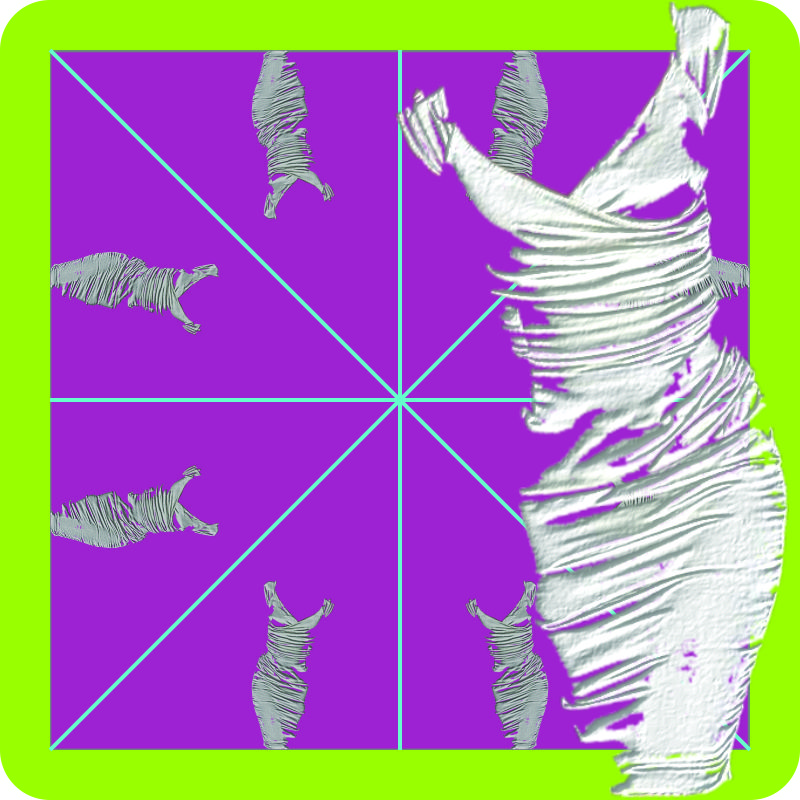
“Absolutely, Eddie. In many ways symmetry appears to be fundamental to how the Universe works. Or we think so, anyway. Here, Anne, have an extra bite of my ginger gelato. For one thing, Eddie, symmetry makes calculations a lot easier. If you know a particular system has the symmetry of a square, for instance, then you can get away with calculating only an eighth of it.”

“You mean a quarter, right, you turn a square four ways.”

“No, eight. It’s done with mirrors. Sy showed me.”

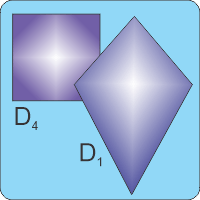
“I’m sure he did, Anne. But Sy, what if it’s not a perfect square? How about if one corner’s pulled out to a kite shape?”

“That’s called a broken symmetry, no surprise. Physicists and engineers handle systems like that with a toolkit of approximations that the mathematicians don’t like. Basically, the idea is to start with some nice neat symmetrical solution then add adjustments, called perturbations, to tweak the solution to something closer to reality. If the kite shape’s not too far away from squareness the adjusted solution can give you some insight onto how the actual thing works.”

“How about if it’s too far?”

“You go looking for a kite‑shaped solution.”

~~ Rich Olcott

Deep Symmetry

“Sy, I can understand mathematicians getting seriously into symmetry. They love patterns and I suppose they’ve even found patterns in the patterns.”

“They have, Anne. There’s a whole field called ‘Group Theory‘ devoted to classifying symmetries and then classifying the classifications. The split between discrete and continuous varieties is just the first step.”

“You say ‘symmetry‘ like it’s a thing rather than a quality.”

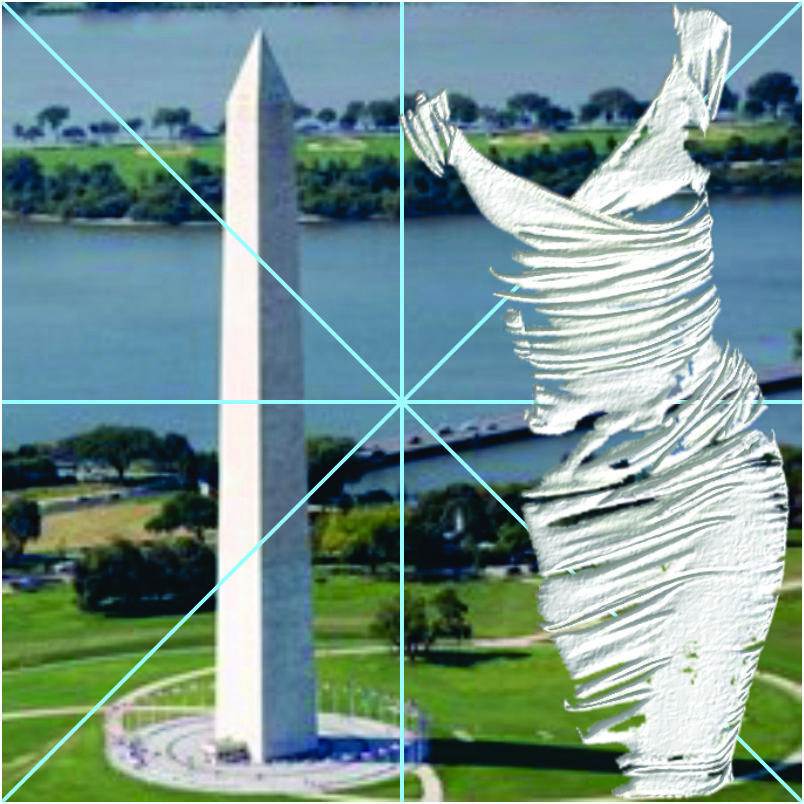
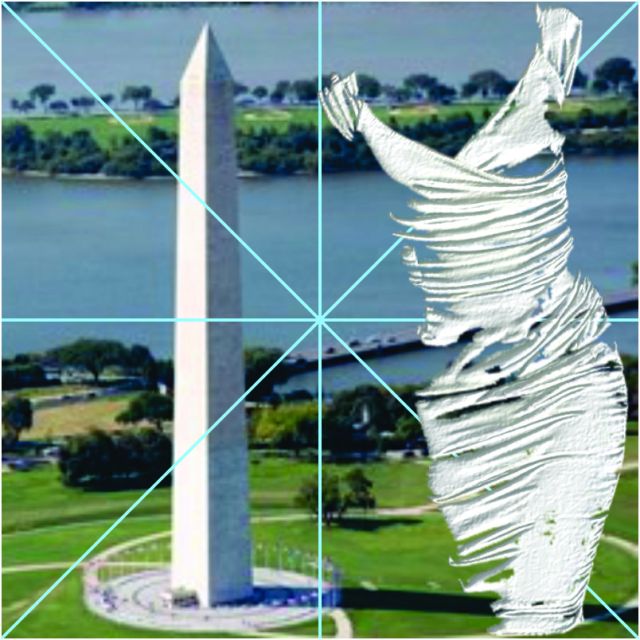
“Nice observation. In this context, it is. Something may be symmetrical, that’s a quality. Or it may be subject to a symmetry operation, say a reflection across its midline. Or it may be subject to a whole collection of operations that match the operations of some other object, say a square. In that case we say our object has the symmetry of a square. It turns out that there’s a limited number of discrete symmetries, few enough that they’ve been given names. Squares, for instance, have D4 symmetry. So do four-leaf clovers and the Washington Monument.”

“OK, the ‘4’ must be in there because you can turn it four times and each time it looks the same. What’s the ‘D‘ about?”

Dihedral, two‑sided, like two appearances on either side of a reflection. That’s opposed to ‘C‘ which comes from ‘Cyclic’ like 1‑2‑3‑4‑1‑2‑3‑4. My lawn sprinkler has C4 symmetry, no mirrors, but add one mirror and bang! you’ve got eight mirrors and D4 symmetry.”

“Eight, not just four?”

“Eight. Two mirrors at 90° generate another one 45° between them. That’s the thing with symmetry operations, they combine and multiply. That’s also why there’s a limited number of symmetries. You think you’ve got a new one but when you work out all the relationships it turns out to be an old one looked at from a different angle. Cubes, for instance — who knew they have a three‑fold rotation axis along each body diagonal, but they do.”

“I guess symmetry can make physics calculations simpler because you only have to do one symmetric piece and then spread the results around. But other than that, why do the physicists care?”

“Actually they don’t care much about most of the discrete symmetries but they care a whole lot about the continuous kind. A century ago, a young German mathematician named Emmy Noether proved that within certain restrictions, every continuous symmetry comes along with a conserved quantity. That proof suddenly tied together a bunch of Physics specialties that had grown up separately — cosmology, relativity, thermodynamics, electromagnetism, optics, classical Newtonian mechanics, fluid mechanics, nuclear physics, even string theory—”

“Very large to very small, I get that, but how can one theory have that range? And what’s a conserved quantity?”

“It’s theorem, not theory, and it capped two centuries of theoretical development. Conserved quantities are properties that don’t change while a system evolves from one state to another. Newton’s First Law of Motion was about linear momentum as a conserved quantity. His Second Law, F=ma, connected force with momentum change, letting us understand how a straight‑line system evolves with time. F=ma was our first Equation of Motion. It was a short step from there to rotational motion where we found a second conserved quantity, angular momentum, and an Equation of Motion that had exactly the same form as Newton’s first one, once you converted from linear to angular coordinates.”

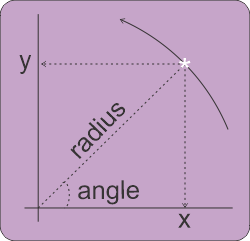
“Converting from x-y to radius-angle, I take it.”

“Exactly, Anne, with torque serving as F. That generalization was the first of many as physicists learned how to choose the right generalized coordinates for a given system and an appropriate property to serve as the momentum. The amazing thing was that so many phenomena follow very similar Equations of Motion — at a fundamental level, photons and galaxies obey the same mathematics. Different details but the same form, like a snowflake rotated by 60 degrees.”

“Ooo, lovely, a really deep symmetry!”

“Mm-hm, and that’s where Noether came in. She showed that for a large class of important systems, smooth continuous symmetry along some coordinate necessarily entails a conserved quantity. Space‑shift symmetry implies conservation of momentum, time‑shift symmetry implies conservation of energy, other symmetries lock in a collection of subatomic quantities.”

“Symmetry explains a lot, mm-hm.”

~~ Rich Olcott

Edged Things and Smooth Things

Yeughh, Sy, that whirling, the entire Universe spinning around me in every direction at once.”

“Well, you were at a point of spherical symmetry, Anne.”

“There’s that word ‘symmetryagain. Right side matches left side, what else is there to say?”

“A whole lot, especially after the mathematicians and physicists started playing with the basic notion.”

“Which is?”

“Being able to execute a transformation without making a relevant difference.”

“Relevant?”

“To the context. Swapping the king of spades for the king of hearts would be relevant in some card games but not others, right? If it doesn’t affect the play or the scoring, swapping those two when no‑one’s looking would be a legitimate symmetry operation. Spin a snowflake 60° and it looks the same unless you care exactly where each molecule is. That’s rotational symmetry, but there’s lots of geometric symmetry operations — reflections, inversions, glides, translations—”

“Translation is a symmetry operation?”

“In this connection, ‘translation‘ means movement or swapping between two different places in space. The idea came from crystals. Think of a 3D checkerboard, except the borderlines aren’t necessarily perpendicular. Perfect crystals are like that. Every cube‑ish cell contains essentially the same arrangement of atoms. In principle you could swap the contents of any two cells without making a difference in any of the crystal’s measurable properties. That’d be a translation symmetry operation.”

“Glides make me think of ice skating.”

“The glide operation makes me think of a chess knight’s move — a translation plus a reflection across the translation path. Think of wet footprints crossing a dry floor. That’s one example of combining operations to create additional symmetries. You can execute 48 unique symmetry operations on a cube even without the translation‑related ones. In my grad school’s crystallography class they taught us about point group and wallpaper and space group symmetries. It blew me away — beautiful in both mathematical and artistic senses. You’ve seen M C Escher’s art?”

“Of course, I love it. I pushed into his studio once to watch him work but he spotted me and shouted something Dutch at me. I’ve wondered what he thought when I pushed out of there.”

“His pieces drew heavily on geometric symmetries. So did Baroque art, music and architecture.”

“Music? Oh, yes — they had motifs and whole sections you could swap, and rhythm patterns and tunes you could read forwards and backwards like in a mirror… We’ve come a long way from snowflake symmetry, haven’t we?”

“We’re just getting started. Here’s where the Physics folks generalized the idea. Your unfortunate experience in space is right on the edge of what most people consider as symmetry. Were you impressed with the cube’s 48 operations?”

“I suppose. I haven’t had time to think about it.”

“A sphere has an infinite number. You could pick any of an infinite number of lines through its center. Each is an axis for an infinite number of rotational symmetries. Times two because there’s an inversion point at the center so the rotation could go in either direction. Then each line is embedded in an infinite number of reflection planes.”

“Goodness, no wonder I was dizzy. But it’s still geometry. What was the edge that the physicists went past?”

“The border between step‑at‑a‑time discrete symmetries and continuous ones. Rotate that snowflake 60° and you’ve got a match; anything not a multiple of 60° won’t pair things up. Across the border, some of the most important results in modern Physics depend on continuous symmetries.”

“How can you even have a continuous symmetry?”

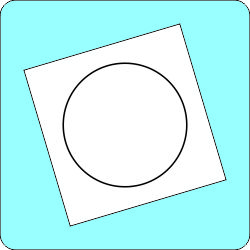
“Here, I’ll draw a circle on this square of paper. I can rotate the square by 90, 180 or 270 degrees and everything’s just the way it was. But if the square’s not relevant because we’re only interested in the circle, then I can rotate the paper by any amount I like and it’s a no‑difference transformation, right?”

“Continuous like on an infinite line but it’s wrapped around.”

“Exactly, and your infinite line is another example — any translation along that line, by a mile or a millimeter, is a perfectly good symmetry operation.”

“Ooo, and time, too. I experience time as an infinite line.”

“So does everyone. but most only travel in one direction.”

~~ Rich Olcott

Three Ways To Get Dizzy

<FZzzzzzzzzzzzzzzzzzzzzzzttt!> “Urk … ulp … I need to sit down, quick.”

“Anne? Welcome back, the couch is over there. Goodness, you do look a little green. Can I get you something to drink?”

“A little cool water might help, thanks.”

“Here. Just sit and breathe. That wasn’t your usual fizzing sound when you visit my office. When you’re ready tell me what happened. Must have been an experience, considering some of your other superpower adventures. Where did you ‘push‘ to this time?”

“Well, you know when I push forward I go into the future and when I push backward I go into the past. When I push up or down I get bigger or smaller. You figured out how pushing sideways kicks me to alternate probabilities. And then <shudder> there was that time I found a new direction to push and almost blew up the Earth.”

“Yes, that was a bad one. I’d think you’ve pretty well used up all the directions, though.”

“Not quite. This time I pushed outwards, the same in every direction.”

“Creative. And what happened?”

“Suddenly I was out in deep space, just tumbling in the blackness. There wasn’t an up or down or anything. I couldn’t even tell how big I was. I could see stars way off in the distance or maybe they were galaxies, but they were spinning all crazy. It took me a minute to realize it was me that was spinning, gyrating in several ways at once. It was scary and nauseating but I finally stopped part of it.”

“Floating in space with nothing to kill your angular momentum … how’d you manage to stabilize yourself at all?”

“Using my push superpower, of course. The biggest push resistance is against the past. I pulled pastward from just my shoulders and that stopped my nose‑diving but I was still whirling and cart‑wheeling. I tried to stop that with my feet but that only slowed me down and I was getting dizzy. My white satin had transformed into a spacesuit and I definitely didn’t want to get sick in there so I came home.”

“How’d you do that?”

“Oh, that was simple, I pulled inward. I had to um, zig‑zag? until I got just the right amount.”

“That explains the odd fizzing. I’m glad you got back. Looks like you’re feeling better now.”

“Mostly. Whew! So, Mr Physicist Sy, help me understand it all. <her voice that sounds like molten silver> Please?”

“Well. Um. There’s a couple of ways to go here. I’ll start with degrees of freedom, okay?”

“Whatever you say.”

“Right. You’re used to thinking in straight‑line terms of front/back, left/right and up/down, which makes sense if you’re on a large mostly‑flat surface like on Earth. In mathspeak each of those lines marks an independent degree of freedom because you can move along it without moving along either of the other two.”

“Like in space where I had those three ways to get dizzy.”

“Yup, three rotations at right angles to each other. Boatmen and pilots call them pitch, roll and yaw. Three angular degrees of freedom. Normal space adds three x-y-z straight‑line degrees, but you wouldn’t have been able to move along those unless you brought along a rocket or something. I guess you didn’t, otherwise you could have controlled that spinning.”

“Why would I have carried a rocket when I didn’t know where I was going? Anyhow, my push‑power can drive my straight‑line motion except I didn’t know where I was and that awful spinning had me discombobulated”

“Frankly, I’m glad I don’t know how you feel. Anyhow, if measurable motion is defined along a degree of freedom the measurement is called a coordinate. Simple graphs have an x-coordinate and a y-coordinate. An origin plus almost any three coordinates makes a coordinate system able to locate any point in space. The Cartesian x-y-z system uses three distances or you can have two distances and an angle, that’s cylindrical coordinates, or two angles and one distance and that’s polar coordinates.”

“Three angles?”

“You don’t know where you are.”

<shudder>
 <shudder>

~~ Rich Olcott

There’s Always An Angle

“No, Moire, when I said the glasses get dark or light depending I was talking about those glasses that just block out shiny, like from windows across the street when the Sun hits ’em just wrong.”

“I got this, Sy. That’s about polarized light, Feder, and polarized sunglasses. Sy and me, we talked about that when we were thinkin’ Star Trek weapons.”

“You guys talk about everything, Vinnie.”

“Pretty much. Anyhow, it goes back to how electrons make light. Electrons got charge and that makes an electric field around them, right? When you jiggle an electron up and down the field jiggles and sooner or later that’ll make some other electron jiggle like maybe in your eye and you see that as light. How’m I doing, Sy?”

“You’re on a roll. Keep it going.”

“Okay, so the electron doesn’t have to jiggle only up and down, it can do side‑to‑side if it feels like it or anything in between and the field goes along with all of that. When you got a lot of electrons doing that together, different‑angle waves go out and that poor second electron gets shoved all around the compass, right?”

“Hey, don’t all those jiggles just cancel each other out?”

“Nah, ’cause their timing’s off. They’re not in sync or nothing so the jiggles push in every direction random‑like.”

“How about lasers? I thought their waves all marched in sync.”

“They’re in sync strong‑and‑weak, but I guess whether they’re up‑and‑down in sync depends on the technology, right, Sy?”

“Right, Vinnie. Simple diode laser beams usually aren’t polarized, but special-purpose lasers may be designed with polarization in the package. Of course, any beam can be polarized if it’s bounced off something at just the right angle.”

“What’s the angle got to do with it, Moire?”

“I bet I know. Sy. Is that bounce angle connected to the prism stuff?”

“Nice shot, Vinnie. Carry on.”

“Ok, Feder, follow me ’cause this is a little complicated. Sy, can I borrow your whiteboard?”

“Sure.”

“Thanks. All right, this thick green wiggle is a regular light ray’s electric field, coming in at a low angle and jiggling in all directions. It hits a window or something, that’s the black line, and some of it gets reflected, that’s the red wiggle, and some gets through but not as much which is why the second green line is skinny. The fast‑slow marks are about wave speeds but it’s why the skinny wiggle runs at that weird angle. We good?”

“Mostly, I guess, but where does the polarization come in?”

“I’m gettin’ there. That’s what the dots are about. I’m gonna pretend that all those different polarization directions boil down to either up‑and‑down, that’s the wiggles, and side to side, that’s the dots. Think of the dots as wiggle coming out and going back in cross‑ways to the up‑and‑down. It’s OK to do that, right, Sy?”

“Done in the best families, Vinnie. Charge on.”

“So anyway, the up‑and‑down field can sink into the window glass and mess around with the atoms in there. They pass some of the energy down through the glass but the rest of it gets gets thrown back out like I show it.”

“But there’s no dots going down.”

“Ah-HAH! The side‑to‑side field doesn’t sink into the glass at all ’cause the atoms ain’t set up right for that. That side‑to‑side energy bounces back out and hits you in the eyes which is why you use those polarizing sunglasses.”

“But how do those glasses work is what I asked to begin with.”

“That’s all I got, Sy, your turn.”

“Nice job, Vinnie. How they cut the glare, Mr Feder, is by blocking only Vinnie’s side‑to‑side waves. Glare is mostly polarized light reflected off of horizontal surfaces like water and roadway. Block that and you’re happy. How they work is by selective absorption. The lenses are made of long, skinny molecules stretched out in parallel and doped with iodine molecules. Iodine’s a big, mushy atom with lots of loosely-held electrons, able to absorb many frequencies but only some polarizations. If a light wave passes by jiggling in the wrong direction, its energy gets slurped. No more glare.”

~~ Rich Olcott

Dark Glasses

My office door THUMPs as Richard Feder barrels in. Vinnie’s half out of his chair with his fists balled up but he settles back down when he sees who it is. “Moire, I gotta question.”

“Afternoon, Mr Feder. What brings you to the 12th floor of the Acme Building?”

“My dentist’s up here. They gave me these really dark glasses for when they aimed a bright light in my mouth to harden something in there so I wondered why’re they so dark an’ what about those glasses that can’t make up their minds?”

“Well, Mr Feder, as usual you’ve asked a jumbled question. Let’s see. The answers all boil down to what light is made of and what the glasses are made of.”

“I thought it was photon particles, Sy. The light, I mean.”

“It is, Vinnie, but photons only act like particles when they’re emitted and when they’re absorbed. In between, they act like waves. Dark glasses are all about photons as waves. The simplest case is the plain dark glasses.”

“Yeah, Moire, simple’s good.”

“They’re black because they’ve been doped with black chemicals. If your glasses are actually made of glass, the manufacturer probably dumped iron and sulfur into the melt. When heated those elements combine to form black iron sulfide particles spread throughout the mass. If the glasses are plastic, the manufacture mixed black dye into the formula. Either way, the more dopant added, the blacker the product and the fewer waves make it through the lens.”

“Great, Sy, but how come the black? I remember that Sun-spectrum poster that Al had up in his shop once. Lotsa sharp dark lines that Cathleen said were from different elements absorbing little slices of that rainbow background. But there were plenty of colors left over to make white.”

“Impressive memory, Vinnie. That was what, three years ago? Anyhow, those absorption lines come from separated atoms floating in the hot gas of the solar atmosphere. Quantum mechanics says that an isolated atom has a characteristic set of electron configurations, each with its own energy level. Say an incoming photon meets a gas atom. If the photon’s energy just matches the difference between the atom’s current configuration and some other configuration, suddenly the atom’s in the new configuration and no more photon. It has to match just right or no absorption. Those sharp lines come from that selectivity, OK?”

“So how do you get total black from selective atoms?”

“You don’t. You get black from less‑selective molecules and larger structures. Atoms right next to each other bring entanglement into the action — which electron is where on which atom? Many more configurations, many more differences between energy level pairs, many more lines that can overlap to make broad absorption bands. Suppose you’ve got some glass or plastic doped to have a single band sucking up everything between orange and green. Shine white light into it. Only red light and blue light come through. We see that as purple, a color that’s not even in the spectrum. Make that band even broader like it is with metals and rocks and iron sulfide; nothing gets through.”

“Then how do they do those glasses that get dark or light depending? The factory can’t put chemicals in but take ’em out temporary‑like when you walk inside.”

“Good point. In fact, the glass composition stays the same, sort of. The factory puts in chemicals that change their structure depending on the light level. If you dope optical glass with silver chloride crystallites, for instance, UV light can energize a chloride’s electron up to where it can leave the chloride and be captured by a silver ion. Do that with enough silver ions in the crystallite and you have a tiny piece of silver metal. Enough pieces and the glass looks gray, at least until heat energy joggles things back to the silver chloride ground state. For plastic lenses they use a subtler strategy — large‑ish molecules with spread‑out electron structures. UV light energizes an electron to another level and the molecule twitches to an opaque alternate form that relaxes when heat shakes it down.”

“Heat, huh? No wonder mine don’t work so good on the beach.”

~~ Rich Olcott

Things That Won’t Work

Vinnie gets a far-away look in his eye. I wait. “Ya know, Sy, there oughtta be a way.”

“A way to what?”

“I ain’t giving up on this faster-than-light communication stuff. I know Einstein said it couldn’t happen because it’d flip cause and effect and he didn’t like that, but that feels too much like philosophy books I’ve read that boil down to, ‘This thing can’t be true because I don’t want it to be.’ Maybe there’s something we ain’t thought of yet.”

“Lots of people have played with that challenge for decades. Do you have any fresh ideas?”

“A couple possibles. Lessee if I’ve got this straight. We’ve got two separate message channels going — one that works instant-like for information between entangled quantum thingies, and one for everything else that’s stuck at lightspeed or less. Suppose I’ve got two entangled pizzas— nah, we’re really talking quantum stuff like electrons and photons so I’ll just say particles. Suppose I’ve got two entangled particles that are some ugly mix of red and green but we know when they’re de-linked they’ll be opposite. I send one to you the regular way but they’re still linked. I look at the one I still got and it’s red, say. The same moment, yours instantly went green but you don’t know that yet until you look or you get status information from me through the not‑instant channel. So the problem is getting information to leak between the two channels, right?”

“That’s about the size of it.”

“OK, try this one. How about I use a magnetic field or something to force mine to red? And maybe a set time later I make it green to confirm I’m in control and it’s a real signal.”

“Sorry, as soon as you manipulate properties in part of an entangled system you break the entanglement and the other part is free to do whatever it wants to. Next?”

“Uhh … time synchronization. How about you and me set a certain time for me to look at mine? You can watch yours and when it flips or not you’ll know.”

“All that does is move the manipulation to the other end of the setup. Me looking at my particle resets yours to whatever color mine isn’t and that breaks the entanglement. Next?”

“Maybe something with a bunch of particles all entangled together? How about—”

“Nup, can’t base a strategy on that. Like everything else quantum, entanglement is statistical. There’s no guarantee that even in our two‑particle system I’ll see green if you see red — the odds are high but not 100%. There’s a proven theorem that says if two particles are ‘maximally entangled,’ adding a third to the system reduces the odds that any two will coordinate their behaviors. A bunch of particles would be even less stable. It’s called the monogamy theorem, care to guess why?”

“Physics fun with metaphors again, cute, but I can see this is a good one. You got anything?”

“Not having to do with entanglement, but I have been playing with a different idea, sort of a blank‑sky approach.”

“You mean blue‑sky.”

“Uh-uh, blank. Think about a sky made of dark matter. Dark matter’s subject to gravity but so far as we know it has absolutely no interaction with electromagnetism of any kind — doesn’t play with electrons, light waves, nothing. Einstein based part of his relativity work on Maxwell’s electromagnetism equations. In fact, that’s where the idea came from that ‘c‘ was the speed limit for the Universe. It was a good idea and there’s a huge amount of evidence that he was right. Everything in our Standard Model except the photon is subject to the Lorentz factor. Both light and gravity acting on normal matter travel at c‑speed. Well, maybe the value of c has something to do with how quarks work. Dark matter doesn’t have quarks. What if dark matter has a different speed limit, maybe a lot higher than c or even no limit at all? Maybe we could exploit that property somehow. How about a dark‑matter telegraph?”

“I’m thinking of my Grampa’s recipe for rabbit stew. ‘First you gotta catch your rabbit,’ he used to say,”

~~ Rich Olcott

The Pizza Connection

“Wait a minute, Sy. If Einstein’s logic proves we can’t have faster‑than‑light communication, what about all the entanglement hype I see in my science magazines?”

“Hype’s the right word, Vinnie. Entanglement’s a real effect, but it doesn’t play well as a communication channel.”

“OK, why not?”

“Let’s set the stage. We’re still in our personal spaceships and we’ve just ordered pizza from Eddie. The entanglement relationship is independent of time and distance so I’m going to skip over how fast we’re going and pretend that Eddie’s using transporter delivery technology, ok?”

“Fine with me,”

“Good. You order your usual double pepperoni with extra cheese, I ask for Italian sausage. Two pizza boxes suddenly appear on our respective mess tables. No reflection on Eddie, but suppose he has a history of getting orders crossed. The quantum formalism says because our orders were filled at the same time and in a single operation, the two boxes are entangled — we don’t know which is which. Before we open the boxes, each of us has a 50:50 shot of getting the right order. It’s like we’ve got a pair of Schrödinger pizzas, half one order and half the other until we look, right?”

“Won’t happen, Eddie’s a pro.”

“True, but stay with me here. I open my box and immediately I know which pizza you received, no matter how far away your ship is from mine. Is that instantaneous communication between us?”

“Of course not, I’m not gonna know which pizza either of us got until I open my own box. Then I’ll know what my meal’s gonna be and I’ll know what you’re having, too. Actually, I’m probably gonna know first because I get hungry sooner than you.”

“Good point. Anyway, entanglement doesn’t transmit human‑scale information. The only communication between us in our spaceships is still limited by Einstein’s rules. But this is a good setup for us to dig a little deeper into the quantum stuff. You rightly rejected the Schrödinger pizza idea because pizza’s human‑scale. One of those boxes definitely holds your pizza or else it definitely holds mine. There’s no in‑between mixtures with human‑scale pizzas. Suppose Eddie sent quantum‑scale nanopizzas, though. Now things get more interesting.”

“Eddie doesn’t mess up orders.”

<sigh> “Even Eddie can’t keep things straight if he sends out a pair of quantum‑scale pizzas. What’s inside a specific entangled box is called a local property. John Stewart Bell proved some statistical criteria for whether a quantum system’s properties are local or are somehow shared among the entangled objects. Scientists have applied his tests to everything from entangled photons up to little squares of diamond. They’ve tracked quantum properties from spin states to vibration modes. A lot of work went into plugging loopholes in Bell’s criteria.”

“What’d they find?”

“The results keep coming up non-local. Our quantum pizzas truly do not have separate characteristics hiding inside their boxes unless Eddie marked a box to destroy the symmetry. All the objects in an entanglement share all the applicable quantum property values until one object gets measured. Instantly, all the entangled objects snap into specific individual property values, like which box holds which pizza. They stop being entangled, too. That happens no matter how far apart they are. Those experimental results absolutely rule out the local‑property idea which was the most appealing version of the ‘underlying reality‘ that Einstein and Bohr argued over.”

“Wait, I can’t tell you anything faster than light, but these quantum thingies automatically do that instant‑like?”

“Annoying, isn’t it? But it’s a sparse form of messaging. My quantum pizza box can tell yours only two things, ‘I’ve been opened‘ and ‘I hold Italian sausage pizza.’ They’re one‑time messages at the quantum level and you as an observer can’t hear either one. Quantum theoreticians call the interaction ‘wave function collapse‘ but Einstein called it ‘spooky action at a distance.’ He hated even that limited amount of instantaneous communication because it goes directly against the first principle of Special Relativity. Relativity has been vigorously tested for over a century. It’s stood up to everything they’ve thrown at it — except for this little mouse nibbling at its base.”

~~ Rich Olcott