

“¡Dios mio! Vera Rubin confirms that galaxies cluster and no-one thinks that’s important?”
“That was in the 1950s, Maria. Her report was just a degree thesis and a minor paper. Her advisor, who should have pushed her case but didn’t, was a cosmologist instead of an observational astronomer. At the time, many considered cosmology to be just barely not metaphysics. What she reported didn’t bear on what the astronomers of the day considered the Big Questions, like how do stars work and is the expansion of the Universe accelerating.”
“That’s political, ¿no?”
“That’s part of how science works — if observations look important, other people work to invalidate them. If results look important, other people work to rebut them. The claims that are validated and can’t be rebutted survive. But the verifiers and rebutters only work on what their colleagues consider to be important. Deciding what’s important is a political process. The history of science is littered with claims that everyone dismissed as unimportant until decades later when they suddenly gained the spotlight. Galaxy clustering is one of those cases. All things considered, I think clustering’s initial obscurity had more to do with the current state of the science than with her being a woman.”
“So how did Vera Rubin react to the nada?”
“She went back to her observing, which is what she was happiest doing anyway. Especially when computers came along and her long-time colleague Kent Ford built a spiffy electronic spectrograph. No more gear-calculating all day for a single number, no more peering down that measuring engine microscope tube. Results came more quickly and she could look at larger assemblies out there in the Universe. Which led to her next breakthrough.”

“Dark matter, yes?”
“No, that came later. This one was about streams.”
“Of water?”
“Of galaxies. At the time, most astronomers thought that galaxy motion was a solved problem. You know about Hubble Flow?”
“No. Is that the streaming?”
“It’s the background for streaming. Hubble Flow is the overall expansion of the Universe, all the galaxies moving away from each other. But it’s not uniform motion. We know, for instance, that the Andromeda and Milky Way galaxies are going to collide in about five billion years. Think of galaxies like gas molecules in an expanding balloon. On the average every molecule gets further away from its neighbors, but if you watched an individual molecule you’d see it bouncing back and forth. Astronomers call that extra movement ‘peculiar motion.'”
“‘Peculiar’ like ‘odd?'”
“It’s an old-fashioned use of the word — ‘peculiar’ like ‘distinctive’ or ‘unique.’ Anyway, the community’s general notion was you could account for galaxy movement as a simple random motion laid on top of the Hubble Flow.”
“Again Occam’s Razor cuts too close?”
“For sure. Rubin and Ford looked at data for almost a hundred distant galaxies all over the sky. Not just any galaxies. They carefully picked a set of one kind of galaxy, known in the trade as ScI, all of which have about the same ratio of absolute brightness to diameter. Measure the diameter, you get the absolute brightness. A distant light appears dimmer as the square of its distance. Measure the brightness we see on Earth, make a few corrections, and the inverse square law lets you calculate how far the galaxy is from here. Then Hubble’s distance-speed law tells you how fast you expect the galaxy to be receding. That’s half of it.”
“OK…?”
“The other half is how fast the galaxies are really moving. For that Rubin and Ford turned to spectroscopy. From the red/blue-shift of each galaxy they had an independent measure of its speed relative to us. Guess what? They didn’t match the Hubble Flow speeds.”
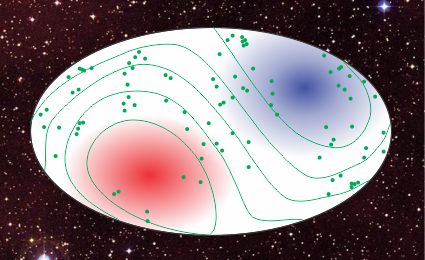
Astronomical Journal 81, 719-37 (1976).
“Faster or slower?”
“Both! In one half the sky these distant galaxies appear to be fleeing faster than the Hubble Flow, and in the other half they’re going slower. The simplest explanation is that our entire Local Group is streaming towards the ‘slowest’ part of the sky. Rubin and company had discovered a large-scale, third kind of galactic motion — rivers of galaxies streaming through the Universe.”
“Did the people get excited?”
“Not for a while, of course.”
~~ Rich Olcott



 “So you’re telling me, Cathleen, that you can tell how hot a star is by
  Cathleen turns to her laptop and starts tapping keys. “Let’s do an example. Suppose we’re looking at a star’s broadband spectrogram. The blackbody curve peaks at 720 picometers. There’s an absorption doublet with just the right relative intensity profile in the near infra-red at 1,060,190 and 1,061,265 picometers. They’re 1,075 picometers apart. In the lab, the sodium doublet’s split by 597 picometers. If the star’s absorption peaks are indeed the sodium doublet then the spectrum has been stretched by a factor of 1075/597=1.80. Working backward, in the star’s frame its blackbody peak must be at 720/1.80=400 picometers, which corresponds to a temperature of about 6,500 K.”


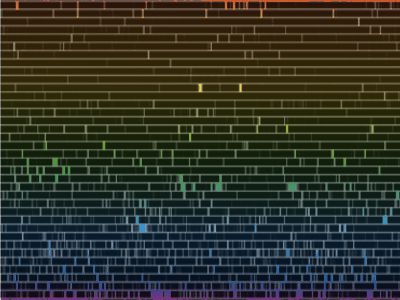 “You’re right, Sy. It’s not a particularly pretty picture, but it shows that nice strong sodium doublet in the yellow and the broad iron and hydrogen lines down in the green and blue. I’ll admit it, Vinnie, this is a faked image I made to show my students what the solar atmosphere would look like if you could turn off the photosphere’s continuous blast of light. The point is that the atoms emit exactly the same sets of colors that they absorb.”
 “Whoa, Sy. Do you read the final chapter of a mystery story before you begin the book?”
 “It is, Sy, and that’s one of the reasons why Hubble’s original number was so far off. He only looked at about 50 close-by galaxies, some of which are moving toward us and some away. You only get a view of the general movement when you look at large numbers of galaxies at long distances. It’s like looking through a window at a snowfall. If you concentrate on individual flakes you often see one flying upward, even though the fall as a whole is downward. Andromeda’s 250,000 mph march towards us is against the general expansion.”


 “Infinite?”


 Hard Science Ain't Hard
