Mushy stuff

“Amanda! Amanda! Amanda!”

“All right, everyone, settle down for our final Crazy Theorist. Jim, you’re up.”

“Thanks, Cathleen. To be honest I’m a little uncomfortable because what I’ve prepared looks like a follow-on to Newt’s idea but we didn’t plan it that way. This is about something I’ve been puzzling over. Like Newt said, black holes have mass, which is what everyone pays attention to, and charge, which is mostly unimportant, and spin. Spin’s what I’ve been pondering. We’ve all got this picture of a perfect black sphere, so how do we know it’s spinning?”

Voice from the back of the room — “Maybe it’s got lumps or something on it.”

“Nope. The No-hair Theorem says the event horizon is mathematically smooth, no distinguishing marks or tattoos. Question, Jeremy?”

“Yessir. Suppose an asteroid or something falls in. Time dilation makes it look like it’s going slower and slower as it gets close to the event horizon, right? Wouldn’t the stuck asteroid be a marker to track the black hole’s rotation?”

“Excellent question.” <Several of Jeremy’s groupies go, “Oooh.”> “Two things to pay attention to here. First, if we can see the asteroid, it’s not yet inside the horizon so it wouldn’t be a direct marker. Beyond that, the hole’s rotation drags nearby spacetime around with it in the ergosphere, that pumpkin‑shaped region surrounding the event horizon except at the rotational poles. As soon as the asteroid penetrates the ergosphere it gets dragged along. From our perspective the asteroid spirals in instead of dropping straight. What with time dilation, if the hole’s spinning fast enough we could even see multiple images of the same asteroid at different levels approaching the horizon.”

Jeremy and all his groupies go, “Oooh.”

“Anyhow, astronomical observation has given us lots of evidence that black holes do spin. I’ve been pondering what’s spinning in there. Most people seem to think that once an object crosses the event horizon it becomes quantum mush. There’d be this great mass of mush spinning like a ball. In fact, that was Schwarzchild’s model for his non-rotating black hole — a simple sphere of incompressible fluid that has the same density throughout, even at the central singularity.”

VBOR — “Boring!”

“Well yeah, but it might be correct, especially if spaghettification and the Firewall act to grind everything down to subatomic particles on the way in. But I got a different idea when I started thinking about what happened to those two black holes that LIGO heard collide in 2015. It just didn’t seem reasonable that both of those objects, each dozens of solar masses in size, would get mushed in the few seconds it took to collide. Question, Vinnie?”

“Yeah, nice talk so far. Hey, Sy and me, we talked a while ago about you can’t have a black hole inside another black hole, right, Sy?”

“That’s not quite what I said, Vinnie. What I proved was that after two black holes collide they can’t both still be black holes inside the big one. That’s different and I don’t think that’s where Jim’s going with this.”

“Right, Mr Moire. I’m not claiming that our two colliders retain their black hole identities. My crazy theory is that each one persists as a high‑density nubbin in an ocean of mush and the nubbins continue to orbit in there as gravity propels them towards the singularity.”

VBOR —”Orbit? Like they just keep that dance going after the collision?”

“Sure. What we can see of their collision is an interaction between the two event horizons and all the external structures. From the outside, we’d see a large part of each object’s mass eternally inbound, locked into the time dilation just above the joined horizon. From the infalling mass perspective, though, the nubbins are still far apart. They collide farther in and farther into the future. The event horizon collision is in their past, and each nubbin still has a lot of angular momentum to stir into the mush. Spin is stirred-up mush.”

Cathleen’s back at the mic. “Well, there you have it. Amanda’s male-pattern baldness theory, Newt’s hyper‑planetary gear, Kareem’s purple snowball or Jim’s mush. Who wins the Ceremonial Broom?”

The claque responds — “Amanda! Amanda! Amanda!”

~ Rich Olcott

A Big Purple Snowball

Cathleen’s back at the mic. “Okay, folks, now for the third speaker in tonight’s Crazy Theory seminar. Kareem, you have the floor.”

“Thanks, Cathleen. Some of you already know I do old‑rock geology. If a rock has a bone in it, I’m not interested. Paleontology to me is like reading this morning’s newspaper. So let me take you back to Precambrian times when Earth may have been purple.”

Kareem’s a quiet guy but he’s got the story‑teller’s gift, probably honed it at field expedition campfires, so we all settle back to listen.

“Four and a half billion years ago, Earth was bright orange. That’s not the color it reflected, that’s the color it glowed. You’ve all seen glass‑blowers at work, how the material gives off a bright orange light coming out of the flame or furnace, soft and ready to be formed. That’s what the planet’s surface was like after its Moon‑birthing collision with Theia. Collisions like that release so much heat that there’s no rocks, just layers of smooth molten glassy slag floating on fluid silicates and nickel‑iron like in a blast furnace. No atmosphere, all the volatiles have been boiled off into space. Got the picture?”

General nodding, especially from maybe‑an‑Art‑major who’s good at pictures.

“Time passes. Heat radiating away cools the world from the outside inward. Now the surface is a thin glassy cap, black like obsidian and basalt, mostly smooth. The cooling contracting cap fractures from the tension while the shrinking interior pulls inward, slow but not gentle. The black glassy surface becomes low craggy mountains and razor‑rubble, sharp enough to slice hiking boots to ribbons. There’s no erosive wind or water yet to round things off. Everything stays sharp‑edged.”

Voice from the back of the room — “Where’s our water from then?”

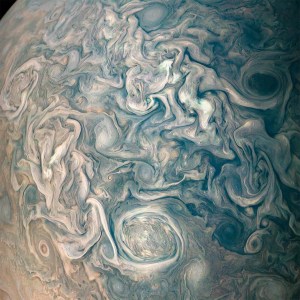
“Good question. Could be buried water that never got the chance to escape past the cap, could be water ferried in on icy comets or worldlets. People argue about it and I’m not taking sides. The planet gets a new color after it cools enough to hold onto water molecules however they got there — but that water doesn’t stay on the surface. Raindrops hitting still‑hot rock hiss back into steamy clouds. If you were on the moon at the time you’d see a white‑and‑grey Earth like Jupiter’s curdled cloud-tops. Visualize a series of million‑year Hurricane Debbies, all over the world.”

He pauses to let that sink in.

“When things finally cool down enough to allow surface water there’s oceans, but they’re not blue. Millions of years of wind and water erosion have ground the sharp rubble to spiky dust. Most of the thrust‑raised mountains, too. Much of the dust is suspended or dissolved in the ocean turning it black. For a while. The dust is loaded with minerals, especially sulfides, very nutritious for a group of not‑quite bacteria called Archaea that eat sulfides using a molecule that’s powered by green light but reflects red and blue. When the Archaea take over, the oceans look magenta from the reflected red and blue.”

Maybe‑an‑Art‑major giggles.

“Next major event, we think, was the Huronian Glaciation, when most or all of the Earth was a solid white because it was covered with ice. Killed off most or the Archaea. When that melted, different parts of the ocean turned black from floating dead Archaea and and then milky turquoise from sulfur particles. Next stage was purple, from a different group of sulfur‑eating purple almost‑bacteria. Then we had snowball whiteness again, which gave green‑reflecting chlorophyll‑users a chance to take over, clear our the sulfur and leave the oceans blue.”

VBOR — “That’s your Crazy Theory?”

“No, that’s mostly mainstream. Question is, what terminated the deepfreezes? Lots of ideas out there — solar dimming and brightening, different combinations of CO2 and methane from volcanoes or bacteria, even meteorites. Anyone remember Ian Malcom’s repeated line in the Jurassic Park movies?”

Everyone — “Life will find a way!”

“Right on. My crazy’s about the two almost‑bacteria. Suppose each kind managed to infiltrate their day’s Great Extinction glaciers. Suppose planet‑wide bacterial purple pigments absorbed sunlight’s energy, melting the ice. Karma, yes?”

~ Rich Olcott

A Great Big Mesh

Cal has my coffee mug filled as soon as I step into his shop. “Get to the back room quick, Sy. Cathleen’s got another Crazy Theories seminar going back there.”

So I do. First thing I hear is Amanda finishing her turn at the mic. “And that’s why humans evolved male pattern baldness.”

A furor of “Amanda! Amanda! Amanda!” then Cathleen regains control. “Thank you, Amanda. Next up — Newt Barnes. What’s your Crazy Theory, Newt?”

“Crazy idea, not a theory, but I like it. Everybody’s heard of black holes, right?”

<general nodding>

“And we’ve all heard that nothing can leave a black hole, not even light.”

<more nodding>

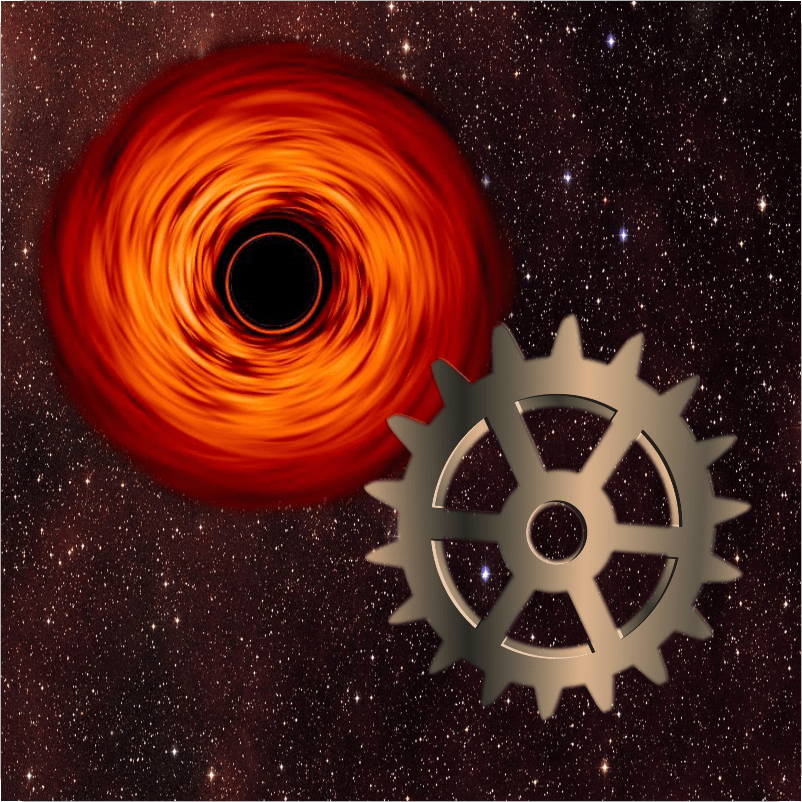
“Well in fact that’s mostly not true. There’s so much confusion about black holes. We’ve known about a black hole’s event horizon and its internal mass since the 1920s. It took years for us to realize that the central mass could wrap a shiny accretion disk around itself, and an ergosphere, and maybe spit out jets. So, close outside the Event Horizon there’s a lot of light‑emitting structure, right?”

<A bit less nodding, but still.>

“Right. So I’ll skip in past a few controversial layers and get down to the famously black event horizon. Why’s it black?”

Voice from the back of the room — “Because photons can’t get out because escape velocity’s faster than lightspeed.”

“That’s the answer I expected, but it’s also one of the confusing parts. You’re right, the horizon marks the level where outward‑bound massy particles can’t escape. The escape velocity equation depends on trading off kinetic and gravitational potential energy. Any particle with mass would have to convert an impossible amount of kinetic energy into gravitational potential energy to get through the barrier. But zero‑mass particles, photons and such, are pure kinetic energy. They aren’t bound by a gravitational potential so escape velocity trade‑offs simply don’t apply. There’s a deeper reason photons also can’t get out.”

VBOR — “So what’s trapping them?”

“Time. It traps photons and any kind of information. The other thing about the Event Horizon is, it’s the level where spacetime is so bent around that the time‑coordinate is just on the verge of pointing inward. Once you’re inside that boundary the cause‑and‑effect arrow of time is against you. Whatever direction you point your flashlight, its beam will emerge in your future and that’s away from the horizon. Trying to send a signal outside would be like sending it into your past, which you can’t do. Nothing gets away from a black hole except…”

“Except?”

“Roger Penrose found a loophole and I may have found another one. There’s something that Wheeler called the No-Hair Theorem. It says that the Event Horizon hides everything inside it except for its mass, electric charge and angular momentum.”

“How do those get out?”

“They don’t get out so much as serve as backdrop for all the drama in the rest of the structure. If you know the mass, for instance, you can calculate its temperature and the Horizon’s diameter and a collection of other properties.”

Cathleen senses a teachable moment and breaks in. “Talk about charge and spin, Newt.”

“I was going there, Cathleen. Kerr and company’s equations take account of both of those. Turns out the attractive forces between opposite charges are so much stronger than gravity that it’s hard for an object in space to build up a significant amount of either kind of charge without getting neutralized almost immediately. Kind of ironic that the Coulomb force, far stronger than gravity, generates net energy contributions that are much smaller than the gravity‑based ones. Spin, though, that’s where the loopholes are. Penrose figured out how particles from the accretion disk could dip into the black hole’s spinning ergosphere, steal some of its energy, and stream up to power the jets.”

VBOR — “What’s your loophole then?”

“Speed contrast between layers. The black hole mass is spinning at a great rate, dragging nearby spacetime and the ergosphere and the accretion disk around with it. But the layers go slower as you move outward. Station a turbine generator like an idler gear between any two layers and you’re pulling power from the black hole’s spin.”

Silence … then, “Amanda! Amanda! Amanda!”

~ Rich Olcott

A.I. and The Ouroboros Effect

The Acme Building Science and Pizza Society is meeting again around the big table near the kitchen in Eddie’s Pizza Place. It’s my deal so I set the next topic. “Artificial Intelligence.” There’s some muttering but play starts.

Cal has first honors. “Not my favorite thing. I hadda change my name ’cause of A.I., f’crying out loud.”

Eddie antes up a chip. “But Cal, your astronomy magazines are loaded with new discoveries that some A.I. made rummaging through godzillabytes of big telescope data. Train an A.I. on a few thousand normal galaxies and then let it chase through the godzillabytes. It says ‘Here’s a weird one‘ and the human team gets to publish papers about a square galaxy or something.”

Susan chips in. “What about all the people who’ve been saved from cancer because an A.I. found bad cells while screening histology images?”

Kareem folds. “Not much A.I. in Geology yet. Our biggest Big Data project these days is whole‑Earth tomography. That uses pretty much all the computer time we can get funds for. A.I.’s Large Language Models soak up all the research money.”

Vinnie raises by a chip. “I use autopilot a lot when I’m flying, but that’s up in the air, Great Circle point‑to‑point and no worries about pedestrian traffic. Autopilot in a car? Not for me, thanks — too many variables and I’ve seen too many crazy situations you couldn’t predict. Black ice in the winter, roadwork and bicyclists the rest of the year — I want to be able to steer and brake when I need to.”

Susan grins. “Are you a stick‑shift purist, Vinnie?”

“Naw, automatic transmissions are okay these days and besides my car uses electric motors and doesn’t even have a transmission. Lots of torque at low revs and that’s the way I like it. What about you, Cathleen? Got any A.I. war stories?”

Cathleen calls Vinnie’s raise. “A few. One thing I’ve learned — chatbots have a limited working memory. I once asked a bot to list Jupiter’s 35 biggest moons in decreasing order of size. It got the first 24 in the right order, then some more moons out of order and two of them were moons of Saturn. So ‘trust but verify‘ like the man said. Sy, you do a lot of writing. What’s your experience?”

I call Cathleen’s raise. “Mixed. I’m a generalist so I have to read a lot of papers or at least be aware of them. Summarizer bots do a decent job on some reports but miss badly when it comes to tying together material that’s not already well organized. Probably comes from that working memory limitation you noticed, Cathleen. The other problem I’ve seen doesn’t apply so much to technical work but it’s a killer for essays and fiction that have anything to do with interactions between people.”

“I’ve seen that, too. No soul.”

“Soul’s the word I’ve been looking for, Kareem. The bots are good at picking up styles and ‘who said what‘ surface material, but they fail completely at emotional subtext, the ‘why‘ that’s the actual thread of a conversation. Subtext is why we read good novels. From what I’ve been seeing recently, it’s not going to get any better.”

“Nothing does, I’m starting to think.”

“C’mon, Cal, your coffee’s improved since the city put in better water pipes. On the other hand, you owe the pot a bet.”

“Sorry. I’m still in, okay?” <sound of chips clinking> “So why’s A.I. not gonna get better? I keep reading how different ones passed tougher tests.”

“Well, that’s the thing. If you’re reading about it online, the bots are, too. What they read goes into their training database. Those impressive test scores may just be the result of inadvertent cheating — but the software’s so opaque that its developers simply don’t know whether or not that’s true. Just another case of the Ouroboros Effect.”

Eddie and Susan meet Cal’s bet, then Vinnie goes all‑in and shows his three queens. “Ouroboros, Sy?”

“The Norse World Snake that eats its tail. Bogus A.I.‑generated output used as A.I. input yields worse output. That’s a loss, not a gain. Unlike here where my four kings take the pot.”

“Geez, Sy, again?”

~~ Rich Olcott

To Fly on Another World

“Uncle Sy, why is PV=nRT the Ideal Gas Equation? Is it because it’s so simple but makes sense anyway?”

“It is ideal that way, Teena, but it’s simply an equation about gases that are ideal. Except there aren’t any. Real gases come close but don’t always follow the rule.”

“Why not? Are they sneaky?”

“Your kind of question. We like to think of gas particles as tiny ping‑pong balls that just bounce off of each other like … ping‑pong balls. That’s mostly true most of the time for most kinds of gas. One exception has to do with stickiness. Water’s one of the worst cases because its H2O molecules like to chain up. When two H2Os collide, if they’re pointed in the right directions they share a hydrogen atom like a bridge and stick together. If that sort of stickiness happens a lot then the quantity measure n acts like it’s less than we’d expect. That makes the PV product smaller.”

“I bet that doesn’t happen much when the gas is really hot. Two particles might stick and then BANG! another particle hits ’em and breaks it up!”

“Good thinking and that’s true. But there’s another kind of exception that holds even at high temperatures. A well‑behaved gas is mostly empty space because the ping‑pong balls are far apart unless they’re actually colliding. But suppose you squeeze out nearly all of the empty space and then try to squeeze some more.”

“Oh! The pressure gets even bigger than the equation says it should because you can’t squeeze the particles any smaller than they are, right?”

“Exactly.”

“Well, if the equation has these problems, why do we even use it at all?”

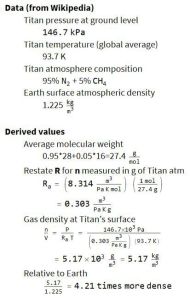
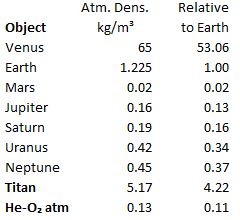
“Because it’s good enough, enough of the time, and we know when not to use it. I’ll give you an example. One of my clients wanted to know air density at ground level on Saturn’s moon Titan and all the planets that have an atmosphere.” <showing Old Reliable’s screen> “I found the planet data I needed in NASA’s Planetary Science website, but I had to do my own calculation for Titan. The pressure’s not crazy high and the temperature’s chilly but not quite cold enough to liquify nitrogen so the situation’s in‑range for the Ideal Gas Equation.”

“What’s a Pa?”

“That’s the symbol for a pascal, the unit of pressure. kPa is kilopascals, just like kg is kilograms. Earth’s atmospheric pressure is about 100 kPa.”

“Reliable says Wikipedia says Titan’s air is mostly nitrogen like Earth’s air is. Titan’s just a moon so it has to be smaller than Earth so its gravity must be smaller, too. Why is its atmosphere so much denser?”

“The cold. Titan’s air is 200 kelvins colder than Earth’s average temperature. You’re right, an individual gas particle feels a smaller pull of gravity on Titan, but it doesn’t have much kinetic energy to push its neighbors away so they all crowd closer together.”

“Why in the world does your client want to know that density number?”

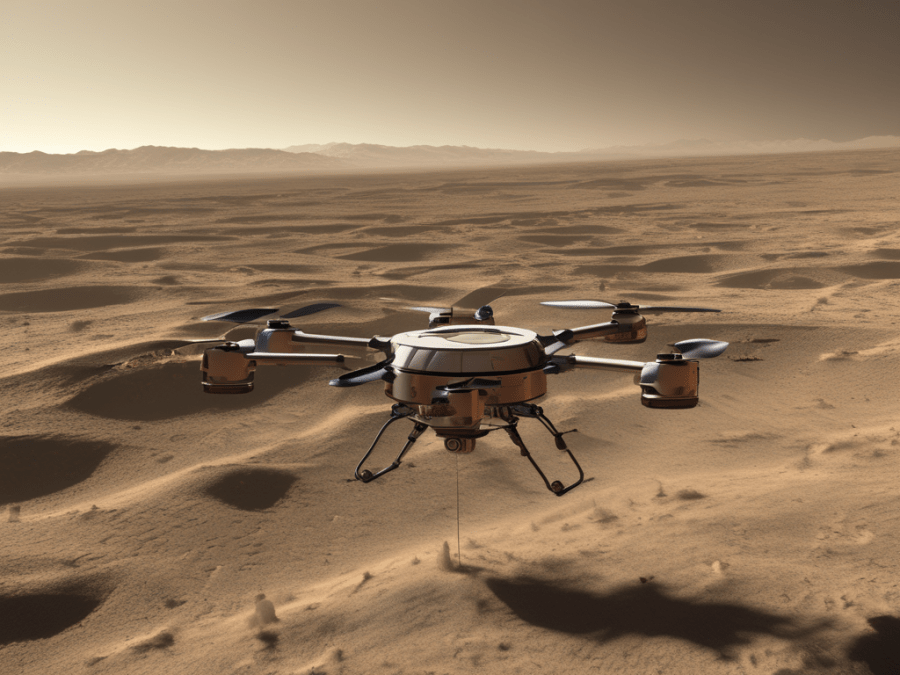
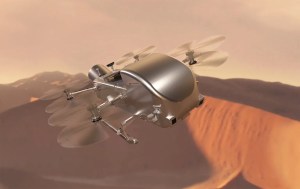
“Clients rarely give me reasons. I suspect this has to do with designing a Titan‑explorer aircraft.”

“Ooo! Wait, what does that have to do with air density?”

“It has to do with how hard the machine has to work to push itself up. It’ll probably have horizontally spinning blades that push the air downwards, like helicopters do. With a setup like that, the lift depends on the blade’s length, how fast it’s spinning, and how dense the air is. If the air is dense, like on Titan, the designers can get the lifting thrust they need with short blades or a slow spin. On Mars the density’s only 2% of Earth’s so Ingenuity‘s rotors were 4 feet across and spun about ten times faster than they’d have to on Earth.”

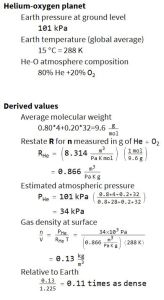
“What about on our helium‑oxygen Earth?”

“That’s pretty much the same calculation. Give me a sec.” <tapping on Old Reliable’s screen> “Gas density would be a tenth of Earth’s, but a HeO‑copter would have to work against full‑Earth gravity. Huge blades rotating at supersonic speeds. Probably not a practical possibility.”

“Aw.”

“Yeah.”

~ Rich Olcott

The Ideal Gas Game

“But Uncle Sy, you never did answer my real question!”

“What question was that, Teena?”

“About the helium planet. With oxygen. Oh, I guess I never did get around to asking that part of it. You side‑tracked us into how a helium‑oxygen atmosphere would be unstable unless it was really cold or the planet had more gravity than Earth so the helium wouldn’t fly away. But what I wanted to know was, what would it be like before the helium left? Like, could we fly a plane there?”

“Mmm, let’s get a leetle more specific. You asked about swapping all of Earth’s atmospheric nitrogen with helium. Was that one helium atom for each nitrogen molecule or each nitrogen atom?”

“What difference would that make?”

“Mass, to begin with. A helium atom weighs about 1/3 of a nitrogen atom, 1/7 of a nitrogen molecule. The atmospheric pressure we feel is the weight of all the air molecules above us. Swap out 80% of those molecules for something lighter, pressure goes down whether we swap helium for molecules or helium for atoms. We could calculate either one. But the change would be much harder to calculate for the atom‑for‑atom swap.”

“Why?”

“Mmm, have you gotten into equations yet in school?”

“You mean algebra, like 3x+7=8x+2? Yeah, they’re super‑easy.”

“This won’t even be as complicated as that. Here’s a famous Physics equation called The Ideal Gas Law — PV=nRT. Each letter stands for one quantity. Two adjacent quantities are multiplied together, okay? The pressure in a container is P, the container’s volume is V, T is the absolute temperature, and n is a measure of how much gas is in there.”

“You skipped R.”

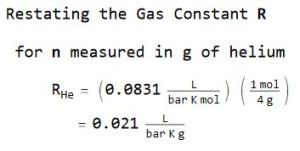
“Yes, I did. It’s a constant number. Its job is to make all the units come out right. For instance, if the pressure’s in atmospheres, the volume’s in liters, n is in grams of helium and the temperature is in kelvins, then R is 0.021. Suppose you’re holding a balloon filled with helium and it’s at room temperature. What can you say about the gas?”

“Umm, all the nRT stuff doesn’t change so P times V, whatever it is, doesn’t change either.”

“If we let it fly upward until the pressure was only half what it is here…?”

“Then V would double. The balloon would get twice as big. Unless it burst, right?”

“You got the idea. Okay, now let’s fiddle with the right-hand side. Suppose we double the amount of helium.”

P times V must get bigger but we don’t know which one.”

“Why not both?”

“Wooo… Each one could get some bigger… Oh, wait, I’m holding the balloon so the pressure’s not going to change so the balloon gets twice bigger.”

“Good thinking. One more thing and we can get back to your difference question. The Ideal Gas Law doesn’t care what kind of gas you’re working with. All the n quantity really cares about is how many particles are in the gas. A particle can be anything that moves about independently of anything else — helium atom or nitrogen molecule, doesn’t matter. If you change the definition of what n is measuring, all that happens is you have to adjust R so the units come out right. Then the equation works fine. Next step—”

“Wait, Uncle Sy, I want to think this atom‑or‑molecule thing through for myself. I’m gonna ignore R times T because both of them stay the same. So if we swap one atom of helium for one molecule of nitrogen, the number of particles doesn’t change and PV doesn’t change. But if we swap one atom of helium for each atom of nitrogen then n doubles and so does PV. But if we do that for the whole atmosphere then we can’t say that the pressure won’t change because the atmosphere could just expand and that’s the V but the pressures are all different as you go higher up anyway. Oh, wait, T changes, too, because it’s cold up there. It’s complicated, isn’t it?”

“It certainly is. Can we stick to just the simple atom‑for‑molecule swap?”

“Uh‑huh.”

~~ Rich Olcott

  • Thanks again, Xander, and happy birthday. Your question was deeper than I thought.

Drag Show

Vinnie lumbers into my office with a troubled look on his face. “Something’s bothering me, Sy.”

“What’s that, Vinnie?”

“This article says NASA’s just finalized a contract with SpaceX to get the International Space Station down, all burnt up and buried in the ocean. Seems a shame. I mean, all the engineering and sweat and risk it took to build it up there, the international cooperation no matter the Cold War, the science for figuring out how to live in space — they ought to leave ISS up there as a memorial or a museum, right?”

“It certainly is a shame, Vinnie, but they just can’t.”

“Why not? 400 kilometers up, it’s not in anyone’s way. It’s all in one piece, won’t contribute to that Kessel cascade problem.”

Kessler cascade. The Kessel Run is a Star Wars thing. But if we left ISS up there it would ultimately contribute to the cascade and in a big way.”

“It’s in space, what could break it up?”

“Actually, it’s in an outer layer of Earth’s atmosphere. Pressure up there is measured in microbars but it’s still billions of atoms per cubic meter. ISS‘ gawky structure induces retrograde drag forces, even in that sparse gas. Drag pulls ISS down about 2 kilometers per month so periodically ISS Mission Control fires rocket engines to boost it back up to nominal orbit. Takes tons of fuel each time. Smaller‑scale drag tries to rip the station apart starting with its solar panels and radiators.”

“Radiators?”

“The white panels hanging off the central truss near the middle. The big brown rectangles are solar panels that power all the station’s equipment. Any time you use energy, inevitably some of it is wasted as heat which builds up unless you eject it somehow. That’s the radiators’ job — can’t dump heat by conduction or convection up there. I read an article once that said your primary target in a space battle would be your enemy’s radiators, because once they’re knocked out whatever’s inside gets cooked.”

“HAW! Basic design flaw for the Millennium Falcon and all the Federation’s Enterprise starships. Fun to know. But I see what you mean about we can’t keep it up there. I’m a pilot, I know what drag can do when it gets a chance. Drag pulls one big chunk off ISS, the rest’d crumble quick. … Wait, now something else doesn’t make sense.”

“What’s that?”

“I thought when you’re in orbit and you slow down you go higher, not lower. You and me and Cal, we talked about that back when Cal was Al. But you just said that drag slowdown pushes ISS lower.”

“You’re right, but back then we considered the case when only gravity and momentum are in play. You’re in stable orbit when you’re going at just the right speed for centrifugal force to balance the pull of gravity at that altitude. Go higher, gravity’s weaker so you don’t need as much speed to balance out.”

“That’s what I remembered.”

“Now we’re looking at a three‑force game where drag is playing on gravity’s side. With both those guys cooperating, the balance shifts away from centrifugal force. Dragged objects slow down and drop down to a lower orbit. Come to think of it, your aircraft is in the same game. When you come in for a landing you deploy your flaps to increase your drag and reduce your lift, right?”

“Right. How ’bout that, ISS acts like an aircraft!”

“Sort of. Mostly spacecraft, a little bit aircraft. Two kilometers isn’t much against four hundred, and the air pressure’s way less. Anyway, NASA’s plan is for a SpaceX ‘US Deorbit Vehicle‘ to act like a super‑drag. If we let drag run its course with no constraints, ISS would eventually come down in pieces all over the place. Deorbit Mission Control should be able to use USDV‘s steerability to aim ISS‘ decaying orbit towards a minimal footprint near Point Nemo.”

“Point Nemo?”

“The ‘oceanic pole of inaccessibility,’ as far away as you can get from any piece of land. It’s also far away from regular shipping and air traffic. Can’t say much about whale traffic though.”

~~ Rich Olcott

Virial Yang And Yin

“But Mr Moire, how does the Virial Equation even work?”

“Sometimes it doesn’t, Jeremy. There’s an ‘if’ buried deep in the derivation. It only works for a system in equilibrium. Sometimes people use the equation as a test for equilibrium.”

“Sorry, what does that mean?”

“Let’s take your problem galaxy cluster as an example. Suppose the galaxies are all alone in the Universe and far apart even by astronomical standards. Gravity’s going to pull them together. Galaxy i and galaxy j are separated by distance Rij. The potential energy in that interaction is Vij = G·mi·mj / Rij. The R‘s are very large numbers in this picture so the V attractions are very small. The Virial is the average of all the V’s so our starting Virial is nearly zero.”

“Nearly but not quite zero, I get that. Wait, if the potential energy starts near zero when things are far apart, and a falling‑in object gives up potential energy, then whatever potential energy it still has must go negative.”

“It does. The total energy doesn’t change when potential energy converts to kinetic energy so yes, we say potential energy decreases even though the negative number’s magnitude gets larger. It’d be less confusing if we measured potential energy going positive from an everything-all-together situation. However, it makes other things in Physics much simpler if we simply write (change in potential energy)+(change in kinetic energy)=0 so that’s the convention.”

“The distances do eventually get smaller, though.”

“Sure, and as the objects move closer they gain momentum and kinetic energy. Gaining momentum is gaining kinetic energy. You’re used to writing kinetic energy as T=m·v²/2, but momentum is p=m·v so it’s just as correct to write T=p²/2m. The two are different ways of expressing the same quantity. When a system is in equilibrium, individual objects may be gaining or losing potential energy, but the total potential energy across the system has reached its minimum. For a system held together by gravity or electrostatic forces, that’s when the Virial is twice the average kinetic energy. As an equation, V+2T=0.”

“So what you’re saying is, one galaxy might fall so far into the gravity well that its potential energy goes more negative than –2T. But if the cluster’s in equilibrium, galaxy‑galaxy interactions during the fall‑in process speed up other galaxies just enough to make up the difference. On the flip side, if a galaxy’s already in deep, other galaxies will give up a little T to pull it outward to a less negative V.”

“Well stated.”

“But why 2? Why not or some other number?”

“The 2 comes from the kinetic energy expression’s ½. The multiplier could change depending on how the potential energy varies with distance. For both gravity and electrostatic interactions the potential energy varies the same way and 2 is fine the way it is. In a system with a different rule, say Hooke’s Law for springs and rubber bands, the 2 gets multiplied by something other than unity.”

“All that’s nice and I see how the Virial Equation lets astronomers calculate cluster‑average masses or distances from velocity measurements. I suppose if you also have the masses and distances you can test whether or not a collection of galaxies is in equilibrium. What else can we do with it?”

“People analyze collections of stars the same way, but Professor Hanneken’s a physicist, not an astronomer. He wouldn’t have used class time on the Virial if it weren’t good for a broad list of phenomena in and outside of astronomy. Quantum mechanics, for instance. I’ll give you an important example — the Sun.”

“One star, all by itself? Pretty trivial to take its average.”

“Not averaging the Sun as an object, averaging its plasma contents — hydrogen nuclei and their electrons, buffeted by intense heat all the way down to the nuclear reactions that run near the Sun’s core. It’s gravitational potential energy versus kinetic energy all over again, but at the atomic level this time. The Virial Theorem still holds, even though turbulence and electromagnetic effects generate a complicated situation.”

“I’m glad he didn’t assign that as a homework problem.”

“The semester’s not over yet.”

~~ Rich Olcott

A Virial Homework Problem

“Uh, Mr Moire? Would you mind if we used Old Reliable to do the calculations on this problem about the galaxy cluster’s Virial?”

Data extracted and re-scaled from Fig 2 of Smith (1936), The Mass of the Virgo Cluster

“Mm, only if you direct the computation, Jeremy. I want to be able to face Professor Hanneken with a clear conscience if your name ever comes up in the conversation. Where do we start?”

“With the data he printed here on the other side of the problem sheet. Old Reliable can scan it in, right?”

“Certainly. What are the columns?”

“The first one’s clear. The second column is the distance between the galaxy and the center of the cluster. Professor Hanneken said the published data was in degrees but he converted that to kiloparsecs to get past a complication of some sort. The third column is, umm, ‘the relative line‑of‑sight velocity.’ I understand the line‑of‑sight part, but the numbers don’t look relativistic.”

“You’re right, they’re much smaller than lightspeed’s 300,000 km/s. I’m sure the author was referring to each galaxy’s motion relative to the other ones. That’s what the Virial’s about, after all. I’ll bet John also subtracted the cluster’s average velocity from each of the measured values because we don’t care about how the galaxies move relative to us. Okay, we’ve scanned your data. What do we do next?”

“Chart it, please, in a scatter plot. That’s always the first thing I do.”

“Wise choice. Here you go. What do we learn from this?”

“On the whole it looks pretty flat. Both fast and slow speeds are spread across the whole cluster. If the whole cluster’s rotating we’d see faster galaxies near the center but we don’t. They’re all moving randomly so the Virial idea should apply, right?”

“Mm-hm. Does it bother you that we’re only looking at motion towards or away from us?”

“Uhh, I hadn’t thought about that. You’re right, galaxy movements across the sky would be way too slow for us to detect. I guess the slowest ones here could actually be moving as fast as the others but they’re going crosswise. How do we correct for that?”

“Won’t need much adjustment. The measured numbers probably skew low but the average should be correct within a factor of 2. What’s next?”

“Let’s do the kinetic energy piece T. That’d be the average of galaxy mass m times v²/2 for each galaxy. But we don’t know the masses. For that matter, the potential energy piece, V=G·M·m/R, also needs galaxy mass.”

“If you divide each piece by m you get specific energy, joules/kilogram of galaxy. That’s the same as (km/s)². Does that help?”

“Cool. So have Old Reliable calculate /2 for each galaxy, then take the average.”

“We get 208,448 J/kg, which is too many significant figures but never mind. Now what?”

“Twice T would be 416,896 which the Virial Theorem says equals the specific potential energy. That’d be Newton’s G times the cluster mass M divided by the average distance R. Wait, we don’t know M but we do know everything else so we can find M. And dividing that by the galaxy count would be average mass per galaxy. So take the average of all the R distances, times the 416,896 number, and divide that by G.”

“What units do you want G in?”

“Mmm… To cancel the units right we need J/kg times parsecs over … can we do solar masses? That’d be easier to think about than kilograms.”

“Old Reliable says G = 4.3×10⁻³ (J/kg)·pc/Mʘ. Also, the average R is … 890,751 parsecs. Calculating M=v²·R/G … says M is about 90 trillion solar masses. With 29 galaxies the average is around 3 trillion solar masses give or take a couple of factors of 2 or so.”

“But that’s a crazy number, Mr Moire. The Milky Way only has 100 billion stars.”

“Sometimes when the numbers are crazy, we’ve done something wrong. Sometimes the numbers tell us something. These numbers mutter ‘dark matter‘ but in the 1930s only Fritz Zwicky was listening.”

~~ Rich Olcott
  • Thanks again to Dr KaChun Yu for pointing out Sinclair Smith’s 1936 paper. Naturally, any errors in this post are my own.

Viral, Virial, What’s The Difference?

A young man’s knock at my office door, eager yet a bit hesitant. “C’mon in, Jeremy, the door’s open.”

“Hi, Mr Moire. Got a minute?”

“It’s slow season, Jeremy. What can I do for you?”

“It’s my physics homework, sir. Professor Hanneken asked a question that I don’t understand.”

“John’s a bit of a joker but asking unsolvable questions isn’t usually one of his things. Well, except for that one about how long it would take to play Mahler’s Piano Quartet if you had only two musicians because of budget restrictions. What’s the question?”

“He wants us to use something called ‘the viral theorem‘ to deduce things about a certain galaxy cluster. I know what viral memes are but I don’t think I’ve ever heard of a theorem that spreads like a virus. I’ve done searches on my class notes and online textbook — nothing. So what is it and how am I supposed to use it?”

“Do you have the question with you?”

“Yessir, it’s #4 on this sheet.”

“Ah, just as I thought. Read it again. The word is ‘virial,’ not ‘viral.’ Big difference.”

“I suppose, but what’s a virial then?”

“We need some context. Imagine a cluster of free‑floating objects bound together by mutual forces of attraction. No central attractor, just lots of pairwise pulling, okay?”

“What kind of forces?”

“That’s the thing, it doesn’t matter. Gravitational, electrostatic, rubber bands even. The only restriction is that the force between each pair of objects follows the same force‑distance rule. For rubber bands it’s mostly just 1/distance until you get near the elastic limit. For gravity and electrostatics the rule is that force runs as 1/distance2. Got that picture?”

<grin> “It’d be tricky rigging up those rubber bands to not get tangled. Anyhow, instead of planets around the Sun you want me to think of stars held in a cluster by each other’s gravity. Do they all have to be the same size or the same distance apart?”

“No, because of what happens next. You’re thinking right — a heavier star pulls harder than a lighter one, and two stars close together feel more mutual force than stars far apart. We account for that variation by taking an average. Multiply force times distance for every possible pairing, then divide the total by the number of objects. The averaged number is the Virial, symbol V.”

“Wait, force times distance. That’s the Physics definition of work, like pulling something up against gravity.”

“Exactly. Work is directed energy. What we’re talking about here is the amount of energy required to pull all those objects away from the center of mass or charge or whatever, out to their current positions. The Virial is the average energy per object. It’s average potential energy because it depends on position, not motion.”

“They’d release all that energy if they just fell together so why don’t … wait, they’re going all different directions so momentum won’t let them, right?”

“You’re on your way. Motion’s involved.”

“Umm … Kepler’s Law — the closer any two of them get, the faster they orbit each other … OH! Kinetic energy! When things fall, potential energy’s converted to kinetic energy. Is there an average kinetic energy that goes up to compensate for the Virial getting smaller?”

“Bingo. When you say ‘average kinetic energy‘ what quantity springs to mind?”

“Temperature. But that’s only for molecules.”

“No reason we can’t define a galactic analog. In fact, Eddington did that back in 1916 when he brought the notion from gas theory over to astrophysics. He even used ‘T‘ for the kinetic average, but remember, this T refers to kinetic energy of stars moving relative to each other, not the temperatures of the stars themselves. Anyhow, the Virial Theorem says that a system of objects is in gravitational or electrostatic equilibrium when the Virial is T/2. Clausius’ ground‑breaking 1870 proof for gases was so general that the theorem’s been used to study everything from sub‑atomic particles to galaxies and dark matter.”

<bigger grin> “With coverage like that, the Virial’s viral after all. Thanks, Mr Moire.”

~~ Rich Olcott
  • Thanks to Dr KaChun Yu for helpful pointers to the literature. Naturally, any errors in this post are my own.