The Moon And Chalk

Cathleen’s talking faster near the end of the class. “OK, we’ve seen how Venus, Earth and Mars all formed in the same region of the protosolar disk and have similar overall compositions. We’ve accounted for differences in their trace gasses. So how come Earth’s nitrogen-oxygen atmosphere is so different from the CO2-nitrogen environments on Venus and Mars? Let’s brainstorm — shout out non-atmospheric ways that Earth is unique. I’ll record your list on Al’s whiteboard.”

“Oceans!”

“Plate tectonics!”

“Photosynthesis!”

“Limestone!”

“The Moon!”

“Wombats!” (That suggestion gets a glare from Cathleen. She doesn’t write it down.)

“Goldilocks zone!”

“Magnetic field!”

“People!”

She registers the last one but puts parentheses around it. “This one’s literally a quickie — real-world proof that human activity affects the atmosphere. Since the 1900s gaseous halogen-carbon compounds have seen wide use as refrigerants and solvents. Lab-work shows that these halocarbons catalyze conversion of ozone to molecular oxygen. In the 1970s satellite data showed a steady decrease in the upper-atmosphere ozone that blocks dangerous solar UV light from reaching us on Earth’s surface. A 1987 international pact banned most halocarbon production. Since then we’ve seen upper-level ozone concentrations gradually recovering. That shows that things we do in quantity have an impact.”

“How about carbon dioxide and methane?”

“That’s a whole ‘nother topic we’ll get to some other day. Right now I want to stay on the Mars-Venus-Earth track. Every item on our list has been cited as a possible contributor to Earth’s atmospheric specialness. Which ones link together and how?”

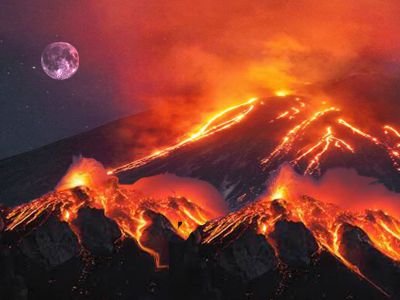
Adopted from image by Immanuel Giel, CC BY-SA 3.0

Astronomer-in-training Jim volunteers. “The Moon has to come first. Moon-rock isotope data strongly implies it condensed from debris thrown out by a huge interplanetary collision that ripped away a lot of what was then Earth’s crust. Among other things that explains why the Moon’s density is in the range for silicates — only 60% of Earth’s density — and maybe even why Earth is more dense than Venus. Such a violent event would have boiled off whatever atmosphere we had at the time, so no surprise the atmosphere we have now doesn’t match our neighbors.”

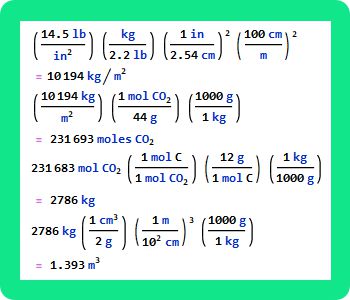
Astrophysicist-in-training Newt Barnes takes it from there. “That could also account for why only Earth has plate tectonics. I ran the numbers once to see how the Moon’s volume matches up with the 70% of Earth’s surface that’s ocean. Assuming meteor impacts grew the Moon by 10% after it formed, I divided 90% of the Moon’s present volume by 70% of Earth’s surface area and got a depth of 28 miles. That’s nicely within the accepted 20-30 mile range for depth of Earth’s continental crust. It sure looks like our continental plates are what’s left of the Earth’s original crust, floating about on top of the metallic magma that Earth held onto.”

Jeremy gets excited. “And the oceans filled up what the continents couldn’t spread over.”

“That’s the general idea.”

Al’s not letting go. “But why does Earth have so much water and why is it the only one of the three with a substantial magnetic field?”

Cathleen breaks in. “The geologists are still arguing about whether Earth’s surface water was delivered by billions of incoming meteorites or was expelled from deep subterranean sources. Everyone agrees, though, that our water is liquid because we’re in the Goldilocks zone. The water didn’t steam away as it probably did on Venus, or freeze below the surface as it may have on Mars. Why the magnetic field? That’s another ‘we’re still arguing‘ issue, but we do know that magnetic fields protect Earth and only Earth from incoming solar wind.”

“So we’re down to photosynthesis and … limestone?”

“Photosynthesis was critical. Somewhere around two billion years ago, Earth’s sea-borne life-forms developed a metabolic pathway that converted CO2 to oxygen. They’ve been running that engine ever since. If Earth ever did have CO2 like Venus has, green things ate most of it. Some of the oxygen went to oxidizing iron but a lot was left over for animals to breathe.”

“But what happened to the carbon? Wouldn’t life’s molecules just become CO2 again?”

“Life captures carbon and buries it. Chalky limestone, for instance — it’s calcium carbonate formed from plankton shells.”

Jim grins. “We owe it all to the Moon.”

~~ Rich Olcott

Traces of Disparity

Cathleen’s an experienced teacher — she knows when off-topic class discussion is a good thing, and when to get back to the lesson plan. “My challenge question remains — why isn’t Earth’s atmosphere some average of the Mars and Venus ones? Thanks to Jeremy and Newt and Lenore we have reason to expect the planets to resemble each other, but in fact their atmospheres don’t. Maria, tell us what you’ve found about how Earth compares with the others.”

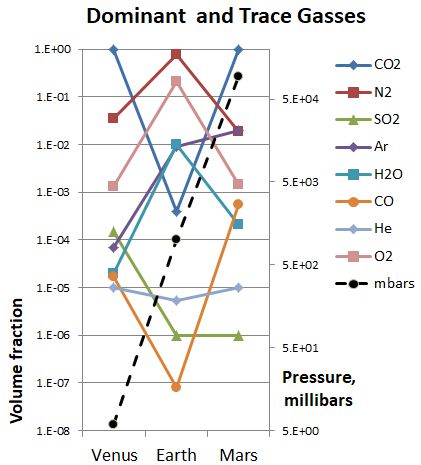
“Yes, Profesora. I found numbers for many of the gasses on each planet and put them into this chart. One thing Earth is right in the middle, most things not.”

“That’s a complicated chart. Read it out to us.”

“Of course. I had to make the vertical scales logarithmic to get the big numbers and small numbers on the same chart. First is the pressure which is the black dotted line. Venus pressure at the surface is nearly 100 times ours but Mars pressure is a bit less than 1/100th of ours. Does that count as Earth being in the middle?”

“That’d be a geometric average. It could be significant, we’ll see. Go on.”

“The gas that is almost the same everywhere is helium, the grey diamonds. That surprised me, because I thought the giant planets got all of that.”

Al’s been listening in. Nothing else going on in his coffee shop, I guess. “I’ll bet most of that helium came from radioactive rocks, not from space. Alpha particles, right, Cathleen?”

Cathleen takes unexpected interruptions in stride. “Bad bet, Al. Uranium and other heavy elements do emit alphas which pick up electrons to become helium atoms. You probably remembered Cleve and Langlet, who first isolated helium from uranium ore. However, the major source of atmospheric alphas is the solar wind. Solar wind interception and atmosphere mass are both proportional to planetary surface area so a constant concentration like this is reasonable. Continue, Maria.”

“The major gasses follow a pattern — about the same fractions on Venus and Mars but much higher or lower than on Earth. Look at carbon dioxide, nitrogen, even oxygen.”

Astronomer-in-training Jim has been doing some mental arithmetic. “Our atmosphere is 100 times denser than on Mars, and Venus is another factor of 100 beyond that. That’s a factor of 104 between them — for every molecule of CO2 on Mars there’s 10,000 on Venus. Oh, but Venus has four times Mars’ surface area so make that 40,000.”

“Good points, both of you. Jim’s approximation leads into something we can learn from Maria’s trace gas numbers. Why do you suppose the concentration of SO2 is about the same for Earth and Mars but 100 times higher on Venus, but the reverse is true for argon? Where do they each come from?”

Jeremy finally has something he can contribute. “Volcanoes! They told us in Geology class that most of our SO2 comes from volcanoes. Before the Industrial Revolution, I mean, when we started burning high-sulfur coal and fuel oils and made things worse. Venus has to be the same. Except for the industry, of course.”

“Probably correct, Jeremy. From radar mapping of Venus we know that it has over 150 large volcanoes. We don’t know how many of them are active, but the Venus Express spacecraft sent back evidence of active vulcanism. In fact, Venus’ SO2 score would probably be even higher if much of its production didn’t oxidize to SO3. That combines with water to form the clouds of sulfuric acid that hide the planet’s surface and reflect sunlight so brightly.”

Maria’s hand is up again. “I don’t understand argon’s purple diamonds, profesora. I know it’s one of the inert gasses so it doesn’t have much chemistry and can’t react into a mineral like CO2 and SO2 can. Shouldn’t argon be about the same on all three planets, like helium?”

“Mm-hm, argon does have a simple chemistry, but its radiochemistry isn’t so simple. Nearly 100% of natural argon is the argon-40 isotope created by radioactive decay of potassium-40. Potassium is tied up in the rocks, so the atmospheric load of argon-40 depends on rocky surface erosion. Not much erosion, not much argon.”

Al’s on tenterhooks. “All this is nice, but you still haven’t said why Earth’s atmosphere is so different.”

~~ Rich Olcott

The Still of The Night

Lenore raises her hand. “Maybe it’s my Chemistry background, but to me that protosolar disk model for the early Solar System looks like a distillation process. You heat up a mixture in the pot and then run the resulting vapors through a multi-stage condenser. Different components of the mixture collect at different points in the condenser depending on the local temperature or maybe something about the condenser’s surface. I got some fun correlations from data I dug up related to that idea.”

“Interesting perspective, Lenore You’re got the floor.”

“Thanks, Professor. Like Newt said, hydrogen and helium atoms are so light that even a low-energy photon or solar wind particle can give them a healthy kick away from the Sun and they wind up orbiting where the gas planets grew up. But there was more sorting than that. Check out this chart.”

“What’re the bubbles?”

“Each bubble represents one planet. I’ve scaled the bubble to show what fraction of the planet is its nickel-iron core. Mercury, for instance, is two-thirds core; the other third is its silicate crust and that’s why its overall density is up there between iron and silicates. Then you go through Venus and Earth, all apparently in the zone where gravity’s inward pull on heavy dust particles is balanced by the solar wind’s intense outward push. From the chart I’d say that outbound metallic and rocky materials are mostly gone by the asteroid belt. Big Jupiter grabs most of the the hydrogen and helium; its little brothers get the leavings. Mars looks like it’s right on the edge of the depletion zone — the numbers suggest that its core, if it has one, is only 12% of its mass.”

Jeremy’s ears prick up. “If it has one?”

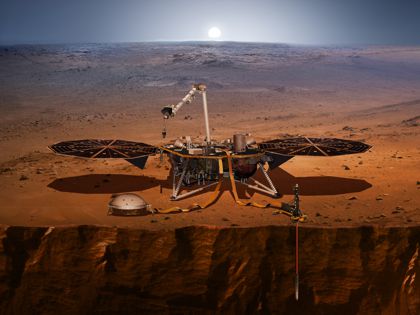
“Yeah, the sources I checked couldn’t say for sure whether or not it does. That’s part of why we sent the Insight lander up there. Its seismic data should help decide the matter. With such a small iron content the planet could conceivably have cooled like silicate raisin bread. It might have isolated pockets of iron here and there instead of gathered in at the center.”

“Weird. So the giant planets are all — wait, what’s Saturn doing with a density below water’s?”

“You noticed that. Theoretically, if you could put Saturn on a really big pool of water in a gravity field it’d float.”

Meanwhile, astrophysicist-in-training Newt Barnes has been inspecting the chart. “Uranus and Neptune don’t fit the pattern, Lenore. If it’s just a matter of ‘hydrogen flees farthest,’ then those two ought to be as light as Saturn, maybe lighter.”

“Yeah, that bothered me, too. Uranus and Neptune are giant planets like Jupiter and Saturn, but they’re not ‘gas giants,’ they’re ‘ice giants.’ All four of them seem to have a junky nickel-iron-silicate core, maybe 1-to-10 times Earth’s mass, but aside from that the gas giants are mainly elemental hydrogen and helium whereas Uranus and Neptune are mostly compounds of oxygen, nitrogen and carbon with hydrogen.”

“How’d all those light atoms get so far out beyond the big guys?”

“Not a clue. Can you help, Professor?”

Cathleen draws ellipses on Al’s whiteboard. “Maybe they did, maybe they didn’t — the jury’s still out. We’re used to our nice neat modern Solar System where almost everything follows nearly circular orbits. It took a while to evolve there starting from the chaotic protosolar disk. Many of the early planetesimals probably had narrow elliptical orbits if they had an orbit at all, considering how often they collided with each other. Astromechanics modelers have burned years of computer time trying to account for what we know of the planets, asteroids, comets and the Kuiper and Oort formations we’ve barely begun to learn about. Some popular ‘Jumping Jupiter‘ models show Jupiter and Saturn migrating in towards the Sun and out again, playing hob with Uranus, Neptune and maybe a third ice giant before that one was ejected from the system altogether. It’s entirely possible that the ice giants grew up Sunward of the hydrogen-rich gas giants. We just don’t know.”

“That’s a challenge.”

“Yes, and my challenge question remains — why isn’t Earth’s atmosphere some average of the Mars and Venus ones?”

~~ Rich Olcott

Should These Three Be Alike?

“What’s all the hubbub in the back room, Al? I’m a little early for my afternoon coffee break and your shop’s usually pretty quiet about now.”

“It’s Cathleen’s Astronomy class, Sy. The department double-booked their seminar room so she asked to use my space until it’s straightened out.”

“Think I’ll eavesdrop.” I slide in just as she’s getting started.

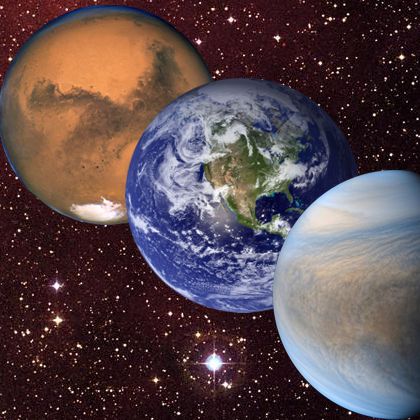
“OK, folks, settle. Last class I challenged you with a question. Venus and Mars both have atmospheres that are dominated by carbon dioxide with a little bit of nitrogen. Earth is right in between them. How come its atmosphere is so different? I gave each of you a piece of that to research. Jeremy, you had the null question. Should we expect Earth’s atmosphere to be about the same as the other two?”

Venus coudtops image by Damia Bouic
JAXA / ISAS / DARTS / Damia Bouic

“I think so, ma’am, on the basis of the protosolar nebula hypothesis. The –“

“Wait a minute, Jeremy. Sy, I saw you sneak in. Jeremy, explain that term to him.”

“Yes’m. Uh, a nebula is a cloud of gas and dust out in space. It could be what got shot out of an exploding star or it could be just a twist in a stream of stuff drifting through the Galaxy. If the twist kinks up, gravity pulls the material on either side of the kink towards the middle and you get a rotating disk. Most of what’s in the disk falls towards its center. The accumulated mass at the center lights up to be a star. Meanwhile, what’s left in the disk keeps most of the original angular momentum but it doesn’t whirl smoothly. There’s going to be local vortices and they attract more stuff and grow up to be planets. That’s what we think happens, anyway.”

“Good summary. So what does that mean for Mars, Venus and the Earth?”

“Their orbits are pretty close together, relative to the disk’s radius, so they ought to have encountered about the same mixture of heavy particles and light ones while they were getting up to size. The light ones would be gas atoms, mostly hydrogen and helium. Half the other atoms are oxygen and they’d react to produce oxides — water, carbon monoxide, grains of silica and iron oxide. And oxygen and nitrogen molecules, of course.”

“Of course. Was gravity the only actor in play there?”

“No-o-o, once the star lit up its photons and solar wind would have pushed against gravity.”

“So three actors. Would photons and solar wind have the same effect? Anybody?”

Silence, until astrophysicist-in-training Newt Barnes speaks up. “No, they’d have different effects. The solar wind is heavy artillery — electrons, protons, alpha particles. They’ll transfer momentum to anything they hit, but they’re more likely to hit a large particle like a dust grain than a small one like an atom. On average, the big particles would be pushed away more.”

“And the photons?”

“A photon is selective — it can only transfer momentum to an atom or molecule that can absorb exactly the photon’s energy. But each kind of atom has its own set of emission and absorption energies. Most light emitted by transitions within hydrogen atoms won’t be absorbed by anything but another hydrogen atom. Same thing for helium. The Sun’s virtually all hydrogen and helium. The photons they emit would move just those disk atoms and leave the heavier stuff in place.”

“That’s only part of the photon story.”

“Oh? Oh, yeah. The Sun’s continuous spectrum. The Sun is hot. Heat jiggles whole ions. Those moving charges produce electromagnetic waves just like charge moving within an atom, but heat-generated waves can have any wavelength and interact with anything. They can bake dust particles and decompose compounds that contain volatile atoms. Then those atoms get swept away in the general rush.”

“Which has the greater effect, solar wind or photons?”

“Hard to say without doing the numbers, but I’d bet on the photons. The metal-and-silicate terrestrial planets are close to the Sun, but the mostly-hydrogen giants are further out.”

“All that said, Jeremy, what’s your conclusion?”

“It sure looks like Earth’s atmosphere should be intermediate between Mars and Venus. How come it’s not?”

~~ Rich Olcott

Red Velvet with Icing

“So Jupiter’s white stripes are huge updrafts of ammonia snow and its dark stripes are weird chemicals we only see when downdrafted ammonia snow evaporates. Fine, but how does that account for my buddy the Great Red Spot? Have another lemon scone.”

“Thanks, Al, don’t mind if I do. Well, those ideas only sort-of account for Spot. The bad news is that they may not have to for much longer.”

“Huh? Why not?”

“Because it seems to be going away.”

“Hey, Sy, don’t mess with me. You know it’s been there for 400 years, why should it go away now?”

“I don’t know anything of the kind. Sure, the early telescope users saw a spot 350 years ago but there’s reason to think that it wasn’t in the same location as your buddy. Then there was a century-long gap when no-one recorded seeing anything special on Jupiter. Without good evidence either way, I think it’s entirely possible we’ve had two different spots. Anyway, the new one has been shrinking for the past 150 years.”

“The big hole must be filling in, then.”

“What hole?”

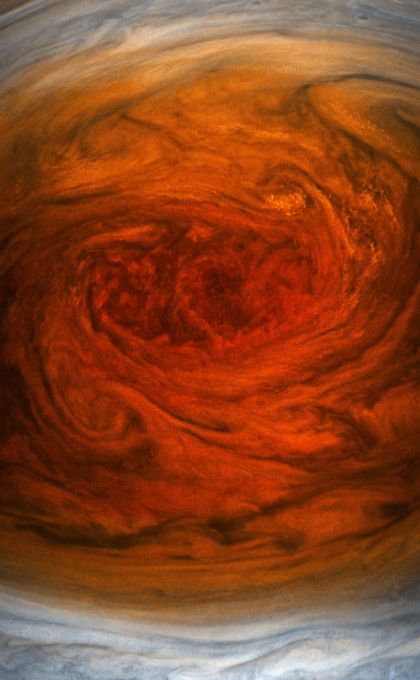
Juno GRS image, NASA/JPL-Caltech/SwRI/MSSS/Gerald Eichstädt

“The Spot. If the dark-colored stripes are what we see when the bright ammonia ice evaporates, then the Spot’s gotta be a hole.”

“A reasonable conclusion from what we’ve said so far, but the Juno orbiter has given us more information. The Spot actually reaches 500 miles further up than the surrounding cloud tops.”

“But higher-up means colder, right? How come we don’t see the white snow?”

“That higher-is-colder rule does apply within Jupiter’s weather layer, mostly, but the Spot’s different. There seems to be a LOT of heat pouring straight up out of it, enough to warm the overlying atmosphere by several hundred degrees compared to the planetary average. That suppresses the ammonia ice, lifts whatever makes the red color and may even promote chemical reactions to make more.”

“But Sy, even I know heat spreads out. You’ve just described something that acts like a searchlight. How could it work like that?”

“Here’s one hypothesis. You’ve got your sound system here rigged up so the back of the shop is quiet, right? How’d you do that?”

“Oh, I bought a couple of directional speakers. They’re deeper than the regular kind and they’ve got this parabolic shape. I aimed them up here to the front where the traffic is. Work pretty good, don’t they?”

“Yes, indeed, and I’m grateful for that. See, they focus sound energy just like you can focus light. Now, to us the Spot just looks like an oval. But it’s probably the big end of a deep cone, spinning like mad and turning turbulent wind energy into white noise that’s focused out like one of your speakers. Wouldn’t that do the trick?”

“Like a huge trombone. Yeah, I suppose, but what keeps the cone cone-shaped?”

“The same thing that keeps it spinning — it’s trapped between two currents that are zipping along in opposite directions. The Spot’s northern boundary is the fastest westbound windstream on the planet. Its southern boundary is an eastbound windstream. The Spot’s trapped between two bands screaming past each other at the speed of sound.”

“Wow. Sounds violent.”

“Incredibly violent, much more than Earth hurricanes. At a hurricane’s eye-wall the wind speeds generally peak below 200 miles per hour. The Great Red Spot’s outermost winds that we can see are 50 miles per hour faster but those triangular regions just east and west must be far worse. When I think about adding in the updrafts and downdrafts I just shudder.”

“Does that have anything to do with the shrinking you told me about?”

“Almost certainly — we simply don’t have enough data to tell. But the new news is that your buddy’s uncorked a fresh shrinkage mode. Since the mid-1800s it’s been contracting along the east-west line, getting more circular. Now it seems to be flaking, too. Big, continent-size regions break away and mix into the dark belt above it. Meanwhile, the white equatorial zone is getting darker, sort of a yellow-green-orange mix.”

GRS image courtesy of Sharin Ahmad

“Yucky-colored. Does that mean the Spot’s draining into it?”

“Who knows? We certainly don’t. Only time will tell.”

~~ Rich Olcott

Icing on The Brownie

“So what you’re saying, Sy, is that Jupiter’s white stripes are ammonia snow clouds that go way up above a lower layer of brown clouds like the white icing stripes I put on my brownies.”

“That’s what I’m saying, Al.”

“But why stripes? We got white clouds here on Earth and sometimes they’re in layers but they don’t make stripes.”

“Well, actually they do, but you need the long-term picture to see it. Ever notice that Earth’s forests and deserts make stripes?”

“How ’bout that? I guess they do, sorta. How’s that work?”

“It took us five hundred years to figure out the details. Quick summary. Sunlight does its best year-round heating job at the Equator, where the oceans humidify the air. Warm air rises. Rising warm air cools, releases its moisture as rain, and you get a rainforest belt. The cooled, dried air spreads out until it sinks at about the 30th parallels north and south. Dry air sucks moisture out of the land as it returns to the Equator and you get desert belts. Repeat the cycle. More loops like that center around both 60th parallels. The pattern’s not completely uniform because of things like mountain ranges that block some of the flows. Basically, though, as the years accumulate you get stripes.”

“Jupiter does that, too, huh?”

“On steroids. In one way it’s simpler — no underlying continents mess things up. On the other hand, Jupiter’s got more than a hundred times Earth’s surface area so there’s room for more loops. Also, Jupiter’s interior is still shedding a lot of heat, almost as much as the planet gets from the Sun. Here’s a diagram on Old Reliable.”

“So you’re saying that the upward loops push Jupiter’s atmosphere to where it’s colder and those white ammonia snow clouds form. Then the downward loops move the clouds to where it’s warmer and the ammonia evaporates to show us the brown stuff. Makes sense. But what’re those side-to-side arrows about? We got anything like those on Earth?”

“Sort of, a little bit. Remember the Coriolis force?”

“Uhh, that’s what makes hurricanes go round and round, right? Something to do with the Equator running faster than places further north or south?”

“That’s the start of it. The Earth as a whole rotates 360° eastward in 24 hours, but how many miles per hour that is depends on where you are. The Equator’s about 25000 miles long so Quito, Ecuador on the Equator does a bit more than 1000 miles per hour. Forty-five degrees away, the 45th parallels are only 70% as long as that, so Salem, Oregon and Queenstown, New Zealand circle 70% slower in miles per hour. Suppose a balloon from Salem travels south as seen from space. As seen from the Equator, the balloon appears in the northeast rather than straight north. Winds work the way that balloon would. All around the world, winds between 10° and 30° north and south come from an east-ish direction most of the time.”

“What about the winds right at the Equator? You’d think the northerly part and the southerly part would cancel each other out.”

“That’s exactly what happens, Al. We’ve got a more-or-less equatorial belt of thunderstorms from humid air cooling off as it goes straight up, but not much of a prevailing wind in any direction — that’s why the old sea captains called the region ‘the doldrums’.”

“An equator belt like Jupiter’s, eh?”

“Not quite. Jupiter has a lovely white equatorial zone all right, but that one doesn’t stand still. It roars eastward, 300 miles per hour faster than the equator’s own 28000 miles per hour. All Jupiter’s white zones move east at a pretty good clip. Its dark belts sprint westward at their own hundred-mile pace. Then there’s the jet streams that run between neighboring bands, and lots of big and little vortices carried along for the ride. The planet’s way too segmented and violent for Coriolis forces to build up enough to play a part. The scientists have a couple of heavily-simplified models, but nowhere near enough data or computer time to fill them in.”

“Earth’s atmosphere is messy enough, thanks. My brain’s hurting.”

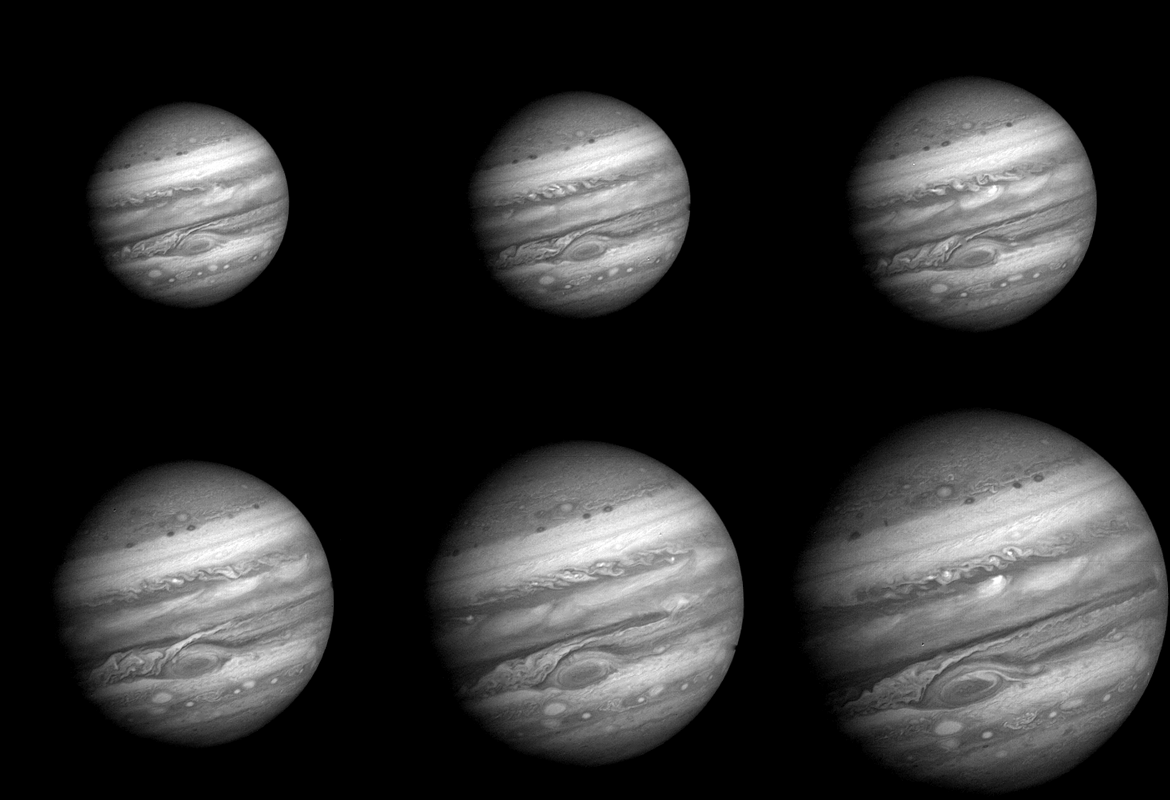
Voyager I video of Jupiter, processed by JPL,
from Wikimedia Commons

~~ Rich Olcott

Lemon, Vanilla, Cinnamon

Al claims that lemon’s a Summertime flavor, which is why his coffee shop’s Scone Flavor of the Month in July is lemon even though it doesn’t go well with his coffee. “Give me one of those lemon scones, Al, and an iced tea. It’s a little warm out there this morning.”

“Sure thing, Sy. Say, what’s the latest science-y thing up in the sky?”

“Oh, there’s a bunch, Al. The Japanese Hayabusa-2 spacecraft collected another sample from asteroid Ryugu. NASA’s gravity-sniffer GRAIL lunar orbiter found evidence for a huge hunk of metallic material five times larger than the Big Island of Hawai’i buried deep under the Moon’s South Pole-Aitken Basin. The Insight Mars lander’s seismometer heard its first Marsquake —“

“Quit yanking my chain, Sy. Anything about Jupiter?”

“Gotcha, Al. I know Jupiter’s your favorite planet. As it happens I do have some Jupiter news for you.”

“The Juno orbiter’s still working, I hope.”

“Sure, sure, far as I know. It’s about to make its 13th close flyby of Jupiter, and NASA administrators have green-lighted the mission to continue until July 2021. Lots of data for the researchers to work on for years. Here’s a clue — what’re the top three things that everyone knows about Jupiter?”

“It’s the biggest planet, of course, and it’s got those stripes and the Great Red Spot. Has the planet gotten smaller somehow?”

“No, but the stripes and the Red Spot are acting weird. Had you heard about that?”

“No, just that the Spot’s huge and red and been there for 400 years.”

“Mmm, we’re not sure about the 400 years. But yes, it’s huge.”

“Four times wider than Earth, right?”

“Hasn’t been that big for a long time. Back in the 1870s telescope technology gave the astronomers that ‘four Earths wide‘ estimate. But the Spot’s shrunk in the last 150 years.”

“A whole lot?”

“Last measurement I saw, it’s just barely over one Earth wide. Seems to have gotten a bit taller, though, and maybe deeper.”

“Taller and deeper? Huh, that’s a new one. I always thought of the Spot as just this big oval ring on Jupiter’s surface.”

“Everyone has that bogus idea of Jupiter as a big smooth sphere with stripes and ovals and swirls painted on it. Don’t forget, we’re looking down at cloud tops, like those satellite pictures we get looking down at a storm system on Earth. From space, one of our hurricanes looks like a spirally disk centered on a dark spot. That dark spot isn’t in the clouds, it’s actually the top of the ocean, miles below the clouds. If you were a Martian working with photos from a telescope on Phobos, you’d be hard-put to figure that out. You need 3-D perspective to get planets right.”

Jupiter image courtesy ESA/Hubble

“Those stripes and stuff aren’t Jupiter’s surface?”

“As far as we can tell, Jupiter doesn’t have a surface. The hydrogen-helium atmosphere just gets denser and denser until it acts like a liquid. There’s a lot of pressure down there. Juno recently gave us evidence for a core that’s a fuzzy mix of stony material and maybe-metallic maybe-solid hydrogen but if that mush is real it’s only 3% of the planet’s mass. Whatever, it’s thousands of miles below what we see. Jupiter’s anything but smooth.”

“Lumps and bumps like this bubbly scone, huh?”

“More organized than that, more like corduroy or a coiled garden hose. The white stripes are hundreds of miles higher-up than the brown stripes so north-to-south it’s like a series of extreme mountain ranges and valleys. The Great Red Spot reaches up maybe 500 miles further.”

“Does that have to do with what they’re made of?”

“It has everything to do with that, we think. You know Earth’s atmosphere has layers, right?”

“Yeah, the stratosphere’s on top, then you got the weather layer where the clouds are.”

“Close enough. Jupiter has all that and more. Thanks to the Galileo probe we know that Jupiter’s ‘weather layer’ has a topmost blue-white cloud layer of ammonia ice particles, a middle red-to-brown layer containing compounds of ammonia and sulfur, and a bottommost white-ish layer of water clouds. The colors we see depend on which layer is exposed where.”

“But why’re they stripey?”

~~ Rich Olcott

Dark Shadows

Change-me Charlie’s still badgering Astronomer-in-training Jim and Physicist-in-training Newt about “Dark Stuff,” though he’s switched his target from dark matter to dark energy. “OK, the expansion of the Universe is speeding up. How does dark energy do that?”

Jim steps up to bat. “At this point dark energy’s just a name. We frankly have no idea what the name represents, although it seems appropriate.”

“Why’s that?”

“Gravity pulls things together, right, and we have evidence that galaxies are flying away from each other. When you pick something up your muscles give it gravitational potential energy that becomes kinetic energy when you let go and it drops. In space, a galaxy moving away from its neighbors gains gravitational potential energy relative to them. If the Energy Conservation Law holds, that energy has to come from somewhere. ‘Dark energy’ is what we call the somewhere, but naming something and understanding it are two different things.”

Newt chips in. “Einstein came at it from a different direction. His General Relativity field equations contained two numbers for observation to fill in — G, Newton’s gravitational constant, and lambda (Λ), which we now call the Cosmological Constant. Lambda measures the energy density of empty space. The equations say the balance between lambda and gravity controls whether the Universe expands, contracts or stays static. Lambda‘s just a little bit positive so the universe is expanding.”

“Same conclusion, different name. Neither one says where the energy comes from.”

That’s my cue. “True, but Einstein’s work goes deeper. Newtonian physics maps the Universe onto a stable grid of straight lines. In General Relativity those lines are deformed and twisted under the influence of massive objects. Vinnie and I talked about how gravity’s a fictitious force arising from that deformation. Like John Wheeler said, ‘Mass tells space-time how to curve, and space-time tells mass how to move.’ Anyway, when you throw dark energy’s lambda into the mix, the grid lines themselves go into motion. Dark energy torques the spacetime fabric that pulls galaxies together.”

“So dark energy pulls things apart by spreading out the grid they’re built on? If that’s so how come I’m still in one piece?”

“Nothing personal, but you’re too small and dense to notice. So am I, so is the Earth.”

“Why should that make a difference?”

“Time for a thought experiment. Think of the Sun. The atoms inside its surface are trying to get out, right? What’s holding them in?”

“The Sun’s gravity.”

“Just like pressure on the skin of a balloon. In either case, as long as things are stable the pressure on an enclosing real or mathematical surface rises and falls with the amount of enclosed energy density and it doesn’t matter which we talk about. Energy density’s easier to think about. With me so far?”

“I guess.”

“Let’s run a few horseback numbers on Old Reliable here. Start with protons and neutrons trying to leave an atomic nucleus. Here’s the total binding energy of an iron-56 nucleus divided by its volume…”

“… so the nuclear particles would fly apart except for the inward pressure exerted by the nuclear forces. Now we’ll go up a level and consider electrons trying to leave a helium atom. They’re held in by the electromagnetic force…”

“Still a lot of inward pressure but less than nuclear by fifty-five powers of ten. Gravity next. That’s what keeps us from flying off into space. I’ll use Earth’s escape velocity to cheat-quantify it…”

“Ten billion times weaker than the electromagnetism that holds our atoms and molecules together. Dark energy’s mass density is estimated to be about 10-27 kilograms per cubic meter. I’ll use that and Einstein’s E=mc2to calculate its pull-us-apart pressure.”

“A quintillion times weaker still.”

“So what you’re saying is, dark energy tries to pull everything apart by stretching out that spacetime grid, but it’s too weak to actually do anything to stuff that’s held together by gravity, electromagnetism or the two nuclear forces.”

“Mostly. Nuclear forces are short-range so distance doesn’t matter. Gravity and electromagnetism get weaker with the square of the distance. Dark energy only gets competitive working on objects that are separated much further than even neighboring galaxies. You’re not gonna get pulled apart.”

~~ Rich Olcott

Dark Horizon

Charlie's table sign says "Dark Energy is bogus"

Change-me Charlie attacks his sign with a rag and a marker, rubbing out “Matter” and writing in “Energy.” Turns out his sign is a roll-up dry-erase display and he can update it on site. Cool. I guess with his rotating-topic strategy he needs that. “OK, maybe dark matter’s a thing, but dark energy ain’t. No evidence, someone just made that one up to get famous!”

And of course Physicist-in-training Newt comes back at him. “Lots of evidence. You know about the Universe expanding?”

“Prove it.” At least he’s consistent.

<sigh> “You know how no two snowflakes are exactly alike but they can come close? It applies to stars, too. Stars are fairly simple in a complicated way. If you tell me a star’s mass, age and how much iron it has, I can do a pretty good job of computing how bright it is, how hot it is, its past and future life history, all sort of things. As many stars as there are, we’re pretty much guaranteed that there’s a bunch of them with very similar fundamentals.”

“So?”

“So when a star undergoes a major change like becoming a white dwarf or a neutron star or switching from hydrogen fusion to burning something else, any other star that has the same fundamentals will behave pretty much the same way. They’d all flare with about the same luminosity, pulsate with about the same frequency —”

“Wait. Pulsate?”

“Yeah. You’ve seen campfires where one bit of flame coming out of a hotspot flares up and dies back and flares up and dies back and you get this pulsation —”

“Yeah. I figured that happens with a sappy log where the heat gasifies a little sap then the spot cools off when outside air gets pulled in then the cycle goes again.”

“That could be how it works, depending. Anyhow, a star in the verge of mode change can go through the same kind of process — burn one kind of atom in the core until heat expansion pushes fuel up out of the fusion zone; that cools things down until fuel floods back in and off we go again. The point is, that kind of behavior isn’t unique to a single star. We’ve known about variable stars for two centuries, but it wasn’t until 1908 that Henrietta Swan Leavitt told us how to determine a particular kind of variable star’s luminosity from its pulsation frequency.”

“Who cares?”

“Edwin Hubble cared. Brightness dies off with the distance squared. If you compare the star’s intrinsic luminosity with how bright the star appears here on Earth, it’s simple to calculate how far away the star is. Hubble did that for a couple dozen galaxies and showed they had to be far outside the Milky Way. He plotted red-shift velocity data against those distances and found that the farther away a galaxy is from us, the faster it’s flying away even further.”

“A couple dozen galaxies ain’t much.”

“That was for starters. Since the 1930s we’ve built a whole series of ‘standard candles,’ different kinds of objects whose luminosities we can convert to distances out to 400 million lightyears. They all agree that the Universe is expanding.”

“Well, you gotta expect that, everything going ballistic from the Big Bang.”

“They don’t go the steady speed you’re thinking. As we got better at making really long-distance measurements, we learned that the expansion is accelerating.”

“Wait. I remember my high-school physics. If there’s an acceleration, there’s gotta be a force pushing it. Especially if it’s fighting the force of gravity.”

“Well there you go. Energy is force times distance and you’ve just identified dark energy. But standard candles aren’t the only kind of evidence.”

“There’s more?”

“Sure — ‘standard sirens‘ and ‘standard rulers.’ The sirens are events that generate gravitational waves we pick up with LIGO facilities. The shape and amplitude of the LIGO signals tell us how far away the source was — and that information is completely immune to electromagnetic distortions.”

“And the rulers?”

“They’re objects, like spiral galaxies and intergalactic voids, that we have independent methods for connecting apparent size to distance.”

“And the candles and rulers and sirens all agree that acceleration and dark energy are real?”

“Yessir.”

~~ Rich Olcott

Dancing in The Dark

Change-me Charlie at his argument table

The impromptu seminar at Change-me Charlie’s “Change My Mind” table is still going strong, but it looks like Physicist-in-training Newt and Astronomer-in-training Jim have met his challenge. He’s switched from arguing that dark matter doesn’t exist to asking how it worked in the Bullet Cluster’s massive collision between two collections of galaxies with their clouds of plasma and dark matter. “OK, the individual galaxies are so spread out they slide past each other without slowing down but the plasma clouds obstruct each other by friction. Wouldn’t friction in the dark matter hold things back, too?”

Jim’s still standing in front of the table. “Now that’s an interesting question, so interesting that research groups have burned a bazillion computer cycles trying to answer it.”

“Interesting, yes, but that interesting?”

“For sure. What we know about dark matter is mostly what it doesn’t do. It doesn’t give off light, it doesn’t absorb light, it doesn’t seem to participate in the strong or weak nuclear forces or interact with normal matter by any means other than gravity, and no identifiable dark matter particles have been detected by bleeding-edge experiments like IceCube and the Large Hadron Collider. So people wonder, does dark matter even interact with itself? If we could answer that question one way or the other, that ought to tell us something about what dark matter is.”

“How’re we gonna do that?”

Newt’s still perched on Charlie’s oppo chair. “By using computers and every theory tool on the shelf to run what-if? simulations. From what we can tell, nearly everywhere in the Universe normal matter is embedded in a shell of dark matter. The Bullet Cluster and a few other objects out there appear to break that rule and give us a wonderful check on the theory work.”

The Bullet Cluster, 1E 0657-56 (NASA image)

“Like for instance.”

“Simple case. What would the collision would looked like if dark matter wasn’t involved? Some researchers built a simulation program and loaded it with a million pretend plasma particles in two cluster-sized regions moving towards each other from 13 million pretend lightyears apart. They also loaded in position and momentum data for the other stars and galaxies shown in the NASA image. The simulation tracked them all as pretend-time marched along stepwise. At each time-step the program applied known or assumed laws of physics to compute every object’s new pretend position and momentum since the prior step. Whenever two pretend-particles entered the same small region of pretend-space, the program calculated a pretend probability for their collision. The program’s output video marked each successful collision with a pink pixel so pinkness means proton-electron plasma. Here’s the video for this simulation.”

“Doesn’t look much like the NASA picture. The gas just spreads out, no arc or cone to the sides.”

“Sure not, which rules out virtually all models that don’t include dark matter. So now the team went to a more complicated model. They added a million dark matter particles that they positioned to match the observed excess gravity distribution. Those’re marked with blue pixels in the videos. Dark matter particles in the model were allowed to scatter each other, too, under control of a self-interaction parameter. The researchers ran the simulations with a whole range of parameter values, from no-friction zero up to about twice what other studies have estimated. Here’s the too-much case.”

“Things hold together better with all that additional gravity, but it’s not a good match either.”

“Right, and here’s the other end of the range — no friction between dark matter particles. Robertson, the video’s author/director, paused the simulation in the middle to insert NASA’s original image so we could compare.”

“Now we’re getting somewhere.”

“It’s not a perfect match. Here’s an image I created by subtracting a just-after-impact simulation frame from the NASA image, then amplifying the red. There’s too much left-over plasma at the outskirts, suggesting that maybe no-friction overstates the case and maybe dark matter particles interact, very slightly, beyond what a pure-gravity theory predicts.”

“Wait, if the particles don’t use gravity, electromagnetism or the nuclear forces on each other, maybe there’s a fifth force!”

“New Physics!”

A roar from Cap’n Mike — “Or they’re not particles!”

~~ Rich Olcott