

A warm Summer day. I’m under a shady tree by the lake, watching the geese and doing some math on Old Reliable. Suddenly a text-message window opens up on its screen. The header bar says 710-555-1701. Old Reliable has never held a messaging app, that’s not what I use it for. The whole thing doesn’t add up. I type in, Hello?
Hello, Mr Moire. Remember me?
Suddenly I do. That sultry knowing stare, those pointed ears. It’s been a year. Hello, Ms Baird. What can I do for you?
Another tip for you, Mr Moire. One of my favorite star systems — the view as you approach it at near-lightspeed is so ... meaningful. Your astronomers call it PSR J0337+1715.
So of course I head over to Al’s coffee shop after erasing everything but that astronomical designation. As I hoped, Cathleen and a few of her astronomy students are on their mid-morning break. Cathleen winces a little when she sees me coming. “Now what, Sy? You’re going to ask about blazars and neutrinos?”
I show her Old Reliable’s screen. “Afraid not, Cathleen, I’ll have to save that for later. I just got a message about this star system. Recognize it?”
“Why, Sy, is that a clue or something? And why is the lettering in orange?”
“Long story. But what can you tell me about this star system?”
“Well, it’s probably one of the most compact multi-component systems we’re ever going to run across. You know what compact objects are?”
“Sure. When a star the size of our Sun exhausts most of its hydrogen fuel, gravity wins its battle against heat. The star collapses down to a white dwarf, a Sun-full of mass packed into a planet-size body. If the star’s a bit bigger it collapses even further, down to a neutron star just a few miles across. The next step would be a black hole, but that’s not really a star, is it?”
“No, it’s not. Jim, why not?”
“Because by definition a black hole doesn’t emit light. A black hole’s accretion disk or polar jets might, but not the object itself.”
“Mm-hm. Sy, your ‘object’ is actually three compact objects orbiting around each other. There’s a neutron star with a white dwarf going around it, and another white dwarf swinging around the pair of them. Vivian, does that sound familiar?”
“That’s a three-body system, like the Moon going around the Earth and both going around the Sun. Mmm, except really both white dwarfs would go around the neutron star because it’s heaviest and we can calculate the motion like we do the Solar System.”
“Not quite. We can treat the Sun as motionless because it has 99% of the mass. J0337+1715’s neutron star doesn’t dominate its system as much as the Sun does ours. That outermost dwarf has 20% of its system’s mass. Phil, what does that suggest to you?”
“It’d be like Pluto and Charon. Charon’s got 10% of their combined mass and so Pluto and Charon both orbit a point 10% of the way out from Pluto. From Earth we see Pluto wobbling side to side around that point. So the neutron star must wobble around the point 20% outward towards the heavy dwarf. Hey, star-wobble is how we find exoplanets. Is that what this is about, Mr Moire? Did someone measure its red-shift behavior?” Cathleen saves me from answering. “Not quite. The study Sy’s chasing is actually a cute variation on red-shift measurements. That ‘PSR‘ designation means the neutron star is a pulsar. Those things emit electromagnetic radiation pulses with astounding precision, generally regular within a few dozen nanoseconds. If we receive slowed-down pulses then the object’s going away; sped-up and it’s approaching, just like with red-shifting. The researchers derived orbital parameters for all three bodies from the between-pulse durations. The heavy dwarf is 200 times further out than the light one, for instance. Not an easy experiment, but it yielded an important result.”
My ears perk up. “Which was…?”
“The gravitational force between the pulsar and each dwarf was within six parts per million of what Newton’s Laws prescribe. That observation rules out whole classes of theories that tried to explain galaxies and galaxy clusters without invoking dark matter.”
Cool, huh?
Uh-huh.
~~ Rich Olcott

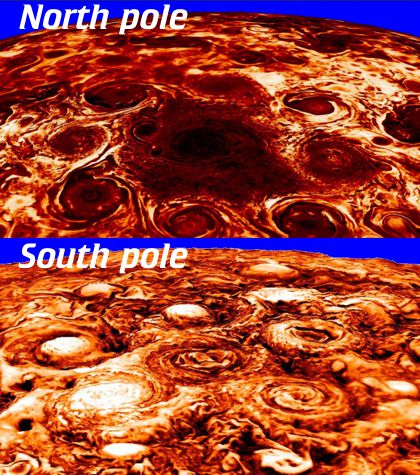 “They’re certainly eye-catching, but I thought Jupiter’s all baby-blue and salmon-colored.”


 “Not much. We can’t see it, and they say there is much more of it than the matter we can see. If we can’t see it, how did she find it? That’s a thing I don’t understand, what I came to your office to ask.”


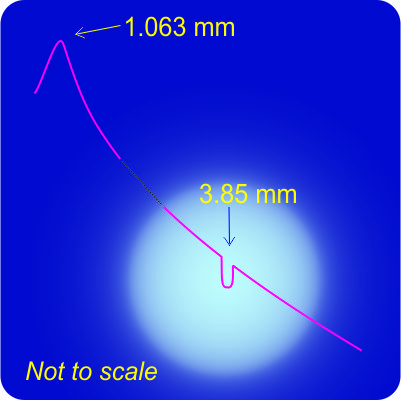


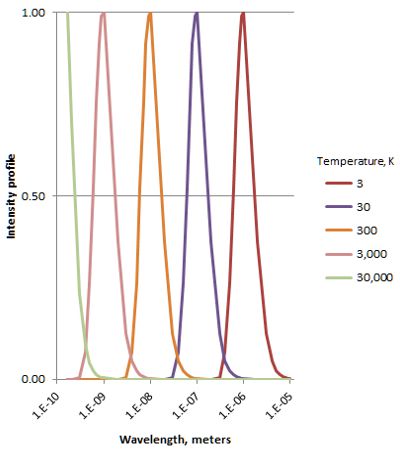
 “So you’re telling me, Cathleen, that you can tell how hot a star is by
  Cathleen turns to her laptop and starts tapping keys. “Let’s do an example. Suppose we’re looking at a star’s broadband spectrogram. The blackbody curve peaks at 720 picometers. There’s an absorption doublet with just the right relative intensity profile in the near infra-red at 1,060,190 and 1,061,265 picometers. They’re 1,075 picometers apart. In the lab, the sodium doublet’s split by 597 picometers. If the star’s absorption peaks are indeed the sodium doublet then the spectrum has been stretched by a factor of 1075/597=1.80. Working backward, in the star’s frame its blackbody peak must be at 720/1.80=400 picometers, which corresponds to a temperature of about 6,500 K.”


 “You’re right, Sy. It’s not a particularly pretty picture, but it shows that nice strong sodium doublet in the yellow and the broad iron and hydrogen lines down in the green and blue. I’ll admit it, Vinnie, this is a faked image I made to show my students what the solar atmosphere would look like if you could turn off the photosphere’s continuous blast of light. The point is that the atoms emit exactly the same sets of colors that they absorb.”
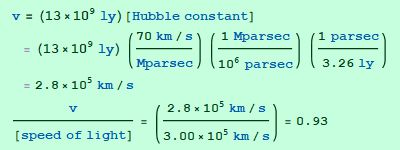 “Whoa, Sy. Do you read the final chapter of a mystery story before you begin the book?”
 “It is, Sy, and that’s one of the reasons why Hubble’s original number was so far off. He only looked at about 50 close-by galaxies, some of which are moving toward us and some away. You only get a view of the general movement when you look at large numbers of galaxies at long distances. It’s like looking through a window at a snowfall. If you concentrate on individual flakes you often see one flying upward, even though the fall as a whole is downward. Andromeda’s 250,000 mph march towards us is against the general expansion.”
 Hard Science Ain't Hard
