Planetary Pastry, Third Course

The Al’s Coffee Shop Astronomy gang is still discussing Jupiter’s Great Red Spot.  Cathleen‘s holding court, which is natural because she’s the only for-real Astronomer in the group…  “So here’s what we’ve got.  The rim of the Great Red Spot goes hundreds of miles an hour in the wrong direction compared to hurricanes on Earth.  An Earth hurricane’s eye is calm but the Jupiter Spot’s rim encloses a complex pattern of high winds.  Heat transport and cloud formation on Earth are dominated by water, but Jupiter’s atmospheric dynamic has two active players — water and ammonia.”

“Here’s your pastries, Cathleen.  I brought you a whole selection.  Don’t nobody sneeze on ’em, OK?”

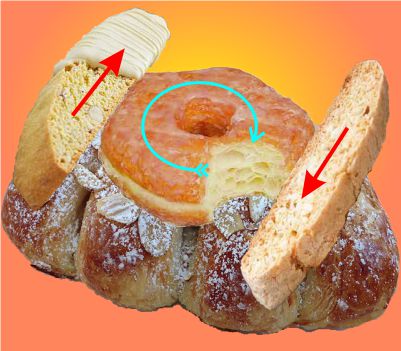
“Oh, they’re perfect, Al.  Thanks.  Let’s start with this bear claw.  We’ll pretend it’s the base of the weather column.  On Earth that’d be mostly ocean, some land surface and some ice.  They’re all rough-ish and steer air currents, which is why there’s a rain shadow inland of coastal mountain ranges.”pastries 2

“Jupiter doesn’t have mountains?”

“We’re virtually certain it doesn’t, Sy.  The planet’s density is so low that it can’t have much heavy material.  It’s essentially an 88,000-mile-wide ball of helium-diluted liquid hydrogen topped by a 30-mile-high weather column.  Anything rocky sank to the core long ago.  The liquid doesn’t even have a real surface.”

<Al and Sy> “Huh?”

“Jovian temps are so low that even at moderate pressures there’s no boundary between gaseous and liquid phases.  Going downward you dive through clear ‘air,’ then progress through an increasingly opalescent haze until you realize you’re swimming.  Physicists just define the ‘surface’ to be the height where the pressure is one atmosphere.  That level’s far enough down that water and ammonia freeze to form overlying cloud layers but hydrogen and helium are still gases.  It could conceivably look like home there except the sky would be weird colors and you don’t see a floor.”

“If the boundary is that blurry, it’s probably pretty much frictionless — weather passes over it without slowing down or losing energy, right?”

“Yup.”

“So there’s way too much slivered almonds and stuff on that bear claw. On this scale it ought to have a mirror finish.”

“Good point.  But now we can start stacking weather onto it.  Here’s my doughnut, to represent the Great Red Spot or any of the other long-lived anticyclones.”

“Auntie who?”

“A-n-t-i-cyclone, Al.  Technical term for a storm that disobeys the Coriolis theory.”

“Uh-HUH. So why’s it do that?”

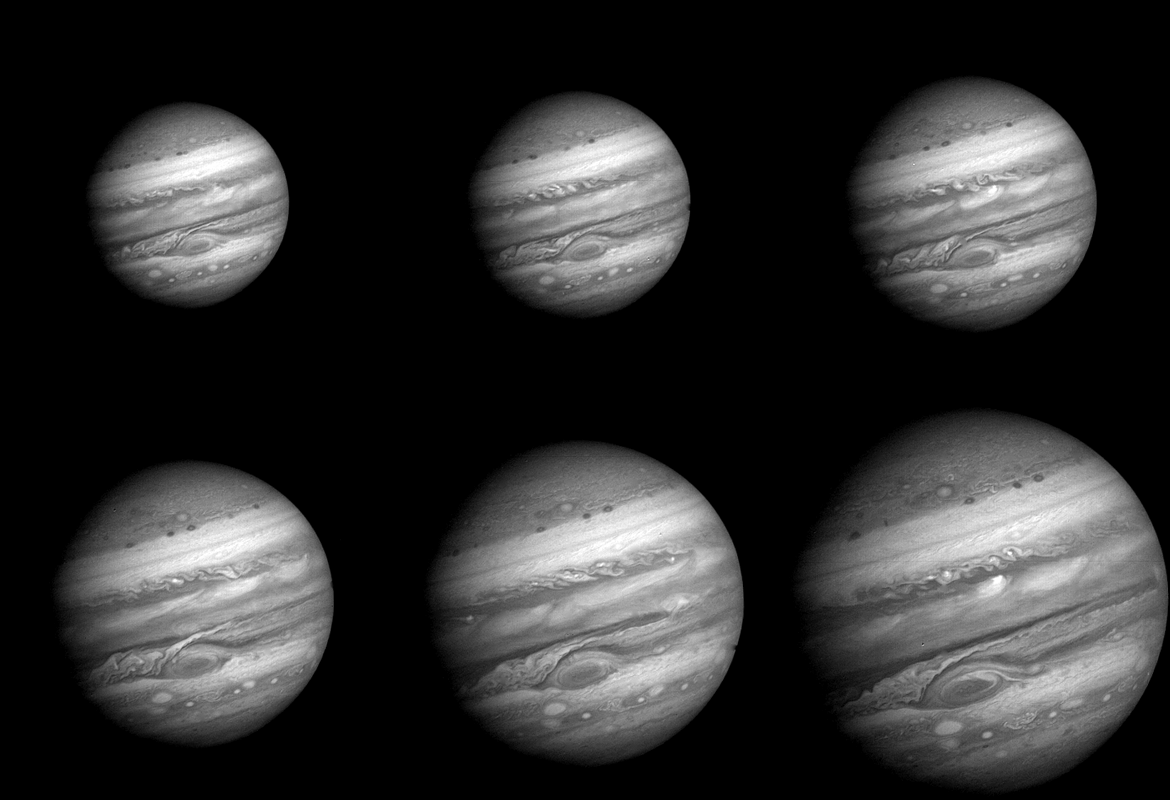
“Well, at this point we can only go up one level in the cause-and-effect chain.  <pulling out smartphone>  NASA’s Voyager 1 spacecraft sent back data for this this wonderful video

790106-0203_Voyager_58M_to_31M_reduced
Jupiter seen by Voyager 1 probe with blue filter in 1979. One image was taken every Jupiter day (approximately 10 hours).  Credit: NASA

“Basically, the Spot is trapped between two jet streams, one going westward at 135 mph and the other going eastward at 110 mph.  I’ll use these biscotti to represent them.pastries with arrows

“Hey, that’s like a rack-and-pinion gear setup, with two racks and an idler, except the idler gear’s four times as wide as the Earth.”

“A bit less than that these days, Sy.  The Spot’s been shrinking and getting rounder.  Every year since 1980 it’s lost about 300 miles east-west and about 60 miles north-south.  As of 2014 it was about 2.8 Earth-widths across.  And no, we don’t know why.  Theories abound, though.”

“What’s one of them?”

“Believe it or not, climate change.  On Jupiter, not Earth.  One group of scientists at Berkeley tackled a couple of observations

  • Unlike Earth, which is much hotter near the Equator than near the poles, Jupiter’s Equator is only a few degrees warmer than its poles.
  • Three persistent White Ovals near the Great Red Spot merged to form a single White Oval that recently turned red but only around the edges.

Their argument is long, technical and still controversial.  However, their proposal is that merging the three ovals disrupted the primary heat transport mechanism that had been evening out Jupiter’s temperature.  IF that’s true, and if it’s the case that Jupiter’s jet streams are powered by heat transport, then maybe disrupted heat patterns are interfering with  the Great Red Spot’s rack-and-pinion machine.  And maybe more.”

“Big changes ahead for the Big Planet.”

“Maybe.”

~~ Rich Olcott

Teena Meets The Eclipses

“Don’t look up until it suddenly gets really dark, Teena.  I’ll tell you when it’s time.”

“OK, Uncle Sy.  Oooo, look at the house where our tree makes a shadow!  It’s all over crescents!”

“Yep, wherever leaves overlap to make a pinhole, it’s like the one we made in our cardboard.  See, those crescents are just like the one our pinhole beams onto the sidewalk.”

“Yeah.  ‘Cause it’s the same Sun, right?”

“Sure is.”

“Are other little kids seeing the eclipse all over the world?  They’ve got the same Sun, too.”

“No, just the ones who happen to be on the shadow stripe that the Moon paints on the Earth.”

“How many kids is that?”

“Hard to tell.  Some families live where the shadow passes through, some families travel to be there, lots of other families just stay where they are.  No-one knows how many of each.  But we can make some not-very-good guesses.”

“The crescent’s going so slow.  Let’s make guesses while we’re waiting.”

“OK.  Let’s start by imagining that all the world’s people are spread evenly over the land and sea.”

“Even on the ocean?  Like everyone has a little boat?”

“Yep, and sleds or whatever on polar ice, people everywhere.  In our city there are eight blocks to a mile, so if we spread out the people there’d be one person every other block.”

“Every other block.  Like just on the black squares on our checker board.”

“Uh-huh.  The Moon’s shadow today will be a circle about 80 miles across and it’ll travel about 2500 miles across the whole country.  The stripe it paints would cover about 6½ million spread-out people.  Maybe 10 million if you count the people in little boats, ’cause the eclipse starts and ends over the ocean.”Local eclipses

“Lots of people.”

“Yes, but only about one person out of every thousand people in the world.”

“We’re pretty lucky then, huh?”

“Oh, yeah.”

“Are there eclipses on other planets?”

“Of a sort, but only for planets that have a moon.  Poor Mercury and Venus don’t have moons so they never see an eclipse.”

“Aww. … Wait — you said ‘of a sort.’  Are there different kinds of eclipses?”

“You’re very alert this morning.  And yes, there are.  Two that get the publicity and two that we never see on Earth.  It has to do with perspective.”

“Per … perspec…?”

“Perspective.  The word originally meant very careful looking but it’s come to be about how things look from a particular point of view.  See that tree across the street?”

“Yeah.”

“Think your hand is bigger than the tree?”

“Of course not.  I climb that tree.”

“OK, put your hand between your eyes and the tree.”

“Oh!  My hand covers the whole tree!”

“Yup.  Nearer things look big and farther things look small.  That’s perspective.  Eclipses are all about perspective.”How big is the Sun

“How come?”

“The perspective principle works in the Solar System, too.  If you were to travel from Earth to Mars to Jupiter and so on, the Sun would look smaller at each planet.”

“Like the far-away trees look smaller than the close trees.  But what does that have to do with eclipses?”

“A planet gets an eclipse when one of its moons comes between it and the Sun.  That’s what’s happening right now here.  Our Moon is moving between us and the Sun and blocking its light.”

“But I don’t see the Moon, just the carved-out piece.”

“That’s because we’re looking at the unlit side of the Moon.  It’s so dim compared to the rest of the sky.  Anyway, the Moon’s width we see is just about the same as the Sun’s width.  The moons on the other planets don’t match up that well.  On Mars, for instance, its moon Phobos appears less than half the width of the Sun even though the Sun appears only 2/3 as wide as we see it.  Phobos can never cover the Sun entirely, so no true eclipse, just a transit.”

“Can the planet’s moon be bigger?”

“Sure.  On Jupiter, Europa’s width completely blocks out the Sun.  That’s called an occultation.  You can look up now.  Jupiter people can never see that corona.”

“Oooooo, so pretty.  We’re lucky, aren’t we?”

“In more ways than you know, sweetie.”

~~ Rich Olcott

Planetary Pastry, Second Course

We’re still sitting in Al’s coffee shop.  “OK, Cathleen, so Jupiter’s Great Red Spot acts like a hurricane turned inside-out.  Where’s the problem?”

“Just that it goes completely against all the computer models we’ve built to understand and predict hurricane activity.  It’ll take a whole new generation of even more complicated models for Jupiter-like planets.”

“Here’s the doughnuts you asked for, Cathleen.”

“Thanks, Al.  Perfect timing. <drawing on a paper napkin>  Let’s look at hurricanes first, OK, Sy?”

“Sure.”

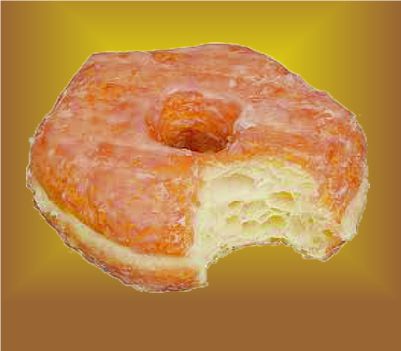
“We’ll start with this doughnut that I’ve just taken a bite out of.  First thing that happens is that warm ocean water heats up the overlying air.  Warmed air rises, so we’ve got an updraft.”

“And then?”

“The rising air is humid (ocean air, remember?).  As it rises it cools and forces moisture to condense out.  Upward flow stops when the warmed air hits the top of the troposphere.  But there’s still more warm air pushing up the plume.  The cooled air has to go somewhere so it spreads out.  That’s where these red arrows on my paper napkin go horizontal.  The cooled air, loaded with water droplets, is heavy so it starts sinking which is why the red arrows turn downward.  They move back across that ocean water again ’cause they’re caught in the inflow.  Full cycle and that’s number 1 here, got it?”

“Yeah.”

“Hey, Cathleen,  are you gonna need more paper napkins?”Donuts 1
“A couple should be enough, Al, thanks.  Now we get to number 2, the Coriolis thing. That’s always tough to talk students through but let’s try.  The Earth rotates once every 24 hours, right, and its circumference at the Equator is 25,000 miles, so relative to the Sun anything at the Equator is flying eastward at about 1,000 miles per hour.  Any place north of the Equator has to be going slower than that, and further north, even slower.  With me, Sy?”

“Gimme a minute … OK, I suppose.”

“Good.  Now suppose a balloon is floating in the breeze somewhere south of that rising plume.  Relative to the plume, it’ll have eastward momentum.  Now the balloon’s caught in the plume’s inflow but it doesn’t go straight in because of that eastward momentum.  Instead it’s going to arc around the plume.  See how I’ve got it coming in off-center?  Al, would that be clockwise or counterclockwise if you’re looking down from a satellite or something?”

“Umm … counterclockwise, yeah?”

“Mm-hm.  What about a balloon that starts out north of the plume?”

“Uhh … It’ll be going slower than the plume, so the plume gets ahead of it and it’ll arc … hey, counterclockwise again!”

“How ’bout that?  Anywhere in the northern hemisphere, air flowing into a low-pressure region will turn it counterclockwise.  As the inflow draws from greater distances, there’s a greater speed difference to drive the counterclockwise spin.  So that’s number 2 here.  Add those two cycles together and you’ve got number 3, which spirals all around the doughnut.  And there’s your hurricane.”

“Cool.  So how does that model not account for the Great Red Spot?”

“To begin with, the Spot’s in Jupiter’s southern hemisphere so it ought to be going clockwise which it definitely is not.  And there’s no broad band of surrounding clouds — just a lot of structure inside the ring, not outside.  There’s something else going on that swamps Coriolis.”

“So how’s Jupiter different from Earth?  Besides being bigger, of course.”

“Lots of ways, Sy.  You know how labels on healthcare products divide the contents into active ingredients and inert ingredients?  The inert ones just carry or modify the effects of the active ones.  Atmospheres work the same way.  On Earth the inert ingredients are nitrogen and oxygen…”

“Hey, oxygen’s important!”

“Sure, Al, but not when you’re modeling air movement.  The important active ingredient is water — it transports a lot of heat when it evaporates from one place and condenses somewhere else.  The biggest outstanding problem in Earth meteorology is accounting for clouds.”

“You’re gonna tell us that Jupiter’s inactive ingredients are hydrogen and helium, I suppose.”

“Precisely, Sy.  Jupiter has two active ingredients, water and ammonia, plus smaller amounts of sulfur and phosphorus compounds.  Makes for a crazy complicated modeling problem.  I’m going to need more pastries.”

“Comin’ up.”


~~ Rich Olcott

Planetary Pastry, First Course

“Morning, Al.  What’s the scone of the day?”

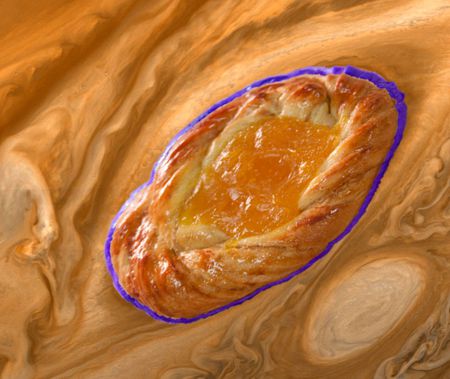
“No scones today, Sy.  Cathleen and one of her Astronomy students used my oven to do a whole batch of these orange-and-apricot Danishes.  Something to do with Jupiter.  Try one.”Great Apricot Spot 1
Cathleen was standing behind me.  “They’re in honor of NASA’s Juno spacecraft.  She just completed a close-up survey of Jupiter’s famous cloud formation, the Great Red Spot.  Whaddaya think?”

“Not bad.  Nice bright color and a good balance of sweetness from the apricot against tartness from the orange.”

“You noticed that, hey?  We had to do a lot of balancing — flavors, colors, the right amount of liquid.  Too juicy and the pastry part comes out gummy, too dry and you break a tooth.  Notice something else?”

“The structure, right?  Like the Spot’s collar around a mushed-up center.”

“Close, but Juno showed us that center’s anything but mushed-up.  <pulls out her smartphone>  Here’s what she sent back.”

GRS 1 @400
Credits: NASA/JPL-Caltech/SwRI/MSSS/Jason Major

“See, it’s swirls within swirls. We tried stirring the filling to look like that but it mostly smoothed out in the baking.”

“Hey, is it true what I heard that the Great Red Spot has been there for 400 years?”

“We think so, Al, but nobody knows for sure.  When Galileo published his telescopic observations of Jupiter in 1610 he didn’t mention a spot.  But that could be because he’d already caught flak from the Church by describing mountains and craters on the supposedly perfect face of the Moon.   Besides, the Jovian moons he saw were much more exciting for the science of the time.  A planet with satellites was a direct contradiction to Aristotle’s Earth-centered Solar System.”

“OK, but what about after Galileo?”

“There are records of a spot between 1665 and 1713 but then no reports of a spot for more than a century.  Maybe it was there and nobody was looking for it, maybe it had disappeared.  But Jupiter’s got one now and it’s been growing and shrinking for the past 185 years.”

“So what is it, what’s it made of and why’s it been there so long?”

“Three questions, one of them easy.”

“Which is easy, Sy?”

“The middle one.  The answer is, no-one knows what it’s made of.  That’s part of Juno‘s mission, to do close-up spectroscopy and help us wheedle what kinds of molecules are in there.  We know that Jupiter’s mostly hydrogen and helium, just like the Sun, but both of those are colorless.  Why some of the planet’s clouds are blue and some are pink — that’s a puzzle, right, Cathleen?”

“Well, we know a little more than that, especially since the Galileo probe dove 100 miles into the clouds in 1995.  The white clouds are colder and made of ammonia ice particles.  The pink clouds are warmer and … ok, we’re still working on that.”

“What about my other two questions, Cathleen?”

“People often call it a hurricane, but that’s a misnomer.  On Earth, a typical hurricane is a broad, complex ring of rainstorms with wind speeds from 75 to 200 mph.  Inside the ring wall people say it’s eerily calm.  The whole thing goes counterclockwise in the northern hemisphere, clockwise in the southern one.”

“So how’s the Great Red Spot different?”

“Size, speed, complexity, even direction.  East-to-west, the Spot is eight times wider than the biggest hurricanes.  Its collar winds run about 350 mph and it rotates counterclockwise even though it’s in Jupiter’s southern hemisphere.  It’s like a hurricane inside-out.”

“It’s not calm inside?”

“Nope, take another look at that Juno image.  There’s at least three very busy bands wrapped around a central structure that looks like it holds three distinct swirls.  That’s the part that’s easiest to understand.” GRS core

“Why so?”

“Geometry.  Adjacent segments of separate swirls have to be moving in the same direction or they’ll cancel each other out.  <scribbles diagram on a paper napkin>  Suppose I’ve got just one inside another one.  If they go in the same direction the faster one speeds up the slower one and they merge.  If they go in opposite directions, one of them disappears.  If there’s more than one inner swirl, there has to be an odd number, see?”

“So if it’s not a hurricane, what is it?”

“Got any donuts, Al?”

~~ Rich Olcott

Twinkle, Twinkle, Tabby’s Star

Al was carrying his coffee pot past our table.  “Refills?  Hey, I heard you guys talking about Tabby’s Star.  Have you seen the latest?”

“Ohmigawd, there’s more?”

“Yeah, Cathleen.  They’ve finally found something that’s periodic.”

“Catch us up, Al.  Cathleen said that the dimmings are irregular.”

“They’ve been, Sy.  But remember Cathleen’s chart that showed big dips in 2011 and 2013, about 750 days apart?  Well, guess what?”

“They’ve seen more dips at 750-day intervals, in 2015 and 2017.”

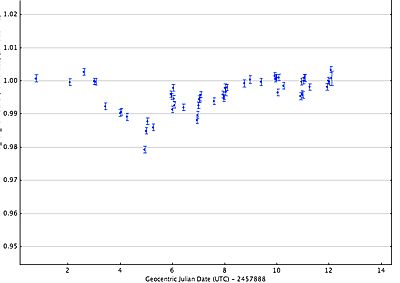
“Well, not quite.  Nobody was looking in 2015.  But Kickstarter funding let the team buy observing time in 2017.  A dip came in right on schedule.  Here’s the picture. [shows smartphone around]”

WTF 2017 peak after day 5
Visible-light photometry of Tabby’s Star
14-28 May 2017
Image from Dr Boyajian’s blog

Cathleen snorted.  “Damn shame we need crowd-funding to support Science these days.”

“True,” I agreed, “but the good news is that the support is there.  Suddenly you’re scribbling on the back of that envelope.  So what does this chart tell us?”

“I’m sure every astronomer out there will tell you, ‘It’s too soon to say anything for sure.‘  This is raw data, which means it’s hasn’t gone through the usual clean-up process to account for instrumental issues, long-term trending, things like that.  The timing is great, though.  The bottom of this dip is at 18May2017.  The first dip bottomed out 2267 days earlier on 4March2011.  Counting the 2015 case that no-one saw, there’d be three intervals from first to most recent.  2267÷3 makes the average 756 days.  Add 756 to the first date and we’re at 28Mar2013, right in the midst of that year’s complex mess.  It does fit together.”

“So whatever’s causing it has a 756-day orbit?”

“Could be.  I know your next question.  If the eclipsing material were in our Solar System, it’d be a bit outside the 687-day orbit of Mars.  But we’ve already ruled out causes near our solar system.  Tabby’s Star is about 1½ times our Sun’s mass.  That 756-day orbit around Tabby, if it is one, is maybe 30% wider than the orbit of Mars.  But.”

[both] “But?”

“But the dip profiles don’t match up from one cycle to the next.  This dip’s only 2% or so, a tenth of the ones in 2011 and 2013.  Of course, the 2013 event spanned multiple dips so Heaven knows which one we should match to.  Even 2011 and 2017 don’t look the same.  The usual quick-and-dirty way to compare dips is to pair up widths at half depth.  That statistic for 2011 is about a day.  This one is twice that or more.  If the absorber is orbiting the star, it’s changing shape and can’t be a planet.”Tabby in orbit
“So what do we got, Sy?”

“Damifino, Al.  Everything Cathleen just told us points to something like an enormous comet loaded with loose rocks that go flying along random paths away from the star.”

“Sorry, Sy, the infrared data rules out the comet dust that would have to be spewed out along with the rocks.  Besides, someone calculated just how much rocky material would be required to reproduce the dimming we’ve seen already.  You’d need a ‘comet’ somewhere between Earth-size and Jupiter-size, and maybe more than one, and with that much mass the rocks wouldn’t fly apart very well.  Oh, and there’s that long-term fading, which the comet idea doesn’t account for.”

“So we’re down to…”

[sigh] “The explanation of last resort, which astronomers are very reluctant to talk about because journalists tend to go overboard.  Maybe, just maybe, we’re witnessing an advanced civilization at work, constructing a Dyson sphere around a star 1500 light years away.  People have talked about such things for decades.  Think about it — the Sun sends out light in all directions.  Earth intercepts only a billionth of that.  If we could completely surround the Sun with solar panels we’d have access to a billion times more energy than if we covered our own planet with panels.  Better yet, it’s all renewable and producing 24 hours a day.  But even with advanced technology, panels around Tabby’s Star would still radiate in the infrared and we don’t see that.”

My smartphone chirped that same odd ringtone and it was that same odd number, 710-555-1701. “Hello, Ms Baird.”

“The Universe is not only stranger than you imagine, Mr Moire, it’s stranger than you can imagine.”

~~ Rich Olcott

Tabby’s Star — Weird Or Really Weird?

I needed some time to mull over what Cathleen had told me about Tabby’s Star, so I went to the counter to replenish our coffee and scones. When I returned I said, “OK, let’s recap.  Dr Boyajian’s Planet Hunters citizen scientists found a star that dims oddly.  But I understand there’s lots of variable stars out there.  What’s so special about this one that the SETI project got interested?”

“There’s variable stars and variable stars, but this one shouldn’t vary.  Look, one of the triumphs of 20th-century science is that we pretty much understand how stars work.  You tell me a handful of a star’s properties, things like radius, surface temperature, iron/hydrogen ratio, a couple more, and I can give you its whole life story from light-up to nova.  We’ve catalogued about 70,000 variable stars.  Virtually all of them do episodic brightening — pulsating or flaring up.  There’s about a hundred that dim more or less regularly, but they’re supergiants with cool, sooty atmospheres.  Tabby’s Star is a flat-out normal F-type main sequence star, about 1½ times the Sun’s mass and a little bit warmer.  Like the clean-cut kid next door — no reason to expect trouble from it.”

“So if it’s not the star itself that’s dimming, then something must be getting between it and us.”

“Well, yeah.  The question is what.  There’s so many theories that one pair of authors wrote a 15-page paper just classifying and rating them.”

“Gimme a few.”
Multi-Tabby Star

“Clouds of interstellar dust, for starters.  Sodium’s sparse in stars and the interstellar medium, but it’s got two easily recognized strong absorption lines in the yellow part of the visible spectrum.  Tabby’s sodium lines are broad and weak like you’d expect in a star’s atmosphere, but in the data they’re overlain by sharp, intense absorption peaks that can only come from sodium-bearing gas or dust in the nine-quadrillion-mile journey from there to here.  So there’s dispersed matter in the line of sight, but it can account for at most 35% of the dimming.  Furthermore, an interstellar cloud would have a hard time maintaining structures small enough to produce the sharp dim-and-recover pattern Boyajian found.  Loosely-bound stuff like dust clouds and gas tends to smear out in space.”

“How about comets, or rings, or clumps of asteroids orbiting the star?”

“There’s evidence against all those, but I guess I haven’t mentioned it yet.  You’ve seen the heat lamps over Eddie’s pizza bar?”

“Sure.  Infrared radiation heats things up.”

“And warm things give off infrared radiation.  ‘Warm’ meaning anything above absolute zero.  Better yet, there’s a well-known relation between an object’s temperature and its infrared spectrum.  Rocks or dust anywhere near the star would absorb energy from whatever kind of light and re-radiate it as heat infrared we could see.  The spectrum would show more infrared than you’d expect from the star itself.  And there isn’t any extra infrared.”

“None?”

“Not so’s our technology can detect.  If there’s any there, it’s less than 0.2% of the total coming from the star, nowhere near enough to account for those 8%, 16% and 22% dips.  So no, no comets or rings or asteroid clumps orbiting Tabby’s Star.”

“How about something orbiting our Sun, way far out where we’ve not found it yet?”

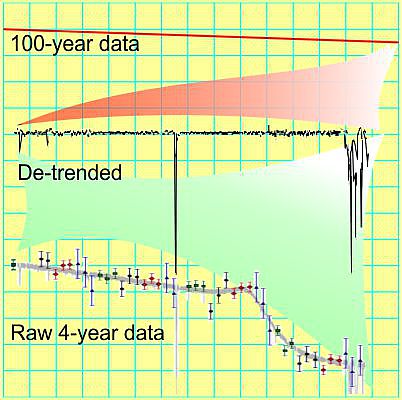
“Any light-blocking object near us, like maybe in the Oort Cloud that sends us long-term comets, should produce the same sort of weirdness from Tabby’s near neighbors.  We don’t see that.  One astronomer studied a star only 25 arc-seconds away — steady as a rock.  So whatever’s causing the dimming is probably close to Tabby’s star.  Oh, wait, here’s one more weirdness.  I just saw a report…” [twiddles on tablet] “Yeah, here it is.  Check out this chart.”Dimming montage“You’ll have to unravel that for me.”

“Sure.  The Planet Hunter team was looking for transits, which generally take at most a few days, so the Kepler science team filtered out slow variations before passing the data along.  After Boyajian’s report came out, two Keplerians looked back at the raw data.  I told you about the 3-6% dimming (estimates vary) since 1890.  The raw Kepler data show a 3% drop in four years!”

“I’m starting to think about Dyson Spheres and Larry Niven’s Ringworld.”

“Now you know why SETI got excited.”

~~ Rich Olcott

The Weirdest, And Naughtiest, Star in The Galaxy

It was an interesting ringtone — aggressive but feminine, with a hint of desperation.  And it was a ringtone I hadn’t programmed into my phone.  The number was intriguing, too — 710-555-1701.  It didn’t add up, so I answered the ring. “Moire here.”

“Hello, Mr Moire, this is Victoria Baird.”

It’s been a long time, Ms Baird.  What can I do for you?”  Her voice and the memory of her pointed ears sent chills down my spine.

“This time it’s what I can do for you, Mr Moire.  Here’s a tip — Tabby’s star.”  I could hear the italics.  I wanted to ask questions but the line went dead.

Considering the context, I called my Astronomy Department source.  “Morning, Cathleen.  It’s break time, can I buy you some of Al’s coffee and a scone?”

“You’re going to ask me questions, aren’t you?  What am I going to have to bone up on?  I know, it’s Tabby’s Star, right?”

“Got it in one, Cathleen.  Meet you at Al’s?”

“Yeah, give me 15 minutes.”Tabbystar 400

A quarter-hour later we had a table, two mugs of coffee and a plate of scones in front of us.  “So how’d you know I’d be asking about Tabby’s star?  And what is it?  And who is Tabby?”

“Tabby is Tabetha (she spells it with an ‘e’) Boyajian, PhD.  She teaches Astronomy at Louisiana State, does research specializing in high-precision star measurement.  In her spare time she manages a citizen-scientist project called Planet Hunters.  The Hunters get their kicks combing through databases from the Kepler satellite telescope.  They get all excited if the records indicate that a star’s been transited.”

“Oh, like that star-dimming that found the TRAPPIST-1 planets?”

“Exactly.  I think they’ve got over a hundred candidate planetary systems and a couple-dozen confirmed ones to their credit by now.  Anyhow, 2012 was a banner year for them, ’cause they raised an alert on what’s now being called the weirdest star in the galaxy.”

“Which would be Tabby’s Star.  Got it.  But what’s weird about it?”

“Poets like to write about ‘the constant stars.’  This star is world-champion not-constant.  You know how stars seem to flicker when you look at them?”

“Yeah, that’s how I tell them apart from planets.”

“Then you know that the flickering comes from starlight getting messed up going through our turbulent atmosphere.  Astronauts don’t see the flickering.  Neither does Kepler up there, so it can reliably detect miniscule variations in a star’s output.  Virtually all of the 150,000 stars it tracked for four years had rock-steady production.  A few of them occasionally dimmed or flared by maybe a percent, but Tabby’s Star (formally known as KIC 8462852) got the Hunters’ attention when it dimmed by 16%.”

“Twenty times a normal dimming!  Did it stay that way or did the light come back up again?”

“Oh, it came back all right, but the curve on the way up didn’t match the curve on the way down.  That was even weirder.  So the team scoured through the star’s 4-year record and found a dozen events on the 0.05-2% scale, plus one at 8% and another at 21%.”

“21%?  That’s a big shadow.”

“Ya think?  Especially since the between-event timing was seriously irregular and some of those events were complex with three or more separate components.  But that’s not all the weirdness. Those dips lasted for hours or even days, longer than most planetary transits.  After Boyajian and her 48 collaborators published their initial report, which has to have one of the naughtiest titles in the astronomical literature, some other —”

“Wait, a naughty title?  C’mon, don’t tease.”

“OK <sigh>.  The technical term for a star’s light output is flux.  That paper was half about the observations and half about what might be causing the variation.  Assuming the star’s real output is constant, the question becomes, ‘What happened to that missing light?‘  Or as the authors put it, ‘Where’s The Flux?‘  Since then both the paper and the star have been informally referred to as WTF.  OK?”

“OK <sigh>.  So you were saying there’s something else.”

“Yeah.  Some other astronomers went digging in the archives.  WTF has been dimming gradually for at least the past 100 years.  Weird, eh?”

“Yeah.  So what’s causing it?”

“We don’t even have good guesses.”

~~ Rich Olcott

Gozer, The Stay Puft Black Hole

We’re downstairs at Eddie’s Pizza.  Vinnie orders his usual pepperoni.  In memory of Sam Panapoulos, I order a Hawaiian.  Then we’re back to talking black holes.

“I been thinking, Sy.  These regular-size black holes, the ones close to the Sun’s mass, we got a lot of ’em?”

“I’ve seen an estimate of 50,000 in the Milky Way Galaxy so you could say they’re common.  That’s one way to look at it.  The other way is to compare 50,000 with the 250 billion stars in the galaxy.  One out of 5,000,000 is a black hole, so they’re rare.  Your choice, Vinnie.”

“But all three confirmed LIGO signals were the next bigger size range, maybe 10 to 30 solar masses; two of ’em hittin’ each other and they’ve all been more than a billion lightyears away.  How come LIGO doesn’t see the little guys that are close to us?”

“Darn good question.  Lessee… OK, I’ve got several possibilities.  Maybe the close-in little guys do collide, but the signal’s too weak for us to detect.  But we can put numbers to that.  In each LIGO event we’ve seen, the collision released about 10% of their 40-to-60-Sun total mass-energy in the form of gravitational waves.  LIGO’s just barely able to detect that, right?”

“They were excited they could, yeah.”

“So if a pair of little-guy black holes collided they’d release about 10% of two makes 0.2 solar masses worth of energy.  That’d be way below our detection threshold if the collision is a billion light-years away.  But we’re asking about collisions inside the Milky Way.  Suppose the collision happened near the center, about 26,000 lightyears from us.  Signal strength grows as the square of how close the source is, so multiply that ‘too weak to detect’ wave by (1 billion/26000)² =15×1012, fifteen quadrillion.  LIGO’d be deafened by a signal that strong.”

“But LIGO’s OK, so we can rule that out.  Next guess.”

“Maybe the signal’s coming in at the wrong frequency.  The equations say that just before a big-guy collision the two objects circle each other hundreds of times a second.  That frequency is in the lower portion of the 20-20,000 cycles-per-second human audio range.  LIGO’s instrumentation was tuned to pick up gravitational waves between 30 and 7,000.  Sure enough, LIGO recorded chirps that were heard around the world.”

“So what frequency should LIGO be tuned to to pick up little-guy collisions?”

“We can put numbers to that, too.  Physics says that at a given orbit radius, revolution frequency varies inversely with the square root of the mass.   The big-guy collisions generated chirps between 100 and 400 cps.  Little guy frequencies would be f2/f50=√(50/2)=5 times higher, between 500 and 2000 cps.  Well within LIGO’s range.”

“We don’t hear those tweets so that idea’s out, too.  What’s your third try?”

“Actually I like this one best.  Maybe the little guys just don’t collide.”

“Why would you like that one?”

“Because maybe it’s telling us something.  It could be that they don’t collide simply because they’re surrounded by so many other stars that they never meet up.  But it also could be that binary black holes, the ones that are fated to collide with each other, are the only ones that can grow beyond 10 solar masses.  And I’ve got a guess about how that could happen.”

“Alright, give.”

“Let’s start with how to grow a big guy.  Upstairs we talked about making little guys.  When a star’s core uses up one fuel, like hydrogen, there’s an explosive collapse that sets off a hotter fuel, like helium, until you get to iron which doesn’t play.  At each step, unburnt fuel outside the core gets blown away.  If the final core’s mass is greater than about three times the Sun’s you wind up with a black hole.  But how about if you don’t run out of fuel?”

“How can that happen?  The star’s got what it’s got.”Binary protoBHs

“Not if it’s got close neighbors that also expel unburnt fuel in their own burn-collapse cycles.  Grab their cast-off fuel and your core can get heavier before you do your next collapse.  Not impossible in a binary or cluster where all the stars are roughly the same age.  Visualize kids tossing marshmallows into each other’s mouths.”

“Or paying for each other’s pizzas.  And it’s your turn.”

~~ Rich Olcott

Prelude to A Waltz

An excited knock, but one I recognize.  In comes Vinnie, waving his fresh copy of The New York Times.

LIGO‘s done it again!  They’ve seen another black hole collision!”

“Yeah, Vinnie, I’ve read the Abbott-and-a-thousand paper.  Three catastrophic collisions detected in less than two years.  The Universe is starting to look like a pretty busy place, isn’t it?”

“And they all involve really big black holes — 15, 20, even 30 times heavier than the Sun.  Didn’t you once say black holes that size couldn’t exist?”

“Well, apparently they do.  Of course the physicists are busily theorizing how that can happen.  What do you know about how stars work, Vinnie?”

“They get energy from fusing hydrogen atoms to make helium atoms.”

“So far, so good, but then what happens when the hydrogen’s used up?”

“They go out, I guess.”

“Oh, it’s a lot more exciting than that. Does the fusion reaction happen everywhere in the star?”

“I woulda said, ‘Yes,’ but since you’re asking I’ll bet the answer is,  ‘No.'”

“Properly suspicious, and you’re right.  It takes a lot of heat and pressure to force a couple of positive nuclei close enough to fuse together despite charge repulsion.  Pressures near the outer layers are way too low for that.  For our Sun, for instance, you need to be 70% of the way to the center before fusion really kicks in.  So you’ve got radiation pressure from the fusion pushing everything outward and gravity pulling everything toward the center.  But what’s down there?  Here’s a hint — hydrogen’s atomic weight is 1, helium’s is 4.”

“You’re telling me that the heavier atoms sink to the center?”

“I am.”

“So the center builds up a lot of helium.  Oh, wait, helium atoms got two protons in there so it’s got to be harder to mash them together than mashing hydrogens, right?”Star zones
“And that’s why that region’s marked ash zone in this sketch.  Wherever conditions are right for hydrogen fusion, helium’s basically inert.  Like ash in a campfire it just sinks out of the way.  Now the fire goes out.  What would you expect next?”

“Radiation pressure’s gone but gravity’s still there … everything must slam inwards.”

Slam is an excellent word choice, even though the star’s radius is measured in thousands of miles.  What’s the slam going to do to the helium atoms?”

“Is it strong enough to start helium fusion?”

“That’s where I’m going.  The star starts fusing helium at its core.  That’s a much hotter reaction than hydrogen’s.  When convective zone hydrogen that’s still falling inward meets fresh outbound radiation pressure, most of the hydrogen gets blasted away.”

“Fusing helium – that’s a new one on me.  What’s that make?”

“Carbon and oxygen, mostly.  They’re as inert during the helium-fusion phase as helium was when hydrogen was doing its thing.”

“So will the star do another nova cycle?”

“Maybe.  Depends on the core’s mass.  Its gravity may not be intense enough to fuse helium’s ashes.  In that case you wind up with a white dwarf, which just sits there cooling off for billions of years.  That’s what the Sun will do.”

“But suppose the star’s heavy enough to burn those ashes…”

“The core’s fresh light-up blows away infalling convective zone material.  The core makes even heavier atoms.  Given enough fuel, the sequence repeats, cycling faster and faster until it gets to iron.  At each stage the star has less mass than before its explosion but the residual core is more dense and its gravity field is more intense.  The process may stop at a neutron star, but if there was enough fuel to start with, you get a black hole.”

“That’s the theory that accounts for the Sun-size black holes?”

“Pretty much.  I’ve left out lots of details, of course.  But it doesn’t account for black holes the size of 30 Suns — really big stars go supernova and throw away so much of their mass they miss the black-hole sweet spot and terminate as a neutron star or white dwarf.  That’s where the new LIGO observation comes in.  It may have clued us in on how those big guys happen.”

“That sketch looks like a pizza slice.”

“You’re thinking dinner, right?”

“Yeah, and it’s your turn to buy.”

~~ Rich Olcott

Goldilocks Zone and The Three Gazillion Bears

“Tell me a bedtime story, Uncle Sy.”

“OK, Teena, what kind of story?”

“One with bears in it.  Nice bears.”

“Hmm…  How about ‘Goldilocks Zone and The Three Gazillion Bears’?”

“Gazillion?  Is that what kind of a bear they are?”

“No, that’s a number word.  It means ‘more than you could ever hope to count.’  Like a million but way way more.”

“But if you can’t count them, how do you know there are three times that many?”

“You’ll see, have patience.”

“Little girls don’t have patience, Uncle Sy, I wanna hear the story.  Wait, water bears?”

“Mm-hm, they’re a different kind of bear.”

“What’s different about them, and what do they do with water?  I bet they swim.”

“Why yes, they do.  In fact, they spend most of their time in water or at least being wet.  Another thing that’s special about them is that they’re tiny, about the size of the smallest dot you can see on your Mommy’s computer screen here.”
waterbear 1“If they’re so small, why are they called bears?”

“Take a look.  Doesn’t she look kind of like a nice bear?”

“She’s got too many legs.”

“She’s got just the right number for water bears.”

“And she’s green.”

“Well, yes, but the picture’s kind of pretend and doesn’t show proper colors.  She’s so small she’s almost transparent.  She eats particles of algae and such, so maybe in real life she might be sort of green.”

“I like the way she’s smiling.  She reminds me of …  the fat man in the Laurel-n-Hardy movie you showed me last Saturday.”

“Oliver Hardy?  Yeah, I can see that.  Except the smiley bit is actually a wrinkle.  Her mouth is the round thing that looks like a nose.”

“That’s silly.  If her nose is her mouth how can she breathe?”

“Through her skin.  Animals can do that if they’re very small.”

“How else is she different?”

“Well, her kind’s one of Earth’s oldest animals.  Scientists have found water bear fossils over 500 million years old, twice as old as the oldest dinosaur.”

“Older than dinosaurs!”

“But the big thing and the big puzzle is, they’re amazingly rugged little beasties.  They live all over the world — high on mountaintops, at the bottom of the sea, next to ice at the South Pole and next to boiling hot springs.  In experiments, water bears have survived doses of chemicals and radiation that would kill most other creatures.  Astronauts on the ISS even exposed dried-out water bears to the vacuum of space.  The little guys just got happy-active again when they were brought back inside and dunked in some water.”

“What’s the puzzle?”

“Why are they so tough?  They make special molecules that protect them against dehydration and radiation and toxins even though they live in wet environments that don’t get irradiated and rarely get poisoned.  Fish and insects that evolved in lightless caves stopped using energy to make eyes they don’t need.  Why or even how have water bears held onto all that specialized protective DNA for hundreds of millions of years?”

“Does anybody know the answer?”

“Nope.  Some people have guessed that because water bears can survive exposure to space, maybe they came to Earth from another planet somewhere.  Maybe some advanced civilization sprayed water bears out into the Universe to spread life around.  Doesn’t that sound spooky?”

“Ooohh, yeah.  I like that.  Water bears from space!”

“But it gets better.  Maybe there’s different kinds of water bears for different kinds of planets.  That’s where Goldilocks Zones come in.  What did Goldilocks say about the porridge?”

“This bowl’s too hot and this bowl’s too cold, but this bowl is j-u-s-t right!”Water bears and planet“Yup, and that’s one way astronomers can classify planets.  Earth’s in the Goldilocks Zone for liquid water, essential for life as we know it.  Saturn’s moon Titan might support some other kind of life in its cold hydrocarbon seas.  If that’s the case, there’d be a much colder Goldilocks Zone for that kind of life.  Maybe there’s another, hotter Goldilocks Zone for life that’s happy in molten silica.  And maybe there’s water bears designed for each kind of Goldilocks Zone.”

“Mommy, Uncle Sy’s being silly again.”

“Nighty-night, Teena-girl.  Sweet dreams.”

“Nighty-night.”

~~ Rich Olcott