How Many Ways Can You Look at The Sky?

Cathleen and I were discussing her TRAPPIST-1 seminar in Al’s coffee shop when a familiar voice boomed over the room’s chatter.

“Hey, Cathleen, I got questions.”

“Vinnie?”

“Yeah, Sy, he hangs out with the Astronomy crew sometimes.  You know him, too, huh?”

“From way back.  Long story.”

“What’re your questions, Vinnie?”

“I missed the start of your talk, Cathleen, but why so much hype about this TRAPPIST-1 system?  We’ve already found 3,500 stars with planets, right, and some of them have several.  What’s so special here?”

“You’re right, Vinnie, Kepler-90 has seven planets, just like TRAPPIST-1. (brandishes a paper napkin)  But that star’s more than 60 times further from us than TRAPPIST-1 is.  It’s just too far away for us to be able to learn much more about the planets than their masses and orbital characteristics.  This new system’s only 40 lightyears away, close enough that we’ve got a hope of seeing what’s in the planetary atmospheres.”

(another paper napkin)  “That ties in with the second thing that’s special.  The star’s surface temperature, 2550ºK, is so low that even though its planets orbit very close in, three of them are probably in the Goldilocks Zone.  They’re not too hot and not too cold for liquid water to exist on their surface.  IF there’s liquid water on one of them and IF there’s something living there, we should be able to detect traces of that biochemistry in the planet’s atmosphere.”

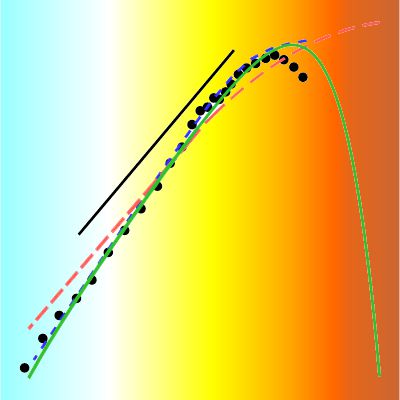
Star demographics
Observational data (dots) and four different models
of star count (vertical axis) versus temperature.
Hotter stars are to the left.

(napkin #3)  “The third special thing is that TRAPPIST-1 is the first-known planet-hosting star in its category — ultra-cool dwarf stars burning below 2700°K.  Finding those stars is hard — they’re small and dim.  No-one really knows how many there are compared to the other categories.  Some models say they should be rare, other models suggest they could be as common as G-type stars like our Sun.  IF there’s lots of ultra-cool dwarfs and IF they generally have planets like G-type stars do, then the category’s a new prime target for exoplanet hunters seeking life-signs.”

“Why’s that?”

“Because it’s easier to spot a small planet around a small star than around a big one.  Transits across TRAPPIST-1 dim its light by 1% or so.  A TRAPPIST-1 planet transiting our Sun would dim it by 1/100th of that.  The same problem hinders planet-finding methods fishing for stars that wobble because a planet’s orbiting around it.”

“Alright, I get that TRAPPIST-1 is special.  My other question is, I heard the part of your talk where you figured the odds on seeing its transits, but you lost me with the word steradian.  My dictionary says that’s an area on a sphere divided by the square of the sphere’s radius. What would that get me?  Where’d your numbers come from?”

“You need one additional piece of information.  If you take any sphere’s total surface area and divide that by r², you’ll always get 4π steradians.  You can use that to convert between absolute surface area and fraction of the sphere.  Mmm…  Sy, you own some land outside of town, yes?”

“A little.”

“And you have mineral rights?”

“Oh, yeah, that’s why I bought it.”

“And they go how far down?”

“All the way to the center of the Earth.”

“So your claim’s actually a pyramid 6370 kilometers deep.  When I moved here I learned it’s impolite to ask how much land someone has.  For round numbers I’ll assume 40 acres, which is about 1,000 square meters.  (tapping keys on her smartphone)  The Earth’s radius is 6.37×10⁶ meters, so Sy’s claim is 1,000/(6.37×106)2 = 2.47×10⁻¹¹ steradians.  Divide 4π by that and you get … 5.08×10¹¹.  So Earth’s entire surface has room for 5.08×10¹¹ patches matching Sy’s.  Visualize 5.08×10¹¹ pyramids pointing in every direction from Earth’s center.  Now extend each pyramid outward to define a separate patch of sky.  Got that picture, Vinnie?”viewing cones

“Sort of.”

“TRAPPIST-1 is 3.74×10¹⁷ meters away.  TRAPPIST-1h’s orbit is a near-circle whose radius is 9.45×10⁹ meters.  It covers π(9.45×10⁹)2/(3.74×1017)2 = 2.00×10⁻¹⁵ steradians on a sphere centered on us. Divide 4π by 2.00×10-15 …  6.27×10¹⁵ sky-patches the size of TRAPPIST-1h’s orbit.  They had to pick the right patch to find TRAPPIST-1.”

“Long odds.”

“Yep.”

~~ Rich Olcott

The Luck o’ The (insert nationality here)

“Afternoon, Al.  What’s the ruckus in the back room?”

“Afternoon, Sy.  That’s the Astronomy crew and their weekly post-seminar coffee-and-critique session.  This time, though, they brought their own beer.  You know I don’t have a beer license, just coffee, right?  Could you go over there and tell ’em to keep it covered so I don’t get busted?”

“Sure, Al.  … Afternoon, folks.  What’s all the happy?”

“Hey, Sy, welcome to the party.  Trappist beer, straight from Belgium!”

“Don’t mind if I do, Cathleen, but Al sure would like for you to put that carton under the table.  Makes him nervous.”

“Sure, no problem.”

“Thanks.  I gather your seminar was about the new seven-planet system.  How in the world do the Trappists connect to that story?”

“Patriotism.  The find was announced by a team from Belgium’s University of Liege.  They’ve built a pair of robotic telescopes tailored for seeking out rocks and comets local to our Solar System.  Exoplanets, too.  Astronomers love tying catchy acronyms to their projects.  This group’s proudly Belgian so they called their robots TRAnsiting Planets and Planetesimals Small Telescopes, ergo TRAPPIST, to honor the country’s 14 monasteries.  And their beer.  Mainly the beer, I’ll bet.”

“So the planets are a Belgian discovery?”

“Well, the lead investigator, Michaël Gillon, is at Liege, and so are half-a-dozen of his collaborators.  Their initial funding came from the Belgian government.  But by the time the second paper came out, the one that claimed a full seven planets spanning a new flavor of Goldilocks Zone, they’d pulled in support and telescope time from over a dozen other countries — USA, India, UK, France, Morocco, Saudi Arabia… the list goes on.  So it’s Belgian mostly but not only.”

“I love international science.  Next question — I see the planets are listed as TRAPPIST-1b, TRAPPIST-1c, and so on up to TRAPPIST-1h.  What happened to TRAPPIST-1a?”

“Rules of nomenclature, Sy.  TRAPPIST-1a is the star itself.  Actually, the star already had a formal name, which I just happen to have written down in my seminar notes somewhere … here it is, 2MASS J23062928 – 0502285.  You can see why TRAPPIST-1 is more popular.”

“I’m not even going to ask how that other name unwinds.  So what was the seminar topic this week?”

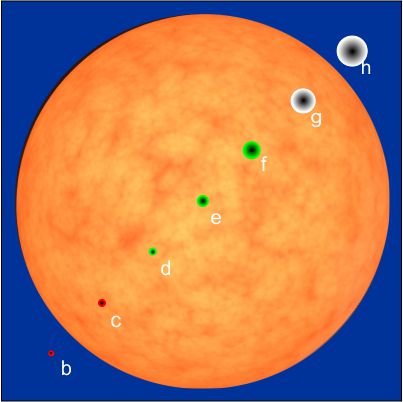
7 planets
TRAPPIST-1’s planets,
drawn to scale against their star. The
green ones are in the Goldilocks Zone.

“The low probability for us ever noticing those planets blocking the star’s light.”

“I’d think seeing a star winking on and off like it’s sending Morse code would attract attention.”

“That’s not close to what it was doing.  It’s all about the scale.  You know those cartoons that show planets together with their host sun?”

(showing her my smartphone) “Like this one?”

“Yeah.  It’s a lie.”

“How is it lying?”

“It pretends they’re all right next to the star.   7 planets perspectiveThis image is a little better.”  (showing me her phone)  “This artist at least tried to build in some perspective.  Even in this tiny solar system, about 1/500 the radius of ours, the star’s distance to each planet is hundreds to a thousand times the size of the planet.  You just can’t show planets AND their orbits together in a linear diagram.  Now, think about how small these planets are compared to their sun.”

“Aaaa-hah!   When there’s an eclipse, only a small fraction of the light is blocked.”

“That’s part of it.  Each eclipse (we call them transits) dims the measured brightness by only a percent or so.  But it’s worse than that.”

eclipses“How so?”

“All those orbits lie in a single plane.  We can’t see the transits unless our position lines up with that plane.  If we’re as little as 1½° out of the plane, we miss them.  But it’s worse than that.”

“How so?”

“During a transit, each planet casts a conical shadow that defines a patch in TRAPPIST-1’s sky.  You can tile TRAPPIST-1’s sky with about 150,000  patches that size.  There’s one chance in 150,000 of being in the right patch to see that 1% dimming.  In our sky there are over 6×10¹⁵ patches the size of TRAPPIST-1h’s orbit.  The team had to inspect the just right patch to find it.”

“With odds like that, no wonder TRAPPIST uses robots.”

“Yep.”

~~ Rich Olcott

The New System’s in Tune

<We interrupt our running story line to bring you this important development…>

“Morning, Sy.  What can I get you?”

“My usual mugfull of black, Al.  What’s the Scone-of-The-Day?”

“I’m calling this The Trappist.  It’s got raspberry jam!”

“Why that name?”

“In honor of TRAPPIST-1, you know, that star they just found a bunch of planets around.”

“Your coffee shop being right next to the Astronomy building, I guess you’ve heard a lot about it.”

“Sy, you couldn’t believe.  The planetologists are going nuts of course, even though no-one’s actually seen the planets, and the astrometrics folks are lining up for telescope time ’cause they’ve got a whole new class of stars to monitor and of course the astrophysicists get to figure out how the system even works.”

“Astrometrics folks?  New class of stars?”

“Yeah, the high-precision star-measurers.  They didn’t used to pay attention to the small, dim stars because why bother.  But now … woo-hoo, whole new ballgame.”

“Nobody’s seen those planets?  How do they know they’re there?”

“Process of elimination, Sy.  The TRAPPIST telescopes picked up repetitive dark blips in the light coming from that star.  It’s a close, fast-moving star so there’s no sense supposing it’s like going behind or in front of a regular array of rocks or stars or something.  It’s not wobbling side-to-side like it would if it was a binary so it’s not traveling along with another star.  If the blips were sunspots going around as the star rotates there’d be only one rhythm, but these blips come in too complicated for that.  Besides, the star’s low-activity, too cool for lotsa sunspots.  Gotta be planets eclipsing it.”

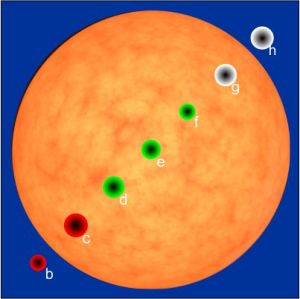
trappist-1-system-450
NASA’s artistic (and cute) rendition
of the TRAPPIST-1 system
Note the close-in steam and the frost further out

“Sounds pretty good, but…”

“Hey Sy, there was something else, maybe you could explain it.  One astrophysics guy was real impressed that the planets had residences.  I didn’t understand that.”

“Residences?  That’s a new one on me.”

“Had something to do with the blip periods.  Yeah, here’s the paper napkin he wrote ’em all down on.”

Object
TRAPPIST-1x
Period, days
Resonance
Actual /
Expected
b
1.51
c
2.42
5c:8b
1.002
d
4.05
3d:5c
1.004
e
6.10
2e:3d
1.004
f
9.20
2f:3e
1.006
g
12.35
3g:4f
1.007
h
20?
5h:8g
1.012?

“Oh, resonances! That I recognize, and yeah, those numbers are much more convincing.  Remember my post about gear logic?”

“Sorry, Sy, that must’ve been a long time ago and who has time to read?”

“I understand.  OK, that post explained how planets that survive the early chaos of a forming solar system tend to wind up in orbits whose relative year-lengths form ratios of small whole numbers.  In our system, for instance, the length of Pluto’s year is exactly 3/2 of Neptune’s, Neptune’s year is twice that of Uranus, and so on.  If a planet doesn’t synch up with its neighbors, it’ll collide with someone or be flung out of the system.  Put another way, a system’s not stable if its planetary orbit periods are just any old numbers.  Make sense?”

“I suppose, so…?”

“So look at this guy’s table.  The periods of each pair of adjacent objects follow that rule almost exactly.  Five times c‘s period is less than 0.25% away from eight times b‘s, and so on all the way out to h, which I take it has an uncertain period because the guy put in that question mark.  In fact, I think this system follows the rule more tightly than our Solar System does.  As far as I’m concerned that regularity in the periods makes the case for TRAPPIST-1 having planets.  You hear anything else?”

“Yeah, there was a lot of excitement about the middle three planets being in some kind of Goldilocks zone.  What’s that about?”

“Hah, I’d be excited, too.  If a planet’s too close to the star, like Mercury is to ours, it’ll be too hot for liquid water.  If the planet’s too far, any water it has would be frozen stiff.  Either way, not good for life to grow there.  In the Goldilocks zone, it’s…”

“Just right, huh, Sy?”

“On the nose, Al.  I’m going to have to read up on TRAPPIST-1.”

~~ Rich Olcott

Three Body Problems

The local science museum had a showing of the Christopher Nolan film Interstellar so of course I went to see it again.  Awesome visuals and (mostly) good science because Nolan had tapped the expertise of Dr Kip Thorne, one of the primary creators of LIGO.  On the way out, Vinnie collared me.

“Hey, Sy, ‘splain something to me.”

“I can try, but first let’s get out of the weather.  Al’s coffee OK with you?”

“Yeah, sure, if his scones are fresh-baked.”

Al saw me walking in.  “Hey, Sy, you’re in luck, I just pulled a tray of cinnamon scones out of the oven.”  Then he saw Vinnie.  “Aw, geez, there go my paper napkins again.”

Vinnie was ready.  “Nah, we’ll use the backs of some ad flyers I grabbed at the museum.  And gimme, uh, two of the cinnamons and a large coffee, black.”

“Here you go.”

At our table I said, “So what’s the problem with the movie?”

“Nobody shrank.  All this time we been talking about how things get smaller in a strong gravity field.  That black hole, Gargantua, was huge.  The museum lecture guy said it was like 100 million times as heavy as the Sun.  When the people landed on its planet they should have been teeny but everything was just regular-size.  And what’s up with that ‘one hour on the planet is seven years back home’ stuff?”

“OK, one thing at a time.  When the people were on the planet, where was the movie camera?”

“On the planet, I suppose.”

“Was the camera influenced by the same gravitational effects that the people were?”

“Ah, it’s the frames thing again, ain’t it?  I guess in the on-planet inertial frame everything stays the relative size they’re used to, even though when we look at the planet from our far-away frame we see things squeezed together.”

(I’ve told you that Vinnie’s smart.)  “You got it.  OK, now for the time thing.  By the way, it’s formally known as ‘time dilation.’  Remember the potential energy/kinetic energy distinction?”

“Yeah.  Potential energy depends on where you are, kinetic energy depends on how you’re moving.”

“Got it in one.  It turns out that energy and time are deeply intertwined all through physics.  Would you be surprised if I told you that there are two kinds of time dilation, one related to gravitational potential and the other to velocity?”

“Nothing would surprise me these days.  Go on.”

“The gravity one dropped out of Einstein’s Theory of Special Relativity.  The velocity one arose from his General Relativity work.”  I grabbed one of those flyers.  “Ready for a little algebra?”

“Geez.  OK, I asked for it.”gargantua-3
“You certainly did.  I’ll just give you the results, and mind you these apply only near a non-rotating sphere with no electric charge.  Things get complicated otherwise.  Suppose the sphere has mass M and you’re circling around it at a distance r from its geometric center.  You’ve got a metronome ticking away at n beats per your second and you’re perfectly happy with that.  We good?”

“So far.”

“I’m watching you from way far away.  I see your metronome running slow, at only n√[1-(2 G·M/r·c²)] beats per my second.  G is Newton’s gravity constant, c is the speed of light.  See how the square root has to be less than 1?”

“Your speed of light or my speed of light?”

“Good question, considering we’re talking about time and space getting all contorted, but Einstein guarantees that both of us measure exactly the same speed.  So anyway, in the movie both the Miller’s Planet landing team and that poor guy left on good ship  Endurance are circling Gargantua.  Earth observers would see both their clocks running slow.  But Endurance is much further out (larger r, smaller fraction) from Gargantua than Miller’s Planet is.  Endurance’s distance gave its clock more beats per Earth second than the planet gets, which is why the poor guy aged so much waiting for the team to return.”

“I wondered about that.”

Then we heard Ramona’s husky contralto.  “Hi, guys.  Al said you were back here talking physics.  Who wants to take me dancing?”

We both stood up, quickly.

“Whee, this’ll be fun.”

~~ Rich Olcott

Gravity’s Real Rainbow

Some people are born to scones, some have scones thrust upon them.  As I stepped into his coffee shop this morning, Al was loading a fresh batch onto the rack.  “Hey, Sy, try one of these.”

“Uhh … not really my taste.  You got any cinnamon ones ready?”

“Not much for cheddar-habañero, huh?  I’m doing them for the hipster trade,” waving towards all the fedoras on the room.  “Here ya go.  Oh, Vinnie’s waiting for you.”

I navigated to the table bearing a pile of crumpled yellow paper, pulled up a chair.  “Morning, Vinnie, how’s the yellow writing tablet working out for you?”

“Better’n the paper napkins, but it’s nearly used up.”

“What problem are you working on now?”

“OK, I’m still on LIGO and still on that energy question I posed way back — how do I figure the energy of a photon when a gravitational wave hits it in a LIGO?  You had me flying that space shuttle to explain frames and such, but kept putting off photons.”

“Can’t argue with that, Vinnie, but there’s a reason.  Photons are different from atoms and such because they’ve got zero mass.  Not just nearly massless like neutrinos, but exactly zero.  So — do you remember Newton’s formula for momentum?”

“Yeah, momentum is mass times the velocity.”

“Right, so what’s the momentum of a photon?”

“Uhh, zero times speed-of-light.  But that’s still zero.”

“Yup.  But there’s lots of experimental data to show that photons do carry non-zero momentum.  Among other things, light shining on an an electrode in a vacuum tube knocks electrons out of it and lets an electric current flow through the tube.  Compton got his Nobel prize for that 1923 demonstration of the photoelectric effect, and Einstein got his for explaining it.”

“So then where’s the momentum come from and how do you figure it?”

“Where it comes from is a long heavy-math story, but calculating it is simple.  Remember those Greek letters for calculating waves?”

(starts a fresh sheet of note paper) “Uhh… this (writes λ) is lambda is wavelength and this (writes ν) is nu is cycles per second.”

“Vinnie, you never cease to impress.  OK, a photon’s momentum is proportional to its frequency.  Here’s the formula: p=h·ν/c.  If we plug in the E=h·ν equation we played with last week we get another equation for momentum, this one with no Greek in it:  p=E/c.  Would you suppose that E represents total energy, kinetic energy or potential energy?”

“Momentum’s all about movement, right, so I vote for kinetic energy.”

“Bingo.  How about gravity?”

“That’s potential energy ’cause it depends on where you’re comparing it to.”

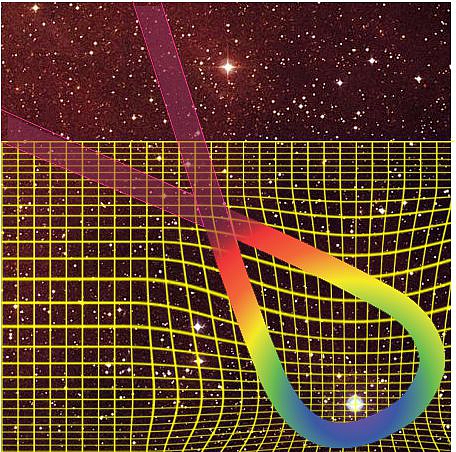
light-in-a-gravity-well“OK, back when we started this whole conversation you began by telling me how you trade off gravitational potential energy for increased kinetic energy when you dive your airplane.  Walk us through how that’d work for a photon, OK?  Start with the photon’s inertial frame.”

“That’s easy.  The photon’s feeling no forces, not even gravitational, ’cause it’s just following the curves in space, right, so there’s no change in momentum so its kinetic energy is constant.  Your equation there says that it won’t see a change in frequency.  Wavelength, either, from the λ=c/ν equation ’cause in its frame there’s no space compression so the speed of light’s always the same.”

“Bravo!  Now, for our Earth-bound inertial frame…?”

“Lessee… OK, we see the photon dropping into a gravity well so it’s got to be losing gravitational potential energy.  That means its kinetic energy has to increase ’cause it’s not giving up energy to anything else.  Only way it can do that is to increase its momentum.  Your equation there says that means its frequency will increase.  Umm, or the local speed of light gets squinched which means the wavelength gets shorter.  Or both.  Anyway, that means we see the light get bluer?”

“Vinnie, we’ll make a physicist of you yet.  You’re absolutely right — looking from the outside at that beam of photons encountering a more intense gravity field we’d see a gravitational blue-shift.  When they leave the field, it’s a red-shift.”

“Keeping track of frames does make a difference.”

Al yelled over, “Like using tablet paper instead of paper napkins.”

~~ Rich Olcott

LIGO and lambda and photons, oh my!

I was walking my daily constitutional when Al waved me into his coffee shop.  “Sy, he’s at it again with the paper napkins.  Do something!”

I looked over.  There was Vinnie at his table, barricaded behind a pile of crumpled-up paper.  I grabbed a chair.

“Morning, Vinnie.  Having fun?”

“Greek letters.  Why’d they have to use Greek letters?”

The question was both rhetorical and derivative so I ignored it.  There were opened books under the barricade — upper-level physics texts.  “How come you’re chasing through those books?”

“I wanted to follow up on how LIGO operates with photons after we talked about all that space shuttle stuff.  But geez, Sy!”

“You’re a brave man, Vinnie.  So,  which letters are giving you trouble?”

“These two, that look kinda like each other upside down.” He pointed to one equation, λ=c.

“Ah, wavelength equals the speed of light divided by the frequency.”

“How do you do that?”

“Some of those symbols go way back.  You just get used to them.  Most of them make sense when you learn the names for the letters — lambda (λ) is the peak-to-peak length of a lightwave, and nu (ν) is the number of peaks per second.  If it makes you feel any better, I’ve yet to meet a physicist who can write a zeta (ζ) — they generally just draw a squiggle and move on.”

“And there’s this other equation,” pointing to E=h·ν.  “What’s that about?”

“Good eye.  You just picked two equations that are fundamental to LIGO’s operation.  If a lightwave has frequency ν, the equations tell us two things about it — its energy is h·ν (h is Planck’s constant, 6.6×10⁻³⁴ Joule-seconds), and its wavelength is c (c is the speed of light).  For instance, yellow light has a frequency near 520×1012/sec.  One photon carries 3.8×10-40 Joules of energy.  Not much, but it adds up when a light beam contains lots of photons.  The same photon has a wavelength near 580×10-9 meters traveling through free space.”

“So what happens when one of those photons is in a LIGO beam?  Won’t a gravitational wave’s stretch-and-squeeze action mess up its wave?”

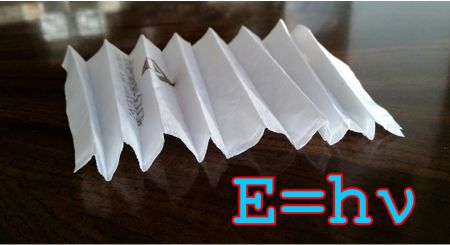
paper-napkin-waveI smoothed out one of Vinnie’s crumpled napkins. As I folded it into pleats and scooted it along the table I said, “Doesn’t mess up the wave so much as change the way we think about it.  We’re used to graphing out a spatial wave as an up-and-down pattern like this that moves through time, right?”
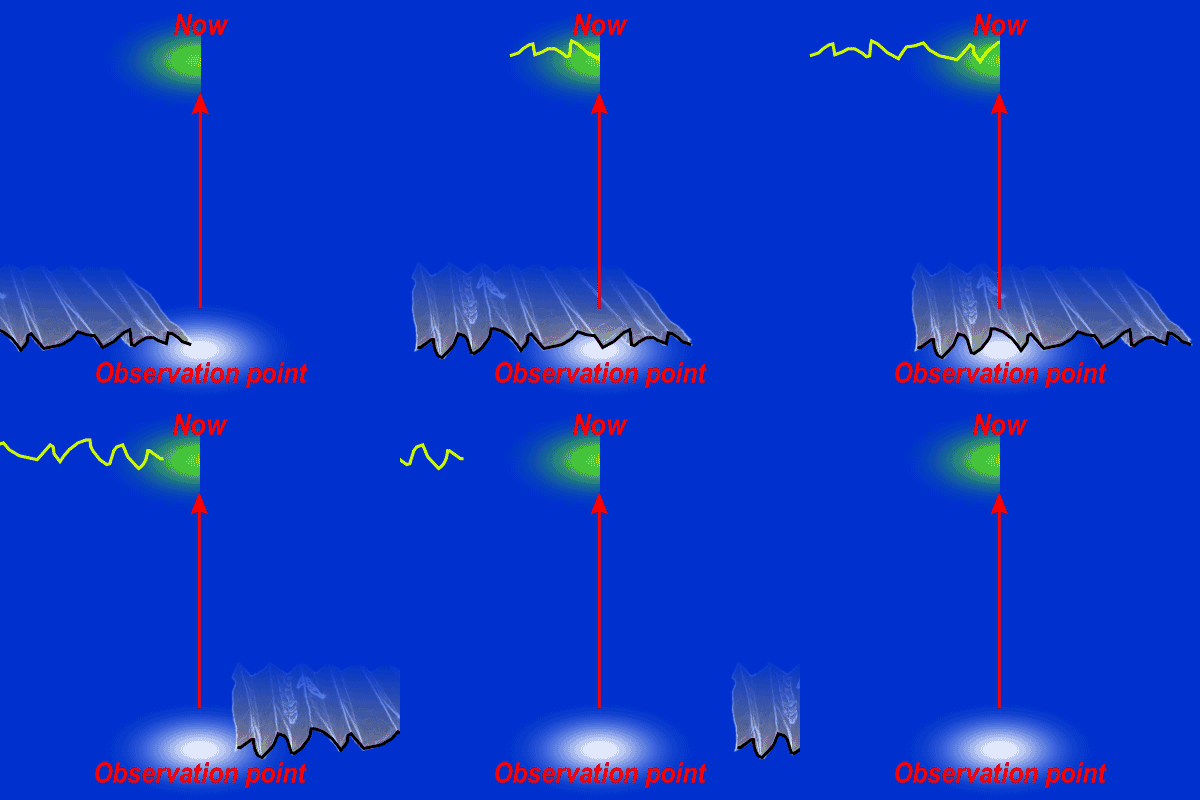
“That’s a lousy-looking wave.”

time-and-space-and-napkin
As the napkin moves through space,
the upper graph shows the height of its edge
above the observation point.

“It’s a paper napkin, f’pitysake, and I’m making a point here. Watch close.  If you monitor a particular point along the wave’s path in space and track how that point moves in time, you get the same profile except we draw it along the t-axis instead of along a space-axis.  See?”

“Hey, the time profile is the space profile going backwards.  Oh, right, it’s goin’ into the past ’cause it’s a memory.”

“That’s one of those things that people miss.  If you only draw sine waves, they’re the same in either direction.  The important point is that although timewaves and spacewaves have the same shape, they’ve got different meanings.  The timewave is directly connected to the wave’s energy by that E equation.  The spacewave is indirectly connected, because your other equation there scales it by the local speed of light.”

“Come again?  Local speed of light?  I thought it was 186,000 miles per second everywhere.”

“It is, but some of those miles are shorter than others.  Near a heavy mass, for instance, or in the compression phase of a gravitational wave, or inside a transparent material.  If you’re traveling in the lightwave’s inertial frame, you see no variation.  But if you’re watching from an independent inertial frame, you see the lightwave hit a slow patch.  Distance per cycle gets shorter.  Like that lambda-nu equation says, when c gets smaller the wavelength decreases.”

Al walked over.  “Gotcha a present, Vinnie.  Here’s a pad of yellow writing paper.  No more napkins, OK?”

“Uhh, thanks.”

“Don’t mention it.”

~~ Rich Olcott

Scone but not forgotten

Al grabbed me as I stepped into his coffee shop.  “Sy, you gotta help me!”

“What’s the trouble, Al?”

“It’s Vinnie.  He’s over there, been scribbling on paper napkins all morning.  I’m running out of napkins, Sy!”

I grabbed a cinnamon scone from the rack and a chair at Vinnie’s table.  “What’s keeping you so busy, Vinnie?”  As if I didn’t know.

LIGO, of course.  Every time I think I understand how the machine works something else occurs to me and it slips outa my hands.”

“How about you explain it to me.  Sometimes the best way to find an answer is to describe the problem to someone else.”

Interferometer 1
Vinnie’s paper napkin #1

(grabbing a napkin near the bottom of one stack) “All right, Sy, I sketched the layout here.  You got these two big L-shaped machines out in the middle of two nowheres 2500 miles apart.  Each L is a pair of steel pipes 2½ miles long.  At the far end of each arm there’s a high-tech stabilized mirror.  Where the two arms meet there’s a laser rigged up to shoot beams down both arms.  There’s also a detector located where the reflected beams join up and cancel each other out unless there’s a gravity wave going past.  Am I good so far?”

“Yeah, that’s pretty much the diagram you see in the books, except it’s gravitational waveGravity waves are something else.”

interferometer-4
Paper napkin #2

“Whatever.  So, here’s a sketch of where I was at when I asked you that first question.  See, I copied my original sketch onto another napkin and stretched it a little where the black circle is to show what a gravitational wave would do in stretch phase.  Ignore the little rips.”

“What rips?”

“Uh, thanks.  Anyway, I was thinking the gravitational wave that stretches the x-beam would also stretch the x-pipe so they couldn’t use the light wave to measure the pipe it’s in.  But LIGO works so that’s wrong thinkin’.

“OK, next is for after we talked about inertial frames.  Took me a few tries to get it like I want it and I wound up having to do two sketches, one for each frame.”  He grabbed a couple more napkins from different stacks.

interferometer-5lp
Paper napkins #37 and #59

“I didn’t do the yellow wiggles ’cause that got confusing and besides I don’t do wiggly lines so good.  Point is, the space-stretch only shows up in the laboratory inertial frame.  The light waves move with space so they don’t notice the difference, right?”

“Well, I wouldn’t want to put it that way in court, Vinnie, but it’s a pretty good description.”

“So the light waves bop along at 186,000 miles per second in their frame, but from the machine’s perspective those are stretched miles so the guy running the machine thinks those photons are faster than the ones in the other pipe.  And that difference in speed gets the yellow lines out of phase with the blue ones and the detector rings a bell or something, right?”

“It’s even better than that.” I reached for another napkin, caught Al’s eye on me and grabbed an envelope from my coat pocket instead. “Remember how a gravitational wave works in two directions perpendicular to the wave’s line of travel?”

interferometer-5d
On the back of an envelope

“Yeah, so?”

“So at the same moment that the wave is stretching space in the x-direction, it’s squeezing space in the y-direction.  LIGO’s detection scheme monitors the difference between the two returning beams.  As I’ve drawn it here using the detector’s inertial frame, the x-beam is going fast AND the y-beam is going slow so the detector sees twice the phase difference. A few milliseconds later they’ll switch because the x-direction will get squeezed while the y-direction gets stretched.  And yeah, a bell does ring but only after some computers munch on the data and subtract out environmental stuff like temperature swings and earthquakes and the janitor’s footsteps.”

“Uh-huh, I think I got it.” Turning in his chair, “Hey, Al, bring Sy here another scone, on me.  And put the one he’s got on my tab, too.”

“Thanks, Vinnie.”

“Don’t mention it.”

~~ Rich Olcott

A Matter of Perspective

As I stepped off the escalator by the luggage carousel a hand came down heavy on my shoulder.

“Keep movin’, I gotchur bag.”

That’s Vinnie, always the surprises.  I didn’t bother to ask how he knew which flight I came in on.  What came next was also no surprise.

“You owe me for the pizza.  Now about that kinetic energy –”

“Hold that thought ’til we get to my office where I can draw diagrams.”

We got my car out of the lot, drove to the Acme Building and took the elevator to 12.

As my computer booted up I asked, “When we talked about potential energy, did we ever mention inertial frames?”

“Come to think of it, no, we didn’t.  How come?”

“Because they’ve got nothing to do with potential energy.  Gravitational and electrical potentials are all about intensity at one location in space relative to other locations in space.  The potentials are static so long as the configuration is static.  If something in the region changes, like maybe a mass moves or the charge on one object increases, then the potential field adjusts to suit.”

“Right, kinetic energy’s got to do with things that move, like its name says.  I get that.  But how does it play into LIGO?”

“Let’s stick with our spacecraft example for a bit.  I’ve been out of town for a while, so a quick review’s in order.  Objects that travel in straight lines and constant speed with respect to each other share the same inertial frame.  Masses wrinkle the shape of space.  The paths light rays take are always the shortest possible paths, so we say a light ray shows us what a straight line is.

“In our story, we’re flying a pair of space shuttles using identical speed settings along different light-ray navigation beams.  Suddenly you encounter a region of space that’s compressed, maybe by a nearby mass or maybe by a passing gravitational wave.

“That compressed space separates our inertial frames.  In your inertial frame there’s no effect — you’re still following your nav beam and the miles per second you measure hasn’t changed.  However, from my inertial frame you’ve slowed down because the space you’re traveling through is compressed relative to mine.  Does all that ring a bell?”

“Pretty much the way I remember it. Now what?”shuttle-escape-framed

“Do you remember the formula for kinetic energy?”

“Give me a sec… mass times the square of the velocity.”

“Uh-huh.  Mind you, ‘velocity’ is the combination of speed and direction but velocity-squared is just a number.  So, your kinetic energy depends in a nice, simple way on speed.  What happened to your kinetic energy when you encountered that gravity well?”

“Ah, now I see where you’re going.  In my frame my speed doesn’t change so I don’t gain or lose kinetic energy.  In your frame you see me slow down so you figure me as losing kinetic energy.”

“But the Conservation of Energy rule holds across the Universe.  Where’d your kinetic energy go?”

“Does your frame see me gaining potential energy somehow that I don’t see in mine?”

“Nice try, but that’s not it.  We’ve already seen that potential energy doesn’t depend on frames.  What made our frames diverge in the first place?”

“That gravity field curving the space I’d flown into.  Hey, action-reaction!  If the curved space slowed me down, did I speed it up?”

“Now we’re getting there.  No, you didn’t speed up space, ’cause space doesn’t work that way — the miles don’t go anywhere.  But your kinetic energy (that I can see and you can’t) did act to change the spatial curvature (that I can see and you can’t).  I suspect the curvature flattened out, but the math to check that is beyond me.”

“Lemme think…  Right, so back to my original question — what I wasn’t getting was how I could lose both kinetic energy AND potential energy flying into that compressed space.  Lessee if I got this right.  We both see I lost potential energy ’cause I’ve got less than back in flat space.  But only you see that my kinetic energy changed the curvature that only you see.  Good?”

“Good.”

(sound of footsteps)

(sound of door)

“Don’t mention it.”

~~ Rich Olcott

Three ways to look at things

A familiar shadow loomed in from the hallway.

“C’mon in, Vinnie, the door’s open.”

“I brought some sandwiches, Sy.”

“Oh, thanks, Vinnie.”

“Don’t mention it.    An’ I got another LIGO issue.”

“Yeah?”

“Ohh, yeah.  Now we got that frame thing settled, how does it apply to what you wrote back when?  I got a copy here…”

The local speed of light (miles per second) in a vacuum is constant.  Where space is compressed, the miles per second don’t change but the miles get smaller.  The light wave slows down relative to the uncompressed laboratory reference frame.

“Ah, I admit I was a bit sloppy there.  Tell you what, let’s pretend we’re piloting a pair of space shuttles following separate navigation beams that are straight because that’s what light rays do.  So long as we each fly a straight line at constant speed we’re both using the same inertial frame, right?”

“Sure.”

“And if a gravity field suddenly bent your beam to one side, you’d think you’re still flying straight but I’d think you’re headed on a new course, right?”

“Yeah, because now we’d have different inertial frames.  I’d think your heading has changed, too.”two-shuttles

“So what does the guy running the beams see?”

“Oh, ground-pounders got their own inertial frame, don’t they?  Uhh… He sees me veer off and you stay steady ’cause the gravity field bent only my beam.”

“Right — my shuttle and the earth-bound observer share the same inertial frame, for a while.”

“A while?”

“Forever if the Earth were flat because I’d be flying straight and level, no threat to the shared frame.  But the Earth’s not flat.  If I want to stay at constant altitude then I’ve got to follow the curve of the surface rather than follow the light beam straight out into space.  As soon as I vector downwards I have a different frame than the guy on the ground because he sees I’m not in straight-line motion.”

“It’s starting to get complicated.”

“No worries, this is as bad as it gets.  Now, let’s get back to square one and we’re flying along and this time the gravity field compresses your space instead of bending it.  What happens?  What do you experience?”

“Uhh… I don’t think I’d feel any difference.  I’m compressed, the air molecules I breath are compressed, everything gets smaller to scale.”

“Yup.  Now what do I see?  Do we still have the same inertial frame?”

“Wow.  Lessee… I’m still on the beam so no change in direction.  Ah!  But if my space is compressed, from your frame my miles look shorter.  If I keep going the same miles per second by my measure, then you’ll see my speed drop off.”

“Good thinking but there’s even more to it.  Einstein showed that space compression and time dilation are two sides of the same phenomenon.  When I look at you from my inertial frame, your miles appear to get shorter AND your seconds appear to get longer.”

“My miles per second slow way down from the double whammy, then?”

“Yup, but only in my frame and that other guy’s down on the ground, not in yours.”

“Wait!  If my space is compressed, what happens to the space around what got compressed?  Doesn’t the compression immediately suck in the rest of the Universe?”

“Einstein’s got that covered, too.  He showed that gravity doesn’t act instantaneously.  Whenever your space gets compressed, the nearby space stretches to compensate (as seen from an independent frame, of course).  The edge of the stretching spreads out at the speed of light.  But the stretch deformation gets less intense as it spreads out because it’s only offsetting a limited local compression.”

“OK, let’s get back to LIGO.  We got a laser beam going back and forth along each of two perpendicular arms, and that famous gravitational wave hits one arm broadside and the other arm cross-wise.  You gonna tell me that’s the same set-up as me and you in the two shuttles?”

“That’s what I’m going to tell you.”

“And the guy on the ground is…”

“The laboratory inertial reference.”

“Eat your sandwich, I gotta think about this.”

(sounds of departing footsteps and closing door)

“Don’t mention it.”

~~ Rich Olcott

A Shift in The Flight

I heard a familiar squeak from the floorboard outside my office.

“C’mon in, Vinnie, the door’s open.  What can I do for you?”

“I still got problems with LIGO.  I get that dark energy and cosmic expansion got nothin’ to do with it.  But you mentioned inertial frame and what’s that about?”

earth-moon“Does the Moon go around the Earth or does the Earth go around the Moon?”

“Huh?  Depends on where you are, I guess.”

“Well, there you are.”

“Waitaminnit!  That can’t be all there is to it!”

“You’re right, there’s more.  It all goes back to Newton’s First Law.”  (showing him my laptop screen)  “Here’s how Wikipedia puts it in modern terms…”

In an inertial reference frame, an object either remains at rest or continues to move at a constant velocity, unless acted upon by a net force.

“That’s really a definition rather than a Law.  If you’re looking at an object and it doesn’t move relative to you or else it’s moving at constant speed in a straight line, then you and the object share the same inertial frame.  If it changes speed or direction relative to you, then it’s in a different inertial frame from yours and Newton’s Laws say that there must be some force that accounts for the difference.”

“So another guy’s plane flying straight and level with me has a piece of my inertial frame?”

“Yep, even if you’re on different vectors.  You only lose that linkage if either airplane accelerates or curves off.”

“So how’s that apply to LIGO’s laser beams?  I thought light always traveled in straight lines.”

“It does, but what’s a straight line?”

“Shortest distance between two points — I been to flight school, Sy.”

“Fine.  So if you fly from London to Mexico City on this globe here you’d drill through the Earth?”mex-atl-jfk-lgw

“Of course not, I’d take the Great Circle route that goes through those two cities.  It’s the shortest flight path.  Hey, how ’bout that, the circle goes through NYC and Atlanta, too.”

“Cool observation, but that line looks like a curve from where I sit.”

“Yeah, but you’re not sittin’ close to the globe’s surface.  I gotta fly in the flight space I got.”

“So does light.  Photons always take the shortest available path, though sometimes that path looks like a curve unless you’re on it, too.  Einstein predicted that starlight passing through the Sun’s gravitational field would be bent into a curve.  Three years later, Eddington confirmed that prediction.”

“Light doesn’t travel in a straight line?”

“It certainly does — light’s path defines what is a straight line in the space the light is traveling through.  Same as your plane’s flight path defines that Great Circle route.  A gravitational field distorts the space surrounding it and light obeys the distortion.”

“You’re getting to that ‘inertial frames’ stuff, aren’t you?”

“Yeah, I think we’re ready for it.  You and that other pilot are flying steady-speed paths along two navigation beams, OK?”

“Navigation beams are radio-frequency.”

“Sure they are, but radio’s just low-frequency light.  Stay with me.  So the two of you are zinging along in the same inertial frame but suddenly a strong gravitational field cuts across just your beam and bends it.  You keep on your beam, right?”

“I suppose so.”

“And now you’re on a different course than the other plane.  What happened to your inertial frame?”

“It also broke away from the other guy’s.”

“Because you suddenly got selfish?”

“No, ’cause my beam curved ’cause the gravity field bent it.”

“Do the radio photons think they’re traveling a bent path?”

“Uh, no, they’re traveling in a straight line in a bent space.”

“Does that space look bent to you?”

“Well, I certainly changed course away from the other pilot’s.”

“Ah, but that’s referring to his inertial frame or the Earth’s, not yours.  Your inertial frame is determined by how those photons fly, right?  In terms of your frame, did you peel away or stay on-beam?”

“OK, so I’m on-beam, following a straight path in a space that looks bent to someone using a different inertial frame.  Is that it?”

“You got it.”

(sounds of departing footsteps and closing door)

“Don’t mention it.”

~~ Rich Olcott