Breathing Space

It was December, it was cold, no surprise.  I unlocked my office door, stepped in and there was Vinnie, standing at the window.  He turned to me, shrugged a little and said, “Morning, Sy.”  That’s Vinnie for you.

“Morning, Vinnie.  What got you onto the streets this early?”

“I ain’t on the streets, I’m up here where it’s warm and you can answer my LIGO question.”

“And what’s that?”

“I read your post about gravitational waves, how they stretch and compress space.  What the heck does that even mean?”

gravwave
An array of coordinate systems
floating in a zero-gravity environment,
each depicting a local x, y, and z axis

“Funny thing, I just saw a paper by Professor Saulson at Syracuse that does a nice job on that.  Imagine a boxful of something real light but sparkly, like shiny dust grains.  If there’s no gravitational field nearby you can arrange rows of those grains in a nice, neat cubical array out there in empty space.  Put ’em, oh, exactly a mile apart in the x, y, and z directions.  They’re going to serve as markers for the coordinate system, OK?”

“I suppose.”

“Now it’s important that these grains are in free-fall, not connected to each other and too light to attract each other but all in the same inertial frame.  The whole array may be standing still in the Universe, whatever that means, or it could be heading somewhere at a steady speed, but it’s not accelerating in whole or in part.  If you shine a ray of light along any row, you’ll see every grain in that row and they’ll all look like they’re standing still, right?”

“I suppose.”

“OK, now a gravitational wave passes by.  You remember how they operate?”

“Yeah, but remind me.”

(sigh)  “Gravity can act in two ways.  The gravitational attraction that Newton identified acts along the line connecting the two objects acting on each other.  That longitudinal force doesn’t vary with time unless the object masses change or their distance changes.  We good so far?”
long-and-transverse-grav
“Sure.”

“Gravity can also act transverse to that line under certain circumstances.  Suppose we here on Earth observe two black holes orbiting each other.  The line I’m talking about is the one that runs from us to the center of their orbit.  As each black hole circles that center, its gravitational field moves along with it.  The net effect is that the combined gravitational field varies perpendicular to our line of sight.  Make sense?”

“Gimme a sec…  OK, I can see that.  So now what?”

“So now that variation also gets transmitted to us in the gravitational wave.  We can ignore longitudinal compression and stretching along our sight line.  The black holes are so far away from us that if we plug the distance variation into Newton’s F=m1m2/r² equation the force variation is way too small to measure with current technology.

“The good news is that we can measure the off-axis variation because of the shape of the wave’s off-axis component.  It doesn’t move space up-and-down.  Instead, it compresses in one direction while it stretches perpendicular to that, and then the actions reverse.  For instance, if the wave is traveling along the z-axis, we’d see stretching follow compression along the x-axis at the same time as we’d see compression following stretching along the y-axis.”

gravwave-2“Squeeze in two sides, pop out the other two, eh?”

“Exactly.  You can see how that affects our grain array in this video I just happen to have cued up.  See how the up-down and left-right coordinates close in and spread out separately as the wave passes by?”

“Does this have anything to do with that ‘expansion of the Universe’ thing?”

“Well, the gravitational waves don’t, so far as we know, but the notion of expanding the distance between coordinate markers is exactly what we think is going on with that phenomenon.  It’s not like putting more frosting on the outside of a cake, it’s squirting more filling between the layers.  That cosmological pressure we discussed puts more distance between the markers we call galaxies.”

“Um-hmm.  Stay warm.”

(sound of departing footsteps and door closing)

“Don’t mention it.”

~~ Rich Olcott

Gentle pressure in the dark

“C’mon in, the door’s open.”

Vinnie clomps in and he opens the conversation with, “I don’t believe that stuff you wrote about LIGO.  It can’t possibly work the way they say.”

“Well, sir, would you mind telling me why you have a problem with those posts?”  I’m being real polite, because Vinnie’s a smart guy and reads books.  Besides, he’s Vinnie.

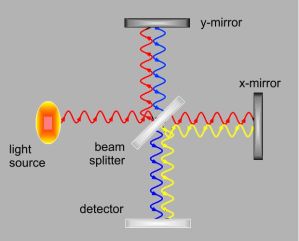
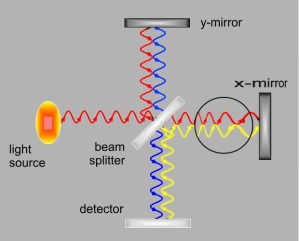
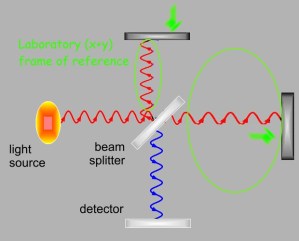
“I’m good with your story about how Michelson’s interferometer worked and why there’s no æther.  Makes sense, how the waves mess up when they’re outta step.  Like my platoon had to walk funny when we crossed a bridge.  But the gravity wave thing makes no sense.  When a wave goes by maybe it fiddles space but it can’t change where the LIGO mirrors are.”

“Gravitational wave,” I murmur, but speak up with, “What makes you think that space can move but not the mirrors?”

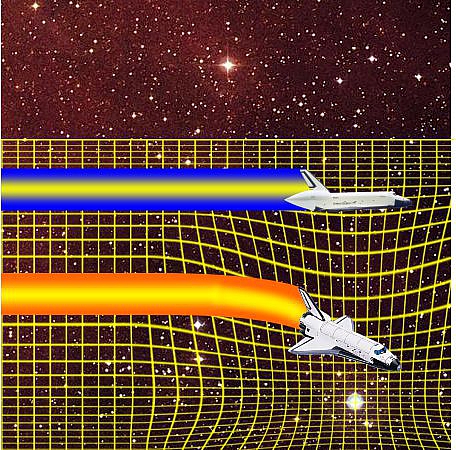
“I seen how dark energy spreads galaxies apart but they don’t get any bigger.  Same thing must happen in the LIGO machine.”

“Not the same, Vinnie.  I’ll show you the numbers.”

“Ah, geez, don’t do calculus at me.”de-vs-gravity

“No, just arithmetic we can do on a spreadsheet.” I fire up the laptop and start poking in  astronomical (both senses) numbers.  “Suppose we compare what happens when two galaxies face each other in intergalactic space, with what happens when two stars face each other inside a galaxy.  The Milky Way’s my favorite galaxy and the Sun’s my favorite star.  Can we work with those?”

“Yeah, why not?”

“OK, we’ll need a couple of mass numbers.  The Sun’s mass is… (sound of keys clicking as I query Wikipedia) … 2×1030 kilograms, and the Milky Way has (more key clicks) about 1012 stars.  Let’s pretend they’re all the Sun’s size so the galaxy’s mass is (2×1030)×1012 = 2×1042 kg. Cute how that works, multiplying numbers by adding exponents, eh?”

“Cute, yeah, cute.”  He’s getting a little impatient.

“Next step is the sizes.  The Milky Way’s radius is 10×104 lightyears, give or take..  At 1016 meters per lightyear, we can say it’s got a radius of 5×10²⁰ meters.  You remember the formula for the area of a circle?”

“Sure, it’s πr2.” I told you Vinnie’s smart.

“Right, so the Milky Way’s area is 25π×1040 m2.  Meanwhile, the Sun’s radius is 1.4×10⁹ m and its cross-sectional area must be 2π×1018 m2.  Are you with me?”

“Yeah, but what’re we doing playing with areas?  Newton’s gravity equations just talk about distances between centers.”  I told you Vinnie’s smart.

“OK, we’ll do gravity first.  Suppose we’ve got our Milky Way facing another Milky Way an average inter-galactic distance away.  That’s about 60 galaxy radii,  about 300×1020 meters.  The average distance between stars in the Milky Way is about 4 lightyears or 4×10¹⁶ meters.  (I can see he’s hooked so I take a risk)  You’re so smart, what’s that Newton equation?”

Force or potential energy?”

“Alright, I’m impressed.  Let’s go for force.”

“Force equals Newton’s G times the product of the masses divided by the square of the distance.”

“Full credit, Vinnie.  G is about 7×10-11 newton-meter²/kilogram², so we’ve got a gravity force of (typing rapidly) (7×10-11)×(2×1042)×(2×1042)/(300×1020)² = 3.1×1029 N for the galaxies, and (7×10-11)×(2×1030)×(2×1030)/(4×1016)² = 1.75×10¹⁷ N for the stars.  Capeesh?”

“Yeah, yeah.  Get on with it.”

“Now for dark energy.  We don’t know what it is, but theory says it somehow exerts a steady pressure that pushes everything away from everything.  That outward pressure’s exerted here in the office, out in space, everywhere.  Pressure is force per unit area, which is why we calculated areas.

“But the pressure’s really, really weak.  Last I saw, the estimate’s on the order of 10-9 N/m².  So our Milky Way is pushed away from that other one by a force of (10-9)×(25π×1040) ≈ 1031 N, and our Sun is pushed away from that other star by a force of (10-9)×(2π×1018) ≈ 1010 N with rounding.  Here, look at the spreadsheet summary…”

 Force, newtons Between Galaxies Between stars
Gravity 3.1×1029 1.75×10¹⁷
Dark energy 1031 1010
Ratio 3.1×10⁻² 17.5×10⁶

“So gravity’s force pulling stars together is 18 million times stronger than dark energy’s pressure pushing them apart.  That’s why the galaxies aren’t expanding.”

“Gotta go.”

(sound of door-slam )

“Don’t mention it.”

~~ Rich Olcott

Here we LIGO again…

I suddenly smelled mink musk, vintage port, and warm honey on fresh-baked strawberry scones.

“C’mon in, Ramona, the door’s open.”

She oscillated in with a multi-dimensional sinusoidal motion that took my breath away and a smile that brought it back.

“Hi, Sy.  I came right over as soon as I got the news.”

“What news is that, Sugar Lumps?”

“LEGO, Sy, they’ve switched LEGO to science mode!”

“That’s LIGO, sweetheart, Laser Interferometer Gravitational-wave Observatory.”  She means well, but she’s Ramona.  “LEGOs are designed to hurt your feet, LIGO’s designed to look at the Universe.”

“Whatever.  I knew you wrote a . whole . series . of . posts . about . it so I thought you’d want to know.”

“It’s worth chasin’ down, doll-face.  Thanks.”symoire

So I headed over to the campus coffee shop.  It just happens to be located between the Astronomy building and the Physics building so I figured it as a good source.  Al was in his usual place at the cash register.

“Hi, Sy.  Haven’t seen you in a while.”

“Been busy, Al.  Lotsa science going on these days.”

“Good, good.   Say, have you heard about LEGO goin’ live?”

“That’s LIGO, Al.  Yeah, Ramona told me.  So what’s the word?”

“OK, you know all about how when they first turned it on for engineering tests back in September, it blew everyone’s mind that they caught a signal almost immediately?”

“Yeah, that’s when I started writing about it.  Two 30-solar-mass black holes collided and jolted the gravitational field of the Universe.  When the twin LIGOs detected that jolt, it confirmed three predictions that came out of Einstein’s General Relativity theory.”

“Had you heard about the second signal they caught the day after Christmas, from a couple of smaller black holes?”

“I bet you sold a lot of coffee that week.”

“You couldn’t believe.  Those guys had so much caffeine in ’em they didn’t even notice New Years.”

“So what came out of that?”

“Like I said, these were smaller black holes, about 10 solar masses each instead of 30, and that’s really got the star-modelers scratching their heads.”

“How so?”

“Well, we pretty much know how to make a black hole that’s just a bit heavier than the Sun.  Say a star’s between 1.3 and 3 solar masses.  When it burns enough of its fuel that its heat energy can’t keep it puffed up against gravity the whole thing collapses down to a black hole.”

“What happens if it’s bigger than that?  Wouldn’t you just get a bigger black hole?”

“That’s the thing.  If it’s above that threshold, the outermost infalling matter meets the outgoing explosion and makes an even bigger explosion, a supernova.  So much matter gets blown away that what’s left is too small to be a black hole.  You just get a white dwarf star or a neutron star, depending.”

“But these signals came from black holes 3-10 times that upper limit.  Where did they come from?”

“That’s why the head-scratching, Sy.  I mean, no-one knows how to make even one and yet they seem to be so common that two pairs of ’em found each other and collided less than four months apart.  The whole theory is up for grabs now.”

“So we got all that just from the engineering test phase, eh?  What’ve they done since that?”

“Oh, the usual tinkering and tweaking.  The unit down in Livingston LA is about 25% more sensitive now, especially in the lower-frequency range.  That’s mostly because they found and plugged some light-leaks and light-scattering hot-spots here and there along its five miles of steel pipe.  LIGO doesn’t look at incoming light, but it does use laser light to detect the gravitational variation.  The Hanford WA unit boosted the power going to its laser and they’ve improved stability in its detectors, made ’em more robust against wind and low-frequency seismic activity.  You know, engineer stuff.  So now they say they’re ready to do science.”

“I can’t write that the tweaks’ll let us look deeper into the Universe, ’cause LIGO doesn’t pick up light waves.  How about I say we get a better feel for things?”

“Sounds ’bout right, Sy.”

“Oh, and give me one of those strawberry scones.  For some reason they look really good today.”

~~ Rich Olcott

The Solar System is in gear

Pythagoras was onto far more than he knew.  He discovered that a stretched string made a musical tone, but only when it was plucked at certain points.  The special points are those where the string lengths above and below the point are in the ratio of small whole numbers — 1:1, 1:2, 2:3, ….  Away from those points you just get a brief buzz.  All of Western musical theory grew out of that discovery.

sinesThe underlying physics is straightforward.  The string produces a stable tone only if its motion has nodes at both ends, which means the vibration has to have a whole number of nodes, which means you have to pluck halfway between two of the nodes you want.  If you pluck it someplace like 39¼:264.77 then you excite a whole lot of frequencies that fight each other and die out quickly.

That notion underlies auditorium acoustics and aircraft design and quantum mechanics.  In a way, it also determines where objects reside in the Solar System.

If you’ve got a Sun with only one planet, that planet can pick any orbit it wants — circular or grossly elliptical, close approach or far, constrained only by the planet’s kinetic energy.

If you toss in a second planet it probably won’t last long — the two will smash together or one will fall into the Sun or leave the system.  There are half-a-dozen Lagrange points, special configurations like “all in a straight line” where things are stable.  Other than those, a three-body system lives in chaos — not even a really good computer program can predict where things will be after a few orbits.

geared-saturnAdd a few more planets in a random configuration and stability goes out the window — but then something interesting happens.  It’s the Chladni effect all over again.  Planets and dust and everything go rampaging around the system.  After a while (OK, a billion years or so) sweet-spot orbits start to appear, special niches where a planet can collect small stuff but where nothing big comes close enough to break it apart.  It’s not like each planet seeks shelter, but if it finds one it survives.
It’s a matter of simple arithmetic and synchrony.  Suppose you’re in a 600-day orbit.  Neighbor Fred looking for a good spot to occupy could choose your same 600-day orbit but on the other side of the Sun from you.  But that’s a hard synchrony to maintain — be off by a few percent and in just a few years, SMASH!

The next safest place would be in a different orbit but still somehow in synchrony with yours.  Inside your orbit Fred has to go faster and therefore has a shorter orbital period than yours.  Suppose Fred’s year is exactly 300 days (a 2:1 period ratio, like a 2:1 gear ratio).  Every six months he’s sort-of close to you but the rest of the time he’s far away.

Our Solar System does seem to have developed using gear-year logic.  Adjacent orbital years are very close to being in whole-number ratios.  Mercury, for instance, circles the Sun in about 88 days.  That’s just 2% away from 2/5 of Venus’s 225¾ days.

This table shows year-lengths for the Sun’s most prominent hangers-on, along with ratios for adjacent objects.  For the “ideal” ratios I arbitrarily picked nearby whole-number multiples of 2.  I calculated how long each object’s year “should” be compared to its lower neighbor — the average inaccuracy across all ten objects is only 0.18%.

Object
Period, years
2 × shorter / longer period
“Ideal” ratio
“Ideal” period, years
Real/”Ideal”
Mercury
0.24
0.24
Venus
0.62
5.11
5 : 2
0.60
102%
Earth
1.00
3.25
3 : 2
0.92
108%
Mars
1.88
3.76
4 : 2
2.00
94%
Ceres
4.60
4.89
5 : 2
4.70
98%
Jupiter
11.86
5.16
5 : 2
11.50
103%
Saturn
29.46
4.97
5 : 2
29.65
99%
Uranus
84.02
5.70
6 : 2
88.37
95%
Neptune
164.80
3.92
4 : 2
168.04
98%
Pluto
248.00
3.01
3 : 2
247.20
100%

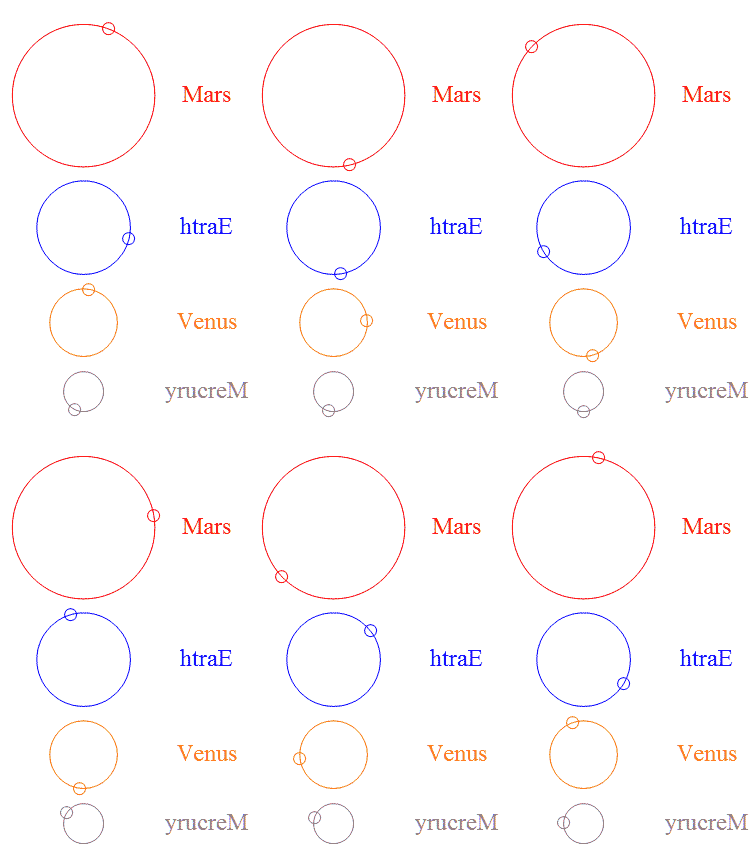
gears-2The usual rings-around-the-Sun diagram doesn’t show the specialness of the orbits we’ve got.  This chart shows the four innermost planets in their “ideal” orbits, properly scaled and with approximately the right phases.  I used artistic license to emphasize the gear-like action by reversing Earth’s and Mercury’s direction.   Earth and Mars are never near each other, nor are Earth and Venus.
It doesn’t show up in this video’s time resolution, but Venus and Mercury demonstrate another way the gears can work.  Mercury nears Venus twice in each full 5-year cycle, once leading and once trailing.  The leading pass slows Mercury down (raising it towards Venus), but the trailing pass speeds it up again.  Net result — safe!

~~ Rich Olcott

Is there a lurker in the Solar System?

The Solar System is much bigger than we learned in school, with a more complicated history.

pillars-with-vortex
NASA’s 2014 edition of “The Pillars of Creation,”
plus a speculative addition

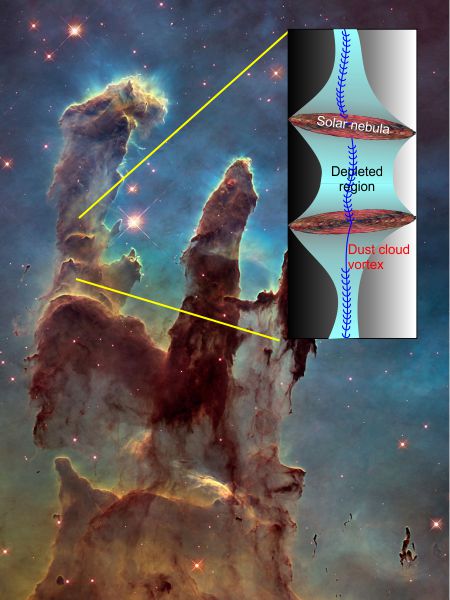
This famous photograph shows a portion of the Eagle Nebula, about 7,000 lightyears away from us but still within the Milky Way Galaxy.  The nebula is a diffuse mass of dust, gas  (mostly hydrogen atoms, of course) and hundreds of stars aborning.  Spectroscopic red- and blue-shift data could prove me wrong, but to my eye those “pillars” are exactly what you’d expect to see if each had formed around a vortex such as I described in my previous post.  Those two bright rings look very much like solar nebulae, don’t they?

If that’s what the rings are, then the region between them should be even emptier than normal interstellar space (estimated at one hydrogen atom per cm³ or about 30 atoms per fluid ounce if you swing that way).  If you’re floating in vacuum and a whole solar system’s gravity is pulling you towards it, then that’s where you’ll go.  Interstellar space will be emptier without you.

By the way, space between galaxies is a million times emptier than space between stars.

The solar nebula hypothesis does a decent job of explaining the familiar structure — an inward succession of gas giants, then an asteroid belt, then rocky planets, all orbiting within a degree or so of their common Plane of The Ecliptic.  When the Sun lit up 4.6 billion years ago, its fierce light stripped hydrogen and other light elements from the region where the inner planets were coalescing.  Those atoms fled outward to the asteroids, the gas giants and beyond.  An eon later, the rocky planets collected water and other volatiles from impacting comets and such.

But some incoming objects, especially the long-period comets, seem to have no respect for the Ecliptic.  They come at us from all angles, an oddity that led Ernst Öpik and Jan Oort to suggest that the familiar planar Solar System is in fact enclosed by a spherical shell of loosely-held objects, ready to pelt us at any time from wherever they happened to be.

No-one’s yet seen that shell, but statistical models suggest it’s huge.  Earth is one Astronomical Unit (AU) from the Sun.  Neptune, our farthest-out known planet, orbits at about 30 AU.  Researchers think the Oort Cloud starts somewhere near 2,000 AU and runs out to 20,000 or more.  Some suggest it may contain material from other solar systems.

Astronomers also think the Cloud contains something like a trillion objects, pebble-size up to planetoids or bigger.  In a volume that large, the average distance between objects is about 30 AU.  When NASA’s New Horizon spacecraft finally flies through the Oort Cloud 900 years from now, accidentally colliding with something shouldn’t be a problem.

outer-orbits
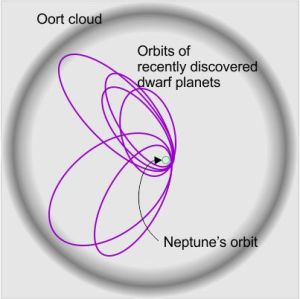
I drew the Oort Cloud much too small
compared to the purple Kuiper Belt Object orbits
(adapted from the Batygin-Brown paper)

In between the familiar Solar System and the Oort Cloud there’s a whole zoo of objects we’ve only started to glimpse in the past 25 years.  The Kuiper Belt is a doughnut of about 100,000 bodies that stay close to the Ecliptic Plane but orbit from just beyond Neptune’s orbit out to about twice as far.  (By my calculation the average distance between the rocks is, you guessed it, about 30 AU.)  These guys are heavily influenced by Neptune’s gravity and thought to be leftovers from our solar nebula.  Most short-period comets seem to come from the Kuiper Belt.

Recently, CalTech astrophysicists Konstantin Batygin and Michael Brown, drew attention to a half-dozen objects with orbits that were strangely similar.  Unlike the other thousand-or-so Kuiper Belt Objects characterized so far, these all

  • go further than 250 AU from the Sun despite getting as close as 50 AU
  • have a perihelion (the point of closest approach to the Sun) at about the same equatorial latitude (see the diagram)
  • (the kicker) the perihelion drops below the ecliptic by about the same amount.

The authors account for these observations, and more, by hypothesizing a Planet 9 that roams out beyond the Kuiper Belt.  They call it “a mildly inclined, highly eccentric distant perturber.”  I know what you’re thinking, but in the paper those are technical terms.

~~ Rich Olcott

Gettin’ kinky in space

Things were simpler in the pre-Enlightenment days when we only five planets to keep track of.  But Haley realized that comets could have orbits, Herschel discovered Uranus, and Galle (with Le Verrier’s guidance) found Neptune.  Then a host of other astronomers detected Ceres and a host of other asteroids, and Tombaugh observed Pluto in 1930.whirlpool-44x100-reversed

Astronomers relished the proliferation — every new-found object up there was a new test case for challenging one or another competing theory.

Here’s the currently accepted narrative…  Long ago but quite close-by, there was a cloud of dust in the Milky Way galaxy.  Random motion within it produced a swirl that grew into a vortex dozens of lightyears long.

Consider one dust particle (we’ll call it Isaac) afloat in a slice perpendicular to the vortex.  Assume for the moment that the vortex is perfectly straight, the dust is evenly spread across it, and all particles have the same mass.  Isaac is subject to two influences — gravitational and rotational.

making-a-solar-nebula
A kinked galactic cloud vortex,
out of balance and giving rise
to a solar system.

Gravity pulls Isaac towards towards every other particle in the slice.  Except for very near the slice’s center there are generally more particles (and thus more mass) toward and beyond the center than back toward the edge behind him.  Furthermore, there will generally be as many particles to Isaac’s left as to his right.  Gravity’s net effect is to pull Isaac toward the vortex center.

But the vortex spins.  Isaac and his cohorts have angular momentum, which is like straight-line momentum except you’re rotating about a center.  Both of them are conserved quantities — you can only get rid of either kind of momentum by passing it along to something else.  Angular momentum keeps Isaac rotating within the plane of his slice.

An object’s angular momentum is its linear momentum multiplied by its distance from the center.  If Isaac drifts towards the slice’s center (radial distance decreases), either he speeds up to compensate or he transfers angular momentum to other particles by colliding with them.

But vortices are rarely perfectly straight.  Moreover, the galactic-cloud kind are generally lumpy and composed of different-sized particles.  Suppose our vortex gets kinked by passing a star or a magnetic field or even another vortex.  Between-slice gravity near the kink shifts mass kinkward and unbalances the slices to form a lump (see the diagram).  The lump’s concentrated mass in turn attracts particles from adjacent slices in a viscous cycle (pun intended).

After a while the lumpward drift depletes the whole neighborhood near the kink.  The vortex becomes host to a solar nebula, a concentrated disk of dust whirling about its center because even when you come in from a different slice, you’ve still got your angular momentum.  When gravity smacks together Isaac and a few billion other particles, the whole ball of whacks inherits the angular momentum that each of its stuck-together components had.  Any particle or planetoid that tries to make a break for it up- or down-vortex gets pulled back into the disk by gravity.

That theory does a pretty good job on the conventional Solar System — four rocky Inner Planets, four gas giant Outer Planets, plus that host of asteroids and such, all tightly held in the Plane of The Ecliptic.

How then to explain out-of-plane objects like Pluto and Eris, not to mention long-period comets with orbits at all angles?outer-orbits-1

We now know that the Solar System holds more than we used to believe.  Who’s in is still “objects whose motion is dominated by the Sun’s gravitational field,” but the Sun’s net spreads far further than we’d thought.  Astronomers now hypothesize that after its creation in the vortex, the Sun accumulated an Oort cloud — a 100-billion-mile spherical shell containing a trillion objects, pebbles to planet-sized.

At the shell’s average distance from the Sun (see how tiny Neptune’s path is in the diagram) Solar gravity is a millionth of its strength at Earth’s orbit.  The gravity of a passing star or even a conjunction of our own gas giants is enough to start an Oort-cloud object on an inward journey.

These trans-Neptunian objects are small and hard to see, but they’re revolutionizing planetary astronomy.

~~ Rich Olcott

Plutonic Goofyness

goofy-and-dp-pluto
Is Pluto wearing a space helmet?
No, that helmet is Pluto.
(Based on a cartoon by Andy Diehl)

Andy Diehl brings up a question worth considering over a tasty beverage.  How come Pluto’s a dog and Goofy’s a dog but Pluto gets the collar end of the leash?  Hardly seems fair.

Which brings us to that other controversial Pluto, the one that NASA’s New Horizon spacecraft visited last July.  (News flash — on 28 October, NASA announced that they’d received the very last of the data NH accumulated during that 2½-hour visit.)  Official Astronomy has reclassified Pluto from “planet” to “dwarf planet,” but NH honcho Alan Stern and much of the rest of the world say, “No way!”

The traditionalist position is, “But we’ve always called Pluto the ninth planet.”  Well, “always” only goes back to when the preternaturally persistent Clyde Tombaugh discovered the object in 1930.  At the time he found it Pluto was indeed the ninth “planet” out from the Sun.  However, it spends about 10% of each orbit* closer to the Sun than the eighth planet, Neptune.  So should we call it the “seven-and-a-fraction-th” planet?

No, because (1) that contravenes Official Astronomy’s rules, and (2) it’d be silly.

So what are the rules for what’s a planet?

  1. The object must be in orbit around its star.
  2. The object must be massive enough to be rounded by its own gravity.
  3. It must have cleared the neighborhood around its orbit.

“Rounded” is a bit tricky.  It doesn’t mean “spherical” because if you spin a  sphere, centrifugal forces move mass towards its equator.  Earth’s equator is 13.3 miles further away from its center than its poles are.  Miller’s Planet in the Interstellar movie is also a spheroid, even further deformed by elongation towards the black hole it orbits, yet it still rates as “rounded by its gravity” and qualifies as a planet.

Clearing the neighborhood” means “my gravity dominates the motion of everything in my orbit.”  Earth and Jupiter, both acknowledged planets, each have retinues of asteroids in the Trojan positions, at the same distance from the Sun as the host planet but in regions 60º ahead of or behind it.  Even so, both planets often suffer messy encounters (remember Chicxulub and Chelyabinsk?) with asteroids and such that hadn’t gotten the memo.

Neptune meets all three criteria.  Its gravity dominates Pluto’s motion even though Pluto’s in a separate orbit.  For every three of Neptune’s trips around the Sun, Pluto makes exactly two.  The gravitational converse doesn’t hold, though.  Pluto’s mass is 0.1% of Neptune’s so the big guy doesn’t care.

pluto-orbits-1This video, from an Orbits Table display at the Denver Museum of Nature and Science, shows a different Plutonian weirdness.  We’re circling the Solar System at about 50 times Earth’s distance from the Sun (50 AU).  Reading inward, the white lines represent the orbits of Neptune, Uranus, Saturn and Jupiter.  The Asteroid Belt is the small greenish ring close to the Sun.  The four terrestrial planets are even further in.  The Kuiper Belt is the greenish ring that encloses the lot.

The  yellow-orange line is Pluto’s orbit.  Most of the Solar System lies within a thin pancake, the Plane of The Ecliptic. Pluto’s orbit is inclined 17º out of the Plane.  That’s odd.

Theory says that the System evolved from an eddy in a primordial cloud of dust and gas.  Gravity shrank that blob of stuff to form a disk at the eddy’s equator as it drew 99.9% of the system’s mass to form the Sun at the disk’s center.

Newton’s First Law is all about Conservation of Momentum.  When applied to circular motion, it says that if you’re whirling in a certain plane, you’ll continue whirling in that plane unless something knocks you out of that plane.  Hence, the Plane of The Ecliptic.

Pluto’s path is a puzzling challenge to the theory.  It was only a minor puzzle until the 1990’s when astronomers discovered a plethora of Pluto-type objects outside of Neptune’s orbit.  Most run way out of the Plane.  Worst is Eris, at inclination 44º .  Clearly, Pluto’s not special.  It belongs to a large tribe that Astrophysicists must explain if they’re to claim to  understand the Solar System.

~~ Rich Olcott

* – During its current 248-year orbit, Pluto was inside Neptune’s orbit between 1979 and 1999.

Hoppin’ water molecules

chladny-2Before you get any further in this post, follow this link to Steve Mould’s demonstration of  Chladni figures.  (I’ll wait here.)  It’s a neat demo and the effect plays into some recent discoveries in planetary science.

Steve’s couscous grains dance to the vibrations of the iron plate they’re sitting on.  The patterns happen because he controls where those vibrations happen.  Or more importantly, don’t happen (see his fingers pinching the plate?).

The study of vibration goes back to Pythagoras, the ancient Greek geek who determined that a plucked stretched string invariably exhibits a whole number of peaks and nodes.  (A node is a point on the string that doesn’t move, like those dots on the chart).  I’m so tempted to yammer about the relationship between nodes and quantum mechanics, but I’ve already posted on that topic.sines

The important point for this post is that Steve’s demonstration shows individual particles, each moving under the influence of random impacts, nonetheless winding up at a common destination.  They’re repeatedly kicked away from points where the iron plate is fluctuating strongly.  If a particle suddenly finds itself on a non-fluctuating nodal point (or nodal line, which is just a collection of nodal points), it stays there because why not?

The basic principle applies to numerous phenomena in Physics, Chemistry and other Sciences.  The particles in Chladni’s experiment were grains of sand.  Steve used coucous grains, which work better in video.  But they could also be molecules.  On the Moon.

Back in the 2000s there was intense debate in the lunar astronomy community.  One argument went, “The Solar Wind teems with hydrogen ions (H+).  The Moon’s surface rocks are mostly silicon oxides.  Those H+ ions will yank oxygen O2- ions off exposed rocks to make H2O molecules.  There has to be water on the Moon!”

The other side of the argument (in real Science there’s always at least one other side) went, “Maybe so, but Solar radiation also contains high-energy electrons and photons that’ll rip those molecules apart.  Water can’t survive up there!”

If/when we plant a Moon colony, the colonists will need water.  Either it gets shipped up from Earth — EXPENSIVE — or we find and mine water up there.  NASA did the only thing that could be done — they sent up a spacecraft for a close look.   When the Lunar Reconnaissance Orbiter (the LRO) launched in 2009 it carried half-a-dozen instruments.  One of them was the Lyman Alpha Mapping Project (LAMP) camera.

LAMP was the embodiment of a sly trick.  Buried in starlight’s ultraviolet spectrum are photons (a.k.a. Lyman-α  light) with a wavelength of 121.6 nanometers.  They’re generated by excited hydrogen atoms and they’re (mostly) absorbed by hydrogen atoms but reflected by rock that doesn’t contain hydrogen.

LAMP’s camera was designed to be sensitive to just those Lyman-α photons.  As LRO circled the Moon, the LAMP camera recorded what fraction of those special photons was bouncing off the Moon.  By subtraction, it told us  what fraction was being absorbed by surface hydrogen.

LAMP did find water.  The fun facts are its form and location — it was frost, buried in “fluffy soils” in the walls of craters.
water-moonThis photo, part of the LAMP exhibit at the Denver Museum of Nature and Science, shows why.  It’s a model of a cratered Moon lit by sunlight.

An H2O molecule may develop anywhere on the Moon’s surface.  Then it experiences life’s usual slings and arrows (well, electrons and photons) that might blast it apart or might merely give it a kinetic kick to somewhere else.  That process continues until the molecule or a descendant drops into a nice shady crater.

The best craters would be the ones in the polar regions, where sunlight arrives at a low angle and the crater walls are permanently shadowed like the one at the top in the model.  That’s exactly were LAMP found the most dark spots.  HAH —  Chladni in space!

But there’s more.  In 2012, NASA’s MESSENGER spacecraft produced evidence for water on Mercury, the hottest planet in the Solar System.  Once again, those molecules were hiding in polar craters along with a few other surprising molecular species.  That knocked my socks off when I read the scientific report.

~~ Rich Olcott

A better idea for Life on Titan

Oh, I do love it when a theoretician comes in from the dugout and turns the game around.  Billy Beane did that for the Oakland baseball team (see Moneyball, the book or the movie).  Now a team led by James Stevenson in Dr Paulette Clancy’s lab at Cornell has done it for the scientific game of “What’s Life?”

Yeah, we’ve all seen the functional criteria: metabolism, self-regulation, growth, responsiveness, reproduction.  But structurally, everyone since Robert Hooke has known that living organisms are made of cells.  For the past 60 years we’ve known that those cells wear a cell membrane, a flexibly fluid two-layer construction of partly-oily molecules designed to separate watery cell contents from watery outside.

The standard membrane model is on the left in these sketches.  The zigzags represent long (15-20 carbons) hydrocarbon chains (the oily part); the red circles they’re bonded to stand for phosphate-containing groups that prefer a watery environment.  The polka dots are salts and other molecules floating in water.  The whole thing depends on  “oil and water don’t mix.”

ambipolar
Alternative membrane structures
(diagram on the right adapted from the Stevenson paper)

But Titan’s liquid environment is hydrocarbons, non-polar and therefor inhospitable to dissolved salts.  In a year-ago post I followed other people in proposing that cells living in Titan’s lakes might use an inverted membrane structure (the middle sketch).  It’d separate oily inside from oily outside by interposing a thin layer of watery.

That might work on worlds whose temperature range matches ours.  Stevenson and his team pointed out that it’s seriously unworkable on cold worlds like Titan (surface temp -290ºF).  The watery parts would be frozen granite-hard and the oily parts would be stiff as high-grade candle wax.  If there are living cells on Titan, they can’t use either two-layer membrane design as they move, grow and do those other life-ish things.

conga-line
Acrylonitrile molecules
in ambipolar array
(adapted from Stevenson)

Stevenson’s team asked the next question, “What else might work?”  They decided to investigate single-layer structures with no salty component at all.  Such membranes could be held together by electric forces between charges that are slightly separated within the same ambipolar molecule (right-most sketch of the three above). For instance, a nitrogen atom holds onto its electrons more tightly than a carbon atom does, so a bonded C≡N pair will be slightly negative on the N side, slightly positive on the C side.

And to avoid the candle-wax problem the tails on those molecules would have to be short.

Titan’s atmosphere is 98% nitrogen and most of the rest is methane and hydrogen, so the group looked at nine ambipolar nitrogen-carbon-hydrogen molecules with short tails.  For each compound they asked, “Would a membrane made of this stuff be stable on Titan?  If so, would that membrane be flexible?”

Those questions are hard to answer experimentally (-290ºF is cold) so the team resorted to advanced molecular dynamics simulation programs that they just happened to have lying around because that’s what the authors do in their day-jobs.

Basically, what the programs do is arrange some virtual molecules (including solvent) in a starting configuration, then let them move around step-by-step under the influence of their mutual attractions and repulsions.  Meanwhile, the programs keep track of the total energy (and a few other things) for the entire assemblage.  Run the simulation until things settle down (if they do); see what virtually happens.

acrylonitrile-azotosome
Virtual acrylonitrile vesicle
(also from Stevenson)

In many (not all) of the computer runs, the molecules under test did indeed form a more-or-less regular membrane floating in the “solvent.”  Only some were “stable,” with calculated energies indicating they’d hold together for days or longer.  Some would even be able to form hollow spheres (vesicles) at least as large as a small virus.  Significantly, “flexibility” values for the stable membranes are in the same range as Earthly cell membranes.

It’s an exciting paper if you’re interested in alien life forms.  Among other things, it suggests that astronomers can’t limit their surveys to planets that exhibit signs of atmospheric O2.

But Life also depends on information storage and transfer.  Earth uses DNA, a huge polar molecule unsuited to Life on Titan.  How might Titan’s Life handle that problem?

~~ Rich Olcott

Life and energy on Titan, maybe

Say you’re an astrobiologist tasked with designing a world that would be able to support life we’d be able to recognize as such.  What absolute essentials would you need to include?

Abundant liquid water?  Biologists have found algae thriving inside desert rocks, moistened only by dew seeping in through microscopic pores.  A comfortable temperature?  We’ve found bacteria living in environments as cold as 5ºF and as warm as 250ºF.  A solid surface to grow on?  Arthur C Clarke (A Meeting with Medusa) wrote about complex life-forms floating in the 3,000-mile-deep atmosphere of Jupiter.  OK, that’s science fiction, but Clarke’s the guy who invented geostationary satellites for telecommunications and GPS.gibbs-energies

Many scientists would say that the obvious essential is a source of chemical energy.  I’d add, “and an efficient mechanism to convert the source energy to a form that can be transported within an organism.”  To my knowledge, all life-forms now on Earth have met the second prerequisite by using the ATP molecule for intra-cellular energy transport.  But life has been amazingly creative in finding ways to build those ATPs.  The tall diagram lists some biologic energy sources in decreasing order of how much energy is released.

All the Biology textbooks tell us that Earth’s energy cycle starts with the Sun.  Solar photons energize plant photosynthesis which creates loads of ATP molecules.  Some of them power a multistep process which combines CO2 and H2O to release O2 and create carbohydrates (CH2O)x.  (Glucose, for instance, is (CH2O)6.  Guess where the term “carbohydrate” came from.)  Earth’s biologic carbon cycle completes when other life “burns” carbohydrates to exploit the energy stored therein.  On this chart, “burn” means “combine with O2” and usually doesn’t involve fire.

Notice that “Make (CH2O)x” is at the bottom of the chart — that process absorbs a lot of energy per carbon atom.  Conversely, “Burn (CH2O)x” releases energy which is why we like sugar too much.

In the past couple of decades we’ve learned that’s not the only way, or maybe even the dominant way, that Earth-life makes its ATPs.  Microbes have evolved a surprising number of “front ends” to the energy machinery.  Here in Colorado we’ve got problems in old mines where microbes build ATPs by oxidizing iron pyrite (FeS) to sludgy rust (Fe2O3) and sulfuric acid (H2SO4).  Works great for them, not so good for downstream organisms.

Iron compounds are such a good energy source that many scientists believe (it’s still controversial) that Earth’s hematite and magnetite deposits were laid down half-a-billion years ago by archaea, microorganisms that preceded bacteria.

Way down on the energy-source scale are the methanogens, archaea that use molecular hydrogen to convert CO2 to methane (CH4).  They only live in zero-oxygen environments — peat bogs, ocean-bottom hydrothermal vents and subsurface veins that are perilous to mine.

Earthly biology participates in many cyclic processes.  The bi-level diagram below highlights two — oxygen cycling between O2 and oxygen compounds, and carbon cycling between CO2 and living tissues (which contain carbohydrates).

If it weren’t for light-driven photosynthesis ( ~~ is a photon), pretty soon all our O2 would be locked up in the ground where it came from.  In a sense, Earth uses life and carbon to get oxygen back up into the atmosphere.  Astronomers look for O2 in a planetary atmosphere as a sign of life.titan-cycles-2

Maybe Titan does something similar.  Titan’s atmosphere contains methane (CH4) and H2 but the quantities aren’t right.  The purple “Lyman α” and blue “Balmer α” lines on the energy chart denote particularly strong solar photons that can break up C-H bonds and generate H2 in Titan’s upper atmosphere.  We understand the relevant processes pretty well and can calculate how much methane, acetylene (C2H2) and H2 should be up there.

The calculated quantities pretty much match what astronomers found in Titan’s upper atmosphere.  But they’re not what Cassini-Huygens found on the ground.  Acetylene just isn’t there, and a (somewhat precarious) computer simulation indicates that there’s much less ground-side H2 than you’d expect from simple diffusion.  Dr Chris McKay has put those clues and the energy stack together to suggest that something on Titan inhales acetylene and hydrogen and exhales methane.

Something alive, maybe?

~~ Rich Olcott