

Say you’re an astrobiologist tasked with designing a world that would be able to support life we’d be able to recognize as such. What absolute essentials would you need to include?
Abundant liquid water? Biologists have found algae thriving inside desert rocks, moistened only by dew seeping in through microscopic pores. A comfortable temperature? We’ve found bacteria living in environments as cold as 5ºF and as warm as 250ºF. A solid surface to grow on? Arthur C Clarke (A Meeting with Medusa) wrote about complex life-forms floating in the 3,000-mile-deep atmosphere of Jupiter. OK, that’s science fiction, but Clarke’s the guy who invented geostationary satellites for telecommunications and GPS.
Many scientists would say that the obvious essential is a source of chemical energy. I’d add, “and an efficient mechanism to convert the source energy to a form that can be transported within an organism.” To my knowledge, all life-forms now on Earth have met the second prerequisite by using the ATP molecule for intra-cellular energy transport. But life has been amazingly creative in finding ways to build those ATPs. The tall diagram lists some biologic energy sources in decreasing order of how much energy is released.
All the Biology textbooks tell us that Earth’s energy cycle starts with the Sun. Solar photons energize plant photosynthesis which creates loads of ATP molecules. Some of them power a multistep process which combines CO2 and H2O to release O2 and create carbohydrates (CH2O)x. (Glucose, for instance, is (CH2O)6. Guess where the term “carbohydrate” came from.) Earth’s biologic carbon cycle completes when other life “burns” carbohydrates to exploit the energy stored therein. On this chart, “burn” means “combine with O2” and usually doesn’t involve fire.
Notice that “Make (CH2O)x” is at the bottom of the chart — that process absorbs a lot of energy per carbon atom. Conversely, “Burn (CH2O)x” releases energy which is why we like sugar too much.
In the past couple of decades we’ve learned that’s not the only way, or maybe even the dominant way, that Earth-life makes its ATPs. Microbes have evolved a surprising number of “front ends” to the energy machinery. Here in Colorado we’ve got problems in old mines where microbes build ATPs by oxidizing iron pyrite (FeS) to sludgy rust (Fe2O3) and sulfuric acid (H2SO4). Works great for them, not so good for downstream organisms.
Iron compounds are such a good energy source that many scientists believe (it’s still controversial) that Earth’s hematite and magnetite deposits were laid down half-a-billion years ago by archaea, microorganisms that preceded bacteria.
Way down on the energy-source scale are the methanogens, archaea that use molecular hydrogen to convert CO2 to methane (CH4). They only live in zero-oxygen environments — peat bogs, ocean-bottom hydrothermal vents and subsurface veins that are perilous to mine.
Earthly biology participates in many cyclic processes. The bi-level diagram below highlights two — oxygen cycling between O2 and oxygen compounds, and carbon cycling between CO2 and living tissues (which contain carbohydrates).
If it weren’t for light-driven photosynthesis ( ~~ is a photon), pretty soon all our O2 would be locked up in the ground where it came from. In a sense, Earth uses life and carbon to get oxygen back up into the atmosphere. Astronomers look for O2 in a planetary atmosphere as a sign of life.
Maybe Titan does something similar. Titan’s atmosphere contains methane (CH4) and H2 but the quantities aren’t right. The purple “Lyman α” and blue “Balmer α” lines on the energy chart denote particularly strong solar photons that can break up C-H bonds and generate H2 in Titan’s upper atmosphere. We understand the relevant processes pretty well and can calculate how much methane, acetylene (C2H2) and H2 should be up there.
The calculated quantities pretty much match what astronomers found in Titan’s upper atmosphere. But they’re not what Cassini-Huygens found on the ground. Acetylene just isn’t there, and a (somewhat precarious) computer simulation indicates that there’s much less ground-side H2 than you’d expect from simple diffusion. Dr Chris McKay has put those clues and the energy stack together to suggest that something on Titan inhales acetylene and hydrogen and exhales methane.
Something alive, maybe?
~~ Rich Olcott

 Long ago in a far-away career, I taught a short-course about then-current theories on the origin of life. The lab portion of the course centered on the 1952

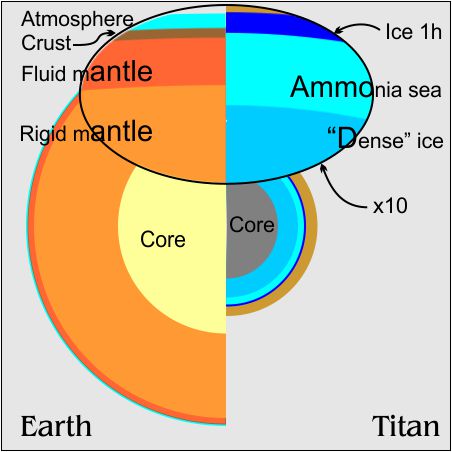
 The primary reason we think Titan is so wet is that Titan’s density is about halfway between rock and water. We know there are other light molecules on Titan — ammonia, methane, etc. We don’t know how much of each. Those compounds don’t have water’s complex phase behavior but many can dissolve in it. That’s why that hypothetical “Ammonia sea” is in the top diagram.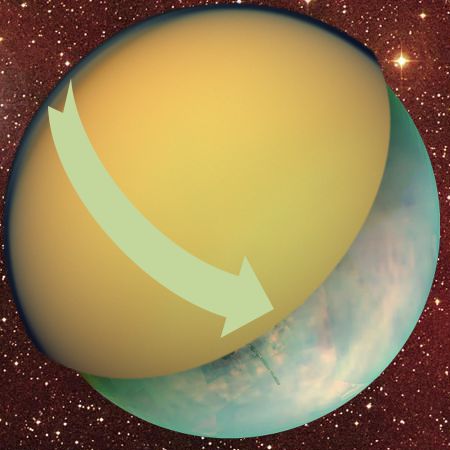

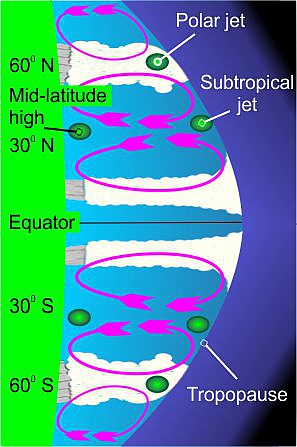 Air warmed by the equatorial Sun rises, only to sink as it heads poleward. Our packet loops between the Equator and about 30ºN (see the diagram).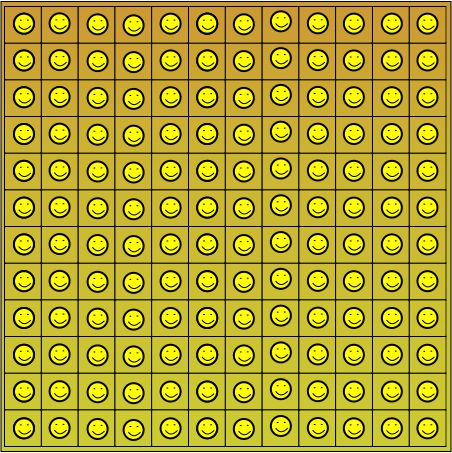
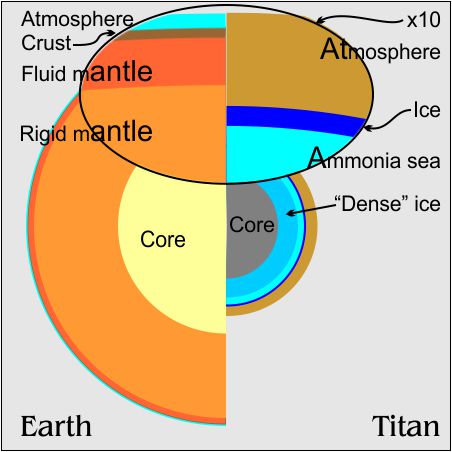 Titan’s atmosphere is heavy-duty compared with Earth’s — 6 times deeper and about 1½ times the surface pressure. When I read those numbers I thought, “Huh? But Titan’s diameter is only 40% as big as Earth’s and its surface gravity is only 10% of ours. How come it’s got such a heavy atmosphere?”
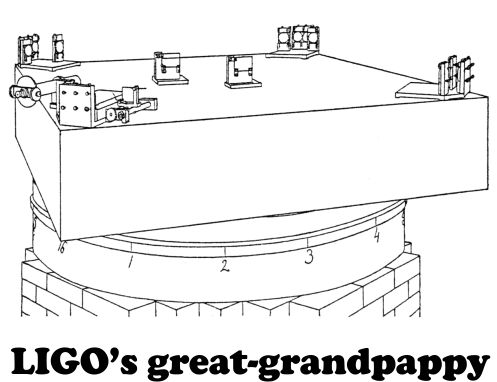
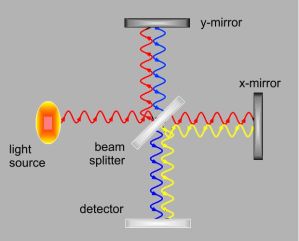 Their common experimental strategy sounds simple enough — compare two beams of light that had traveled along different paths


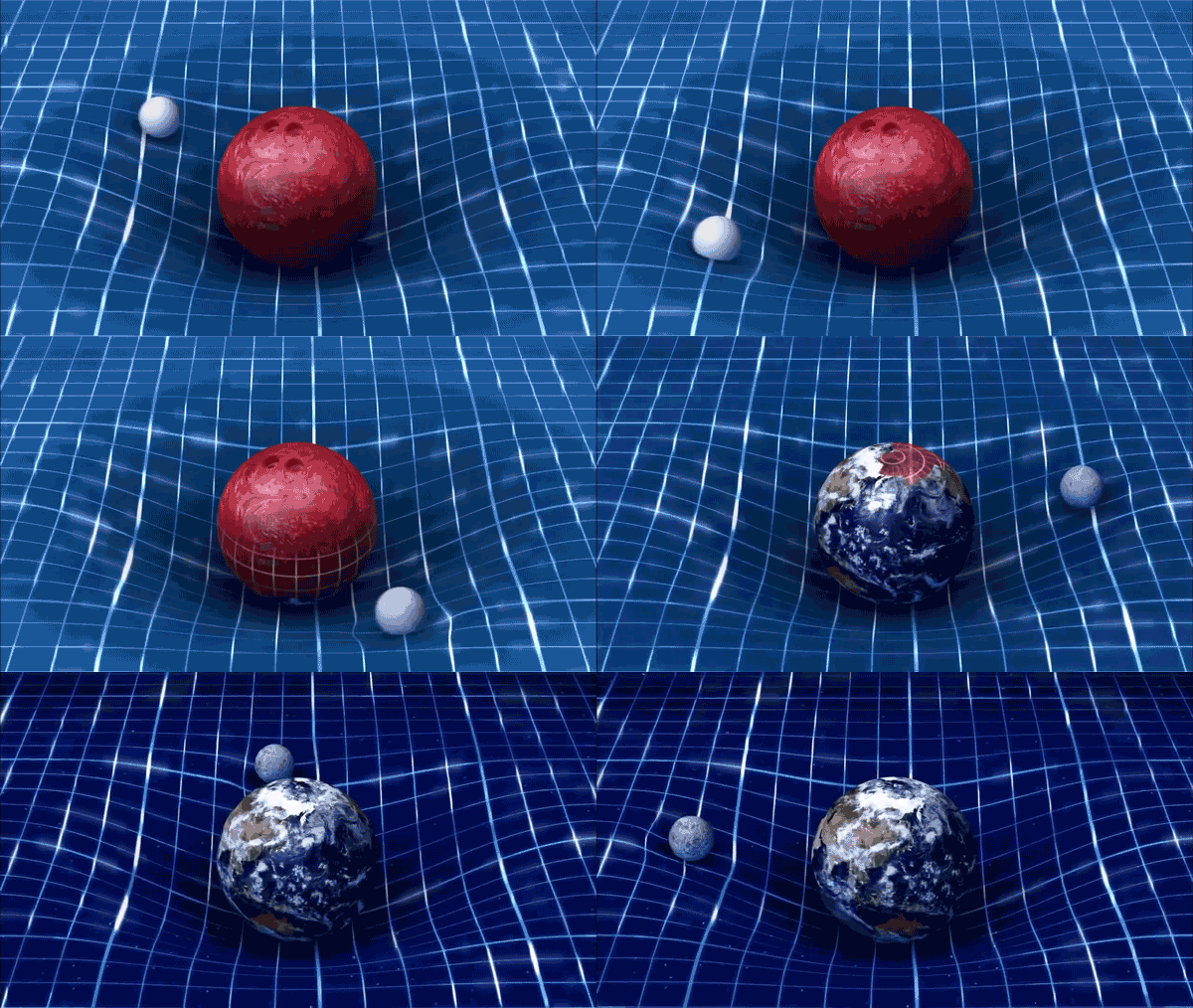
 Of all the wave varieties we’re familiar with, gravitational waves are most similar to (NOT identical with!!) sound waves. A sound wave consists of cycles of compression and expansion like you see in this graphic. Those dots could be particles in a gas (classic “sound waves”) or in a liquid (sonar) or neighboring atoms in a solid (a xylophone or marimba).
 Einstein noticed that implication of his Theory of General Relativity and in 1916 predicted that the path of starlight would be bent when it passed close to a heavy object like the Sun. The graphic shows a wave front passing through a static gravitational structure. Two points on the front each progress at one graph-paper increment per step. But the increments don’t match so the front as a whole changes direction. Sure enough, three years after Einstein’s prediction, Eddington observed just that effect while watching a total solar eclipse in the South Atlantic.
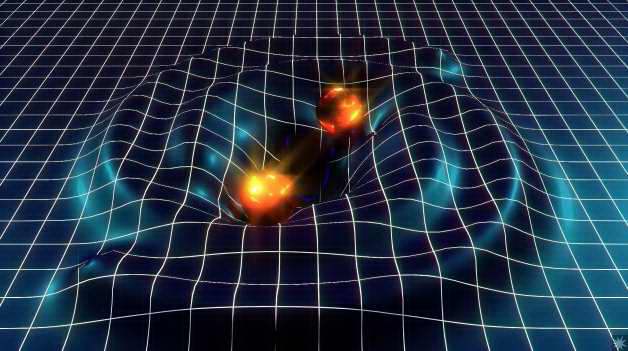
 We’re being dynamic here, so the simulation has to include the fact that changes in the mass configuration aren’t felt everywhere instantaneously. Einstein showed that space transmits gravitational waves at the speed of light, so I used a scaled “speed of light” in the calculation. You can see how each of the new features expands outward at a steady rate.
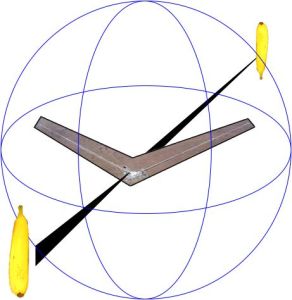 The second question is harder. The best the aLIGO team could do was point to a “banana-shaped region” (their words, not mine) that covers about 1% of the sky. The team marshaled a world-wide collaboration of observatories to scan that area (a huge search field by astronomical standards), looking for electromagnetic activities concurrent with the event they’d seen. Nobody saw any. That was part of the evidence that this collision involved two black holes. (If one or both of the objects had been something other than a black hole, the collision would have given off all kinds of photons.)
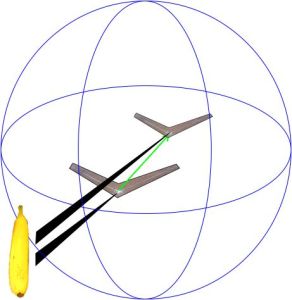 In contrast, a LIGO facility is (roughly speaking) omni-directional. When a LIGO installation senses a gravitational pulse, it could be coming down from the visible sky or up through the Earth from the other hemisphere — one signal doesn’t carry the “which way?” information. The diagram above shows that situation. (The “chevron” is an image of the LIGO in Hanford WA.) Models based on the signal from that pair of 4-km arms can narrow the source field to a “banana-shaped region,” but there’s still that 180o ambiguity.
 The great “if only” is that the VIRGO installation in Italy was not recording data when the Hanford WA and Livingston LA saw that September signal. With three recordings to reconcile, the aLIGO+VIRGO combination would have had enough information to slice that banana and localize the event precisely.

 We can investigate things that take longer than an instrument’s characteristic time by making repeated measurements, but we can’t use the instrument to resolve successive events that happen more quickly than that. We also can’t resolve events that take place much closer together than the instrument’s characteristic length.
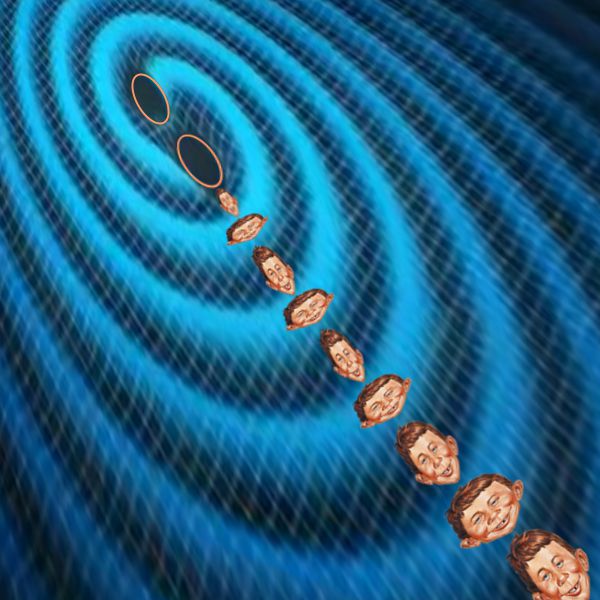
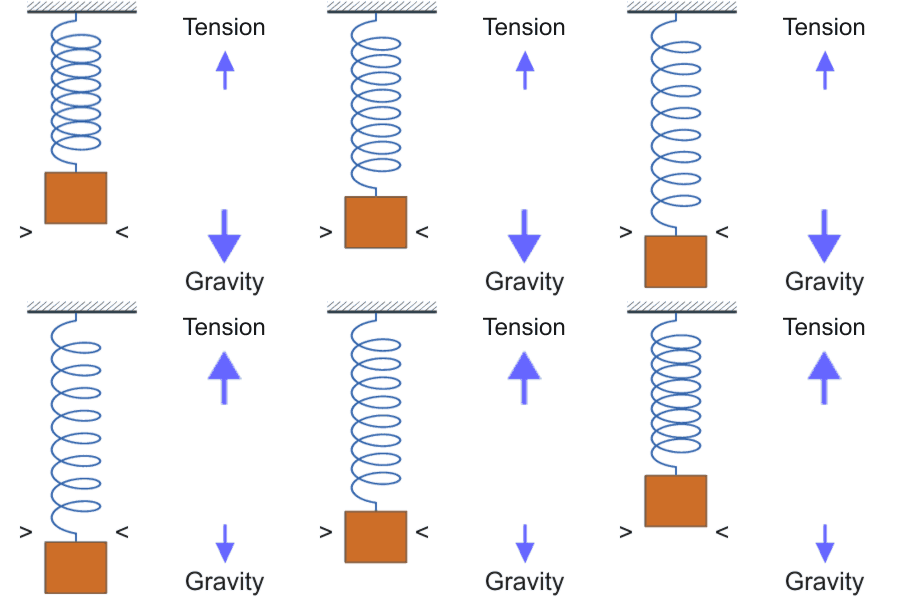 A wave happens in a system when a driving force and a restoring force take turns overshooting an equilibrium point AND the away-from-equilibrium-ness gets communicated around the system. The system could be a bunch of springs tied together in a squeaky old bedframe, or labor and capital in an economic system, or the network of water molecules forming the ocean surface, or the fibers in the fabric of space (whatever those turn out to be).
 An isolated black hole is surrounded by an intense gravitational field and a corresponding compression of spacetime. A pair of black holes orbiting each other sends out an alternating series of tensions, first high, then extremely high, then high…


