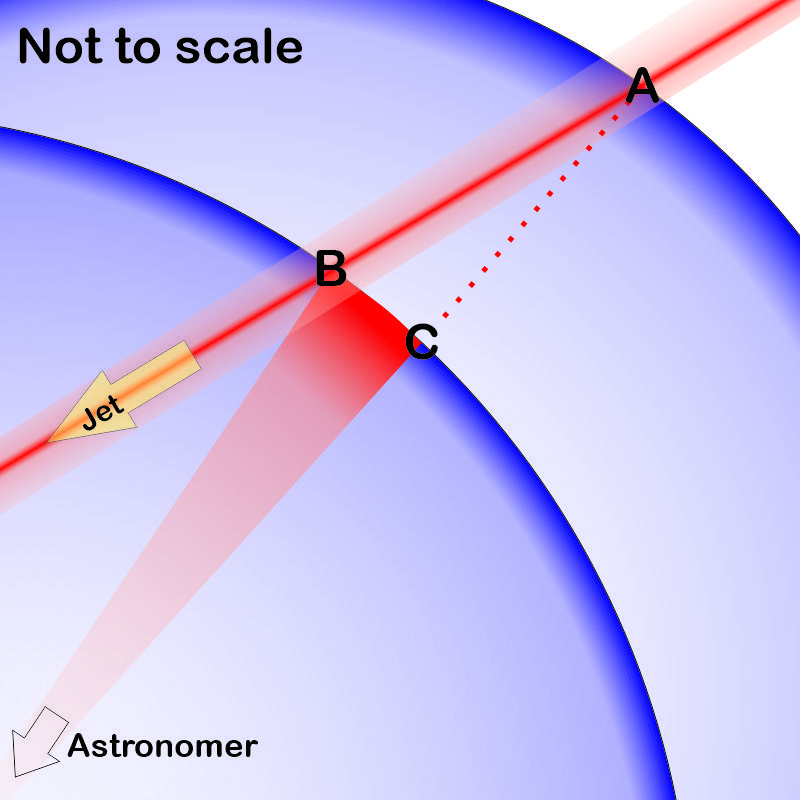
Sky Lights

“Mom! Uncle Sy! Come outside NOW before it goes away!”

“Whah— oooh!”
 ”An aurora! Thanks for calling us.”

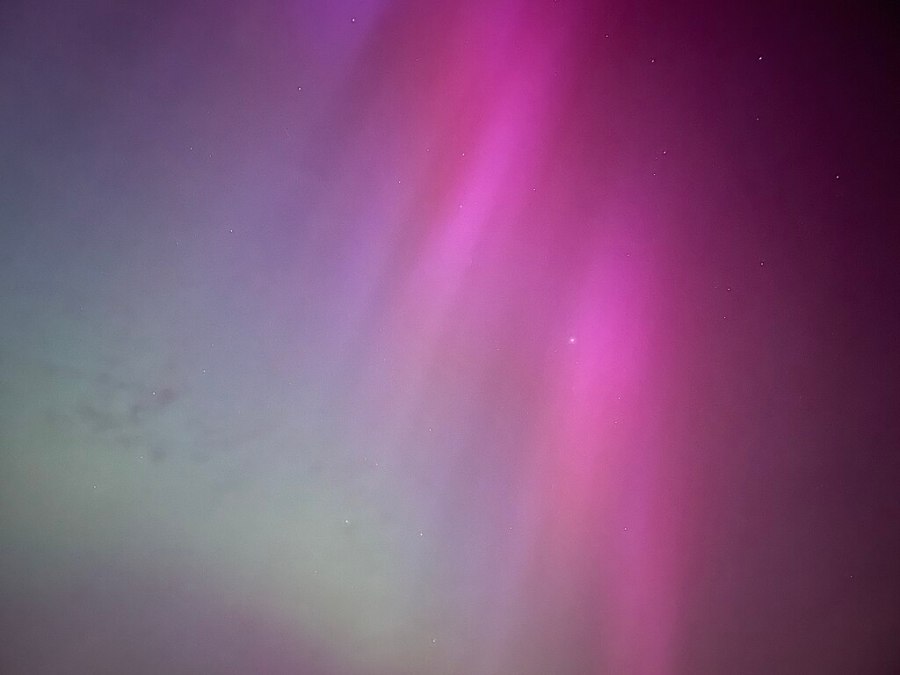
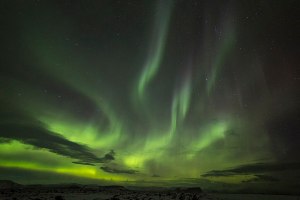
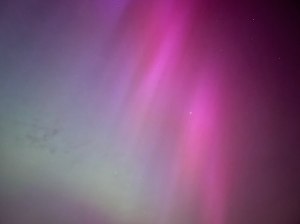
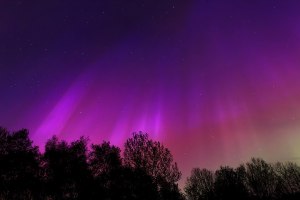
“Glowing curtains rippling across the sky! Spotlights shining down through them! Where do those come from?”

“From the Sun, Teena.”

“C’mon, Sy. The Sun’s 93 million miles away. Even if that bright streak up there is as much as 10 miles across, which I doubt, the beam from the Sun would be only a teeny‑tiny fraction of a degree wide. Not even magnetars send out anything that narrow.”

“Didn’t say it’s a beam, Sis. The whole display comes from the Sun as single package. Sort of. Sometimes.”

“Even for you, little brother, that’s a new level of weasel‑wording.”

“Well, it’s complicated.”

“So unravel it. Start from the beginning.”

“Okay. The Sun’s covered in plasma—”

“Eww!”

“Not that kind of plasma, Teena. This is mostly hydrogen atoms except they’re so hot that the electrons and protons break away from each other and travel separately. What have they told you in school about magnets?”

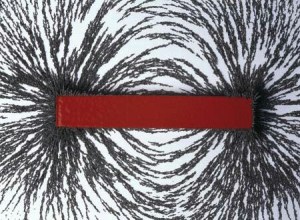
“Not much. Umm … electric currents push on magnets and that’s how motors work, and magnets push on electrons and that’s how a generator works. Oh, and Mr Cox laid a sheet of paper on top of a magnet and sprinkled iron filings on it so we could see the lines of force, but when I asked him what made the magnetism ’cause I didn’t see any wires he started talking about electrons in iron atoms and then the bell rang and I had to go to Spanish class.”

The shape of the bar magnet’s field, disclosed by iron filings chaining together.

<sigh> “The clock rules, doesn’t it? Anyway, he was on the right track, but I want to get back to those lines of force. Were they there before he sprinkled on those filings?”

“Mmm … Mom would say, ‘That’s a good question,’ but how could you know? I’m gonna say they were.”

“Your Mom would be right, but sorry, you’re wrong. With no iron filings in the picture, the magnetic field is nice and smooth, everywhere just the same or maybe only a little bit stronger or weaker than neighboring points. No lines. Conditions change when you put the first bit of iron anywhere in the field. As Mr Cox was probably saying when the bell interrupted, the electrons in the grain’s iron atoms align orbitals with the magnetic field. The alignment affects the surrounding field and that pulls in other iron bits that change the field even more.”

“But wouldn’t that make just a solid iron blob?”

“No, because a magnetic field has both strength and direction. Once the first particle points along the field, the iron bits it recruits rotate to point mostly in the same direction. You wind up with a chain of specks tracing out where they’ve acted together to alter the field. The chain’s surrounded by spaces where the field’s been stressed.”

“And then lotsa chains make lotsa lines, yeah!”

“I see where you’re headed, Sy. You’re going to claim that the vertical lines we see in the curtains trace out the Sun’s magnetic field.”

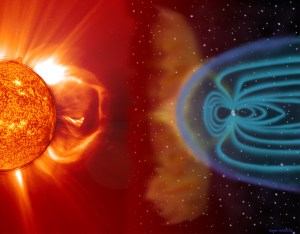
“Not quite, Sis. There’s only one magnetic field, a combination of Earth’s field, the Sun’s field, and the magnetic fields contained in whatever the Sun throws our way. Way out here Earth’s field is about ten thousand times stronger than the Sun’s is, but the fields inside a CME can range up to 10% or 20% of Earth’s. The moving curtains up there are the result of a magnetic tussle between us and a CME or maybe a flare’s outflow.”

“But there aren’t any iron filings up there, Uncle Sy!”

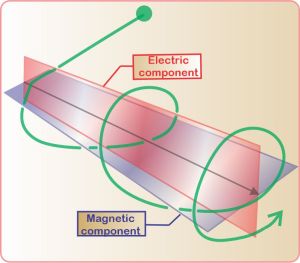
“True, but there are free charged particles in the ionosphere thanks to UV radiation from the Sun. A free electron caught in a magnetic field whips into a tight spiral. Its field gets neighbor particles spiraling. Pretty soon you wind up with a chain of them spiraling together, lining up like the filings do.”

“The spotlights?”

“Probably ion blobs embedded in the CME, but that’s a guess.”

Aurora, photo by W.carter
licensed under CC BY-SA 4.0

~ Rich Olcott

A Play Beyond The Play

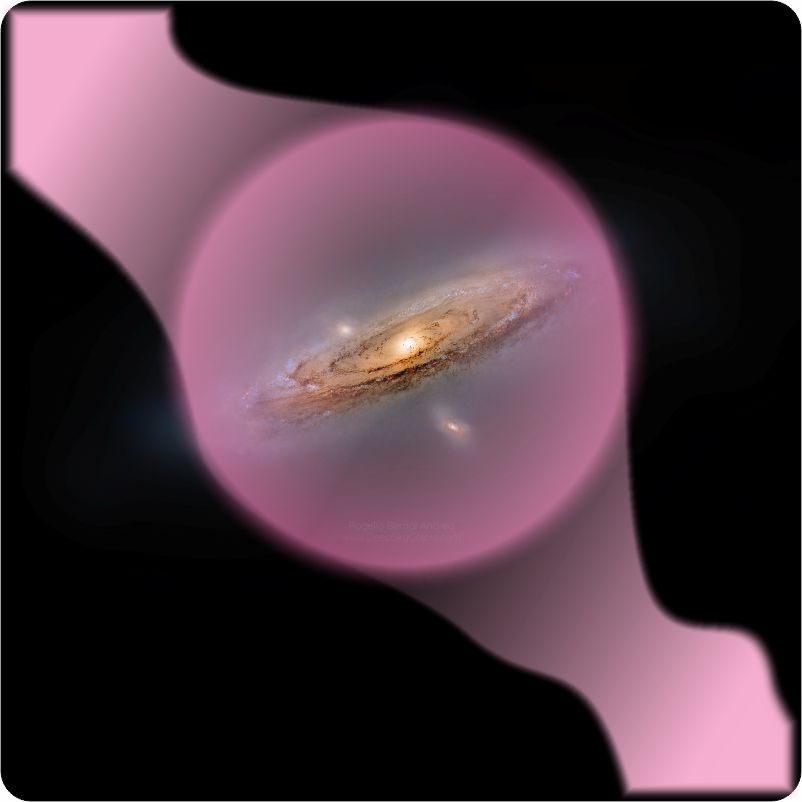
Vinnie takes a long thoughtful look at the image that had dashed his beautiful six‑universe idea. “Wait, Sy. I don’t like this picture”

“Because it messes up your invention?”

“No, because how can they know what that halo looks like? I mean, the whole thing with dark matter is that we can’t see it.”

“You’re right about that. Dark matter’s so transparent that even with five times more mass than normal matter, it doesn’t block CMB photons coming from 13.8 billion lightyears away. That still boggles my brain every once in a while. But dark matter’s gravitational effects — those we can see.”

“Yeah, I remember a long time ago we talked about Fritz Zwicky and Vera Rubin and how they told people about galaxies held together by too much gravity but nobody believed them.”

“Well, they did, after a while—”

“A long while, like a long while since those talks. Remind me what ‘too much gravity’ was about.”

“It was about conflicts between their observations and the prevailing theoretical models. Everyone thought that galaxies and galaxy clusters should operate pretty much like planetary orbits — your speed increases the closer you are to the center, up to Einstein’s speed limit. Newton’s Laws of Motion predict how fast you should move if you’re at a certain distance from a body with a certain mass. If you’re moving faster than that, you fly away.”

“Yeah, escape velocity. So the galaxies in Zwicky’s cluster didn’t follow Newton’s Laws?”

“They didn’t seem to. Galaxies that should have escaped were still in there. The only way he could explain the stability was to suppose the galaxies are only a small fraction of the cluster’s mass. Extra gravity from the extra mass must bind things together. Forty years later Rubin’s improved technology revealed that stars within galaxies had the same anomalous motion.”

“I’m guessing the ‘faster near the center’ rule didn’t hold, or else you wouldn’t be telling this story. Spun like a wheel, I bet.”

“When a wheel spins, every part of it rotates at the same angular speed, the same number of degrees per second, right?”

“Ahh, the bigger my circle the higher my airspeed so the rule would be ‘faster farther out’.”

“That’s the wheel rule, right, but Rubin’s data showed that stars within galaxies don’t obey that one either. She measured lots of stars in Andromeda and other galaxies. Their linear speeds, kilometers per second, are nearly identical from near the center all the way out. Even dust and gas clouds beyond the galactic starry edges also fit the ‘same linear speed everywhere’ rule. You’d lose the bet.”

“That just doesn’t feel right. How can just gravity make that happen?”

“It can if the right amount of dark matter’s distributed in the right‑shaped smeared‑out hollowed‑out spherical halo. The halo’s radial density profile looks about like this. Of course, profiles for different galaxies differ in spread‑outness and other details, but the models are pretty consistent.”

“Wait, if dark matter only does gravity like you said, why’s that hole in the middle? Why doesn’t everything just fall inward?”

“Dark matter has mass so it also has inertia, momentum and angular momentum, just as normal matter does. Suppose some of the dark matter has collected gravitationally into a blob and the blob is moving slower than escape velocity. If it’s flying straight at the center of gravity it’ll get there and stay there, more or less. But if the blob’s aimed in any other direction, it has angular momentum relative to the center. Momentum’s conserved for dark matter, too. The blob eventually goes into orbit and winds up as part of the shell.”

“Does Zwicky’s galaxy cluster have a halo, too?”

“Not in the same way. Each galaxy probably has its own halo but the galaxies are far apart relative to their size. The theoreticians have burned huge amounts of computer time simulating the chaos inside large ensembles of gravity‑driven blobs. I just read one paper about a 4‑billion‑particle calculation and mind you, a ‘particle’ in this study carried more than a million solar masses. Big halos host subhalos, with filaments of minihalos tying them together. What we can’t see is complicated, too.”

~ Rich Olcott
Old Sol And The Pasta Pot

<chirp, chirp> “Excuse me, folks, it’s my niece. Hello, Teena.”

“Hi, Uncle Sy. What’s a kme?”

“Sorry, I don’t know that word. Spell it.”

“I’ve never seen it written down. Brian says the Sun’s specially active and gonna spit out a kme that’ll bang into Earth and knock us out of our orbit.”

“Ah, that’s a C‑M‑E, three separate letters. It stands for Coronal Mass Ejection. As usual, Brian’s got some of it right and much of it wrong. The right part is that the Sun’s at the peak of its 11‑year activity cycle so there’s lots of sunspots and flares—”

“He said flares, too. They’re super bright and could cook an Astronaut and it’d happen so fast we won’t have any warning.”

“Once again, partially right but mostly wrong. Here, let me give you to Cathleen who can set you straight. Cathleen, did you catch the conversation’s drift?”

<phone‑pass pause> “Hello, Teena. I gather you’re upset about solar activity?”

“Hi, Dr O’Meara. Yes, my sorta‑friend Brian likes to scare me with what he brings back from going down YouTube rabbit holes. I don’t really believe him but. You know?”

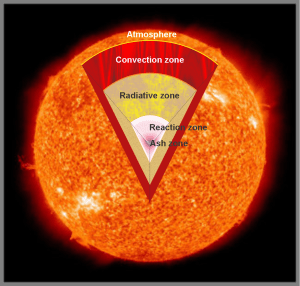
“I understand. Rabbit holes do tend to collect rubbish. Here, let me send you a diagram I use in my classes.” <another pause> “Did you get that?”

“Mm‑hm. Brian showed me a picture like that without the cut‑out part because he was all about the bright flashes.”

“Of course he was. I’ll skip the details, but the idea is that the Sun generates its heat and light energy deep in the reaction zone. Various processes carry that energy up through other zones until it hits the Sun’s atmosphere. You’ve watched water boil on the stove, surely.”

“Oh, yes. Mom put me in charge of doing the pasta last year. I don’t care what they say, a watched pot does eventually boil if there’s enough heat underneath it. I experimented.”

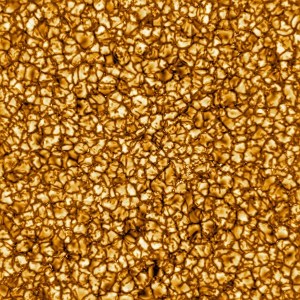
“Wonderful. That process, heat rising into a fluid layer, works the same way on the Sun as it does in your pasta pot. Heat ascends through the fluid but it doesn’t do that uniformly. No, the continuous fluid separates into distinct cells, they’re called Bénard cells, where hot fluid comes up the center, spreads out and cools across the top and then flows down the cell’s outer boundary.”

“That’s what I see happen in the pot with low water and low heat just before the bubbling starts.”

“Right, bubbling will disturb what had been a stable pattern. The cells in the Sun’s surface, they’re called granules, continually rise up to the surface and crowd out neighbors that have cooled off enough to sink or disappear.”

“Funny to say something on the Sun is cool.”

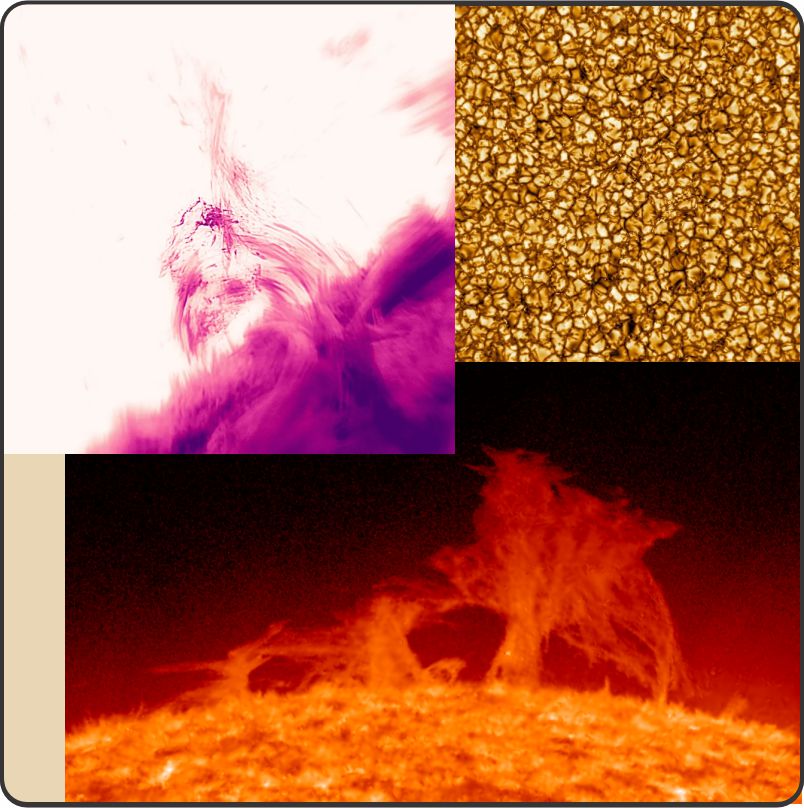
“Relatively cool, only 4000K compared to 6000K. But the Sun has bubbles, too. The granules run about 1500 kilometers wide and last only a quarter‑hour. There’s evidence they’re in top of a supporting layer of supergranules 20 times wider. Or maybe the plasma’s magnetic field is patchy. Anyhow, the surface motion is chaotic. Occasionally, especially concentrated heat or magnetic structure punches out between the granules. There’s a sudden huge release of superhot plasma, a blast of electromagnetic energy radiating out at all frequencies — that’s one of Brian’s flares. Lasts about as long as the granules.”

“That’s what could cook an astronaut?”

“Not really, The radiation’s pretty spread out by the time it’s travelled 150 million kilometers to us. The real danger is from high‑energy particle storms that travel along the Sun’s magnetic field lines. Space crews need to take shelter from them but particle masses travel slower than light so there’s several hours notice.”

“So what about the CMEs?”

“They’re big bubbles of plasma mass that the Sun throws off a few times a year on average. Maybe they come from ultra‑flares but we just don’t know. Their charged particles and magnetic fields can mess up our electronic stuff, but don’t worry about their mass. If a CME’s entire mass hit us straight on, it’d be only a millionth of a millionth of Earth’s mass. We’d roll on just fine.”

~ Rich Olcott
Surf Lake Loki? No, Thanks.

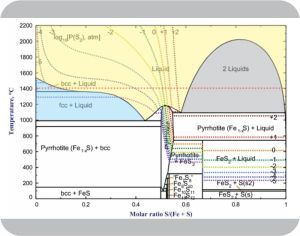
Vinnie’s been eavesdropping (he’s good at that). “You guys said that these researcher teams looked at how iron and sulfur play together at a bunch of different temperature, pressures and blend ratios. That’s a pretty nice chart, the one that shows mix and temperature. Got one for pressure, like the near‑vacuum over Loki’s lava lake on Io?”

“Not to my knowledge, Vinnie. Of course I’m a lab chemist, not a theoretical astrogeochemist. Kareem’s phase diagram is for normal atmospheric pressure. I’d bet virtually all related lab work extends from there to the higher pressures down toward Earth’s center. Million‑atmosphere experiments are difficult — even just trying to figure out whether a microgram sample’s phase in a diamond anvil cell is solid or liquid. Right, Kareem?”

“Mm‑hm, but the computer work’s hard, too, Susan. We’ve got several suites of software packages for modeling whatever set of pressure-temperature-composition parameters you like. The problem is that the software needs relevant thermodynamic data from the pressure and temperature extremes like from those tough‑to‑do experiments. There’s been surprises when a material exhibited new phases no‑one had ever seen or measured before. Water’s common, right, but just within the past decade we may have discovered five new high‑pressure forms of ice.”

“May have?”

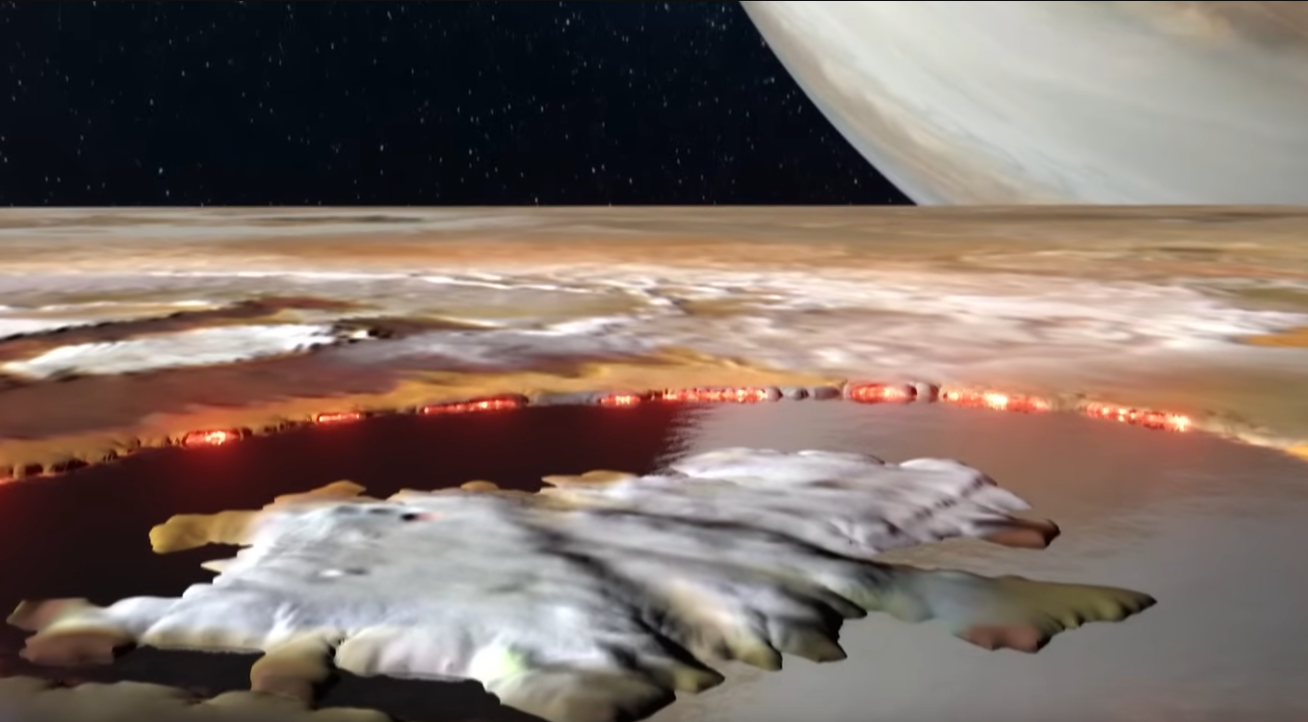
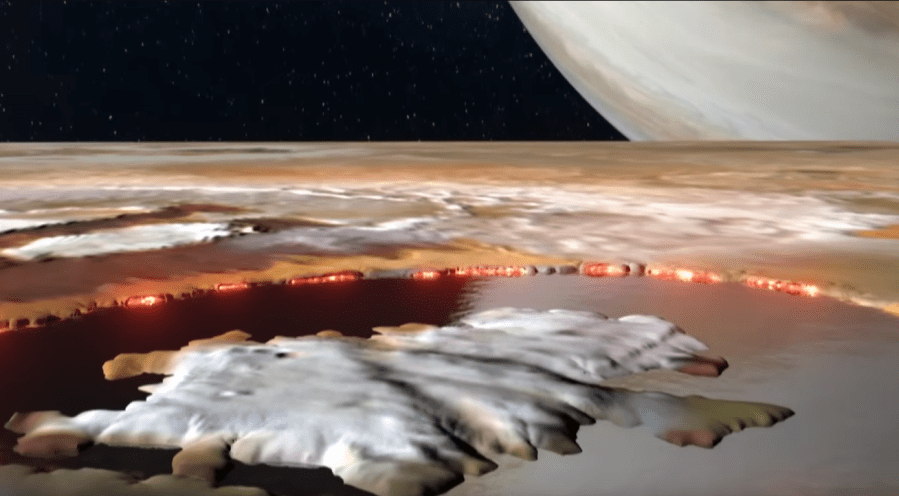
Artist’s concept of Loki Patera,
a lava lake on Jupiter’s moon Io
Credit: NASA/JPL-Caltech/SwRI/MSSS

“The academics are still arguing about each of them. Setting aside that problem, modeling Io’s low‑pressure environment is a challenge because it’s not a lab situation. Consider Cal’s pretty picture there. See those glowing patches all around the lava lake’s shore? They’re real. Juno‘s JIRAM instrument detected hot rings around Loki and nearly a dozen of its cousins. Such continual heat release tells us the lakes are being stirred or pumped somehow. Whatever delivers heat to the shore also must deliver some kind of hot iron‑sulfur phase to the cooler surface. That’ll separate out like slag in a steel furnace.”

“It’s worse than that, Kareem. Sulfur’s just under oxygen in the periodic table, so like oxygen it’s willing to be gaseous S2. Churned‑up hot lava can’t help but give off sulfur vapor that the models will have to account for.”

I cut in. “It’s worse than that, Susan. I’ve written about Jupiter’s crazy magnetic field, off‑center and the strongest of any planet. Io’s the closest large moon to Jupiter, deep in that field. Sulfur molecules run away from a magnetic field; free sulfur atoms dive into one. Either way, if you’re some sulfur species floating above a lava lake when Jupiter’s field sweeps past, you won’t be hanging around that lake for long. Most likely, you’ll join the parade across the Io‑to‑Jupiter flux tube bridge.”

Susan chortles. “Obviously not an equilibrium. It’s a steady state!”

“Huh?” from everyone. Cal gives her, “Steady state?”

Chemical equilibrium is when a reaction and its reverse go at equal rates, right, so the overall composition doesn’t change. That’s the opposite of situations where there’s a forward reaction but for some reason the products don’t get a chance to back‑react. Classic case is precipitation, say when you bubble smelly H2S gas through a solution that may contain lead ions. If there’s lead in there you get a black lead sulfide sediment that’s so insoluble there’s no re‑dissolve. Picture an industrial vat with lead‑contaminated waste water coming in one pipe and H2S gas bubbling in from another. If you adjust the flow rates right, all the lead’s stripped out, there’s no residual stink in the effluent water and the net content of the vat doesn’t change. That’s a steady state.”

“What’s that got to do with Loki’s lake?”

“Sulfur vapors come off it and those glowing rings tell us it’s giving off heat. It’s just sitting there not getting hotter and probably not changing much in composition. There’s got to be sulfur and heat inflow to make up for the outflow. The lake’s in a steady state, not an equilibrium. Thermodynamic calculations like Gibbs’ phase rule can’t tell you anything about the lake’s composition because that depends on the kinetics — how fast magma comes in, how fast heat and sulfur go out. Kareem’s phase diagram just doesn’t apply.”

~ Rich Olcott
A Lazy Summer Day at 1400°C

Susan Kim and Kareem are supervising while Cal mounts a new poster in the place of honor behind his cash register. “A little higher on the left, Cal.”

“How’s this, Susan? Hey, Sy, get over here and see this. Ain’t it a beaut?”

“Nice, Cal. What’s it supposed to be? Is that Jupiter in the background?”

“Yeah, Jupiter all right. Foreground is supposed to be a particular spot on its moon Io. They think it’s a lake of molten sulfur!”

“No way, from that picture at least! I’ve seen molten sulfur. It goes from pale yellow to dark red as you heat it up, but never black like that.”

“It’s not going to be lab-pure sulfur, Susan. This is out there in the wild so it’s going to be loaded with other stuff, especially iron. But the molten sulfur I’ve seen in volcanoes is usually burning with a blue flame. I guess the artist left that out.”

“No oxygen to burn it with, Kareem. Why did you mention iron in particular?”

“Yeah, this article I took the image from says that lake’s at 1400°C. I thought blast furnaces ran hotter than that.”

I’ve been looking things up on Old Reliable. “They do, Cal, typically peaking near 2000°C.”

“So if this lake has iron in it, why isn’t the iron solid?”

“Same answer as I gave to Susan, Cal. The iron’s not pure, either. Mixtures generally melt or freeze at lower temperatures than their pure components. Sy would probably start an entropy lecture—”

“I would.”

“But I’m a geologist. Earth is about ⅓ iron. That’s mixed in with about 10% as much sulfur, mostly in the core where pressures and temperatures are immense. We want to understand conditions down there so we’ve spent tons of lab time and computer time to determine how various iron‑sulfur mixtures behave at different temperatures and pressures. It’s complicated.” <brings up an image on his phone> “Here’s what we call the system’s phase diagram.”

“You’re going to have to read that to us.”

“I expected to. Temperature increases along the y‑axis. Loki’s temp is at the dotted red line. Left‑to‑right we’ve got increasing sulfur:iron ratios — pure iron on the left, pure sulfur on the right. The idea is, pick a temperature and a mix ratio. The phase diagram tells you what form or forms dominate. The yellow area, for instance, is liquid — molten stuff with each kind of atom moving around randomly.”

“What’s the ‘bcc’ and ‘fcc’ about?”

“I was going to get to that. They’re abbreviations for ‘body‑centered cubic’ and ‘face‑centered cubic’, two different crystalline forms of iron. The fcc form dominates below that horizontal line at about 1380°C, converts to bcc above that temperature. Pure bcc freezes at about 1540°C, but add some sulfur to the molten material and you drive that freezing temperature down along the blue‑yellow boundary.”

“And the gray area?”

“Always a fun thing to explain. It’s basically a no‑go zone. Take the point at 1400°C and 80:20 sulfur:iron, for instance. The line running through the gray zone along those red dots, we call it a tie line, skips from 60:40 to 95:5, right? That tells you the 60:40 mix doesn’t accept additional sulfur. The extra part of the 80:20 total squeezes out as a separate 95:5 phase. Sulfur’s less dense than iron so the molten 95:5 will be floating on top of the 60:40. Two liquids but they’re like oil and water. If you want a uniform 80:20 liquid you have to shorten the tie line by raising the temp above 2000°C.”

“All that’s theory. Is there evidence to back it up?”

“Indeed, Sy, now that Juno‘s up there taking pictures. When the spacecraft rounded Io last February JunoCam caught several specular reflections of sunlight just like it had bounced off mirrors. At first the researchers suspected volcanic glass but the locations matched Loki and other hot volcanic calderas. The popular science press can say ‘sulfur lakes’ but NASA’s being cagey, saying ‘lava‘ — composition’s probably somewhere between 10:90 and 60:40 but we don’t know.”

~ Rich Olcott

The Trough And The Plateau

Particularly potent pepperoni on Pizza Eddie’s special tonight so I dash to the gelato stand. “Two dips of pistachio in a cup, please, Jeremy, and hurry. Hey, why the glum look?”

“The season’s moving so slowly, Mr Moire. I’m a desert kid, used to bright skies. I need sunlight! We’re getting just a few hours of cloudy daylight each day. It seems like we’re never gonna leave this pattern. Here’s your gelato.”

“Thanks. Sorry about the cloudiness, it’s the wintertime usual around here. But you’re right, we’re on a plateau.”

“Nosir, the Plateau’s the Four Corners area, on the other side of the Rockies, miles and miles away from here.”

<chuckle> “Not the Colorado Plateau, the darkness plateau. Or the daylight trough, if you prefer. Buck up, we’ll get a daylight plateau starting in a few months.” <unholstering Old Reliable> “Here’s a plot of daylight hours through the year at various northern latitudes. We’re in between the red and green curves. For folks south of the Equator that’d just turn upside‑down, of course. I added a star at today’s date in mid‑December, see. We’re just shy of the winter solstice; the daylight hours are approaching the minimum. You’re feeling stressed because these curves don’t change much day-to-day near minimum or maximum. In a couple of weeks the curve will bend upwards again. Come the Spring equinox, you’ll be shocked at how rapidly the days lengthen.”

“Yeah, my Mom says I’m too impatient. She says that a lot. Okay, above the Arctic Circle they’ve got months‑long night and then months‑long day, I’ve read about that. I hadn’t realized it was a one‑day thing at the Circle. Hey, look at the straight lines leading up to and away from there. Is that the Summer solstice? Those low‑latitude curves look like sine waves. Are they?”

“Summer solstice in the northern hemisphere, Winter solstice for the southerners. The curves are distorted sines. Ready for a surprise?”

<Looks around the nearly empty eatery.> “With business this slow I’m just sitting here so I’m bored. Surprise me, please.”

“Sure. One of the remarkable things about a sine wave is, when you graph its slopes you get another sine wave shifted back a quarter. Here, check it out.”

“Huh! When the sine wave’s mid-climb, the slope’s at its peak. When the sine wave’s peaking, the slope’s going through zero on the way down. And they do have exactly the same shape. I see where you’re going, Mr Miore. You’re gonna show me the slopes of the daylight graphs to see if they’re really sine waves.”

“You’re way ahead of me and Old Reliable, Jeremy.” <frantic tapping on OR’s screen> “There, point‑by‑point slopes for each of the graphs. Sorta sine‑ish near the Equator but look poleward.”

“The slopes get higher and flatter until the the Arctic Circle line suddenly drops down to flip its sign. Those verticals are the solstices, right?”

“Right. Notice that even at the Circle the between‑solstice slopes aren’t quite constant so the straight lines you eye‑balled aren’t quite that. North of the Circle the slopes go nuts because of the abrupt shifts between varying and constant sun.”

“How do you get these curves, Mr Moire?”

“It’s a series of formulas. Dust off your high school trig. The Solar Declination Angle equation is about the Sun’s height above or below the horizon. It depends on Earth’s year length, its axial tilt and the relative date, t=T‑T0. For these charts I set T0 to the Spring equinox. If the height’s negative the Sun’s below the horizon, okay?”

“Sine function is opposite‑over‑hypotenuse and the height’s opposite alright or we’d burn up, yup.”

“The second formula gives the the Hour Angle between your longitude and whichever longitude has the Sun at its zenith.”

“Why would you want that?”

“Because it’s the heart of the duration formula. When you roll all three formulas together you get one big expression that gives daylight duration in terms of Earth’s constants, time of year and your location. That’s what I plotted.”

“How about the slope curves?”

“Calculus, Jeremy, d/dt of that combined duration function. It’s beyond my capabilities but Old Reliable’s up to it.”

~ Rich Olcott

Caged But Free

Afternoon coffee time. Cal waves a handful of astronomy magazines at us as Cathleen and I enter his shop. “Hey, guys, there’s a ton of black hole stuff in the news all of a sudden.”

Cathleen plucks a scone from the rack. “Not surprised, Cal. James Webb Space Telescope looks harder and deeper than we ever could before and my colleagues have been feasting on the data. Black holes are highly energetic so the most extreme ones show up well. The Hubble and JWST folks find new extremes every week.”

Cal would be disappointed if I didn’t ask. “So what’s the new stuff in there?”

<flipping through the magazines> “This seems to be quasar jet month. We’ve got a new champion jet and this article says M87’s quasar makes novas.”

“Remind me, Cathleen, what’s a quasar?”

“A quasi‑stellar object, Sy, except we now know it’s a galaxy with a supermassive black hole—”

“I thought they all had super‑massives.”

“Most do, but these guys are special. For reasons researchers are still arguing about, they emit enormous amounts of energy, as much as a trillion average stars. Quasar luminosity is more‑or‑less flat all across the spectrum from X-rays down as low as we can measure. Which isn’t easy, because the things are so far away that Universe expansion has stretched their waves by z‑factors of 6 or 8 or more. We see their X‑ray emissions in the infrared range, which is why JWST’s optimized for infrared.”

“What does ‘flat’ tell you?”

“Sy’d give a better answer than I would. Sy?”

“Fun fact, Cal. Neither atoms nor the Sun have flat spectra and for the same reason: confinement. Electromagnetic waves come from jiggling charges, right? In an atom the electron charge clouds are confined to specific patterns centered on the nucleus. Each pattern holds a certain amount of energy. The atom can only move to a different charge pattern by emitting or absorbing a wave whose energy matches the difference between the pattern it’s in and some alternate pattern. Atomic and molecular spectra show peaks at the energies where those transitions happen.”

“But the Sun doesn’t have those patterns.”

“Not in the stepped energy‑difference sense. The Sun’s made of plasma, free electrons and nuclei all bouncing off each other, moving wherever but confined to the Sun’s spherical shape by gravity. Any particle that’s much more or less energetic than the local average eventually gets closer to average by exchanging energy with its neighbors. Free charged particles radiate over a continuous, not stepwise, spectrum of energies. The free‑particle combined spectrum has a single peak that depends on the average temperature. You only get flat spectra from systems that aren’t confined either way.”

“What I get from all that is a jet’s flat spectrum says that its electrons or whatever aren’t confined. But they must be — the things are thin as a pencil for thousands of lightyears. Something’s gotta be holding them together but why no peaks?”

“Excellent question, Cal. By the way, jets can be even longer than you said. I’ve read about your champion jet. It extends 23 million lightyears, more than a hundred times the width of the Milky Way galaxy. Straight as a string, no kinks or wiggles during a billion years of growth. I think what’s going on is that the charged particles are confined side‑to‑side somehow but they’re free to roam along the jet’s axis. If that’s the case, the flat‑spectrum light ought to be polarized. I’m sure someone is working on that test now. Your thoughts, Sy?”

“As a physicist I’m interested in the ‘somehow.’ We only know of four forces. The distances are too big for weak and strong nuclear forces. Gravity’s out, too, because it acts equally in all directions, not just crosswise to the axis. That leaves electromagnetic fields in some super‑strong self‑reinforcing configuration. The particles must be spiraling like mad about that central axis. I’ll bet that explains Cal’s quasar galaxy concentrating novae close to its SMBH jet axis. A field that strong could generate enough interference to wreak havoc on an unstable star’s plasma.”

Hubble’s view of the M87 galaxy and jet
Credit NASA and the Hubble Heritage Team (STScI/AURA)

~ Rich Olcott

The Oldest Clock Ticks Slowest

<Cliff‑hanger Cathleen strikes again> “How can you even measure a 2million year halflife?”

Kareem’s right back at her. “What’s a halflife?”

“Start a clock, weigh a sample, wait around for a while and then weigh it again to see how much is still there. When half of it’s gone, stop the clock and you’ve measured a half‑life. Simple.”

“Simple but not that simple or maybe a bit simpler. For one thing, you don’t have to wait for a full halflife. For spontaneous radioactivity, all you have to know is the interval and whatever fraction disappeared. There’s a nice equation that ties those two to the halflife.”

“Spontaneous? Like there’s another kind?”

“Stimulated radioactivity. That’s what nuclear reactors do — spew neutrons at uranium235 atoms, for instance, transmuting them to uranium236 so they’ll split into krypton and barium atoms and release energy and more neutrons. How often that happens depends on neutron concentration. Without that provoking push, the uranium nuclei would just split when they felt like it and that’s the natural halflife.”

“Wait. I know that curve, it’s an exponential. Why isn’t e in the equation?”

“It could be. Would you prefer e-0.69315*t/half‑life? Works just as well but it’s clumsier. Base‑2 makes more sense when you’re talking halves. Usually when you say ‘exponential’ people visualize an increase. Here we’re looking at a decrease by a constant percentage rate but yeah, that’s an exponential, too. You get a falling curve like that from a Geiger counter and you’re watching counts per minute from someone’s thyroid that’s been treated with iodine‑131. Its 8‑day half‑life is slow enough to track that way. Really short half‑lives I don’t know much about; I care about the slow disintegraters that are either primordial or generated by some process.”

“Primordial — that means ‘back to the beginning’, which in your specialty would mean the beginning of the Solar System. We’re pretty sure the Sun’s pre‑planetary disk was built from dust broadcast by stars that went nova. Isotopes in the dust must be the primordial isotopes, right? Which ones are the other kind?”

“Mmm, aluminum‑26 is a good example. The half‑life equation still applies even for million‑year intervals. Half‑life of aluminum‑26 is about 0.7 million years and it decays to magnesium‑26. Whatever amount got here from the stars would have burnt down to a trillionth of that within the first 30 million years or so after arrival. Any aluminum‑26 we find today couldn’t be primordial. On the other hand, cosmic rays can smack a proton and neutron out of a silicon‑28 nucleus and voila! a new aluminum‑26. There’s a steady rain of cosmic rays out in space so there’s a steady production of aluminum‑26 out there. Not here on Earth, though, because our atmosphere blocks out most of the rays. Very nice for us geologists who can compare measured aluminum‑26 to excess magnesium‑26 to determine when a meteorite fell.”

“Excess?”

“Background magnesium is about 10% magnesium‑26 so we have subtract that to get the increment which came from aluminum‑26. A lot of the arguments in our field hinge on how much of which isotope is background or was background when a given rock formed. That’s one reason you see so much press about tiny but rugged zircons. They’re key to uranium‑lead dating. Crystallizing zirconium silicate doesn’t allow lead ions into its structure but it happily incorporates uranium ions. Uranium‑235 and uranium‑238 both decay to crystal‑trapped lead, but each isotope goes to a different lead isotope and with a different half‑life. The arithmetic’s simpler and the results are more definitive when you know that the initial lead content was zero.”

“So that aluminum‑magnesium trick’s not your only tool?”

“Hardly. The nuclear chemists have given us a long list of isotope chains, what decays to what with what half‑life and how much energy the radiating particle gets. Nuclei flit between quantum energy levels just like atoms and molecules do, except a spectrum of alpha or beta particles is a different game from the light‑wave spectrum. Tell me a radiated particle’s energy and I can probably tell you which isotope spat it out and disappeared.”

“Your ladder rungs are Cheshire Cat grins.”

~~ Rich Olcott

The Not-so-dangerous Banana

“Y’know, Cathleen, both our ladders boil down to time. Your Astronomy ladder connects objects at different times in the history of the Universe. My Geology ladder looks back into the Solar System’s history.”

“As an astronomer I normally think of parsecs or lightyear distances but you have a point, Kareem. Edwin Hubble linked astronomical space with time. Come to think of it, my cosmologist colleagues work almost exclusively in the time domain, like ‘T=0 plus a few lumptiseconds.’ Billions of years down to that teeny time interval — how does your time ladder compare?”

“Lumptiseconds out to a hundred trillion times the age of the Universe. I win.”

“C’mon, Kareem.”

“No, really, Sy. My ladder uses isotopes. Every carbon atom has 6 protons in the nucleus, right? Carbon‑12 adds 6 neutrons and it’s stable but another isotope, carbon‑14, has 8 neutrons. It’s radioactive — spits out an electron and becomes stable nitrogen‑14 with 7 and 7. Really heavy isotopes like uranium‑238 spit out alpha particles.”

“Wait, if carbon‑14 spits out an electron doesn’t that make it a carbon ion?”

“Uh‑uh, Cathleen, the electron comes out of the nucleus, not the electron cloud. It’s got a hundred thousand times more energy than a chemical kick could give it. Sy could explain—”

“Nice try, Kareem, this is your geologic time story. Let’s stay with that.”

“If I must. So, the stable isotopes last forever, pretty much, but the radioactive ones are ticking bombs with random detonation times.”

“What’s doing the ticking? Surely there’s no springs or pendulums in there.”

“Quantum, Cathleen. Sy’s trying to stay out of this so I’ll give you my outsider answer. I picture every kind of subatomic particle constantly trying to leave every nucleus, butting their little heads bazillions of times a second against walls set up by the weak and strong nuclear forces. Nearly every try is a bounce‑back, but one success is enough to break the nucleus. Every isotope has its own personal set of parameters for each kind of particle — wall height, wall thickness, something like an internal temperature ruling how hard the particles hit the walls. The ticking is those head‑butts; the randomness comes from quantum’s goofy rules somehow. How’s that, Sy?”

“Good enough for jazz, Kareem. Carry on.”

“Right. So every kind of radioisotope is characterized by what kinds of particle it emits, how much energy each kind has after busting through a wall, and how often that happens in a given sample size. And the isotope’s chemistry, of course, which is the same as every other isotope that has the same number of protons. The general rule is that the stable isotopes have maybe a few more neutrons than protons but nearly every element has some unstable isotopes. The ones with too many neutrons, like carbon‑14, emit electrons as beta particles. They go up a square in the Periodic Table. Too few and they drop down by emitting a positron.”

“All those radioactive stand‑ins for normal atoms. Sounds ghastly. Why are we still here and not all burnt up?”

“First, when one of these atoms decays by itself it’s a lot of energy for that one atom, but the energy spreads out as heat across many atoms. Unless a bunch of atoms crumble at about the same time, there’s only a tiny bit of general heating. The major biological danger from radioactivity comes from spit‑out particles breaking protein or DNA molecules.”

“Mutated, not burnt.”

“Mm‑hm. Second, the radioactives are generally rare relative to their stable siblings. In many cases that’s because the bad guys, like aluminum‑26, have had time to decay to near‑zero. That banana you’re eating has about half a gram of potassium atoms but only 0.012% are unstable potassium‑40. Third, an isotope with a long half‑life doesn’t lose many atoms per unit time. A kilogram of tellurium‑128, for instance, loses 2000 atoms per year. The potassium‑40 in your banana has a half‑life of nearly 2 million years. Overall, it releases only about 1300 beta particles per second producing less than a nanowatt of heat‑you‑up power. Not to worry.”

“Two million years? How do you measure something that slow?”

~~ Rich Olcott

EROs Atop A Ladder

“‘That’s where the argument started? That’s right up there with ‘Then the murders began.’ Cathleen Cliff‑hanger strikes again.”

<giggling> “Gotcha, Sy, just like always. Sorry, Kareem, we’ve had this thing since we were kids.”

“Don’t mind me, but do tell him what’s awry with the top of your galactic distance ladder.”

“I need to fill you in first about the ladder’s framework. We know the distances to special ‘standard candles’ scattered across the Universe, but there’s oodles of other objects that aren’t special that way. We can’t know their distances unless we can tie them to the candles somehow. Distance was Edwin Hubble’s big thing. Twenty years after Henrietta Swan Leavitt identified one kind of candle, Hubble studied the light from them. The farthest spectra were stretched more than the closest ones. Better yet, there was a strict relationship between the amount of stretch, we call it the z factor, and the candle’s distance. Turns out that everything at the intergalactic scale is getting farther from everything else. He didn’t call that expansion the Hubble Flow but we do. It comes to about 7% per billion lightyears distance. z connects candle spectrum, object spectrum and object distance. That lets us calibrate successive overlapping steps on the distance ladder, one candle type to the next one.”

“A constant growth rate — that’s exponential, by definition. Like compound interest. The higher it gets, it gets even higher faster.”

“Right, Kareem, except that in the past quarter-century we’ve realized that Hubble was an optimist. The latest data suggests the expansion he discovered is accelerating. We don’t know why but dark energy might have something to do with it. But that’s another story.”

“Cathleen, you said the distance ladder’s top rung had something to do with surface brightness. Surface of what?”

“Galaxies. Stars come at all levels of brightness. You can confirm that visually, at least if you’re in a good dark‑sky area. But a galaxy has billions of stars. When we assess brightness for a galaxy as a whole, the brightest stars make up for the dimmest ones. On the average it’ll look like a bunch of average stars. The idea is that the apparent brightness of some galaxy tells you roughly how many average stars it holds. In turn, that gives you a rough estimate of the galaxy’s mass — our final step up the mass ladder. Well, except for gravitational lensing, but that’s another story.”

“So what’s wrong with that candle?”

“We didn’t think anything was wrong until recently. Do you remember that spate of popular science news stories a year ago about giant galaxies near the beginning of time when they had no business to exist yet?”

“Yeah, there was a lot of noise about we’ll have to revise our theories about how the Universe evolved from the Big Bang, but the articles I saw didn’t have much detail. From what you’ve said so far, let me guess. These were new galaxy sightings, so probably from James Webb Space Telescope data. JWST is good at infra‑red so they must have been looking at severely stretched starlight—”

z-factor near 8″

“— so near 13 billion lightyears old, but the ‘surface brightness’ standard candle led the researchers to claim their galaxies held some ridiculous number of stars for that era, at least according to current theory. How’d I do?”

“Good guess, Sy. That’s where things stood for almost a year until scientists did what scientists do. A different research group looking at even more data as part of a larger project came up with a simpler explanation. Using additional data from JWST and several other sources, the group concentrated on the most massive galaxies, starting with low‑z recent ones and working back to z=9. Along the way they found some EROs — Extremely Red Objects where a blast of infra‑red boosts their normal starlight brightness. The researchers attribute the blast to hot dust associated with a super‑massive black hole at each ERO’s center. The blast makes an ERO appear more massive than it really is. Guess what? The first report’s ‘ridiculously massive’ early galaxies were EROs. Can’t have them in that top rung.”

“Kareem, how about the rungs on your ladder?”

~~ Rich Olcott