Why Is Io Hot, Europa Not?

The Acme Pizza and Science Society is back in session at Eddie’s circular table. Al won the last pot so he gets to pick the next topic. “I been reading about Jupiter’s weird moon Io.”

“How’s it any weirder than Ganymede that’s bigger than Mercury?”
  ”Or Europa that’s got geysers and maybe life?”

“Guys, it’s the only yellow moon in the Solar System. You can’t any weirder than that! We got lots of stony moons that are mostly gray, a few water‑ice moons that are white like snow and then there’s Io by itself covered with sulfur.”

“Yellow?”

“Mostly yellow, except where it’s red or dark brown. Or white. They’re all sulfur colors.”

“I’ve seen yellow sulfur, but red?”

“It’s like carbon can be diamond or graphite. Sulfur can be different colors depending on how hot it was when it froze. The article said the white’s probably frozen sulfur dioxide that smells like burning matches.”

“Where’d all that sulfur come from?”

“From inside Io. It’s got like 400 volcanoes that blast out sulfur and stuff. Some of it falls back and that’s why Io is yellow, but a lot gets all the way into space. The article said Io loses a tonne per second. Nothin’ else in the Solar System is that active. Or that dense, probably ’cause it blasted away all its light stuff a long time ago. Anyway, I got a theory.”

“Don’t stop there. What’s the theory?”

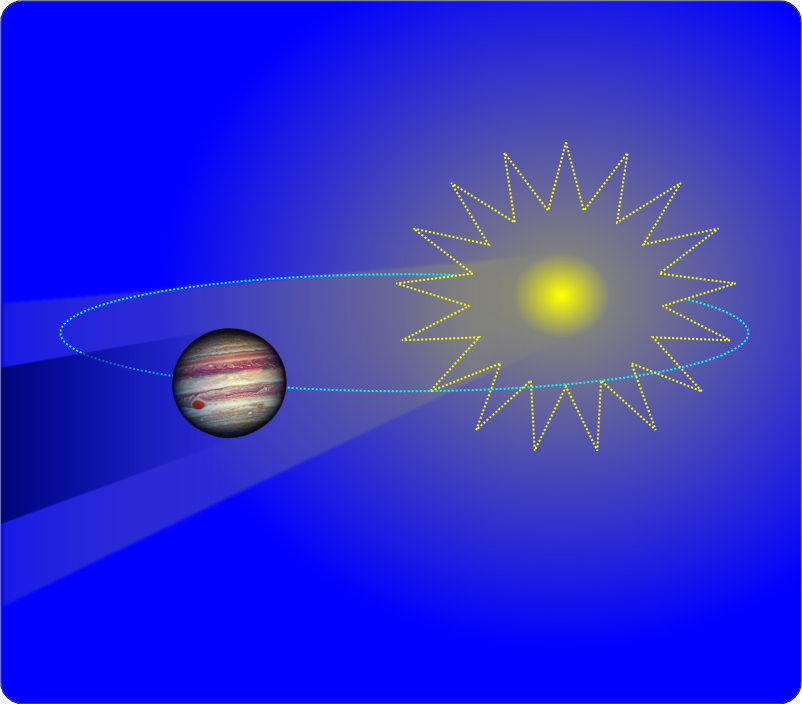
“Jupiter’s stripes got all those colors, right, and Sy here wrote astronomers think the brownish bands have sulfur. My theory is that Jupiter got its sulfur from Io. Whaddaya think, Sy?”
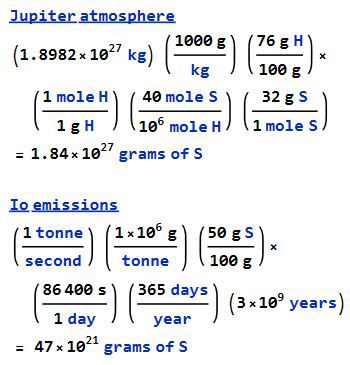
“Interesting idea.” <drawing Old Reliable from its holster> “We need numbers before we can upgrade that to a conjecture.” <screen‑tapping> “So, how much sulfur does Jupiter have, and how much could Io have supplied? … Ah, here’s a chart to get us started. Says for every million hydrogen atoms in Jupiter’s atmosphere there’s 40 sulfurs. This Wikipedia article says that the planet masses 1.898×1027 kilograms. 76% of that is hydrogen which calculates to … 1.8×1027 grams of sulfur.”

“That’s a lot of sulfur.”

“Mm-hm. Now, using your tonne per second loss rate and guessing it’s 50% sulfur and that’s been going on for ¾ of the system’s life so far, I get that Io may have shed about 5×10²² grams of sulfur. That’s short by 4½ powers of 10. Sorry, Al, Io contributed a little to Jupiter’s sulfur stash but not enough to promote your idea to a conjecture.”

Jim tosses some chips into the pot. “It’s worse than that, Sy. Galileo‘s probe fell into a clear hotspot so it sampled Jupiter’s gaseous atmosphere but it totally missed the sulfur tied up in those brown clouds. Jupiter’s got even more sulfur than your calculation shows. But there’s still an open question.”

“What’s open?”

Animation by WolfmanSF, CC0, via Wikimedia Commons

“The inner three Galilean moons are locked into resonant orbits. Laplace explained how their separate gravitational fields continually nudge each other to stay in sync. A 1979 paper supported that explanation but then claimed that the moon‑moon nudges produced enough tidal friction within Io to power volcanoes.”

“What’s wrong with that?”

“It doesn’t tell us why Io’s the only one hot enough to boil off all its water.”

“Io had water?”

“Probably, long ago. All three share the same orbital plane and probably formed from the same disk of gas and dust. Both Europa and Ganymede are water worlds, covered by kilometers of water ice. Io should be wet or the other two would be dry by now. Something’s different with Io and it’s not inter‑moon gravitation.”
“Why not?”

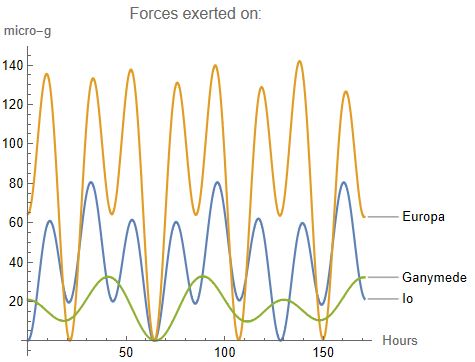
“Numbers. Those moon‑moon interactions are measured in microgravities. Such light impulses can synchronize effectively if repeated often enough, but these just aren’t energetic enough to boil a moon. Besides, Europa stays cool even though it feels a lot more action than Io does.”

“You got a theory?”

“A hypothesis. I’m betting on magnetism. Io’s deep in Jupiter’s lumpy magnetic field which must generate eddy currents in Io’s mostly iron core. I think Io heats up like a pot on an induction stove.”

~~ Rich Olcott

SPLASH Splish plink

<chirp, chirp, chirp, chirp> “Moire here. This’d better be good.”

“Hello, Mr Moire. I’m one of your readers.”

“Do you have any idea what time it is?”

“Afraid not, I don’t know what time zone you’re in.”

“It’s three o’clock in the morning! Why are you calling me at this hour?”

“Oh, sorry, it’s mid-afternoon here. Modern communications tech is such a marvel. No matter, you’re awake so here’s my question. I’ve been pondering that micro black hole you’ve featured in the last couple of posts. You convinced me it would have a hard time hitting Earth but then I started thinking about it hitting the Sun. The Sun’s diameter is 100 times Earth’s so it presents 10,000 times more target area, yes? Further, the Sun’s 300,000 times more massive than Earth so it has that much more gravity. Surely the Sun is a more effective black hole attractor than Earth is.”

“That’s a statement, not a question. Worse yet, you’re comparing negligible to extremely negligible and neither one is worth losing sleep over which is what I’m doing now.”

“Wait on, I’ve not gotten to my question yet which is, suppose a black hole did happen to collide with the Sun. What would happen then?”

<yawn> “Depends on the size of the black hole. If it’s supermassive, up in the billion‑sun range, it wouldn’t hit the Sun. Instead, the Sun would hit the black hole but there’d be no collision. The Sun would just sink quietly through the Event Horizon.”

“Wouldn’t it rip apart?”

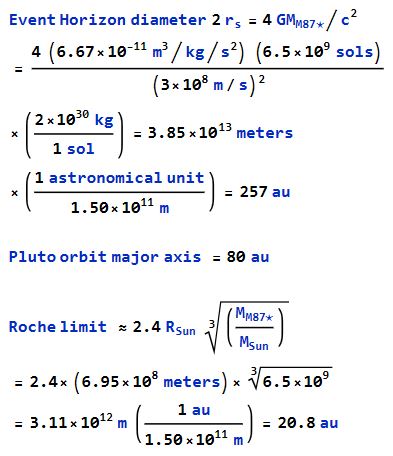
“You’re thinking of those artistic paintings showing great blobs of material being torn away by a black hole’s gravity. Doesn’t work that way, at least not at this size range.” <grabbing Old Reliable from my nightstand and key‑tapping> “Gravitational forces are distance‑dependent. Supermassives are large even by astronomical standards. The M87* black hole, the first one ESA got an image of, has the mass of 6 billion Suns and an Event Horizon three times wider than Pluto’s orbit. The tidal ripping‑apart you’re looking for only happens when the mass centers of two objects approach within Roche’s limit. Suppose a Sun‑sized star flew into M87*’s Event Horizon. Their Roche limit would be 100 astronomical units inside the Event Horizon. If any ripping happened, no evidence could escape to us.”

“Another illusion punctured.”

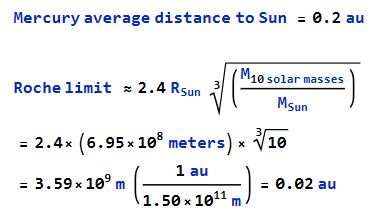
“Don’t give up hope. The next‑smaller size category have masses near our Sun’s. The Event Horizon of a 10‑solar‑mass black hole would be only about 60 kilometers wide. The Roche Zone for an approaching Sun is a million times wider. There’s plenty of opportunity for ferocious ripping on the way in.”

“Somehow that’s a comfort, but my question was about even smaller black holes — micro‑size flyspecks such as you wrote about. What effect would one have on the Sun?”

“You’d think it’d be a simple matter of the micro‑hole, let’s call it Mikey, diving straight to the Sun’s center while gobbling Sun‑stuff in a gluttonous frenzy, getting exponentially bigger and more voracious every second until the Sun implodes. Almost none of that would happen. The Sun’s an incredibly violent place. On initial approach Mikey’d be met with powerful, rapidly moving magnetic fields. If he’s carrying any charge at all they’d give him whip‑crack rides all around the Sun’s mostly‑vacuum outer layers. He might not ever escape down to the Convection Zone.”

“He’d dive if he escaped there or he’s electrically neutral.”

“Mostly not. The Convection Zone’s 200,000-kilometer depth takes up two‑thirds of the Sun’s volume and features hyper‑hurricane winds roaring upward, downward and occasionally sideward. Mikey would be a very small boat in a very big forever storm.”

“But surely Mikey’s density would carry him through to the core.”

“Nope, the deeper you go, the smaller the influence of gravity. Newton proved that inside a massive spherical shell, the net gravitational pull on any small object is zero. At the Sun’s core it’s all pressure, no gravity.”

“Then the pressure will force‑feed mass into Mikey.”

“Not so much. Mikey has jets and and an accretion disk. Their outward radiation pressure sets an upper limit on Mikey’s gobbling speed. The Sun will nova naturally before Mikey has any effect.”

“No worries then.”

~~ Rich Olcott

Hiding Among The Hill Spheres

Bright Spring sunlight wakes me earlier than I’d like. I get to the office before I need to, but there’s Jeremy waiting at the door. “Morning, Jeremy. What gets you here so soon after dawn?”

“Good morning, Mr Moire. I didn’t sleep well last night, still thinking about that micro black hole. Okay, I know now that terrorists or military or corporate types couldn’t bring it near Earth, but maybe it comes by itself. What if it’s one of those asteroids with a weird orbit that intersects Earth’s orbit? Could we even see it coming? Aren’t we still in danger of all those tides and quakes and maybe it’d hollow out the Earth? How would the planetary defense people handle it?”

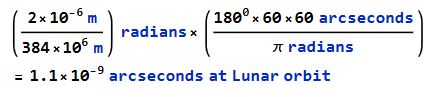
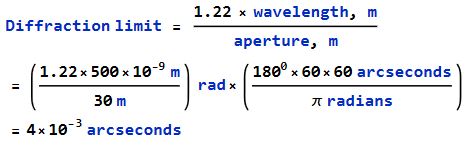
“For so early in the day you’re in fine form, Jeremy. Let’s take your barrage one topic at a time, starting with the bad news. We know this particular object would radiate very weakly and in the far infrared, which is already a challenge to detect. It’s only two micrometers wide. If it were to cross the Moon’s orbit, its image then would be about a nanoarcsecond across. Our astrometers are proud to resolve two white‑light images a few milliarcseconds apart using a 30‑meter telescope. Resolution in the far‑IR would be about 200 times worse. So, we couldn’t see it at a useful distance. But the bad news gets worse.”

“How could it get worse?”

“Suppose we could detect the beast. What would we do about it? Planetary defense people have proposed lots of strategies against a marauding asteroid — catch it in a big net, pilot it away with rocket engines mounted on the surface, even blast it with A‑bombs or H‑bombs. Black holes aren’t solid so none of those would work. The DART mission tried using kinetic energy, whacking an asteroid’s moonlet to divert the moonlet‑asteroid system. It worked better than anyone expected it to, but only because the moonlet was a rubble pile that broke up easily. The material it threw away acted as reaction mass for a poorly controlled rubble rocket. Black holes don’t break up.”

“You’re not making getting to sleep any easier for me.”

“Understood. Here’s the good news — the odds of us encountering anything like that are gazillions‑to‑one against. Consider the probabilities. If your beast exists I don’t think it would be an asteroid or even from the Kuiper Belt. Something as exotic as a primordial black hole or a mostly‑evaporated stellar black hole couldn’t have been part of the Solar System’s initial dust cloud, therefore it wouldn’t have been gathered into the Solar System’s ecliptic plane. It could have been part of the Oort cloud debris or maybe even flown in on a hyperbolic orbit from far, far away like ‘Oumuamua did. Its orbit could be along any of an infinite number of orientations away from Earth’s orbit. But it gets better.”

“I’ll take all the improvement you can give me.”

“Its orbital period is probably thousands of years long or never.”

“What difference does that make?”

“You’ve got to be in the right place at the right time to collide. Earth is 4.5 billion years old. Something with a 100‑year orbit would have had millions of chances to pass through a spot we happen to occupy. An outsider like ‘Oumuamua would have only one. We can even figure odds on that. It’s like a horseshoe game where close enough is good enough. The object doesn’t have to hit Earth right off, it only has to pierce our Hill Sphere.”

“Hill Sphere?”

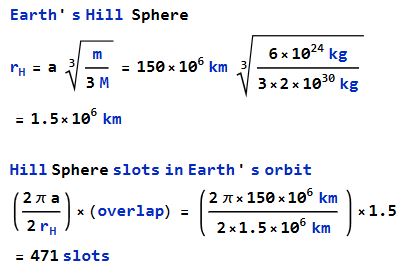
“A Hill Sphere is a mathematical abstract like an Event Horizon. Inside a planet’s Sphere any nearby object feels a greater attraction to the planet than to its star. Velocities permitting, a collision may ensue. The Sphere’s radius depends only on the average planet–star distance and the planet and star masses. Earth’s Hill Sphere radius is 1.5 million kilometers. Visualize Hill Spheres crowded all along Earth’s orbit. If the interloper traverses any Sphere other than the one we’re in, we survive. It has 1 chance out of 471 . Multiply 471 by 100 spheres sunward and an infinity outward. We’ve got a guaranteed win.”

“I’ll sleep better tonight.”

~~ Rich Olcott

The Sky’s The Limit

Another meeting of the Acme Pizza and Science Society, at our usual big round table in Pizza Eddie’s place on the Acme Building’s second floor. (The table’s also used for after‑hours practical studies of applied statistics, “only don’t tell nobody, okay?“) It’s Eddie’s turn to announce the topic for the evening. “This one’s from my nephew, guys. How high up is the sky on Mars?”

General silence ensues, then Al throws in a chip. “Well, how high up is the sky on Earth?”

Being a pilot, Vinnie’s our aviation expert. “Depends on who’s defining ‘sky‘ and why they did that. I’m thinking ‘the sky’s the limit‘ and for me that’s the highest altitude I can get up to legal‑like. Private prop planes generally stay below 10,000 feet, commercial jets aren’t certified above 43,000 feet, private jets aren’t supposed to go above 51,000 feet.”

Eddie counters. “How about the Concorde? And those military high-flyers?”

“They’re special. The SST has, um, had unique engineering to let it go up to 60,000 feet ’cause they didn’t want sonic boom complaints from ground level. But it don’t fly no more anyhow. I’ve heard that the Air Force’s SR-71 could hit 85,000 feet but it got retired, too.”

Al’s not impressed. “All that’s legal stuff. There’s a helicopter flying on Mars but the FAA don’t make the rules there. What else we got?”

Geologist Kareem swallows his last bite of cheese melt. “How about the top of the troposphere? That’s the lowest layer of our atmosphere, the one where most of our weather and sunset colors happen. If you look at clouds in the sky, they’re inside the troposphere.”

“How high is that?”

“It expands with heating, so the top depends where you’re measuring. At the Equator it can be as high as 18½ kilometers; near a pole in local winter the top squeezes down to 6 kilometers or so. And to your next question — above the troposphere we’ve got the stratosphere that goes up to 50 kilometers. What’s that in feet, Sy?”

<drawing Old Reliable and screen-tapping…> “Says about 31.2 miles or 165,000 feet. Let’s keep things in kilometers from here on, okay?”

“Then you’ve got the mesosphere and the exosphere but the light scattering that gives us a blue sky happens below them so I’d say the sky stops at 50 kilometers.”

Al’s been rummaging through his astronomy magazines. “I read somewhere here that you’re not an astronaut unless you’ve gone past either 80 or 100 kilometers, which is weird with two cut‑offs. Who came up with those?”

Vinnie’s back in. “Who came up with the idea was a guy named von Kármán. One of the many Hungarians who came to the US in the 30s to get away from the Nazis. He did a bunch of advanced aircraft design work, helped found Aerojet and JPL. Anyway, he said the boundary between aeronautics and astronautics is how high you are when the atmosphere gets too thin for wings to keep you up with aerodynamic lift. Beyond that you need rockets or you’re in orbit or you fall down. He had equations and everything. For the Bell X‑2 he figured the threshold was around 52 miles up. What’s that in kilometers, Sy?”

“About 84.”

“So that’s where the 80 comes from. NASA liked that number for their astronauts but the Europeans rounded it up to 100. Politics, I suppose. Do von Kármán’s equations apply to Mars as well as Earth?”

“Now we’re getting somewhere, Vinnie. They do, sort of. It’s complicated, because there’s a four‑way tug‑of‑war going on. Your aircraft has gravity pulling you down, lift and centrifugal force pulling you up. Lift depends on the atmosphere’s density and your vehicle’s configuration. The fourth player is the kicker — frictional heat ruining the craft. Lift, centrifugal force and heating all get stronger with speed. Von Kármán based his calculations on the Bell X‑2’s configuration and heat‑management capabilities. Problem is, we’re not sending an X‑2 to Mars.”

“Can you re‑calibrate his equation to put a virtual X‑2 up there?”

“Hey, guys, I think someone did that. This magazine says the Karman line on Mars is 88 kilometers up.”

“Go tell your nephew, Eddie.”

~~ Rich Olcott

Visionaries Old And New

Cathleen’s back at the mic. “Let’s have a round of applause for Maria, Jeremy, Madison and C‑J. Thank you all. We have a few minutes left for questions… Paul, you’re first.”

“Thanks, Cathleen. A comment, not a question. As you know, archeoastronomy is my specialty so I applaud Jeremy’s advocacy for the field. I agree with his notion that the Colorado Plateau’s dry, thin air generally lets us see more stars than sea‑level Greeks do. When I go to a good dark sky site, it can be difficult to see the main stars that define a constellation because of all the background dimmer stars. However, I don’t think that additional stars would change the pictures we project into the sky. Most constellations are outlined from only the brightest stars up there. Dimmer stars may confuse the issue, but I very much doubt they would have altered the makeup of the constellations a culture defines. Each culture uses their own myths and history when finding figures among the stars.”

“Thanks for the confirmation from personal experience, Paul. Yes, Sy?”

“Another comment not a question. I’m struck by how Maria’s Doppler technique and Jeremy’s Astrometry complement each other Think of a distant stellar system like a spinning plate balanced on a stick. Doppler can tell you how long the stick is. Astrometry can tell you how wide the plate is. Both can tell you how fast it’s spinning. The strongest Doppler signal comes from systems that are edge‑on to us. The strongest Astrometry signal comes from systems we see face‑on. Those are the extreme cases, of course. Most systems are be at some in‑between angle and give us intermediate signals.”

“That’s a useful classification, Sy. Madison’s and C‑J’s transit technique also fits the edge‑on category. Jim, I can see you’re about to bust. What do you have to tell us about?”

“How about a technique that lets you characterize exoplanets inside a galaxy we see as only a blurry blob? This paper I just read blew me away.”

“Go ahead, you have the floor.”

“Great. Does everyone know about Earendel?” <blank looks from half the audience, mutters about ‘Lord Of The Rings?’ from several> “OK, quick refresher. Earendel is the name astronomers gave to the farthest individual star we’ve ever discovered. It’s either 13 or 28 billion lightyears away, depending on how you define distance. We only spotted it because of an incredible coincidence — the star happens to be passing through an extremely small region of space where light in our general direction is concentrated thousands‑fold into a beam towards us. Earendel may be embedded in a galaxy, but the amplification region is so narrow we can’t see stars that might be right next to it.”

<Feder’s voice> “Ya gonna tell us what makes the region?”

“Only very generally, because it’s complicated. You know what a magnifying lens does in sunlight.”

“Sure. I’ve burnt ants that way.”

“… Right. So what you did was take all the light energy hitting the entire surface of your lens and concentrate it on a miniscule spot. The concentration factor was controlled by the Sun‑to‑lens‑to‑spot distances and the surface area of the lens. Now bring that picture up to cosmological distances. The lens is the combined gravitational field of an entire galaxy cluster, billions of lightyears away from us, focusing light from Earendel’s galaxy billions of lightyears farther away. Really small spots at both ends of the light path and that’s what isolated that star.”

“That’s what got you excited?”

“That’s the start of it. This new paper goes in the other direction. The scientists used brilliant X‑ray light from an extremely distant quasar to probe for exoplanets inside a galaxy’s gravitational lens. Like one of your ants analyzing sunlight’s glare to assess dust flecks on your lens. Or at least their averaged properties. A lens integrates all the light hitting it so your ant can’t see individual grains. What it can do, though, is estimate numbers and size ranges. This paper suggests the lensing galaxy is cluttered with 2000 free‑floating planets per main‑sequence star — stars too far for us to see.”

~~ Rich Olcott

  • Thanks to Dave Martinez and Dr Ka Chun Yu for their informative comments.

To See Beneath The Starlight


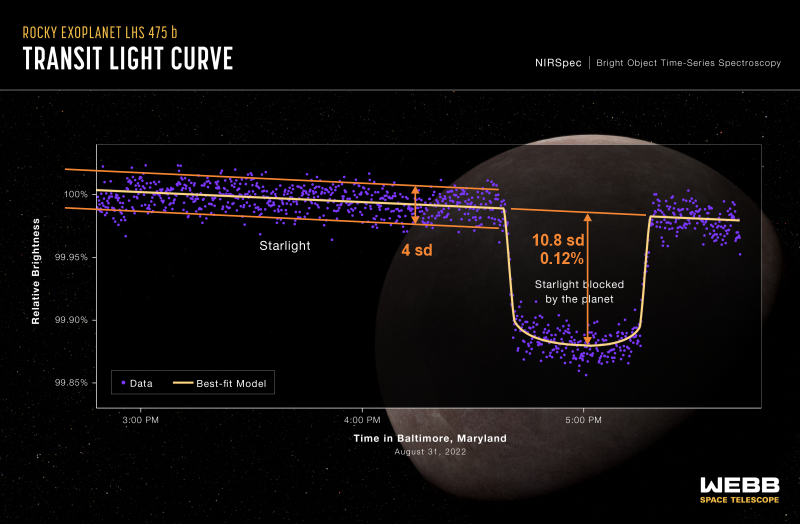
C‑J casts an image to Al’s video screen. “This is new news, just came out a couple of weeks ago. It’s the lead figure from NASA’s announcement of JWST’s first exoplanet examination. We’re picked this study because the scientists used the transit technique. I’ve added the orange stuff so we can make a point. Each blue dot is one measurement from JWST’s Near‑Infrared Spectrograph while it looked at a star named LHS 457. Even though the telescope is outside Earth’s atmosphere and operating at frigid temperatures, you can see that the numbers scatter. Surely the star’s light isn’t changing that quickly – the dots are about 9 seconds apart – the spread has to come from noise in JWST’s electronics.”

Adapted from image by NASA Credit: NASA, ESA, CSA, L. Hustak (STScI).

“We’re just partway through our statistics class but we know to expect 95% of noise to be within 2 standard deviations either way of the average. With about 400 dots per hour, C‑J drew his lines to put about 10 dots per hour each above and below.”

“Right, Madison, and the point we want to make is how small that range is. Only about 0.04% difference. That’s like one drop in a 2500‑drop titration. Professor Kim’s samples in our Chem lab generally take around 20 milliliters which is about 400 drops.”

“So anyway, look at that dip in the light curve. That’s way out of the noise range. The starlight really did dim, even though it wasn’t by much.”

“By the way, NASA’s press release is a little misleading and in fact missed the point of the research. JWST didn’t find this exoplanet, the TESS satellite system did. JWST looked where TESS said to and yup, there it was. This report was really about what JWST could tell us about the exoplanet’s atmosphere.”

“There’s a bunch of possibilities that the researchers can now eliminate. C‑J, please cast the next slide to the screen. We need to be clear, this isn’t the spectrum that JWST recorded during a transit.”

Adapted from image by NASA (Credit: NASA, ESA, CSA, L. Hustak (STScI)), and Figure 2 in Lustig-Yeager, et al.

“No, that would have been simply the star’s light after some of it was filtered through the planet’s atmosphere. The researchers used a lot of computer time to subtract out the right amount of the star’s own spectrum. This is what’s left — their estimate of the spectrum of the planet’s atmosphere if it has one. I added the orange error bar on each point and for the sake of comparisons I traced in that dotted curve marked ‘Metallicity‘ from the scientists’ paper. The other lines are models for four possible atmospheres.”

“Why orange again? And why are the bars longer to the right of that gap?”

“I like orange. I had to trace the bars for this slide because NASA’s diagram used dark grey that doesn’t show up very well. The dots in the wavelength range beyond 3.8 microns are from a noisier sensor. Professor O’Meara, we need some help here. What’s metallicity and why did the paper’s authors think it’s important?”

“We haven’t touched on that topic in class yet. ‘Metallicity’ is the fraction of a star’s material made up of atoms heavier than hydrogen and helium. A star could have high metallicity either because it was born in a dust cloud loaded with carbons and oxygens, or maybe it’s old and has generated them from its own nuclear reactions. Either way, a planet in a highmetallicity environment could have an atmosphere packed with molecules like O2, H2O, CH4 and CO2. That doesn’t seem to be the case here, does it?”

“No, ma’am. The measured points don’t have this model’s peaks or valleys. Considering the error bars, the transmission spectrum is pretty much flat. Most of the researchers’ other models also predict peaks that aren’t there. The best models are a tight cloud deck like Venus or Titan, or thin and mostly CO2 like Mars, or no atmosphere at all.”

“Even a null curve tells us more than we knew.”

~~ Rich Olcott

Significant Twinkles

Cathleen’s got a bit of fire in her eye. “Good exposition, Jeremy, but only just barely on‑assignment. You squeezed in your exoplanet search material at the very end. <sigh> Okay, for our next presentation we have two of our freshmen, Madison and C‑J.”

“Hello, everybody, I’m Madison. I fell in love with Science while watching Nova and Star Trek with my family. Doctor O’Meara’s Astronomy class is my first step into the real thing. C‑J?”

“Hi, I’m C‑J, like she said. What started me on Astronomy was just looking at the night sky. My family’s ranch is officially in dark sky country, but really it’s so not dark. Jeremy’s also from the High Plateau and we got to talking. We see a gazillion stars up there, probably more stars than the Greeks did because they were looking up through humid sea-level air. On a still night our dry air’s so clear you can read by the light of those stars. I want to know what’s up there.”

“Me, too, but I’m even more interested in who‘s up there living on some exoplanet somewhere. How do we find them? We’ve just heard about spectroscopy and astrometry. C‑J and I will be talking about photometry, measuring the total light from something. You can use it even with light sources that are too dim to pick out a spectrum. Photometry is especially useful for finding transits.”

“A transit is basically an eclipse, an exoplanet getting between us and its star—”

“Like the one we had in 2017. It was so awesome when that happened. All the bird and bug noises hushed and the corona showed all around where the Sun was hiding. I was only 12 then but it changed my Universe when they showed us on TV how the Moon is exactly the right size and distance to cover the Sun.”

“Incredible coincidence, right? Almost exactly 100% occultation. If the Moon were much bigger or closer to us we’d never see the corona’s complicated structure. We wouldn’t have that evidence and we’d know so much less about how the Sun works. But even with JWST technology we can’t get near that much detail from other stars.”

“Think of trying to read a blog post on your computer, but your only tool is a light meter that gives you one number for the whole screen. Our nearest star, Alpha Centauri, is 20% larger than our Sun but it’s 4.3 lightyears away. I worked out that at that distance its image would be about 8½ milliarcseconds across. C‑J found that JWST’s cameras can’t resolve details any finer than 8 times that. All we can see of that star or any star is the light the whole system gives off.”

“So here’s where we’re going. We can’t see exoplanets because they’re way too small and too far away, but if an exoplanet transits a star we’re studying, it’ll block some of the light. The question is, how much, and the answer is, not very. Exoplanets block starlight according to their silhouette area. Jupiter’s diameter is about a tenth the Sun’s so it’s area is 1% of the Sun’s. When Jupiter transits the Sun‑‑‑”

“From the viewpoint of some other solar system, of course—”

“Doesn’t matter. Jupiter could get in between the Sun and Saturn; the arithmetic works out the same. The maximum fraction of light Jupiter could block would be its area against the Sun’s area and that’s still 1%.”

“Well, it does matter, because of perspective. If size was the only variable, the Moon is so much smaller than the Sun we’d never see a total eclipse. The star‑planet distance has to be much smaller than the star‑us distance, okay?”

“Alright, but that’s always the way with exoplanets. Even with a big planet and a small star, we don’t expect to measure more than a few percent change. You need really good photometry to even detect that.”

“And really good conditions. Everyone knows how atmospheric turbulence makes star images twinkle—”

“Can’t get 1% accuracy on an image that’s flickering by 50%—”

“And that’s why we had to get stable observatories outside the atmosphere before we could find exoplanets photometrically.”

~~ Rich Olcott
Astrometers Are Wobble-Watchers

letter A Hi, Sy, what’s going on in Cathleen’s seminar?

You were right, Al.
It’s about exoplanets and how to find them.
Jeremy’s pitching astrometry.
That’s about measuring star locations in the sky.
I’ll fill you in later.

“So that’s my cultural colonialism rant, thanks for listening. On to the real presentation. Maria showed us how to look for exoplanets when they wobble along our line of sight. But what if they wobble perpendicular to that? Careful measurement should show that, right? The ancients thought that holy forces had permanently set the positions of all the stars except for the planets so they didn’t measure that close. Tycho Brahe took meticulous measurements with room‑sized instruments—”

<voice from the back> “Room‑sized? What difference does that make?”

“What if I told you that two stars are 3 millimeters apart in the sky?”

<another voice> “How far out’s your ruler? Sky stuff, you need to talk angles because that’s all you got.”

“Well there you go. That’s why Tycho went for maximum angle‑measuring accuracy. He built a sextant with a 5‑foot radius. He used an entire north‑south wall as a quadrant. His primary instrument was an armillary sphere three yards across.”

<first voice again> “Wait, a sphere, like a big bubble? Why north‑south? What’s a quadrant?”

  • I give him a nudge. “He’s just a kid, Mr Feder. Be nice. One question at a time.”
  • “But I got so many!”

“Think about Tycho’s goal. Like astrometers before him, he wanted to build an accurate map of the heavens. Native Americans a thousand years or more ago carved free‑hand star maps on cave ceilings and turtle shells. Tycho followed the Arabic and Chinese quantitative mapping traditions. There’s two ways to do that. One is to measure and map the visual angles between many pairs of stars. That strategy fails quickly because errors accumulate. Four or five steps along the way you’re plotting the same star in two different locations.”

<Feder’s voice again> “There’s a better way?”

“Yessir. Measure and map each star relative to a standard coordinate system. If your system’s a good one, errors tend to average out. The latitude‑longitude system works well for locating places on Earth. Two thousand years ago the Babylonians used something similar for places in the crystal sphere they thought supported the stars above us. Where the equinoctial Sun rose on the horizon was a special direction. Their buildings celebrated it. Starting from that direction the horizontal angle to a star was its longitude. The star’s latitude was its angle up from the horizon towards the zenith straight above. But those map coordinates don’t work for another part of the world. Astrometers needed something better.”

<Feder again> “So what did they do already?”

“They may or may not have believed the Earth itself is round, but they recognized the Pole Star’s steady position that the rest of the sky revolved around. They also noticed that as each month went by the constellations played ring‑a‑rosie in a plane perpendicular to the north‑south axis. Call that the Plane of The Ecliptic. Pick a star, measure its angle away from the Ecliptic and you’ve got an ecliptic latitude. Measure its angle around the Ecliptic away from a reference star and you’ve got a ecliptic longitude. Tycho’s instruments were designed to measure star coordinates. His quadrant was a 90° bronze arc he embedded in that north‑south wall, let him measure a star’s latitude as it crossed his meridian. His ‘Sphere’ was simply a pair of calibrated metal rings on a gimbal mounting so he could point to target and reference stars and measure the angle between them. If his calibration used degree markings they’d be about 25 millimeters apart. His work was the best of his time but the limit of his accuracy was a few dozen arcseconds.”

“Is that bad?”

“It is if you’re looking for exoplanets by watching for stellar wobble. Maria’s Jupiter example showed the Sun wobbling by 1½ million kilometers. I worked this example with a bigger wobble and a star that would be mid‑range for most of our constellations. Best case, we’d see its image jiggling by about 90 microarcseconds. Tycho’s instruments weren’t good enough for wobbles.”

~~ Rich Olcott

The Stars from A Different Viewpoint

“Thank you, Maria, nice job showing us why the Doppler method had such a hard time finding exoplanets. Next up, Jeremy. You’re not going to talk about black holes, are you?”

“No, ma’am, my subject today is astrometry, but that’s useful for both exoplanets and black holes. I have to be careful when I say the word because it sounds so much like astronomy but they’re different things. It helped when I looked the words up. Turns out that ‘astronomy‘ means ‘naming stars‘ but ‘astrometry‘ means ‘measuring‘ them. Not weighing one or any of that, just measuring accurately where that star is in the sky at a certain moment. Everyone on Earth has the sky above. In the days before city life and city lights brought their eyes down, cultures all over the world were doing astronomy and astrometry. Professional astronomers generally use Greek and Arabic names, but that’s Eurocentrism and it got silly.”

<voice from the back> “Like how?”

“The Greeks couldn’t name constellations in the southern hemisphere’s skies because they never saw those stars. Polynesian navigators and Indigenous Australians saw them. Those cultures had their own perfectly good constellations. Did official Astronomy ask any of those people? Of course not, so we’ve got contrived designations like The Microscope and The Air Pump. Some of you know that I’m doing a research project with Professor Begaye to correlate constellations from different cultures. I’ve found some surprises.”

<voice from the back> “Like what?”

“Practically everyone in the northern hemisphere has a special image for the Pole Star and the stars close to it. Europeans picked out Ursa Minor, the Little Bear. For us Navajos the same stars make up The Northern Fire in the sky’s dome like the fire in our traditional domed hogan homes. Staying close to the Northern Fire we see two human figures, a woman and a man. One surprise for me was that the woman’s most prominent stars are the same ones the Greeks chose for Cassiopeia, also a female. The man’s image includes many of the same stars that Europeans call Ursa Major, the Big Bear. Did you know that the word ‘Artic‘ comes from the Greek word ‘arktos‘ which means ‘bear‘? Anyway, further out there’s a winter constellation containing three bright stars in a straight line plus a few more that could be shoulders and knees.”

<voice from the back> “Orion!”

“Mm-hm. We have almost exactly the same constellation. It’s also a hunter, except that the Greeks picture the three stars as his belt and we say it’s the quiver for his arrows. Right in front of the hunter are—”

<voice from the back> “The Pleaides!”

“But for us they’re Dilyehe, the Planting Stars. When they go below the horizon it’s time to plant corn. Which gets me to astrometry. The stars and constellations have always been clocks and calendars for the world’s cultures. Typically they compare the position of the Sun or certain stars with special structures.”

<voice from the back> “Like Stonehenge and the Pyramids!”

“There’s claims and doubts about both of those. People have searched out apparent special locations, like ‘This doorway and that window were placed to show a certain star rising on Midsummers Eve,’ but without explicit markings there’s no way to be sure it wasn’t just accidental. Besides, both structures were built with huge stone blocks, a real challenge to place accurately enough to pick out just one star on one day. We Navajos don’t build structures to track special times. We use mountains.”

<voice from the back> “What, you move mountains around?”

“No, we honor and respect the natural landscape for its beauty. What we do is find the special places that help the mountains and other landmarks tell us what time of year it is. My favorite example is the Double Sunset.”

<voice from the back> “Can’t have two!”

“Yes, you can, if the mountains are sharp and stand close to one another. On the right day of the year, the Sun sets behind one mountain, then peeks for just a minute through the cleft between the two. You just have to know where to stand to see that.”

~ Rich Olcott

Useful Eccentricity

“Hi, Al. What’s the hubbub in the back room?”

“Cathleen’s doing another astronomy class group seminar. This one’s about exoplanets. I’d like to listen in but I’ve got to tend the cash register here. Take notes, okay?”

“Sure, no problem.”

Professor Cathleen’s at the podium. “Okay, class, settle down. I hope everyone’s ready with their presentations. Maria, you’ve got a good topic to start us off.”

“Thank you. Everyone here knows I’ve been interested in spectroscopy since I was a student intern at Arecibo. It is such a powerful thing to know that a particular kind of atom, anywhere in the Universe, absorbs or gives off exactly the same pattern of light frequencies. Suppose you are looking at the spectrum of a star or a galaxy and you recognize a pattern, like sodium’s yellow doublet or hydrogen’s Lyman series. The pattern won’t be at its normal frequencies because of the Doppler effect. That’s good because the amount of blue‑shift or red‑shift tells us how quick the object is moving toward or away from us. That was how Dr Hubble proved that most other galaxies are flying away.”

<casts a slide to Al’s video screen> “I’ll begin with a review of some class material. The spectroscopy we see in the sky is light that was emitted at some peak wavelength lambda. Lambda with the little ‘o‘ is what we see for the same emission or absorption process in the laboratory. The wavelength difference between sky and laboratory is the absolute shift. Divide that by the laboratory wavelength to get the relative shift, the z‑scale. All the light from one object should have the same z value. It is important that z also gives us the object’s velocity if we multiply by the speed of light.”

<voice from the rear> “What’s the ‘fe ka‘ stuff about?”

“I was getting to that. Those two lines describe a doublet, a pair of peaks that always appear together. This is in the X‑ray spectrum of iron which is Fe for the chemists. K-alpha is a certain process inside the iron atom. Astronomers like to use that doublet because it’s easy to identify. Yes, profesora?”

“Two additional reasons, Maria. Iron’s normally the heaviest element in a star because stellar nuclear fusion processes don’t have enough energy to make anything heavier than that. Furthermore, although every element heavier than neon generates a K-alpha doublet, the peak‑to‑peak split increases with atomic mass. Iron’s doublet is the widest we see from a normal star.”

“Thank you. So, the arithmetic on the rest of the slide shows how Dr Hubble might have calculated the speed of a galaxy. But that’s steady motion. Exoplanets orbiting a star appear to speed ahead then fall behind the star, yes? We need to think about how a planet affects its star. This next slide talks about that. My example uses numbers for the Sun and Jupiter. We say Jupiter goes around the Sun, but really, they both go around their common center of gravity, their barycenter. You see how it’s calculated here — MP is the planet’s mass, MS is the star’s mass, dSP is the star-to-planet distance and dB is the distance from the star’s center to the barycenter. I’ve plugged in the numbers. The barycenter is actually ten thousand kilometers outside the Sun!”

“So you could say that our Sun counterbalances Jupiter by going in a tight circle around that point.”

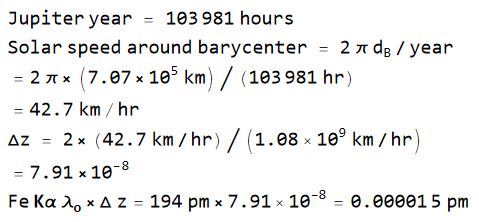
“Exactly! For my third slide I worked out whether a distant astronomer could use Doppler logic to detect Sun‑Jupiter motion. The first few lines calculate the size of the Sun’s circle and than how fast the Sun flies around it. Each Jupiter year’s blue shift to red shift totals only 79 parts per billion. The Sun’s iron K‑alpha1 wavelength varies only between 193.9980015 and 193.9979985 picometers. This is far too small a change to measure, yes?”

<dramatic pause> “I summarize. To make a good Doppler signal, a star must have a massive exoplanet that’s close enough to push its star fast around the barycenter but far enough away to pull the barycenter outside of the star.”

“Thank you, Maria.”

“X” marks the barycenter

~~ Rich Olcott