Wikipedia Skillz

A young man’s knock, eager yet a bit hesitant.

“C’mon in, the door’s open.”

Tall kid, glasses, hoodie thrown back.

“Hi, Mr Moire, can I ask you some questions?  I’m doing a term paper on black holes and I’ve read up on in Wikipedia but there’s things I don’t understand and besides Ms Plenum said not to trust Wikipedia.”

“Hold on, son, let’s get acquainted first.  You are…?”

“My name’s Jeremy Yazzie, sir, and I’m like Richard Feynman’s archetypical intelligent high school student he wanted to explain things to except he gave up on particle spin.”

“Well, you have done your homework, though you’ve muddled a couple of his quotes.  But about Wikipedia — Ms Plenum’s mostly right but in my experience the technical articles are pretty dependable.  Those writers are usually more interested in explaining than convincing.  Have you checked Wikipedia’s Talk pages?”

“There’s, like, comments?”

“Sort of, except Talk pages lie behind articles and target what’s right or wrong and what should be changed to make the article better.  I often learn as much from the technical discussion as I do from the article itself.”

wikieyes
A riff on Wikipedia’s logo, original in Wikimedia Commons

“I’ve never seen those pages.  How do I get to them?”

“You need a desktop view.  That’s the standard view when you use a desktop or laptop computer, but you can only maybe get to it on a handheld device.  Depends on the device, the browser, and even their maintenance levels.  Do you have a handheld in that backpack?”

“Yeah, an iPad.”

“Safari, Firefox and Chrome can all show that other view.”

“I’ve got all three.”

“Great, pull up Chrome, get to Wikipedia and look up ‘Black hole.'”

… “Got it.  Uhh… don’t see anything about a Talk page.”

“You’re looking at ‘mobile mode.’  See that three-dots icon at the top right?  Tap on it and check the pop-up menu.”

“Hah, here’s one that says, Request Desktop Site.  I’ll tap on that.  Hey, now I’ve got tabs above the text, one says Article and another that says Talk.  Whoa, here’s one that says View Source.  Whups, now there’s a box that says I can start editing.  Better not, huh?  How do I get out of that?”

“Tap your browser’s backup button.  By the way, even though in principle anyone can edit any article, the Wikipedia moderators have locked down some of the most popular or controversial just to prevent update wars.  This article’s one of those.”

“Yeah, I just backed up then tried View Source again and it says I’m not an established registered user.  No duh, right?  OK, lessee what’s in the Talk page.  Umm, how-to stuff and then organization stuff and then, huh! ‘this article has been rated GA-class on the quality scale.’ People come around and, like, check your work?”

“Absolutely, which is why I think Ms Plenum’s advice is a little too pessimistic.  Trust but verify — if you see something you’d like to quote but you don’t want to look foolish, double-check with another source.  But on the whole I’ve found the science, math and other technical articles to be trustworthy.”

“Aha, the first set of comments is about my questions, Hawking radiation and how black holes evaporate and what are virtual particles and like that.”

“So many questions, so little time.  Let’s finish off with the browser issue before we dive into physics.  Bring up your Firefox browser on that iPad.”

“All right.  Mmm, I’m going to Wikipedia, and I’m searching for ‘Black hole’ … got it, but the display doesn’t have tabs or a three-dot icon.”

“Firefox has two ways to get to desktop mode.  One way is to tap the three-bar icon at the top right…”

“YESS! the pop-up menu has half-a-dozen options and there’s Request Desktop Site.  Hey, it toggles, I can flip modes back and forth.  Sweet!  What’s the other way?”

“Press-and-hold the reload circle-arrow in the address bar.”

“A-hah, that opens a Request Desktop Site button right under the arrow.  Cool, that’s a toggle, too.  How does Safari handle this stuff?”

“They use the reload circle-arrow ploy, same as Firefox, dunno who did it first.”

“Oops, late for class.  Seeya.”

“Don’t mention it.”

~~ Rich Olcott

Goldilocks Zone and The Three Gazillion Bears

“Tell me a bedtime story, Uncle Sy.”

“OK, Teena, what kind of story?”

“One with bears in it.  Nice bears.”

“Hmm…  How about ‘Goldilocks Zone and The Three Gazillion Bears’?”

“Gazillion?  Is that what kind of a bear they are?”

“No, that’s a number word.  It means ‘more than you could ever hope to count.’  Like a million but way way more.”

“But if you can’t count them, how do you know there are three times that many?”

“You’ll see, have patience.”

“Little girls don’t have patience, Uncle Sy, I wanna hear the story.  Wait, water bears?”

“Mm-hm, they’re a different kind of bear.”

“What’s different about them, and what do they do with water?  I bet they swim.”

“Why yes, they do.  In fact, they spend most of their time in water or at least being wet.  Another thing that’s special about them is that they’re tiny, about the size of the smallest dot you can see on your Mommy’s computer screen here.”
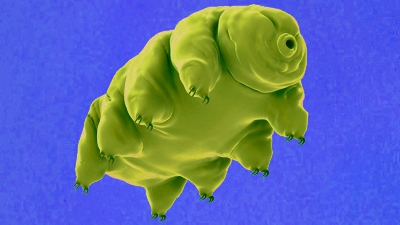
waterbear 1“If they’re so small, why are they called bears?”

“Take a look.  Doesn’t she look kind of like a nice bear?”

“She’s got too many legs.”

“She’s got just the right number for water bears.”

“And she’s green.”

“Well, yes, but the picture’s kind of pretend and doesn’t show proper colors.  She’s so small she’s almost transparent.  She eats particles of algae and such, so maybe in real life she might be sort of green.”

“I like the way she’s smiling.  She reminds me of …  the fat man in the Laurel-n-Hardy movie you showed me last Saturday.”

“Oliver Hardy?  Yeah, I can see that.  Except the smiley bit is actually a wrinkle.  Her mouth is the round thing that looks like a nose.”

“That’s silly.  If her nose is her mouth how can she breathe?”

“Through her skin.  Animals can do that if they’re very small.”

“How else is she different?”

“Well, her kind’s one of Earth’s oldest animals.  Scientists have found water bear fossils over 500 million years old, twice as old as the oldest dinosaur.”

“Older than dinosaurs!”

“But the big thing and the big puzzle is, they’re amazingly rugged little beasties.  They live all over the world — high on mountaintops, at the bottom of the sea, next to ice at the South Pole and next to boiling hot springs.  In experiments, water bears have survived doses of chemicals and radiation that would kill most other creatures.  Astronauts on the ISS even exposed dried-out water bears to the vacuum of space.  The little guys just got happy-active again when they were brought back inside and dunked in some water.”

“What’s the puzzle?”

“Why are they so tough?  They make special molecules that protect them against dehydration and radiation and toxins even though they live in wet environments that don’t get irradiated and rarely get poisoned.  Fish and insects that evolved in lightless caves stopped using energy to make eyes they don’t need.  Why or even how have water bears held onto all that specialized protective DNA for hundreds of millions of years?”

“Does anybody know the answer?”

“Nope.  Some people have guessed that because water bears can survive exposure to space, maybe they came to Earth from another planet somewhere.  Maybe some advanced civilization sprayed water bears out into the Universe to spread life around.  Doesn’t that sound spooky?”

“Ooohh, yeah.  I like that.  Water bears from space!”

“But it gets better.  Maybe there’s different kinds of water bears for different kinds of planets.  That’s where Goldilocks Zones come in.  What did Goldilocks say about the porridge?”

“This bowl’s too hot and this bowl’s too cold, but this bowl is j-u-s-t right!”Water bears and planet“Yup, and that’s one way astronomers can classify planets.  Earth’s in the Goldilocks Zone for liquid water, essential for life as we know it.  Saturn’s moon Titan might support some other kind of life in its cold hydrocarbon seas.  If that’s the case, there’d be a much colder Goldilocks Zone for that kind of life.  Maybe there’s another, hotter Goldilocks Zone for life that’s happy in molten silica.  And maybe there’s water bears designed for each kind of Goldilocks Zone.”

“Mommy, Uncle Sy’s being silly again.”

“Nighty-night, Teena-girl.  Sweet dreams.”

“Nighty-night.”

~~ Rich Olcott

The Importance of Saving Data

Sorry, but I’ve got to break into my normal Monday-morning stream to spread this around.  It’s a ProPublica document (click on the link to pull down a copy) detailing safe ways to leak information.

When I first heard about the data-stashing “parties” I thought it was something of an over-reaction.  Climate scientists and students organizing a massive effort to copy important data out of government files in case the new Administration decided to cover it all up somehow.

I’ve changed my mind.

What changed it was USDA’s suddenly blocking access to their animal welfare database, the one that keeps inspection records on research labs, companies, zoos, circuses, and animal transporters and how well they adhere to the Animal Welfare Act.

The agency said in a statement that it revoked public access to the reports “based on our commitment to being transparent …”  Being transparent by blocking information — there’s a certain Orwellian flavor to that, but it gets better.

I followed this article‘s link to see the original statement.  Well, I tried to follow it.  FireFox flat-out refused to show me the page because “Your connection is not secure. The owner of acis.aphis.educ.usda.gov has configured their website improperly.”  The error code was “SEC_ERROR_UNKNOWN_ISSUER.” Funny that an official .gov site mucked up its security certificate.

Then I tried Microsoft’s  edge browser, which has less alert security than my beefed-up FireFox.  edge showed me an imposing and somewhat threatening USDA e-Login page including the statements that “Unauthorized or improper use of this system may result in disciplinary action, as well as civil and criminal penalties…. You have no reasonable expectation of privacy regarding any communications or data transiting or stored on this information system…. Your consent is final and irrevocable…

disappearing-lorem-ipsumAll this before Mr Sonny Perdue III is confirmed as the new Secretary of Agriculture. That name rings a bell, right?  Yeah, Perdue Farms, the country’s #3 poultry farmer. It’s hard not to connect dots to the Department suddenly wanting to hide farm inspection records.
So, it’s now pretty clear that we can expect other government-funded databases to disappear without warning, especially databases even remotely related to climate change, drug safety, water supply degradation, … you know, the things that there are regulations about that get in the way when your object is to maximize profits.

So — if you’re in science and you have possession of or access to data (databases, files, whatever) that might be in jeopardy

  1.  Get it to an offsite and secure backup ASAP
  2. When/if it becomes clear that your or the public’s access to that data is about to be restricted, take one or more of the actions laid out in the ProPublica document.

Sometimes it’s rational to be paranoid.

~~ Rich Olcott

A Defective Story

It was an interesting knock at my office door — aggressive but feminine, with a hint of desperation.

“C’mon in, the door’s open.”

She wore a business suit that must have cost a month’s rent.  It fit her like it had been sewn on, and she had all the right sizes.  There was a button missing from the left sleeve.  On the other hand her left lapel bore a Star Trek badge, Security Section.

“What can I do for you, Miss…?”

“My name’s Victoria Baird, Mr Moire.  I’m CEO of ADastra, ‘media relations for the stars.’  I’ve been reading your posts, put two and two together, and thought I’d better drop in.”

“Well, it’s nice to know I’ve got readers.  Which posts caught your attention?”

“Several of them, but mostly this one,” pointing to a Web page on her smartphone.  It was my Breathing Space video.  “You show how gravitational waves fluctuate as they polarize local space.  They induce varying curvatures in different directions.  Curved space is mass, Mr Moire, but this curvature moves at lightspeed.  Hadn’t you noticed that?”

“It crossed my mind, yes, but when I thought about surfing a gravitational wave like ocean surfers do, I realized you’d have to get up to the wave’s speed to ride it.”

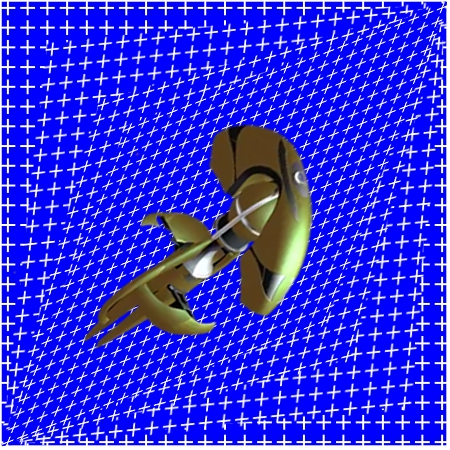
jellyfish-starcraft
Spock’s Jellyfish starcraft,
as seen in the 2009 Star Trek film
(image from the video by Rob Morey)

“There’s more.  Are you familiar with that one-man starcraft that Ambassador Spock used in the 2009 Star Trek film?  The ship with the rotating after-section?”

“I did see ‘Baby Star Trek,’ yes.”

“Did you know that the starcraft’s official design designation is Jellyfish?”

“No, I hadn’t heard that.”

“Well, it is.  And you’ve written about Earth jellyfish, haven’t you, Mr Moire, and how their propulsion system is so efficient?”

I was getting a little tired of her aggressive questions, so I challenged her with one of my own.  “And you see a connection?”

“I do, and that’s why you have to help me, Mr Moire.  Can I trust you?”

“Secrets are my business, Miss Baird.  Uncovering them or covering them up, it’s all the same to me.”

“Maybe I need to let my hair down.”  She removed her cloche cap and her pointed ears sprang free.  “I need you to get me back to my crew.”

“Can’t you just call them on that communicator badge?”

“This is costume jewelry.  The spectrum here on Earth is so crowded that my real badge is useless at long range.  I’ve been looking for subtle signals in the media.  I thought your posts were just such a signal … but I can see you’re a local.”

“Guilty as charged.  I take it the connection you saw resembled the signal you sought?”

“Yes.  You’ve published two of the essential principles of the LaForge Drive.  The first was your displays of spatial curvature in motion.  The second was your description of how jellyfish move by stepping along a ladder of seawater vortices.

jellyfish-2“That’s what the LaForge Drive does, Mr Moire.  The counter-rotating blades are an osmium-hassium alloy, the densest substance known, and under tremendous compression.  Together their mass creates a complex pilot wave in the gravity field.  The spacecraft surfs on that waveform the way a jellyfish surfs on the eddies it creates.
“The wave’s phase velocity exceeds lightspeed by some enormous factor we’ve never been able to measure.  In fact, I’m here on Earth because I was on a research cruise to find if there’s a limit.  We … ran into a problem and I’m part of an away team sent to procure … something we need.”

“That trope’s been done to death, Miss Baird.  And besides, that design wouldn’t be practical.  What’s your real story?”

“What do you mean it’s not practical?”

“You can’t steer.  Pilot waves follow the most intense local spatial curvature, which means the craft will always home like a torpedo on the nearest large mass.”

Suddenly that badge chirped.  “We’ve recovered the detonator, Lieutenant.  Have you kept him from looking out the window?”

“Yes, his eyes have been on me the whole time.  Ready for beam-up.  Goodbye, Mr Moire, that was fun.”

Her form began to shimmer, twinkle … and disappeared.

“Don’t mention it.”

~~ Rich Olcott

Calvin And Hobbes And i

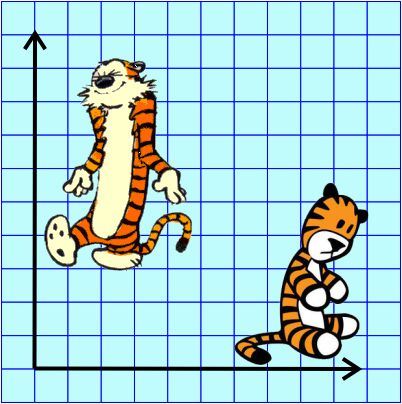
Hobbes 2I so miss Calvin and Hobbes, the wondrous, joyful comic strip that cartoonist Bill Watterson gave us between 1985 and 1995.  Hobbes was a stuffed toy tiger — except that 6-year-old Calvin saw him as a walking, talking man-sized tiger with a sarcastic sense of humor.
So many things in life and physics are like Hobbes — they depend on how you look at them.  As we saw earlier, a fictitious force disappears when viewed from the right frame of reference.  There’s that particle/wave duality thing that Duc de Broglie “blessed” us with.  And polarized light.

In an earlier post I mentioned that light is polar, in the sense that a single photon’s electric field acts to vibrate an electron (pole-to-pole) within a single plane.
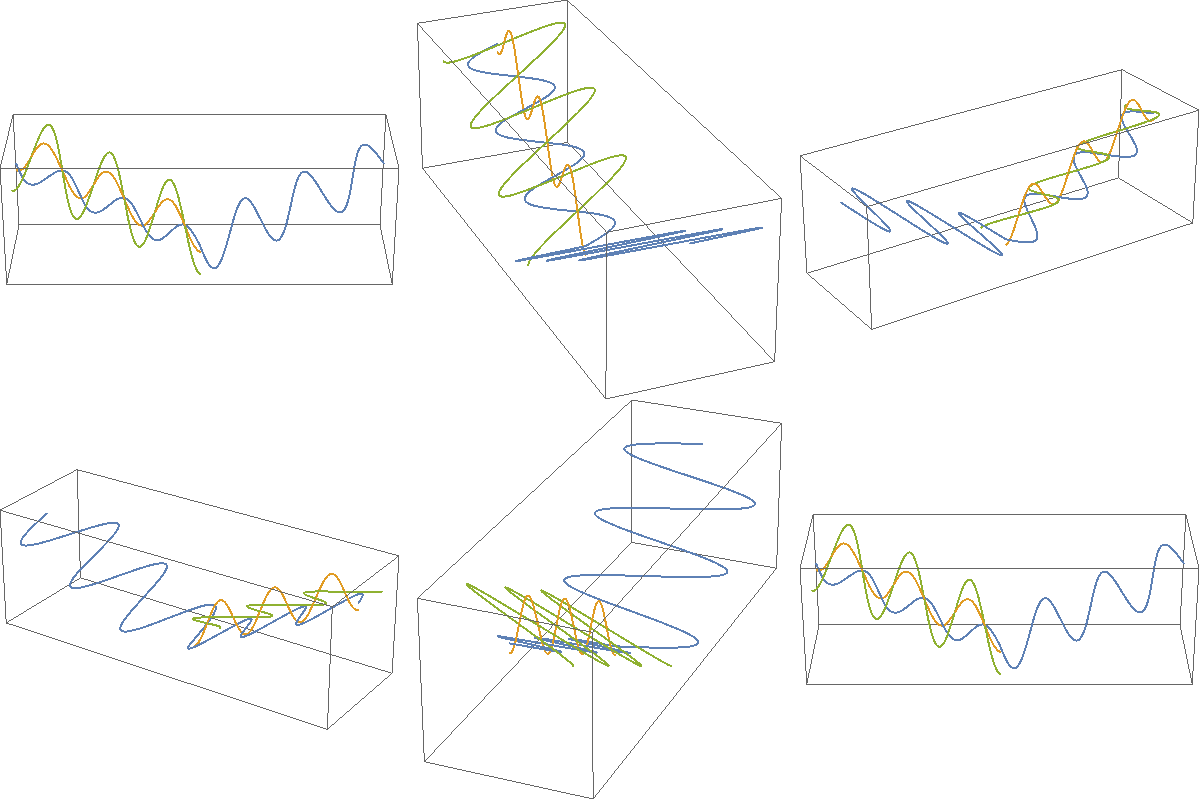
wavesIn this video, orange, green and blue electromagnetic fields shine in from one side of the box onto its floor.  Each color’s field is polar because it “lives” in only one plane.  However, the beam as a whole is unpolarized because different components of the total field direct recipient electrons into different planes giving zero net polarization.  The Sun and most other familiar light sources emit unpolarized light.

When sunlight bounces at a low angle off a surface, say paint on a car body or water at the beach, energy in a field that is directed perpendicular to the surface is absorbed and turned into heat energy.  (Yeah, I’m skipping over a semester’s-worth of Optics class, but bear with me.)  In the video, that’s the orange wave.

At the same time, fields parallel to the surface are reflected.  That’s what happens to the blue wave.

Suppose a wave is somewhere in between parallel and perpendicular, like the green wave.  No surprise, the vertical part of its energy is absorbed and the horizontal part adds to the reflection intensity.  That’s why the video shows the outgoing blue wave with a wider swing than its incoming precursor had.

The net effect of all this is that low-angle reflected light is polarized and generally more intense than the incident light that induced it.  We call that “glare.”  Polarizing sunglasses can help by selectively blocking horizontally-polarized electric fields reflected from water, streets, and that *@%*# car in front of me.

Wave_Polarisation
David Jessop’s brilliant depiction of plane and circularly polarized light

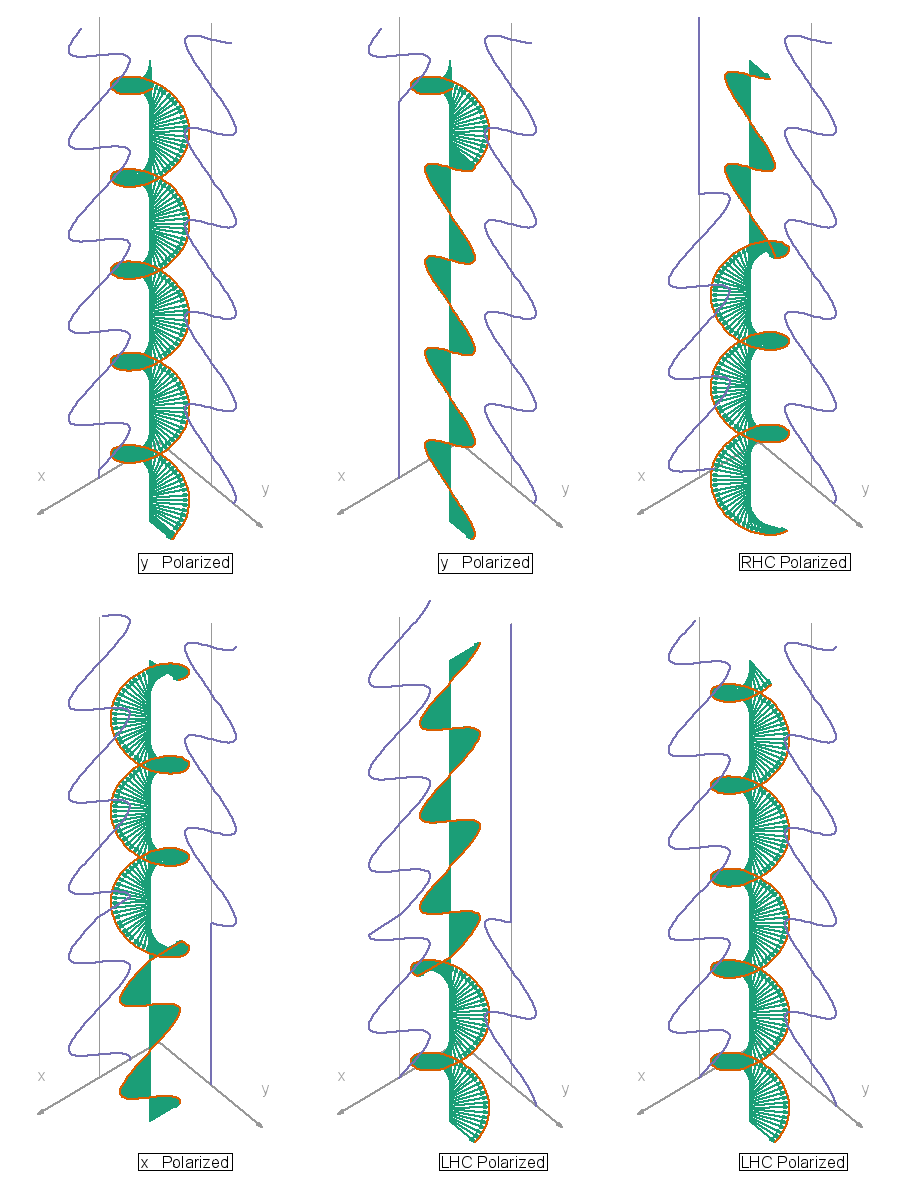
Things can get more complicated. The waves in the first video are all in synch — their peaks and valleys match up (mostly). But suppose an x-directed field and a y-directed field are headed along the same course.  Depending on how they match up, the two can combine to produce a field driving electrons along the x-direction, the y-direction, or in clockwise or counterclockwise circles.  Check the red line in this video — RHC and LHC depict the circularly polarized light that sci-fi writers sometimes invoke when they need a gimmick.

Physicists have several ways to describe such a situation mathematically.  I’ve already used the first, which goes back 380 years to René Descartes and the Cartesian x, y,… coordinate system he planted the seed for.  We’ve become so familiar with it that reading a graph is like reading words.  Sometimes easier.

In Cartesian coordinates we write x– and y-coordinates as separate functions of time t:
x = f1(t)
y = f2(t)
where each f could be something like 0.7·t2-1.3·t+π/4 or whatever.  Then for each t-value we graph a point where the vertical line at the calculated x intersects the horizontal line at the calculated y.

But we can simplify that with a couple of conventions.  Write √(-1) as i, and say that i-numbers run along the y-axis.  With those conventions we can write our two functions in a single line:
x + i y = f1(t) + i f2(t)
One line is better than two when you’re trying to keep track of a big calculation.

But people have a long-running hang-up that’s part theory and part psychology.  When Bombelli introduced these complex numbers back in the 16th century, mathematicians complained that you can’t pile up i thingies.  Descartes and others simply couldn’t accept the notion, called the numbers “imaginary,” and the term stuck.

Which is why Hobbes the way Calvin sees him is on the imaginary axis.

~~ Rich Olcott

Is cyber warfare imaginary?

Rule One in hooking the reader with a query headline is: Don’t answer the question immediately.  Let’s break that one.  Yes, cyber warfare is imaginary, but only for a certain kind of “imaginary.”  What kind is that, you ask.  AaaHAH!

spy1
Antonio Prohías’ Mad Magazine spies
didn’t normally use cyber weaponry

It all has to do with number lines.  If the early Greek theoreticians had been in charge, the only numbers in the Universe would have been the integers: 1, 2, 3,….  Life is simple when your only calculating tool is an abacus without a decimal point.  Zero hadn’t been invented in their day, nor had negative numbers.

Then Pythagoras did his experiments with harmony and harp strings, and the Greeks had to admit that ratios of integers are rational.

More trouble from Pythagoras: his a2+b2=c2 equation naturally led to c=√(a2+b2).  Unfortunately, for most integer values of a and b, c can’t be expressed as either an integer or a ratio of integers.  The Greeks labeled such numbers (including π) as irrational and tried to ignore them.

Move ahead to the Middle Ages, after Europe had imported zero and the decimal point from Brahmagupta’s work in India, and after the post-Medieval rise of trade spawned bookkeepers who had to cope with debt.  At that point we had a continuous number line running from “minus a whole lot” to “plus you couldn’t believe” (infinity wasn’t seriously considered in Western math until the 17th century).

By then European mathematicians had started playing around with algebraic equations and had stumbled into a problem.  They had Brahmagupta’s quadratic formula (you know, that [-b±√(b2-4a·c)]/2a thing we all sang-memorized in high school).  What do you do when b2 is less than 4a·c and you’re looking at the square root of a negative number?

Back in high school they told us, “Well, that means there’s no solution,” but that wasn’t good enough for Renaissance Italy.  Rafael Bombelli realized there’s simply no room for weird quadratic solutions on the conventional number line.  He made room by building a new number line perpendicular to it.  The new line is just like the old one, except everything on it is multiplied by i=√(-1).

(Bombelli used words rather than symbols, calling his creation “plus of minus.”  Eighty years later, René Descartes derisively called Bombelli’s numbers “imaginary,” as opposed to “real” numbers, and pasted them with that letter i.  Those labels have stuck for 380 years.  Except for electricity theoreticians who use j instead because i is for current.)

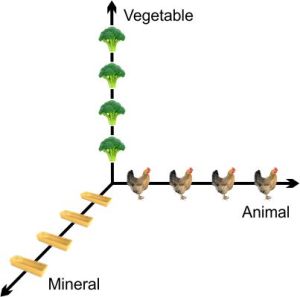
AxesSuppose you had a graph with one axis for counting animal things and another for counting vegetable things.  Animals added to animals makes more animals; vegetables added to vegetables makes more vegetables.  If you’ve got a chicken, two potatoes and an onion, and you share with your buddy who has a couple of carrots, some green beans and another onion, you’re on your way to a nice chicken stew.

Needs salt, but that’s on yet another axis.

Bombelli’s rules for doing arithmetic on two perpendicular number lines work pretty much the same.  Real numbers added to reals make reals, imaginaries added to imaginaries make more imaginaries.  If you’ve got numbers like x+i·y that are part real and part imaginary, the separate parts each follow their own rule.  Multiplication and division work, too, but I’ll let you figure those out.

The important point is that what happens on each number line can be specified independently of what happens on the other, just like the x and y axes in Descartes’ charts.  Together, Bombelli’s and Descartes’ concepts constitute a nutritious dish for physicists and mathematicians.

Scientists love to plot different experimental results against each other to see if there’s an interesting relationship in play.  For certain problems, for example, it’s useful to plot real-number energy of motion (kinetic energy) against some other variable on the i-axis.

Two-time Defense Secretary Donald Rumsfeld used to speak of “kinetic warfare,” where people get killed, as opposed to the “non-kinetic” kind.  Apparently, he would have visualized cyber somewhere up near the i-axis.  In that scheme, cyber warriors with their ones and zeros are Bombelli-imaginary even if they’re real.

 ~~ Rich Olcott


How rockets don’t work

WoodyI was only 10 years old but already had Space Fever thanks to Chesley Bonestell’s artwork in Collier’s and Life magazines.  I eagerly joined the the movie theater ticket line to see George Pal’s Destination Moon.  I loved the Woody Woodpecker cartoon (it’s 12 minutes into the YouTube video) that explained rockets to a public just getting used to jet planes.  But the explanation’s wrong.

Go ahead, follow the link and watch the cartoon.  I’ll wait here.

Pretty far-sighted for 1950, eh?  And it’s amazing how much they got right, including how the driving force for the Space Race was international politics.  But oh, the physics…

Yeah, they tacitly acknowledged Newton’s Third Law: For every action there is an equal and opposite reaction.  The cartoon implies that the action is the pellets coming out of the barrel and the reaction is Woody getting knocked back.  But that can’t be right: if it were true you wouldn’t get any kick when you fire a blank cartridge — but you do.  Let’s take a close look at just what actions are in play.

Maybe it’s the pellets plus the gases behind it pushing forward and the gun pushing backward?  Sort of, but where do the gases come from?  Right, the exploding charge next to your cheek in the receiver.  Those gases move equally in all directions.  Some of them push pellets down the barrel.  Some of them push on the back end of the receiver which pushes the gun stock which mashes your shoulder.  But there’s bunches of molecules that uselessly collide with the receiver’s walls.

Action and reaction balance out just fine but only when you consider the gases moving outward from the center of the BANG.  For instance, if left and right didn’t balance perfectly the piece would crash into your ear or swing around and flatten your nose or the back of your head.

Both shotguns and conventional rockets get their propulsive energy from chemical combustion.  The reason gun parts have to be strong is all those hot molecules dashing in every direction other than down and up the barrel.  A chemical rocket casing has to be strong for the same reason.

Chemical combustion is just not an efficient use of propellant mass.  Just look at this NASA image of a SpaceX Falcon 9 during a DSCOVR launch — huge side-flare from molecules that make no contribution to forward thrust:DSCOVR launch
Wouldn’t it be nice if we had a way to put all our propulsion energy into moving the vehicle forward?

There’s good news and not-so-good news.  People are working on a few other options, all of which depend on forces we know how to steer: electric and magnetic.  Unfortunately, each of them has drawbacks.

Unlike rockets, ion thrusters use an electric or magnetic field to accelerate ions (duh!) away from the vehicle.  It’s a much more efficient process because there’s little off-axis action/reaction — all the propellant heads out the nozzle (action) and all the push-back force (reaction) acts directly on the vehicle.

But… ions resist being crowded together so you can’t blast huge quantities out the nozzle like you’d need to for a launch from Earth.  Up in space, though, ion thrusters are perfect for satellite attitude adjustment and similar low-power tasks.  The Dawn mission to Vesta and Ceres used an ion thruster to boost the spacecraft continuously from Earth to target.  It’d be impractical to build a chemical-powered system to do that.

Rather than send out atoms one by one, a rail-gun drive could use high-power magnetic fields to accelerate lumps of iron down a track and away.  Iron goes one way, vessel goes the other.  Might work in the Asteroid Belt where lumps of iron are there by the billions, but on the other hand I’d rather not be a Belter tooling along in my mining tug only to be hit amidships by someone’s cast-off reaction mass.

And then there’s the Q-thruster and EmDrive.  I hope to eventually include enough physics background in this blog that we can discuss the controversies and prospects for new-physics drives based on space warps and such.  You can check out Dr Harold White’s video for some of that.  It’d be sooo cool if they work.

~~ Rich Olcott

Smoke and a mirror

Etna jellyfish pairGrammie always grimaced when Grampie lit up one of his cigars inside the house.  We kids grinned though because he’d soon be blowing smoke rings for us.  Great fun to try poking a finger into the center, but we quickly learned that the ring itself vanished if we touched it.

My grandfather can’t take credit for the smoke ring on the left — it was “blown” by Mt Etna.  Looks very like the jellyfish on the right, doesn’t it?  When I see two such similar structures, I always wonder if the resemblance comes from the same physics phenomenon.

This one does — the physics area is Fluid Dynamics, and the phenomenon is a vortex ring. We need to get a little technical and abstract here: to a physicist a fluid is anything that’s composed of particles that don’t have a fixed spatial relationship to each other. Liquid water is a fluid, of course (its molecules can slide past each other) and so is air.  The sun’s ionized protons and electrons comprise a fluid, and so can a mob of people and so can vehicle traffic (if it’s moving at all).  You can use Fluid Dynamics to analyze motion when the individual particles are numerous and small relative to the volume in question.

Ring x-section
Adapted from a NOAA page

You get a vortex whenever you have two distinct fluids in contact but moving at sufficiently different velocities.  (Remember that “velocity” includes both speed and direction.)  When Grampie let out that little puff of air (with some smoke in it), his fast-moving breath collided with the still air around him.  When the still air didn’t get out of the way, his breath curled back toward him.  The smoke collected in the dark gray areas in this diagram.

That curl is the essence of vorticity and turbulence.  The general underlying rule is “faster curls toward slower,” just like that skater video in my previous post.  Suppose fluid is flowing through a pipe.  Layers next to the outside surface move slowly whereas the bulk material near the center moves quickly.  If the bulk is going fast enough, the speed difference will generate many little whorls against the circumference, converting pump energy to turbulence and heat.  The plant operator might complain about “back pressure” because the fluid isn’t flowing as rapidly as expected from the applied pressure.

But Grampie didn’t puff into a pipe (he’s a cigar man, right?), he puffed into the open air.  Those curls weren’t just at the top and bottom of his breath, they formed a complete circle all around his mouth.  If his puff didn’t come out perfectly straight, the smoke had a twist to it and circulated along that circle, the way Etna’s ring seems to be doing (note the words In and Out buried in the diagram’s gray blobs).  When a vortex closes its loop like that, you’ve got a vortex ring.

A vortex ring is a peculiar beast because it seems to have a life of its own, independent of the surrounding medium.  Grampie’s little puff of vortical air usually retained its integrity and carried its smoke particles for several feet before energy loss or little fingers broke up the circulation.

To show just how special vortex rings are, consider the jellyfish.  Until I ran across this article, I’d thought that jellyfish used jet propulsion like octopuses and squids do — squirt water out one way to move the other way.  Not the case.  Jellyfish do something much more sophisticated, something that makes them possibly “the most energy-efficient animals in the world.”

jellyfish vortices

Thanks to a very nice piece of biophysics detective work (read the paper, it’s cool, no equations), we now know that a jellyfish doesn’t just squirt.  Rather, it relaxes its single ring of muscle tissue to open wide.  That motion pulls in a pre-existing vortex ring that pushes against the bell.  On the power stroke, the jellyfish contracts its bell to push water out (OK, that’s a squirt) and create another vortex ring rolling in the opposite direction.  In effect, the jellyfish continually builds and climbs a ladder of vortex rings.

Vortex rings are encapsulated angular momentum, potentially in play at any size in any medium.

~~ Rich Olcott

Smack-dab in the middle

BridgeSee that little guy on the bridge, suspended halfway between all the way down and all the way up?  That’s us on the cosmic size scale.

I suspect there’s a lesson there on how to think about electrons and quantum mechanics.

Let’s start at the big end.  The physicists tell us that light travels at 300,000 km/s, and the astronomers tell us that the Universe is about 13.7 billion years old.  Allowing for leap years, the oldest photons must have taken about 4.3×10¹⁷ seconds to reach us, during which time they must have covered 1.3×1026 meters.  Double that to get the diameter of the visible Universe, 2.6×1026 meters.  The Universe probably is even bigger than that, but far as I can see that’s as far as we can see.

At the small end there’s the Planck length, which takes a little explaining.  Back in 1899, Max Planck published his epochal paper showing that light happens piecewise (we now call them photons).  In that paper, he combined several “universal constants” to derive a convenient (for him) universal unit of length: 1.6×10⁻³⁵ meters.  It’s certainly an inconvenient number for day-to-day measurements (“Gracious, Junior, how you’ve grown!  You’re now 8×1034 Planck-lengths tall.”).  However, theoretical physicists have saved barrels of ink and hours of keyboarding by using Planck-lengths and other such “natural units” in their work instead of explicitly writing down all the constants.

Furthermore, there are theoretical reasons to believe that the smallest possible events in the Universe occur at the scale of Planck lengths.  For instance, some theories suggest that it’s impossible to measure the distance between two points that are closer than a Planck-length apart.  In a sense, then, the resolution limit of the Universe, the ultimate pixel size, is a Planck length.

sizelineSo that’s the size range of the Universe, from 1.6×10⁻³⁵ up to 2.6×1026 meters. What’s a reasonable way to fix a half-way mark between them?

It makes no sense to just add the two numbers together and divide by two the way we’d do for an arithmetic average. That’d be like adding together the dime I owe my grandson and the US national debt — I could owe him 10¢ or $10, but either number just disappears into the trillions.

The best way is to take the geometrical average — multiply the two numbers and take the square root.  I did that.  It’s the X in the sizeline, at 6.5×10⁻⁵ meters, or about the diameter of a fairly large bacterium.  (In the diagram, VSC is the Vega Super Cluster, AG is the Andromeda Galaxy, and the numbers are those exponents of 10.)

That’s worth marveling at.  Sixty orders of magnitude between the size of the Universe and the size of the ultimate pixel.  Yet from blue whales to bacteria, Earth’s life just happens to occupy the half-dozen orders right in the middle of the range.  We think that’s it.

Could this be another case of the geocentric fallacy?  Humans were so certain that Earth was the center of the Universe, before Brahe and Galileo and Newton proved otherwise.  Is there life out there at scales much larger or much smaller than we imagine?

Who knows? But here’s an intriguing physics/quantum angle I’d like to promote.  We know a lot about structures bigger than us — solar systems and binary stars and galaxy clusters on up.  We know a few sizes and structures a bit smaller — viruses and molecules and atoms.  We’re aware of quarks and gluons that reside inside protons and atomic nuclei, but we don’t know their size or structure.

Even a proton is huge on the Planck-length scale.  At 1.8×10⁻¹⁵ meters the proton measures some 1020 Planck-lengths.  There’s as much scale-space between the Planck-length and the proton as there is between the Earth (1.3×10⁷ meters) and the Universe.

It’s hard to believe that Terra infravita’s area has no structure whereas Terra supravita is so … busy.  The Standard Model’s “ultimate particles,” the electrons and photons and neutrinos and quarks and gluons, all operate down there somewhere.   It’s reasonable to suppose that they reflect a deeper architecture somewhere on the way down to the Planck-length foam.

Newton wrote (in Latin), “I do not make hypotheses.”  But golly, it’s tempting.

~~ Rich Olcott

There’s a lot of not much in Space

A while ago I drove from Denver to Fort Worth, and I was impressed. See, there’s a lot of not much in eastern Colorado. It’s pretty much the same in western Oklahoma except there’s less not much because there’s less of Oklahoma – but Texas has way more not much than anybody.

That gives Texas not much to brag about, but they do the best they can, bless their hearts.

What got me started on this rant was a a pair of astronomical factoids Katherine Kornei wrote in the Nov 2014 Discover magazine.

“If galaxies were shrunk to the size of apples, neighboring galaxies would be only a few meters apart….”
“If the stars within galaxies were shrunk to the size of oranges, they would be separated by 4,800 kilometers (3,000 miles).”

Apple orangeSo there’s a lot of not much between galaxies, but a whole lot more not much, relatively speaking, within them. I just measured an apple and an orange in my kitchen. They’re both about the same size, 3 inches in diameter, so I have no idea why she chose different fruits – perhaps she wanted to avoid comparing apples and oranges.

Anyway, if you felt like doing the galaxy visualization you could put two apple galaxies on the floor about 12 feet apart and then line up about 50 apples between them. A fair amount of space for more galaxies.

To see inside a galaxy you could put one orange star in Miami FL, and its on-the-average nearest orange neighbor in Seattle WA. Then you could set out a long skinny row of just about 63 million oranges in between. Oh, and on this scale the nearest galaxy would be about 2 billion miles (or 43 quadrillion oranges) away. Way more not much inside a galaxy than between two neighboring ones.

So if we squeeze all those apples and oranges together we’d get rid of all the empty space, right?

Not by a long shot. Nearly all those stars are balls of very hot gas, which means they’re made up of atoms crossing empty space inside the star to collide with other atoms. Relative to the size of the atoms, how much empty space is there inside the star?

Matryoshkii 1For example, every chemistry student learns that 6×10²³ molecules of any gas take up a volume of 22.4 liters at normal Earth temperature and pressure. For a single-atom gas like helium that works out to about 22 atom-widths between atoms.

Now think about emptiness inside the Sun. If it’s a typical star (which it is) and if all of its atoms are hydrogen (which they mostly are) and if the average density of the Sun (1408 kg/m3) applied all the way down to the center of the Sun (which it doesn’t), and if we believe NASA’s numbers for the Sun (hey, why not?), then the average density works out to about 0.7 atom-widths between neighbors.

So no empty space to squeeze out of the Sun, eh? Well, actually there is quite a lot, because those atoms are mostly empty space, too.

OK, I cheated up there about the Sun, because virtually all of the Sun’s atoms have been dissociated into separated electrons and nuclei. The nucleus is much smaller than than its atom – by a factor of 60,000 or so. Think of a grape seed in the middle of a football field.

To sum it upward, we’ve got a set of Russian matryoshka dolls, one inside the next. At the center is a collection of grape seeds, billions and billions of them, each in their own football field. The football fields are all balled into a stellar orange (or maybe an apple), but there are billions of those crammed into a galactic apple (or maybe an orange) that’s about ten feet away from the nearest other piece of fruit.

As Douglas Adams wrote in Hitchhiker’s Guide to The Galaxy,

“Space … is big. Really big. You just won’t believe how vastly, hugely, mindbogglingly big it is. I mean, you may think it’s a long way down the road to the chemist’s, but that’s just peanuts to space…”

The thing to realize is that the function of all that space is to keep everything from being in the same place. That’s important.

~~ Rich Olcott