Save The Whales? Burn Turpentine

“OK, Sy, I’ve told you the oil, wax and spermaceti story from my chemistry viewpoint. What got you reading up on whales?”

“A client asked a question that had me going down a rabbit hole that turned into a wormhole leading to a whole bunch of Biology and some Economics. Good thing I enjoy learning random facts.”

“OK, I’ll bite. What was the question?”

“Alright, Susan, see how you do with this. We need our eyes to be round so they can rotate in their sockets and still focus images on their retinas. They can hold that spherical shape against atmospheric pressure because they’re filled with watery stuff and they have a pump‑and‑drain mechanism inside that maintains a slight positive internal pressure. Whales dive down to where water pressures are a hundred atmospheres or more, enough to squeeze their lungs shut. They must use their vision sense down there because their retinal rod cells, the low‑light receptors, are sensitive to blue light. That’s what you’d need for hunting where the water above you filters out all the longer wavelengths. So why doesn’t the pressure down there crumple their eyeballs?”

“Oh, Sy, that’s easy. Water’s among the least compressible molecular liquids we know of. It takes an immense amount of pressure to reduce its volume even by 1%. Hunting-ground pressure isn’t nearly high enough to sabotage water‑filled eyeballs.”

“D’oh! So simple. And here I am, reading a dissection report on a sperm whale’s eyeball. Which, by the way, is about 22 times heavier than a human’s.”

“That’s where your wormhole led you?”

“No, actually, it led me to a econo-political argument about why kerosene got big in the 1860s.”

“Say what? I thought kerosene came in because sperm whales were getting hard to find.”

“That’s the story Big Oil likes. Apparently free-market enthusiasts have been lauding the petroleum industry as heroes dashing in with kerosene to save the whales and by the way, prospering completely independent of any government actions. Turns out History doesn’t support either claim. Ever hear of Camphine?”

“Nope.”

“Camphine saved the whales but then sank with nary a trace. I got most of the story from a PBS blog but pieced that together with a Wikipedia article and a bunch of old government statistics.. I charted the numbers and came up with some interesting correlations. Are you at your computer so I can email it to you?”

“Sure.”

“On its way.”

“Ooo, complicated. Care to read it to me?”

“Of course. Fun fact — fats from toothed whales are generally waxier than fat from baleen whales. Sperm whales just happen to be at the far end of that trend. Anyway, I concentrated on the sperm whale data. The red line is the total amount of spermaceti obtained from whales taken by US craft in each year,”

“Five million gallons in 1842? That’s ten thousand whales!”

“Mm-hm. The red line drops sharply after those peak years despite the whalers floating a bigger fleet — that’s the black line. The hunters found diminishing returns because the harvest just wasn’t sustainable. But people still wanted their spermaceti candles — the green line shows the price continued to rise until the mid‑1850s. Not only inside the US — the blue line shows exports rising because foreign whalers couldn’t supply demand from their own markets.”

“Bad prospects. What happened in the yellow part of the chart?”

“Competition from a new product called Camphine, a.k.a. ‘burning oil.’ In the mid‑1830s a guy in Maine and a couple of New Yorkers started making liquid substitutes for spermaceti. The products were mixtures of turpentine, grain alcohol and a little camphor for aroma. You needed a special lamp to burn it but you got a flame that rivaled sperm candles for brightness and color purity. Sold like gang‑busters, up to 200 million gallons per year, but the Civil War killed it off.”

“How?”

“Federal embargoes on Southern pine forest turpentine, Federal taxes on alcohol. Kerosene and the Pennsylvania oil wells in 1859 rode in decades late to save the whales. Camphine was helping but government trade and tax policies cut it off at the pass.”

~~ Rich Olcott
Candle, Candle, Burning Bright

<chirp, chirp> “Moire here.”

“Hi, Sy, it’s Susan Kim. I did a little research after our chat. The whale oil story isn’t quite what we’re told.”

“Funny, I’ve been reading up on whales, too. So what’s your chemical discovery?”

“What do we get from a fire, Sy?”

“Light, heat and leftovers.”

“Mm-hm, and back in 18th Century America, there was plenty of wood and coal for heat. Light was the problem. I can’t imagine young Abe Lincoln reading by the flickering light of his fireplace — he must have had excellent eyesight. If you wanted a mostly steady light you burned some kind of fat, either wax candles or oil lamps.”

“Wait, aren’t fat and wax and oil three different things?”

“Not to a chemist. Fat’s the broadest category, covers molecules and mixtures with chains of ‑CH2‑ groups that don’t dissolve in water. Maybe the chains include a few oxygen atoms but the molecules are basically hydrocarbons. Way before we knew about molecules, though, we started classifying fats by whether or not the material is solid at room temperature. Waxes are solid, oils are liquid. You’re thinking about waxy‑looking coconut oil, aren’t you?”

“Well….”

“Coconuts grow where rooms are warm so we call it an oil, OK? I think it’s fun that you can look at a molecular structure and kind of predict whether the stuff will be waxy or oily.”

“How do you do that?”

“Mmm… It helps to know that a long chain of ‑CH2‑ groups tends to be straight‑ish but if there’s an ‑O‑ link in the chain the molecule can bend and even rotate there. Also, you get a kink in the chain wherever there’s a –CH=CH– double bond. We call that a point of unsaturation.”

“Ah, there’s a word I recognize, from foodie conversations. Saturated, unsaturated, polyunsaturated — that’s about double bonds?”

“Yup. So what does your physicist intuition make of all that?”

“I’d say the linear saturated molecules ought to pack together better than the bendy unsaturated ones. Better packing means lower entropy, probably one of those solid waxes. The more unsaturation or more ‑O‑ links, the more likely something’s an oil. How’d I do?”

“Spot on, Sy. Now carry it a step further. Think of a –CH2– chain as a long methane. How do suppose the waxes and oils compare for burning?”

“Ooo, now that’s interesting. O2 has much better access to fuel molecules if they’re in the gas phase so a good burn would be a two‑step process — first vaporization and then oxidation. Oils are already liquid so they’d go gaseous more readily than an orderly solid wax of the same molecular weight. Unless there’s something about the –O– links that ties molecules together…”

“Some kinds have hydrogen-bond bridging but most of them don’t.”

“OK. Then hmm… Are the double-bond kinks more vulnerable to oxygen attack?”

“They are, indeed, which is why going rancid is a major issue with the polyunsaturated kinds.”

“Oxidized hydrocarbon fragments can be stinky, huh? Then I’d guess that oil flames tend to be smellier than wax flames. And molecules we smell aren’t getting completely oxidized so the flame would probably be smokier, too. And sootier. Under the same conditions, of course.”

“Uh-huh. Would you be surprised if I told you that flames from waxes tend to be hotter than the ones from oils?”

“From my experience, not surprised. Beeswax candlelight is brighter and whiter than the yellow‑orange light I saw when the frying oil caught fire. Heat glow changes red to orange to yellow to white as the source gets hotter. Why would the waxes burn hotter?”

“I haven’t seen any studies on it. I like to visualize those straight chains as candles burning from the ends and staying alight longer than short oil fragments can, but that’s a guess. Ironic that a hydrogen flame is just a faint blue, even though it’s a lot hotter than any hydrocarbon flame. Carbon’s the key to flamelight. Anyway, the slaughter started when we learned a mature sperm whale’s head holds 500 gallons of waxy spermaceti that burns even brighter than beeswax.”

~~ Rich Olcott

  • Whale image adapted from a photo by Gabriel Barathieu CC BY SA 2.0

The Venetian Blind Problem

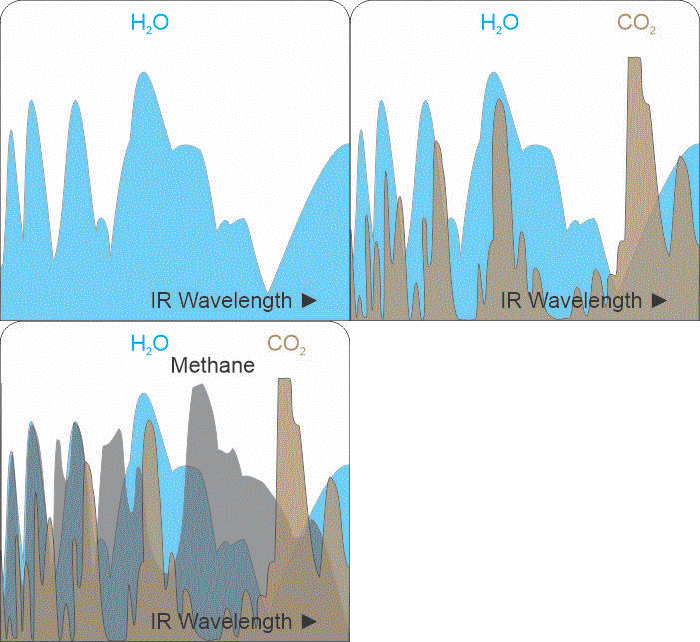
Susan Kim gives me the side‑eye. “Sy, I get real suspicious when someone shows me a graph with no axis markings. I’ve seen that ploy used too often by people pushing a bias — you don’t know what happens offstage either side and you don’t know whether an effect was large or small. Your animated chart was very impressive, how that big methane infrared absorption peak just happens to fill in the space between CO2 and H2O peaks. But how wide is the chart compared to the whole spectrum? Did you cherry‑pick a region that just happens to make your point?”

“Susan, how could you accuse me of such underhanded tactics? But I confess — you’re right, sort of. <more tapping on Old Reliable’s keyboard> The animation only covered the near‑IR wavelengths from 1.0 to 5.0 micrometers. Here’s the whole strip from 0.2 micrometers in the near UV, out to 70 micrometers in the far IR. Among other things, it explains the James Webb Space Telescope, right, Al?”

Spectrum of Earth’s atmosphere. Adapted
under the Creative Commons 3.0 license
from Robert Wohde’s work
with the HITRAN2004 spectroscopic database,

“I know the Webb’s set up for IR astronomy from space, Sy. Wait, does this graph say there’s too much water vapor blocking the galaxy’s IR and that’s why they’re putting the scope like millions of miles away out there?”

“Not quite. The mission designers’ problem was the Sun’s heat, not Earth’s water vapor. The solution was to use Earth itself to shield the device from the Sun’s IR emissions. The plan is to orbit the Webb around the Earth‑Sun L2 point, about a million miles further out along the Sun‑Earth line. Earth’s atmosphere being only 60 miles thick, most of it, the Webb will be quite safe from our water molecules. No, our steamy atmosphere’s only a problem for Earth‑based observatories that have to peer through a Venetian blind with a few missing slats at very specific wavelengths.”

“Don’t forget, guys, the water spectrum is a barrier in both directions. Wavelengths the astronomers want to look at can’t get in, but also Earth’s heat radiation at those wavelengths can’t get out. Our heat balance depends on the right amount of IR energy making it out through where those missing slats are. That’s where Sy’s chart comes in — it identifies the wavelengths under threat by trace gases that aren’t so trace any more.”

“And we’re back to your point, Susan. We have to look at the whole spectrum. I heard one pitch by a fossil fuel defender who based his whole argument on the 2.8‑micrometer CO2 peak. ‘It’s totally buried by water’s absorption,‘ he claimed. ‘Can’t possibly do us any further damage.’ True, so far as it goes, but he carefully ignored CO2‘s other absorption wavelengths. Pseudoscience charlatan, ought to be ashamed of himself. Methane’s not as strong an absorber as CO2, but its peaks are mostly in the right places to do us wrong. Worse, both gas concentrations are going up — CO2 is 1½ times what it was in Newton’s day, and methane is 2½ times higher.”

“Funny how they both go up together. I thought the CO2 thing was about humanity burning fossil fuels but you said methane operations came late to that game.”

“Right on both counts, Al. Researchers are still debating why methane’s risen so bad but I think they’re zeroing in on cow gas — belches and farts. By and large, industry has made the world’s population richer over the past two centuries. People who used to subsist on a grain diet can now afford to buy meat so we’ve expanded our herds. Better off is good, but there’s an environmental cost.”

Al gets a far-away look. “Both those gases have carbon in them, right? How about we burn methane without the carbon in, just straight hydrogen?”

Susan gets excited. “Several groups in our lab are working on exactly that possibility, Al. The 2H2+O2→2H2O reaction yields 30% more energy per oxygen atom than burning methane. We just need to figure out how to use hydrogen economically.”

~~ Rich Olcott

It’s A Trap!

Late morning, no-one else in his coffee shop so Al pulls up a chair. “OK, Susan, so coal’s a mess for ash and air pollution but also each carbon from coal gives us less energy than a carbon from methane. So why the muttering against switching to natural gas?”

“Big-ticket reasons, Al. One, natural gas isn’t pure methane. Mostly methane, sure, but depending on the source you get a whole collection of other things in the mix — heavier hydrocarbons like propane and butane, stinky sulfides and amines, even helium and mercury. Gas from a well has to be purified before you’d want it piped to your house.”

“Piped. Oh, yeah, pipelines. Probably a lot more efficient than coal transport but I see how they get problems, too.”

“Indeed they do. Pipelines break and leak and some idiots even use them for target practice. The worst kind of waste.”

“Yeah, when the oil gets out and ruins the land or someone’s water supply.”

“That’s bad locally, all right, but it’s when methane leaks out that the global damage starts.”

“Global?”

“Mm-hm, because methane’s a gas and mixes in with the rest of the atmosphere. If a pipeline or a truck or anything springs a leak in, say, Chicago, the methane molecules can go anywhere.”

“So?”

“So a couple of things. A decade in the atmosphere oxidizes most methane molecules to, guess what, CO2, the same problematic CO2 we get from burning coal. But before it degrades, methane’s an even bigger heat‑trapper than CO2 is.”

“Whaddaya mean, heat‑trapper?”

“Do you want to take this, Sy? It’s more Physics than Chemistry and besides, my mocha latte’s getting cold.”

“Hmm, there’s a bunch of moving parts in this. Al, you owe Susan a warm-up while I think.”

“Here ya go, Susan.”

“Thanks, Al. I’ll get you guys started. Why did my coffee get cold?”

“Good one, Susan. Al, it’s a universal principle — left to itself, energy spreads out. Heat finds ways to travel from a concentrated, high‑temperature source to low‑temperature absorbers. The exceptions occur when some extra process expends energy to pump heat in the other direction. So, that coffee naturally lost heat to the table by conduction, to the air by convection and to the general environment by radiation. The only thing that can stop those processes is perfect insulation. That’s the thing about the atmosphere.”

“Whoa, that’s a jump or three too fast.”

“OK, let’s follow a sunbeam aimed in the Earth’s direction. Its photons carry a wide range of energies, ultraviolet down to far infrared. On the way in, a UV photon hits an atmospheric ozone molecule and gets absorbed. No more UV photon but now the molecule is in an excited state. It calms down by joggling its neighbor molecules, that’s heat transfer, and maybe emitting a longer wavelength photon or two. Ozone filters out incoming UV and in the process spreads out the photon’s concentrated energy. What’s left in the sunbeam is visible and infrared light that gets down to us. You with me?”

“Makes sense so far.”

“Good. Next stage is that the visible and IR light heat the Earth, which then re-radiates the energy as infrared light mostly at longer wavelengths. The problem is that not all the IR gets out. Water molecules absorb some wavelengths in that range. Every absorption event means more heat distribution into the atmosphere when the molecule relaxes. Ocean evaporation maintains a huge number of IR‑blocking water molecules in the atmosphere.”

“I heard that ‘some‘ weasel‑word. Other wavelengths still make it through, right?”

I unholster Old Reliable, tap a few keys. “Here’s water’s absorption pattern in the mid‑to‑far‑infrared. A high peak means absorption centered at that wavelength. This is scaled per molecule per unit area, so double the molecules gives you double the absorption.”

Spectrum profiles from M. Etminan, et al., doi:10.1002/2016GL071930

“Lots of blank space between the peaks, though.”

“Which is where CO2 and methane get into the game. It’s like putting green and blue filters in front of a red one. With enough of those insulating molecules up there there’s no blank space and lots of imbalance from trapped heat.”

“Methane’s worse.”

“Lots worse.”

~~ Rich Olcott

Hyperbolas But Not Hyperbole

Minus? Where did that come from?”

<Gentle reader — If that question looks unfamiliar, please read the preceding post before this one.>

Jim’s still at the Open Mic. “A clever application of hyperbolic geometry.” Now several of Jeremy’s groupies are looking upset. “OK, I’ll step back a bit. Jeremy, suppose your telescope captures a side view of a 1000‑meter spaceship but it’s moving at 99% of lightspeed relative to you. The Lorentz factor for that velocity is 7.09. What will its length look like to you?”

“Lorentz contracts lengths so the ship’s kilometer appears to be shorter by that 7.09 factor so from here it’d look about … 140 meters long.”

“Nice, How about the clocks on that spaceship?”

“I’d see their seconds appear to lengthen by that same 7.09 factor.”

“So if I multiplied the space contraction by the time dilation to get a spacetime hypervolume—”

“You’d get what you would have gotten with the spaceship standing still. The contraction and dilation factors cancel out.”

“How about if the spaceship went even faster, say 99.999% of lightspeed?”

“The Lorentz factor gets bigger but the arithmetic for contraction and dilation still cancels. The hypervolume you defined is always gonna be just the product of the ship’s rest length and rest clock rate.”

His groupies go “Oooo.”

One of the groupies pipes up. “Wait, the product of x and y is a constant — that’s a hyperbola!”

“Bingo. Do you remember any other equations associated with hyperbolas?”

“Umm… Yes, x2–y2 equals a constant. That’s the same shape as the other one, of course, just rotated down so it cuts the x-axis vertically.”

Jeremy goes “Oooo.”

Jim draws hyperbolas and a circle on the whiteboard. That sets thoughts popping out all through the crowd. Maybe‑an‑Art‑major blurts into the general rumble. “Oh, ‘plus‘ locks x and y inside the constant so you get a circle boundary, but ‘minus‘ lets x get as big as it wants so long as y lags behind!”

Another conversation – “Wait, can xy=constant and x2–y2=constant both be right?”
  ”Sure, they’re different constants. Both equations are true where the red and blue lines cross.”

A physics student gets quizzical. “Jim, was this Minkowski’s idea, or Einstein’s?”

“That’s a darned good question, Paul. Minkowski was sole author of the paper that introduced spacetime and defined the interval, but he published it a year after Einstein’s 1905 Special Relativity paper highlighted the Lorentz transformations. I haven’t researched the history, but my money would be on Einstein intuitively connecting constant hypervolumes to hyperbolic geometry. He’d probably check his ideas with his mentor Minkowski, who was on the same trail but graciously framed his detailed write‑up to be in support of Einstein’s work.”

One of the astronomy students sniffs. “Wait, different observers see the same s2=(ct)2d2 interval between two events? I suppose there’s algebra to prove that.”

“There is.”

“That’s all very nice in a geometric sort of way, but what does s2 mean and why should we care whether or not it’s constant?”

“Fair questions, Vera. Mmm … you probably care that intervals set limits on what astronomers see. Here’s a Minkowski map of the Universe. We’re in the center because naturally. Time runs upwards, space runs outwards and if you can imagine that as a hypersphere, go for it. Light can’t get to us from the gray areas. The red lines, they’re really a hypercone, mark where s2=0.”

From the back of the room — “A zero interval?”

“Sure. A zero interval means that the distance between two events exactly equals lightspeed times light’s travel time between those events. Which means if you’re surfing a lightwave between two events, you’re on an interval with zero measure. Let’s label Vera’s telescope session tonight as event A and her target event is B. If the A–B interval’s ct difference is greater then its d difference then she can see Bif the event is in our past but not beyond the Cosmic Microwave Background. But if a Dominion fleet battle is approaching us through subspace from that black dot, we’ll have no possible warning before they’re on us.”

Everyone goes “Oooo.”

~~ Rich Olcott

Maybe It’s Just A Coincidence

Raucous laughter from the back room at Al’s coffee shop, which, remember, is situated on campus between the Physics and Astronomy buildings. It’s Open Mic night and the usual crowd is there. I take a vacant chair which just happens to be next to the one Susan Kim is in. “Oh, hi, Sy. You just missed a good pitch. Amanda told a long, hilarious story about— Oh, here comes Cap’n Mike.”

Mike’s always good for an offbeat theory. “Hey, folks, I got a zinger for you. It’s the weirdest coincidence in Physics. Are you ready?” <cheers from the physicists in the crowd> “Suppose all alone in the Universe there’s a rock and a planet and the rock is falling straight in towards the planet.” <turns to Al’s conveniently‑placed whiteboard> “We got two kinds of energy, right?”

Potential Energy    Kinetic Energy

Nods across the room except for Maybe-an-Art-major and a couple of Jeremy’s groupies. “Right. Potential energy is what you get from just being where you are with things pulling on you like the planet’s gravity pulls on the rock. Kinetic energy is what potential turns into when the pulls start you moving. For you Physics smarties, I’m gonna ignore temperature and magnetism and maybe the rock’s radioactive and like that, awright? So anyway, we know how to calculate each one of these here.”

PE = GMm/R    KE = ½mv²

“Big‑G is Newton’s gravitational constant, big‑M is the planet’s mass, little‑m is the rock’s mass, big‑R is how far apart the things are, and little‑v is how fast the rock’s going. They’re all just numbers and we’re not doing any complicated calculus or relativity stuff, OK? OK, to start with the rock is way far away so big‑R is huge. Big number on the bottom makes PE’s fraction tiny and we can call it zero. At the same time, the rock’s barely moving so little‑v and KE are both zero, close enough. Everybody with me?”

More nods, though a few of the physics students are looking impatient.

“Right, so time passes and the rock dives faster toward the planet Little‑v and kinetic energy get bigger. Where’s the energy coming from? Gotta be potential energy. But big‑R on the bottom gets smaller so the potential energy number gets, wait, bigger. That’s OK because that’s how much potential energy has been converted. What I’m gonna do is write the conversion as an equation.

GMm/R=½mv²

“So if I tell you how far the rock is from the planet, you can work the equation to tell me how fast it’s going and vice-versa. Lemme show those straight out…”

v=(2GM/R)    R=2GM/v²

Some physicist hollers out. “The first one’s escape velocity.”

“Good eye. The energetics are the same going up or coming down, just in the opposite direction. One thing, there’s no little‑m in there, right? The rock could be Jupiter or a photon, same equations apply. Suppose you’re standing on the planet and fire the rock upward. If you give it enough little‑v speed energy to get past potential energy equals zero, then the rock escapes the planet and big‑R can be whatever it feels like. Big‑R and little‑v trade off. Is there a limit?”

A couple of physicists and an astronomy student see where this is going and start to grin.

“Newton physics doesn’t have a speed limit, right? They knew about the speed of light back then but it was just a number, you could go as fast as you wanted to. How about we ask how far the rock is from the planet when it’s going at the speed of light?”

R=2GM/

Suddenly Jeremy pipes up. “Hey that’s the Event Horizon radius. I had that in my black hole term paper.” His groupies go “Oooo.”

“There you go, Jeremy. The same equation for two different objects, from two different theories of gravity, by two different derivations.”

“But it’s not valid for lightspeed.”

“How so?”

“You divided both sides of your conversion equation by little‑m. Photons have zero mass. You can’t divide by zero.”

Everyone in the room goes “Oooo.”

~~ Rich Olcott

The Gelato Model

“Eddie, this ginger gelato’s delicious — not too sweet and just the right amount of ginger bite.”

“Glad you like it, Anne.”

On the way down here, Sy was telling me about how so many things in the Universe run on the same mathematics if you look at them with the right coordinate system. Sy, how do you pick ‘the right coordinate system?”

“The same way you pick the right property to serve as a momentum in Newton’s Equation of Motion — physical intuition. You look for things that fit the system. Sometimes that puts you on the road to understanding, sometimes not. Eddie, you keep track of your gelato sales by flavor. How are they doing?”

“Pistachio’s always a good seller, Sy, but ginger has been coming on strong this year.”

“In motion terns, pistachio’s momentum is constant but ginger is gaining momentum, right?”

“S’what I said.”

“Measured in dollars or trayfuls?”

“In batches. I make it all in-house. I’m proud of that. Dollars, too, of course, but that’s just total for all flavors.”

“Batches all the same size?”

“Some are, some not, depending. If I had a bigger machine I could make more but I do what I can.”

“There you go, Anne, each gelato flavor is like a separate degree of freedom. Eddie’s tracked sales since he started so we can take that date as the origin. Measuring change along any degree in either batches or dollars we have perfectly respectable coordinates although the money view of the system is fuzzier. Velocity is batches per unit time, there’s even a speed limit, and ginger has accelerated. Sound familiar?”

“Sounds like you’re setting up a Physics model.”

“Call it gelato trend physics, but I don’t think I can push the analogy much further. The next step would be to define a useful momentum like Newton did with his Law of Motion.”

F=ma? That’s about acceleration, isn’t it?”

“Probably not in Newton’s mind. Back in his day they were arguing about which was conserved, energy or momentum. It was a sloppy argument because no‑one agreed on crisp definitions. People could use words like ‘quantity of motion‘ to refer to energy or momentum or even something else. Finally Newton defined momentum as ‘mass times velocity‘, but first he had to define ‘mass‘ as ‘quantity of matter‘ to distinguish it from weight which he showed is a force that’s indirectly related to mass.”

“So is it energy or momentum that’s conserved?”

“Both, once you’ve got good definitions of them. But my point is, our car culture has trained us to emphasize acceleration. Newton’s thinking centered on momentum and its changes. In modern terms he defined force as momentum change per unit time. I’m trying to think of a force‑momentum pair for Eddie’s gelato. That’s a problem because I can’t identify an analog for inertia.”

“Inertia? What’s that got to do with my gelato?”

“Not much, and that’s the problem. Inertia is resistance to force. Who can resist gelato? If it weren’t for inertia, the smallest touch would be enough to send an object at high speed off to forever. The Universe would be filled with dust because stars and planets would never get the chance to form. But here we are, which I consider a good thing. Where does inertia come from? Newton changed his mind a couple of times. To this day we only have maybe‑answers to that question.”

“You know we want to know, Sy.”

“Einstein’s favorite guess was Mach’s Principle. There’s about a dozen different versions of the basic idea but they boil down to matter interacting with the combined gravitational and electromagnetic fields generated by the entire rest of the Universe.”

“Wow. Wait, the stars are far away and the galaxies are much, much further away. Their fields would be so faint, how can they have any effect at all?”

“You’re right, Anne, field intensity per star does drop with distance squared. But the number of stars goes up with distance cubed. The two trends multiply together so the force trends grow linearly. It’s a big Universe and size matters.”

“So what about my gelato?”

“We’ll need more research, Eddie. Another scoop of ginger, Anne?”

~~ Rich Olcott

Symmetrical Eavesdropping

“Wait, Sy, you’ve made this explanation way more complicated than it has to be. All I asked about was the horrible whirling I’d gotten myself into. The three angular coordinates part would have done for that, but you dragged in degrees of freedom and deep symmetry and even dropped in that bit about ‘if measurable motion is defined.’ Why bother with all that and how can you have unmeasurable motion?”

“Curiosity caught the cat, didn’t it? Let’s head down to Eddie’s and I’ll treat you to a gelato. Your usual scoop of mint, of course, but I recommend combining it with a scoop of ginger to ease your queasy.”

“You’re a hard man to turn down, Sy. Lead on.”

<walking the hall to the elevators> “Have you ever baked a cake, Anne?”

“Hasn’t everyone? My specialty is Crazy Cake — flour, sugar, oil, vinegar, baking soda and a few other things but no eggs.”

“Sounds interesting. Well, consider the path from fixings to cake. You’ve collected the ingredients. Is it a cake yet?”

“Of course not.”

“Ok, you’ve stirred everything together and poured the batter into the pan. Is it a cake yet?”

“Actually, you sift the dry ingredients into the pan, then add the others separately, but I get your point. No, it’s not cake and it won’t be until it’s baked and I’ve topped it with my secret frosting. Some day, Sy, I’ll bake you one.”

<riding the elevator down to 2> “You’re a hard woman to turn down, Anne. I look forward to it. Anyhow, you see the essential difference between flour’s journey to cakehood and our elevator ride down to Eddie’s.”

“Mmm… OK, it’s the discrete versus continuous thing, isn’t it?”

“You’ve got it. Measuring progress along a discrete degree of freedom can be an iffy proposition.”

“How about just going with the recipe’s step number?”

“I’ll bet you use a spoon instead of a cup to get the right amount of baking soda. Is that a separate step from cup‑measuring the other dry ingredients? Sifting one batch or two? Those’d change the step‑number metric and the step-by-step equivalent of momentum. It’s not a trivial question, because Emmy Noether’s symmetry theorem applies only to continuous coordinates.”

“We’re back to her again? I thought—”

The elevator doors open at the second floor. We walk across to Eddie’s, where the tail‑end of the lunch crowd is dawdling over their pizzas. “Hiya folks. You’re a little late, I already shut my oven down.”

“Hi, Eddie, we’re just here for gelato. What’s your pleasure, Anne?”

“On Sy’s recommendation, Eddie, I’ll try a scoop of ginger along with my scoop of mint. Sy, about that symmetry theorem—”

“The same for me, Eddie.”

“Comin’ up. Just find a table, I’ll bring ’em over.”

We do that and he does that. “Here you go, folks, two gelati both the same, all symmetrical.”

“Eddie, you’ve been eavesdropping again!”

“Who, me? Never! Unless it’s somethin’ interesting. So symmetry ain’t just pretty like snowflakes? It’s got theorems?”

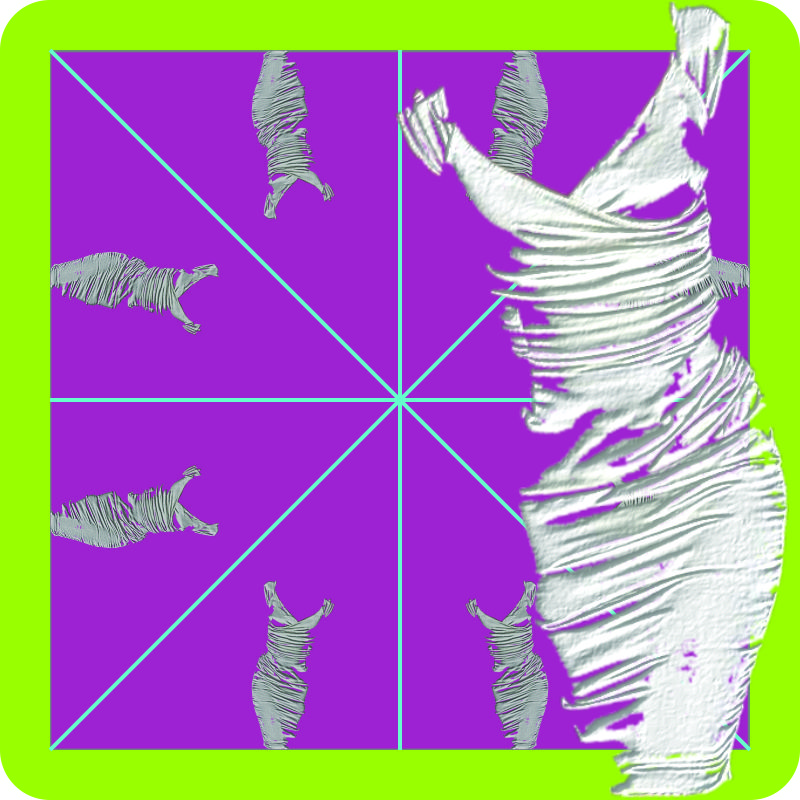
“Absolutely, Eddie. In many ways symmetry appears to be fundamental to how the Universe works. Or we think so, anyway. Here, Anne, have an extra bite of my ginger gelato. For one thing, Eddie, symmetry makes calculations a lot easier. If you know a particular system has the symmetry of a square, for instance, then you can get away with calculating only an eighth of it.”

“You mean a quarter, right, you turn a square four ways.”

“No, eight. It’s done with mirrors. Sy showed me.”

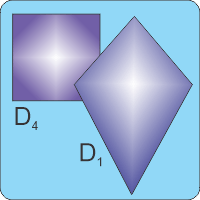
“I’m sure he did, Anne. But Sy, what if it’s not a perfect square? How about if one corner’s pulled out to a kite shape?”

“That’s called a broken symmetry, no surprise. Physicists and engineers handle systems like that with a toolkit of approximations that the mathematicians don’t like. Basically, the idea is to start with some nice neat symmetrical solution then add adjustments, called perturbations, to tweak the solution to something closer to reality. If the kite shape’s not too far away from squareness the adjusted solution can give you some insight onto how the actual thing works.”

“How about if it’s too far?”

“You go looking for a kite‑shaped solution.”

~~ Rich Olcott

Deep Symmetry

“Sy, I can understand mathematicians getting seriously into symmetry. They love patterns and I suppose they’ve even found patterns in the patterns.”

“They have, Anne. There’s a whole field called ‘Group Theory‘ devoted to classifying symmetries and then classifying the classifications. The split between discrete and continuous varieties is just the first step.”

“You say ‘symmetry‘ like it’s a thing rather than a quality.”

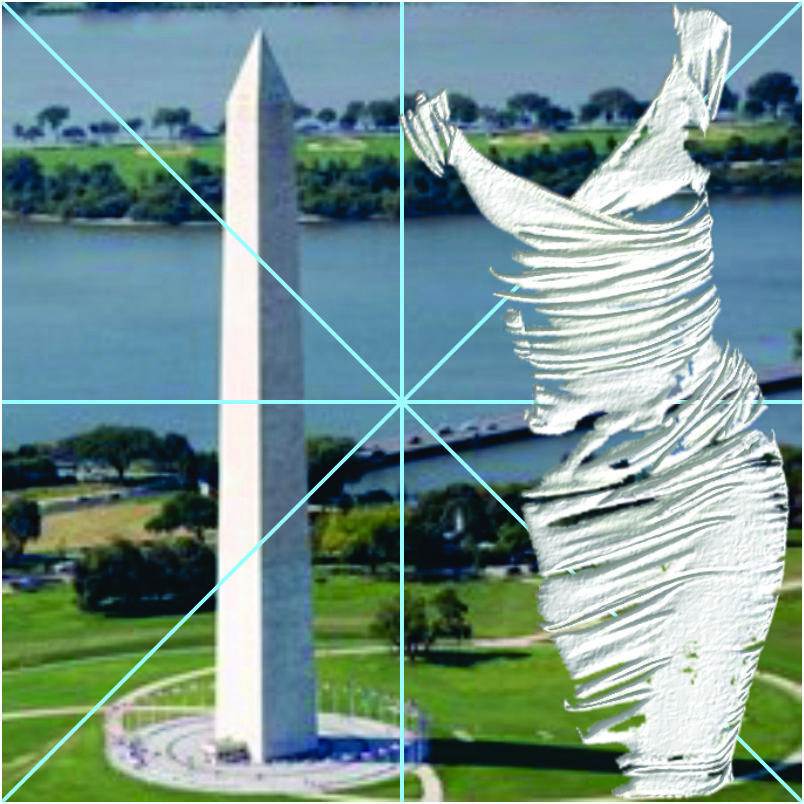
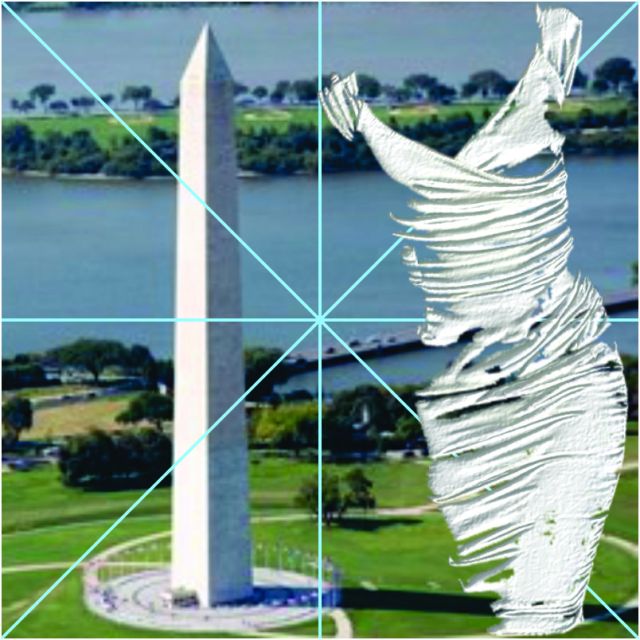
“Nice observation. In this context, it is. Something may be symmetrical, that’s a quality. Or it may be subject to a symmetry operation, say a reflection across its midline. Or it may be subject to a whole collection of operations that match the operations of some other object, say a square. In that case we say our object has the symmetry of a square. It turns out that there’s a limited number of discrete symmetries, few enough that they’ve been given names. Squares, for instance, have D4 symmetry. So do four-leaf clovers and the Washington Monument.”

“OK, the ‘4’ must be in there because you can turn it four times and each time it looks the same. What’s the ‘D‘ about?”

Dihedral, two‑sided, like two appearances on either side of a reflection. That’s opposed to ‘C‘ which comes from ‘Cyclic’ like 1‑2‑3‑4‑1‑2‑3‑4. My lawn sprinkler has C4 symmetry, no mirrors, but add one mirror and bang! you’ve got eight mirrors and D4 symmetry.”

“Eight, not just four?”

“Eight. Two mirrors at 90° generate another one 45° between them. That’s the thing with symmetry operations, they combine and multiply. That’s also why there’s a limited number of symmetries. You think you’ve got a new one but when you work out all the relationships it turns out to be an old one looked at from a different angle. Cubes, for instance — who knew they have a three‑fold rotation axis along each body diagonal, but they do.”

“I guess symmetry can make physics calculations simpler because you only have to do one symmetric piece and then spread the results around. But other than that, why do the physicists care?”

“Actually they don’t care much about most of the discrete symmetries but they care a whole lot about the continuous kind. A century ago, a young German mathematician named Emmy Noether proved that within certain restrictions, every continuous symmetry comes along with a conserved quantity. That proof suddenly tied together a bunch of Physics specialties that had grown up separately — cosmology, relativity, thermodynamics, electromagnetism, optics, classical Newtonian mechanics, fluid mechanics, nuclear physics, even string theory—”

“Very large to very small, I get that, but how can one theory have that range? And what’s a conserved quantity?”

“It’s theorem, not theory, and it capped two centuries of theoretical development. Conserved quantities are properties that don’t change while a system evolves from one state to another. Newton’s First Law of Motion was about linear momentum as a conserved quantity. His Second Law, F=ma, connected force with momentum change, letting us understand how a straight‑line system evolves with time. F=ma was our first Equation of Motion. It was a short step from there to rotational motion where we found a second conserved quantity, angular momentum, and an Equation of Motion that had exactly the same form as Newton’s first one, once you converted from linear to angular coordinates.”

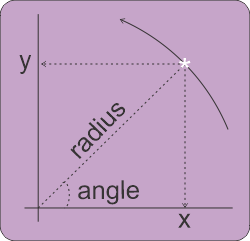
“Converting from x-y to radius-angle, I take it.”

“Exactly, Anne, with torque serving as F. That generalization was the first of many as physicists learned how to choose the right generalized coordinates for a given system and an appropriate property to serve as the momentum. The amazing thing was that so many phenomena follow very similar Equations of Motion — at a fundamental level, photons and galaxies obey the same mathematics. Different details but the same form, like a snowflake rotated by 60 degrees.”

“Ooo, lovely, a really deep symmetry!”

“Mm-hm, and that’s where Noether came in. She showed that for a large class of important systems, smooth continuous symmetry along some coordinate necessarily entails a conserved quantity. Space‑shift symmetry implies conservation of momentum, time‑shift symmetry implies conservation of energy, other symmetries lock in a collection of subatomic quantities.”

“Symmetry explains a lot, mm-hm.”

~~ Rich Olcott

Edged Things and Smooth Things

Yeughh, Sy, that whirling, the entire Universe spinning around me in every direction at once.”

“Well, you were at a point of spherical symmetry, Anne.”

“There’s that word ‘symmetryagain. Right side matches left side, what else is there to say?”

“A whole lot, especially after the mathematicians and physicists started playing with the basic notion.”

“Which is?”

“Being able to execute a transformation without making a relevant difference.”

“Relevant?”

“To the context. Swapping the king of spades for the king of hearts would be relevant in some card games but not others, right? If it doesn’t affect the play or the scoring, swapping those two when no‑one’s looking would be a legitimate symmetry operation. Spin a snowflake 60° and it looks the same unless you care exactly where each molecule is. That’s rotational symmetry, but there’s lots of geometric symmetry operations — reflections, inversions, glides, translations—”

“Translation is a symmetry operation?”

“In this connection, ‘translation‘ means movement or swapping between two different places in space. The idea came from crystals. Think of a 3D checkerboard, except the borderlines aren’t necessarily perpendicular. Perfect crystals are like that. Every cube‑ish cell contains essentially the same arrangement of atoms. In principle you could swap the contents of any two cells without making a difference in any of the crystal’s measurable properties. That’d be a translation symmetry operation.”

“Glides make me think of ice skating.”

“The glide operation makes me think of a chess knight’s move — a translation plus a reflection across the translation path. Think of wet footprints crossing a dry floor. That’s one example of combining operations to create additional symmetries. You can execute 48 unique symmetry operations on a cube even without the translation‑related ones. In my grad school’s crystallography class they taught us about point group and wallpaper and space group symmetries. It blew me away — beautiful in both mathematical and artistic senses. You’ve seen M C Escher’s art?”

“Of course, I love it. I pushed into his studio once to watch him work but he spotted me and shouted something Dutch at me. I’ve wondered what he thought when I pushed out of there.”

“His pieces drew heavily on geometric symmetries. So did Baroque art, music and architecture.”

“Music? Oh, yes — they had motifs and whole sections you could swap, and rhythm patterns and tunes you could read forwards and backwards like in a mirror… We’ve come a long way from snowflake symmetry, haven’t we?”

“We’re just getting started. Here’s where the Physics folks generalized the idea. Your unfortunate experience in space is right on the edge of what most people consider as symmetry. Were you impressed with the cube’s 48 operations?”

“I suppose. I haven’t had time to think about it.”

“A sphere has an infinite number. You could pick any of an infinite number of lines through its center. Each is an axis for an infinite number of rotational symmetries. Times two because there’s an inversion point at the center so the rotation could go in either direction. Then each line is embedded in an infinite number of reflection planes.”

“Goodness, no wonder I was dizzy. But it’s still geometry. What was the edge that the physicists went past?”

“The border between step‑at‑a‑time discrete symmetries and continuous ones. Rotate that snowflake 60° and you’ve got a match; anything not a multiple of 60° won’t pair things up. Across the border, some of the most important results in modern Physics depend on continuous symmetries.”

“How can you even have a continuous symmetry?”

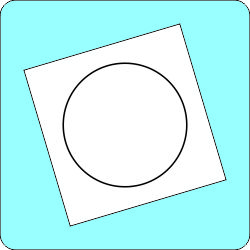
“Here, I’ll draw a circle on this square of paper. I can rotate the square by 90, 180 or 270 degrees and everything’s just the way it was. But if the square’s not relevant because we’re only interested in the circle, then I can rotate the paper by any amount I like and it’s a no‑difference transformation, right?”

“Continuous like on an infinite line but it’s wrapped around.”

“Exactly, and your infinite line is another example — any translation along that line, by a mile or a millimeter, is a perfectly good symmetry operation.”

“Ooo, and time, too. I experience time as an infinite line.”

“So does everyone. but most only travel in one direction.”

~~ Rich Olcott