Fierce Roaring Beast

A darkish day calls for a fresh scone so I head for Al’s coffee shop. Cathleen’s there with some of her Astronomy students. Al’s at their table instead of his usual place behind the cash register. “So what’s going on with these FRBs?”

She plays it cool. “Which FRBs, Al? Fixed Rate Bonds? Failure Review Boards? Flexible Reed Baskets?”

Jim, next to her, joins in. “Feedback Reverb Buffers? Forged Razor Blades?
Fennel Root Beer?”

I give it a shot. “Freely Rolling Boulders? Flashing Rapiers and Broadswords? Fragile Reality Boundary?”

“C’mon, guys. Fast Radio Bursts. Somebody said they’re the hottest thing in Astronomy.”

Cathleen, ever the teacher, gives in. “Well, they’re right, Al. We’ve only known about them since 2007 and they’re among the most mystifying objects we’ve found out there. Apparently they’re scattered randomly in galaxies all over the sky. They release immense amounts of energy in incredibly short periods of time.”

“I’ll say.” Vinnie’s joins the conversation from the next table. “Sy and me, we been talking about using the speed of light to measure stuff. When I read that those radio blasts from somewhere last just a millisecond or so, I thought, ‘Whatever makes that blast happen, the signal to keep it going can’t travel above lightspeed. From one side to the other must be closer than light can travel in a millisecond. That’s only 186 miles. We got asteroids bigger than that!'”

“300 kilometers in metric.” Jim’s back in. “I’ve played with that idea, too. The 70 FRBs reported so far all lasted about a millisecond within a factor of 3 either way — maybe that’s telling us something. The fastest way to get lots of energy is a matter-antimatter annihilation that completely converts mass to energy by E=mc².  Antimatter’s awfully rare 13 billion years after the Big Bang, but suppose there’s still a half-kilogram pebble out there a couple galaxies away and it hits a hunk of normal matter. The annihilation destroys a full kilogram; the energy release is 1017 joules. If the event takes one millisecond that’s 1020 watts of power.”

“How’s that stand up against the power we receive in an FRB signal, Jim?”

“That’s the thing, Sy, we don’t have a good handle on distances. We know how much power our antennas picked up, but power reception drops as the square of the source distance and we don’t know how far away these things are. If your distance estimate is off by a factor of 10 your estimate of emitted power is wrong by a factor of 100.”

“Ballpark us.”

<sigh> “For a conservative estimate, say that next-nearest-neighbor galaxy is something like 1021 kilometers away. When the signal finally hits us those watts have been spread over a 1021-kilometer sphere. Its area is something like 1049 square meters so the signal’s power density would be around 10-29 watts per square meter. I know what you’re going to ask, Cathleen. Assuming the radio-telescope observations used a one-gigahertz bandwidth, the 0.3-to-30-Jansky signals they’ve recorded are about a million million times stronger than my pebble can account for. Further-away collisions would give even smaller signals.”

Looking around at her students, “Good self-checking, Jim, but for the sake of argument, guys, what other evidence do we have to rule out Jim’s hypothesis? Greg?”

“Mmm… spectra? A collision like Jim described ought to shine all across the spectrum, from radio on up through gamma rays. But we don’t seem to get any of that.”

“Terry, if the object’s very far away wouldn’t its shorter wavelengths be red-shifted by the Hubble Flow?”

“Sure, but the furthest-away one we’ve tagged so far is nearer than z=0.2. Wavelengths have been stretched by 20% or less. Blue light would shift down to green or yellow at most.”

“Fran?”

“We ought to get even bigger flashes from antimatter rocks and asteroids. But all the signals have about the same strength within a factor of 100.”

“I got an evidence.”

“Yes, Vinnie?”

“That collision wouldn’t’a had a chance to get started. First contact, blooie! the gases and radiation and stuff push the rest of the pieces apart and kill the yield. That’s one of the problems the A-bomb guys had to solve.”

Al’s been eaves-dropping, of course. “Hey, guys. Fresh Raisin Bread, on the house.”

~~ Rich Olcott
Friendly Resting Behemoths

Trombones And Echoes

Vinnie’s fiddling with his Pizza Eddie’s pizza crumbs. “Hey, Sy, so we got the time standard switched over from that faked 1900 Sun to counting lightwave peaks in a laser beam. I understand why that’s more precise ’cause it’s a counting measure, and it’s repeatable and portable ’cause they can set up a time laser on Mars or wherever that uses the same identical kinds of atoms to do the frequency stuff. All this talk I hear about spacetime, I’m thinkin’ space is linked to time, right? So are they doing smart stuff like that for measuring space?”

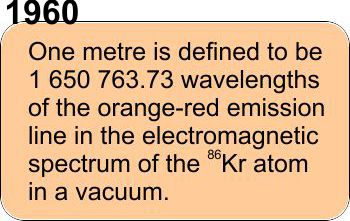
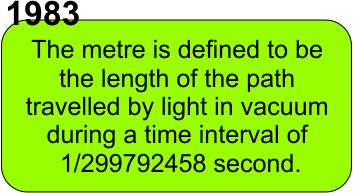
“They did in 1960, Vinnie. Before that the meter was defined to be the distance between two carefully positioned scratches on a platinum-iridium bar that was lovingly preserved in a Paris basement vault. In 1960 they went to a new standard. Here, I’ll bring it up on Old Reliable. By the way, it’s spelled m-e-t-e-r stateside, but it’s the same thing.”

“Mmm… Something goofy there. Look at the number. You’ve been going on about how a counted standard is more precise than one that depends on ratios. How can you count 0.73 of a cycle?”

“You can’t, of course, but suppose you look at 100 meters. Then you’d be looking at an even 165,076,373 of them, OK?”

“Sorta, but now you’re counting 165 million peaks. That’s a lot to ask even a grad student to do, if you can trust him.”

“He won’t have to. Twenty-three years later they went to this better definition.”

“Wait, that depends on how accurate we can measure the speed of light. We get more accurate, the number changes. Doesn’t that get us into the ‘different king, different foot-size’ hassle?”

“Quite the contrary. It locks down the size of the unit. Suppose we develop technology that’s good to another half-dozen digits of precision. Then we just tack half-a-dozen zeroes onto that fraction’s denominator after its decimal point. Einstein said that the speed of light is the same everywhere in the Universe. Defining the meter in terms of lightspeed gives us the same kind of good-everywhere metric for space that the atomic clocks give us for time.”

“I suppose, but that doesn’t really get us past that crazy-high count problem.”

“Actually, we’ve got three different strategies for different length scales. For long distances we just use time-of-flight. Pick someplace far away and bounce a laser pulse off of it. Use an atomic clock to measure the round-trip time. Take half that, divide by the defined speed of light and you’ve got the distance in meters. Accuracy is limited only by the clock’s resolution and the pulse’s duration. The Moon’s about a quarter-million miles away which would be about 2½ seconds round-trip. We’ve put reflectors up there that astronomers can track to within a few millimeters.”

“Fine, but when distances get smaller you don’t have as many clock-ticks to work with. Then what do you do?”

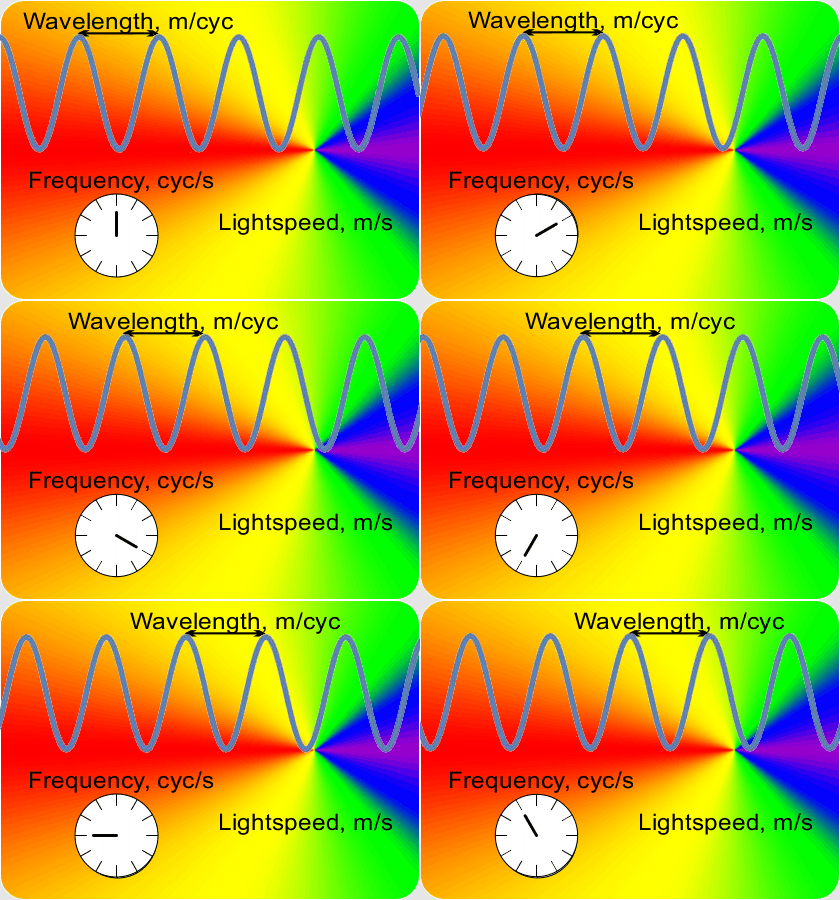
“You go to something that doesn’t depend on clock-ticks but is still connected to that constant speed of light. Here, this video on Old Reliable ought to give you a clue.”

“OK, the speed which is a constant is the number of peaks that’s the frequency times the distance between them that’s the wavelength. If I know a wavelength then arithmetic gets me the frequency and vice-versa. Fine, but how do I get either one of them?”

“How do you tune a trombone?”

“Huh? I suppose you just move the slide until you get the note you want.”

“Yup, if a musician has good ear training and good muscle memory they can set the trombone’s resonant tube length to play the right frequency. Table-top laser distance measurements use the same principle. A laser has a resonant cavity between two mirrors. Setting the mirror-to-mirror distance determines the laser’s output. When you match the cavity length to something you want to measure, the laser beam frequency tells you the distance. At smaller scales you use interference techniques to compare wavelengths.”

Vinnie gets a gleam in his eye. “Time-of-flight measurement, eh?” He flicks a pizza crumb across the room.

In a flash Eddie’s standing over our table. “Hey, hotshot, do that again and you’re outta here!”

“Speed of light, Sy?”

“Pretty close, Vinnie.”

~~ Rich Olcott
What Time Is It on Mars?

I’m puffing a little after hiking up a dozen flights of stairs. That whole bank of Acme Building elevators is closed off while the repair crew tries to free up the one that trapped us. The crowd waiting for the other bank is forgetaboutit. I unlock my office door and there’s Vinnie, tinkering with the thermostat. “Geez, Sy, it’s almost as cold in here as it is out in the hall. Hey, ya think there’s anything to the rumor that building management is gonna rent out that elevator as office space? And how does time work on Mars?”

“Morning, Vinnie. You’re right, I don’t think so, and where’d that last question come from?”

“I been thinking about those ultra-accurate clocks and how they’d play into that relativity stuff we talked about with Ramona.” <short lull in the conversation as we both consider Ramona> “Suppose there’s one of those clocks in a satellite going around Earth. If I remember right, it’s going ZIP around the planet so its clock ought to run faster than my wristwatch, but it’s further out of Earth’s gravity well so its clock ought to run slower. Which would win?”

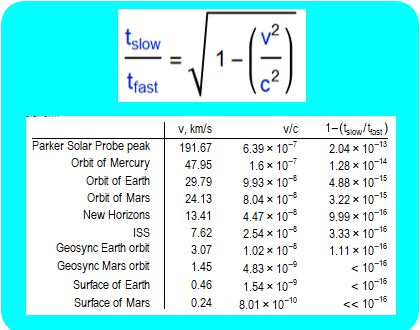
“You remembered right — you’ve got Special Relativity and General Relativity in a couple of nutshells, and yes, they sometimes work in opposite directions. You have to look at the numbers. Give me a sec to work up a few examples on Old Reliable… OK, let’s start with the speed part. That’s Special Relativity because they both start with ‘SP’.”

“Cute.”

“I thought so.  OK, here’s a handful of locations and their associated straight-line speeds relative to some star far away. That last column shows a difference factor for a clock at each location compared to a far-away motionless clock in a zero gravitational field. Multiply the factor by 86,400 seconds per day to get the time difference per day. The fastest thing on the list is that spacecraft we’re sending to the Sun by way of some slingshot maneuvers around Venus to speed it up. The Special Relativity difference comes to less than two nanoseconds per day. That’s barely in the range we can detect. It’s way less for everyplace else. ”

“Hey, Mars is down at the bottom. Lemme think why… OK, slower rotation than Earth’s, AND smaller radius so you don’t move as far for the same degrees of spin, so the formula barely subtracts anything from 1.0, right?”

“Yup, the slower you go compared to lightspeed the smaller the time adjustment. The difference between unity and the ratio for a point on Mars’ surface is so small that Old Reliable suffered a floating-point underflow trying to calculate it. That’s hard to make it do. Bottom line, the SR effect doesn’t really kick in unless you’re going faster than practically everything larger than an atom.”

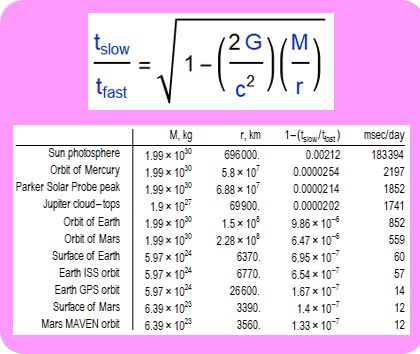
“So how about the gravity wells? I’ll bet the deeper the well, the more time gets stretched.”

“Good bet. The well gets deeper as the attracting mass increases. But your clock feels less of a squeeze if it’s further away. The net effect is controlled by the mass-to-distance ratio inside that square root. Worst case in this table is at the top. A clock embedded in the Sun’s photosphere loses 0.00212*(86400 sec/day)=183 seconds compared to a far-away motionless clock in free-fall. We here on Earth lose 912 milliseconds a day total, but the astronauts on the ISS lose about 3 milliseconds less than we do because they’re further away from Earth’s center.”

“Yeah, I read about those twin astronauts. The one flying on the ISS didn’t get older as fast as the one that stayed on Earth.”

“About a second’s-worth over a year. So, do you have your relativity and Mars-time answer?”

“Sorta. But what time is it up there right now?”

“Hey, Mars is a whole world and has different times at different places just like Earth does. Wherever you are on Mars, ‘noon’ is when the Sun is overhead. Mars spins about 3% slower than Earth does — noon-to-noon there is Earth’s 24 hours plus 37 minutes and change. Add in the net 340-millisecond relativistic daily drift away from Earth time. No way can you sync up Earth and Mars times.”

“Nothin’s simple, huh?”

~~ Rich Olcott

A Clock You Can Count On And Vice-versa

We’re both leery of the Acme Building’s elevators after escaping from one, so Vinnie and I take the stairs down to Pizza Eddie’s. “Faster, Sy, that order we called in will be cold when we get there.”

“Maybe not, Vinnie. Depends on his backlog.”

“Hey, before all this started, we were talking about the improved time standard and you said something about optical clockwork. I gather it’s got something to do with lasers and such.”

“It sure does. Boils down to Science preferring count-based units over ratios because they’re more precise. If you count something twice you should get exactly the same answer each time; if you’re measuring a ratio against a ruler or something, duplicate measurements might not agree. For instance, you can probably tell me how many steps there are between floors — “

“Fourteen”

“— more precisely than you can tell me the floor-to-floor height in feet or meters. And more accurately, too.”

“How can it be more accurate? I’ve got a range-finder gadget that reads out to a tenth of an inch. Or a millimeter if you set the switch for that.”

“Because that reading is subject to all sorts of potential errors — maybe you’re pointing it at an angle, or its temperature calibration is off, or you’re moving and there’s a Doppler effect. It may give you exactly the same reading twice in a row —”

“I always measure twice before I cut once.”

“Of course you do. My point is, that device might give you very precise but inaccurate answers that are way off. You’d have to calibrate its readings against a trustworthy standard to be sure.”

“Suppose my range-finder’s as precise as my step-counting. How can step-counting be better?”

“Because the step is defined as the measurement unit. There’s no calibration issues or instrumental drift or ‘it depends on how good the carpenter was,’ a step is a step. Step counting is accurate by definition. Nearly all our conventional units of measurement have some built-in ‘‘it depends’ factors that drive the measurement folks crazy. Like the foot, for instance — every time a new king came to power, his foot became the new standard and every wood and cloth merchant in the kingdom had to revise their inventory listings.”

“OK, so that’s basically why the time-measurement people wanted to get away from that ‘a second is a fraction of a day back when‘ definition — too many ‘it depends’ factors and they wanted something they could count. Got it. So back in what, 1967? they switched to a time standard where they could count waves and they went to the ‘a second is so many waves‘ thing. I also got that their first shot was to use microwaves ’cause that’s what they could count. But that was half-a-century ago. Haven’t they moved up the spectrum since then, say to visible light?”

“Not quite. They had to get tricky. Think about it. Yellow-orange light’s wavelength is about 600 nanometers or 600×10-9 meters. Divide that by the speed of light, 3×10⁸ meters/second, and you get that each wave whizzes by in only 2×10-15 seconds. Our electronics still can’t count that fast, but we can cheat. Uhhh … which would be easier to answer — how many floors in this building or how many steps?”

“Floors, of course, there’s a lot fewer of them.”

“But the step count would track the floor count, regular as clockwork, because an exact number of steps separates each pair of floors. If you know one count, arithmetic tells you the other. The same logic can work with lightwaves. Soon after the engineers developed mode-locking theory and a few tricks like frequency combs, they figured out ways to stabilize a maser by mode-locking it to a laser. It’s like gearing down a once-a-second pendulum to regulate the hour-hand of a clock, so of course they called it optical clockwork even though there’s no gears.”

“Maser?”

“A maser does microwaves the way a laser does lightwaves. Every tick from a cesium-based maser is about 47,000 ticks from a strontium-based laser. Mode-lock them together and your clock’s good within a few seconds over the age of the Universe.”

“Hiya, Eddie.”

“Hiya, Vinnie. Perfect timing. Those pizzas you called for, they’re just comin’ outta the oven.”

~~ Rich Olcott
In A Pinch And Out Again

<Vinnie’s phone rings> “Yeah, Michael? That ain’t gonna work, Micheal.” <to me> “Michael wants to hoist us out through the elevator cab’s ceiling hatch.” <to phone> “No, it’s a great idea, Michael, it’d be no problem for Sy, he’s skinny, but no way am I gonna fit through that hatch. Yeah, keep looking for the special lever. Hey, call Eddie downstairs for some pizza you can send through the hatch. Yeah, you’re right, pizza grease and elevator grease don’t mix. Right, we’ll wait, like we got any choice. Bye.” <to me> “You heard.”

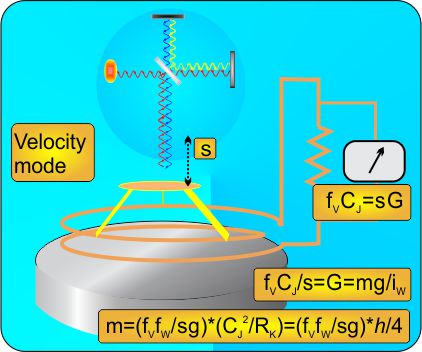
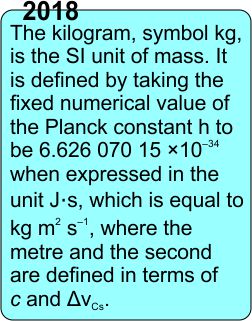
“Yeah, I got the drift. Plenty more time to talk about the improved portable kilogram standard.”

“I thought we were talking about lasers. No, wait, we got there by talking about the time standard.”

“We were and we did, but all the improved measurements are based on laser tech. Mode-locking, optical tweezers and laser cooling, for instance, are key to the optical clockwork you need for a really good time standard.”

“Optical tweezers?”

“Mm-hm, that’s yet another laser-related Nobel Prize topic. There’s been nearly a dozen so far. Optical tweezers use light beams to grab and manipulate small particles. Really small, like cells or molecules or even single atoms.”

“Grabbing something with light? How’s that work?”

“Particles smaller than a light beam get drawn in to where the beam’s electric field varies the most. With a tightly-focused laser beam that special place is just a little beyond its focus point. You can use multiple beams to trap particles even more tightly where the beams cross.”

“Is that how ‘laser cooling’ works? You hold an atom absolutely still and it’s at absolute zero?”

“Nice idea, Vinnie, but your atom couldn’t ever reach absolute zero because everything has a minimum amount of zero-point energy. But you’re close to how the most popular technique is set up. It’s elegant. You start with a thin gas of the atoms you want to work with. Their temperature depends on their average kinetic energy as they zip around, right?”

“Yeah, so you want to slow them down.”

“Now you shine in two laser beams, one pointing east and one pointing west, and their wavelengths are just a little to the red of what those atoms absorb. Imagine yourself sitting on one of those atoms coming toward the east-side laser.”

Blue shift! I’m coming toward the waves so I see them scrunched together at a wavelength where my atom can absorb a photon. But what about the other laser?”

“You’d see its wavelength red-shifted away from your atom’s sweet spot and the atom doesn’t absorb that photon. But we’re not done. Now your excited atom relaxes by emitting a photon in some random direction. Repeat often. The north-south momentum change after each cycle averages out to zero but east-west momentum always goes down. The gas temperature drops.”

“Cool.”

All this talk of particles balanced in force fields gives me an idea. “Vinnie, d’ya think we stopped closer to the fifth floor or the sixth?”

“I think we’re almost down to five.”

“Good, that gives us a better chance. Where were you standing when we stopped?”

“Right by the buttons, like always. Whaddaya got in mind?”

“Michael said that’s a new elevator door, right? No offense, you’re heavy and I’m no light-weight. Both of us were standing at the very front of the cab. I’m thinking maybe our unbalanced weight tilted the cab just enough to catch an edge on some part of the door mechanism they didn’t put in quite right. Let’s switch places and both jump up and while we’re in the air wallop the top of the cab’s back wall as hard as we can. OK, on three — one, two, three!” “

<B-BLAMkchitKKzzzzzrrrrrrr-T>

“Michael. It’s Vinnie. We’re out. Yeah, ‘s wunnerful, I’m glad you’re glad. Look, something was sorta outta place in the new door mechanism on five and now it’s way outta place and the cab’s probably here for the duration. Call your repair guys, but before you do that bring up some Caution tape and something that’ll block the door open. Quick-like, right? I’m holding this door but I ain’t gonna be a statue long ’cause I’m hungry.”

~~ Rich Olcott
Elevator, Locked And Loaded

Vinnie’s on his phone again.  “Michael!  Where are you, man?  We’re still trapped in this elevator!  Ah, geez.”  <to me>  “Guy can’t find the special lever.”  <to phone>  “Well, use a regular prybar, f’petesake.”  <to me>  “Says he doesn’t want to damage the new door.”  <to phone>  “Find something else, then.  It’s way past dinner-time, I’m hungry, and Sy’s starting to look good, ya hear what I’m sayin’?  OK, OK, the sooner the better.”  <to me>  “Michael’s says he’s doin’ the best he can.”

“I certainly hope so.  Try chewing on one of your moccasins there.  It’d complain less than I would and probably taste better.”

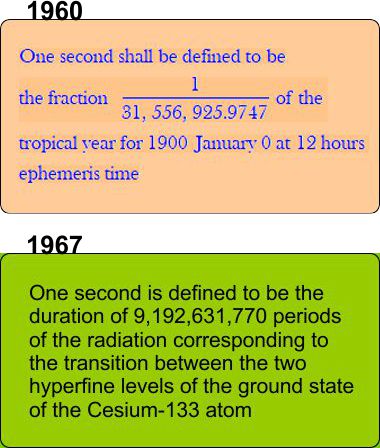
“Don’t worry about it.  Yet.”  <looks at Old Reliable’s display, takes his notebook from a pocket, scribbles in it>  “That 1960 definition has more digits than the 1967 one.  Why’d they settle for less precision in the new definition?  Lemme guess — 1960s tech wasn’t up to counting frequencies any higher so they couldn’t get any better numbers?”

“Nailed it, Vinnie.  The International Bureau of Weights and Measures blessed the cesium-microwave definition just as laser technology began a whole cascade of advancements.  It started with mode-locking, which led to everything from laser cooling to optical clockwork.”

“We got nothing better to do until Michael. Go ahead, ‘splain those things.”

“Might as well, ’cause this’ll take a while. What do you know about how a laser works?”

“Just what I see in my magazines. You get some stuff that can absorb and emit light in the frequency range you like. You put that stuff in a tube with mirrors at each end but one of them’s leaky. You pump light in from the side. The stuff absorbs the light and sends it out again in all different directions. Light that got sent towards a mirror starts bouncing back and forth, getting stronger and stronger. Eventually the absorber gets saturated and squirts a whoosh of photons all in sync and they leave through the leaky mirror. That’s the laser beam. How’d I do?”

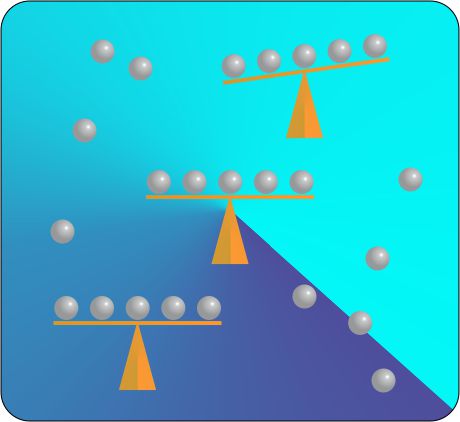
“Pretty good, you got most of the essentials except for the ‘saturated-squirting’ part. Not a good metaphor. Think about putting marbles on a balance board. As long as the board stays flat you can keep putting marbles on there. But if the board tilts, just a little bit, suddenly all the marbles fall off. It’s not a matter of how many marbles, it’s the balance. But what’s really important is that there’s lots of boards, one after the other, all down the length of the laser cavity, and they interact.”

“How’s that important?”

“Because then waves can happen. Marbles coming off of board 27 disturb boards 26 and 28. Their marbles unbalance boards 25 and 29 and so on. Waves of instability spread out and bounce off those mirrors you mentioned. New marbles coming in from the marble pump repopulate the boards so the process keeps going. Here’s the fun part — if a disturbance wave has just the right wavelength, it can bounce off of one mirror, travel down the line, bounce back off the other mirror, and just keep going. It’s called a standing wave.”

“I heard this story before, but it was about sound and musical instruments. Standing waves gotta exactly match the tube length or they die away.”

“Mm-hm, wave theory shows up all over Physics. Laser resonators are just another case.”

“You got a laser equivalent to overtones, like octaves and fourths?”

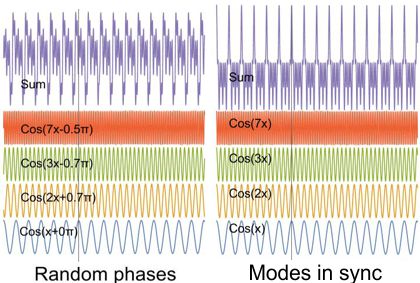
“Sure, except that laser designers call them modes. If one wave exactly fits between the mirrors, so does a wave with half the wavelength, or 1/3 or 1/4 and so on. Like an organ pipe, a laser can have multiple active modes. But it makes a difference where each mode is in its cycle. Here, let me show you on Old Reliable … Both graphs have time along the horizontal. Reading up from the bottom I’ve got four modes active and the purple line on top is what comes out of the resonator. If all modes peak at different times you just get a hash, but if you synchronize their peaks you get a series of big peaks. The modes are locked in. Like us in this elevator.”

“Michael! Get us outta here!”

~~ Rich Olcott

Time in A Bottle, Sort Of

We’re in the Acme Building’s elevator, headed down to Eddie’s for pizza, when there’s a sudden THUNK.  Vinnie’s got his cellphone out and speed-dialed before I’ve registered that we’ve stopped.  “Michael, it’s me, Vinnie.  Hi.  Me and Sy are in elevator three and it just stopped between floors.  Yeah, between six and five.  Of course I know that’s where, I always count floors.  Look, you get us outta here quick and I won’t have to call the rescue squad and you don’t have paperwork, OK?  Warms my heart to hear you say that.  Right.  And there’s pizza in it for you when we’re out.  Thanks, Michael.”  <to me>  “Says it’ll be a few minutes.  You good for climbing out when he levers the doors?”

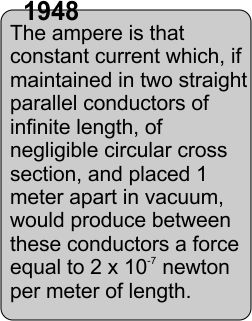
“Sure, no problem.  Might as well keep on about why the kilogram definition changed.  Oddly enough, the story starts with one of the weirdest standards in Science.  Here, I’ll pull it up on Old Reliable…”

“OK, that’s a weird number in the fraction, but what’s weird about the whole definition?”

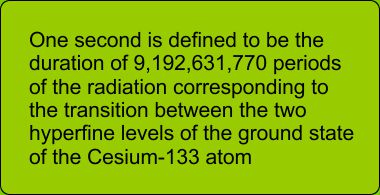
“Think about it — when they defined this standard in 1960, it essentially said, ‘Go back sixty years, see how long it took for the Sun to return to exactly where it was in the sky a year earlier, capture exactly that weird fraction of the one-year interval in a bottle and bring it back to the present for comparison with an interval you want to report a time for.  Sound doable to you?”

“Mmm, no.  But these guy’s weren’t stupid.  There had to be a way.”

“The key is in those words, ephemeris time.”

“Something like Greenwich Time?  How would that help?” 

“Greenwich Mean Time would be better — ‘mean’ as in ‘average.’  You know the Earth doesn’t spin perfectly, right?”

“Yeah, it wobbles.  The Pole Star won’t be at the pole in a few thousand years.”

“That’s the idea but things are messier than that.  For instance, when a large mass moves around, like a big volcano eruption or a major ice-sheet breakup or monsoon rains using Indian Ocean water to drench Southwest Asia, that causes a twitch in the rotation.”

“Hard to see how those twitches would be measurable.”

“They are when you’re working at 9-digit precision, which atomic clocks exceeded long ago.  Does your GPS unit have that spiffy dual-frequency function for receiving satellite time signals?”

“Sure does  — good to within a foot.”

“That’d be about 30 centimeters.  Speed of light’s 3×10⁸ meters per second so you’re depending on satellite radio time-checks good to about, um, 100 nanoseconds, in a data field holding week number and seconds down to nanoseconds.  So you’d expect measurement jitter within … about 2 parts in 1015.  Pretty good, and on that scale those twitches count.”

“What do they do about them?”

“Well, you can’t fix Earth, but you can measure the twitches very carefully and then average over them.  Basically, you list all the Sun-position measurements made over many years, along with the corresponding time as reported by then-current science’s best clocks.  Use those observations to build a mathematical model of where an averaged fake Sun would appear to be at any given moment if it were absolutely regular, no twitches.  When the fake Sun would be at its highest during a given day, that’s noon GMT.”

“Fine, but what’s that got to do with your weird definition?”

“You can run your mathematical model backward in time to see how many times your best-we’ve-got-now clock would tick between fake noon and fake 12:00:01 on that date.  That calibrates your clock.”

“Seems a little circular to me — Sun to clock to model to fake-Sun to clock.”

“Which is why, now that we’ve got really good clocks, they’ve changed the operational definition by dropping the middleman.  The most precise measurements for anything depend on counting.  We now have technology that can count individual peaks in a lightwave signal.  These days the second is defined this way.  If a counter misses one peak, that’s one part in 10 million, three counts per year.  That’s so much better than Solar time they sometimes have to throw in a ‘leap-second’ so the years can keep up with the clocks.”

“Michael’s way overdue.  I’m callin’ him again.”

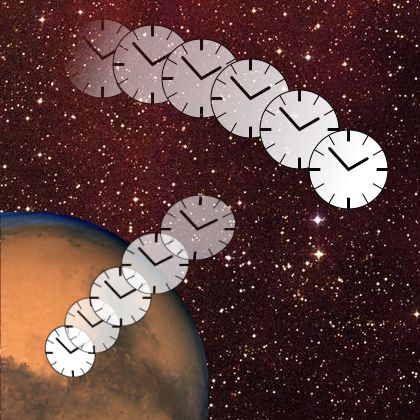
Clock image from vecteezy.com

~~ Rich Olcott


An Official Mass Movement

A December nip’s in the air.  I’m in my office trying to persuade the heating system to be more generous, when Vinnie wanders in carrying a magazine.  “I been reading about how a pound won’t be a pound any more.”

This takes me a moment to work out.  “Ah, you’re talking kilograms, not pounds, right?”

“Pound, kilogram, same difference, they’re both weights.”

“No, they’re not.  A kilogram at the bottom of the sea would still be a kilogram at the top of a mountain, but a pound high up weighs less than a pound lower down.”

“In what alternate universe does that make sense?”

“In any universe where Galileo’s observations and Newton’s equations are valid.  Thanks to them we know the difference between weight and mass.”

“Which is…?”

“That’s where things get subtle and it took Newton to tease them apart.  It’s the difference between quantifying something with a spring scale and quantifying it with a balance.  Say you put a heavy object on a scale.  It pulls down on the spring and the spring pulls up on the object.  When everything stops moving, the upward and downward forces are equal.  Given the spring’s stretch-per-pound relationship, you can measure the stretch and figure out how many pounds of force the object exerts.”

“Yeah, so…?”

“So now you put the same object on one pan of a balance.  You put kilogram blocks on the other pan until the balance beam levels out.  The beam goes level because the two sides of the balance carry the same mass.  Count the blocks and you know your object’s mass in kilograms.”

“Like I said, same difference.”

“Nope, because you’ve done two different operations.  On a balance your object will match up with the same number of blocks wherever you go with them.  Balance measurements are all about mass.  With the spring scale you compared gravity’s force against some other kind of force.  If you go somewhere else where gravity’s weaker, say to the top of Mt Everest, the scale will show a different weight even though the mass hasn’t changed.”

“How much different?”

“Not much for most purposes — about two pounds per ton between sea-level and Mt Everest’s peak.  But that’s a huge variation for physicists who look for clues to the Universe in the 5th or 6th decimal place.  High tech science and engineering need measurements, like mass, that are precise, stable and reproducible in many labs.  You noticed that both of my example measurements are too approximate for the techs.”

“Sure, the scale thing can be off because the spring can get wonky with use.  Um, and you can only measure the stretch within a percent or so probably.  But you can count the kilogram blocks — that ought to be a pretty good number.”

“Count-based metrics are indeed the most precise, but they’re problematic in their own way.  For one thing, maybe the object isn’t an exact number of kilograms.  Best you can do is say it’s between and n+1 kilograms.  But it’s worse than that.  The kilogram blocks can get wonky, too — finger-marks, corrosion, all of that.”

“But you can counter that by comparing the daily-use blocks with a standard you don’t use much.”

“Which sooner or later gets wonky with use so you have re-calibrate it to a whole chain of calibration blocks going back to a lovingly preserved great-grandmaster standard block, but what do we do when we get to Mars where it’d be difficult to get the local standard back to Earth for a re-calibration?”

“I see the problem.  Is that why a kilogram won’t be a kilogram any more?”

“Well, that’s why The Kilogram won’t be Le grand K, the great-grandmaster standard — a carefully monitored hunk of platinum-iridium that’s actually kept in a guarded, climate-controlled vault in a Paris basement.  It’s taken out only once every few years to compare with its kin.  Even so it appears to have lost 50 micrograms since 1889.  We think.  So they’re demoting it.” 

“What’re they replacing it with?  Not another lump of metal, then?”

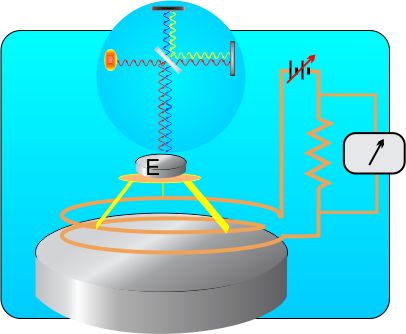
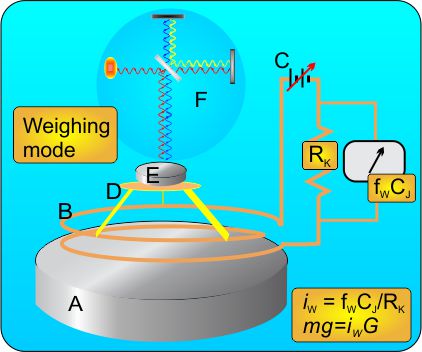
“Oh, no, they need something that’s precisely reproducible anywhere, preferably something that’s count-based.  The new standard will be official soon.  It’s a great physics story.”

~~ Rich Olcott

A Force-to-Force Meeting

The Crazy Theory contest is still going strong in the back room at Al’s coffee shop. I gather from the score board scribbles that Jim’s Mars idea (one mark-up says “2 possible 2 B crazy!“) is way behind Amanda’s “green blood” theory.  There’s some milling about, then a guy next to me says, “I got this, hold my coffee,” and steps up to the mic.  Big fellow, don’t recognize him but some of the Physics students do — “Hey, it’s Cap’n Mike at the mic.  Whatcha got for us this time?”

“I got the absence of a theory, how’s that?  It’s about the Four Forces.”

Someone in the crowd yells out, “Charm, Persuasiveness, Chaos and Bloody-mindedness.”

“Nah, Jennie, that’s Terry Pratchett’s Theory of Historical Narrative.  We’re doing Physics here.  The right answer is Weak and Strong Nuclear Forces, Electromagnetism, and Gravity, with me?  Question is, how do they compare?”

Another voice from the crowd. “Depends on distance!”

“Well yeah, but let’s look at cases.  Weak Nuclear Force first.  It works on the quarks that form massive particles like protons.  It’s a really short-range force because it depends on force-carrier particles that have very short lifetimes.  If a Weak Force carrier leaves its home particle even at the speed of light which they’re way too heavy to do, it can only fly a small fraction of a proton radius before it expires without affecting anything.  So, ineffective anywhere outside a massive particle.”

It’s a raucous crowd.  “How about the Strong Force, Mike?”

.  <chorus of “HOO-wah!”>

“Semper fi that.  OK, the carriers of the Strong Force —”

.  <“Naa-VY!  Naaa-VY!”>

.  <“Hush up, guys, let him finish.”>

“Thanks, Amanda.  The Strong Force carriers have no mass so they fly at lightspeed, but the force itself is short range, falls off rapidly beyond the nuclear radius.  It keeps each trio of quarks inside their own proton or neutron.  And it’s powerful enough to corral positively-charged particles within the nucleus.  That means it’s way stronger inside the nucleus than the Electromagnetic force that pushes positive charges away from each other.”

“How about outside the nucleus?”

“Out there it’s much weaker than Electromagnetism’s photons that go flying about —”

.  <“Air Force!”>

.  <“You guys!”>

“As I was saying…  OK, the Electromagnetic Force is like the nuclear forces because it’s carried by particles and quantum mechanics applies.  But it’s different from the nuclear forces because of its inverse-square distance dependence.  Its range is infinite if you’re willing to wait a while to sense it because light has finite speed.  The really different force is the fourth one, Gravity —”

.  <“Yo Army!  Ground-pounders rock!”>

“I was expecting that.  In some ways Gravity’s like Electromagnetism.  It travels at the same speed and has the same inverse-square distance law.  But at any given distance, Gravity’s a factor of 1038 punier and we’ve never been able to detect a force-carrier for it.  Worse, a century of math work hasn’t been able to forge an acceptable connection between the really good Relativity theory we have for Gravity and the really good Standard Model we have for the other three forces.  So here’s my Crazy Theory Number One — maybe there is no connection.”

.  <sudden dead silence>

“All the theory work I’ve seen — string theory, whatever — assumes that Gravity is somehow subject to quantum-based laws of some sort and our challenge is to tie Gravity’s quanta to the rules that govern the Standard Model.  That’s the way we’d like the Universe to work, but is there any firm evidence that Gravity actually is quantized?”

.  <more silence>

“Right.  So now for my Even Crazier Theories.  Maybe there’s a Fifth Force, also non-quantized, even weaker than Gravity, and not bound by the speed of light.  Something like that could explain entanglement and solve Einstein’s Bubble problem.”

.  <even more silence>

“OK, I’ll get crazier.  Many of us have had what I’ll call spooky experiences that known Physics can’t explain.  Maybe stupid-good gambling luck or ‘just knowing’ when someone died, stuff like that.  Maybe we’re using the Fifth Force in action.”

.  <complete pandemonium>
four forces plus 1

~ Rich Olcott


Note to my readers with connections to the US National Guard, Coast Guard, Merchant Marine and/or Public Health Service — Yeah, I know, but one can only stretch a metaphor so far.

Atoms are solar systems? Um, no…

Suddenly there’s a hubbub of girlish voices to one side of the crowd.  “Go on, Jeremy, get up there.”  “Yeah, Jeremy, your theory’s no crazier than theirs.”  “Do it, Jeremy.”

Sure enough, the kid’s here with some of his groupies.  Don’t know how he does it.  He’s a lot younger than the grad students who generally present at these contests, but he’s got guts and he grabs the mic.

“OK, here’s my Crazy Theory.  The Solar System has eight planets going around the Sun, and an oxygen atom has eight electrons going around the nucleus.  Maybe we’re living in an oxygen atom in some humongous Universe, and maybe there are people living on the electrons in our oxygen atoms or whatever.  Maybe the Galaxy is like some huge molecule.  Think about living on an electron in a uranium atom with 91 other planets in the same solar system and what happens when the nucleus fissions.  Would that be like a nova?”

There’s a hush because no-one knows where to start, then Cathleen’s voice comes from the back of the room.  Of course she’s here — some of the Crazy Theory contest ring-leaders are her Astronomy students.  “Congratulations, Jeremy, you’ve joined the Honorable Legion of Planetary Atom Theorists.  Is there anyone in the room who hasn’t played with the idea at some time?”

No-one raises a hand except a couple of Jeremy’s groupies.

“See, Jeremy, you’re in good company.  But there are a few problems with the idea.  I’ll start off with some astronomical issues and then the physicists can throw in some more.  First, stars going nova collapse, they don’t fission.  Second, compared to the outermost planet in the Solar System, how far is it from the Sun to the nearest star?”

A different groupie raises her hand and a calculator.  “Neptune’s about 4 light-hours from the Sun and Alpha Centauri’s a little over 4 light-years, so that would be … the 4’s cancel, 24 hours times 365 … about 8760 times further away than Neptune.”

“Nicely done.  That’s a typical star-to-star distance within the disk and away from the central bulge.  Now, how far apart are the atoms in a molecule?”

“Aren’t they pretty much touching?  That’s a lot closer than 8760 times the distance.”

“Yes, indeed, Jeremy.  Anyone else with an objection?  Ah, Maria.  Go ahead.”

“Yes, ma’am.  All electrons have exactly the same properties, ¿yes? but different planets, they have different properties.  Jupiter is much, much heavier than Earth or Mercury.”

Astrophysicist-in-training Jim speaks up.  “Different force laws.  Solar systems are held together by gravity but at this level atoms are held together by electromagnetic forces.”

“Carry that a step further, Jim.  What does that say about the geometry?”

“Gravity’s always attractive.  The planets are attracted to the Sun but they’re also attracted to each other.  That’ll tend to pull them all into the same plane and you’ll get a flat disk, mostly.  In an atom, though, the electrons or at least the charge centers repel each other — four starting at the corners of a square would push two out of the plane to form a tetrahedron, and so forth.  That’s leaving aside electron spin.  Anyhow, the electronic charge will be three-dimensional around the nucleus, not planar.  Do you want me to go into what a magnetic field would do?”

“No, I think the point’s been made.  Would someone from the Physics side care to chime in?”

“Synchrotron radiation.”

“Good one.  And you are …?”

“Newt Barnes.  I’m one of Dr Hanneken’s students.”

“Care to explain?”

“Sure.  Assume a hydrogen atom is a little solar system with one electron in orbit around the nucleus.  Any time a charge moves it radiates waves into the electromagnetic field.  The waves carry forces that can compel other charged objects to move.  The distance an object moves, times the force exerted, equals the amount of energy expended by the wave.  Therefore the wave must carry energy and that energy must have come from the electron’s motion.  After a while the electron runs out of kinetic energy and falls into the nucleus.  That doesn’t actually happen, so the atom’s not a solar system.”

Jeremy gets general applause when he waves submission, then the crowd’s chant resumes…

.——<“Amanda! Amanda! Amanda!”>Bohr and Bohr atom

~~ Rich Olcott