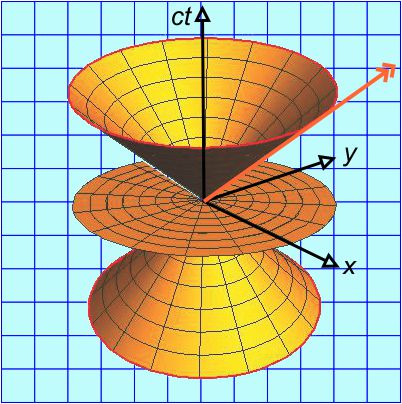
Gravity and other fictitious forces

In this post I wrote, “gravitational force is how we we perceive spatial curvature.”
Here’s another claim — “Gravity is like centrifugal force, because they’re both fictitious.”   Outrageous, right?  I mean, I can feel gravity pulling down on me now.  How can it be fictional?

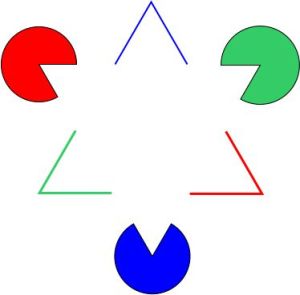
Fictitious triangle
A fictitious triangle

“Fictitious,” not “fictional,” and there’s a difference.  “Fictional” doesn’t exist, but a fictitious force is one that, to put it non-technically, depends on how you look at it.

Newton started it, of course.  From our 21st Century perspective, it’s hard to recognize the ground-breaking impact of his equation F=a.  Actually, it’s less a discovery than a set of definitions.  Its only term that can be measured directly is a, the acceleration, which Newton defined as any change from rest or constant-speed straight-line motion.  For instance, car buffs know that if a vehicle covers a one-mile half-mile (see comments) track in 60 seconds from a standing start, then its final speed is 60 mph (“zero to sixty in sixty”).  Furthermore, we can calculate that it achieved a sustained acceleration of 1.47 ft/sec2.

Both F and m, force and mass, were essentially invented by Newton and they’re defined in terms of each other.  Short of counting atoms (which Newton didn’t know about), the only routes to measuring a mass boil down to

  • compare it to another mass (for instance, in a two-pan balance), or
  • quantify how its motion is influenced by a known amount of force.

Conversely, we evaluate a force by comparing it to a known force or by measuring its effect on a known mass.

Once the F=a. equation was on the table, whenever a physicist noticed an acceleration they were duty-bound to look for the corresponding force.  An arrow leaps from the bow?  Force stored as tension in the bowstring.  A lodestone deflects a compass needle?  Magnetic force.  Objects accelerate as they fall?  Newton identified that force, called it “gravity,” and showed how to calculate it and how to apply it to planets as well as apples.  It was Newton who pointed out that weight is a measure of gravity’s force on a given mass.

Incidentally, to this day the least accurately known physical constant is Newton’s G, the Universal Gravitational Constant in his equation F=G·m1·m2/r2.  We can “weigh” planets with respect to each other and to the Sun, but without an independently-determined accurate mass for some body in the Solar System we can only estimate G.  We’ll have a better value when we can see how much rocket fuel it takes to push an asteroid around.

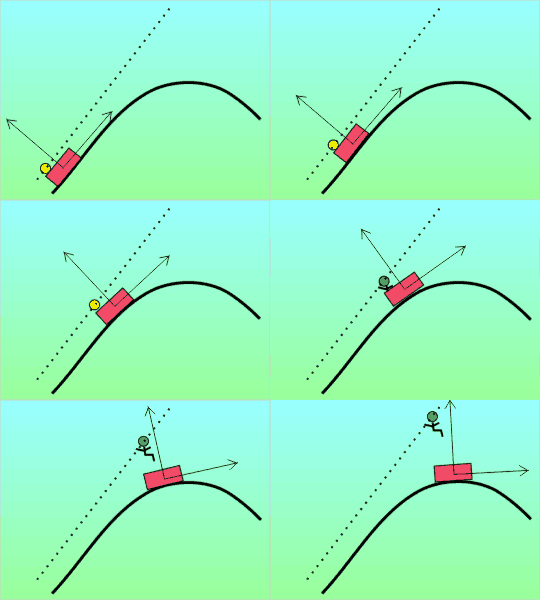
CoasterBut there are other accelerations that aren’t so easily accounted for.  Ever ride in a car going around a curve and find yourself almost flung out of your seat?  This little guy wasn’t wearing his seat belt and look what happened.  The car accelerated because changing direction is an acceleration due to a lateral force.  But the guy followed Newton’s First Law and just kept going in a straight line.  Did he accelerate?
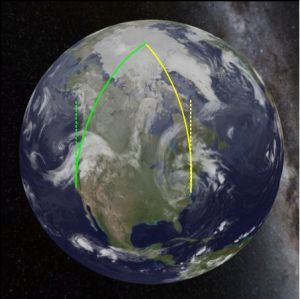
This is one of those “depends on how you look at it” cases.  From a frame of reference locked to the car (arrows), he was accelerated outwards by a centrifugal force that wasn’t countered by centripetal force from his seat belt.  However, from an earthbound frame of reference he flew in a straight line and experienced no force at all.

Side forceSuppose you’re investigating an object’s motion that appears to arise from a new force you’d like to dub “heterofugal.”  If you can find a different frame of reference (one not attached to the object) or otherwise explain the motion without invoking the “new force,” then heterofugalism is a fictitious force.
Centrifugal and centripetal forces are fictitious.  The  “force” “accelerating” one plane towards another as they both fly to the North Pole in this tale is actually geometrical and thus also fictitious   So is gravity.

In this post you’ll find a demonstration of gravity’s effect on the space around it.  Just as a sphere’s meridians give the effect of a fictitious lateral force as they draw together near its poles, the compressive curvature of space near a mass gives the effect of a force drawing other masses inward.

~~ Rich Olcott

What’s that funnel about, really?

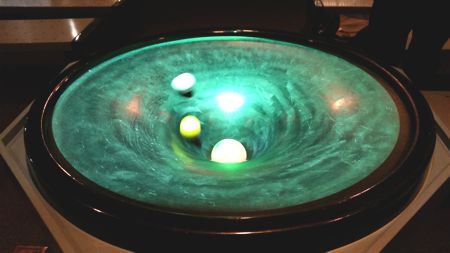
If you’ve ever watched or read a space opera (oh yes, you have), you know about the gravity well that a spacecraft has to climb out of when leaving a planet.  Every time I see the Museum’s gravity well model (photo below), I’m reminded of all the answers the guy gave to, “Johnny, what can you make of this?

The model’s a great visitor-attracter with those “planets” whizzing around the “Sun,” but this one exhibit really represents several distinct concepts.   For some of them it’s not quite the right shape.DMNS gravity well

The simplest concept is geometrical.  “Down” is the direction you move when gravity’s pulling on you.

HS cone
Gravitational potential energy change
for small height differences

A gravity well model for that concept would be just a straight line between you and the neighborhood’s most intense gravity source.

You learned the second concept in high school physics class.  Any object has gravitational potential energy that measures the amount of energy it would give up on falling.  Your teacher probably showed you the equation GPE = m·g·h, where m is the mass of the object, h is its height above ground level, and g is a constant you may have determined in a lab experiment.

If the width of the gravity well model at a given height represents GPE at that level, the model is a simple straight-sided cone.

Newton energy cone
Gravitational potential energy change
for large height differences
The h indicates
an approximately linear range
where the HS equation could apply.

But of course it’s not that simple.  Newton’s Law of Gravity says that the potential energy at any height r away from the planet’s center is proportional to 1/r.

Hmm… that looks different from the “proportional to h” equation.  Which is right?

Both equations are valid, but over different distance scales.  The HS teachers didn’t quite lie to you, but they didn’t give you the complete picture either.  Your classroom was about 4000 miles (21,120,000 feet) from Earth’s center, whereas the usual experiments involve height differences of at most a dozen feet.  Even the 20-foot drop from a second-story window is less than a millionth of the way down to Earth’s center.

Check my numbers:

Height h 1/(r+h)
× 108
Difference in 1/(r+h)
× 1014
0 4.734,848,484 0
20 4.734,844,001 4.48
40 4.734,839,517 8.97
60 4.734,835,033 13.45
80 4.734,830,549 17.93
100 4.734,826,066 22.42

rh lineSure enough, that’s a straight line (see the chart).  Reminds me of how Newton’s Law of Gravity is valid except at very short distances.  The HS Law of Gravity works fine for small spans but when the distances get big we have to use Newton’s equation.

We’re not done yet. That curvy funnel-shaped gravity well model could represent the force of gravity rather than its potential energy.  Newton told us that the force goes as 1/r2 so it decreases much more rapidly than the potential energy does as you get further away.  The gravity force well has a correspondingly sharper curve to it than the gravity energy well.

Newton force cone
The force of gravity
or an embedding diagram

The funnel model could also represent the total energy required to get a real spacecraft off the surface and up into space.  Depending on which sci-fi gimmickry is in play, the energy may come from a chemical or ion rocket, an electromagnetic railgun, or even a tractor beam from some mothership way up there.

No matter the technology, the theoretical energy requirement to get to a given height is the same.  In practice, however, each technology is optimal for some situations but forbiddingly inefficient in others.  Thus, each technology’s funnel  has its own shape and that shape will change depending on the setting.

In modern physics, the funnel model could also represent Einstein’s theory of how a mass “bends” the space around it.  (Take a look at this post, which is about how mass curves space by changing the local distance scale.)  Cosmologists describe the resulting “shapes” with embedding diagrams that are essentially 2D pictures of 3D (or 4D) contour plots.  The contours are closest together where space is most compressed, just as lines showing a steep hillside on a landscape contour map are close together.

The ED around a non-spinning object looks just like the force model picture above.  No surprise — gravitational force is how we we perceive spatial curvature.

~~ Rich Olcott

Throwing a Summertime curve

All cats are gray in the dark, and all lines are straight in one-dimensional space.  Sure, you can look at a garden hose and see curves (and kinks, dammit), but a short-sighted snail crawling along on it knows only forward and backward.  Without some 2D notion of sideways, the poor thing has no way to sense or cope with curvature.

Up here in 3D-land we can readily see the hose’s curved path through all three dimensions.  We can also see that the snail’s shell has two distinct curvatures in 3D-space — the tube has an oval cross-section and also spirals perpendicular to that.

But Einstein said that our 3D-space itself can have curvature.  Does mass somehow bend space through some extra dimension?  Can a gravity well be a funnel to … somewhere else?

No and no.  Mathematicians have come up with a dozen technically different kinds of curvature to fit different situations.  Most have to do with extrinsic non-straightness, apparent only from a higher dimension.  That’s us looking at the hose in 3D.

Einstein’s work centered on intrinsic curvature, dependent only upon properties that can be measured within an object’s “natural” set of dimensions.Torus curvature

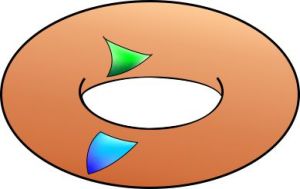
On a surface, for instance, you could draw a triangle using three straight lines.  If the figure’s interior angles sum up to exactly 180°, you’ve got a flat plane, zero intrinsic curvature.  On a sphere (“straight line” = “arc from a great circle”) or the outside rim of a doughnut, the sum is greater than 180° and the curvature is positive.
Circle curvatures
If there’s zero curvature and positive curvature, there’s gotta be negative curvature, right?  Right — you’ll get less-than-180° triangles on a Pringles chip or on the inside rim of a doughnut.

Some surfaces don’t have intersecting straight lines, but you can still classify their curvature by using a different criterion.  Visualize our snail gliding along the biggest “circle” he/she/it (with snails it’s complicated) can get to while tethered by a thread pinned to a point on the surface. Divide the circle’s circumference by the length of the thread.  If the ratio’s equal to 2π then the snail’s on flat ground.  If the ratio is bigger than ,  the critter’s on a saddle surface (negative curvature). If it’s smaller, then he/she/it has found positive curvature.

In a sense, we’re comparing the length of a periphery and a measure of what’s inside it.  That’s the sense in which Einsteinian space is curved — there are regions in which the area inside a circle (or the volume inside a sphere) is greater than or less than what would be expected from the size of its boundary.

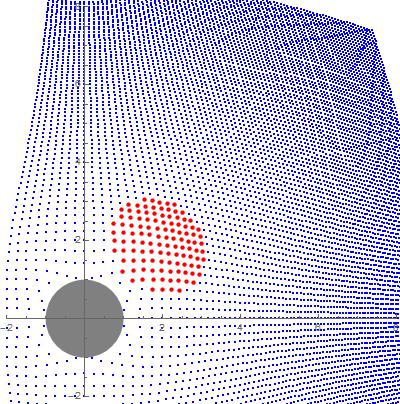
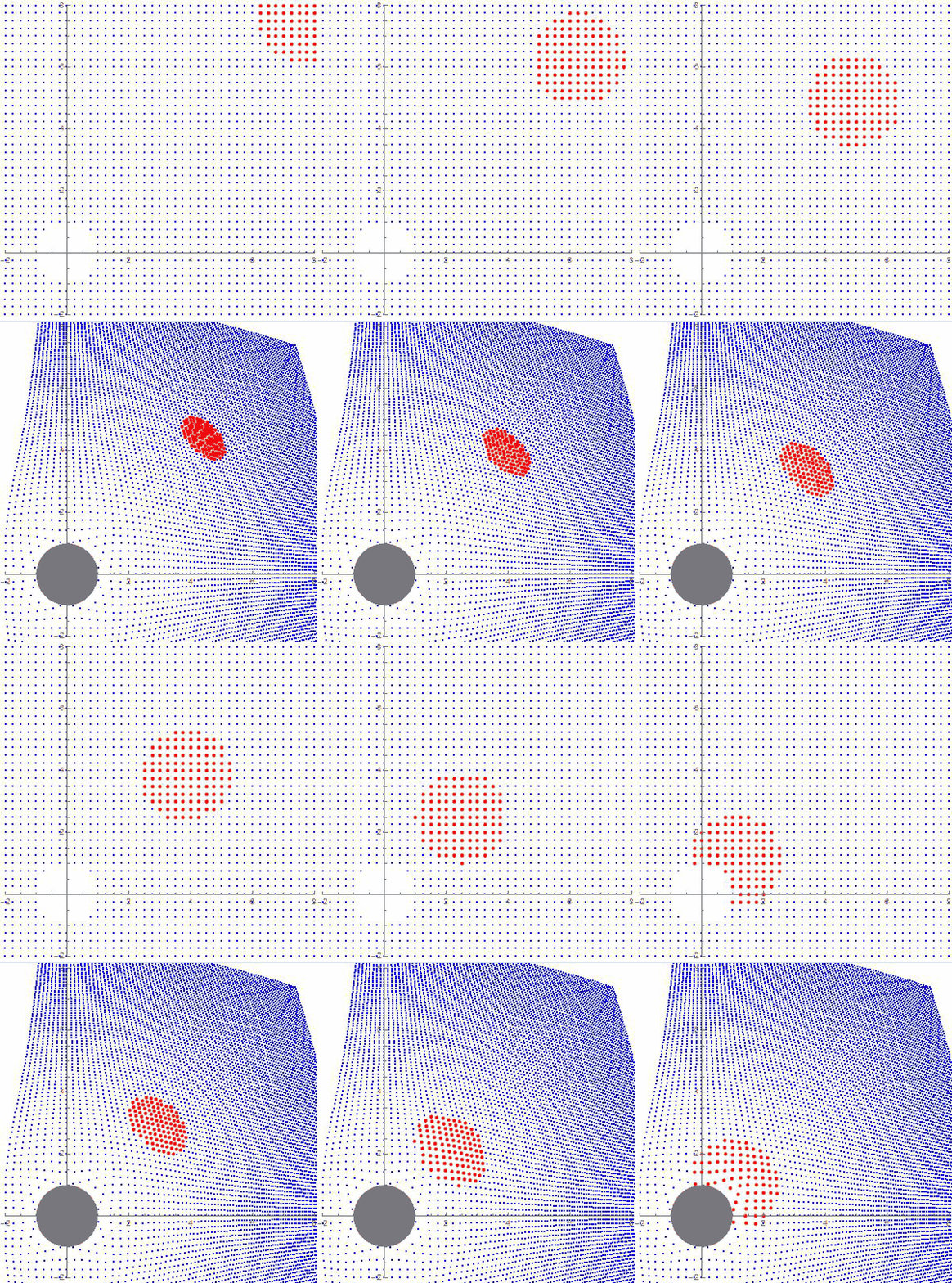
Here’s an example.  The upper panel’s dotted grid represents a simple flat space being traversed by a “disk.”  See how the disk’s location has no effect on its size or shape.  As a result, dividing its circumference by its radius always gives you 2π.Curvature 3

In the bottom panel I’ve transformed* the picture to represent space in the neighborhood of a black hole (the gray circle is its Event Horizon) as seen from a distance.  Close-up, every row of dots would appear straight.  However, from afar the disk’s apparent size and shape depend on where it is relative to the BH.

By the way, the disk is NOT “falling” into the BH.  This is about the shape of space itself — there’s no gravitational attraction or distortion by tidal spaghettification.

Visually, the disk appears to ooze down one of those famous 3D parabolic funnels.  But it doesn’t — all of this activity takes place within the BH’s equatorial plane, a completely 2D place.  The equations generate that visual effect by distorting space and changing the local distance scale near our massive object.  This particular distortion generates positive curvature — at 90% through the video, the disk’s C/r ratio is about 2% less than 2π.

As I tell Museum visitors, “miles are shorter near a black hole.”

~~ Rich Olcott

* – If you’re interested, here are the technical details.  A Schwarzchild BH, distances as multiples of the EH radius.  The disk (diameter 2.0) is depicted at successive time-free points in the BH equatorial plane.  The calculation uses Flamm’s paraboloid to convert each grid point’s local (r,φ) coordinates to (w,φ) to represent the spatial configuration as seen from r>>w.

Reflections in Einstein’s bubble

There’s something peculiar in this earlier post where I embroidered on Einstein’s gambit in his epic battle with Bohr.  Here, I’ll self-plagiarize it for you…

Consider some nebula a million light-years away.  A million years ago an electron wobbled in the nebular cloud, generating a spherical electromagnetic wave that expanded at light-speed throughout the Universe.

Last night you got a glimpse of the nebula when that lightwave encountered a retinal cell in your eye.  Instantly, all of the wave’s energy, acting as a photon, energized a single electron in your retina.  That particular lightwave ceased to be active elsewhere in your eye or anywhere else on that million-light-year spherical shell.

Suppose that photon was yellow light, smack in the middle of the optical spectrum.  Its wavelength, about 580nm, says that the single far-away electron gave its spherical wave about 2.1eV (3.4×10⁻¹⁹ joules) of energy.  By the time it hit your eye that energy was spread over an area of a trillion square lightyears.  Your retinal cell’s cross-section is about 3 square micrometers so the cell can intercept only a teeny fraction of the wavefront.  Multiplying the wave’s energy by that fraction, I calculated that the cell should be able to collect only 10-75 joules.  You’d get that amount of energy from a 100W yellow light bulb that flashed for 10-73 seconds.  Like you’d notice.

But that microminiscule blink isn’t what you saw.  You saw one full photon-worth of yellow light, all 2.1eV of it, with no dilution by expansion.  Water waves sure don’t work that way, thank Heavens, or we’d be tsunami’d several times a day by earthquakes occurring near some ocean somewhere.

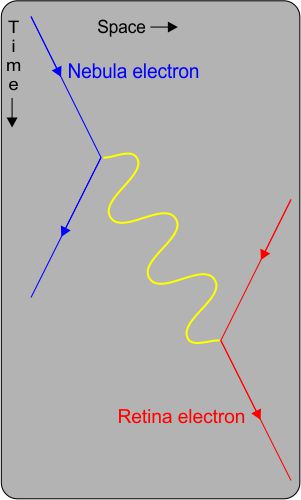
Feynman diagramHere we have a Feynman diagram, named for the Nobel-winning (1965) physicist who invented it and much else.  The diagram plots out the transaction we just discussed.  Not a conventional x-y plot, it shows Space, Time and particles.  To the left, that far-away electron emits a photon signified by the yellow wiggly line.  The photon has momentum so the electron must recoil away from it.

The photon proceeds on its million-lightyear journey across the diagram.  When it encounters that electron in your eye, the photon is immediately and completely converted to electron energy and momentum.

Here’s the thing.  This megayear Feynman diagram and the numbers behind it are identical to what you’d draw for the same kind of yellow-light electron-photon-electron interaction but across just a one-millimeter gap.

It’s an essential part of the quantum formalism — the amount of energy in a given transition is independent of the mechanical details (what the electrons were doing when the photon was emitted/absorbed, the photon’s route and trip time, which other atoms are in either neighborhood, etc.).  All that matters is the system’s starting and ending states.  (In fact, some complicated but legitimate Feynman diagrams let intermediate particles travel faster than lightspeed if they disappear before the process completes.  Hint.)

Because they don’t share a common history our nebular and retinal electrons are not entangled by the usual definition.  Nonetheless, like entanglement this transaction has Action-At-A-Distance stickers all over it.  First, and this was Einstein’s objection, the entire wave function disappears from everywhere in the Universe the instant its energy is delivered to a specific location.  Second, the Feynman calculation describes a time-independent, distance-independent connection between two permanently isolated particles.  Kinda romantic, maybe, but it’d be a boring movie plot.

As Einstein maintained, quantum mechanics is inherently non-local.  In QM change at one location is instantaneously reflected in change elsewhere as if two remote thingies are parts of one thingy whose left hand always knows what its right hand is doing.

Bohr didn’t care but Einstein did because relativity theory is based on geometry which is all about location. In relativity, change here can influence what happens there only by way of light or gravitational waves that travel at lightspeed.

In his book Spooky Action At A Distance, George Musser describes several non-quantum examples of non-locality.  In each case, there’s no signal transmission but somehow there’s a remote status change anyway.  We don’t (yet) know a good mechanism for making that happen.

It all suggests two speed limits, one for light and matter and the other for Einstein’s “deeper reality” beneath quantum mechanics.

~~ Rich Olcott

Gargh, His Heirs, and the AAAD Problem

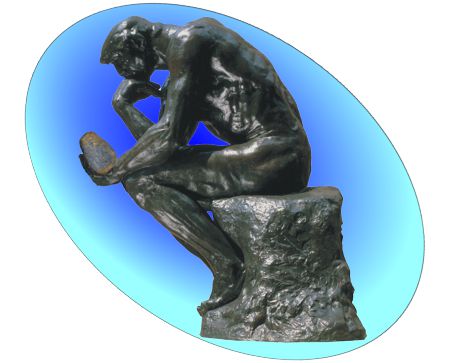
Gargh the thinkerGargh, proto-humanity’s foremost physicist 2.5 million years ago, opened a practical investigation into how motion works.  “I throw rock, hit food beast, beast fall down yes.  Beast stay down no.  Need better rock.”  For the next couple million years, we put quite a lot of effort into making better rocks and better ways to throw them.  Less effort went into understanding throwing.
There seemed to be two kinds of motion.  The easier kind to understand was direct contact — “I push rock, rock move yes.  Rock stop move when rock hit thing that move no.”  The harder kind was when there wasn’t direct contact — “I throw rock up, rock hit thing no but come back down.  Why that?

Gargh was the first but hardly the last physicist to puzzle over the Action-At-A-Distance problem (a.k.a. “AAAD”).  Intuition tells us that between pusher and pushee there must be a concrete linkage to convey the push-force.  To some extent, the history of physics can be read as a succession of solutions to the question, “What linkage induces this apparent case of AAAD?”

Most of humanity was perfectly content with AAAD in the form of magic of various sorts.  To make something happen you had to wish really hard and/or depend on the good will of some (generally capricious) elemental being.

aristotle 1Aristotle wasn’t satisfied with anything so unsystematic.  He was just full of theories, many of which got in each other’s way.  One theory was that things want to go where they’re comfortable  because of what they’re made of — stones, for instance, are made of earth so naturally they try to get back home and that’s why we see them fall downwards (no concrete linkage, so it’s still AAAD).
Unfortunately, that theory didn’t account for why a thrown rock doesn’t just fall straight down but instead goes mostly in the direction it’s thrown.  Aristotle (or one of his followers) tied that back to one of his other theories, “Nature hates a vacuum.”  As the rock flies along, it pushes the air aside (direct contact) and leaves a vacuum behind it. More air rushes in to fill the vacuum and pushes the rock ahead (more direct contact).

We got a better (though still AAAD) explanation in the 17th Century when physicists invented the notions of gravity and inertia.Newton 204

Newton made a ground-breaking claim in his Principia.  He proposed that the Solar System is held together by a mysterious AAAD force he called gravity.  When critics asked how gravity worked he shrugged, “I do not form hypotheses” (though he did form hypotheses for light and other phenomena).

Inertia is also AAAD.  Those 17th Century savants showed that inertial forces push mass towards the Equator of a rotating object.  An object that’s completely independent of the rest of the Universe has no way to “know” that it’s rotating so it ought to be a perfect sphere.  In fact, the Sun and each of its planets are wider at the equator than you’d expect from their polar diameters.  That non-sphere-ness says they must have some AAAD interaction with the rest of the Universe.  A similar argument applies to linear motion; the general case is called Mach’s Principle.
JCMaxwell

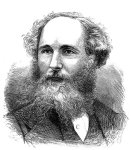
The ancients knew of the mysterious AAAD agents electricity and its fraternal twin, magnetism.  However, in the 19th Century James Clerk Maxwell devised a work-around.  Just as Newton “invented” gravity, Maxwell “invented” the electromagnetic field.  This invisible field isn’t a material object.  However, waves in the field transmit electromagnetic forces everywhere in the Universe.  Not AAAD, sort of.

It wasn’t long before someone said, “Hey, we can calculate gravity that way, too.”  That’s why we now speak of a planet’s gravitational field and gravitational waves.

But the fields still felt like AAAD because they’re not concrete.  Some modern physicists stand that objection on its head.  Concrete objects, they say, are made of atoms which themselves are nothing more than persistent fluctuations in the electromagnetic and gravitational fields.  By that logic, the fields are what’s fundamental — all motion is by direct contact.einstein-tongue edged

Einstein moved resolutely in both directions.  He negated gravity’s AAAD-ness by identifying mass-contorted space as the missing linkage.  On the other hand, he “invented” quantum entanglement, the ultimate spooky AAAD.

 ~~ Rich Olcott

Is there stuff behind the stats?

dragon plate 3It would have been awesome to watch Dragon Princes in battle (from a safe hiding place), but I’d almost rather have witnessed “The Tussles in Brussels,” the two most prominent confrontations between Albert Einstein and Niels Bohr.
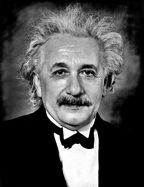
The Tussles would be the Fifth (1927) and Seventh (1933) Solvay Conferences.  Each conference was to center on a particular Quantum Mechanics application (“Electrons and Photons” and “The Atomic Nucleus,” respectively).  However, the Einstein-Bohr discussions went right to the fundamentals — exactly what does a QM calculation tell us?

Einstein’s strength was in his physical intuition.  By all accounts he was a good mathematician but not a great one.  However, he was very good indeed at identifying important problems and guiding excellent mathematicians as he and they attacked those problems together.

Einstein 187Like Newton, Einstein was a particle guy.  He based his famous thought experiments on what his intuition told him about how particles would behave in a given situation.  That intuition and that orientation led him to paradoxes such as entanglement, the EPR Paradox, and the instantaneously collapsing spherical lightwave we discussed earlier.  Einstein was convinced that the particles QM workers think about (photons, electrons, etc.) must in fact be manifestations of some deeper, more fine-grained reality.

bohr 187Bohr was six years younger than Einstein.  Both Bohr and Einstein had attained Directorship of an Institute at age 35, but Bohr’s has his name on it.  He started out as a particle guy — his first splash was a trio of papers that treated the hydrogen atom like a one-planet solar system.  But that model ran into serious difficulties for many-electron atoms so Bohr switched his allegiance from particles to Schrödinger’s wave theory.  Solve a Schrödinger equation and you can calculate statistics like average value and estimated spread around the average for a given property (position, momentum, spin, etc).

wittgenstein 187Here’s where Ludwig Wittgenstein may have come into the picture.  Wittgenstein is famous for his telegraphically opaque writing style and for the fact that he spent much of his later life disagreeing with his earlier writings.  His 1921 book, Tractatus Logico-Philosophicus (in German despite the Latin title) was a primary impetus to the Logical Positivist school of philosophy.  I’m stripping out much detail here, but the book’s long-lasting impact on QM may have come from its Proposition 7: Whereof one cannot speak, thereof one must be silent.

I suspect that Bohr was deeply influenced by the LP movement, which was all the rage in the mid-1920s while he was developing the Copenhagen Interpretation of QM.

An enormous literature, including quite a lot of twaddle, has grown up around the question, “Once you’ve derived the Schrödinger wave function for a given system, how do you interpret what you have?”  Bohr’s Copenhagen Interpretation was that the function can only describe relative probabilities for the results of a measurement.  It might tell you, for instance, that there’s a 50% chance that a particle will show up between here and here but only a 5% chance of finding it beyond there.

Following Logical Positivism all the way to the bank, Bohr denounced as nonsensical or even dangerously misleading any attachment of further meaning to a QM result.  He went so far as to deny the very existence of a particle prior to a measurement that detects it.  That’s serious Proposition 7 there.

I’ve read several accounts of the Solvay Conference debates between Einstein and Bohr.  All of them agree that the conversation was inconclusive but decisive.  Einstein steadfastly maintained that QM could not be a complete description of reality whilst Bohr refused to even consider anything other than inscrutable randomness beneath the statistics.  The audience consensus went to Bohr.

None of the accounts, even the very complete one that I found in George Musser’s book Spooky Action at A Distance, provide a satisfactory explanation for why Bohr’s interpretation dominates today.  Einstein described multiple situations where QM’s logic appeared to contradict itself or firmly established experimental results.  However, at each challenge Bohr deflected the argument from Einstein’s central point to argue a subsidiary issue such as whether Einstein was denying the Heisenberg Uncertainty Principle.

Albert still stood at the end of the bouts, but Niels got the spectators’ decision on points.  Did the ref make the difference?

~~ Rich Olcott

Gin And The Art of Quantum Mechanics

“Fancy a card game, Johnny?”
“Sure, Jennie, deal me in.  Wot’re we playin’?”
“Gin rummy sound good?”


Great idea, and it fits right in with our current Entanglement theme.  The aspect of Entanglement that so bothered Einstein, “spooky action at a distance,” can be just as spooky close-up.  Check out this magic example — go ahead, it’s a fun trick to figure out.

Spooky, hey?  And it all has to do with cards being two-dimensional.  I know, as objects they’ve got three dimensions same as anyone (four, if you count time), but functionally they have only two dimensions — rank and suit.gin rummy hand

When you’re looking at a gin rummy hand you need to consider each dimension separately.  The queens in this hand form a set — three cards of the same rank.  So do the three nines.  In the suit dimension, the 4-5-6-7 run is a sequence of ranks all in the same suit.Gin rummy chart

A physicist might say that evaluating a gin rummy hand is a separable problem, because you can consider each dimension on its own. <Hmm … three queens, that’s a set, and three nines, another set.  The rest are hearts.  Hey, the hearts are in sequence, woo-hoo!> 

“Gin!”

If you chart the hand, the run and sets and their separated dimensions show up clearly even if you don’t know cards.

A standard strategy for working a complex physics problem is to look for a way to split one kind of motion out from what else is going on.  If the whole shebang is moving in the z-direction, you can address  the z-positions, z-velocities and z-forces as an isolated sub-problem and treat the x and y stuff separately.  Then, if everything is rotating in the xy plane you may be able to separate the angular motion from the in-and-out (radial) motion.

But sometimes things don’t break out so readily.  One nasty example would be several massive stars flying toward each other at odd angles as they all dive into a black hole.  Each of the stars is moving in the black hole’s weirdly twisted space, but it’s also tugged at by every other star.  An astrophysicist would call the problem non-separable and probably try simulating it in a computer instead of setting up a series of ugly calculus problems.Trick chart

The card trick video uses a little sleight-of-eye to fake a non-separable situation.  Here’s the chart, with green dots for the original set of cards and purple dots for the final hand after “I’ve removed the card you thought of.”  The kings are different, and so are the queens and jacks.  As you see, the reason the trick works is that the performer removed all the cards from the original hand.

The goal of the illusion is to confuse you by muddling ranks with suits.  What had been a king of diamonds in the first position became a king of spades, whereas the other king became a queen.  You were left with an entangled perception of each card’s two dimensions.

In quantum mechanics that kind of entanglement crops up any time you’ve got two particles with a common history.  It’s built into the math — the two particles evolve together and the model gives you no way to tell which is which.

Suppose for instance that an electron pair has zero net spin  (spin direction is a dimension in QM like suit is a dimension in cards).  If the electron going to the left is spinning clockwise, the other one must be spinning counterclockwise.  Or the clockwise one may be the one going to the right — we just can’t tell from the math which is which until we test one of them.  The single test settles the matter for both.

Einstein didn’t like that ambiguity.  His intuition told him that QM’s statistics only summarize deeper happenings.  Bohr opposed that idea, holding that QM tells us all we can know about a system and that it’s nonsense to even speak of properties that cannot be measured.  Einstein called the deeper phenomena “elements of reality” though they’re currently referred to as “hidden variables.”  Bohr won the battle but maybe not the war — Einstein had such good intuition.

~~ Rich Olcott

Oh, what an entangled wave we weave

“Here’s the poly bag wiff our meals, Johnny.  ‘S got two boxes innit, but no labels which is which.”
“I ordered the mutton pasty, Jennie, anna fish’n’chips for you.”
“You c’n have this box, Johnny.  I’ll take the other one t’ my place to watch telly.”

<ring>
” ‘Ullo, Jennie?  This is Johnny.  The box over ‘ere ‘as the fish.  You’ve got mine!”


In a sense their supper order arrived in an entangled state.  Our friends knew what was in both boxes together, but they didn’t know what was in either box separately.  Kind of a Schrödinger’s Cat situation — they had to treat each box as 50% baked pasty and 50% fried codfish.

But as soon as Johnny opened one box, he knew what was in the other one even though it was somewhere else.  Jennie could have been in the next room or the next town or the next planet — Johnnie would have known, instantly, which box had his meal no matter how far away that other box was.

By the way, Jennie was free to open her box on the way home but that’d make no difference to Johnnie — the box at his place would have stayed a mystery to him until either he opened it or he talked to her.

Entangled 2Information transfer at infinite speed?  Of course not, because neither hungry person knows what’s in either box until they open one or until they exchange information.  Even Skype operates at light-speed (or slower).

But that’s not quite quantum entanglement, because there’s definite content (meat pie or batter-fried cod) in each box.  In the quantum world, neither box holds something definite until at least one box is opened.  At that point, ambiguity flees from both boxes in an act of global correlation.

There’s strong experimental evidence that entangled particles literally don’t know which way is up until one of them is observed.  The paired particle instantaneously gets that message no matter how far away it is.

Niels Bohr’s Principle of Complementarity is involved here.  He held that because it’s impossible to measure both wave and particle properties at the same time, a quantized entity acts as a wave globally and only becomes local when it stops somewhere.

Here’s how extreme the wave/particle global/local thing can get.  Consider some nebula a million light-years away.  A million years ago an electron wobbled in the nebular cloud, generating a spherical electromagnetic wave that expanded at light-speed throughout the Universe.

cats-eye nebula
The Cat’s Eye Nebula (NGC 6543)
courtesy of NASA’s Hubble Space Telescope

Last night you got a glimpse of the nebula when that lightwave encountered a retinal cell in your eye.  Instantly, all of the wave’s energy, acting as a photon, energized a single electron in your retina.  That particular lightwave ceased to be active elsewhere in your eye or anywhere else on that million-light-year spherical shell.

Surely there was at least one other being, on Earth or somewhere else, that was looking towards the nebula when that wave passed by.  They wouldn’t have seen your photon nor could you have seen any of theirs.  Somehow your wave’s entire spherical shell, all 1012 square lightyears of it, instantaneously “knew” that your eye’s electron had extracted the wave’s energy.

But that directly contradicts a bedrock of Einstein’s Special Theory of Relativity.  His fundamental assumption was that nothing (energy, matter or information) can go faster than the speed of light in vacuum.  STR says it’s impossible for two distant points on that spherical wave to communicate in the way that quantum theory demands they must.

Want some irony?  Back in 1906, Einstein himself “invented” the photon in one of his four “Annus mirabilis” papers.  (The word “photon” didn’t come into use for another decade, but Einstein demonstrated the need for it.)  Building on Planck’s work, Einstein showed that light must be emitted and absorbed as quantized packets of energy.

It must have taken a lot of courage to write that paper, because Maxwell’s wave theory of light had been firmly established for forty years prior and there’s a lot of evidence for it.  Bottom line, though, is that Einstein is responsible for both sides of the wave/particle global/local puzzle that has bedeviled Physics for a century.

~~ Rich Olcott

Think globally, act locally. Electrons do.

“Watcha, Johnnie, you sure ‘at particle’s inna box?”
“O’course ’tis, Jennie!  Why wouldn’t it be?”
“Me Mam sez particles can tunnel outta boxes ’cause they’re waves.”

“Can’t be both, Jessie.”


Double slit experiment
The double-slit experiment.
An electron beam travels from the source at left to a display screen. In between there’s a barrier with two narrow slits.

Maybe it can.

Nobel-winning (1965) physicist Richard Feynman said the double-slit experiment (diagrammed here) embodies the “central mystery” of Quantum Mechanics.

When the bottom slit is covered the display screen shows just what you’d expect — a bright area  opposite the top slit.

When both slits are open, the screen shows a banded pattern you see with waves.  Where a peak in a top-slit wave meets a peak in the bottom-slit wave, the screen shines brightly.  Where a peak meets a trough the two waves cancel and the screen is dark.  Overall there’s a series of stripes.  So electrons are waves, right?

But wait.  If we throttle the beam current way down, the display shows individual speckles where each electron hits.  So the electrons are particles, right?

Now for the spooky part.  If both slits are open to a throttled beam those singleton speckles don’t cluster behind the slits as you’d expect particles to do.  A speckle may appear anywhere on the screen, even in an apparently blocked-off region.  What’s more, when you send out many electrons one-by-one their individual hits cluster exactly where the bright stripes were when the beam was running full-on.

It’s as though each electron becomes a wave that goes through both slits, interferes with itself, and then goes back to being a particle!

By the way, this experiment isn’t a freak observation.  It’s been repeated with the same results many times, not just with electrons but also with light (photons), atoms, and even massive molecules like buckyballs (fullerene spheres that contain 60 carbon atoms).  In each case, the results indicate that the whatevers have a dual character — as a localized particle AND as a wave that reacts to the global environment.

Physicists have been arguing the “Which is it?” question ever since Louis-Victor-Pierre-Raymond, the 7th Duc de Broglie, raised it in his 1924 PhD Thesis (for which he received a Nobel Prize in 1929 — not bad for a beginner).  He showed that any moving “particle” comes along with a “wave” whose peak-to-peak wavelength is inversely proportional to the particle’s mass times its velocity.  The longer the wavelength, the less well you know where the thing is.

I just had to put numbers to de Broglie’s equation.  With Newton in mind, I measured one of the apples in my kitchen.  To scale everything, I assumed each object moved by one of its diameters per second.  (OK, I cheated for the electron — modern physics says it’s just a point, so I used a not-really-valid classical calculation to get something to work with.)

“Particle” Mass, kilograms Diameter, meters Wavelength, meters Wavelength, diameters
Apple 0.2 0.07 7.1×10⁻³³ 1.0×10⁻³¹
Buckyball 1.2×10⁻²⁴ 1.0×10⁻⁹ 0.083 8.3×10+7
Hydrogen atom 1.7×10⁻²⁷ 1.0×10⁻¹⁰ 600 6.0×10+12
Electron 9.1×10⁻³¹ 3.0×10⁻¹⁷ 3.7×10+12 1.2×10+29

That apple has a wave far smaller than any of its hydrogen atoms so I’ll have no trouble grabbing it for a bite.  Anything tinier than a small virus is spread way out unless it’s moving pretty fast, as in a beam apparatus.  For instance, an electron going at 1% of light-speed has a wavelength only a nanometer wide.

Different physicists have taken different positions on the “particle or wave?” question.  Duc de Broglie claimed that both exist — particles are real and they travel where their waves tell them to.  Bohr and Heisenberg went the opposite route, saying that the wave’s not real, it’s only a mathematical device for calculating relative probabilities for measuring this or that value.  Furthermore, the particle doesn’t exist as such until a measurement determines its location or momentum.  Einstein and Schrödinger liked particles.  Feynman and Dirac just threw up their hands and calculated.

Which brings us to the other kind of quantum spookiness — “entanglement.”  In fact, Einstein actually used the word spukhafte (German for “spooky”) in a discussion of the notion.  He really didn’t like it and for good reason — entanglement rudely collides with his own Theory of Relativity.  But that’s another story.

~~ Rich Olcott

Location, Location, Location

“Hoy, Johnny, still got that particle inna box?”
“Sure do, Jessie.”
“So where’s hit in there?”
“Me Pap says hit’s spread-out like but hit’s mostly inna middle.”
“Why’s hit spread then?”
“The more I taps the box, the wider hit spreads. Sommat to do wiff energy.”


PIB0
Newton would have answered Jessie’s question by saying, sort of, “Pick a point anywhere in the box.  The probability that the particle is at that point is equal to the probability that it’s at any other point.” PIB stack

Quantum physicists take a different approach. They start by saying, “We know there’s zero probability that the particle is anywhere outside of the box, so there must be zero probability that it’s exactly at any wall.”

Now for a trick that we’re actually quite used to.  When you listen to an orchestra, you can usually pick out the notes being played by a particular instrument.  Someone blessed/cursed with perfect pitch can tell when a note is just a leetle bit flat, say an A being played at 438 cycles instead of 440. You can create any sound by mixing together the right frequencies in the right proportion. That’s how an MP3 recorder does it.

QM solutions use that strategy the other way round. They calculate probabilities by adding together sets of symmetric elementary shapes, all of which are zero at certain places, like the box walls. For instance, on average Johnnie’s particle will be near the middle of his box, so we start a set with an orange mound of probability right there. That mound is like our base frequency — it has no nodes, no non-wall places where the probability is zero.

Then we add a first overtone, the one-node yellow shape that represents equal probability on either side of a plane of zero probability.

Two nodal planes at right angles give us the four-peaked green shape. Further steps up have more and more nodal planes (cyan then blue, and so on). The video shows the running total up to 46 nodes.

.PIB sum
As we add more nodes, the cumulative shape gets smoother and broader.  After a huge number of steps, the sum will look pretty much like Newton’s (except for right at the walls, of course).

So if the classical and QM boxes wind up looking the same, why go to all that trouble?  Because those nodes don’t come for free.

Inverse tennisSuppose you’re playing goalie in an inverse tennis game.  There’s a player in each service box.  Your job is to run the net line using your rackets to prevent either player from getting a ball into the opposing half-court.  Basically, you want the ball’s locations to look like the single-node yellow shape up above.  You’ll have to work hard to do that.

Now suppose they give you a second, crosswise net (the green shape).  You’re going to have to work twice as hard.  Now add a third net, and so on … each additional nodal plane is going to be harder (cost more energy) to keep empty.  Not a problem if you have an infinite amount of energy.

Enter Planck and Einstein.  They showed there’s a limit for small systems like atoms and molecules.  Electrons dash about in atom- or molecule-shaped boxes, but the principle is the same.  The total probability distribution is still the sum of bounded elementary shapes.  However, you can’t use an infinite number of them.  Rather, you start with the cheapest shapes (the fewest nodes) and build upward.

Tally two electrons for each shape you use.  Why two?  Because that’s the rule, no arguments.

It’s important to realize that QM does NOT say that two specific electrons occupy one shape.  All the charge is spread out over all the shapes — we’re just keeping count.

When you run out of electrons the accumulated model shows everything we can know about the electronic configuration.  You won’t know where any particular electron is, but you’ll know where some electron spends some time.  For a chemist that’s the important thing — the peaks and nodes, the centers of negative and positive charge, are the most likely regions for chemical reactions to happen.

Johnnie’s energetic taps make his particle boldly go where no particle has gone before.

~~ Rich Olcott