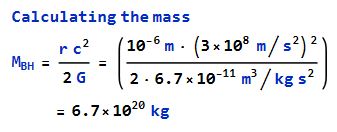
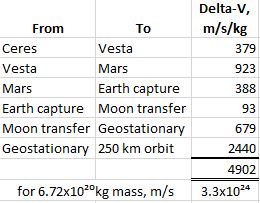
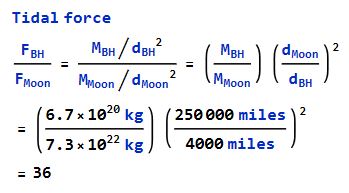
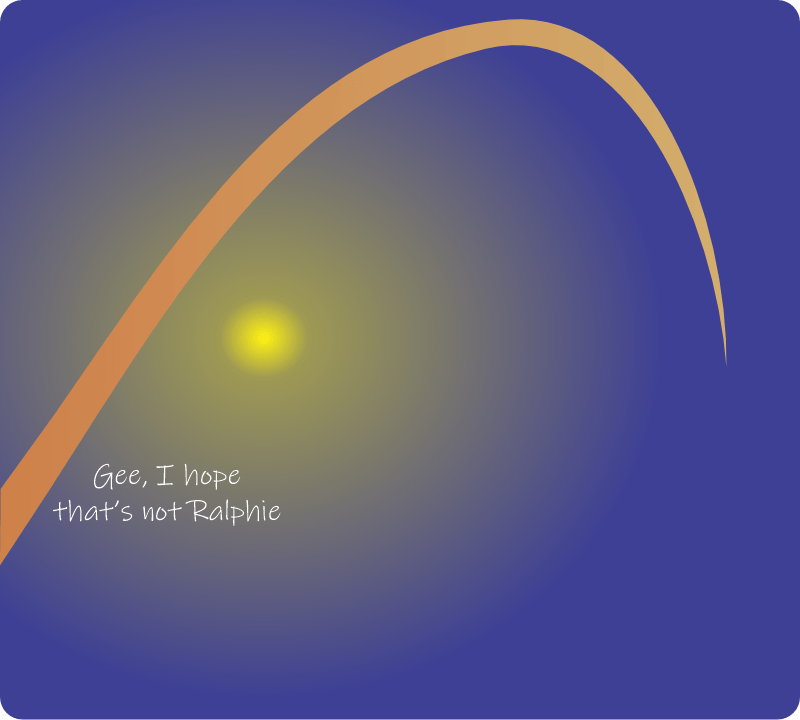
The Situation of The Gravity

<bomPAH-dadadadaDEEdah> It’s been a while since Old Reliable blared that unregistered ringtone. Sure enough, the phone function’s caller‑ID display says 710‑555‑1701.  “Commander Baird, I presume? Long time no hear.”

<downcast tone with a hint of desperation> “It’s Lieutenant now.”

“Sorry to hear that. What happened?”

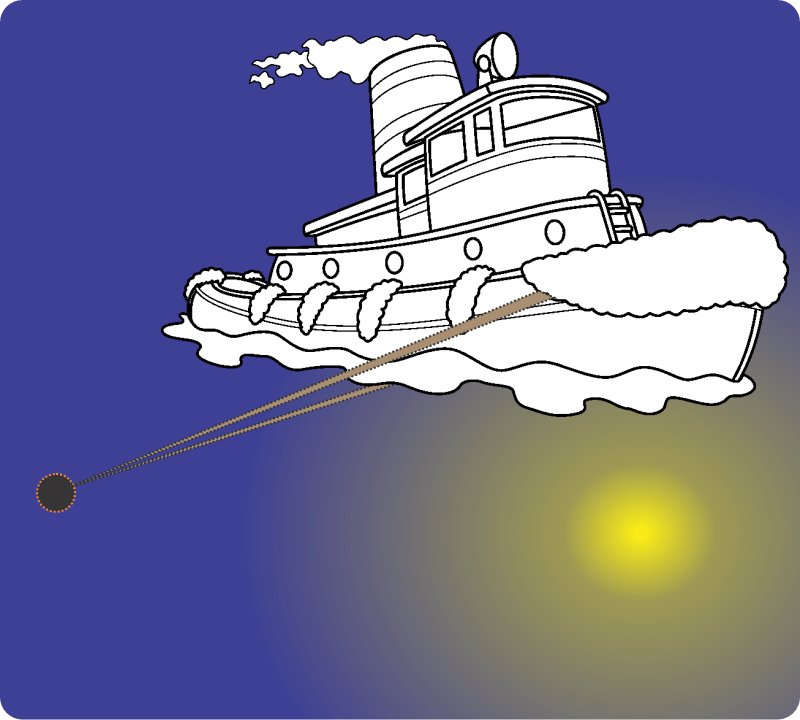
Project Lonesome was a bust. It took us years to assemble those two planetoids but getting them into the right orbits around the black hole was more of a challenge than we planned for. Planetoid Pine got away from us and fell down through the Event Horizon. One big blast of inforon radiation and no more project. We lost a few robot space tugs but all carbon‑based personnel survived. Medical Bay just now pronounced me healthy — it’s amazing what they can do about pervasive sub‑cellular damage these days. The Board of Inquiry decided no‑one was at fault but they down‑ranked me because I was primary advocate for a jinxed project.”

“Well, those 15-minute orbits were a gamble all along. So why this phone call?”

“You know how it is, sitting in Med Bay with nothing much to do. I was poking around and happened to read a few of the files you’re working on—”

“Which ones?”

“The Projects directory.”

“But those are client files I’ve encrypted with the latest technology.”

“Oh, please, Mr Moire, I am calling from the 24th Century. Upton’s algorithm for zeta‑function decryption is ancient history. Don’t worry, your client’s secrets are safe, although one of your clients may not be.”

“Whoa, say what? Which one? What kind of danger? They all seem healthy, look both ways before crossing the street, that sort of thing.”

“One of those projects is extremely dangerous.”

“Which one? The biometrically‑lockable archery bow shouldn’t cause any problems. The electric yoga outfit? I triple‑checked the wiring and insulation specs, they’re safe and reliable. The robot rabbit? Surely not. Does this involve lethal spy‑craft of some sort? I try to avoid military work.”

“No, it’s the perpetual motion machine.”

“Ralphie’s project? Laws of Thermodynamics and all, I told him that’s just not going to work. He insisted I check his blueprints to make sure nothing’s going to blow up. I gave them a quick glance, didn’t see anything dicey.”

“It wouldn’t be obvious, especially not in view of your primitive science—”

“Hey!”

“No offense intended, Mr Moire, but it is primitive from my perspective. Two hundred years make a difference. Consider the state of Earth’s science in 1723 — Graham was still perfecting the pendulum clock.”

“Point taken, reluctantly. So what should I look for, and why?”

The Prime Directive applies across time periods, too, so I can’t go into detail with you. I’ll just say it’s not any one component, it’s the overall physical arrangement and what will happen when he powers up. Move the boxy bits closer together or further apart by two centimeters and the danger’s gone.”

“But what’s the danger? I can’t just tell him to reconfigure for no reason.”

“Directed gravity, Mr Moire, the sculpting of spacetime. It’s the reason we don’t need safety belts on a starship — we manufacture local gravity that always pulls toward the deck. In fact, directed gravity’s at the heart of warp drive technology. Cochrane stumbled on the effect accidentally but fortunately his lab was in a reinforced hard‑rock tunnel so damage was limited.”

“Anti-gravity? Oh, that’d be so cool. Flying cars at last, and sky‑cycles. Okay, there’d be problems and we’d need an AI-boosted Air Traffic Control agency. The military would be all over the idea. But all that’s way down the road, so to speak. I don’t understand how that puts Ralphie in immediate danger and why would a tunnel help?”

“Not anti-gravity, directed gravity. Gravity’s built into the structure of spacetime. Gravity can’t be blocked, but it can be shifted. The only way to weaken it in one location is to make it stronger somewhere else. Suppose Cochrane had first powered‑up his device on the ground in the open air. Depending on which way it was pointed, either he’d have been crushed between rising magma and down‑falling air, or…”

“I’ll tell Ralphie to re‑configure his gadget. Thanks for the warning.”

~~ Rich Olcott

  • Thanks, Alex, for inspiring this.

Symmetry And The Loopholes

“So, we’ve got geometry symmetry and relativity symmetry. Is that it, Sy?”

“Hardly, Al. There’s scores of them. Mathematics has a whole branch devoted to sorting and classifying the operations and how they group together. Shall I list a few dozen?”

“Ah, no, don’t bother, thanks. You got one I’d recognize?”

“How about charge symmetry? Flip an electron’s negative charge and you’ve got a positron that has exactly the same mass and the same interaction with light waves. OK, positrons move opposite to electrons in a magnetic field which is how their existence was confirmed, but charge is s a fundamental symmetry for normal matter.”

“Oh, right, charge is a piece of that CPT symmetry you hung your anti‑Universe story on. Which reminds me, you never said what the ‘P’ stands for.”

“Parity, as in Charge‑Parity‑Time. Before you ask, ‘parity‘ is left-right symmetry. Parity symmetry says you can replace ‘clockwise‘ with ‘counterclockwise‘ in a system and the equations describing the system will give perfectly good predictions. Time symmetry is about time running forward or backward. The equations are happy either way. The CPT theorem says the three symmetries are solidly tied together — you can’t flip one without the other two tagging along. If some process emits particle X with clockwise spin, there’s some equivalent process that soaks up an anti-X if it’s spinning counterclockwise. Very firm theorem, lots of laboratory evidence for it from electromagnetism and the nuclear strong force. But.”

“But?”

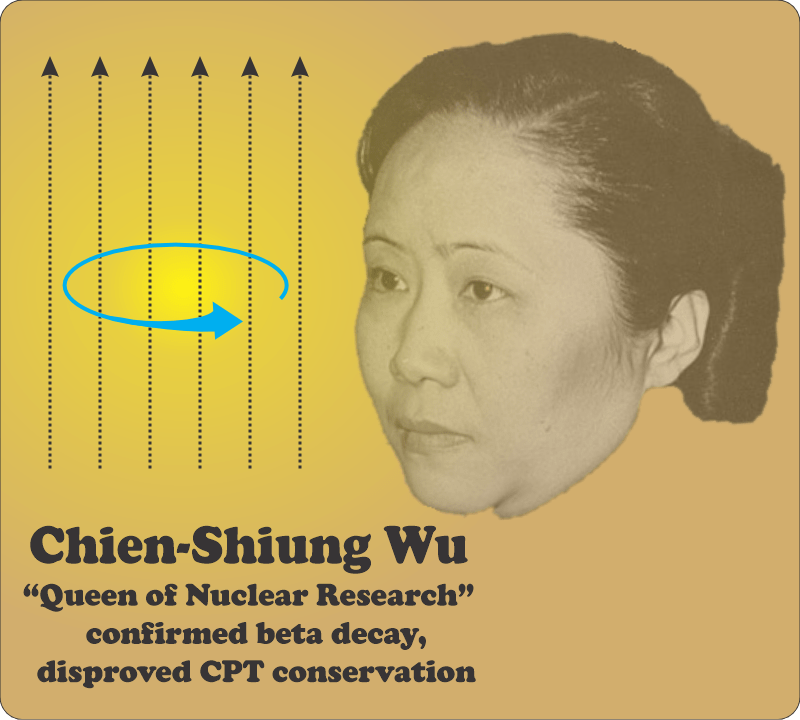
“But Chien‑Shiung Wu did an experiment that showed the nuclear weak force doesn’t always obey CPT rules. Her worked proved we live in a handed Universe. She should have gotten a Nobel for that, but it was last century and the Nobel Committee was men‑only. Two theory guys copped the prize that should have gone to the three of them. The theory guys protested but the Committee ignored Wu anyway. Sometimes things aren’t fair.”

“Tell me about it. So the theory’s got a loophole?”

“Apparently, but to my knowledge no‐one’s found it. Some string theories claim to hint at an explanation but that’s not much help, considering.”

“Huh. Could the loophole maybe be an example of symmetry breaking?”

“Very good question. I think it’s a qualified probably but that’s a guess.”

“Sy, I think that’s the wishy-washiest you’ve ever been.”

“One of my rules is, when you’re going out on a limb be sure you’re properly roped to the tree. In this case I’m generalizing from a single sample.”

“You’re gonna tell me, right?”

   Professor Higgs presents
       the Higgs Bozo.

“Just the bare outline because I don’t want to get into the deep weeds. Back in the 1960s Physics was in trouble because the nuclear strong force particles that bind the nucleus together were found to have mass and move slowly. Strong‑force theory at the time said they should be massless and move at lightspeed. The theory depended on part of the potential energy varying with the symmetry of a circle. Then Higgs—”

“The Higgs Boson guy?”

“That’s him. Anyway, he published a three‑page paper showing that those binding particles aren’t controlled solely by the nuclear strong force. Because they have a charge they also engage with the electromagnetic field. Electromagnetism is a lot weaker than the strong force, but it’s strong enough to deform the theory’s circle into an ellipse. Breaking the circular symmetry in effect gives the particles mass and slows them down.”

“So where’s the boson come in? I thought it’s what makes mass for everything.”

“Absolutely not, probably. The protons and neutrons have plenty of mass on their own, thank you very much. It’s only those strong-force particles that gain mass, less than 1% of the nucleus total. But the whole story is a great example of how making a system less symmetrical, even a little bit, can completely change how it operates. We think that’s what drove the Big Bang’s story. The early Universe was so dense and hot it was a perfectly symmetrical quark soup — chaos all the way down. Space expansion opened successive symmetry loopholes that permitted layers of structure formation.”

<looking at hands> “I don’t feel unsymmetrical.”

“Trust me, deep down you are.”

~~ Rich Olcott
Reflection, Rotation And Spacetime

“Afternoon, Al.”

“Hiya, Sy. Hey, which of these two scones d’ya like better?”

“”Mm … this oniony one, sorta. The other is too vegetable for me ‑ grass, I think, and maybe asparagus? What’s going on?”

“Experimenting, Sy, experimenting. I’m going for ‘Taste of Spring.’ The first one was spring onion, the second was fiddlehead ferns. I picked ’em myself.”

“Very seasonal, but I’m afraid neither goes well with coffee. I’ll take a caramel scone, please, plus a mug of my usual mud.”

“Aw, Sy, caramel’s a winter flavor. Here you go. Say, while you’re here, maybe you could clear up something for me?”

“I can try. What’s the something?”

“After your multiverse series I got out my astronomy magazines to read up on the Big Bang. Several of the articles said that we’ve gone through several … um, I think they said ‘epochs‘ … separated by episodes of symmetry breaking. What’s that all about?”

“It’s about a central notion in modern Physics. Name me some kinds of symmetry.”

“Mmm, there’s left‑right, of course, and the turning kind like a snowflake has. Come to think — I like listening to Bach and Vivaldi when I’m planet‑watching. I don’t know why but their stuff reminds me of geometry and feels like symmetry.”

“Would it help to know that the word comes from the Greek for ‘same measure‘? Symmetry is about transformations, like your mirror and rotation operations, that affect a system but don’t significantly change to its measurable properties. Rotate that snowflake 60° and it looks exactly the same. Both the geometric symmetries you named are two‑dimensional but the principle applies all over the place. Bach and the whole Baroque era were just saturated with symmetry. His music was so regular it even looked good on the page. Even buildings and artworks back then were planned to look balanced, as much mass and structure on the left as on the right.”

“I don’t read music, just listen to it. Why does Bach sound symmetric?”

“There’s another kind of symmetry, called a ‘translation‘ don’t ask why, where the transformation moves something along a line within some larger structure. That paper napkin dispenser, for instance. It’s got a stack of napkins that all look alike. I pull one off, napkins move up one unit but the stack doesn’t look any different.”

“Except I gotta refill it when it runs low, but I get your drift. You’re saying Bach takes a phrase and repeats it over and over and that sounds like translational symmetry along the music’s timeline.”

“Yup, maybe up or down a few tones, maybe a different register or instrument. The repeats are the thing. Play his Third Brandenberg Concerto next time you’re at your telescope, you’ll see what I mean.”

“Symmetry’s not just math then.”

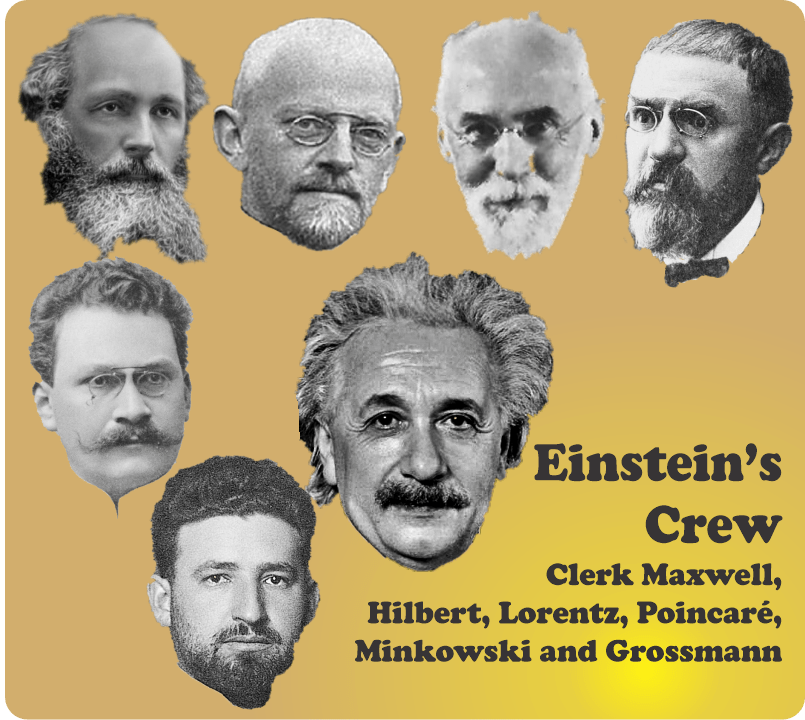
“Like I said, it’s everywhere. You’ve seen diagrams of DNA’s spiral staircase. It combines translation with rotation symmetry, does about 10 translation steps per turn, over and over. The Universe has a symmetry you don’t see at all. No‑one did until Lorentz and Poincaré revised Heaviside’s version of Maxwell’s electromagnetism equations for Minkowski space. Einstein, Hilbert and Grossman used that work to give us and the Universe a new symmetry.”

“Einstein didn’t do the math?”

“The crew I just named were world‑class in math, he wasn’t. Einstein’s strengths were his physical intuition and his ability to pick problems his math buddies would find interesting. Look, Newton’s Universe depends on absolute space and time. The distance between two objects at a given time is always the same, no matter who’s measuring it or how fast anyone is moving. All observers measure the same duration between two incidents regardless. Follow me?”

“Makes sense. That’s how things work hereabouts, anyway.”

“That’s how they work everywhere until you get to high speeds or high gravity. Lorentz proved that the distances and durations you measure depend on your velocity relative to what you’re measuring. Extreme cases lead to inconsistent numbers. Newton’s absolute space and time are pliable. To Einstein such instability was an abomination. Physics needs a firm foundation, a symmetry between all observers to support consistent measurements throughout the Universe. Einstein’s Relativity Theory rescued Physics with symmetrical mathematical transformations that enforce consistency.”

~~ Rich Olcott

Time And The Egg

I unlock my office door and there’s Vinnie in the client chair flipping a coin from hand to hand. If my building ever switches to digital locks he’d take it as a challenge. “Morning, Vinnie.”

“Morning, Sy. Been reading your multiverse series and something you said bothered me.”

“What’s that?”

“Back when you wrote up your anti-Universe idea that some other group had come up with first—”

“Don’t remind me.”

“—you mentioned how time going backwards makes for negative energy, like that’s obvious. It ain’t obvious to me.”

“Okay … Ah. What word keeps coming up in our black hole discussions?”

“Geez, frames again? Universes ain’t black holes.”

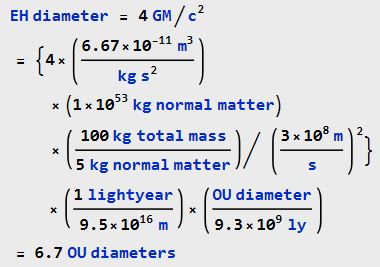
“Don’t be so sure. Suppose there’s a black hole Event Horizon that encloses our entire Observable Universe. An Event Horizon’s diameter depends on how much mass it has inside. Astronomy’s given us an estimate of how much normal matter our Observable Universe contains. I adjusted that number upward to account for the expected quantity of dark matter plus dark energy’s equivalent mass. When I plugged that grand total into Schwarzchild’s formula for the diameter of an Event Horizon, the result was about seven times wider than what we can observe. We could be inside a huge black hole but we’ll never know either way.”

“Whoa! Wouldn’t we notice a drift towards the singularity at its middle?”

“Not if we’re reasonably far out or if the drift rate is tiny compared to the slow chaos of intergalactic space. Mind you, it took us centuries to develop the technology that told us we’re inside the Milky Way and two‑thirds of the way out from the core.”

“We used frames for thinking about going really fast or being outside a black hole. Now we’re inside one or maybe not. How’s frames gonna help us with that?”

“Well, not the inertial frames where we compared relativistic observers, but the idea is similar. A traveler in an intense gravity field experiences slower time in its inertial frame than a distant partner does in theirs. Clocks appear to run weirdly if they’re compared between separate frames whose relative velocities are near lightspeed.”

“Yeah, that’s what we said.”

“Now picture two observational frames, one here in our Universe and one in the anti‑Universe if there is one. Time in the two frames flows in opposite directions away from the Big Bang between them. The two‑frames notion is a convenient way to think about consequences. Negative energy is one.”

“Now we’re getting somewhere. So give.”

“Well, what does energy do?”

“It makes things happen.”

“Negative energy does, too, considered from inside its frame. Looking from our frame, though, negative energy makes things unhappen. This spoon on our table has gravitational potential energy relative to the floor, right?”

“Yeah, you push it over the edge it’ll fall down.”

“But looking from our frame at a similar situation in the anti‑Universe running on anti‑time, an anti‑spoon on its floor has negative gravitational potential energy. We’d see it fall up to its table. Make sense?”

“Gimme a minute.” <pause> “Kinda hard to visualize but I’m starting to get there.” <longer pause> “Alright, you know I hate equations but even I know about Einstein’s E=mc². That is a square so it’s always positive so if E is negative then the mass gotta be negative, too.”

“From our frame all mass in the anti‑Universe looks negative. Negative mass would attract negative mass just like positive mass attracts positive mass here. Gravity in the anti‑Universe would work exactly the same way as our gravity does, so where’s the problem?”

“Gimme another minute.” <more pausing> “Suppose that spoon was an anti‑egg. You’re sayin’ when it goes splat over there, we’re gonna see it unsplat? Unsplatting uses up entropy. How about the ‘Entropy always increases‘ rule?”

“Right on the unsplat, wrong on the other. The full statement of Thermodynamics’ Second Law says that entropy never decreases in an isolated system. You can’t get much more isolated than being a separate Universe — no inputs of energy or matter from our Universe or anywhere else, right? From our frame, it looks like the anti‑Universe flipped the Second Law but that’s only because we’re using the wrong clock.”

~~ Rich Olcott

Noodles or A Sandwich?

“Wait, Sy, your anti-Universe idea says there are exactly two um, sub‑Universes. Even the word ‘multiverse‘ suggests more than that.”

“You’re right, Susan, most of the multiverse proposals go to the other extreme. Maybe the most extreme version grew in reaction to one popular interpretation of quantum theory. Do you know about the ‘Many Worlds‘ notion?”

“Many Worlds? Is that the one about when I decide between noodles for lunch or a sandwich, the Universe splits and there’s one of me enjoying each one?”

“That’s the popular idea. The physics idea is way smaller, far bigger and even harder to swallow. Physicists have been arguing about it for a half‑century.”

“Come again? Smaller AND bigger?”

“Smaller because it’s a quantum‑based idea about microscopic phenomena. Doesn’t say anything about things big enough to touch. Remember how quantum calculations predict statistics, not exact values? They can’t give you anything but averages and spreads. Einstein and Bohr had a couple of marquee debates about that back in the 1930s. Bohr maintained that our only path to understanding observations at the micro‑scale was to accept that events there are random and there’s no point discussing anything deeper than statistics. Einstein’s position was that the very fact that we’re successfully using an average‑based strategy says that there must be finer‑grained phenomena to average over. He called it ‘the underlying reality.’ The string theory folks have chased that possibility all the way down to the Planck‑length scale. They’ve found lots of lovely math but not much else. Hugh Everett had a different concept.”

“With that build‑up, it’d better have something to do with Many Worlds.”

“Oh, it does. Pieces of the idea have been lying around for centuries, but Everett pulled them all together and dressed them up in a quantum suit. Put simply, in his PhD thesis he showed how QM’s statistics can result from averaging over Universes. Well, one Universe per observation, but you experience a sequence of Universes and that’s what you average over.”

“How can you show something like that?”

“By going down the rabbit hole step by step and staying strictly within the formal QM framework. First step was to abstractify the operation of observing. He said it’s a matter of two separate systems, an observer A and a subject B. The A could be a person or electronics or whatever. What’s important is that A has the ability to assess and record B‘s states and how they change. Given all that, the next step is to say that both A and B are quantized, in the sense that each has a quantum state.”

“Wait, EACH has a quantum state? Even if A is a human or a massive NMR machine?”

“That’s one of the hard‑to‑swallows, but formally speaking he’s okay. If a micro‑system can have a quantum state then so can a macro‑system made up of micro‑systems. You just multiply the micro‑states together to get the macro‑state. Which gets us to the next step — when A interrogates B, the two become entangled. We then can only talk about the combined quantum state of the A+B system. Everett referred to an Einstein quote when he wrote that a mouse doesn’t change the Moon by looking at it, but the Moon changes the mouse. The next step’s a doozy so take a deep breath.”

“Ready, I suppose.”

B could have been in any of its quantum states, suppose it’s #10. After the observation, A+B must be an entangled mixture of whatever A was, combined with each of B‘s possible final states. Suppose B might switch to #42. Now we can have A+B(#42), separate from a persisting A+B(#10), plus many other possibles. As time goes by, A+B(#42) moves along its worldline independent of whatever happens to A+B(#10).”

“If they’re independent than each is in its own Universe. That’s the Many Worlds thing.”

“Now consider just how many worlds. We’re talking every potential observing macro‑system of any size, entangled with all possible quantum states of every existing micro‑system anywhere in our Observable Universe. We’re a long way from your noodles or sandwich decision.”

“An infinity of infinities.”

“Each in its own massive world.”

“Hard to swallow.”

~~ Rich Olcott

A Two-Way Stretch, Maybe

“Okay, Moire, I guess I gotta go with the Big Bang happening, but I still have a problem with it making everything come from a point full of nothing.”

“Back at you, Mr Feder. I have problems with your problem. To begin with, forget about your notion of a point with zero size. There’s some reason to think the Bang started with an event sized on the order of the Planck length, 10-35 meter. That’s small, but it’s not zero.”

“I suppose, but with the whole mass of the Universe crammed in there, ain’t that a recipe for the ultimate black hole? Nothing could get outta there.”

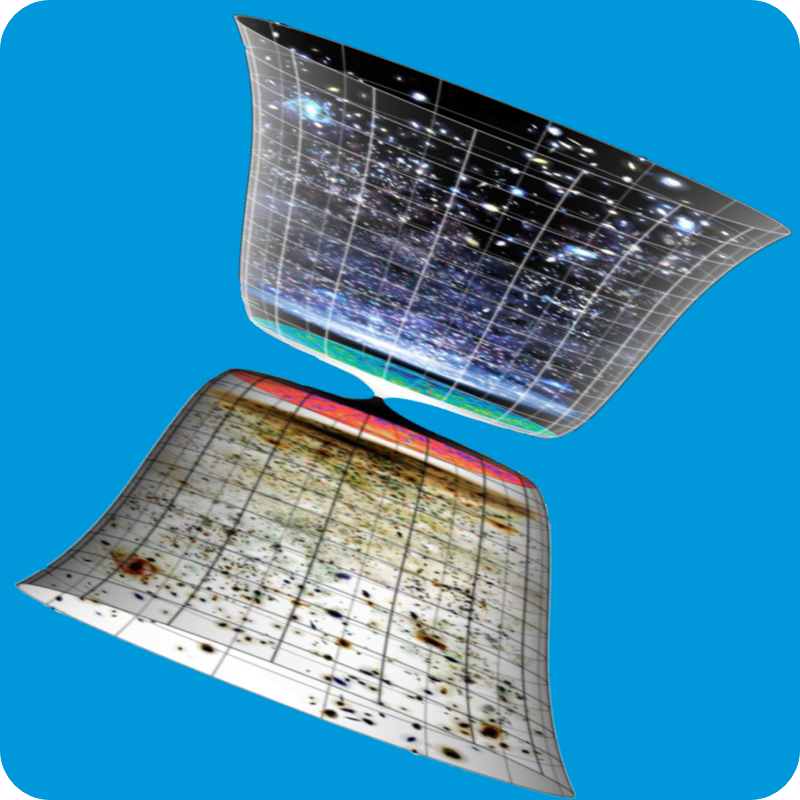
“Nothing needs to. What’s inside is already everything, remember? Besides, there isn’t an outside — space simply doesn’t exist outside of the spacetime the Bang created. Those bell‑shaped ‘Evolution of The Universe‘ diagrams are so misleading. I say that even though I’ve used the diagram myself. It’s just a graph with Time running along the central axis and Space expanding perpendicular to that. People have prettied it up to make it cylindrical and added galaxies and such. The lines just represent how much Space has expanded since the Bang. Unfortunately, people look at the bell as a some kind of boundary with empty space outside, but that’s so wrong.”

“No outside? Hard to wrap your head around.”

“Understandable. Only physicists and mathematicians get used to thinking in those terms and mostly we do it with equations instead of trying to visualize. Our equations tell us the Universe expands at the speed of light plus a bit.”

“Wait, I thought nothing could go faster than the speed of light.”

“True, nothing can traverse space faster than light or gravity, but space itself expands. At large distances it’s doing that faster than light. We actually had to devise two different definitions of distance. ‘Co‑moving distance‘ includes the expansion. ‘Proper distance‘ doesn’t. In another couple billion years, the farthest things we can see today will be co‑moving away so fast that the photons they emit will be carried away faster than they can fly towards us. Those objects will leave our Observable Universe, the spherical bubble that encloses the objects whose light gets a chance to reach us.”

“My head hurts from the expanding. Get back to the Bang thing ’cause it was small. Too small to hold atoms I guess so how can it explode to be everything?”

‘Expand’, not ‘explode‘ — they’re different — but good guess. The Bang’s singularity was smaller than an atom by at least a factor of 1024, but conditions were far too hot in there for atoms to exist, or nuclei, or even protons and neutrons. Informally we call it a quark soup, which is okay because we think quarks are structureless points that can cram to near‑infinite density. We don’t yet know enough Physics for good calculations of temperature, density or much of anything else.”

“That’s a lot of energy, even if it’s not particles. Which is what I’m getting at. I keep hearing you can’t create energy, just transform it, right? So where did the energy come from?”

“That’s a deep question, Mr Feder, and we don’t have an answer or hypothesis or even a firm guess. It gets down to what energy even is — we’re just barely nibbling at the edges of that one. One crazy idea I kind of like is that creating our Universe took zero energy because the process was exactly compensated for by creating an anti‑Universe whose total anti‑energy matches our total energy.”

“Whaddaya mean, anti‑Universe and anti‑energy?”

<deep breath> “You know an atom has negatively‑charged electrons bound to its positively‑charged nucleus, right? Well, the anti‑Universe I’m thinking of has that situation and everything else reversed. Positive electrons, negative nucleus, but also flipped left‑right parities for some electroweak particle interactions. Oh, and time runs backwards which is how anti‑energy becomes a thing. Our Universe and my crazy anti‑Universe emerge at Time Zero from the singularity. Then they expand in opposite directions along the Time axis. Maybe the quarks and their anti‑quarks got sorted out at the flash‑point, I dunno.”

“So there’s an anti‑me out there somewhere?”

“I wouldn’t go that far.”

~~ Rich Olcott

Everything Everywhere All at Once

It’s either late Winter or early Spring, the weather can’t make up its mind. The geese don’t seem to approve of my walk around the park’s lake but then I realize it’s not me they object to. “Hey, Moire, wait up, I got a question for you!”

“Good morning, Mr Feder. What can I do for you?”

“This Big Bang thing I been hearing about. How can it make everything from nothing like they say?”

“You’re in good form, Mr Feder, lots of questions buried within a question.”

“Oh yeah? Seems pretty simple to me. How do we even know it happened?”

“Well, there you go, one buried question up already. We have several lines of evidence to support the idea. One of them is the CMB.”

“Complete Monkey Business?”

“Very funny. No, it’s the Cosmic Microwave Background, long‑wavelength light that completely surrounds us. It has the same wavelength profile and the same intensity within a dozen parts per million no matter what direction we look. The best explanation we have for it is that the light is finally arriving here from the Big Bang roughly 14 billion years ago. Well, a couple hundred thousand years after the Bang itself. It took that long for things to cool down enough for electrons and protons to pair up as atoms. The photons had been bouncing around between charged particles but when the charges neutralized each other the photons could roam free.”

“Same in all directions so we’re in the center, huh? The Bang musta been real close‑by.”

“Not really. Astronomers have measured the radiation’s effects on a distant intergalactic dust cloud. The effect is just what we’d expect if the cloud were right here. We’re not in a special location. From everything we can measure, the Bang happened everywhere and all at once.”

“Weird. Hard to see how that can happen.”

“We answered that nearly a century ago when Edwin Hubble discovered that there are other galaxies outside the Milky Way and that they’re in motion.”

“Yeah, I heard about that, too, with everything running away from us.”

“Sorry, no. We’re not that special, remember? On the average, everything’s running away from everything else.”

“Whaddaya mean, ‘on the average‘? Why the wishy-washy?”

“Because things cluster together and swirl around. The Andromeda galaxy is coming straight toward us, for instance, but it won’t get here for 5 billion years. The general trend only shows up when you look at large volumes, say a hundred million lightyears across or bigger. The evidence says yeah, everything’s spreading out.”

“But how can everything be moving away from everything? You run away from something, you gotta be running toward something else.”

“That’d be true if your somethings are all confined in a room whose walls don’t move. The Universe doesn’t work that way. The space between somethings continually grows new space. The volume of the whole assemblage increases.”

“Is that why I just hadda buy new pants?”

“No, that’s just you gaining weight from all that beer and bar food. The electromagnetism that holds your atoms and molecules together is much stronger than what’s driving the expansion. So is the gravitation that holds solar systems and galaxies together. Expansion only gets significant when distances get so large that the inverse square laws diminish both those forces to near zero.”

“What’s this got to do with the CMB?”

“The CMB tells us that the Bang happened everywhere, but expansion says that at early times when stars and galaxies first formed, ‘everywhere‘ was on a much smaller scale than it is now. Imagine having a video of the expansion and playing it backwards. Earendel‘s the farthest star we’ve seen, but if we and it existed 12 billion years ago we’d measure it as being close‑by but still all the way across the observable Universe. Carry that idea the rest of the way. The Big Bang is expansion from a super‑compressed everywhere.”

“Okay, what’s driving the expansion?”

“We don’t know. We call it ‘dark energy‘ but the name’s about all we have for it.”

“Aaaa-HAH! At last something you don’t know!”

“Science is all about finding things we don’t know and working to figure them out.”

~~ Rich Olcott

The Sky’s The Limit

Another meeting of the Acme Pizza and Science Society, at our usual big round table in Pizza Eddie’s place on the Acme Building’s second floor. (The table’s also used for after‑hours practical studies of applied statistics, “only don’t tell nobody, okay?“) It’s Eddie’s turn to announce the topic for the evening. “This one’s from my nephew, guys. How high up is the sky on Mars?”

General silence ensues, then Al throws in a chip. “Well, how high up is the sky on Earth?”

Being a pilot, Vinnie’s our aviation expert. “Depends on who’s defining ‘sky‘ and why they did that. I’m thinking ‘the sky’s the limit‘ and for me that’s the highest altitude I can get up to legal‑like. Private prop planes generally stay below 10,000 feet, commercial jets aren’t certified above 43,000 feet, private jets aren’t supposed to go above 51,000 feet.”

Eddie counters. “How about the Concorde? And those military high-flyers?”

“They’re special. The SST has, um, had unique engineering to let it go up to 60,000 feet ’cause they didn’t want sonic boom complaints from ground level. But it don’t fly no more anyhow. I’ve heard that the Air Force’s SR-71 could hit 85,000 feet but it got retired, too.”

Al’s not impressed. “All that’s legal stuff. There’s a helicopter flying on Mars but the FAA don’t make the rules there. What else we got?”

Geologist Kareem swallows his last bite of cheese melt. “How about the top of the troposphere? That’s the lowest layer of our atmosphere, the one where most of our weather and sunset colors happen. If you look at clouds in the sky, they’re inside the troposphere.”

“How high is that?”

“It expands with heating, so the top depends where you’re measuring. At the Equator it can be as high as 18½ kilometers; near a pole in local winter the top squeezes down to 6 kilometers or so. And to your next question — above the troposphere we’ve got the stratosphere that goes up to 50 kilometers. What’s that in feet, Sy?”

<drawing Old Reliable and screen-tapping…> “Says about 31.2 miles or 165,000 feet. Let’s keep things in kilometers from here on, okay?”

“Then you’ve got the mesosphere and the exosphere but the light scattering that gives us a blue sky happens below them so I’d say the sky stops at 50 kilometers.”

Al’s been rummaging through his astronomy magazines. “I read somewhere here that you’re not an astronaut unless you’ve gone past either 80 or 100 kilometers, which is weird with two cut‑offs. Who came up with those?”

Vinnie’s back in. “Who came up with the idea was a guy named von Kármán. One of the many Hungarians who came to the US in the 30s to get away from the Nazis. He did a bunch of advanced aircraft design work, helped found Aerojet and JPL. Anyway, he said the boundary between aeronautics and astronautics is how high you are when the atmosphere gets too thin for wings to keep you up with aerodynamic lift. Beyond that you need rockets or you’re in orbit or you fall down. He had equations and everything. For the Bell X‑2 he figured the threshold was around 52 miles up. What’s that in kilometers, Sy?”

“About 84.”

“So that’s where the 80 comes from. NASA liked that number for their astronauts but the Europeans rounded it up to 100. Politics, I suppose. Do von Kármán’s equations apply to Mars as well as Earth?”

“Now we’re getting somewhere, Vinnie. They do, sort of. It’s complicated, because there’s a four‑way tug‑of‑war going on. Your aircraft has gravity pulling you down, lift and centrifugal force pulling you up. Lift depends on the atmosphere’s density and your vehicle’s configuration. The fourth player is the kicker — frictional heat ruining the craft. Lift, centrifugal force and heating all get stronger with speed. Von Kármán based his calculations on the Bell X‑2’s configuration and heat‑management capabilities. Problem is, we’re not sending an X‑2 to Mars.”

“Can you re‑calibrate his equation to put a virtual X‑2 up there?”

“Hey, guys, I think someone did that. This magazine says the Karman line on Mars is 88 kilometers up.”

“Go tell your nephew, Eddie.”

~~ Rich Olcott

Well, well, well

<chirp, chirp> “Moire here.”

“Hi, Sy, it’s Susan Kim. I’m at a break point while this experiment runs. Do you want to check the scones at Al’s?”

“I’ve got a bad case of February, feel like just hibernating somewhere. Can’t get started on anything so I might as well head over there.”

“You need Al’s patented Morning Dynamite brew. See you in a couple of minutes.”


“Hi, Al. My usual mocha latte, please, and your special wake-up potion for Sy. He’s got the Februaries.”

“Here you go, Susan. Bottom of the pot coming at ya, Sy. It’ll get ya lively, for sure.”

<We grab a table.> “So, Susan, what’s this experiment that you can just let alone for a while?”

“One of your blog posts inspired it. Do you remember the one about warm water freezing faster than cold?”

“Sometimes it does that, but the point of the post was how it’s only randomly sometimes in some experiments and not at all in others. Are you experimenting with water freezing?”

“No, but I’m working on a related problem. I can’t say much about it other than that there’s an industrial process that depends on recovering a crystalline product from a hot, concentrated solution. The problem is that if the solution is too weak nothing crystallizes when it cools but if it’s too concentrated the whole batch solidifies in one big mass. The industry wants to find the right conditions for making lots of small crystals. I’ve got a grant to research ways to do that.”

“That does sound a little like water freezing. How did my blog post help?”

“I was thinking about how crystals form. We know a lot about how ions or molecules come in from solution to attach to the surface of a growing crystal. Either they’re electrostatically pulled to just the right spot or they bounce on and off the surface until they find a place they fit into. But how does that surface get started in the first place?”

“Well, I imagine it happens when two molecules love each other very mu— OW!”

“Sy Moire, get your mind back on Science! … Sorry, did it really hurt that much?”

“It wouldn’t have but that’s the same spot on the same shoulder that Cathleen got me on.”

“Actually, your flip remark isn’t that far from what we think happens except the correct verb is ‘attract,’ not ‘love.‘ Some researchers even call the initial speck ‘the embryo‘ but most of us say ‘nucleus.’ Nucleation might start with only a few molecules clicking into the right configuration, or it might require a cluster of hundreds being mostly right. The process might even require help from short‑lived solvent structures. So many variables. Nobody has a good predictive theory or even broadly useful models. It’s all by art and rule of thumb.”

“Sounds like a challenge.”

“Oh, it is. Here’s the tip I took from your blog post. You mentioned that some of the freezing studies used hundreds of trials and reported what percent of them froze. Most of the industrial crystallization studies work at pilot plant scale, with liters or gallons of solution going into each trial. I decided to go small instead. Lab supply companies sell culture plates for biological work. Typically they’re polystyrene trays holding up to a hundred one‑milliliter wells. I bought a bunch of those, and I also bought a machine that can automatically load the wells with whatever solutions I like. I’ve positioned it next to a temperature‑controlled cabinet with a camera to photograph a batch of trays at regular intervals.”

“Nice, so you can set up many duplicates at each chemical concentration and keep statistics on how many form crystals at each temperature.”

“At high concentrations I expect all the wells to show crystals. The obvious measurement will be crystal size range at each temperature. But with no change in apparatus I can go to lower and lower concentrations to where crystallization itself is random like the freezing experiments. Some wells will crystallize, some won’t. Statistics on those trays may tell us things about nucleation. It’s gonna be fun.”

“D’ya suppose the planets are culture plate wells for creation’s life experiments?”

~~ Rich Olcott

Visionaries Old And New

Cathleen’s back at the mic. “Let’s have a round of applause for Maria, Jeremy, Madison and C‑J. Thank you all. We have a few minutes left for questions… Paul, you’re first.”

“Thanks, Cathleen. A comment, not a question. As you know, archeoastronomy is my specialty so I applaud Jeremy’s advocacy for the field. I agree with his notion that the Colorado Plateau’s dry, thin air generally lets us see more stars than sea‑level Greeks do. When I go to a good dark sky site, it can be difficult to see the main stars that define a constellation because of all the background dimmer stars. However, I don’t think that additional stars would change the pictures we project into the sky. Most constellations are outlined from only the brightest stars up there. Dimmer stars may confuse the issue, but I very much doubt they would have altered the makeup of the constellations a culture defines. Each culture uses their own myths and history when finding figures among the stars.”

“Thanks for the confirmation from personal experience, Paul. Yes, Sy?”

“Another comment not a question. I’m struck by how Maria’s Doppler technique and Jeremy’s Astrometry complement each other Think of a distant stellar system like a spinning plate balanced on a stick. Doppler can tell you how long the stick is. Astrometry can tell you how wide the plate is. Both can tell you how fast it’s spinning. The strongest Doppler signal comes from systems that are edge‑on to us. The strongest Astrometry signal comes from systems we see face‑on. Those are the extreme cases, of course. Most systems are be at some in‑between angle and give us intermediate signals.”

“That’s a useful classification, Sy. Madison’s and C‑J’s transit technique also fits the edge‑on category. Jim, I can see you’re about to bust. What do you have to tell us about?”

“How about a technique that lets you characterize exoplanets inside a galaxy we see as only a blurry blob? This paper I just read blew me away.”

“Go ahead, you have the floor.”

“Great. Does everyone know about Earendel?” <blank looks from half the audience, mutters about ‘Lord Of The Rings?’ from several> “OK, quick refresher. Earendel is the name astronomers gave to the farthest individual star we’ve ever discovered. It’s either 13 or 28 billion lightyears away, depending on how you define distance. We only spotted it because of an incredible coincidence — the star happens to be passing through an extremely small region of space where light in our general direction is concentrated thousands‑fold into a beam towards us. Earendel may be embedded in a galaxy, but the amplification region is so narrow we can’t see stars that might be right next to it.”

<Feder’s voice> “Ya gonna tell us what makes the region?”

“Only very generally, because it’s complicated. You know what a magnifying lens does in sunlight.”

“Sure. I’ve burnt ants that way.”

“… Right. So what you did was take all the light energy hitting the entire surface of your lens and concentrate it on a miniscule spot. The concentration factor was controlled by the Sun‑to‑lens‑to‑spot distances and the surface area of the lens. Now bring that picture up to cosmological distances. The lens is the combined gravitational field of an entire galaxy cluster, billions of lightyears away from us, focusing light from Earendel’s galaxy billions of lightyears farther away. Really small spots at both ends of the light path and that’s what isolated that star.”

“That’s what got you excited?”

“That’s the start of it. This new paper goes in the other direction. The scientists used brilliant X‑ray light from an extremely distant quasar to probe for exoplanets inside a galaxy’s gravitational lens. Like one of your ants analyzing sunlight’s glare to assess dust flecks on your lens. Or at least their averaged properties. A lens integrates all the light hitting it so your ant can’t see individual grains. What it can do, though, is estimate numbers and size ranges. This paper suggests the lensing galaxy is cluttered with 2000 free‑floating planets per main‑sequence star — stars too far for us to see.”

~~ Rich Olcott

  • Thanks to Dave Martinez and Dr Ka Chun Yu for their informative comments.