Tiramisu And Gemstones

“Sis, you say there’s dessert?”

“Of course there is, Sy. Teena, please bring in the tray from the fridge.”

“Tiramisu! You did indeed go above and beyond. Thank you, Teena. Your Mom’s question must be a doozey.”

“I’ll let you enjoy a few spoonfulls before I hit you with it.” <minutes with spoon noises and yumming> “Okay. tell me about entanglement.”

“Whoa! What brought that on?”

“I’ve seen the word bandied about in the popular science press—”

“And pseudoscience—”

“Well, yes. I’m writing something where the notion might come in handy if it makes sense.”

“How can you tell what’s pseudoscience?”

“Good question, Teena. I look for gee-whiz sentences, especially ones that include weasely words like ‘might‘ and ‘could.’ Most important, does the article make or quote big claims that can’t be disproven? I’d want to see pointers to evidence strong enough to match the claims. A respectable piece would include comments from other people working in the same field. Things like that.”

“What your Mom said, and also has the author used a technical term like ‘energy‘ or ‘quantum‘ but stretched it far away from its home base? Usually when they do that and you have even an elementary idea what the term really means, it’s pretty clear that the author doesn’t understand what they’re writing about. That goes double for a lot of what you’ll see on YouTube and social media in general. It’s just so easy to put gibberish up there because there’s no‑one to contradict a claim, or if there is, it’s too late because the junk has already spread. ‘Entanglement‘ is just the latest buzzword to join the junk‑science game.”

“So what can you tell us about entanglement that’s non‑junky?”

“First thing is, it’s strictly a microscopic phenomenon, molecule‑tiny and smaller. Anything you read about people or gemstones being entangled, you can stop reading right there unless it’s for fun.”

“Weren’t Rapunzel and the prince entangled?

“They and all the movie’s other characters were tangled up in the story, yes, but that’s not the kind of entanglement your Mom’s asking about. This kind seems to involve something that Einstein called ‘spooky action at a distance‘. He didn’t like it.”

“‘Seems to‘?”

“Caught me, Sis, but it’s an important point. You make a system do something by acting on it, right? We’re used to actions where force is transmitted by direct contact, like hitting a ball with a bat. We’ve known how direct contact works with solids and fluids since Newton. We’ve extended the theory to indirect contact via electric and other fields thanks to Maxwell and Einstein and a host of other physicists. ‘Action at a distance‘ is about making something happen without either direct or indirect contact and that’s weird.”

“Can you give us an example?”

“How about an entanglement story? Suppose there’s a machine that makes coins, nicely packaged up in gift boxes. They’re for sweethearts so it always makes the coins in pairs, one gold and one silver. These are microscopic coins so quantum rules apply — every coin is half gold and half silver until its box is opened, at which point it becomes all one pure metal.”

“Like Schrödinger’s asleep‑awake kitty‑cat!”

“Exactly, Teena. So Bob buys a pair of boxes, keeps one and gives the other to Alice before he flies off in his rocket to the Moon. Quantum says both coins are both metals. When he lands, he opens his box and finds a silver coin. What kind of coin does Alice have?”

“Gold, of course.”

“For sure. Bob’s coin‑checking instantly affected Alice’s coin a quarter‑million miles away. Spooky, huh?”

“But wait a minute. Alice’s coin doesn’t move. It’s not like Bob pushed on it or anything. The only thing that changed was its composition.”

“Sis, you’ve nailed it. That’s why I said ‘seems to‘. Entanglement’s not really action at a distance. No energy or force is exerted, it’s simply an information thing about quantum properties. Which, come to think of it, is why there’s no entanglement of people or gemstones. Even a bacterium has billions and billions of quantum‑level properties. Entanglement‑tweaking one or two or even a thousand atoms won’t affect the object as a whole.”

~~ Rich Olcott
Metrological Extremes

Al’s coffee shop smells festive. “Hiya, Sy. Can I interest you in a peppermint latte this morning?”

Adapted from a YouTube video contributed by NPL(UK)

“You know me better than that, Al. My usual black mud, please. Hmm… What flavor’s hiding under the chocolate frosting on the scone rack?”

“Strawberry.”

“In that case I’ll take two. Your latest artwork behind the cash register is more a scroll than a poster.”

“You noticed. Yeah, it’s very cool but I don’t understand a couple things.”

“Oh? Like what?”

“Like what’s NPL, for starters, but mostly what the poster’s even about. I get that it’s science-y and my Physics and Astronomy customers chuckle at it, but…”

“Well, for starters, NPL is the United Kingdom’s National Physical Laboratory. In USA terms they’re a little bit like a mixture of NIST and what used to be Bell Labs with a side order of DARPA. They were early supporters of high‑precision instrumentation, computer and network tech, lots of cutting‑edge stuff until they were privatized and the company that mostly bought them lost a whole lot of money. Now they’re back to a government plus academy structure but they’re still a going concern, one of the major drivers behind the SI conventions.”

“You wrote about that a while ago, din’tcha?”

“Did a whole series that started with revising the official mass standard and wound up at the full set of Système International basic and derived units. Pretty boring until you realize that precise measurement has been crucial to practically all manufacturing since the introduction of mass production. And it’s important to use a consistent set of units. One of NASA’s worst black eyes was the Mars Climate Orbiter failure when one team used Imperial feet‑and‑pounds units and everyone else was on the metric system.”

“I gotta use both sets. Most of my baking supplies come in pounds, but the coffee beans and some of the flavorings come in kilograms. I gotta use my computer to resize a recipe.”

“That’s the thing with the metric system. It’s all about powers of ten. No dividing by 12 or is it 16 or even 5280 to get to a different size range — just move the decimal and you’re done. I don’t know why people have so much trouble with it.”

“It’s something new, Sy.”

“Yeah, but it’s not been new since the 1800s. It’s a long time since doctors prescribed by the scruple or minim. All there’s been for generations is milligrams and microliters. Gas prices being what they are these days I’m surprised the oil companies haven’t been pushing to sell by the liter — price per unit volume would drop by nearly a quarter.”

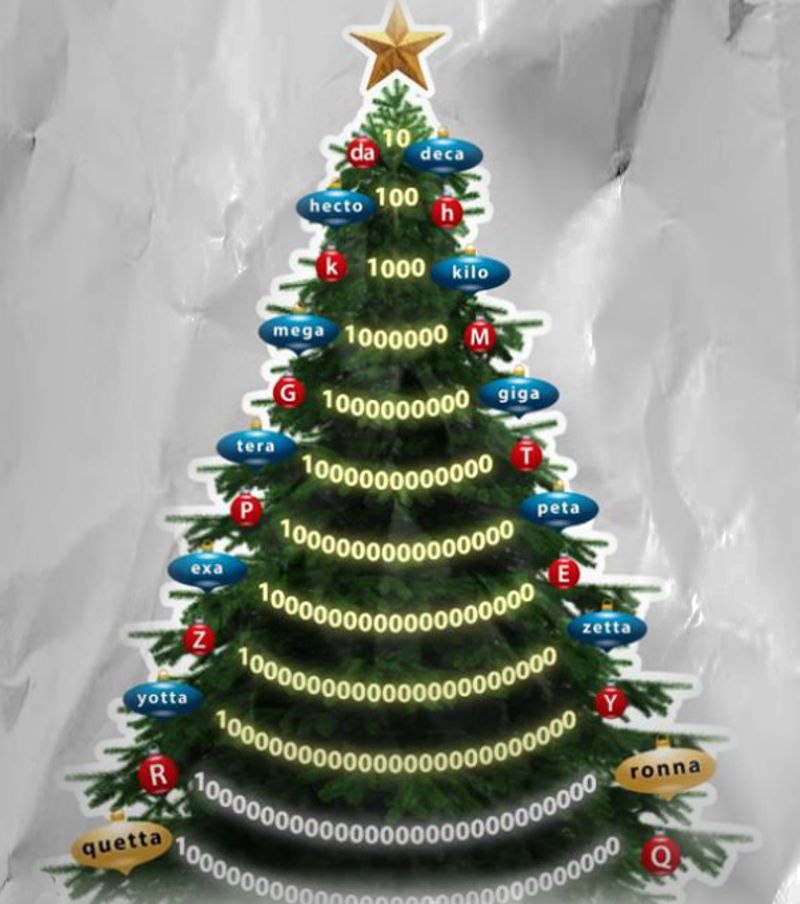
“I see ‘milli’ and ‘micro’ ornaments on one of those Christmas trees. Is that what they’re about?”

“That’s the ‘divide by a thousand’ tree. You already know ‘milli’ as the first cut‑down from grams or whatever the unit is. Divide by another thousand, you’ve got ‘micro’, which is one millionth or 10‑6. You’ve seen the ‘nano’ prefix by now — it’s 10‑9 and I like the nano‑nine connection. The ornaments on that tree display the prefixes for smaller and smaller subdivisions. The gold ones near the bottom are new this year. ‘Quecto’ is 10‑30, which would take you 30 digits if you wrote the number out.”

“So I guess the other tree is ‘multiply by a thousand.‘ Yup, there’s the ‘kilo’ for a thousand grams. Someone once told me I get about ten thousand beans in a kilogram bag.”

“Ten beans to a gram, then. That makes each bean a tenth of a gram or 100 milligrams. See how easy? Try figuring that in ounces.”

“Nice. Hey, I recognize ‘mega’ next to … a million. Counting’s hard without the commas in there.”

“Some people use spaces. You probably remember ‘giga’ and ‘tera’ from gigabytes and terabytes, you being a computer user.”

“Gigabucks, too. I read the news, you know. Politicians and CEOs play in the billions. But who needs numbers as big as ‘quetta’? That’s what, 1030?”

“Scientists and computer storage managers, mostly. Jupiter’s just shy of two quettagrams, and civilization’s on the path to generating a ronnabyte of data.”

~~ Rich Olcott

Dinner Rolls And Star Dust

“MAH-ahm! Uncle Sy’s here! Hi, Uncle Sy, dinner’s almost ready. I’ve saved up some questions for you”

“Hi, Teena, let’s have—”

“Now Teena, we said we’d hold the questions until after the meal. Hi, Sy.”

“Hi, Sis. Smells wonderful. One of Mom’s recipes?”

“Nope, I’m experimenting. Mom’s pasta sauce, though. You toss the salad and we’ll dig in.”

<later> “Wow. Sis, that lasagna was amazing. Five different meats, I think, and four different cheeses? Every mouthful was a new experience. A meal that Mom would’ve been proud of.”

“Six meats, you missed one. Full credit — Teena did the dinner rolls, from scratch, and she composed the salad.”

“Well, young lady, I think your grandma would be proud of you, too. You’ve earned questions. I may stay awake long enough to answer them.”

“Yay.”

“First the dishes, guys, then to the living room.”

“Sure, Sis. And you get a question, too.”

“As a matter of fact…”

<later> “Okay, Teena, question number one.”

“Alright. Umm. Brian tries to annoy me by saying over and over that the Sun’s gonna supernova into a black hole. That’s not true, is it?”

“You can tell Brian that the Sun’s way too small to make either a supernova or a black hole. Yes, the Sun will collapse in something like five billion years, but when that happens it’ll only be a garden‑variety nova. When things calm down there’ll be a white dwarf in the middle of our Solar System, not a black hole. Supernovas come from really big stars and they leave neutron stars behind or sometimes just emptiness. To get a black hole you need a star at least half again bigger than ours. D’ya think that’ll shut Brian down?”

“No-o, because there’s other things he says to annoy me.”

“Like what?”

“That our galaxy’s gonna collide with another one and we’ll all burn up in the explosion.”

“He’s got a thing for disasters, doesn’t he? Well, he’s partially right but mostly wrong. Yes, galaxy Andromeda is on a collision course with the Milky Way. But that collision won’t be anything like what he’s talking about. Remember those bird flocks we talked about?”

“Oh that was so long ago. What was the word? Mur, mur .. something?”

“Murmuration. That was your favorite word back then.”

“Oh, yes. It still is, now that I remember it.” <Sis and I give each other a look.> “What do birds have to do with galaxies?”

“Imagine two flocks colliding. Think there’ll be feathers all over the place?”

“No, the flocks would pass right through each other, except maybe some birds from one flock might fly off with the other one.”

“That’s pretty much what will happen with us and Andromeda. Stars in each galaxy are lightyears apart, hundreds of star‑widths apart, like cars miles apart on a highway. Star‑star collisions during a galaxy collision will be very rare. The galaxy’s own shapes will be distorted and gravity will pull stars from one galaxy to the other, but that’s about the extent of it. Anyway, that’s also about five billion years into the future. So Brian’s off on that prediction, too. Anything else?”

“Actually, yes. He says we’re made of stardust. I thought we’re made of atoms.”

“Indeed we are, but the atoms come from stars. Quick story about how stars work. The oldest and most common kind of atom is hydrogen. Back at the beginning of the Universe that’s all there was. If you shove hydrogen atoms together with enough heat and pressure, like inside stars, they combine to form heavier atoms like carbon and oxygen. You’re made of hydrogen and carbon and oxygen and such, but all your atoms except hydrogen were cooked up inside stars.”

“But how did they get inside me?”

“Remember those novas and supernovas? Doesn’t matter which kind of star collapses, half or more of its atoms spray into the Universe. They become star dust adrift in the winds of space, waiting to become part of another solar system and whatever’s in it. Brian’s right on this one, you are made of star dust.”

“Whooo, that’s awesome!”

“My question’s after dessert, Sy.”

~~ Rich Olcott

  • Thanks to the young Museum visitors who asked these questions.

The Frame Game

A familiar footstep outside my office, “C’mon in, Vinnie, the door’s open.”

“Hi, Sy, how ya doin’?”

“Can’t complain. Yourself?”

“Fine, fine. Hey, I been thinking about something you said while Al and us were talking about rockets and orbits and such. You remember that?”

“We’ve done that in quantity. What statement in particular?”

“It was about when you’re in the ISS, you still see like 88% of Earth’s gravity. But I seen video of those astronauts just floating around in the station. Seems to me those two don’t add up.”

“Hah! We’re talking physics of motion here. What’s the magic word?”

“You’re saying it’s frames? I thought black holes did that.”

“Black holes are an extreme example, but frame‑thinking is an essential tool in analyzing any kind of relative motion. Einstein’s famous ‘happy thought‘ about a man in a free‑falling elevator—”

“Whoa, why is that a happy thought? I been nervous about elevators ever since that time we got stuck in one.”

“At least it wasn’t falling, right? Point is, the elevator and whoever’s in it agree that Newton’s First Law of Motion is valid for everything they see in there.”

“Wait, which Law is that?”

“‘Things either don’t move or else they move at a steady pace along a straight line.’ Suppose you’re that guy—”

“I’d rather not.”

“… and the elevator is in a zero‑gravity field. You take something out of your pocket, put it the air in front of you and it stays there. You give it a tap and it floats away in a straight line. Any different behavior means that your entire frame — you, the elevator and anything else in there — is being accelerated by some force. Let’s take two possibilities. Case one, you and the elevator are resting on terra firma, tightly held by the force of gravity.”

“I like that one.”

“Case two, you and the elevator are way out in space, zero‑gravity again, but you’re in a rocket under 1-g acceleration. Einstein got happy because he realized that you’d feel the same either way. You’d have no mechanical way to distinguish between the two cases.”

“What’s that mean, mechanical?”

“It excludes sneaky ways of outside influence by magnetic fields and such. Anyhow, Einstein’s insight was key to extending Newton’s First Law to figuring acceleration for an entire frame. Like, for instance, an orbiting ISS.”

“Ah, you’re saying that floating astronauts in an 88% Earth-gravity field is fine because the ISS and the guys share the frame feeling that 88% but the guys are floating relative to that frame. But down here if we could look in there we’d see how both kinds of motion literally add up.”

“Exactly. It’s just much easier to think about only one kind at a time.”

“Wait. You said the ISS is being accelerated. I thought it’s going a steady 17500 miles an hour which it’s got to do to stay 250 miles up.”

“Is it going in a straight line?”

“Well, no, it’s going in a circle, mostly, except when it has to dodge some space junk.”

“So the First Law doesn’t apply. Acceleration is change in momentum, and the ISS momentum is constantly changing.”

“But it’s moving steady.”

“But not in a straight line. Momentum is a vector that points in a specific direction. Change the direction, you change the momentum. Newton’s Second Law links momentum change with force and acceleration. Any orbiting object undergoes angular acceleration.”

“Angular acceleration, that’s a new one. It’s degrees per second per second?”

“Yup, or radians. There’s two kinds, though — orbiting and spinning. The ISS doesn’t spin because it has to keep its solar panels facing the Sun.”

“But I’ve seen sci-fi movies set in something that spins to create artificial gravity. Like that 2001 Space Odyssey where the guy does his running exercise inside the ship.”

“Sure, and people have designed space stations that spin for the same reason. You’d have a cascade of frames — the station orbiting some planet, the station spinning, maybe even a ballerina inside doing pirouettes.”

“How do you calculate all that?”

“You don’t. You work with whichever frame is useful for what you’re trying to accomplish.”

“Makes my head spin.”

~~ Rich Olcott

Climbing Out Of A Well

Al can’t contain himself. “Wait, it’s gravity!”

Vinnie and I are puzzled. “Come again?”

“Sy, you were going on about how much speed a rocket has to shed on the way to some special orbit around Mars, like that’s a big challenge. But it’s not. The rocket’s fighting the Sun’s gravity all the way. That’s where the speed goes. The Earth’s gravity, too, a little bit early on, but mostly the Sun’s, right?”

“Good point, Al. Sun gravity’s what bends the rocket onto a curve instead of a straight line. Okay, Sy, you got a magic equation that accounts for the shed speed? Something’s gotta, ’cause we got satellites going around Mars.”

“Good point, Vinnie, and you’re right, there is an equation. It’s not magic, you’ve already seen it and it ties kinetic energy to gravitational potential energy.”

“Wait, if I remember right, kinetic energy goes like mass times velocity squared. How can you calculate that without knowing how big the rocket is?”

“Good question. We get around that by thinking things through for a unit mass, one kilogram in SI units. We can multiply by the rocket’s mass when we’re done, if we need to. The kinetic energy per unit mass, we call that specific kinetic energy, is just ½v². Look familiar?”

“That’s one side of your v²=2GM/R equation except you’ve got the 2 on the other side.”

“Good eye, Al. The right-hand side, except for the 2, is specific gravitational potential energy, again for unit mass. But we can’t use the equation unless we know the kinetic energy and gravitational potential are indeed equal. That’s true if you’re in orbit but we’re talking about traveling between orbits where you’re trading kinetic for potential or vice versa. One gains what the other loses so Al’s right on the money. Traveling out of a gravity well is all about losing speed.”

Al’s catching up. “So how fast you’re going determines how high you are, and how high you are says how fast you have to be going.”

Vinnie frowns a little. “I’m thinking back to in‑flight refueling ops where I’m coming up to the tanker from below and behind while the boom operator directs me in. That doesn’t sound like it’d work for joining up to a satellite.”

“Absolutely. If you’re above and behind you could speed up to meet the beast falling, or from below and ahead you could slow down to rise. Away from that diagonal you’d be out of luck. Weird, huh?”

“Yeah. Which reminds me, now we’re talking about this ‘deeper means faster‘ stuff. How does the deep‑dive maneuver work? You know, where they dive a spacecraft close to a planet or something and it shoots off with more speed than it started with. Seems to me whatever speed it gains it oughta give up on the way out of the well.”

“It’s a surprise play, alright, but it’s actually two different tricks. The slingshot trick is to dive close enough to capture a bit of the planet’s orbital momentum before you fly back out of the well. If you’re going in the planet’s direction you come out going faster than you went in.”

“Or you could dive in the other direction to slow yourself down, right?”

“Of course, Al. NASA used both options for the Voyager and Messenger missions. Vinnie, I know what you’re thinking and yes, theoretically stealing a planet’s orbital momentum could affect its motion but really, planets are huge and spacecraft are teeny. DART hit the Dimorphos moonlet head-on and slowed it down by 5%, but you’d need 66 trillion copies of Dimorphos to equal the mass of dinky little Mercury.”

“What’s the other trick?”

“Dive in like with the slingshot, but fire your rocket engine when you’re going fastest, just as the craft approaches its closest point to the planet. Another German rocketeer, Hermann Oberth, was the first to apply serious math to space navigation. This trick’s sometimes called the Oberth effect, though he didn’t call it that. He showed that rocket exhaust gets more effective the faster you’re going. The planet’s gravity helps you along on that, for free.”

“Free help is good.”

~~ Rich Olcott

Not Too Fast, Not Too Slow

“Vinnie, those nifty-looking transfer orbits that Hohmann invented but didn’t get to patent — you left something out.”

“What’s that, Sy?”

“The geometry looks lovely — a rocket takes off tangent to its orbit around one planet or something and inserts along a tangent to an orbit around something else. Very smooth and I can see how that routing avoids having to spend fuel to turn corners. But that ignores speeds.”

“What difference does that make?”

“It makes a difference whether or not you can get into the orbit you’re aiming for. Any orbit is a trade-off between gravity’s pull and the orbiter’s kinetic energy. Assuming you’re going for a circular orbit, there’s a strict relationship between your final height and your approach speed when you’re finally flying on the horizontal. You don’t want to come in too fast or too slow.”

“First thing I learned in pilot school. But that relationship’s an equation, ain’t it?”

“A couple, actually, but they’re simple. Let’s back into the problem. Say your mission is to put a communications relay satellite into lunastationary orbit around the Moon—”

“Lunastationary?”

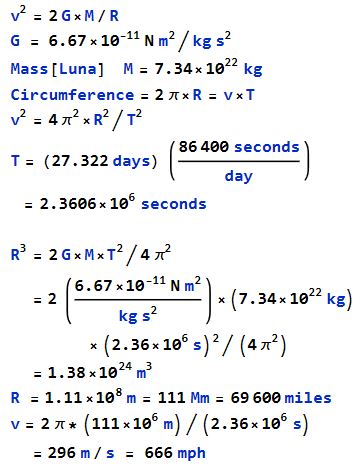
“Like geostationary, but with the Moon. The satellite’s supposed to hover permanently above one spot on the Moon’s equator, so its orbital period has to equal the Moon’s ‘day,’ <pulling out Old Reliable, tapping> which is 27.322 days. Your satellite must loop around the Moon in exactly that much time. Either it’s scooting at low altitude or it’s ambling along further up. If we knew the speed we could find the radius, and if we knew the radius we could find the speed. We need some math.”

“I knew it. You’re gonna throw calculus at me.”

“Relax, Vinnie, it’s only algebra and we’re only going to combine two formulas and you already know one of them. The one you don’t know connects the speed, which I’m calling v, with the radius, R. They’re tied together by the Moon’s mass, M and Newton’s gravitational constant G. The formula is v2=2G×M/R. You can handle that, right?”

“Lessee … that says if I either double the mass or cut the distance by two, the speed has to be four times larger. Makes sense ’cause that’s about being in a deeper gravity well or getting closer in. Am I on track?”

“Absolutely. Next formula is the one you know, the circumference of a circle or in this case, the distance around that orbit.”

“That’s easy, 2πR.”

“And that’s also speed times the time, T so I’ll set those equal. <tapping on Old Reliable> Okay, the first formula says v2 so I square the circumference equation and solve that for v2 . You still with me?”

“You’re gonna set those two v-squareds equal, I suppose.”

“You’re still on track. Yup and then I gather the Rs on one side and everything else on the other. That gives me something in R3 but that’s okay. Plug in all the numbers, take the cube root and we get that you need to position that satellite 111 megameters out from the Moon’s center, flying at 296 meters per second. Think you can manage that?”

“Given the right equipment, sure. Seventy thousand miles out from the Moon … pretty far.”

“It’s about ¾ of the way to the Moon from Earth.”

“Cool. Does that R3 formula work for the planets?”

“Sure. Works for the Sun, too, but that’s so massive and spins so fast the sol‑stationary orbit’s half way to Mercury. An orbiter would have to fly 205 000 miles an hour to keep up with an equatorial sunspot. Flying something‑stationary over other planets offers problems beyond targeting the orbit, though.”

“Besides how long the trip would be?”

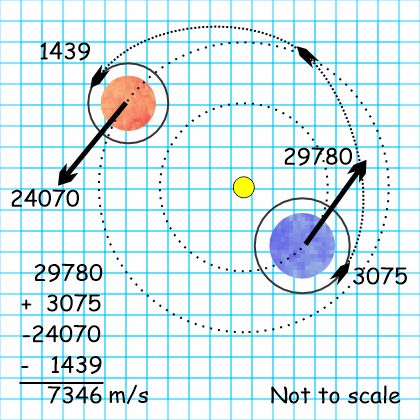
“Well, that, yes, but here’s another one. Suppose you’re going to Mars, aiming at an ares‑stationary orbit. It’ll be 20 megameters, 12500 miles from the center. You need to make your tangential injection at a Mars‑relative speed of 1439 meters per second. Problem is, you left Earth from a geostationary orbit at 3075 m/s relative to Earth. At the classic Hohmann positions, Earth’s going 5710 m/s relative to Mars, Somehow you’re going to have to shed 7346 m/s per second of excess speed.”

~~ Rich Olcott

Carefully Considered Indirection

“C’mon, Vinnie, you’re definitely doing Sy stuff. I ask you a question about how come rockets can get to the Moon easier than partway and you go round the barn with ballistics and cruisers. Stop dodging.”

“Now, Al, Vinnie’s just giving you background, right. Vinnie?”

“Right, Sy, though I gotta admit a lot of our talks have gone that way. So what’s your answer?”

“Nice try, Vinnie. You’re doing fine, so keep at it.”

“Okay. <deep breath> It has to do with vectors, Al, combination of amount and direction, like if you’re going 3 miles north that’s a vector. You good with that?”

“If you say so.”

“I do. Then you can combine vectors, like if you’re going 3 miles north and at the same time 4 miles east you’ve gone 5 miles northeast.”

“That’s a 3-4-5 right triangle, even I know that one. But that 5 miles northeast is a vector, too, right?”

“You got the idea. Now think about fueling a rocket going up to meet the ISS.”

“Sy said it’s 250 miles up, so we need enough fuel to punch that far against Earth’s gravity.”

“Not even close. If the rocket just went straight up, it’d come straight down again. You need some sideways momentum, enough so when you fall you miss the Earth.”

“Miss the Earth? Get outta here!”

“No, really. Hey, Sy, you tell him.”

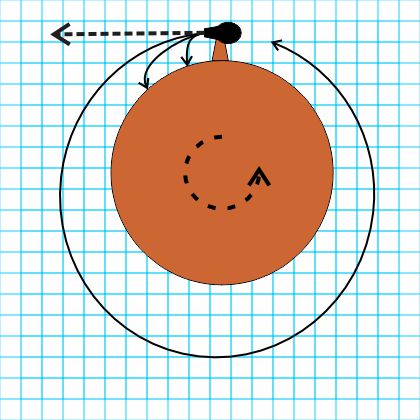
“Vinnie’s right, Al. That insight goes back to Newton. He proposed a thought experiment about building a powerful cannon to fire horizontally from a very tall mountain. <sketching on paper napkin> A ball shot with a normal load of powder might hit the adjacent valley. Shoot with more and more powder, balls would fly farther and farther before hitting the Earth. Eventually you fire with a charge so powerful the ball flies far enough that its fall continues all around the planet. Unless the cannon blows up or the ball shatters.”

“That’s my point, Al. See, Newton’s cannon balls started out going flat, not up. To get up and into orbit you need up and sideways velocity, like on the diagonal. You gotta calculate fuel to do both at the same time.”

“So what’s that got to do with easier to get to the Moon than into orbit?”

“‘S got everything to do with that. Not easier, though, just if you aim right the vectors make it simpler and cheaper to carry cargo to the Moon than into Earth orbit.”

“So you just head straight for the Moon without going into orbit!”

“Not quite that simple, but you got the general idea. Remember when I brought that kid’s top in here and me and Sy talked about centrifugal force?”

“Do I? And I made you clean up all those spit-wads.”

“Yeah, well, suppose that cannon’s at the Equator <adding dotted lines to Sy’s diagram> and aimed with the Earth’s spin and suppose we load in enough powder for the ball to go straight horizontal, which is what it’d do with just centrifugal force.”

“If I’m standing by the cannon it’d look like the ball’s going sideways.”

“Yup. Basically, you get the up‑ness for free. We’re not talking about escape velocity here, that’s different. We’re talking about the start of a Hohmann orbit.”

“Who’s Hohmann?”

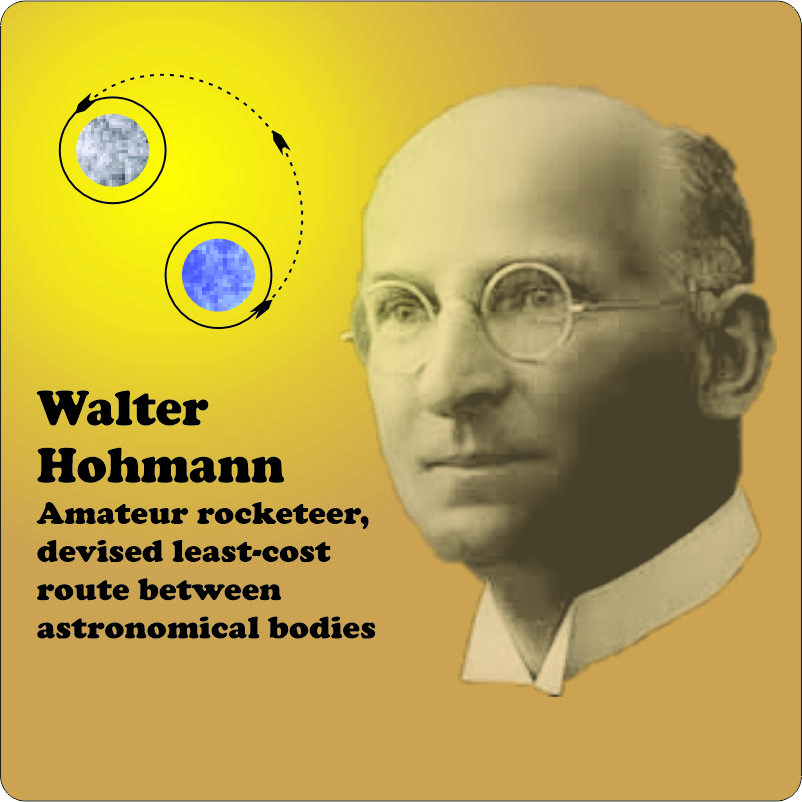
“German engineer. When he was a kid he read sci‑fi like the rest of us and that got him into the amateur rocketry scene. Got to be a leader in the German amateur rocket club, published a couple of leading‑edge rocket science books in the 1920s but dropped out of the field when the Nazis started rolling and he figured they’d build rocket weapons. Anyhow, he invented this orbit that starts off tangent to a circle around one planet or something, follows an ellipse to end tangent to a circle around something else. Smooth transitions at both ends, cheapest way you can get from here to there. Kinks in the routing cost you fuel and cargo capacity to turn. Guy shoulda patented it.”

“Wait, an orbit’s a mathematical abstraction, not a thing.”

“Patent Office says it’s a business method, Sy. Check out PAS-22, for example.”

“Incredible.”

~ Rich Olcott

  • Thanks to Ken, who asked another question.

The Cold Equation

Afternoon break time. I’m enjoying one of Al’s strawberry scones when he plops one of his astronomy magazines on Vinnie’s table. “Vinnie, you bein’ a pilot and all, could you ‘splain some numbers which I don’t understand? It’s this statistics table for super‑heavy lifter rockets. I think it says that some of them can carry more cargo to the Moon than if they only go partway there. That’s nuts, right?”

Vehicle Payload to LEO GSO Payload TLI Payload
Energia 100 20 32
Falcon Heavy 64 27 28
NASA’s SLS 1b 105 42
SpaceX Starship 100
Yenisei 103 26 28
Yenisei Don 140 30 33
LEO=Low Earth Orbit, GSO = Geosynchronous Orbit, TLI=Trans Lunar Injection
Payloads in metric tons (megagrams)

“Lemme think … LEO is anywhere up to about 2000 kilometers. GSO is about 36000 kilometers out, so it makes sense that with the same amount of fuel and stuff you can’t lift as much out there. TLI … that’s not to the Moon, that’s to a point where you can switch from orbiting the Earth to orbiting the Moon so, yeah, that’s gonna be way farther out, like a couple hundred thousand kilometers or more depending.”

“Depending on what?”

“Oh, lots of things — fuel, orbit, design philosophy—”

“Now wait, you been taking Sy lessons. Philosophy?”

“No, really. There’s two basic ways to do space travel, either you’re ballistic or you’re cruising. All the spacecraft blast‑offs you’ve seen are ballistic. Use up most of your fuel to get a good running start and then basically coast the rest of the way to your target. Ballistic means you gotta aim careful from the get‑go. That’s the difference between ballistic and cruise missiles. Cruisers keep burning fuel and accelerating. That lets ’em change directions whenever.”

“Cruisers are better, right, so you can point at different asteroids? I read about that weird orbit they had to send the Lucy mission on.”

“Actually, Lucy used the ballistic‑and‑coast model. NASA spent a bucketful of computer time calculating exactly where to point and when to lift off so Lucy could visit all those asteroids.”

“Why not just use a cruise strategy and skip around?”

“Cruisers are just fine once you’re up between planets. NASA’s Dawn mission to the Vesta and Ceres asteroids used a cruise drive — but only after the craft rode a boostered Delta‑II ballistic up to low Earth orbit. Nine boosters worth of ballistic. The problem is you’re caught in a double bind. You need to burn fuel to get the payload off the planet, but you need to burn fuel to get the fuel off, too. ‘S called diminishing returns. Hey, Sy, what’s that guy’s name?”

“Which guy?”

“The rocket equation guy, the Russian.”

“Ah. Tsiolkovsky. Lived in a log cabin but wrote a lot about space travel. Everything from rocket theory to airlocks and space stations. What about him?”

“I’m tellin’ Al about rockets. Tsiol… That guy’s equation says if you know how much you need to change velocity and you know your payload mass, you can figure how much fuel you need to burn to do that.”

“With some conditions, Vinnie. There’s a multiplier in there you have to calibrate for fuel, engine design. even whether you’re traveling through water or vacuum or different atmospheres. Then, the equation doesn’t figure in gravity. Oh, and it only works with straight‑line velocity change. If you want to change direction you need to use calculus to figure the—”

“Hey, I just realized why they use boosters!”

“Why’s that, Al?”

“The gravity thing. Gravity’s strongest near the Earth, right? Once the beast gets high enough, you’re not fighting as much gravity. You don’t need the extra power.”

“True, but that’s not the whole picture. The ISS orbit’s about 250 miles up, which puts it about 4250 miles from the planet’s center. Newton’s Law of Gravity says the field all the way up there is still about 88% of what’s at the surface. The real reason is that a booster’s basically a fuel tank. Once you’ve burned the fuel you don’t need the tank and that’s a lot of weight to carry for nothing.”

“Right, tank and engine don’t count as payload so dump ’em.”

“Seems cold‑hearted, though.”

~~ Rich Olcott

Science or Not-science?

Vinnie trundles up to Jeremy’s gelato stand. “I’ll take a Neapolitan, one each chocolate, vanilla and strawberry.”

“Umm… Eddie forgot to order more three-dip cones and I’m all out. I can give you three separate cones or a dish.”

“The dish’ll be fine, way less messy. Hey, Sy, I got a new theory.”

“Mm… Unless you’ve got a lot of firm evidence it can’t be a theory. Could be a conjecture or if it’s really good maybe a hypothesis. What’s your idea?”

“Thing is, Sy, there can’t be any evidence. Ever. That’s the fun of it.”

“Conjecture, then. C’mon, out with it.”

“Well, you remember all that stuff about how time bends toward a black hole’s mass and that’s how gravity works?”

“Sure, except it’s not just black holes. Time bends the same way toward every mass, it’s just more intense with black holes.”

“Understood. Anyway, we talked once about how stars collapse to form black holes but that’s only up to a certain size, I forget what—”

“Ten to fifteen solar masses. Beyond that the collapse goes supernova and doesn’t leave much behind but dust.”

“Right. So you said we don’t know how to make size‑30 black holes like the first pair that LIGO found.”

“We’ve got a slew of hypotheses but the jury’s still out.”

“That’s what I hear. Well, if we don’t even know that much then we for‑sure don’t know how to make the supermassive black hole the science magazines say we’ve got in the middle of the Milky Way.”

“We’ve found that nearly every galaxy has one, some a lot bigger than ours. Why that’s true is one of the biggest mysteries in astrophysics.”

“And I know the answer! What if those supermassive guys started out as just big lumps of dark matter and then they wrapped themselves in more dark matter and everything else?”

“Cute idea, but the astronomy data says we can account for galaxy shapes and behavior if they’re embedded at the center of a spherical halo of dark matter.”

“Not a problem, Sy. Look at the numbers. Our superguy is a size‑4‑million, right? The whole Milky Way’s a billion times heavier than that. Tuck an extra billionth into the middle of the swirl and the stars wouldn’t see the difference.”

“Okay, but there’s more data that says dark matter spreads itself pretty evenly, doesn’t seem to clump up like you need it to.”

“Yeah, but maybe there’s two kinds, one kind clumpy and the other kind not. Only way to find out is to look inside a superguy but time blocks information flow out of there. So no‑one can say I’m wrong!”

“But sir, that’s not science!”

“Why not, kid?”

“The unit my philosophy class did on Popper.”

“The stuff you sniff or the penguins guy?”

“Neither, Karl Popper the philosopher. Dr Crom really likes Popper’s work so we spent a lot of time reading him. Popper was one of the Austrian intellectuals the Nazis chased out when they took power in the 1930s. Popper traveled around, wound up in New Zealand where he wrote his Open Society book that shredded Hegel and Marx. Those sections were fun reading even if they were wordy. Anyway, one of Popper’s big things was the demarcation problem, how to tell the difference between what’s a scientific assertion and what’s not. He decided the best criterion was if there’s a way to prove the assertion false. Not whether it was false but whether it could at least be tested. I was surprised by how many goofy things the Greeks said that would qualify as Popper‑scientific even though they were just made up and have been proven wrong.”

“Well there you go, Vinnie. Physics and the Universe don’t let us see into a supermassive black hole, therefore your idea isn’t testable even in principle. Jeremy’s right, it’s not scientific even though it’s all dressed up in a Science suit.”

“I can still call it a conjecture, though, right, Sy?”

“Conjecture it is. Might even be true, but we’ll never know unless we somehow find out something about dark matter that surprises us. We’ve been surprised a lot, though, so don’t give up hope.”

~~ Rich Olcott

Chocolate, Mint And Notation

“But calculus, Mr Moire. Why do they insist we learn calculus? You said that Newton and Leibniz started it but why did they do it?”

“Scoop me a double-dip chocolate-mint gelato, Jeremy, and I’ll tell you about an infamous quarrel. You named Newton first. I expect most Europeans would name Leibniz first.”

“Here’s your gelato. What does geography have to do with it?”

“Thanks. Mmm, love this combination. Part of the geography thing is international history, part of it is personality and part of it is convenience. England and continental Europe have a history of rivalry in everything from the arts to trade to outright warfare. Each naturally tends to favor its own residents and institutions. Some people say that the British Royal Society was founded to compete with the French philosophical clubs. Maybe England’s king appointed Newton as the society’s President to upgrade the rivalry. Dicey choice. From what I’ve read, Newton’s didn’t hate everybody, he just didn’t like anybody. But somehow he ran that group effectively despite his tendency to go full‑tilt against anyone who disagreed with his views.”

“Leibniz did the same thing on the European side?”

“No, quite the opposite. There was no pre‑existing group for him to head up and he didn’t start one. Instead, he served as a sort of Information Central while working as diplomat and counselor for a series of rulers of various countries. He carried on a lively correspondence with pretty much everyone doing science or philosophy. He kept the world up to date and in the process inserted his own ideas and proposals into the conversation. Unlike Newton, Leibniz was a friendly soul, constantly looking for compromise. Their separate calculus notations are a great example.”

“Huh? Didn’t everyone use the same letters and stuff?”

“The letters, yeah mostly, but the stuff part was a long time coming. What’s calculus about?”

“All I’ve seen so far is proofs and recipes for integrating different function types. Nothing about what it’s about.”

Newton approximates arc ABCDEF.

<sigh> “That’s because you’re being taught by a mathematician. Calculus is about change and how to handle it mathematically. That was a hot topic back in the 1600s and it’s still central to Physics. Newton’s momentum‑acceleration‑force perspective led him to visualize things flowing with time. His Laws of Motion made it easy to calculate straight‑line flows but what to do about curves? His solution was to break the curve into tiny segments he called fluxions. He considered each fluxion to be a microscopic straight line that existed for an infinitesimal time interval. A fluxion’s length was its time interval multiplied by the velocity along it. His algebraic shorthand for ‘per time‘ was to put a dot over whatever letter he was using for distance. Velocity along x was . Acceleration is velocity change per time so he wrote that with a double dot like . His version of calculus amounted to summing fluxion lengths across the total travel time.”

“But that only does time stuff. What about how, say, potential energy adds up across a distance?”

“Excellent question. Newton’s notation wasn’t up to that challenge, but Leibniz developed something better.”

“He copied what Newton was doing and generalized it somehow.”

“Uh, no. Newton claimed Leibniz had done that but Leibniz swore he’d been working entirely independently. Two lines of evidence. First, Newton was notoriously secretive about his work. He held onto his planetary orbit calculations for years before Halley convinced him to publish. Second, Leibniz and other European thinkers came to the problem with a different strategy. Descartes invented Cartesian coordinates a half‑century before. That invention naturally led the Europeans to plot anything against anything. Newton’s fluxions combined tiny amounts of distance and time; Leibniz and company split the two dimensions, one increment along each component. Leibniz tried out a dozen different notations for the increment. After much discussion he finally settled on a simple d. The increment along x is dx, but x could be anything quantitative. dy/dx quantifies y‘s change with x.”

“Ah, the increments are the differentials we see in class. But those all come from limit processes.”

“Leibniz’ d symbol and its powerful multi‑dimensional extensions carry that implication. More poetry.”

~~ Rich Olcott