Flasks Of Money

<chirp, chirp> “Moire here.”

“Hiya, Sy, it’s me again.”

“Hi, Eddie. I thought you were done with your deliveries tonight. That was a good stromboli, by the way, just the right amount of zing and sauce.”

“Thanks. Yeah, I’m done for the day, but I was thinking while I drove home. We said that the Feds and the banks together can tinker with the money supply so there’s no Conservation of Money like we got Conservation of Energy. But then we said that it matters to keep money in local businesses instead of letting it drain away somewhere else. That says there’s only so much to go around like the amount doesn’t change. So which is it?”

“Good point. You’ve touched on another contrasting parallel between Physics and Economics. In Physics we mostly understand how atoms work and we’ve got a pretty good handle on the forces that control objects big enough to see. J Willard Gibbs, probably the foremost physicist of the late 1800s, devised Statistical Mechanics to bridge the gap between the two levels. The idea is to start with the atoms or molecules. They’re quantum objects, of course, so we can’t have much precise information at that level. What we can get, though, is averages and spreads on one object’s properties — speed, internal energy levels, things like that. Imagine we have an ensemble of those guys, mostly identical but each with their own personal set of properties. Gibbs showed us how to apply low-level averages and spreads across the whole ensemble to calculate upper-level properties like magnetic strength and heat capacity.”

“Ensemble. Fancy word.”

“Not my word, blame Gibbs. He invented the field so we go with his terminology. Atoms weren’t quite a respectable topic of conversation at the time so he kept things general and talked about ‘macroscopic properties‘ which we can measure directly and ‘microscopic properties‘ which were mysterious at the time. Think of three flasks holding samples of some kind of gas, OK?”

“No problem.”

“The first flask is stoppered, no gas can get in or out but energy can pass through the flask’s wall. Gibbs would call the confined collection of molecules a ‘canonical ensemble‘. Because the wall transmits energy we can use an external thermometer to measure the ensemble’s temperature. Other than that, all we know about the contents is the number of particles and the volume the particles can access.”

“Canonical?”

“In Gibbs’ usage it means that he’s pared things down to an abstract essence. It doesn’t matter whether what’s inside is atoms or fruitflies, his logic still holds. Now for flask number two. It’s heavily insulated so whatever energy it had inside originally, that’s what it’s got now. We can’t measure the temperature in this one. Gibbs would consider the particles in there to be a ‘microcanonical ensemble,’ with the ‘micro’ indicating the energy restriction.”

“Where there’s a microcanonical there’s gotta be a macrocanonical.”

“You’d think, but Gibbs used the term ‘grand canonical ensemble‘ instead. That’s flask number three, which has neither insulation nor stopper. Both energy and matter are free to enter or leave the ensemble. Gibbs’ notion of canonical ensembles and the math that grows out of them have been used in every kind of analysis from solid state physics to cybersecurity.”

“OK, I think I see where you’re going here. Money acts sorta like energy so you’re gonna lay out three kinds of economy restriction.”

“You’re way ahead of me and the economists, Eddie. They’ve only got two levels, though they do use reasonable names for them — microeconomics and macroeconomics. For them the micro level is about individuals, businesses, the markets they play in and how they spend their incomes. Supply-demand thinking gets used a lot.”

“That figures. What about macro?”

“Macro level is about regions and countries and the world. Supply‑demand plays here, too, except the macroeconomists worry about how demand for money itself affects its value compared to everything else.”

“They got bridges like Gibbs built?”

“Nope. Atoms are simple, people are complicated. The economists are still arguing about the basics. Anyway, the economists’ micro level assumes local money stays local and has a stable value.”

“Keeping my business stable is good.”

~~ Rich Olcott

What Goes Around

<shout from outside my office door> “Stromboli Express. Get ’em while they’re hot!”

“The door’s open, Eddie, and you’re right on schedule.”

“I aim to please, Sy. Which ain’t easy while I’m wearing this virus mask.”

“On you it looks good, Eddie. Just leave the order on the credenza. How’s my account?”

“Still good from that last twenty. I gotta say, I appreciate you keeping your tab on the plus side. You, Vinnie, all you singles, your orders are keeping me in business despite that corporate PizzaDoodle shop that opened up.”

“Doing my part to keep the money local, Eddie. Besides, you do good pizza.”

“What difference does keeping the money local make? Anything to do with money being energy?”

“Whoa, where did that come from?”

You told me, Sy. When prices get higher than a perfect supply‑demand market would set them, it’s from inefficiency like what happens to machine energy that gets turned into heat by friction.”

“Ah, you stretched my metaphor a little too far. Money behaves like energy in some ways but not in others. For one thing, Conservation of Energy applies universally, we think, but Conservation of Money not so much.”

“The dollars in my wallet don’t multiply, that’s for sure.”

“Individuals aren’t allowed to fiddle the money supply — that’s called counterfeiting. But the 1930s Great Depression taught us that purposefully creating and destroying money is part of the government’s job. Banks can vary the money supply, too, sort of.”

“Yeah, I’ve seen videos of the Mint’s printing presses and them grinding up ratty old used bills.”

“That’s the least of what they do these days. Depending on which way you define ‘money’, only about a fifth of the money supply is cash currency.”

“There’s definitions of money?”

“Mm-hm. That’s one of the keys to the part the banks play. One definition is just the currency, like you’d think. The economists pay attention to a broader definition. When you deposit tonight’s receipts in the bank, the cash doesn’t just sit in a vault. For that matter, your credit card and debit card take can’t sit in a vault. What does the bank do? It keeps a certain percentage of its deposited dollars as a reserve in case you want to pull dollars out to pay Joey for his sausage or something. The rest of those dollars can be loaned out. The loaned dollars generally get deposited for a while before they’re spent and a fraction of those deposits can be loaned out … you see where this is going.”

“Whoa, so I put on a hundred and that turns into maybe four, five hundred or more by when the dust settles. I see what you mean about banks creating money even if it’s not real money.”

“Oh, it’s real money — officially blessed marks in a ledger or more likely, bits in computers instead of paper and coins, but it counts. Anyhow, the second definition of ‘money’ combines currency and deposits from all those loans.”

“So what’s to prevent the bank from loaning out all their money and riding this pony over and over again? That’s what I’d want to do, pull in interest on like, infinite loans.”

“That’s where the government steps in. Depositors need to be sure they can make withdrawals. The Feds don’t tell banks, ‘You can only loan out a certain number of dollars.‘ What they do say is, “Your reserves have to total up to at least x fraction of your deposits.’ The Feds are free to change the value of x up or down depending on whether they want to shrink or expand the money supply.”

“Closing down or opening up the spigot and Conservation of Money ain’t a thing, gotcha. But what does that have to do with you guys keeping money local?”

“Think back to that $20 bill that went from you to Vinnie to Al to me to you. What would have happened if Al had decided to invest in some weird coffee beans instead of buying those magazines from me?”

“The dollars would fly away from our local bank and they wouldn’t be there for an x fraction loan for my business. Gotcha.”

~~ Rich Olcott

Supply, Demand And Friction

<chirp, chirp> “Moire here. Open for business on a reduced schedule.”

“Hiya, Sy. It’s Eddie, taking orders for tonight’s pizza deliveries. My 6:15 wave is full-up, can I schedule you for 6:45? Whaddaya like tonight?”

“Yeah, a little later’s OK, Eddie. Mmmm, I think a stromboli this time. Rolled up like that, it ought to stay hot longer.”

“Good idea. Hey, I been thinking about that ‘velocity of money‘ thing and the forces that change where it goes. Isn’t that just another name for ‘supply and demand’? Bad weather messes up the wheat crop, I gotta pay more for pizza flour, that kinda thing.”

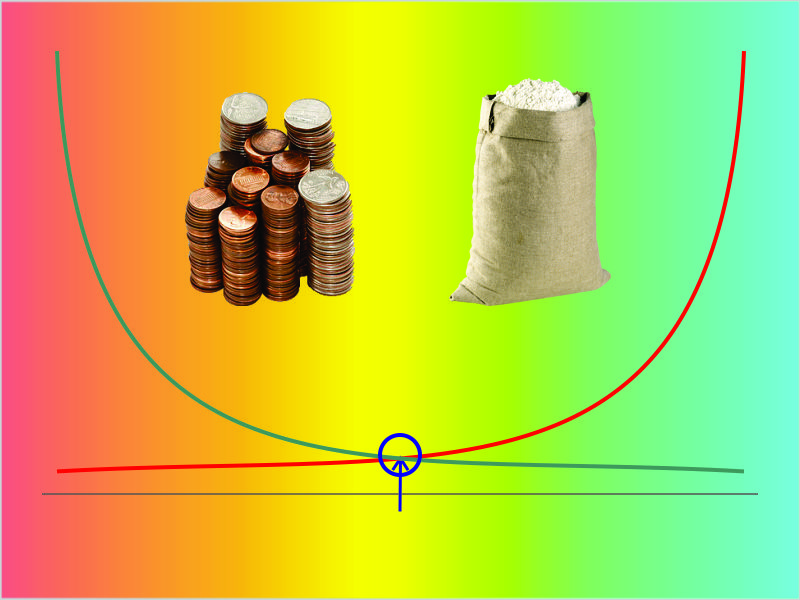
“That’s one of the oldest theories in economics, the idea that low supply increases prices and conversely. Economists often use two hyperbolas to describe the trade-off. Unfortunately, the idea’s only sorta true and only for certain markets. Oh, and it’s only sorta related to how fast money flows through the economy.”

“C’mon, Sy, you’re talking to a professional here. I watch my costs pretty close. Supply-demand tells my story — a bad tomato harvest drives my red sauce price through the roof.”

“No question it works for some products where there’s many independent buyers, many independent sellers, everyone has the same information, and a few other technical only-ifs. It’s what they call a perfect market. How many different companies do you buy flour from?”

“Three or four in town here. I switch around. Keeps ’em on their toes and holds their price down.”

“Competition’s a good thing, right? No buyer pays more than they absolutely must and no seller takes less than their competition does. Negative feedback all over the place. If one vendor figures out an advantage and can make money selling the same stuff for a lower price, everyone else copies them and the market price settles into a new lower equilibrium and there’s no advantage any more.”

“Yeah, that’s the way it works for flour.”

“And a few other commodities like grains and metals and West Texas crude. Economic theorists love the perfect-market model because it sets prices so nicely. Physicists love ideal cases, too — frictionless pulleys on infinitely sharp pivots, that kind of thing, where you can ignore the practical details. Most markets have lots of practical considerations that gum up the works.”

“Devil’s in the details, huh?”

“Sure. I seem to recall you’ve got a favorite sausage supplier.”

“Yeah, my brother-in-law Joey. OK, he’s family, but he does good work — fresh meat ground exactly the way I want it, got a good nose for spices, dependable delivery, what’s not to like?”

“Is he more expensive?””

“A little, a little, but it’s worth it.”

“So hereabouts there’s an imperfect market for sausage. The economists might tally Joey’s extra profit from that premium price to an accounting column labeled ‘Goodwill.’ A physicist would have another name for it.”

“Goodwill. Joey’d like that. So what would the physicist call it?”

“Real mechanical systems are never perfectly energy‑efficient. Energy is always lost to friction. In my money‑physics framework money’s lost to friction. It’s the reason you pay a premium above what would be perfect‑market price for sausage. Nothing wrong with that so long as you know you’re doing it and why. Most real markets are loaded with friction of various sorts. Think of market regulators as mechanics, running around with oil cans as they reduce inefficiency and friction.”

“What other frictions … lemme think. Monopoly, for sure — some big chain takes over my market, drives me the rest of the way out of business and then they can charge whatever they want. Umm … collusion, either direction. Advertising, maybe, but that’s mostly legal.”

“You got the idea. So, how is business?”

“Are you kidding? Way off. I had to lay off people, now it’s just me baking and delivering.”

“Would you buy flour these days at the usual price?”

“Nah. At the rate things are going what I got will last me for a l‑o‑o‑n‑g time. I got no place to put any more.”

“Your customers aren’t buying, you’re not buying, money’s not changing hands. The velocity of money’s so low that supply-demand isn’t capable of setting price. That’s deflation, not market friction.”

“Either way, it hurts.”

~~ Rich Olcott

The Buck Rolls On, We Hope

<knock, knock> “Door’s open. Come in but maintain social distance.”

“Hiya, Sy. Here’s your pizza, still hot and everything but no pineapple.”

“Thanks, Eddie. Just put it on the credenza. There’s a twenty there waiting for you. Put the balance on my tab.”

“Whoa, I recognize this bill. It’s the one that Vinnie won off me at the after‑hours dice game last month before all this started. See, I initialed it down here on the corner ’cause Vinnie usually don’t do that well. How’d you get it from him?”

“I didn’t get it from Vinnie, I got it from Al when I sold him a batch of old astronomy magazines. Vinnie must have finally paid off his tab at Al’s coffee shop.”

“Funny how that one bill just went in a circle. Financed some risky business, paid off a loan, bought stuff, and here I get it again so I can buy stuff to make more pizza. That’s a lotta work for one piece of paper.”

“Mm-hm. Everyone’s $20 better off now, all because the bill kept moving. Chalk it off to ‘the velocity of money.‘ If Vinnie didn’t spend that money the velocity’d be zero and none of the rest would have happened.”

“That sounds suspiciously like Physics, Sy.”

“Guilty as charged, Eddie. Just following along with what Isaac Newton started back when he was staying at his mother’s place, hiding out from the bubonic plague.”

Newton, after a day at the beach
while wearing an anti-viral mask

“What’s that got to do with money? Was Newton a banker?”

“Not quite, although the last 30 years of his life he headed up England’s Royal Mint. The core of his work during his Science years was all about change and rate of change. His Laws of Motion quantified what it takes to cause change. He developed his version of calculus to bridge between how fast change happens and how much change has happened.”

“Hey, that’s those graphs you showed me, with the wave on the top line and the slope underneath.”

“Bingo. Pandemics are a long way from the simple systems that Newton studied, but the important point is that to study his planets and pendulums he developed general strategies for tackling complex situations. He started with just a few basic concepts, like position and speed, and expanded on them.”

“Speed’s speed, what’s to expand?”

“Newton expanded the notion of speed to velocity, which also includes direction. From Newton’s point of view, the velocity of a planet in orbit is continuously changing even if its miles per hour is as steady as … a planet.”

“Who cares?”

“Newton did, because he wanted to know what makes the change happen. His starting point was if there’s any motion, it’s got to be at constant speed and in a straight line unless some force causes a velocity change. That’s where his notion of gravity came from — he invented the idea of ‘the force of gravity‘ to account for us not flying off the rotating Earth and the Earth not zooming away from the Sun. His methods set the model that physicists have followed ever since — if we see motion, we measure how fast it’s happening and then we look for the force or forces that can explain that.”

“Now I see where you’re going. That ‘velocity of money‘ thing is about how fast the paper changes hands, isn’t it? Wait, if Vinnie had put that twenty up on his wall as a trophy, then the chain would’ve been broken.”

“Right, or if Al had diverted it to buy, say, coffee beans. That’s why we say velocity of money and not speed, because the direction of flow counts.”

“Smelling more and more like Physics, Sy. Like, there’s astrophysics and biophysics and you’re coming up with econophysics.”

“Well, yeah, but I didn’t invent the term. It’s already out there, with textbooks and academic study groups and everything. It’s just interesting to use economics as a metaphor for physics and vice-versa. The fun is in seeing where the metaphors break down.”

“I see one already, Sy. Those forces — we all had different reasons to kick the bill along.”

“Good point. Now we figure out those forces.”

~~ Rich Olcott

Shortfall

<chirp, chirp> The non-business line again. “Moire here.”

“Hiya, Sy, it’s Eddie. I’m taking orders for tonight’s deliveries. I got some nice-looking artichokes here, how about a garlic and artichoke pizza?”

“No thanks, Eddie, I’ll stick with my usual pepperoni. Wait, you got any ham?”

“Sure.”

“Let’s go with a Hawai’ian.”

“Sy, we’ve had this conversation. You want pineapple on pizza you open a can and dump some on there after I leave the premises and don’t tell me. I got standards!”

“Calm down, Eddie, just yanking your chain. Yeah, do me one of those garlic and artichoke ones. Sounds more classical.”

“That’s better. I got you in the 6:15 wave, OK? Hey, that reminds me. I read your post series about waves and that got me thinking.”

“Nice to know someone reads them.”

“Well, things are real quiet, just me in the kitchen these days so I’m scraping the barrel, you know?”

“Ouch.”

“Gotcha back. Anyhow, that series was all about wiggly waves that repeat regular-like, right? I get that scientists like ’em ’cause they’re easy to calculate with. But that Logic Curve you wrote about goes up and doesn’t come back down again. Does anybody do math with that kind?”

Logistic Curve — blue line,
Associated slope — red line

“Logistic Curve. ‘Logic Curve‘ isn’t a thing. The mathematicians have come up with a plethora of curves and curve families. The physicists have found uses for many of them. The Logistic Curve, for instance, is one of the first tools they take off the shelf for systems that have both lower and upper limits. You’ve seen a lot about how it’s applied to epidemiology. People also use it for ecology, economics, linguistics, chemistry, even agriculture.”

“What do the top and bottom lines have to do with each other?”

“Ah. Sorry I hadn’t made that clear. OK, find a blank page in your order pad. At the top draw a horizontal zig-zag line like a series of 45‑degree triangles touching corners.”

“45 degrees is easy — that’s an 8-slice pizza. Done.”

“You’ve just drawn what’s called a triangle wave, no surprise. OK, now right under that, you’re going to draw another wave that shows the slope of each triangle segment. Where the triangle line goes up you’ve got a positive slope that goes up one unit for every unit across so draw a line at plus‑one, OK?”

“A-ha. Got it.”

“Where the triangle line goes down you’ve got a negative slope, minus‑one.”

“What about where the triangles got points?”

“Just draw a vertical line to connect the slope segments. What’s the completed second line look like?”

“A zig-zag bunch of square boxes. Hey, wait, we made the second line be the slopes for all the pieces, right? Lemme go check the picture in the ‘Curve‘ post. So what you’re saying is … the red line is all the slopes along the blue line … OK, can I say that the red line is how fast stuff is coming at me and the blue line is the backlog?”

“Half-right. For what we’re talking about, ‘slope‘ is whatevers per time‑unit. The blue line shows how much total has come at you so far. Backlog is a little more complicated.”

“I gotta go back and read those posts again. Now I see why they’re saying ‘flattening the curve‘ — they want the blue line to not climb so fast.”

“That’s part of it.. Flattening that red-line curve as much as we can is important. That’s what the masks and social distancing are about. Maybe as many people get sick, total, but if they trickle in instead of flooding in then they don’t overload the system. Here, I’ll send a sketch to your phone.”

“Got it, but there’s lots of lines there.”

“The red line is your completion rate — pizza orders per hour, patients per day, whatever. The red line goes flat because having only one oven limits your throughput. The gray part above it is pizzas per hour you couldn’t bake or patients your hospital couldn’t take that day. The green line is doable business; the black line shows how more capacity would have improved things.”

“Reduce the incoming, raise the capacity or lose the people. Whoa.”

~~ Rich Olcott

Flattening The Curve

<chirp chirp> My phone’s non-business ring-tone. “Moire here.”

“Hi, Mr Moire, it’s me, Jeremy, again. Sorry for the hold-up. My phone’s on the charger now so we can keep going about the Logistics Curve and all.”

“Logistic Curve, Jeremy, singular. Logistics plural has to do with managing the details of a military or business operation. That’s quite different from population growth which is what the Logistic Curve is about. Though come to think of it, these days we’re seeing a tie‑in. So where were we?”

“We had that S-shaped Logistic Curve with exponential growth at the beginning but then it plateaus and you showed me a humpy curve that’s the slope of the other one and you said the humpy curve is like R = K*S*(N‑S) if N is everybody and S is how many are susceptible to the virus. But you kind of skipped over K.”

“True and I’ll get to K, but that ‘humpy’ curve is important. In the context of the pandemic, it’s people per day — how many catch the virus, how many show up for medical care, how many need ventilators or even mortuary care — there’s a different K for each question. The hump is what we’re trying to get control of. The K factors summarize a whole pipeline of ifs and maybes. Some of them are knobs that we may be able to use to flatten the hump.”

“We can do that? How?”

“Good question. Here, let me send your phone another image. Let me know when you receive it.”

“It’s here, Mr Moire. Looks like you’ve got three Logistic Curves but they’re stretched out different amounts.”

“Stretched out on the time axis, and that’s crucial. I generated those three plots by using different values for K. Sooner or later in all three models everyone catches the bug. In the blue-line case, though, that happens over a much longer time interval than in the red-line case. If you’re a public health official or hospital administrator you pray for the blue-line case — the slow initial rise gives you a heads-up and more time to get ready for future incoming cases. Better yet, because the cases-per-day peak is flatter you don’t need as many masks and ventilators to take of the patients and your front-line people are less likely to be over‑extended. Assuming you’ve hired enough in the first place.”

“So the government wants to reduce the K numbers to get to the blue-line case.”

“Absolutely. Keep in mind, K is such a complicated summary of things that realistic models are complex. Experienced modelers know that the more factors you put into a model, the riskier the predictions become. Anyway some of the things that go into K we can’t control, we can only measure or estimate them and try to account for what’d happen if something changes.”

“Like what?”

“Suppose you’re exposed to the virus. What’s the probability that you’ll come down with symptoms bad enough to need medical care? Current data suggests those odds depend a lot on uncontrollable things like your age and medical history. A model for a retirement community almost certainly needs a different set of K-values then a model for a college town full of teens and twenty-somethings. But that gets into a different cluster of factors.”

“That’s for sure. My grandparents are a lot more careful about their health than my crew is.”

“Which gets us into the K-factors we can at least try to manage. Simple example — you can’t catch the virus if you’re not exposed to it. That’s what Social Distancing is all about and that’s why you’re staying at home, thank you very much. Typically, models gauge that piece by surveying what fraction of the population is complying with the stay-at-home, masking and 6-feet-away rules. We need to get to 70% or better to keep the patients-per-day rate down to what the hospitals can cope with. A vaccine, when we get one, will have the same effect but that’s a year away.”

“Yeah, and if someone invents a good treatment so people don’t have to go on ventilators, that’d help the K for that end of the pipeline.”

“Get to work on it, Jeremy.”

~~ Rich Olcott

The Curve To Be Flattened

<chirp chirp> My phone’s ring-tone for an non-business call. “Moire here.”

“Mr Moire, it’s Jeremy.”

“I hope so, Jeremy, my phone shows your caller-ID. I’m glad you called instead of trying to drop by, the city being under lockdown orders and all. What’s your question?”

“Oh, no question, sir, I just called to chat. It’s lonely over here. If you’ve got the time, anything you’d like to talk about would be fine.”

“Mm… Well, I am working on a project but maybe talking it out will help get my thoughts in order. Have you seen that ‘Flatten the curve‘ chart?”

“Sure, it’s been hard to escape. They use it to tell us why we shouldn’t do group stuff while this virus is going around. Are you writing about where the chart comes from?”

“That’s my project, all right. There’re two ways to get to that chart and I’m trying to decide which will work better. I could start from ecology studies of invading organisms taking over a new territory. At first the organisms multiply rapidly, doubling then doubling again —”

“That’s exponential growth, Mr Moire. We talked about that!”

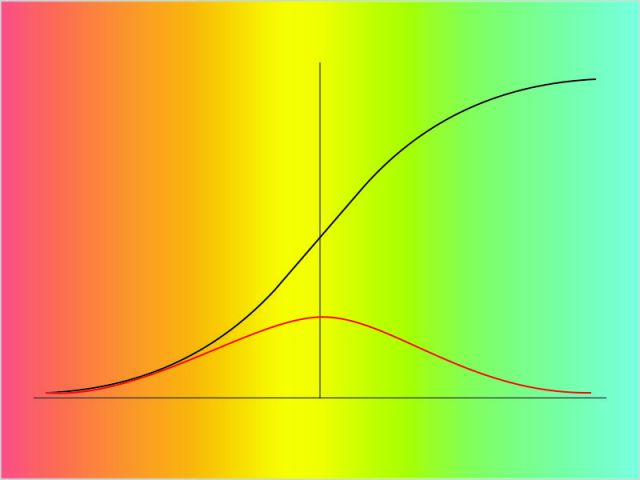
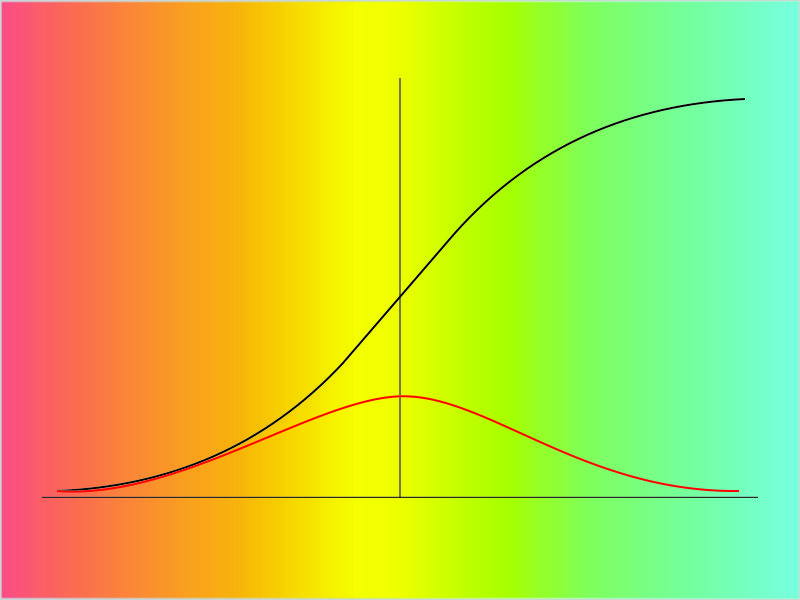
“Just sent you an image. When researchers plot invasions they usually look like the black line, the Logistic Curve. Its height represents the organism’s population as time increases left-to-right. At the beginning there’s that exponential rise. Over on the right the growth rate slows as the plants or animals or bugs use up increasingly scarce resources. The part in the middle’s almost linear. All that’s a familiar story by now, right?”

The Logistic Curve (black) and its slope (red)

“Uh-huh. We talked a lot about ecology back in kid school except we hadn’t learned graphs yet. What’s the red curve?”

“That’s the interesting part I’m trying to write about. One way to look at it is that it’s simply the slope of the Logistic curve. See how where the Logistic is rising, the slope is rising, too? That’s the way exponentials work — ‘the higher the faster‘ as they say. The slope switches direction just where the Logistic switches from growth to slow-down. The Logistic Curve approaches its limit when the organism’s population approaches the carrying capacity of the territory. That’s also where the slope gets shallowest. Very few resources, very little expansion.”

“What’s the other way to look at it?”

“We start with the slope curve itself. It has its own straight-forward interpretation, especially if the organism is a a bacterium or virus that causes disease. Consider the population under attack as the resource. How fast will the disease spread?”

“Uh… what I keep hearing is that if more people get sick, other people will get infected faster.”

“But what happens when nearly everyone’s caught it and they’ve either recovered or left us?”

“Oh, there’ll be fewer people left to catch it so the disease spreads more slowly.”

“Let me put that into algebra. I’ll write N for the total number of people and that’ll be a constant, we hope. At any given time we’ve got S as the current number of people who are susceptible. Then (N‑S) tells us how many people are NOT susceptible. Are you with me?”

“Fine so far.”

“So from what we’ve just said, the rate of infection is low when S is low and also low when (N‑S) is low. One way to make that into an equation is to write the rate as R = K*S*(N‑S). K is just a number we can adjust to account for things like virulence and Social Distance effectiveness. If we plot R against time what shape will it have?”

“Mmm… S is nearly the same as N at the start so (N‑S) is nearly zero then. At the finish, S is nearly zero. Exactly in the middle S equals (N‑S). They each have to be higher than near-zero there. That makes R be low at each end and high in the middle. Ah, that’s sort-of the shape of the slope curve!”

“It’s exactly the shape of the slope curve. So how do we flatten it?”

<click-click, click-click> “Oops, Mr Moire, my phone battery’s about dead. Gotta go get the charger. I’ll be right back.”

“I’ll be here, Jeremy.”

~~ Rich Olcott

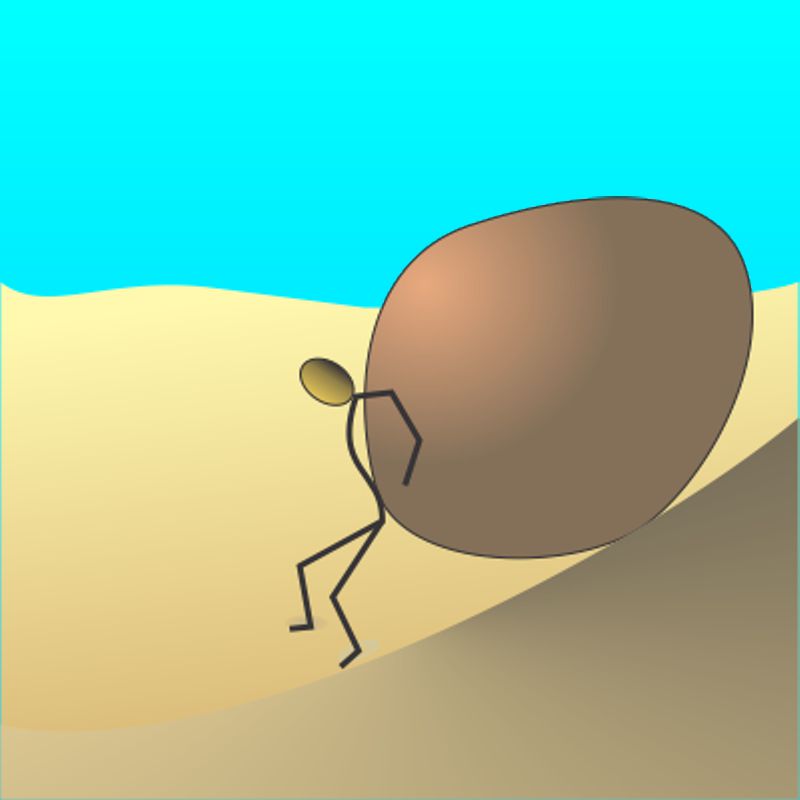
Sisyphus on A Sand Dune

I’m walking the park’s paths on a lovely early Spring day when, “There you are, Moire. I got a question!”

“As you always do, Mr Feder. What’s your question this time?”

“OK, this guy’s saying that life is all about fighting entropy but entropy always increases anyway. I seen nothing in the news about us fighting entropy so where’s he get that? Why even bother if we’re gonna lose anyway? Where’s it coming from? Can we plug the holes?”

“That’s 4½ questions with a lot of other stuff hiding behind them. You’re going to owe me pizza at Eddie’s AND a double-dip gelato.”

“You drive a hard bargain, Moire, but you’re on.”

“Deal. Let’s start by clearing away some underbrush. You seem to have the idea that entropy’s a thing, like water, that it flows around and somehow seeps into our Universe. None of that’s true.”

“That makes no sense. How can what we’ve got here increase if it doesn’t come from somewhere?”

“Ah, I see the problem — conservation. Physicists say there are two kinds of quantities in the Universe — conserved and non‑conserved. The number of cards in a deck is is a conserved quantity because it’s always 52, right?”

“Unless you’re in a game with Eddie.”

“You’ve learned that lesson, too, eh? With Eddie the system’s not closed because he occasionally adds or removes a card. Unless we catch him at it and that’s when the shouting starts. So — cards are non-conserved if Eddie’s in the game. Anyway, energy’s a conserved quantity. We can change energy from one form to another but we can’t create or extinguish energy, OK?”

“I heard about that. Sure would be nice if we could, though — electricity outta nothing would save the planet.”

“It would certainly help, and so would making discarded plastic just disappear. Unfortunately, mass is another conserved quantity unless you’re doing subatomic stuff. Physicists have searched for other conserved quantities because they make calculations simpler. Momentum‘s one, if you’re careful how you define it. There’s about a dozen more. The mass of water coming out of a pipe exactly matches the mass that went in.”

“What if the pipe leaks?”

“Doesn’t matter where the water comes out. If you measure the leaked mass and the mass at the pipe’s designed exit point the total outflow equals the inflow. But that gets me to the next bit of underbrush. Energy’s conserved, that’s one of our bedrock rules, but energy always leaks and that’s another bedrock rule. The same rule also says that matter always breaks into smaller pieces if you give it a chance though that’s harder to calculate. We measure both leakages as entropy. Wherever you look, any process that converts energy or matter from one form to another diverts some fraction into bits of matter in random motion and that’s an increase of entropy. One kind of entropy, anyway.”

“Fine, but what’s all this got to do with life?”

“It’s all to get us to where we can talk about entropy in context. You’re alive, right?”

“Last I looked.”

“Ever break a bone?”

<taps his arm> “Sure, hasn’t everybody one time or another?”

“Healed up pretty well, I see. Congratulations. Right after the break that arm could have gone in lots of directions it’s not supposed to — a high entropy situation. So you wore a cast while your bone cells worked hard to knit you together again and lower that entropy. Meanwhile, the rest of your body kept those cells supplied with energy and swept away waste products. You see my point?”

“So what you’re saying is that mending a broken part uses up energy and creates entropy somewhere even though the broken part is less random. I got that.”

“Oh, it goes deeper than that. If you could tag one molecule inside a living cell you’d see it bouncing all over the place until it happens to move where something grabs it to do something useful. Entropy pushes towards chaos, but the cell’s pattern of organized activity keeps chaos in check. Like picnicking on a windy day — only constant vigilance maintains order. That’s the battle.”

“Hey, lookit, Eddie’s ain’t open. I’ll owe you.”

“Pizza AND double-dip gelato.”

~~ Rich Olcott

Presbyopic Astronomy

Her phone call done, Cathleen returns to the Spitzer Memorial Symposium microphone with her face all happiness. “Good news! Jim, the grant came through. Your computer time and telescope access are funded. Woo-hoo!!”

<applause across the audience and Jim grins and blushes>

Cathleen still owns the mic. “So I need to finish up this overview of Spitzer highlights. Where was I?”

Maybe-an-Art-major tries to help. “The middle ground of our Universe.”

“Ah yes, thanks. So we’ve looked at close-by stars but Spitzer showed us a few more surprises lurking in the Milky Way. This, for instance — most of the image is colorized from the infra‑red, but if you look close you can see Chandra‘s X‑ray view, colorized purple to highlight young stars.”

The Cepheus-B molecular cloud
X-ray: NASA/CXC/PSU/K. Getman et al.; IRL NASA/JPL-Caltech/CfA/J. Wang et al

<hushed general “oooo” from the audience>

“Giant molecular clouds like this are scattered throughout the Milky Way, mostly in the galaxy’s spiral arms. As you see, this cloud’s not uniform, it has clumps and voids. By Earth standards the cloud is still a pretty good vacuum. The clumps are about 10-15 of our atmosphere’s density, but that’s still a million times more dense than our Solar System’s interplanetary space. The clumps appear to be where new stars are born. The photons and other particles from a newly-lit star drive the surrounding dust away. My arrow points to one star with a particularly nice example of that — see the C-shape around the star?”

The maybe-an-Art-major pipes up. “How about that one just a little below center?”

“Uh-huh. There’s so much activity in that dense region that the separate shockwaves collide to create hot spots that’ll generate even more stars in the future. The clouds are mostly held together by their own gravity. They last for tens of millions of years, so we think of them as huge roiling stellar nurseries.”

“Like my kid’s day care center but bigger.”

“Mm-mm, but let’s turn to the Milky Way’s center, home of that famous black hole with the mass of four million Suns and this remarkable structure, a double-helix of warm dust.”

False-color infra-red image of the Double-Helix Nebula
The double helix nebula.
Credit: NASA/JPL-Caltech/M. Morris (UCLA)

Vinnie blurts out, “That’s a jet from a black hole! One of Newt’s babies.”

Newt can’t resist breaking into Cathleen’s pitch. “Maybe it’s a jet, Vinnie. Yes, it’s above the central galactic plane and perpendicular to it, but the helix doesn’t quite point to the central black hole.”

“So take another picture that follows it down.”

“We’d love to, but we can’t. Yet. That image came from a long-wavelength instrument that only operated during Spitzer‘s initial 5-year cold period. Believe me, there are bunches of astronomers who can’t wait for the James Webb Space Telescope‘s far-IR instruments to get into position and start doing science. Meanwhile, we’ve got just the one image and a few earlier ones from an even less-capable spacecraft. This thing may be a lit-up part of a longer structure that twists down to the black hole or at least its accretion disk. We just don’t know.”

Cathleen takes control again. “The next image comes from outside our galaxy — far outside.”

Spitzer visualization of Galaxy MACS 1149-JD1
Credit: NASA/ESA/STScI/W. Zheng (JHU), and the CLASH team

The maybe-an-Art-major snorts, “Pointillism derivative!”

“No, it’s pixels from a starfield image with a very low signal-to-noise ratio. That red blotch in the center is one of the most distant objects ever observed, gracefully named MACS 1149-JD1. It’s a galaxy 13.2 billion lightyears away. That’s so far away that the expansion of the Universe has stretched the galaxy’s emitted photons by a factor of 10.2. Spectrum-wise, 1149-JD1’s ultra-violet light skipped right past the visible range and down into the near infra-red. Intensity-wise, that galaxy’s about 5200 times further away than the Andromeda galaxy. Assuming the two are about the same overall brightness, 1149-JD1 would be about 27 million times fainter than Andromeda.”

“How can we even see anything that dim?”

“We couldn’t, except for a fortunate coincidence. Right in line between us and 1149-JD1 there’s a massive galaxy cluster whose gravity acts like a lens to focus 1149-JD1’s light.”

The seminar’s final words, from maybe-an-Art-major — “A distant light, indeed.”

~~ Rich Olcott

Myopic Astronomy

Cathleen goes into full-on professor mode. “OK folks, settle down for the final portion of “IR, Spitzer and The Universe,” our memorial symposium for the Spitzer Space Telescope which NASA retired on January 30. Jim’s brought us up to speed about what infra-red is and how we work with it. Newt’s given us background on the Spitzer and its fellow Great Observatories. Now it’s my turn to show some of what Astronomy has learned from Spitzer. Thousands of papers have been published from Spitzer data so I’ll just skim a few highlights, from the Solar System, the Milky Way, and the cosmological distance.”

“Ah, Chinese landscape perspective,” murmurs the maybe-an-Art-major.

“Care to expand on that?” Cathleen’s a seasoned teacher, knows how to maintain audience engagement by accepting interruptions and then using them to further her her own presentation.

“You show detail views of the foreground, the middle distance and the far distance, maybe with clouds or something separating them to emphasize the in‑between gaps.”

“Yes, that’s my plan. Astronomically, the foreground would be the asteroids that come closer to the Earth than the Moon does. Typically they reflect about as much light as charcoal so our visible-light telescopes mostly can’t find them. But even though asteroids are as cold as interplanetary space that’s still above absolute zero. The objects glow with infra-red light that Spitzer was designed to see. It found hundreds of Near-Earth Objects as small as 6 meters across. That data helped spark disaster movies and even official conversations about defending us from asteroid collisions.”

<A clique in the back of the room> “Hoo-ahh, Space Force!

Some interruptions she doesn’t accept. “Pipe down back there! Right, so further out in the Solar System, Spitzer‘s ability to detect glowing dust was key to discovering a weird new ring around Saturn. Thanks to centuries of visible‑range telescope work, everyone knows the picture of Saturn and its ring system. The rings together form an annulus, an extremely thin circular disk with a big round hole in the middle. The annulus is bright because it’s mostly made of ice particles. The annulus rotates to match Saturn’s spin. The planet’s rotational axis and the annulus are both tilted by about 27° relative to Saturn’s orbit. None of that applies to what Spitzer found.”

Vinnie’s voice rings out. “It’s made of dust instead of ice, right ?”

Cathleen recognizes that voice. “Good shot, Vinnie, but the differences don’t stop there. The dust ring is less a disk than a doughnut, about 200 thousand times thicker than the icy rings and about 125 times wider than the outermost ice ring. But the weirdest part is that the doughnut rotates opposite to the planet and it’s in Saturn’s orbital plane, not tilted to it. It’s like the formation’s only accidentally related to Saturn. In fact, we believe that the doughnut and its companion moon Phoebe came late to Saturn from somewhere else.”

She takes a moment for a sip of coffee. “Now for the middle distance, which for our purpose is the stars of the Milky Way. Spitzer snared a few headliners out there, like TRAPPIST-1, that star with seven planets going around it. Visible-range brightness monitoring suggested there was a solar system there but Spitzer actually detected light from individual planets. Then there’s Tabby’s Star with its weird dimming patterns. Spitzer tracked the star’s infra‑red radiance while NASA’s Swift Observatory tracked the star’s emissions in the ultra‑violet range. The dimming percentages didn’t match, which ruled out darkening due to something opaque like an alien construction project. Thanks to Spitzer we’re pretty sure the variation’s just patchy dust clouds.”

Spitzer view of the Trifid Nebula
Credit: NASA/JPL-Caltech/J. Rho (SSC/Caltech)

<from the crowd in general> “Awww.”

“I know, right? Anyway, Spitzer‘s real specialty is inspecting warm dust, so no surprise, it found lots of baby stars embedded in their dusty matrix. Here’s an example. This image contains 30 massive stars and about 120 smaller ones. Each one has grown by eating the dust in its immediate vicinity and having lit up it’s now blowing a bubble in the adjacent dust.” <suddenly her cellphone rings> “Oh, sorry, this is a call I’ve got to take. Talk among yourselves, I’ll be right back.”

~~ Rich Olcott