Why So Big?

“How come so big, kid?”

“Beg pardon, Mr Feder?”

“Mars has the biggest volcanoes and all, like that canyon you can’t even see across.  Earth’s bigger than Mars, right?  How come we don’t have stuff like that?”

“Maybe we do but we’ve not found it yet.  Earth’s land area is only 4% greater than the surface area of Mars.  Our ocean floor and what’s beneath the Greenland and Antarctic ice sheets are like a whole second planet twice as big as the land we’ve explored so far.  Some people refer to the Mid-Atlantic Ridge as a 10000-mile-long volcano.  No-one knows for sure what-all else is down there.  Even on land we’ve probably had enormous landforms like Alba Mons but on the geologic timescale they don’t last long here.”

“So like I said, how come?”

“Because of what we have that Mars doesn’t.  Massive forces of erosion — wind, water, Goldilocks temperatures — that grind down landforms something fierce.”

Watney_s route 420
Mark Watney’s travel route in The Martian.
Image by ESA/DLR/FU Berlin
under Creative Commons license

“Wait, Mars has winds.  What about those dust storms, and that windstorm that damn near destroyed Watney’s spaceship?”

“Um, Watney’s a fictional character.  The dust storms do exist, though —  one of them created a blackout that may have killed the Opportunity rover’s solar power.  But Martian dust grains are about the size of smoke particles.  Doesn’t take much of a wind to get those grains into the air and keep them there even in Martian atmosphere that’s only 1% as thick as Earth’s.  A 120-mph wind on Earth would blow you over, but one on Mars would just give you a gentle push.  Martian winds can barely roll a sand grain along the ground.  They definitely can’t sandblast a volcano like Earth winds can.  Which, by the way is why planetologists panned that storm scene in your The Martian movie.  Couldn’t happen.  The film production team admitted that.  The rest of the science was pretty good, though.”

“OK then, water.  You talking like dripping water can wear a hole in a rock?”

“More like water in quantity — glaciers carving off mountaintops and rivers digging canyons and ocean waves smashing shorelines to sandy powder.  Dripping water works, too — water’s corrosive enough even at low temperatures that it can dissolve most kinds of rock if you give it enough time.  But Mars has no glaciers or rivers or oceans.  Probably no dripping water, either”

“You were kidding about Goldilocks, right?  Talk about fictional characters!”

“Not in this case.  To planetologists, ‘Goldilocks’ is a technical term.  You know, ‘not too cold, not too warm…”

“‘Just right,’ yeah, yeah.  But just right for what?  What’s Mars got that’s Goldilocks-ish?”

“Sorry, it’s Earth that has the Goldilocks magic, not Mars, and what’s just right is that we’re in the right temperature range for water to exist in gas and liquid and solid forms.  Mars’ surface is way too cold for liquid water.”

“Wait, I read that they’d found liquid water there.”

“Not on the surface.  The radar experiment aboard European Space Agency’s Mars Express spacecraft found an indication of liquid water, but it’s a kilometer below the surface.  Twenty kilometers wide, maybe a meter thick — more of a pond than the ‘lake’ the media were talking about.”

“Why should it make a difference that Earth’s Goldilocks-ish?  I mean, we’re comfortable but we’re not rocks.  What’s that got to do with the volcanoes?”

“Recycling, Mr Feder, recycling.  On Mars, if enough gaseous water molecules could get together to make rain, which they can’t, they’d freeze to the ground and stay there for a long, long time.  On Earth, though, most rain stays liquid and you get ground water or run-off which eventually evaporates and rains down again.  The same molecules get many, many chances to grind down a mountain.”

“But Earth water can freeze, too.”

“Remember we’re Goldilocks-ish.  Liquid water soaks into a cracked rock where it freezes, expands to pry off a chip or two, and thaws to freeze again.  Water’s freeze-thaw cycle can do a lot of damage if it gets to repeat often enough.”

“So Mars has big stuff because…”

“The planet’s too cold to wear it away.”

~~ Rich Olcott
Raindrops landing in a red-brown puddle
Adapted image from Clipart-library.com

The Big Splash? Maybe.

You’ve not seen half of it, Mr Feder.  Mars has the Solar System’s tallest volcano, most massive volcano, biggest planetary meteor strike, deepest and longest  canyon…”

“Wait, kid, I’ve been to the Grand Canyon.  Thing is … BIG!  What’d they say?  A mile deep, 18 miles wide, 250 miles long.  No way Mars can beat that.”

“Valles Marineris is 4½ miles deep, 120 miles wide and 2500 miles long.  The Grand Canyon meanders, packing its length into only 150 miles of bee-line distance.  Marineris stretches straight as a string.  No river carved that formation, but the planetologists can’t agree on what did.”

Labeled Mars map 2 420
Mars map from NASA/JPL/GSFC

“They got evidence, don’t they?”

“Not enough.  Different facts point in different directions and no overall theory has won yet.  Most of it has to do with the landforms.  Start with the Tharsis Bulge, big as a continent and rising kilometers above Mars’ average altitude.  Near the Bulge’s highest point, except for the volcanoes, is a fractured-looking region called Noctis Labyrinthus.  Starting just west of  the Labyrinth a whole range of wrinkly highlands and mountains arcs around south and then east to point towards the eastern end of Marineris.  Marineris completes the arc by meeting the Labyrinth to its west.  Everything inside that arc is higher than everything else around it.  Except for the volcanoes, of course.”

“Looks like something came up from underneath to push all that stuff up.”

“Mm-hm, but we don’t know what, or what drove it, or even how fast everything happened.  There are theories all over the place”

“Like what?”

“Well, maybe it’s upwellng from a magma hotspot, like the one under the Pacific that’s been creating Hawaiian Islands one at a time for the past 80 million years.  Some people think the upwelling mostly lifted the existing crust like expanding gas bubbles push up the crust of baking bread.  Other people think that the upwelling’s magma broke through the crust to form enormous lava flows that covered up whatever had been there before.”

“You said ‘maybe.'”

“Yeah.  Another group of theories sees a connection between Tharsis and Hellas Basin, which is almost exactly on the other side of the planet.  Hellas is the rock-record of a mega-sized meteorite strike, the third largest confirmed one in the Solar System.  Before you ask, the other two are on the Moon.  Like I said, it’s a group of theories.  The gentlest one, if you can call it that, is that energy from the impact rippled all around the planet to focus on the point opposite the impact.  That would have disrupted the local equilibrium between crustal weight and magma’s upward pressure.  An imbalance like that would encourage uplift, crustal cracking and, ultimately, Valles Marineris.”

“Doesn’t sound very gentle.”

“It wouldn’t have been but it might even have been nastier.  Another possibility is that the meteorite may not have stopped at the crust.  It could have hit hard enough, and maybe with enough spin, to drill who knows how far through the fluid-ish body of the planet, raising the Bulge just by momentum and internal slosh.  Worst case, some of Tharsis’ rock might even have come from the intruder.”

Realistic Orange-red Liquid Splash Vector
Adapted from an image by Vecteezy

“Wow, that would have been a sight to see!”

“Yeah, from a distance.  Any spacecraft flying a Mars orbit would be in jeopardy from rock splatter.  We’ve found meteors on Earth that we know originated on Mars because they have bubbles holding trapped gas that matches the isotope signature of Martian atmosphere.  A collision as violent as the one I just described could certainly have driven rocky material past escape velocity and on its way to us.  Oh, by the way and speaking of sights — you’d be disappointed if you actually visited Valles Marineris.”

“How could anything that ginormous be a disappointment?”

“You could look down into it but you probably couldn’t see the far side.  Mars is smaller than Earth and its surface curves downward more rapidly.  Suppose you stood on one side of the valley’s floor where it’s 4 miles deep.  The opposite wall, maybe 100 miles away, would be beyond your 92-mile horizon limit for an object that tall.”

“Aw, phooey!”

~~ Rich Olcott

Holes in The Ground — Big Ones

Al’s stacking chairs on tables, trying to close his coffee shop, but Mr Richard Feder (of Fort Lee, NJ) doesn’t let up on Jim.  “What’s all this about Gale Crater or Mount Sharp that Curiosity‘s running around?  Is it a crater or a mountain?  How about it’s a volcano?  How do you even tell the difference?”

That’s a lot of questions but Jim’s got game.  “Gale is an impact crater, about three and a half billion years old.  The impacting meteorite must have hit hard, because Mount Sharp’s in the middle of Gale.”

Mud drop
Adapted from a photo
by Davide Restivo, Aarau, Switzerland
[CC BY-SA 2.0] via Wikimedia Commons
“How’s that follow?”

“Have you ever watched a rain drop hit a puddle?  It forces the puddle water downward and then the water springs back up again to form a peak.  The same general process  happens when a meteorite hits a rocky surface except the solid peak doesn’t flatten out like water does.  We know that’s the way many meteor craters on the Moon and here on Earth were formed.  We’re pretty sure it’s what happened at Gale — the core of Mount Sharp (formal astronomers call it Aeolis Mons) is probably that kind of peak.”

“Only the core?  What about the rest of it?”

“That’s what Curiosity has been digging into.”  <I have to smile — Jim’s not one to do puns on purpose.>  “The rover’s found evidence that the core’s wrapped up in lots of sedimentary clays, sulfates, hematites and other water-derived minerals of a sort that wouldn’t be there unless Gale had once been a lake like Oregon’s Crater Lake.  That in turn says that Mars once had liquid water on its surface.  That’s why everyone got so excited when those results came in.”

“Oregon’s Crater Lake was from a meteorite?”

“Oops, bad example.  No, that one’s a water-filled volcanic caldera.”

“How do you know?  Any chance its volcano will blow?”

“The best evidence, of course, is the mineralogy.  Volcanoes are made of igneous rocks — lava, tefra and everything in between.  Impact craters are made of whatever was there when the meteorite hit, although the heat and the pressure spike transform a lot of it into some metamorphic form.”

“But you can’t check for that on Mars or the Moon.”

“Mostly not, you’re right, so we have to depend on other clues.  Most volcanoes, for instance, are above the local landscape; most impact structures are below-level.  There are other subtler tests, like the pattern and distance that ejecta were thrown away from the event.  In general we can be 95-plus percent sure whether we’re looking at a volcano or an impact crater.  And no, it won’t any time soon.”

“What won’t do what?”

“You asked whether Crater Lake’s volcano will erupt.  Mount Mazama blew up 7700 years ago and it’s essentially been dormant ever since.”

“There’s some weasel-wording back there — most volcanoes do this, most impacts do that.  What about the exceptions?”

“Those generally have to do with size.  The really enormous features are often hard to even recognize, much less classify.  On Mars, for instance the Northern Lowlands region is significantly smoother than most of the rest of the planet.  Some people think that’s because it’s a huge lava flow that obliterated older impact structures.  Other people think the Lowlands is old sea bottom, smooth because meteorites would have splashed water instead of raising rocky craters.”

Labeled Mars map 420
Mars map from NASA/JPL/GSFC

“I’ll bet ocean.”

“There’s more.  You’ve heard about Olympus Mons on Mars being the Solar System’s biggest volcano, but that’s really only by height.  Alba Mons lies northeast of Olympus and is far huger by volume — 600 million cubic miles of rock but it’s only 4 miles high.  Average slope is half a degree — you’d never notice the upward grade if you walked it.  Astronomers thought Alba was just a humungous plain until they got detailed height data from satellite measurements.”

“The other one’s more than 4 miles high?”

“Oh, yeah.  Olympus Mons rises about 13.5 miles from the base of its surrounding cliffs.  That’s more than the jump from the bottom of the Mariana Trench to the top of Mount Everest.”

“Things on Mars are big, alright.”

~~ Rich Olcott


Why Is Mars Red But Earth Is Blue?

The grad students’ Crazy Theory Contest event at Al’s coffee shop is breaking up.  Amanda’s flaunting the Ceremonial Broom she won with her ‘Spock and the horseshoe crabs‘ theory.  Suddenly a voice from behind me outroars the uproar.  “Hey, Mars guy, I got questions.”

Jim looks up and I look around.  Sure enough, it’s Mr Richard Feder.  I start with the introductions but he barrels right along.  “People call Mars the Red Planet, but I seen NASA pictures and it’s brown, right?  All different kinds of brown, with splotches.  There’s even one picture with every color in the rainbow.  What’s with that and what color is Mars really?”

Jim’s a newly-fledged grad student so I step in to give him a chance to think.  “That rainbow picture, Mr Feder, did it have a circular purple spot about a third of the way up from the bottom and was it mostly blue along the top?”

“Yeah, sounds about right.”

“That’s a NASA topographic map, color-coded for relative elevations, purple for low areas to red high-up.  The blue area is the Northern Lowlands surrounding the North Pole, and that purple spot is Hellas Basin, a huge meteor crater billions of years old.  It’s about 5 miles deep which is why they did it in purple.  The map colors have nothing to do with the color of the planet.”

“About your question, Mr …. Feder is it?”

“Yeah, kid, Richard Feder, Fort Lee, New Jersey.”

“Good to meet you, sir.  The answer to your question is, ‘It depends.’  Are you looking down from space or looking around on the surface?  And where are you looking?  Come to think of it, when are you looking?”

“All I’m asking is, is it red or not?  Why make it so complicated?”

“Because it is complicated.  A few months ago Mars had a huge dust storm that covered the whole planet.  At the surface it was far darker than a cloudy moonless night on Earth.  From space it was a uniform butterscotch color, no markings at all.”

“OK, say there’s no dust in the air.”

“Take away all the floating dust and it almost wouldn’t be Mars any more.  The atmosphere’s only 1% of Earth’s and most of that is CO2 — clear and colorless.”

“So what would we see looking down at the surface?”

“Uh … you’re from New Jersey, right?  What color is New Jersey’s surface?”

<a little defensively> “We got a lot of trees and farms, once you get away from all the buildings along the coast and the Interstates, so it’s green.”

“Mars doesn’t have trees, farms, buildings or roads.  What color is New Jersey underneath all that?”

“The farmland soil’s black of course, and the Palisades cliffs near me are, too.  Down-state to the south we got sand-colored sand on the beaches and clay-colored clay.”

“Mars has clay, the Curiosity rover confirmed that, and it’s got basalt like your cliffs, but it has no soil.”

“Huh? How could it not have soil?  That’s just ground-up rocks, right, and Mars has rocks.”

“Soil’s way more then that, Mr Feder.  If all you have is ground-up rocks, it’s regolith.  The difference is the organic material that soil has and regolith doesn’t — rotted vegetable matter, old roots, fungus, microorganisms.  All that makes the soil black and helps it hold moisture and generally be hospitable to growing things.  So far as we know, Mars has none of that.  We’ve found igneous, sedimentary and metamorphic rocks just like on Earth; we’ve found clays, hematites and gypsum that had to have been formed in a watery environment.  But so far no limestone — no fossilized shelly material like that would indicate life.”

“What you’re saying is that Mars colors look like Earth colors except no plants.  So why do astronomers call Earth a ‘pale blue marble’ but Mars is ‘the red planet’?”

“Earth looks pale blue from space.  The blue is the dominant color reflected from the 70% of Earth’s surface that’s ocean-covered.  It’s pale because of white light reflected from our clouds of water vapor.  Mars lacks both.  What Mars does have is finely-divided iron oxide dust, always afloat above the surface.”

“Mars looks red ’cause it’s atmosphere is rusty?”

“Yessir.”Earth and Mars

~~ Rich Olcott

A Force-to-Force Meeting

The Crazy Theory contest is still going strong in the back room at Al’s coffee shop. I gather from the score board scribbles that Jim’s Mars idea (one mark-up says “2 possible 2 B crazy!“) is way behind Amanda’s “green blood” theory.  There’s some milling about, then a guy next to me says, “I got this, hold my coffee,” and steps up to the mic.  Big fellow, don’t recognize him but some of the Physics students do — “Hey, it’s Cap’n Mike at the mic.  Whatcha got for us this time?”

“I got the absence of a theory, how’s that?  It’s about the Four Forces.”

Someone in the crowd yells out, “Charm, Persuasiveness, Chaos and Bloody-mindedness.”

“Nah, Jennie, that’s Terry Pratchett’s Theory of Historical Narrative.  We’re doing Physics here.  The right answer is Weak and Strong Nuclear Forces, Electromagnetism, and Gravity, with me?  Question is, how do they compare?”

Another voice from the crowd. “Depends on distance!”

“Well yeah, but let’s look at cases.  Weak Nuclear Force first.  It works on the quarks that form massive particles like protons.  It’s a really short-range force because it depends on force-carrier particles that have very short lifetimes.  If a Weak Force carrier leaves its home particle even at the speed of light which they’re way too heavy to do, it can only fly a small fraction of a proton radius before it expires without affecting anything.  So, ineffective anywhere outside a massive particle.”

It’s a raucous crowd.  “How about the Strong Force, Mike?”

.  <chorus of “HOO-wah!”>

“Semper fi that.  OK, the carriers of the Strong Force —”

.  <“Naa-VY!  Naaa-VY!”>

.  <“Hush up, guys, let him finish.”>

“Thanks, Amanda.  The Strong Force carriers have no mass so they fly at lightspeed, but the force itself is short range, falls off rapidly beyond the nuclear radius.  It keeps each trio of quarks inside their own proton or neutron.  And it’s powerful enough to corral positively-charged particles within the nucleus.  That means it’s way stronger inside the nucleus than the Electromagnetic force that pushes positive charges away from each other.”

“How about outside the nucleus?”

“Out there it’s much weaker than Electromagnetism’s photons that go flying about —”

.  <“Air Force!”>

.  <“You guys!”>

“As I was saying…  OK, the Electromagnetic Force is like the nuclear forces because it’s carried by particles and quantum mechanics applies.  But it’s different from the nuclear forces because of its inverse-square distance dependence.  Its range is infinite if you’re willing to wait a while to sense it because light has finite speed.  The really different force is the fourth one, Gravity —”

.  <“Yo Army!  Ground-pounders rock!”>

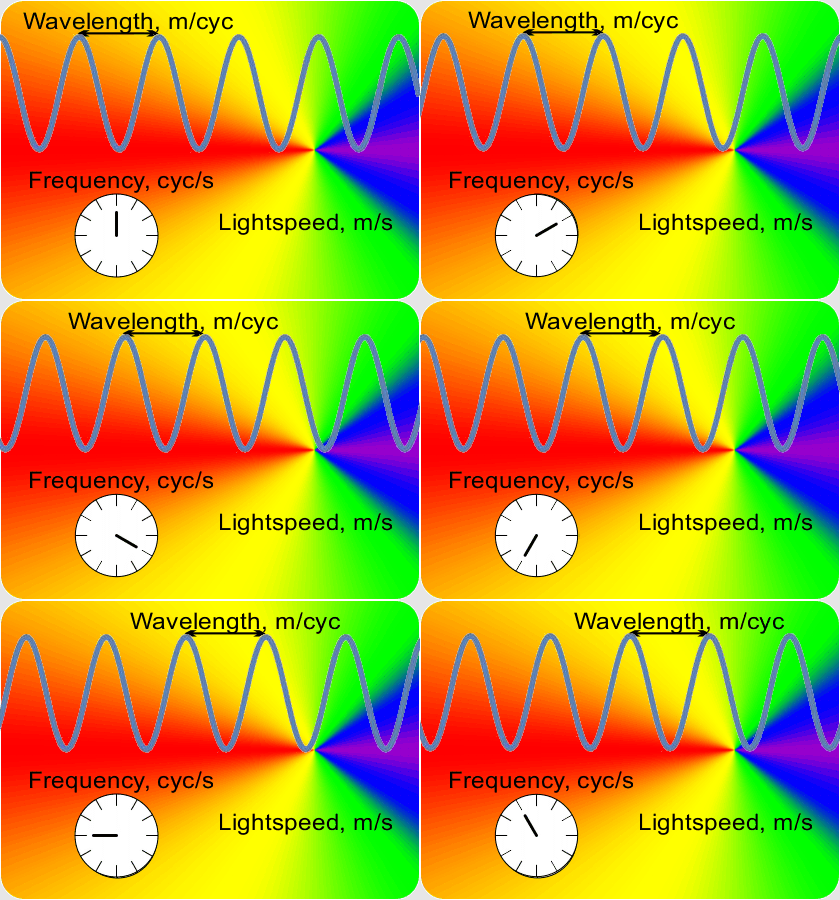
“I was expecting that.  In some ways Gravity’s like Electromagnetism.  It travels at the same speed and has the same inverse-square distance law.  But at any given distance, Gravity’s a factor of 1038 punier and we’ve never been able to detect a force-carrier for it.  Worse, a century of math work hasn’t been able to forge an acceptable connection between the really good Relativity theory we have for Gravity and the really good Standard Model we have for the other three forces.  So here’s my Crazy Theory Number One — maybe there is no connection.”

.  <sudden dead silence>

“All the theory work I’ve seen — string theory, whatever — assumes that Gravity is somehow subject to quantum-based laws of some sort and our challenge is to tie Gravity’s quanta to the rules that govern the Standard Model.  That’s the way we’d like the Universe to work, but is there any firm evidence that Gravity actually is quantized?”

.  <more silence>

“Right.  So now for my Even Crazier Theories.  Maybe there’s a Fifth Force, also non-quantized, even weaker than Gravity, and not bound by the speed of light.  Something like that could explain entanglement and solve Einstein’s Bubble problem.”

.  <even more silence>

“OK, I’ll get crazier.  Many of us have had what I’ll call spooky experiences that known Physics can’t explain.  Maybe stupid-good gambling luck or ‘just knowing’ when someone died, stuff like that.  Maybe we’re using the Fifth Force in action.”

.  <complete pandemonium>
four forces plus 1

~ Rich Olcott


Note to my readers with connections to the US National Guard, Coast Guard, Merchant Marine and/or Public Health Service — Yeah, I know, but one can only stretch a metaphor so far.

Atoms are solar systems? Um, no…

Suddenly there’s a hubbub of girlish voices to one side of the crowd.  “Go on, Jeremy, get up there.”  “Yeah, Jeremy, your theory’s no crazier than theirs.”  “Do it, Jeremy.”

Sure enough, the kid’s here with some of his groupies.  Don’t know how he does it.  He’s a lot younger than the grad students who generally present at these contests, but he’s got guts and he grabs the mic.

“OK, here’s my Crazy Theory.  The Solar System has eight planets going around the Sun, and an oxygen atom has eight electrons going around the nucleus.  Maybe we’re living in an oxygen atom in some humongous Universe, and maybe there are people living on the electrons in our oxygen atoms or whatever.  Maybe the Galaxy is like some huge molecule.  Think about living on an electron in a uranium atom with 91 other planets in the same solar system and what happens when the nucleus fissions.  Would that be like a nova?”

There’s a hush because no-one knows where to start, then Cathleen’s voice comes from the back of the room.  Of course she’s here — some of the Crazy Theory contest ring-leaders are her Astronomy students.  “Congratulations, Jeremy, you’ve joined the Honorable Legion of Planetary Atom Theorists.  Is there anyone in the room who hasn’t played with the idea at some time?”

No-one raises a hand except a couple of Jeremy’s groupies.

“See, Jeremy, you’re in good company.  But there are a few problems with the idea.  I’ll start off with some astronomical issues and then the physicists can throw in some more.  First, stars going nova collapse, they don’t fission.  Second, compared to the outermost planet in the Solar System, how far is it from the Sun to the nearest star?”

A different groupie raises her hand and a calculator.  “Neptune’s about 4 light-hours from the Sun and Alpha Centauri’s a little over 4 light-years, so that would be … the 4’s cancel, 24 hours times 365 … about 8760 times further away than Neptune.”

“Nicely done.  That’s a typical star-to-star distance within the disk and away from the central bulge.  Now, how far apart are the atoms in a molecule?”

“Aren’t they pretty much touching?  That’s a lot closer than 8760 times the distance.”

“Yes, indeed, Jeremy.  Anyone else with an objection?  Ah, Maria.  Go ahead.”

“Yes, ma’am.  All electrons have exactly the same properties, ¿yes? but different planets, they have different properties.  Jupiter is much, much heavier than Earth or Mercury.”

Astrophysicist-in-training Jim speaks up.  “Different force laws.  Solar systems are held together by gravity but at this level atoms are held together by electromagnetic forces.”

“Carry that a step further, Jim.  What does that say about the geometry?”

“Gravity’s always attractive.  The planets are attracted to the Sun but they’re also attracted to each other.  That’ll tend to pull them all into the same plane and you’ll get a flat disk, mostly.  In an atom, though, the electrons or at least the charge centers repel each other — four starting at the corners of a square would push two out of the plane to form a tetrahedron, and so forth.  That’s leaving aside electron spin.  Anyhow, the electronic charge will be three-dimensional around the nucleus, not planar.  Do you want me to go into what a magnetic field would do?”

“No, I think the point’s been made.  Would someone from the Physics side care to chime in?”

“Synchrotron radiation.”

“Good one.  And you are …?”

“Newt Barnes.  I’m one of Dr Hanneken’s students.”

“Care to explain?”

“Sure.  Assume a hydrogen atom is a little solar system with one electron in orbit around the nucleus.  Any time a charge moves it radiates waves into the electromagnetic field.  The waves carry forces that can compel other charged objects to move.  The distance an object moves, times the force exerted, equals the amount of energy expended by the wave.  Therefore the wave must carry energy and that energy must have come from the electron’s motion.  After a while the electron runs out of kinetic energy and falls into the nucleus.  That doesn’t actually happen, so the atom’s not a solar system.”

Jeremy gets general applause when he waves submission, then the crowd’s chant resumes…

.——<“Amanda! Amanda! Amanda!”>Bohr and Bohr atom

~~ Rich Olcott

Helios versus Mars, Planetary Version

Al waves me over the moment I step through the door of his coffee shop.  “Sy, ya gotta squeeze into the back room.  The grad students are holding another Crazy Theory contest and they’re having a blast.  I don’t know enough science to keep up with ’em but you’d love it.  Here’s your coffee.”

“Thanks, Al.  I’ll see what’s going on.”

The Crazy Theory contest is a hallowed Al’s Coffee Shop tradition — a “seminar” where grad students present their weirdest ideas in competition.  Another tradition (Al is strong on this one) is that the night’s winner has to sweep up the thrown spitballs and crumpled paper napkins at the end of the presentations.  I weave my way in just as the girl at the mic finishes her pitch with, “… and that’s why Spock and horseshoe crabs both have green blood!”

Some in the crowd start chanting “Amanda!  Amanda!  Amanda!”  She’s already reaching for the Ceremonial Broom when Jim steps up to the mic and waves for quiet.  “Wanna hear how the Sun oxidized Mars and poisoned it for us?”

Helios and Mars
Helios and Mars
Mars image adopted from photo by Mark Cartwright
Creative Commons license
Attribution-NonCommercial-ShareAlike

Voice from the crowd — <“The Sun did what?”>

“You remember titration from school chem lab?”

.——<“Yeah, you put acid in a beaker and you drip in a base until the solution starts to turn red.”>

“What color is Mars?”

.——<“Red!”>

“Well, there you are.”

.——<“Horse-hockey!  What’s that got to do with the Sun or what you said about poison?”>

“Look at what our rovers and orbiters found on Mars — atmosphere only 1% of Earth’s but even that’s mostly CO2, no liquid water at the surface, rust-dust everywhere, soil’s loaded with perchlorate salts.  My Crazy Theory can explain all of that.”

.——<“Awright, let’s hear it!”>

“Titration’s all about counting out chemical species.  Your acid-base indicator pinked when you’d neutralized your sample’s H+ ions by adding exactly the right number of OH ions to turn them all into H2O, right?  So think about Mars back in the day when it had liquid water on the ground and water vapor in the atmosphere.  Along comes solar radiation, especially the hard ultra-violet that blows apart stratospheric H2O molecules.  ZOT!  Suddenly you’ve got two free hydrogen atoms and an oxygen floating around.  Then what happens?”

It’s a tough crowd.  <“We’re dying to hear!  Get on with it!”>

“The hydrogens tie up as an H2 molecule.  The escape velocity on Mars is well below the speed of H2 molecules at any temperature above 40K, so those guys abandon Mars for the freedom of Space.  Which leaves the oxygen atom behind, hungry for electrons and ready to oxidize anything it can get close to.”

They’re starting to come along.  <“Wouldn’t the oxygen form O2 and fly away too?”>

“Nowhere near as quickly.  An O2 molecule is 16 times heavier than an H2 molecule.  At a given temperature it moves 1/4 as fast and mostly stays on-planet where it can chew up the landscape.”

.——<“How could an atom do that?”>

“It’s a chain process.  First step for the O is to react with something else in the atmosphere — make an oxidizing molecule like ozone or hydrogen peroxide.  That diffuses down to ground level where it can eat rocks.”

.——<“Wait, ‘eat rocks’!!?!  How does that happen?”>

“Look, most rocks are basically lattices of double-negative oxide ions with positive metal ions tucked in between to balance the charge.  Surface oxide ions can’t be oxidized by an ozone molecule, but they can transmit electron demand down to the metal ions immediately underneath.  An iron2+ ion gets oxidized to iron3+, one big step towards rust-dust.  The charge change disrupts the existing oxide lattice pattern and that piece of the rock erodes a little.”

.——<“What about the poison?”>

“Back when Mars had oceans, they had to have lots of chloride ions floating around to be left behind when the ocean dried up.  Ozone converts chloride to perchlorate, ClO4, which is also a pretty good oxidizer.  Worse, it’s the right size and charge to sneak into your thyroid gland and mess it up.  Poison for sure.  Chemically, solar radiation raised the oxidation state of the whole planet.”

One lonely voice — “Nice try, Jim” — but then the chant returns…

.——<“Amanda!  Amanda!  Amanda!”>

~~ Rich Olcott

Schroeder’s Magic Kittycat

“Bedtime, Teena.”

“Aw, Mommie, I had another question for Uncle Sy.  And I’m not sleepy yet anyhow.”

“Well, if we’re just sitting here relaxing, I suppose.  Sy, make your answer as boring as possible.”

“You know me better than that, Sis, but I’ll try.  What’s your question, Teena?”

“You said something once about quantum and Schroeder’s famous kittycat.  Why is it famous?  If it’s quantum it must be a very, very small cat.  Is it magic?”

“???… Oh, Schrödinger’s Cat.  It’s a pretend cat, not a real one, but it’s famous because it’s both asleep and awake.”

“I see what you did there, Sy.”

“Yeah, Sis, but it’s for a good cause, right?”

“But Uncle Sy, how can you tell?  Sometimes Tommie our kittycat looks sound asleep but he’s not really because he can hear when Mommie opens the cat-food can.”

“Schrödinger’s Cat is special.  Whenever he’s awake his eyes are wide open and whenever he’s asleep his eyes are shut.  And he’s in a box.”

“Tommie loves to sit in boxes.”

“Schrödinger’s Cat’s box is sealed tight.  You can’t see into it.”

“So how do you know whether he’s asleep?”

“That was Mr Schrödinger’s point.  We can’t know, so we have to suppose it’s both.  Many people have made jokes about that.  Mr. Schrödinger said the usual interpretation of quantum mechanics is ridiculous and his cat story was his way of proving that.  The cat doesn’t even have to be quantum-small and the story still works.”

“How could it be halfway?  Either his eyes are open or they’re … wait, sometimes Tommie squints, is that it?”

“Nice try, but no.  Do you remember when we were looking at the bird murmuration and I asked you to point to its middle?”

“Oh, yes, and it was making a beautiful spiral.  Mommie, you should have seen it!”

“Were there any birds right at its middle?”

“Um, no-o.  All around the middle but not right there.”

“Birds to the left, birds to the right, but no birds in the middle.  But if I’d I asked you to point to the place where the birds were, you’d’ve pointed to the middle.”

“Uh-huh.”

“You see how that’s like Mr Schrödinger’s cat’s situation?  It’s really asleep or maybe it’s really awake, but if we’re asked for just one answer we’d have to say ‘halfway between.’  Which is silly just like Mr Schrödinger said — by the usual quantum calculation we’d have to consider his cat to be half awake.  That was part of the long argument between Mr Einstein and the other scientist.”

“Wait, Sy, I didn’t hear that part of you two’s conversation on the porch.  What argument was that?”

“This was Einstein’s big debate with Niels Bohr.  Bohr maintained that all we could ever know about the quantum world are the probabilities the calculations yielded.  Einstein held that the probabilities had to result from processes taking place in some underlying reality.  Cat reality here, which we can resolve by opening the box, but the same issue applies across the board at the quantum level.  The problem’s more general than it appears, because much the same issue appears any time you can have a mixture of two or more states.  Are you asleep yet, Sweetie?”

“Nnn, kp tkng.”

“OK.  Entanglement, for instance.  Pretty much the same logic that Schrödinger disparaged can also apply to quantum particles on different paths through space.  Fire off any process that emits a pair of particles, photons for instance.  The wave function that describes both of them together persists through time so if you measure a property for one of them, say polarization direction, you know what that property is for the other one without traveling to measure it.  So far, so good.  What drove Einstein to deplore the whole theory is that the first particle instantaneously notifies the other one that it’s been measured.  That goes directly counter to Einstein’s Theory of Relativity which says that communication can’t go any faster than the speed of light.  Aaand I think she’s asleep.”

“Nice job, Sy, I’ll put her to bed.  We may discuss entanglement sometime.  G’night, Sy.”

“G’night, Sis.  Let me know the next time you do that meatloaf recipe.”

Cat emerging from murmuration~~ Rich Olcott

Stairway to A Rainbow

“OK, Teena, can you guess why I had you put those different things on different steps?”

“Oh, another game of Which of these things aren’t the same!  I love those!  So we’ve got a marble on one step; a tennis ball, a yo-yo and a ring-toss ring on the second step; and a softball and a ring-in-a-ring on the third step.”Shapes on steps

“Don’t forget we’re pretending the softball is hollow with a ping-pong ball floating in its middle.”

“I didn’t forget, Uncle Sy.  Uh… everything’s round, so that can’t be it.  Wait, there’s round-like-a-ball and round-like-a-donut, but we’ve got donut-thingies on two steps. … Oh!  The marble doesn’t have any empty places inside, the tennis ball has one and the softball has two.  Is that it?  But the other things don’t fit.”

“I’m sorry, I wasn’t fair with you ’cause I didn’t tell you about another rule.  See how yo-yo and donut shapes have a pinch-in-the-middle?  We call that a node and it counts as one empty place.”

“Wait, we forgot about the way-far-away empty place.  That counts for all of them, too, right?”

“Good remembering, that’s absolutely right.  It’s a node, too.”

<dancing about, singing>  “Then I know the answer, I know the answer!  The step number is the number of empty places, um, nodes.  The marble on the first step has one.  The tennis ball and the yo-yo and the ring on the second step have two, and the third-step things have three.  See that, Mommie?”

“Very good, Sweetie.  So what’s that got to do with colors, Sy?”

“Suppose we’re looking at a murmuration —”

“My lovely, lovely new word —”

“Yes, Teena.  Suppose for some reason we’d put a big hunk of bird food up on a tall pole.  Birds would fly to make a tight ball around the top of that pole.  Which of Teena’s toys would it look like?”

“Like that marble.”

“That’s right, no node in the middle.  Now suppose we want to get the birds away from the pole.  What could we do and what would the murmuration look like?”

“Set off a firecracker in the middle.  BOOM and all the birds fly away!”

“If they all fly the same distance, which toy would that look like?”

“The tennis ball!  BOOM and a tennis ball shape!  BOOM!”

“Settle down, Sweetie.  I suppose someone could make noise at the foot of the pole…. That would make a half-dumbbell shape as the birds fly upward.”

“Right on, Sis.  One more possibility — we could send a noisy drone to fly circles above the pole.”

“The birds would make a bigger circle between the drone’s orbit and the ground.  Oh!  Your donut shape.”

“Each way, the murmuration changes to a shape with one additional node and we go up a step.  And when we stop annoying the birds?”

“They fly right back to the food.  Ah, I see where you’re going.  They form that ball shape again and we have fewer nodes.  Now, about the colors…”

“Teena, do you think a murmuration could have half a node?”

“No, that’d be silly.”

“Absolutely right.  There’s no in-between step on the stairway, and there’s no in-between shape in an atom.”

“Wait, you mean that whenever an atom goes from a, say 2-node shape to a 3-node shape, that’s the famous quantum jump?”

“Yup, and the jump-down is, too.  Teena, let’s put all the toys back in your toy box and try an experiment.”

“OK … done!”

“Good job.  Now get up on the second step and jump down to the first one.  Make it a loud jump.”

“Sy!”

“Just this once, Sis, for demonstration purposes.”

“OK, just this once, Teena, and never again!”

“Yay!” <THUMP>

“So what’s that prove?”

“That energy is released when you go down a step or allow a murmuration to fill in an empty space.  Teena’s jump released sound energy.  Atoms release light energy when their charge cloud — ‘scuse me, Teena, quantum murmuration — goes to a shape with fewer nodes.  And the amount of energy for each different node-count change is always the same.”

“I think I see where you’re headed.  Each different jump makes a different color?”

“Sis, you’re as smart as I’ve always said you are.”

Murmuration concentric 2

~~ Rich Olcott

The Shapes of Fuzziness

Egg murmuration 1“That was a most excellent meat loaf, Sis.  Flavor balance was perfect.”

“Glad you liked it, Sy.  Mom’s recipe, of course, with the onion soup mix.”

“Yeah, but there was an extra tang in there.”

“Hah, you caught that!  I threw in some sweet pickle relish to brighten it some.”

“Mommy, Uncle Sy told me about quantum thingies and how they hide behind barriers and shoot rainbows at us.”

Sis gives me that What now? look so I must defend myself.  “Whoa, Teena, that’s not even close to what I said.”

“I know, Uncle Sy, but it’s more fun this way.  Little thingies going, ‘Pew! Pew! Pew!’

“Hey, get me out of trouble with your Mom, here.  What did I say really?”

<sigh> “Everything’s made of these teeny-weeny quantum thingies, smaller even than a water-bear egg — so small — and they have to obey quantum rules.  One of the rules is, um, if a lot of them get together to make a big thing, the big thing has to follow big-thing rules even though the little things follow quantum rules.”

“Nicely put, Sweetie.”

“And sometimes the quantum thingies act like waves and sometimes they act like real things and no-one knows how they do that.  And, uh, something about barriers making forbidden places that colors come out of and I’m mixed up about that.”

“Excellent summary, young lady.  That deserves an extra —” <sharp look from Sis who has a firm ‘No rewarding with food!‘ policy> “— chase around the block the next time we go scootering.”

“Yay!  But can you unconfuse me about the forbidden areas and colors?”

“Well, I can try.  Tell you what, bring your toy box over by the stairway, OK?  We’ll pick it all up when we’re done, Sis, I promise.  Ready, Teena?”

“Ready!”

“OK, put your biggest marble on the bottom step. Yes, it is pretty.  Now put a tennis ball and that dumbbell-shaped thing on the second step.  Oh, it’s a yo-yo?  Cool.  And that ring-toss ring, put it on the second step, too.  Now for the third step.  Put the softball there and … umm … take some of those Legos and make a little ring inside a big ring.  Thanks, Sis, just half a cup.  Ready, Teena?”

“Just a sec… ready!”

“Perfect.  Oh, Teena, you forgot to tell Mommy about the murmuration.”

“Oh, she’s seen them.  You know, Mommie, thousands of birds flying in a big flock and they have rules so they keep together but not too close and they make big pictures in the sky.”

“Yes, I have, sweetheart, but what does that have to do with quantum, Sy?”

“How would you describe their shapes?”

“Oh, they make spirals, and swirls… I’ve seen balls and cones and doughnuts and wide flowing sheets, and other shapes we simply don’t have names for.”

“These shapes on the stairs are the first few letters in science’s alphabet for describing complex shapes like atoms.  It’s like spelling a word.  That ball on the first step is solid.  The tennis ball is a hollow shell.  Pretend the softball is hollow, too, with a hollow ping-pong ball at its center.  If you pretend that each of these is a murmuration, Teena, does that make you think of anything?”

“Mmm..  There aren’t any birds flying outside of the marble, or outside or inside of the tennis ball.  And I guess there aren’t any flying between the layers in the ping-softball.  Are those forbidden areas?”

“C’mere for a high-five!  That’s exactly where I’m going with this.  The marble has one forbidden region infinitely far away.  The tennis ball has that one plus a second one at its middle.  The softball-ping-pong combo has three and so on.  We can describe any spherical fuzziness by mixing together shapes like that.”Combining shapes

“So what about the rings and that dumbbell yo-yo?”

“That’s the start of our alphabet for fuzziness that isn’t perfectly round.  Math has given us a toolkit of spheres, dumbbells, rings and fancier figures that can describe any atom.  Plain and fancy dumbbells stretch the shape out, rings bulge its equator, and so on.  Quantum scientists use the shapes to describe atoms and molecules.”

“Why the stairsteps?”

“What about my colors?”

~ Rich Olcott