


Vinnie’s always been a sucker for weird-mutant sci-fi films so what Jennie says gets him going. “So you got these teeny-tiny neutrinos and they mutate? What do they do, get huge and eat things?”
“Nothing that interesting, Vinnie — or uninteresting, depending on what you’re keen on. No, what happens is that each flavor neutrino periodically switches to another flavor.”
“Like an electron becomes a muon or whatever?”
“Hardly. The electron and muon and tau particles themselves don’t swap. Their properties differ too much — the muon’s 200 times heaver than the electron and the tau’s sixteen times more massive than that. It’s their associated neutrinos that mutate, or rather, oscillate. What’s really weird, though, is how they do that.”
“How’s that?”
“As I said, they cycle through the three flavors. And they cycle through three different masses.”
“OK, that’s odd but how is it weird?”
“Their flavor doesn’t change at the same time and place as their mass does.”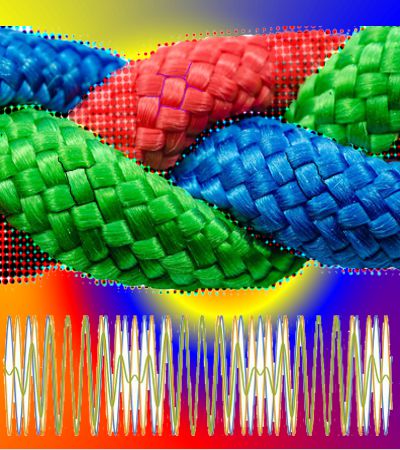
“Wait, what?”
“Each kind of neutrino, flavor-wise, is distinct — it reacts with a unique set of particles and yields different reaction products to what the other kinds do. But experiments show that the mass of each kind of neutrino can vary from moment to moment. At some point, the mass changes enough that suddenly the neutrino’s flavor oscillates.”
“That makes me think each mass could be a mix of three different flavors, too.”
“Capital, Vinnie! That’s what the math shows. It’s two different ways of looking at the same coin.”
“The masses oscillate, too?”
“Oh, indeed. But no-one knows exactly what the mass values are nor even how the mass variation controls the flavors. Or the other way to. We know two of the masses are closer together than to the third but that’s about it. On the experimental side there’s loads of physicists and research money devoted to different ways of measuring how neutrino oscillation rates depend on neutrino energy content.”
“And on the theory side?”
“Tons of theories, of course. Whenever we don’t know much about something there’s always room for more theories. The whole object of experiments like IceCube is to constrain the theories. I’ve even got one I may present at Al’s Crazy Theory Night some time.”
“Oh, yeah? Let’s hear it.”
“It’s early days, Al, so no flogging it about, mm? Do you know about beat frequencies?”
“Yeah, the piano tuner ‘splained it to me. You got two strings that make almost the same pitch, you get this wah-wah-wah effect called a beat. You get rid of it when the strings match up exact.” He grabs a few glasses from the counter and taps them with a spoon until he finds a pair that’s close. “Like this.”
“Mm-hmm, and when the wah-wahs are close enough together they merge to become a note on their own. You can just imagine how much more complicated it gets when there are three tones close together.”
I see where she’s going and bring up a display on Old Reliable —an overlay of three sine waves. “Here you go, Jennie. The red line is the average of the three regular waves.” “Thanks, Sy. Look, we’ve got three intervals where everything syncs up. See the new satellite peaks half-way in between? There’s more hidden pattern where things look chaotic in the rest of the space.”
“Yeah, so?”
“So, Vinnie, my crazy theory is that like a photon’s energy depends on its wave frequency in the electromagnetic field, a neutrino is a combination of three weak-field waves of slightly different frequency, one for each mass. When they sync up one way you’ve got an electron neutrino, when they sync up a different way you’ve got a muon neutrino, and a third way for a tau neutrino.”
I’ve got to chuckle. “Nothing against your theory, Jennie, though you’ve got some work ahead of you to flesh it out and test it. I just can’t help thinking of Einstein and his debates with Bohr. Bohr maintained that all we can know about the quantum realm are the averages we calculate. Einstein held that there must be understandable mechanisms underlying the statistics. Field-based theories like yours are just what Einstein ordered.”
“I could do worse.”
~~ Rich Olcott


 “Why should there be flashes? I thought neutrinos didn’t interact with matter.”

 “Hello, Jennie. Haven’t seen you for a while.”
 Momentum is velocity times mass. These guys fly so close to lightspeed that for a long time scientists thought that neutrinos are massless like photons. They’re not, so I used several different v/c ratios to see what the relativistic correction does. Slow neutrinos are huge, by atom standards. Even the fastest ones are hundreds of times wider than a nucleus.”
 “Wait, right ascension in hours-minute-seconds but declination in degrees?”

 Cathleen saves me from answering. “Not quite. The study Sy’s chasing is actually a cute variation on red-shift measurements. That ‘PSR‘ designation means the neutron star is a pulsar. Those things emit electromagnetic radiation pulses with astounding precision, generally regular within a few dozen nanoseconds. If we receive slowed-down pulses then the object’s going away; sped-up and it’s approaching, just like with red-shifting. The researchers derived orbital parameters for all three bodies from the between-pulse durations. The heavy dwarf is 200 times further out than the light one, for instance. Not an easy experiment, but it yielded an important result.”

 With my finger I draw in the frost on his gelato cabinet. “Imagine this is a brass ball, except I’ve pulled one side of it out to a cone. Someone’s loaded it up with extra electrons so it’s carrying a high negative charge.”
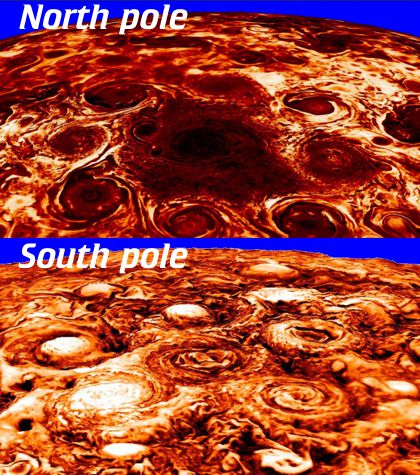 “They’re certainly eye-catching, but I thought Jupiter’s all baby-blue and salmon-colored.”


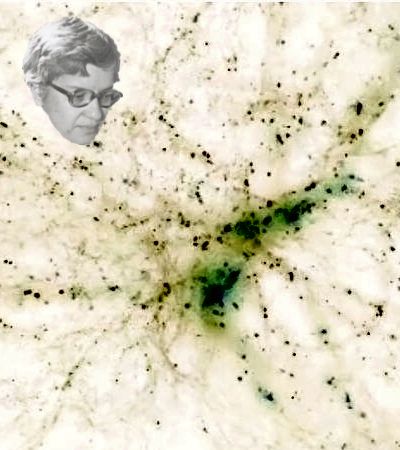
 “Not much. We can’t see it, and they say there is much more of it than the matter we can see. If we can’t see it, how did she find it? That’s a thing I don’t understand, what I came to your office to ask.”


 Hard Science Ain't Hard
