

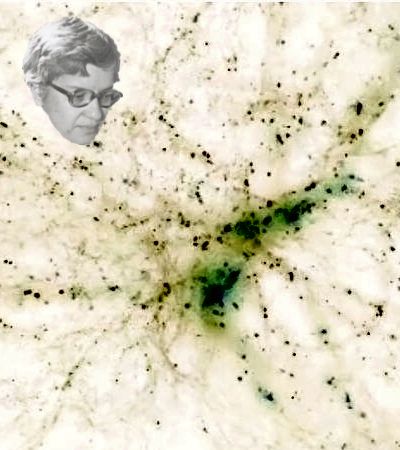
“But Mr Moire, first Vera Rubin shows that galaxies don’t spread out like sand grains on a beach…”
“That’s right, Maria.”
“And then she shows that galaxy streams flow like rivers through the Universe…”
“Yes.”
“And then she finds evidence for dark matter! She changed how we see the Universe and still they don’t give her the Nobel Prize??!?”
“All true, but there’s a place on Mars that’s named for her and it’ll be famous forever.”
“Really? I didn’t know about that. Where is it and why did they give it her name?”
“What do you know about dark matter?”
 “Not much. We can’t see it, and they say there is much more of it than the matter we can see. If we can’t see it, how did she find it? That’s a thing I don’t understand, what I came to your office to ask.”
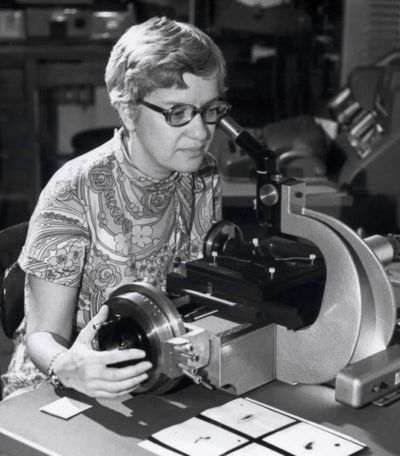
“It all has to do with gravity. Rubin’s studies of dozens of galaxies showed that they really shouldn’t exist, at least on the basis of the physics we knew about at the time. She’d scan across a galaxy’s image, measuring how its red-shifted spectrum changed from the coming-toward-us side to the going-away-from-us side. The red-shift translates to velocity. The variation she found amazed the people she showed it to.”
“What was amazing about it?”
“It was a flat line. Look at the galaxy poster on my wall over there.”
“Oh, la galaxia del Molinete. It’s one of my favorites.”
“We call it the Pinwheel Galaxy. Where would you expect the stars to be moving fastest?”
“Near the center, of course, and they must move slower in those trailing arms.”
“That’s exactly what Rubin didn’t find. From a couple of reasonable assumptions you can show that a star’s speed in a rotating galaxy composed only of other stars should be proportional to 1/√R, where R is its distance from the center. If you pick two stars, one twice as far out as the other, you’d expect the outermost star to be going 1/√2 or only about 70% as fast as the other one.”
“And she found…?”
“Both stars have the same speed.”
“Truly the same?”
“Yes! It gets better. Most galaxies are embedded in a ball of neutral hydrogen atoms. With a different spectroscopic technique Rubin showed that each hydrogen ball around her galaxies rotates at the same speed its galaxy does, even 50% further out than the outermost stars. Everything away from the center is traveling faster than it should be if gravity from the stars and gas were the only thing holding the galaxy together. Her galaxies should have dispersed long ago.”
“Could electrical charge be holding things together?”
“Good idea — electromagnetic forces can be stronger than gravity. But not here. Suppose the galaxy has negative charge at its center and the stars are all positive. That’d draw the stars inward, sure, but star-to-star repulsion would push them apart. Supposing that neighboring stars have opposite charges doesn’t work, either. And neutral hydrogen atoms don’t care about charge, anyway. The only way Rubin and her co-workers could make the galaxy be stable is to assume it’s surrounded by an invisible spherical halo with ten times as much mass as the matter they could account for.”
“Mass that doesn’t shine. She found ‘dark matter’ with gravity!”
“Exactly.”
“What about planets and dust? Couldn’t they add up to the missing mass?”
“Nowhere near enough. In out Solar System, for instance, all the planets add up to only 0.1% of the Sun’s mass.”
“Ah, ‘planets’ reminds me. Why is Vera Rubin’s name on Mars?”
“Well, it’s not strictly speaking on Mars, yet, but it’s on our maps of Mars. You know the Curiosity rover we have running around up there?”
“Oh yes, it’s looking for minerals that deposit from water.”
“Mm-hm. One of those minerals is an iron oxide called hematite. Sometimes it’s in volcanic lava but most of the time it’s laid down in a watery environment. And get this — it’s often black or dark gray. Curiosity found a whole hill of the stuff.”

“Yes, so…?”
“What else would the researchers name an important geologic feature made of darkish matter?”
~~ Rich Olcott




 “So you’re telling me, Cathleen, that you can tell how hot a star is by
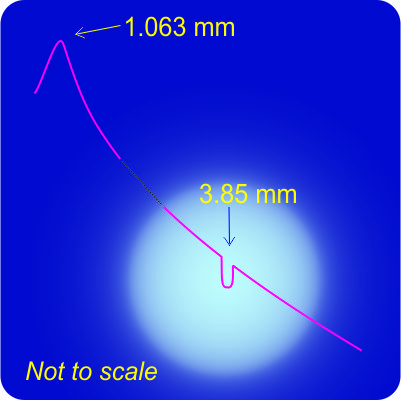
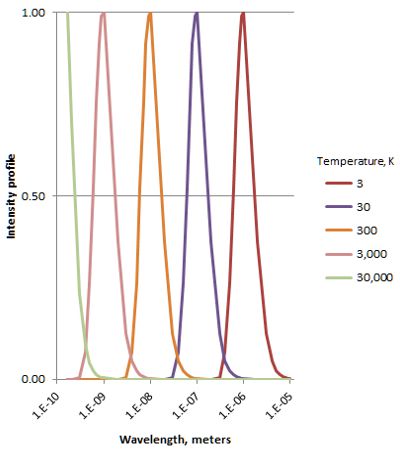
  Cathleen turns to her laptop and starts tapping keys. “Let’s do an example. Suppose we’re looking at a star’s broadband spectrogram. The blackbody curve peaks at 720 picometers. There’s an absorption doublet with just the right relative intensity profile in the near infra-red at 1,060,190 and 1,061,265 picometers. They’re 1,075 picometers apart. In the lab, the sodium doublet’s split by 597 picometers. If the star’s absorption peaks are indeed the sodium doublet then the spectrum has been stretched by a factor of 1075/597=1.80. Working backward, in the star’s frame its blackbody peak must be at 720/1.80=400 picometers, which corresponds to a temperature of about 6,500 K.”


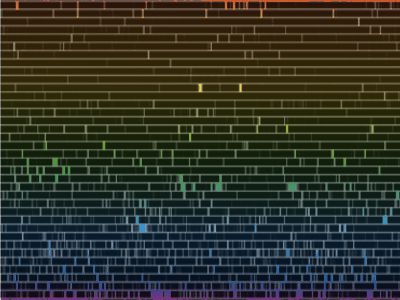 “You’re right, Sy. It’s not a particularly pretty picture, but it shows that nice strong sodium doublet in the yellow and the broad iron and hydrogen lines down in the green and blue. I’ll admit it, Vinnie, this is a faked image I made to show my students what the solar atmosphere would look like if you could turn off the photosphere’s continuous blast of light. The point is that the atoms emit exactly the same sets of colors that they absorb.”
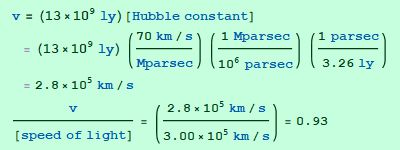 “Whoa, Sy. Do you read the final chapter of a mystery story before you begin the book?”
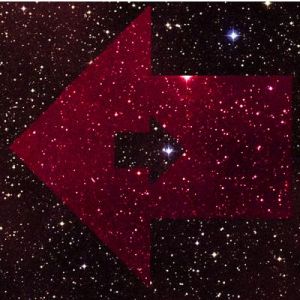 “It is, Sy, and that’s one of the reasons why Hubble’s original number was so far off. He only looked at about 50 close-by galaxies, some of which are moving toward us and some away. You only get a view of the general movement when you look at large numbers of galaxies at long distances. It’s like looking through a window at a snowfall. If you concentrate on individual flakes you often see one flying upward, even though the fall as a whole is downward. Andromeda’s 250,000 mph march towards us is against the general expansion.”


 “Infinite?”
 Hard Science Ain't Hard
