A Neutral Party

“Hi, folks, sorry I’m late to the party. What are we arguing about and which side am I on?”

“Hi, Vinnie. We started out talking about neutrality and Jim proved that we’re electrically neutral otherwise we’d spray ourselves apart because of like‑charge repulsons.”

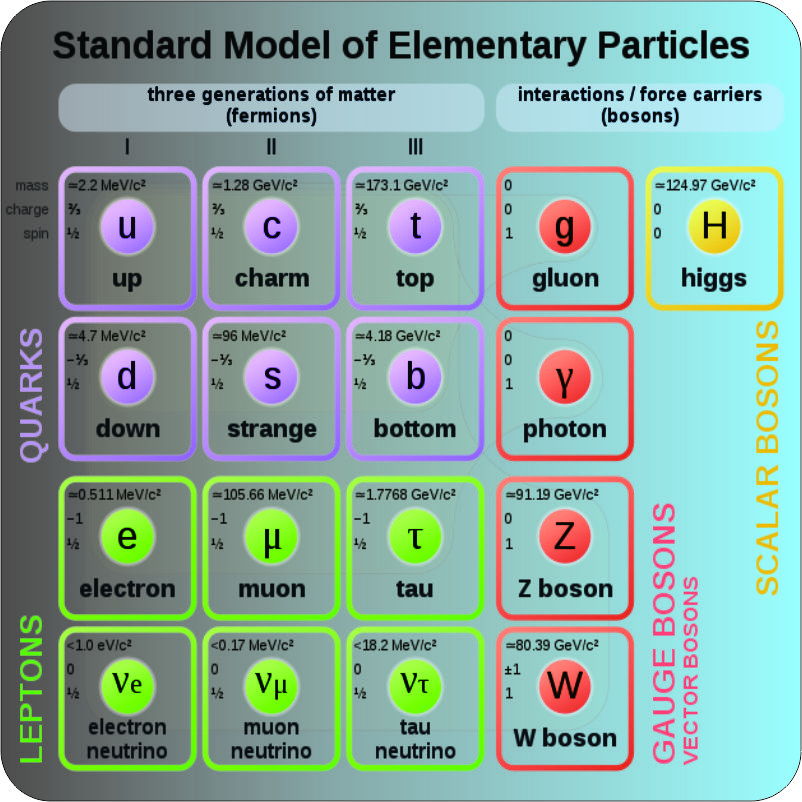
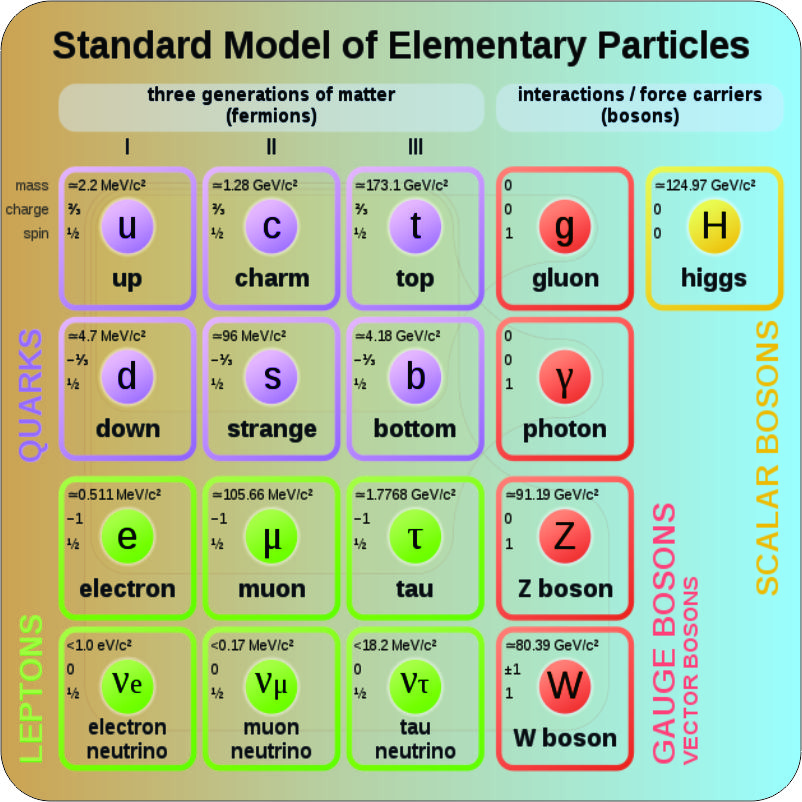
“Yeah, an’ then we got into the Standard Module picture here and how it’s weird that the electron charge exactly cancels out the quark mixture in a proton even though electrons don’t have quarks and quarks don’t have exact charges.”

Jim’s on it. “Almost, Eddie. Quarks have exact charges, but they’re exact fractions. They just add up when you mix three of them to make a particle. Two of them, sometimes. Up‑quark, up‑quark and down‑quark is two‑thirds plus two‑thirds minus one‑third equals one. That’s one proton, exactly opposing one electron’s charge.”

Vinnie’s good at mental math. “What happens when you mix one‑third plus one‑third minus two‑thirds which is zero?”

“Two downs and an up. That’s a neutron.”

“Ups, downs, electrons, protons, neutrons — except for the neutrino the first column’s pretty much atoms, right? What’s with those other boxes?”

“We only see evidence for the other purple‑box quarks in collider records or nuclear reactions. Same for the muon and tau. They’re all way too unstable to contribute much to anything that hangs around. The guys in the red and gold boxes aren’t building blocks, they’re more like glue that holds everything else together. The green‑box neutrinos at the bottom are just weird and we’ll probably be a long time figuring them out.”

“Says here that neutrinos have zero charge, and so do most of the force thingies. Is that really zero or is it just too small to measure?”

“A true Chemistry‑style question, Susan. Charges we can count but you’re right, energy exchanges in a process have to be measured. The zero charges are really zero. For example, Pauli dreamed up the neutrino as an energy‑accounting trick for a nuclear process where all the charges went to known products but there was energy left over. If they existed at all, neutrinos could carry away that energy but they had to have zero charge. A quarter‑century later we detected some and they fit all the requirements.”

Vinnie perks up. “Zero charge so they doesn’t interact with light, teeny mass per each but there’s a hyper‑gazillion of them out there which oughtta add up to a lot of mass. Could neutrinos be what dark matter is?”

“Some researchers thought that for a while but the idea hasn’t held up to inspection. The neutrinos we know about come to about 1% of dark matter’s mass. Some people think there may be a really heavy fourth kind of neutrino that would make up the difference, but it’s a long shot and there’s no firm evidence for it so far. Dark matter doesn’t interact with photons, photons interact with electric charge, quarks have electric charge. If you’ve got quarks you’re not dark matter.”

“How about neutrons floating around?”
 ”Those molecular clouds I’ve read about Aren’t they neutral? Are there neutral stars?”
  ”How about neutron stars and black holes?”
   ”What’s a neutron star?”

“All good questions. Free neutrons are a bad bet, Vinnie — unless they’re bound with protons they usually emit an electron and become a proton within an hour. Susan, electrostatic forces would overwhelm gravity so we believe stars and molecular clouds must be electrically neutral or close to it. Anyway, stars and clouds can’t be dark matter because they’ve got quarks. Eddie, what do you suppose happens when a star uses up the fuel that keeps it big?”

“Since you ask it that way, I suppose it caves in.”

“Got it in one. If the star’s too big to collapse to be a white dwarf but too small to collapse to be a black hole, it collapses to be a neutron star. Really weird objects — a star‑and‑a‑half of of mass packed into a 10‑kilometer sphere, probably spinning super‑fast and possessing a huge magnetic field. From a ‘what is dark matter?‘ perspective, though, collapsed stars of any sort are still made of quarks and can’t qualify.”

“So what is dark matter then?”

“Good question.”

~~ Rich Olcott

  • Thanks to Alex, who asked a question.

Quarkery

Susan, aghast. “But I thought the Standard Model was supposed to be the Theory of Everything.”

Jim, abashed. “A lot of us wish that phrase had never been invented. Against the mass of the Universe it’s barely the theory of anything.”

Me, typecast. “That’s a heavy claim, Jim. Big Physics has put many dollars and fifty years of head time into filling out that elegant table of elementary particles. I remember the celebration when the LHC finally found the Higgs boson in 2012. I’ve read that the Higgs field is responsible for the mass of the Universe.”

“A little bit true, Sy, sort of. We think it’s responsible for about 1% of the mass of all the matter we understand. There’s another mechanism that accounts for the other 99%.”

Eddie, downcast. “I’m lost, guys. What Standard Module are you talking about?”

“Do you remember the Periodic Table of the chemical elements?”

“A little. Science class had big poster up on the wall. Had all kinds of atoms in it, right?”

“Yup. Scientists spent centuries breaking down minerals and compounds to find substances that chemical methods couldn’t break down any further. Those were the chemical elements, things like iron and carbon and oxygen. The Periodic Table arranges elements so as to highlight similarities in how they’ll interact. The Standard Model carries that idea down to the sub‑subatomic level.”

“Wait, sub‑subatomic level?”

“Mm-hm. Chemists would say that ‘subatomic‘ is about electrons, protons and neutrons. Count an atom’s electrons. That and some fairly simple rules can tell you what structure types it prefers to participate in and what it reacts with. Count the protons and neutrons in its nucleus. That gives you its atomic weight and starts you on the road to figuring reaction quantities. That’s all that the chemists need to know about atoms. All due respect, Susan, but physicists want to dig deeper. That’s what the Standard Model is all about.”

“So you’re saying that the protons and neutrons are made of these … quarks and things? Is that what comes out of those collider experiments?”

“No on both, Eddie. You ever whack a light pole with a baseball bat?”

“Sure, who hasn’t?”

“The sounds that came out, do you think the pole was made of them?”

“Course not, and I never bought the Brooklyn Bridge, neither.”

“Calm down, Eddie, just making a point. Suppose before you whacked that pole you’d attached a whole string of sensitive microphones all up and down it, and then when you whacked it you recorded all the vibrations your whack set off. Do you think with the recorded frequencies and a lot of math a good audio engineer could tell you what the pole is made of and how thick the casing is?”

“Maybe.”

“That’s what’s going on with the colliders. They whack particles with other particles, record everything that comes out and use math to work out what must have happened to make that event happen. Theory together with data from a huge number of whacks let people like Heisenberg, Gell‑Mann, Ne’eman and Nishijima to the seventeen boxes in that table.”

“‘Splain those particles to me.”

“Don’t think particles, think collections of properties. The Periodic Table’s ‘iron‘ box is about having 26 electrons and combining with 24 grams of oxygen to form 80 grams of Fe2O3. In the Standard Model table, the boxes are about energy, charge, lifetime, some technical properties, and rules for which can interact with what. We’ve never seen a free‑standing quark particle and there’s good reason to think we never will. We mostly see only two‑ or three‑quark mixtures. Some of the properties, like charge, simply add together. It takes a mixture to make a particle.”

“Then how did they figure what goes into a box?”

“Theoreticians worked to find the minimum set of independent properties that could still describe observations. Different mixtures of up and down quarks, for instance, account for protons, neutrons and many mesons.”

Vinnie, at last. “Hi, folks, sorry I’m late to the party. What are we arguing about and which side am I on?”

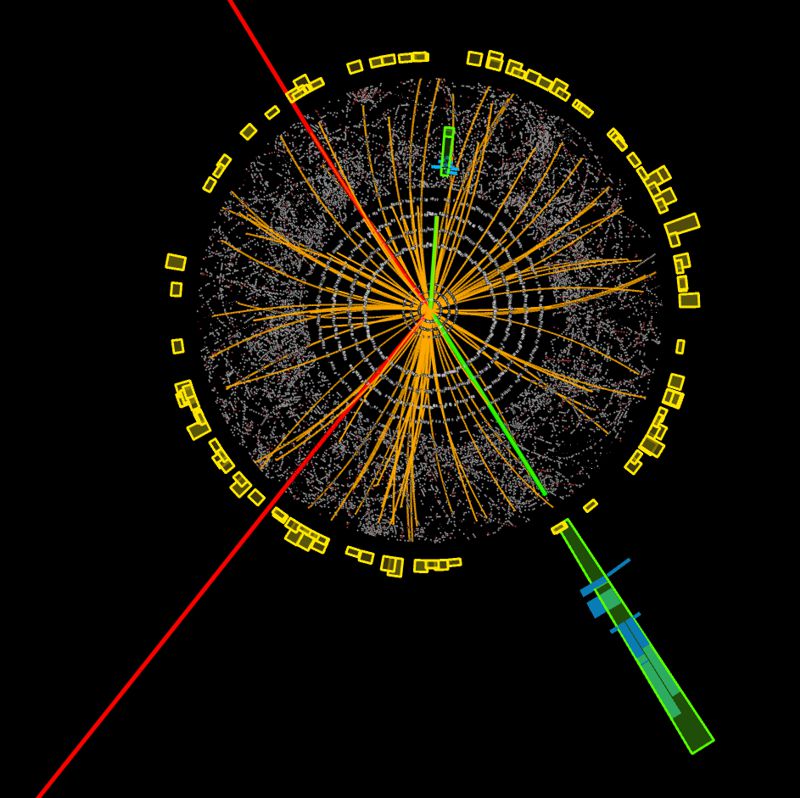
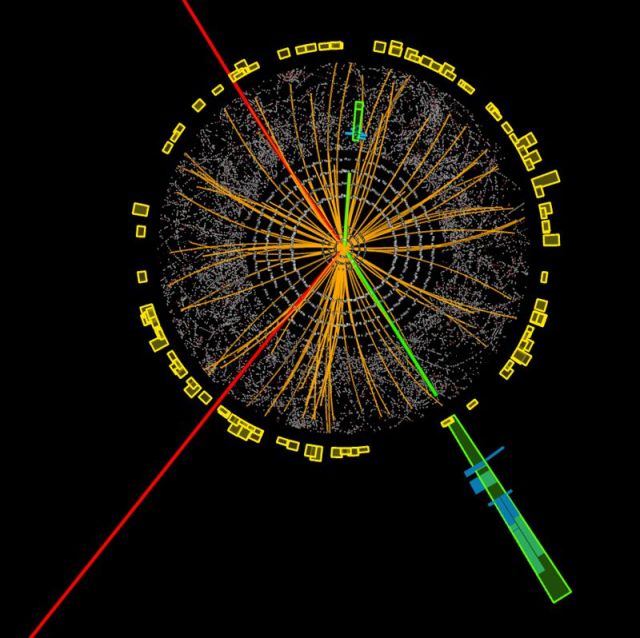
Higgs candidate LHC event trace
Electrons (green) and muons (red) exiting the event

~~ Rich Olcott

Neutral

It’s that kind of an afternoon. Finished up one project, don’t feel much like starting another. Spring rain outside so instead of walking to Al’s for coffee I take the elevator down to Pizza Eddie’s on 2. Looks like other folks have the same feeling. “Afternoon, all. What’s the current topic of conversation?”

“Well, Sy, it started out as Star Wars versus Star Trek but then Jim said he could care less and Susan said that meant he did care and he said no, he’s ambivalent and she said that still meant he cared, and—”

“I get it, Eddie. Susan, why does ‘ambivalent‘ mean Jim cares?”

“Chemistry, Sy. ‘Valence‘ means ‘bonding‘ and ‘ambi-‘ means ‘both‘ so ‘ambi‑valent‘ means ‘bonded to both‘.”

“But Susan, ambidextrous means able to use both hands, not unable to use either hand. I want to say I don’t particularly like or dislike either one.”

“It’s like trying to decide between fire ants or hornets. You could say ‘No‑win,’ right?”

“No, that’s not it, either, Eddie. That’s ‘everybody loses.’ I’m smack in the middle.”

“Sounds like absolute neutrality. Hard to get there.”

“Don’t look at Chemistry. If I take an acid solution and add just enough base to get to neutral pH, there’s still tenth‑micromolar concentrations of acid and base in there. I guess we could call that ambivalent.”

“Neutrality’s hard for humans and chemicals, yeah, but that’s where the Universe is.”

“Why do you say that, Jim?”

“Because we’ve got proof right in front of us. Look, planets and stars and people exist as distinct objects, right? They’re not a finely-divided mist.”

“So?”

“So if the Universe were not exactly electrically neutral, then opposite charges repelling would split everything apart.”
 ”Wait, nothing would have a chance to form in the first place.”
   ”Wait, couldn’t you have lumps of like 99 positives and 100 negatives or whatever that just cancel out?”

“Eddie, when you say ‘cancel out’ you’re still talking about being absolutely neutral at the lump level. It’s like this table salt that has positive sodium ions and negative chlorides but the crystals are neutral or we’d get sparks when I pour some out like this.”
 ”Hey, don’t waste the salt. Costs money.”

“I still think it’s weird how all electrons have the same charge and it’s exactly the same as the proton charge. Protons are made of quarks, right, and electrons aren’t. So how can you take three of something and have that add up to exactly one of something different?”

“I can give you Feynman and Wheeler’s answer to part of that, Susan. The electron has an anti‑partner, the positron, which is exactly like the electron in every way except it has the opposite charge. When electron and positron meet they annihilate to produce a burst of high‑energy photons. But there’s a flip side — high‑energy photons sometimes interact to make an electron‑positron pair. Feynman and Wheeler were both jokers. They suggested that a positron could be an electron traveling backward in time. Wheeler said, ‘Maybe they’re all the same electron,’ zig‑zagging across eternity. But that doesn’t account for the quarks. A proton has two up‑quarks, each with a charge of negative 2/3 electron, and one down‑quark with a charge of positive 1/3 electron. Add ’em up — you exactly neutralize one electron. Fun, huh?”

“Fun, Jim, but I’m a chemist. On a two-pan balance I can weigh out equal quantities of molasses and rock dust but I don’t expect them to interact with any simple mathematical relationship. Why should the quark’s charge be any exact multiple or divisor of the electron’s? And why is the electron charge the size it is instead of some other number?”

“Well, there you’ve got me. The quantum chromodynamics Standard Model has been amazingly successful for quantitative predictions, but not so good for explaining things outside of its own terms. The math lays out the relationship between quark and electron charge, but doesn’t give us a physical ‘why.’ The theory has 19 ‘adjustable constants’ but no particular reason why they should have the specific values that fit the observations. Also, the theory doesn’t include gravity. It’s a little embarrassing.”

“Sounds like you’re ambivalent about the theory.”

~~ Rich Olcott

Galaxies Fluffy And Faint

Cathleen’s at the coffee shop’s baked goods counter. “A lemon scone, please, Al.”

I’m next in line. “Lemon sounds good to me, too. It’s a warm day.”

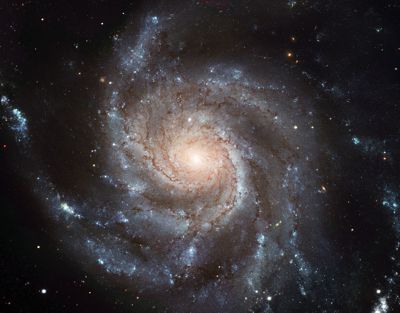
The Pinwheel Galaxy, NGC 5457
Credit: ESA/Hubble

“Sure thing, Sy. Hey, got a question for you, Cathleen, you bein’ an Astronomer and all. I just saw an Astronomy news item about a fluffy galaxy and they mentioned a faint galaxy. Are they the same and why the excitement?”

“Not the same, Al. It’ll be easier to show you in pictures. Sy, may I borrow Old Reliable?”

“Sure, here.”

“Thanks. OK, Al, here’s a classic ‘grand design‘ spiral galaxy, NGC 5457, also known as The Pinwheel. Gorgeous, isn’t it?”

“Sure is. Hey, I’ve wondered — what does ‘NGC‘ stand for, National Galaxy Collection or something?”

“Nope. The ‘G‘ doesn’t even stand for ‘Galaxy‘. It’s ‘New General Catalog‘. Anyway, here’s NGC 2775, one of our prettiest fluffies. Doesn’t look much like the Pinwheel or Andromeda, does it?”

NGC 2775
Credit: NASA / ESA / Hubble / J. Lee / PHANGS-HST Team / Judy Schmidt

“Nah, those guys got nice spiral arms that sort of grow out of the center. This one looks like there’s an inside edge to all the complicated stuff. And it’s got what, a hundred baby arms.”

“The blue dots in those ‘baby arms’ are young blue stars. They’re separated by dark lanes of dust just like the dark lanes in classic spirals. The difference is that these lanes are much closer together. The grand design spirals are popular photography subjects in your astronomy magazines, Al, but they’re only about 10% of all spirals. I’ll bet your news item was about 2775 because we’re just coming to see how mysterious this one is.”

“What’s mysterious about it?”

“That central region. It’s huge and smooth, barely any visible dust lanes and no blue dots. It’s bright in the infra‑red, which is what you’d expect from a population of old red stars. In the ultra‑violet, though, it’s practically empty — just a small dot at the center. UV is high‑energy light. It generally comes from a young star or a recent nova or a black hole’s accretion disk. The dot is probably a super-massive back hole. but its image is just a tiny fraction of the smooth region’s width. With a billion red stars in the way it’s hard to see how the black hole’s gravity field could have cleaned up all the dust that should be in there. Li’l Fluffy here is just begging for some Astrophysics PhD candidates to burn computer time trying to explain it.”

NGC 1052-DF2
Credit: NASA, ESA, and P. van Dokkum (Yale University)

“What about Li’l Faint?”

“That’s probably this one, NGC 1052-DF2. Looks a bit different, doesn’t it?

“I’ll say. It’s practically transparent. Is it a thing at all or just a smudge on the lens?”

“Not a smudge. We’ve got multiple images in different wavelength ranges from multiple observatories, and there’s another similar object, NGC 1052-DF4, in the same galaxy group. We even have measurements from individual stars and clusters in there. The discovery paper claimed that DF2 is so spread out because it lacks the dark matter whose gravity compacts most galaxies. That led to controversy, of course.”

“Is there anything in Science that doesn’t? What’s this argument?”

“It hinges on distance, Sy. The object is about as wide as the Milky Way but we see only 1% as many stars. Does their mass exert enough gravitational force to hold the structure together? There’s a fairly good relationship between a galaxy’s mass and its intrinsic brightness — more stars means more emitting surface and more mass. We know how quickly apparent brightness drops with distance. From other data the authors estimated DF2 is 65 lightyears away and from its apparent brightness they back‑calculated its mass to be just about what you’d expect from its stars alone. No dark matter required to prevent fly‑aways. Another group using a different technique estimated 42 lightyears. That suggested a correspondingly smaller luminous mass and therefore a significant amount of dark matter in the picture. Sort of. They’re still arguing.”

“But why does it exist at all?”

“That’s another question.”

~~ Rich Olcott

  • Thanks to Oriole for suggesting this topic.

Space Potatoes

“Uncle Sy, what’s the name of the Moon face that’s just a sliver?”

“It’s called a crescent, Teena, and it’s ‘phase,’ not ‘face’. Hear the z-sound?”

“Ah-hah, one of those spelling things, huh?”

“I’m afraid so. What brought that question up?”

“I was telling Bratty Brian about the Moon shadows and he said he saw a cartoon about something that punched a hole in the Moon and left just the sliver.”

“Not going to happen, Sweetie. Anything as big as the Moon, Mr Newton’s Law of Gravity says that it’ll be round, mostly, except for mountains and things.”

“Cause there’s something really heavy in the center?”

“No, and that’s probably what shocked people the most back in those days. They had Kings and Emperors, remember, and a Pope who led all the Christians in Europe. People expected everything to have some central figure in charge. That’s why they argued about whether the center of the Universe was the Earth or the Sun. Mr Newton showed that you don’t need anything at all at the center of things.”

“But then what pulls the things together?”

“The things themselves and the rules they follow. Remember the bird murmuration rules?”

“That was a long time ago, Uncle Sy. Umm… wasn’t one rule that each bird in the flock tries to stay about the same distance from all its neighbors?”

“Good memory. That was one of the rules. The others were to fly in the same general direction as everybody else and to try stay near the middle of the flock. Those three rules pretty much kept the whole flock together and protected most of the birds from predators. Mr Newton had simpler rules for rocks and things floating in space. His first rule was. ‘Keep going in the direction you’ve been going unless something pulls you in another direction.’ We call that inertia. The second rule explained why rocks fly differently than birds do.”

“Rocks don’t fly, Uncle Sy, they fall down.”

“Better to think of it as flying towards other things. Instead of the safe‑distance rule, Mr Newton said, ‘The closer two things are, the harder they pull together.’ Simple, huh?”

“Oh, like my magnet doggies.”

“Yes, exactly like that, except gravity always attracts. There’s no pushing away like magnets do when you turn one around. Suppose that back when the Solar System was being formed, two big rocks got close. What would happen?”

“They’d bang together.”

“And then?”

“They’d attract other rocks and more and more. Bangbangbangbang!”

“Right. What do you suppose happens to the energy from those bangs? Remember, we’re out in space so there’s no air to carry the sound waves away.”

“It’d break the rocks into smaller rocks. But the energy’s still there, just in smaller pieces, right?”

“The most broken-up energy is heat. What does that tell you?”

“The rock jumble must get … does it get hot enough to melt?”

“It can So now suppose there’s a blob of melted rock floating in space, and every atom in the melted rock is attracted to every other atom. Pretend you’re an atom out at one end of the blob.”

“I see as many atoms to one side as to the other so I’m gonna pull in towards the middle.”

“And so will all the other atoms. What shape is that going to make the blob?”

“Ooooh. Round like a planet. Or the Sun. Or the Moon!”

“So now tell me what would happen if someone punched a hole in the Moon?”

“All the crumbles at the crescent points would get pulled in towards the middle. It wouldn’t be a crescent any more!”

“Exactly. Mind you, if it doesn’t melt it may not be spherical. Melted stuff can only get round because molten atoms are free to move.”

“Are there not-round things in space?”

“Lots and lots. Small blobs couldn’t pull themselves spherical before freezing solid. They could be potato‑shaped, like the Martian moons Phobos and Deimos. Some rocks came together so gently that they didn’t melt. They just stuck together, like Asteroid Bennu where our OSIRIS-REx spacecraft sampled.”

“Space has surprising shapes, huh?”

“Space always surprises.”

~~ Rich Olcott

  • Thanks to Xander and Alex who asked the question.

Shadow Play

“Uncle Sy! Uncle Sy! You’re back! Didja see the red moon?”

“Hi, Teena. Good to be home. No, I didn’t get to see the red moon. Where I was it didn’t even get red.”

“I saw it! I saw it! Mommie put me to bed early so I could wake up to see it earrrly in the morning. I saw the red part but the Moon looked smaller than it does coming up from behind the houses and they said it was going to be sooo big but it wasn’t. Anyway, I didn’t stay awake. Why was it red?”

“Was it really red red like your favorite crayon?”

“Mm-no, more like orange-y red.”

“Sunset color, right?”

“Uh-huh. Was it sunset on the Moon?”

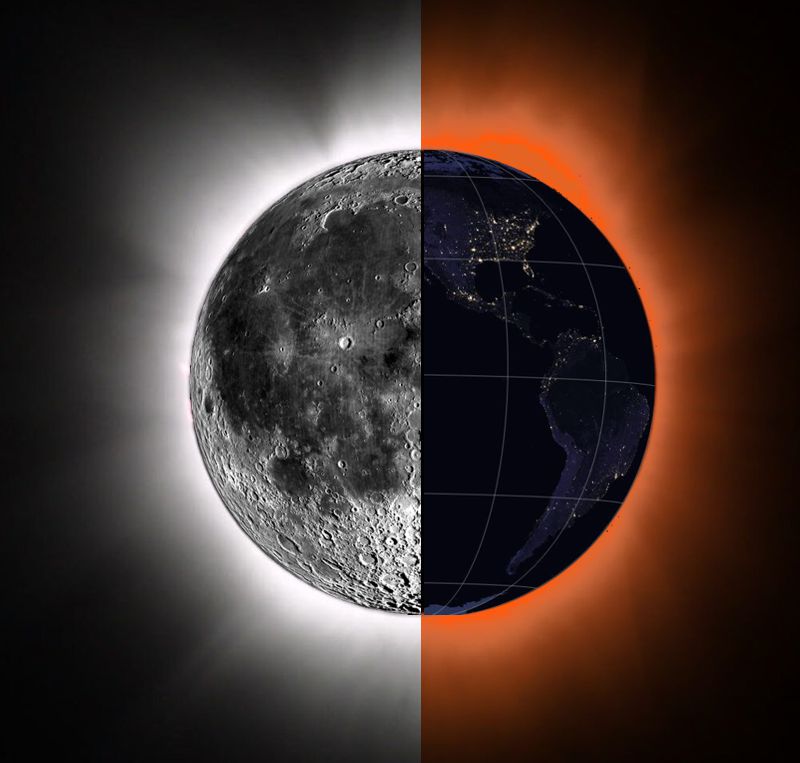
“Sort of. The sunsets we see on Earth are red mostly because our air absorbs the Sun’s blue light when we’re looking across the atmosphere. Only the red light gets through to our eyes. Remember the solar eclipse we saw, when the Moon came exactly between us and the Sun? Moon eclipses are inside out from that. We come between the Moon and the Sun. The only light getting past us has gone across our atmosphere just like sunset light does so it’s orange‑y red like a sunset.”

“Oooh … does the Sun ever get between us and the Moon?”

“Don’t worry, Sweetie. We’re far, far from the Sun. Mr Newton’s Laws of Motion say that we and the Moon will be waltzing out here for a long, long time.”

“Whee, we’re dancing around the Sun! MOMmie, Uncle Sy’s here!”

“Hi, Sis. You saw the eclipse, then.”

“Mm-hm. I realized while I was watching it that lunar phase shadows work differently from eclipses.”

“Oh? How so?”

“The shadow shapes are different, for one. The edge of the lunar phase shadow always passes through both poles. In a solar eclipse the shadow only reaches the poles at totality, and in a lunar eclipse there’s this almost straight shadow arc that marches across the whole face.”

“Interesting. You said ‘for one,’ so what else?”

“Eclipse shadows move in the wrong direction. Starting from a full moon, the shadow comes in from the right until you get to new moon, then it falls away to the left until you get back to full moon. Agreed?”

“I always get confused. I’ll take your word for it.”

“I looked it up. In two places. Anyhow, in both kinds of eclipse the shadow creeps from left to right. Just backwards from the lunar phases. I wonder if that has anything to do with ancient societies thinking that an eclipse is somehow evil.”

“Mommie, you know you’re not supposed to use words I don’t know unless you’re keeping secrets. What’s lunar faces?”

“Sorry, Teena, not secret. Lunar means Moon. Sy, can you show her phases on Old Reliable?”

“Sure. Here’s a quick sketch, Teena. Pretend that the little ball is the Moon going around the Earth. The Sun is off to the right. You know the Moon goes around the Earth and it always keeps the same side towards us, right?”

“That’s the Man In The Moon except it’s really mountains and stuff pointing at us.”

“That’s what the little triangle shows, like it’s his nose. See how sometimes it’s in the light and sometimes it’s in shadow? The big ball is what we see when the Moon is in each position. When the Man is facing straight towards the Sun we call that the Full Moon phase. When he’s completely in shadow that’s the New Moon phase. There’s names for other special positions, and all of the special positions are phases, OK?”

“I suppose you have a logical explanation for the shadows?”

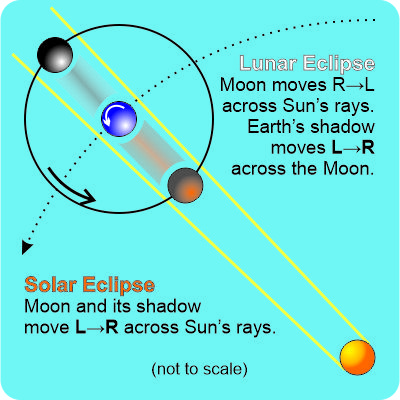
“Sure, Sis. It’s all about where the shadow’s being cast and how the shadow caster is moving at the time. This diagram tells the story. Nearly everything in the Solar System runs counterclockwise—”

“Widdershins.”

“… Right. Every orbit runs left‑to‑right half the time, right‑to‑left the other half. The two kinds of eclipse happen in opposite halves. The geometry works out that we see both eclipse shadows move left‑to‑right. See?”

“Cool.”

~~ Rich Olcott

  • Thanks to Alex for the question, and to Lori for the shadow observation, which I hadn’t seen discussed before.

Listen to The Rock Music

“Kareem, how did we learn this stuff about the Earth’s insides? I mean, clouds and winds hundreds of miles down?”

“Fair question, Eddie. Jules Verne’s Voyage to The Center of The Earth couldn’t happen, because hollow volcanic tubes don’t go near far enough down. Drilling’s not useful for exploring the mantle — we’ve only gotten about six miles through the seafloor crust and that’s still probably a dozen miles up from where the mantle starts. Forget what you’ve seen in the comics or a movie, we won’t in our lifetimes have a sub‑like vehicle that can melt through rock, withstand million‑atmosphere pressures and swim through superheated lava. So what we do is oscillate, triangulate and calulate.”

“I’ll bite. Oscillate? Triangulate?”

“How we do earthquake chasing, Sy. For thousands of years, humanity experienced a quake as a local jolt. It wasn’t until the 1850s that we realized each quake incident has multiple components: a sudden rupture somewhere, the resulting shock that travels through the Earth to other locations, and maybe aftershocks from follow‑on ruptures. The shock is a whole train of waves. We used to record them on those big cylindrical seismograph drums with oscillating pens, but most stations have gone digital since the early 90s. More accurate data, easier to handle but less picturesque.”

“True. The TV weather guys love pics of the big cylinder with all the wiggly lines. How about the triangulations?”

“Suppose you feel an earthquake shock. How do you find out where the rupture occurred and how big it was?”

“Hard to do from one location. A really big one far away would give you the same blip as a small one close by. And you probably wouldn’t know how deep it was or what direction it came from. I guess you’d need to compare notes with some far‑away observers. The one closest to the rupture would have received the strongest signal.”

“Yeah, Sy, and if everybody kept track of when they felt the jolt then you could draw a map with the different times and that’d zero in on it. Uhh … three places and you’ve got it.”

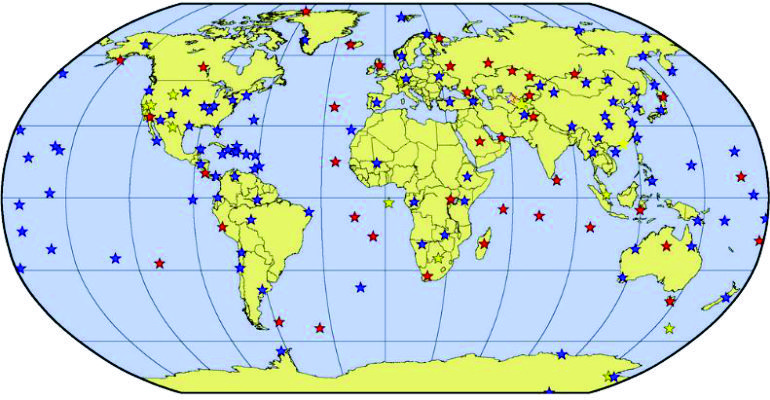
The IRIS Global Seismic Network as of 2021.

“Three points makes a triangle, Eddie, you’ve just described triangulation. It’s a general principle — the more points of view you have to work with, the better the image. Seismic tomography is all about merging well‑characterized data from lots of stations. That’s why we built an international Global Seismic Network, 152 identically‑equipped stations. Here’s a map.”

“How ’bout that, Sy? Lotsa triangles, all over the world.”

“Reminds me of Feynman’s insight that an electron doesn’t take just one path from A to B, it takes all possible paths. Earthquake shocks must go around the Earth and through the Earth, so each of those stations could hear multiple wave trains from a strong‑enough earthquake. These days it’s all digital, I suppose, and tied together with high‑precision time‑ticks. Kareem, they must be able to localize within a millimeter.”

“Not really, Sy. There’s a complication the early seismologists discovered even with primitive timing and recording equipment. The waves don’t all travel at the same speed. Depending on what’s in the way some of them even stop.”

“Wait, these shocks are basically sound waves. Does sound go fast or slow or stop depending on where it is in the Earth?”

“Sonic physics, Sy. The stiffer the material the faster sound travels. About 1½ kilometer/second in water, 3 in stone and 6 in metals but those numbers vary with composition, temperature and pressure. Especially pressure, like millions of atmospheres near the center. In the early 1900s Mohorovičić saw two signals from the same quake. One P‑wave/S‑wave pair came direct through the crust, the second followed a bent path through some different material. That was our first clue that crust and mantle are distinct but they’re both solid.”

P‑wave? S‑wave?”

“Like Push‑wave and Shake‑wave, Eddie. S‑waves shake side‑to‑side but fluids don’t shake so they block S‑waves. P‑waves pass right through. S‑waves traversing the LLSVP ‘clouds’ mean the regions are probably solid, but the waves don’t go as fast as a solid should carry them. It’s a strange world down there.”

~~ Rich Olcott

Mineral Winds

“Hey, if you guys are gonna use one of my tables at lunchtime, you oughtta order pizza.”

“Eddie, Eddie, you’re the one asking the questions that kept Kareem here into lunch hour. You owe him, seems to me.”

“Mmm, okayyy, but Sy, you can ante up. What can I get you, Kareem?”

“Nothing, thanks, unless you’ve got a halal oven.”

“Matter of fact I do, sort of. There’s a hotspot on the top left I only use for cheese melts so it should be OK for you. No pork spatters up there ever, that’s for sure.”

“A cheese melt would be fine, thanks.”

“Same for me, Eddie.”


<a few minutes later> “Here ya go, guys, straight outta the hotspot, lightly browned on top. Better let them sit a minute, you don’t wanna burn your mouth.”

“Thanks for the warning, Eddie.”

“Whatcha got there, a map?”

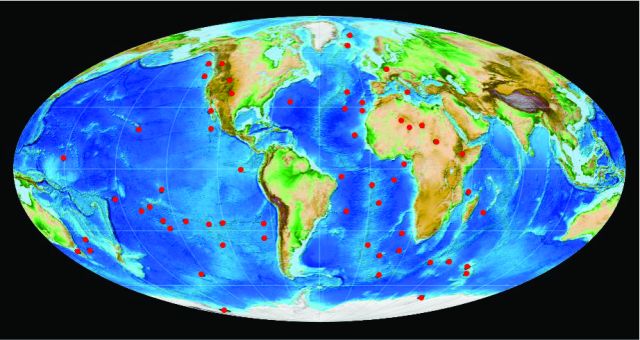
“Mm-hm, red dots for Earth’s sixty confirmed or proposed hotspots. Sy wanted to know more about the one that did a number on India.”

“What’s a hotspot? It’s like a big volcano, right?”

“Related but not quite. Most volcanoes are near where two plates are colliding. The classic case is the volcanoes along the western coastlines of the Americas The continents push westward and ride over Pacific seafloor plates, even break off slabs they shove down into the mantle where the heat melts them. The molten material squeezes up through cracks and escapes through volcanoes. Look where the dots are, though.”

BOW Bowie  COB Cobb
HAW Hawai’i
ANA AnahimYEL Yellowstone

“Most of them aren’t anywhere near the edge of anything. Yellowstone and those guys in Africa are as far from an edge as you can get. And I don’t see any red dots near Japan or the Philippines which are both really active for volcanoes and earthquakes.”

“Right, Sy. The primary criterion for a hot spot is vulcanism far from plate edges. But there’s another characteristic that many share. It’s easiest to see in this close‑up. Start with the Hawai’i, Cobb and Bowie hotspots. Each one is at the head of a straight‑line chain of volcanoes, older to younger as you get closer to the hotspot. The chains even run parallel with each other. The Anahim and Yellowstone hotspots also have parallel chains but they go west‑to‑east which makes sense if the continents are moving westward. It all fits with the idea that hotspots have stable locations in the mantle, and they scribble volcanoes on the plates that move over them. That’s the basis for much of what we know about ocean‑plate motion. But.”

“But?”

“There’s controversy, of course. Magnetism surveys and isotope data seem to show that some hotspots may move or even flutter slowly in some geology‑timescale wind. I just read—”

“Hey, Kareem, I’ve decorated so many pizzas with pepperoni slices I see red‑dot patterns everywhere. Your world map looks like there’s a ring of red dots around Africa and a stripe across the south Pacific. Does that mean anything?”

“We think it does, Eddie, but we’re still figuring out what. A technique called seismic tomography has given us evidence for a pair of huge somethings called LLSVPs deep into the mantle and on opposite sides of the Earth. One, unofficially known as TUZO, underlies much of Africa and that hotspot ring you noticed. The other one, JASON, is below your hotspot stripe in the South Pacific. We know very little about them so far, just that they stick out in the tomograms and they’ve probably been more‑or‑less where they are for a billion years. And no, we have no idea why hotspots appear around the edge of TUZO but along the center of JASON.”

“What else is lurking down there?”

“Who knows? The textbook diagrams show the mantle as this inert homogeneous shell sitting between core and crust. But its upper part is fluid and six times deeper than our atmosphere. The new tech is showing us currents something like winds and objects something like clouds, all at geological sizes and timescales. Classical Geophysics down there has been like doing weather science but ignoring clouds, mountains and oceans. There’s weather beneath us and we’re just beginning to see it.”

~~ Rich Olcott

The Bad, Sad, Rad Red Dot

“Was it just my imagination, Kareem, or was there some side action going on in that Africa‑Eurasia nutcracker video?”

“Always the trained observer, eh, Sy? You’re right, India had an interesting life in the same era. Here, let me bring up another Gplates video on Old Reliable. I need to show both sides of the world so I’ll switch from orthographic to Mollweide projection. Aannd I don’t need to go quite as far back, only to about 120 million years. Mmm, yeah, I’ll squeeze in some special markings, give me a sec… There. This slick enough for you?”

India’s 120-million-year journey
rendered using the GPlates system
and configuration data from Müller, et al., 2019, doi.org/10.1029/2018TC005462

“Busy, indeed. Care to read out what‑all is happening?”

“Sure. The big thing, of course, is the new ocean opening up around the Mid-Atlantic Rift. Further south, by 120 million years ago Gondwanaland had already calved off South America and Africa so all it had left was Madagascar, India, Australia and the Antarctic.”

“Somehow I’d always thought that Madagascar was tied to southern Africa, but I guess not.”

“Hasn’t been for 175 million years, and back then it was up level with where Kenya and Somalia are now. OK, what caught your eye east of Africa was India zoomin’ on up there three times faster than South America was drifting away from Africa. What I’ve done here, I locked the display onto Antarctica so everything’s moving relative to that even though Antarctica wandered around a bit, too. Then I marked a spot in central India, dialed back to 120 million years ago and started scanning forward by three‑million-year increments. At each step I put an orange dot over my marked spot. The dot sequence shows the subcontinent’s motion up to today. You can see it’s not a straight line and the points aren’t evenly spaced.”

“The uneven spacing and wiggly line say that India didn’t move at constant velocity.”

“Spoken like a true physicist.”

“And like any physicist who sees a velocity change I wonder about the forces that make that happen. That red dot, for instance, why did it break the pattern?”

“The red dot is special because it marks 66 million years ago. Does that date ring a bell with you?”

“Umm … Ah-hah! That was the meteor that killed off the dinosaurs, right?”

“The Chicxulub impactor had a lot to do with it, but that wasn’t the whole story. The dot is already far ahead of where it should have been considering India’s previous vector. Something happened that sped that plate along a good three million years before the meteor hit. We’re pretty sure the something was related to massive continental volcanic activity on India just south of where my dots are. The lava covered half the continent, six hundred thousand square miles. All that molten discharge undoubtedly came along with toxic gases that would have fouled the planet’s atmosphere and troubled the dinosaurs and everything else trying to breathe,”

“And what caused the volcanoes?”

“Really bad luck. There’s an active hotspot, we call it Réunion after the French island that’s on top of it at the moment. India just happened to pass right over the hotspot between 69 and 63 million years ago. The spot’s rising magma punched through the subcontinent’s bedrock, ran all over the place and maybe lubricated the passage. Then along comes the meteor when India’s only halfway across the hotspot. The asteroid doesn’t hit India but where it hits is almost as bad — just off the Mexican coast, almost exactly on the other side of the planet from where India is at the time. Imagine a massive ring of violent earthquakes sweeping around the Earth’s surface and coming to a focus smack in the middle of the volcanoes. That’s my shooting red line, except the shakers really come at India from every direction. The magma outflow rate doubles. Altogether, the discharge finally lays over 1015 metric tons of lava on top of poor India and whatever’s living there at the time.”

“Wow. Talk about your perfect storm.”

“The only good thing to come out of it is all the minerals in the magma left India with incredibly fertile soil.”

“That’s something.”

~~ Rich Olcott

Ka-RUNCH!

“Kareem, will you ever actually tell me what’s going on with the volcanoes in Italy and Greece and Turkey? And do it quick, I gotta start getting ready for the lunch trade.”

“Eddie, you’re the one who keeps asking the side questions. Sy, I see you’re carrying Old Reliable.”

“I always travel ready for action, Kareem.”

“You got the GPlates system loaded in there? It’s a go‑to tool in our Geophysics lab.”

“Matter of fact, I do, but I’ve not had time to start playing with it. Here, show us what it can do.”

“I’ve got a particular display in mind, give me a minute. <busy‑fingers pause> There. What you’re looking at is Planet Earth as we think it was 195 million years ago.”

“Is that Pangaea?”
 ”Is that Pangaea?”

“Sure is. Most of Earth’s high‑silica slag had sutured together in one big supercontinent that stretched from pole to pole.”

“What’s on Earth’s other side?”

“Mostly a huge ocean, which is why I colored it flat blue. There were probably seamounts and rifts and stuff scattered around the seabottom but all that high‑density low‑silica structure is long gone, shoved below by the continents that rode over it. This is a snapshot at the time when Pangaea was just beginning to come apart — you can see where South America is ripping away from Africa at their southern juncture, and North America’s just started to move off to the west.”

“What’s the difference between the light blue and the darker blue?”

“Good eyes, Eddie, and it’s important. The light blue is the continental shelf.”

“It’s not part of the continent?”

“Oh, it is. The shelf’s the flooded margin, partly ancient consolidated rock and partly sediments that have washed down over the ages. There’s usually a steepish drop‑off from the shelf down to the abyssal bottoms. My hero Wegener is the guy who realized that when you’re putting the jigsaw puzzle together, the shelf is the border you need to pay attention to.”

“What’s the yellow-line kite shape?”

“It ties together some points that’ll help answer Eddie’s Italy‑Greece‑Turkey question. Let me put the video in motion…”

Earth from 195 million years ago to the present
rendered using the GPlates system
and configuration data from Müller, et al., 2019, doi.org/10.1029/2018TC005462

“I see you’ve got Africa in the center instead of the usual New World axis.”

“Why not? Anyway it’s convenient for Eddie’s volcanoes. See that fragment at the kite’s eastern corner? I marked it with dark circle. Watch what happened to it about 55 million years ago, and where it went after that.”

“It banged into what’s gonna be Turkey!”

“Mm-hm, and the land crinkled up and that’s the origin of Turkey’s volcano belt that I’ve marked purple. GPlates calls that chunk the Kirsehir plate. No connection with the vulcanism further west.”

“Wait. That little thing is a plate?”

“The definition depends on who you’re talking to and what about. Officially we’ve got cratons, major plates, minor plates, microplates and terranes, but there’s fuzzy lines between them. GPlates ‘plate’ list contains about a thousand chunks that have moved around independently and are big enough to pay attention to.”

“I can see why you called it the Africa‑Eurasia nutcracker, Kareem. It crunches right down on that continental shelf north of Africa.”

“That’s the planet’s oldest bit of seafloor, Sy, maybe 300 million years old, half again older than anywhere else. Maybe the rock got brittle with age, but the collision region’s faults and folds are incredibly complex.”

“It’s a hot mess, HAW!”

“Can’t say you’re wrong, Eddie. Anyway, south and west of Turkey there’s a whole series of trenches where north‑bound seafloor crust dives under south‑bound structures. The sunken material melts, puffs up and pushes up against what’s above it. All of that leaves beaucoodles of weak spots for magma to leak upwards and you get volcanoes throughout the red‑marked area.”

“One thing I get from this, Eddie, is that it’s not one long arc from Italy through Turkey. Kareem’s pointed out two different formation periods, 50 million years apart.”

“I get that, too, Sy. It’s amazing what you can see when you look close.”

“And when hundreds of researchers gather data over two centuries.”

“Thanks, Kareem. Gotta go.”

~~ Rich Olcott