


Rule One in hooking the reader with a query headline is: Don’t answer the question immediately. Let’s break that one. Yes, cyber warfare is imaginary, but only for a certain kind of “imaginary.” What kind is that, you ask. AaaHAH!
didn’t normally use cyber weaponry
It all has to do with number lines. If the early Greek theoreticians had been in charge, the only numbers in the Universe would have been the integers: 1, 2, 3,…. Life is simple when your only calculating tool is an abacus without a decimal point. Zero hadn’t been invented in their day, nor had negative numbers.
Then Pythagoras did his experiments with harmony and harp strings, and the Greeks had to admit that ratios of integers are rational.
More trouble from Pythagoras: his a2+b2=c2 equation naturally led to c=√(a2+b2). Unfortunately, for most integer values of a and b, c can’t be expressed as either an integer or a ratio of integers. The Greeks labeled such numbers (including π) as irrational and tried to ignore them.
Move ahead to the Middle Ages, after Europe had imported zero and the decimal point from Brahmagupta’s work in India, and after the post-Medieval rise of trade spawned bookkeepers who had to cope with debt. At that point we had a continuous number line running from “minus a whole lot” to “plus you couldn’t believe” (infinity wasn’t seriously considered in Western math until the 17th century).
By then European mathematicians had started playing around with algebraic equations and had stumbled into a problem. They had Brahmagupta’s quadratic formula (you know, that [-b±√(b2-4a·c)]/2a thing we all sang-memorized in high school). What do you do when b2 is less than 4a·c and you’re looking at the square root of a negative number?
Back in high school they told us, “Well, that means there’s no solution,” but that wasn’t good enough for Renaissance Italy. Rafael Bombelli realized there’s simply no room for weird quadratic solutions on the conventional number line. He made room by building a new number line perpendicular to it. The new line is just like the old one, except everything on it is multiplied by i=√(-1).
(Bombelli used words rather than symbols, calling his creation “plus of minus.” Eighty years later, René Descartes derisively called Bombelli’s numbers “imaginary,” as opposed to “real” numbers, and pasted them with that letter i. Those labels have stuck for 380 years. Except for electricity theoreticians who use j instead because i is for current.)
 Suppose you had a graph with one axis for counting animal things and another for counting vegetable things. Animals added to animals makes more animals; vegetables added to vegetables makes more vegetables. If you’ve got a chicken, two potatoes and an onion, and you share with your buddy who has a couple of carrots, some green beans and another onion, you’re on your way to a nice chicken stew.
Needs salt, but that’s on yet another axis.
Bombelli’s rules for doing arithmetic on two perpendicular number lines work pretty much the same. Real numbers added to reals make reals, imaginaries added to imaginaries make more imaginaries. If you’ve got numbers like x+i·y that are part real and part imaginary, the separate parts each follow their own rule. Multiplication and division work, too, but I’ll let you figure those out.
The important point is that what happens on each number line can be specified independently of what happens on the other, just like the x and y axes in Descartes’ charts. Together, Bombelli’s and Descartes’ concepts constitute a nutritious dish for physicists and mathematicians.
Scientists love to plot different experimental results against each other to see if there’s an interesting relationship in play. For certain problems, for example, it’s useful to plot real-number energy of motion (kinetic energy) against some other variable on the i-axis.
Two-time Defense Secretary Donald Rumsfeld used to speak of “kinetic warfare,” where people get killed, as opposed to the “non-kinetic” kind. Apparently, he would have visualized cyber somewhere up near the i-axis. In that scheme, cyber warriors with their ones and zeros are Bombelli-imaginary even if they’re real.
~~ Rich Olcott


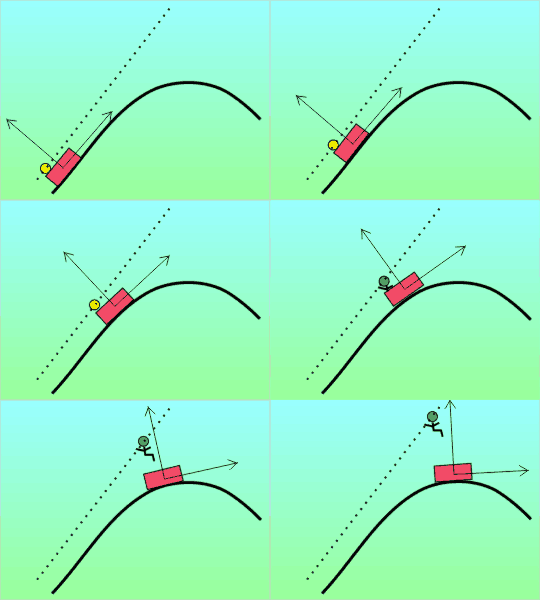 But there are other accelerations that aren’t so easily accounted for. Ever ride in a car going around a curve and find yourself almost flung out of your seat? This little guy wasn’t wearing his seat belt and look what happened. The car accelerated because changing direction is an acceleration due to a lateral force. But the guy followed Newton’s First Law and just kept going in a straight line. Did he accelerate?
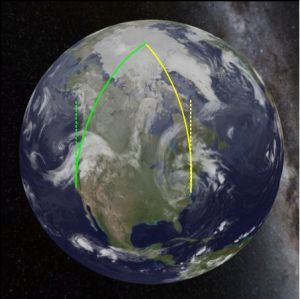 Suppose you’re investigating an object’s motion that appears to arise from a new force you’d like to dub “heterofugal.” If you can find a different frame of reference (one not attached to the object) or otherwise explain the motion without invoking the “new force,” then heterofugalism is a fictitious force.



 Sure enough, that’s a straight line (see the chart). Reminds me of how Newton’s Law of Gravity is valid



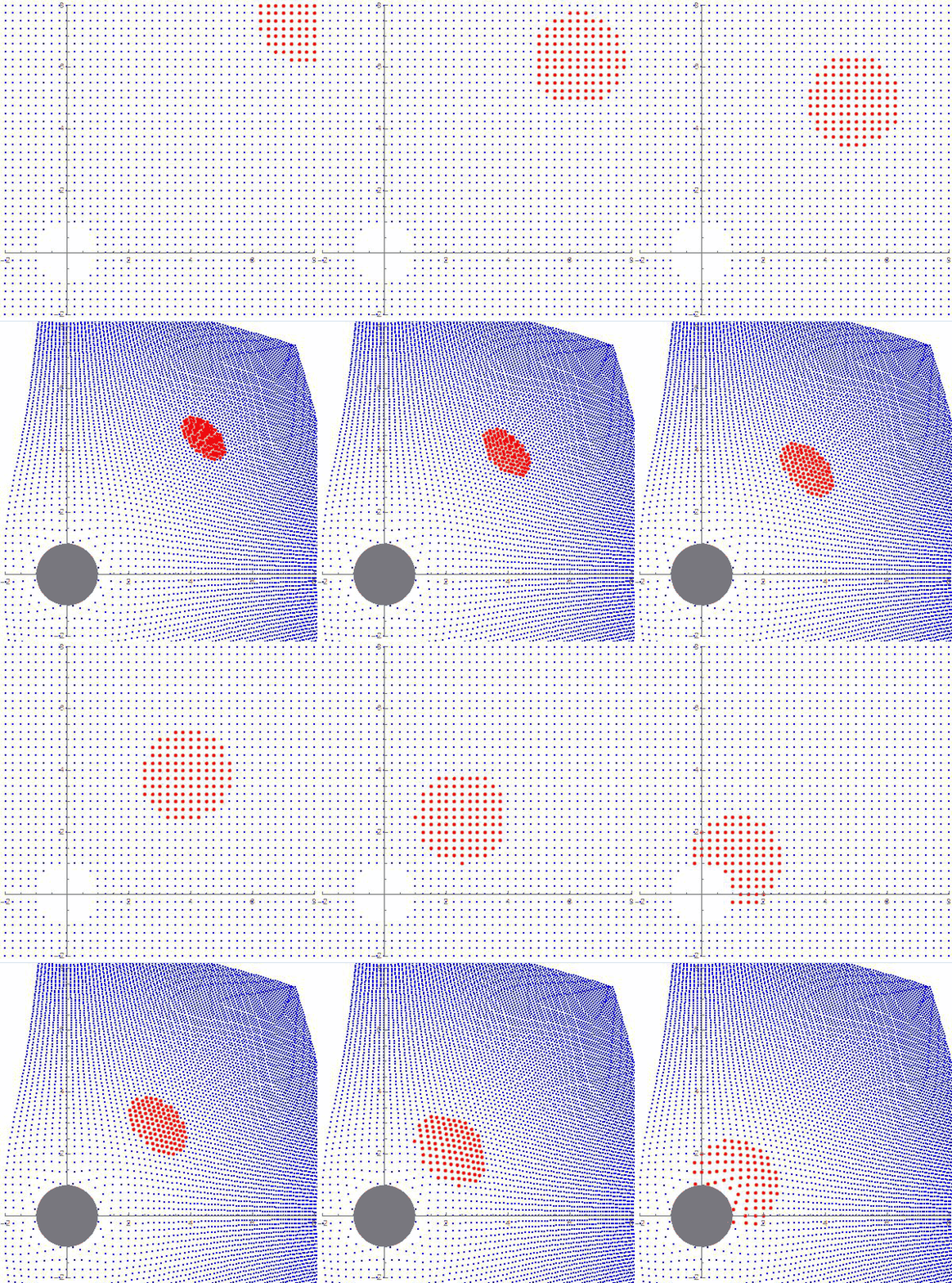
 In several of his Discworld books, author Terry Pratchett featured something called Library-space, L-space for short. It’s defined as “a dimension that connects every library and book depository in the universe. L-Space is portrayed as a natural outgrowth of the fact that knowledge = power = energy = matter = mass and mass warps space, and therefore, libraries in the Discworld universe are a very dangerous place indeed for the unprepared”.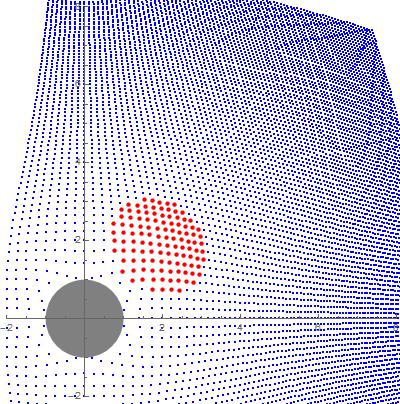



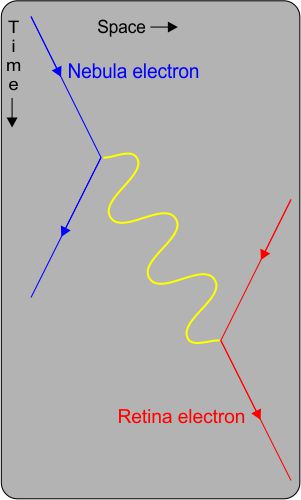 Here we have a Feynman diagram, named for the Nobel-winning (1965) physicist who invented it and much else. The diagram plots out the transaction we just discussed. Not a conventional x-y plot, it shows Space, Time and particles. To the left, that far-away electron emits a photon signified by the yellow wiggly line. The photon has momentum so the electron must recoil away from it.
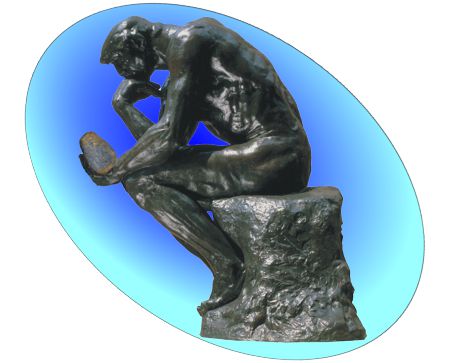 Gargh, proto-humanity’s foremost physicist 2.5 million years ago, opened a practical investigation into how motion works. “I throw rock, hit food beast, beast fall down yes. Beast stay down no. Need better rock.” For the next couple million years, we put quite a lot of effort into making better rocks and better ways to throw them. Less effort went into understanding throwing.
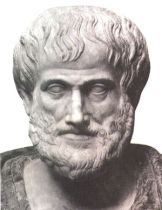 Aristotle wasn’t satisfied with anything so unsystematic. He was just full of theories, many of which got in each other’s way. One theory was that things want to go where they’re comfortable because of what they’re made of — stones, for instance, are made of earth so naturally they try to get back home and that’s why we see them fall downwards (no concrete linkage, so it’s still AAAD).



 It would have been awesome to watch Dragon Princes in battle (from a safe hiding place), but I’d almost rather have witnessed “The Tussles in Brussels,” the two most prominent confrontations between Albert Einstein and Niels Bohr.
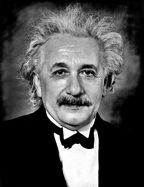 Like Newton, Einstein was a particle guy. He based his famous thought experiments on what his intuition told him about how particles would behave in a given situation. That intuition and that orientation led him to paradoxes such as entanglement, the
  Bohr was six years younger than Einstein. Both Bohr and Einstein had attained Directorship of an Institute at age 35, but Bohr’s has his name on it. He started out as a particle guy — his first splash was a trio of papers that treated the hydrogen atom like a one-planet solar system. But that model ran into serious difficulties for many-electron atoms so Bohr switched his allegiance from particles to Schrödinger’s wave theory. Solve a Schrödinger equation and you can calculate statistics like
  Here’s where Ludwig Wittgenstein may have come into the picture. Wittgenstein is famous for his telegraphically opaque writing style and for the fact that he spent much of his later life disagreeing with his earlier writings. His 1921 book, Tractatus Logico-Philosophicus (in German despite the Latin title) was a primary impetus to the Logical Positivist school of philosophy. I’m stripping out much detail here, but the book’s long-lasting impact on QM may have come from its Proposition 7: “Whereof one cannot speak, thereof one must be silent.“
 Hard Science Ain't Hard