
One year ago I kicked off these weekly posts with some speculations about how Life might exist on Saturn’s moon Titan. My surmises were based on reports from NASA’s Cassini-Huygens mission, plus some Physical Chemistry expectations for Titan’s frigid non-polar mix of liquid ethane and methane. Titan offers way more fun than that.
The environment on Titan is different from everything we’re used to on Earth. For instance, the atmosphere’s weird.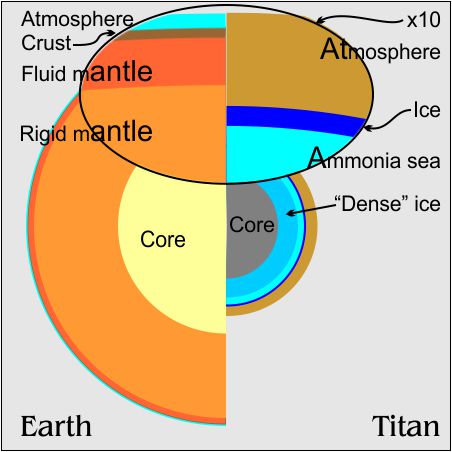 Titan’s atmosphere is heavy-duty compared with Earth’s — 6 times deeper and about 1½ times the surface pressure. When I read those numbers I thought, “Huh? But Titan’s diameter is only 40% as big as Earth’s and its surface gravity is only 10% of ours. How come it’s got such a heavy atmosphere?”
Wait, what’s gravity got to do with air pressure? (I’m gonna use “air pressure” instead of “surface atmospheric pressure” because typing.) Earth-standard sea level air pressure is 14.7 pounds of force per square inch. That 14.7 pounds is the total weight of the air molecules above each square inch of surface, all the way out to space.
(Fortunately, air’s a hydraulic fluid so its pressure acts on sides as well as tops. Otherwise, a football’s shape would be even stranger than it is.)
Newton showed us that weight (force) is mass times the the acceleration of gravity. Gravity on Titan is 1/10 as strong as Earth’s, so an Earth-height column of air on Titan should weigh about 1½ pounds.
But Titan’s atmosphere (measured to the top of each stratosphere) goes out 6 times further than Earth’s. If we built out that square-inch column 6 times taller, it’d weigh only 9 pounds on Titan, well shy of the 22 pounds the Huygens lander measured. Where does the extra weight come from?
My first guess was, heavy molecules. If gas A has molecules that are twice as heavy as gas B’s, then a given volume of A would weigh twice as much as the same volume of B. An atmosphere composed of A will press down on a planet’s surface twice as hard as an atmosphere composed of B.
Good guess, but doesn’t apply. Earth’s atmosphere is 78% N2 (molecular weight 28) and 21% O2 (molecular weight 32) plus a teeny bit of a few other things. Their average molecular weight is about 29. Titan’s atmosphere is 98% N2 so its average molecular weight (28) is virtually equal to Earth’s. So no, those tarry brown molecules that block our view of Titan’s surface aren’t numerous enough to account for the high pressure.
My second guess is closer to the mark, I think. I remembered the Ideal Gas Law, the one that says, “pressure times volume equals the number of molecules times a constant times the absolute temperature.” In symbols, P·V=n·R·T.
Visualize one gas molecule, Fred, bouncing around in a cube sized to match the average volume per molecule, V/n=R·T/P. If Fred goes outside his cube in any direction he’s likely to bang into an adjacent molecule. If Fred has too much contact with his neighbors they’ll all stick together and become a liquid or solid.
The equation tells us that if the pressure doesn’t change, the size of Fred’s cube rises with the temperature. Just for grins I calculated the cube’s size for standard Earth conditions: (22.4 liters/mole)×(1 cubic meter/1000 liters)×(1 mole/6.02×1023 molecules)=37.2×10⁻²⁷ cubic meter/molecule. The cube root of that is the length of the cube’s edge — 3.3 nanometers, about 8.3 times Fred’s 0.40-nanometer diameter.∗
Earth-standard surface temperature is about 300°K (absolute temperatures are measured in Kelvins). Titan’s surface temperature is only 94°K. On Titan that cube-edge would be 8.3*(94/300)=2.6 times Fred’s diameter — if air pressure were Earth-standard.
But really Titan’s air pressure is 1.5 times higher because its column is so tall and contains so much gas. The additional pressure squeezes Fred’s cube-edge down to 2.6*(1/1.5)=1.8 times his diameter. Still room enough for Fred to feel well-separated from his neighbors and continue acting like a proper gas.
The primary reason Titan’s atmosphere is so dense is that it’s chilly up there. Also, there’s a lot of Freds.
~~ Rich Olcott
∗ – For the technorati… The cube-root of the Van der Waals volume for N2. And yeah, I know I’m almost writing about Mean Free Path but I think the development’s simpler this way.
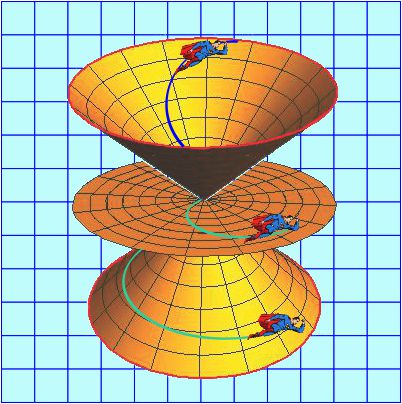


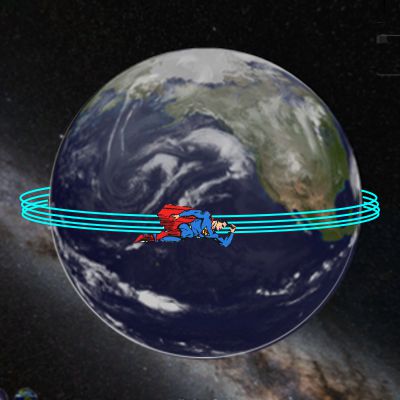 But for this post let’s consider a trope that’s been taken off the shelf again and again since those days, even in the movies. This rendition should get the idea across — Our Hero, in a desperate effort to fix a narrative hole the writers had dug themselves into, is forced to fly around the Earth at faster-than-light speeds, thereby reversing time so he can patch things up.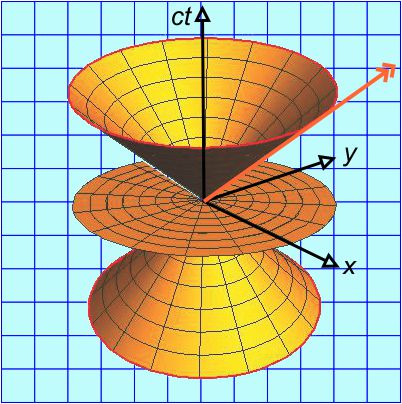
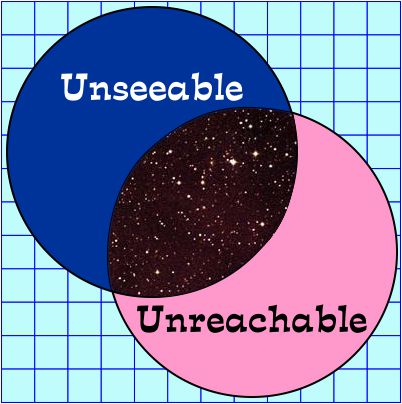
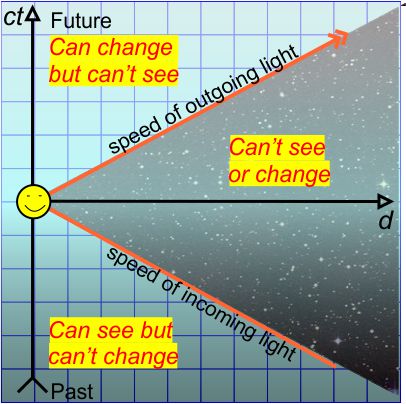
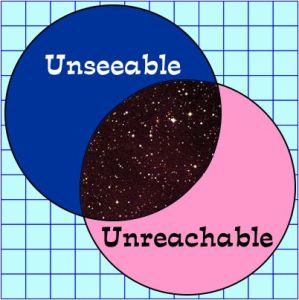 The rest of the Minkowski diagram could do for a Venn diagram. We at (0,0,0,0) can do something that will cause something to happen at (ct,x,y,z) to the left of the top orange line. However, we won’t be able to see that effect until we time-travel forward to its t. That region is “reachable but not seeable.”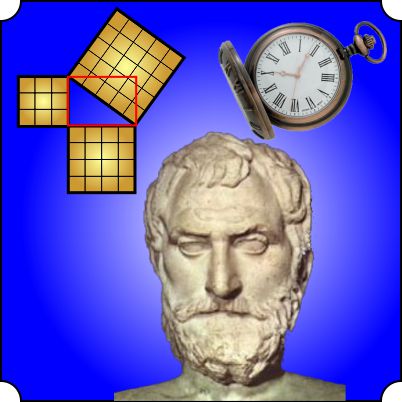
 One more step and we can answer Ken’s question. A moving object’s proper time is defined to be the time measured by a clock affixed to that object. The proper time interval between two events encountered by an object is exactly Minkowski’s spacetime interval. Lucy’s clock never moves from zero.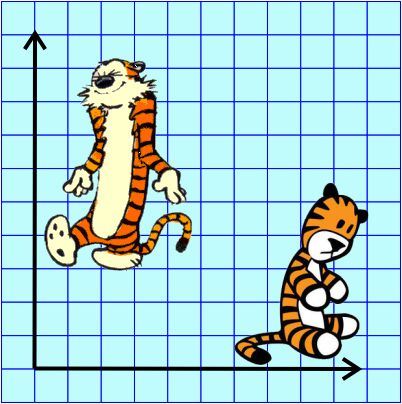
 I so miss Calvin and Hobbes, the wondrous, joyful comic strip that cartoonist Bill Watterson gave us between 1985 and 1995. Hobbes was a stuffed toy tiger — except that 6-year-old Calvin saw him as a walking, talking man-sized tiger with a sarcastic sense of humor.
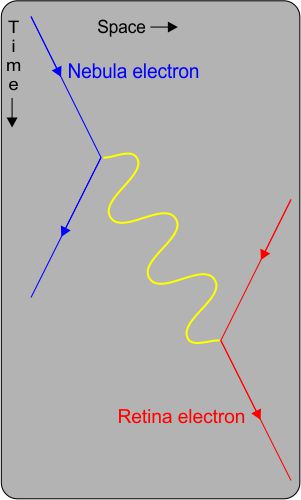
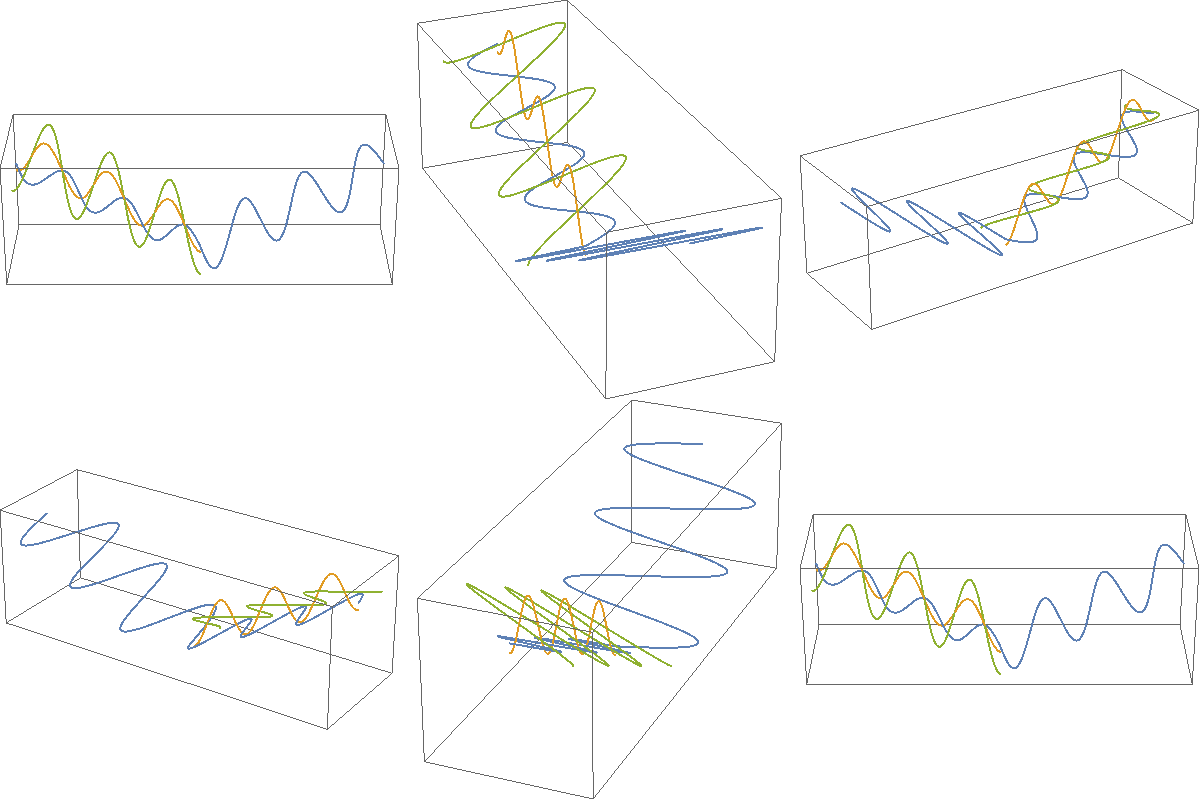 In this video, orange, green and blue electromagnetic fields shine in from one side of the box onto its floor. Each color’s field is polar because it “lives” in only one plane. However, the beam as a whole is unpolarized because different components of the total field direct recipient electrons into different planes giving zero net polarization. The Sun and most other familiar light sources emit unpolarized light.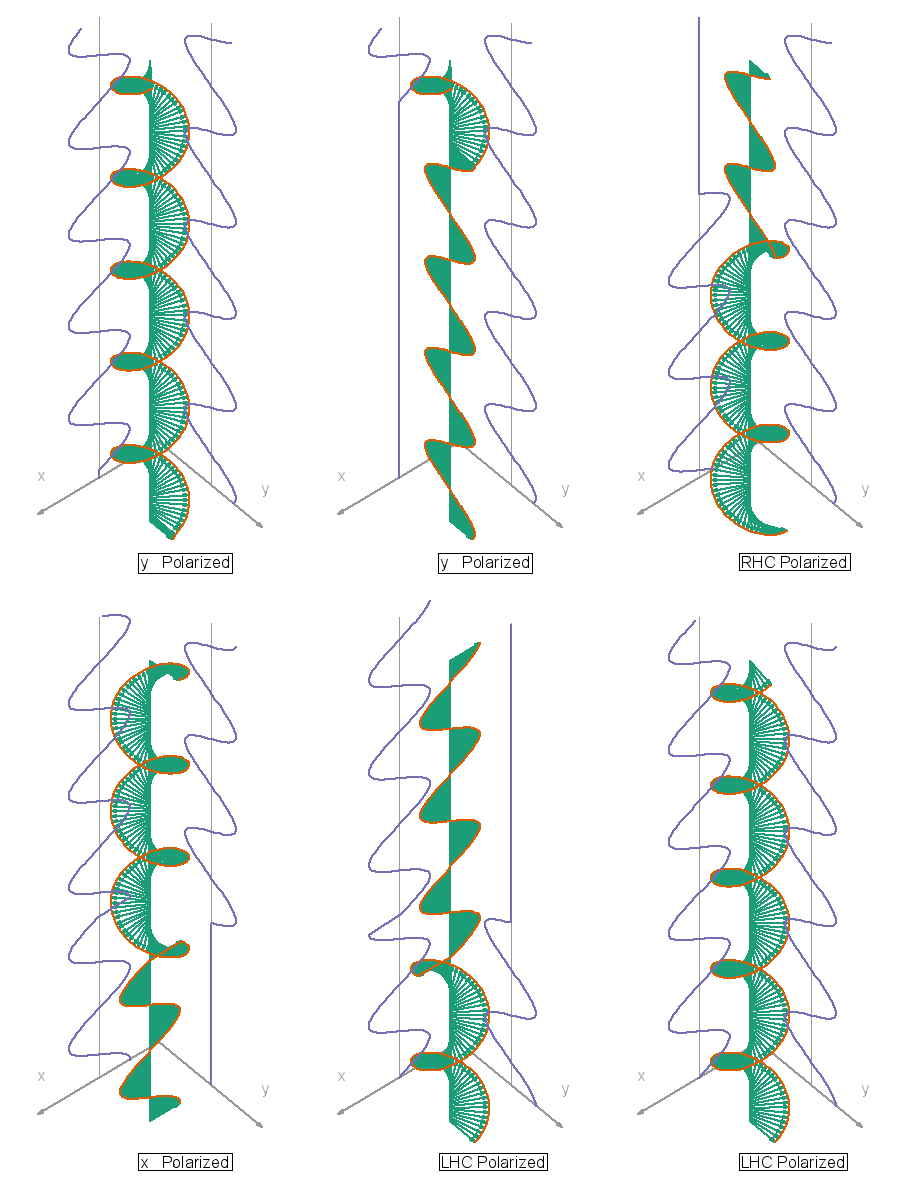

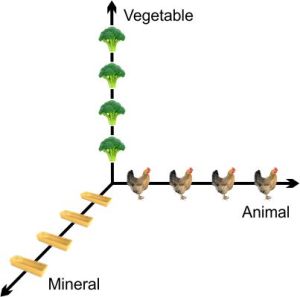 Suppose you had a graph with one axis for counting animal things and another for counting vegetable things. Animals added to animals makes more animals; vegetables added to vegetables makes more vegetables. If you’ve got a chicken, two potatoes and an onion, and you share with your buddy who has a couple of carrots, some green beans and another onion, you’re on your way to a nice chicken stew.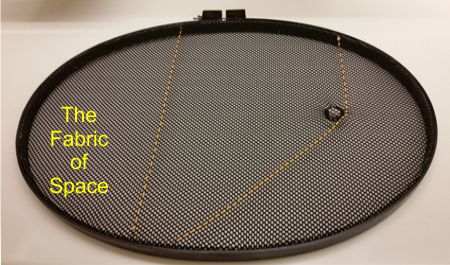


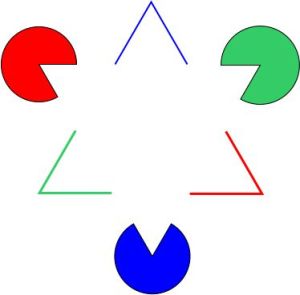
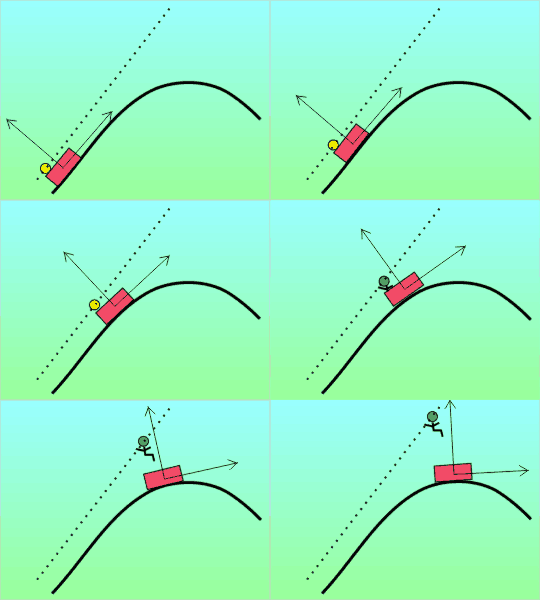 But there are other accelerations that aren’t so easily accounted for. Ever ride in a car going around a curve and find yourself almost flung out of your seat? This little guy wasn’t wearing his seat belt and look what happened. The car accelerated because changing direction is an acceleration due to a lateral force. But the guy followed Newton’s First Law and just kept going in a straight line. Did he accelerate?
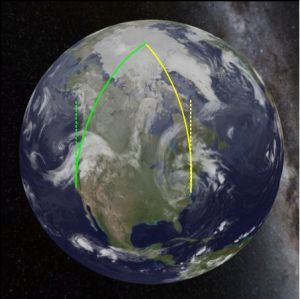 Suppose you’re investigating an object’s motion that appears to arise from a new force you’d like to dub “heterofugal.” If you can find a different frame of reference (one not attached to the object) or otherwise explain the motion without invoking the “new force,” then heterofugalism is a fictitious force.

