

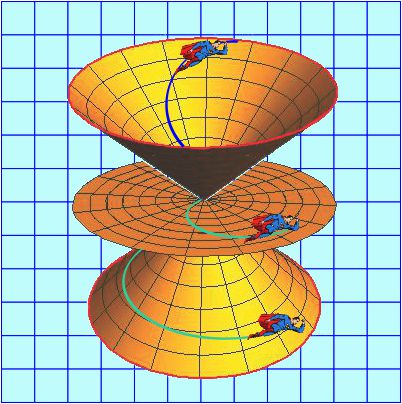
Comic book and movie plotlines often make Superman accelerate up to lightspeed and travel backward in time. Unfortunately, well-known fundamental Physics principles forbid that. But suppose Green Lantern or Dr Strange could somehow magic him past the Lightspeed Barrier. Would that let him do his downtimey thing?

A quick review of Light’s Hourglass. According to Einstein we live in 4D spacetime. At any moment you’re at a specific time t relative to some origin time t=0 and a specific 3D location (x,y,z) relative to a spatial origin (0,0,0). Your spacetime address is (ct,x,y,z) where c is the speed of light. This diagram shows time running vertically into the future, plus two spatial coordinates x and y. Sorry, I can’t get z into the diagram so pretend it’s zero.
The two cones depict all the addresses which can communicate with the origin using a flash of light. Any point on either cone is at just the right distance d=√(x²+y²+z²) to match the distance that light can travel in time t. The bottom cone is in the past, which is why we can see the light from old stars. The top cone is in the future, which is why we can’t see light from stars that aren’t born yet.
If he obeys the Laws of Physics as we know them, Superman can travel anywhere he wants to inside the top cone. He goes upward into the future at the rate of one second per second, just like anybody. On the way, he can travel in space as far from (ct,0,0,0) as he likes so long as it’s not farther than the distance that light can travel the same route at his current t.
From our perspective, the Hourglass is a stack of circles (spheres in 3D space) centered on (ct,0,0,0). From Supey’s perspective at time t he’s surrounded by a figure with radius ct that Physics won’t let him break through. That’s his Lightspeed Barrier, like the Sonic Barrier but 900,000 times faster.
Suppose Green Lantern has magicked Supey up to twice lightspeed along the x-axis. At moment t, he’s at (ct,2ct,0,0), twice as far as light can get. In the diagram he’s outside the top cone but above the central disk.
Now GL pours on the power to accelerate Superman. Each increment gets the Man of Steel closer to that disk. He’s always “above” it, though, because he’s still moving into the future. Only if he were to get to infinite speed could he reach the disk.
However, at infinite speed he’d go anywhere/everywhere instantaneously which would be confusing to even his Kryptonian intellect. On the way he might run into things (stars, black holes,…) with literally zero time to react.
But the plotlines have Tall-Dark-and-Muscular flying into the past, breaching that disk and traveling downwards into the bottom cone. Can GL make that happen?
Enter the Lorentz correction. If you have rest mass m0 and you’re traveling at speed v, your effective mass is m=m0/√[1-(v/c)²]. That raises a couple of issues when you exceed lightspeed.
Suppose GL decelerates Superluminal Supey down towards lightspeed. The closer he approaches c from higher speeds, the smaller that square root gets and the greater the effective mass. It’s the same problem Superman faced when accelerating up to lightspeed. That last mile per second down to c requires an infinite amount of braking energy — the Lightspeed Barrier is impermeable in both directions.
The other problem is that if v>c there’s a negative number inside that square root. Above lightspeed, your effective mass becomes Bombelli-imaginary. Remember Newton’s famous F=m·a? Re-arrange it to a=F/m. A real force applied to an object with imaginary mass produces an imaginary acceleration. “Imaginary” in Physics generally means “perpendicular in some sense” and remember we’re in 4D here with time perpendicular to space.
GL might be able to shove Superman downtime, but he’d have to
- squeeze inward at hiper-lightspeed with exactly the same force along all three spatial dimensions, to make sure that “perpendicular” is only along the time axis
- start Operation Squish at some time in his own future to push towards the past.
Nice trick. Would Superman buy in?
~~ Rich Olcott

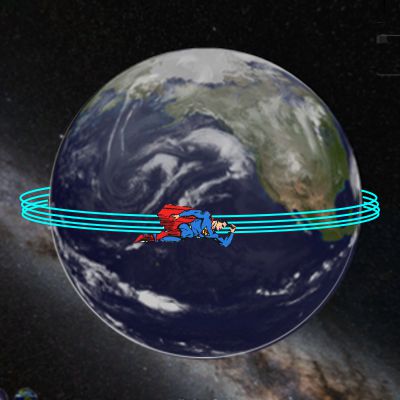 But for this post let’s consider a trope that’s been taken off the shelf again and again since those days, even in the movies. This rendition should get the idea across — Our Hero, in a desperate effort to fix a narrative hole the writers had dug themselves into, is forced to fly around the Earth at faster-than-light speeds, thereby reversing time so he can patch things up.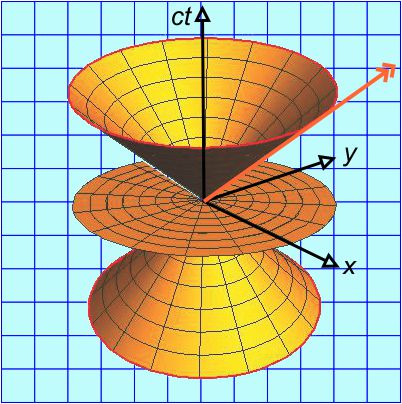
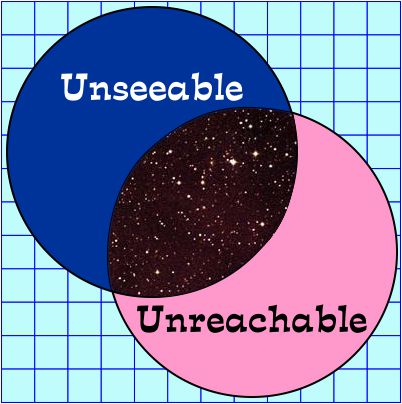
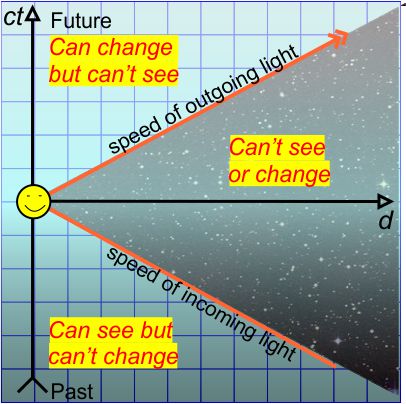
 The rest of the Minkowski diagram could do for a Venn diagram. We at (0,0,0,0) can do something that will cause something to happen at (ct,x,y,z) to the left of the top orange line. However, we won’t be able to see that effect until we time-travel forward to its t. That region is “reachable but not seeable.”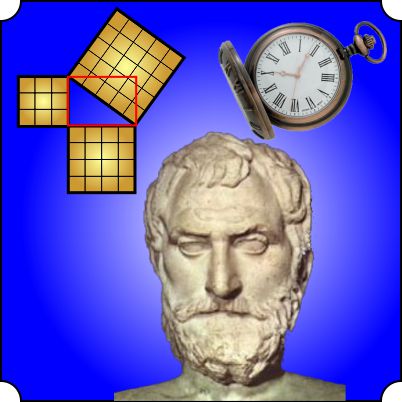
 One more step and we can answer Ken’s question. A moving object’s proper time is defined to be the time measured by a clock affixed to that object. The proper time interval between two events encountered by an object is exactly Minkowski’s spacetime interval. Lucy’s clock never moves from zero.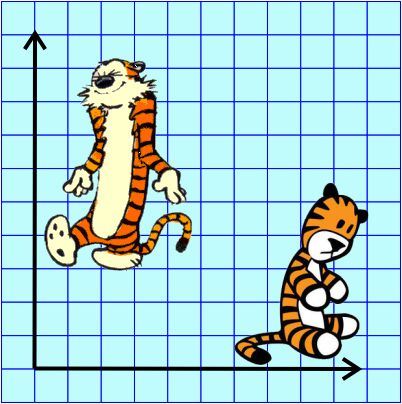
 I so miss Calvin and Hobbes, the wondrous, joyful comic strip that cartoonist Bill Watterson gave us between 1985 and 1995. Hobbes was a stuffed toy tiger — except that 6-year-old Calvin saw him as a walking, talking man-sized tiger with a sarcastic sense of humor.
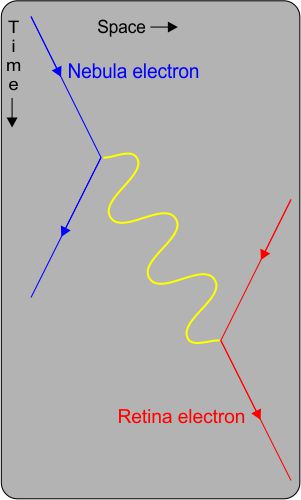
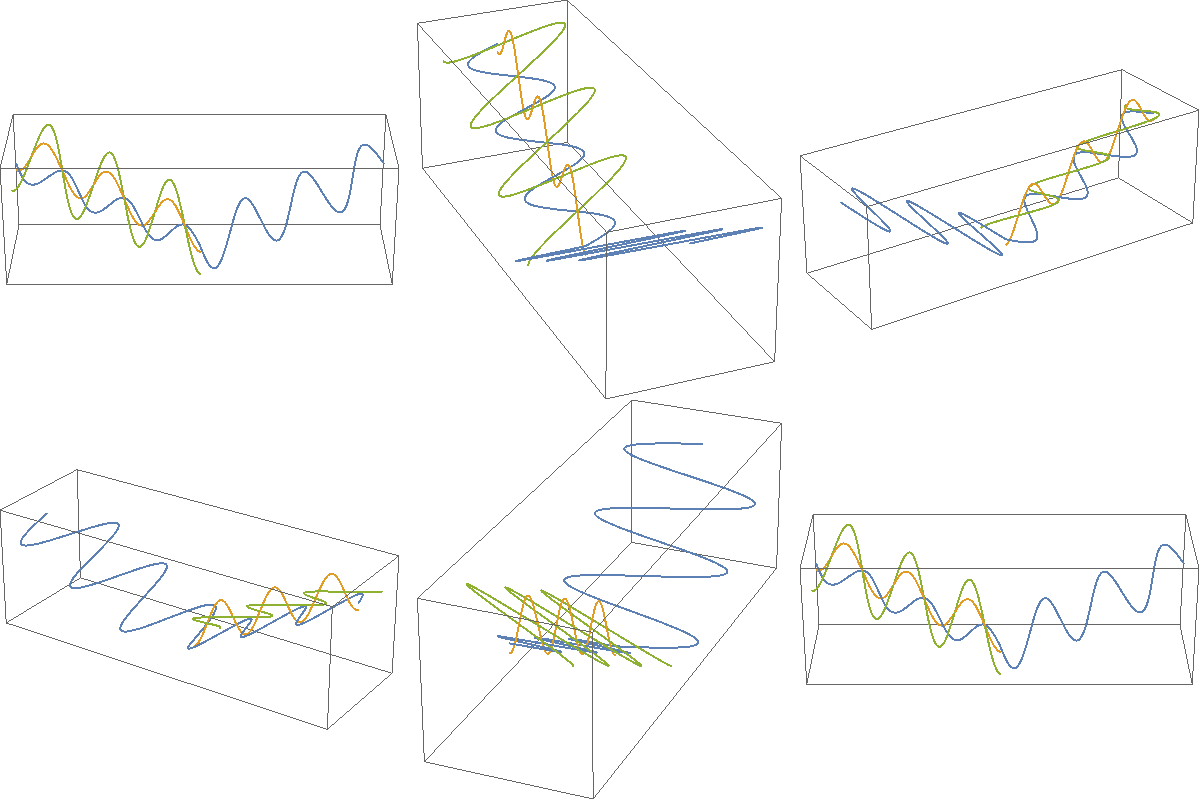 In this video, orange, green and blue electromagnetic fields shine in from one side of the box onto its floor. Each color’s field is polar because it “lives” in only one plane. However, the beam as a whole is unpolarized because different components of the total field direct recipient electrons into different planes giving zero net polarization. The Sun and most other familiar light sources emit unpolarized light.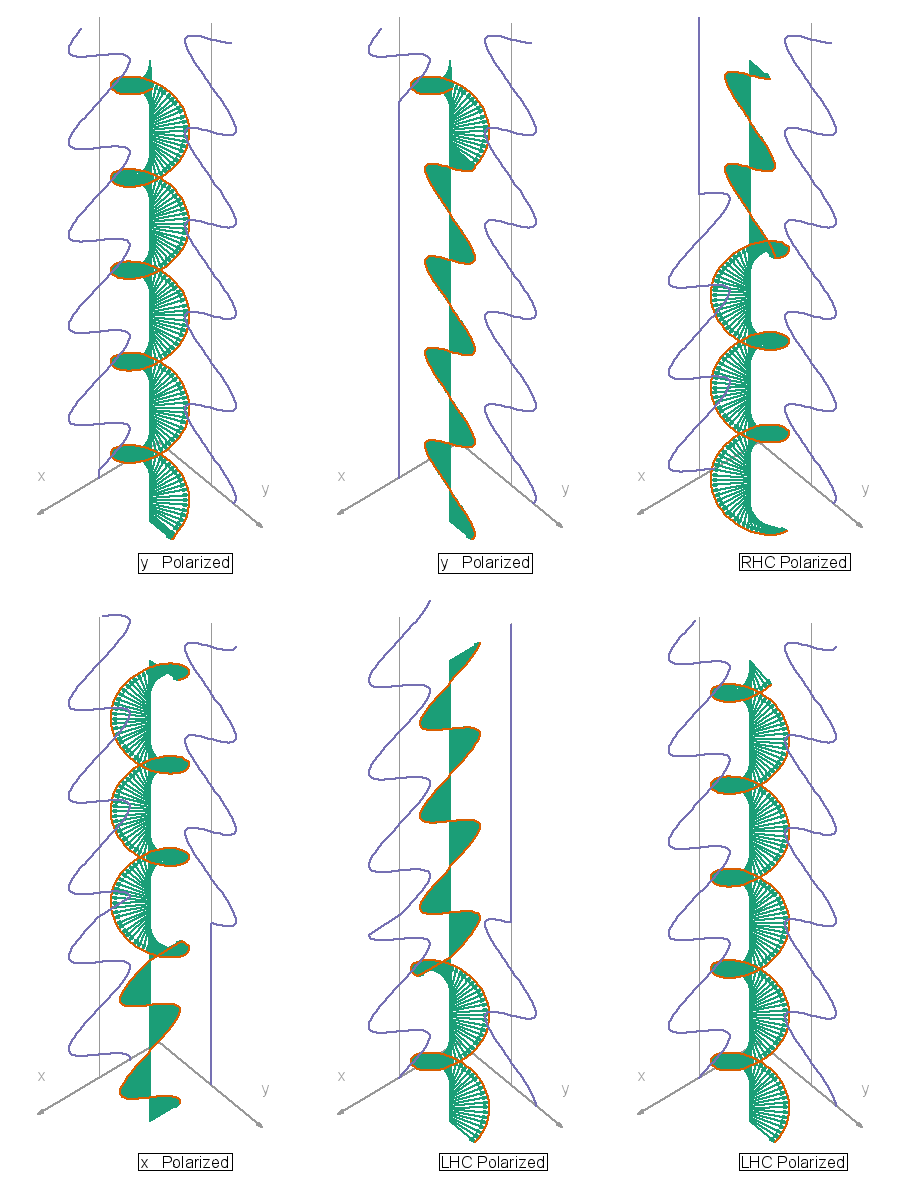

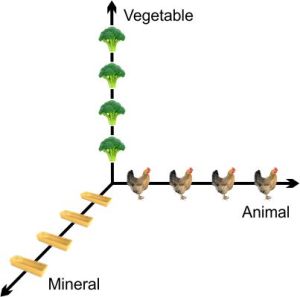 Suppose you had a graph with one axis for counting animal things and another for counting vegetable things. Animals added to animals makes more animals; vegetables added to vegetables makes more vegetables. If you’ve got a chicken, two potatoes and an onion, and you share with your buddy who has a couple of carrots, some green beans and another onion, you’re on your way to a nice chicken stew.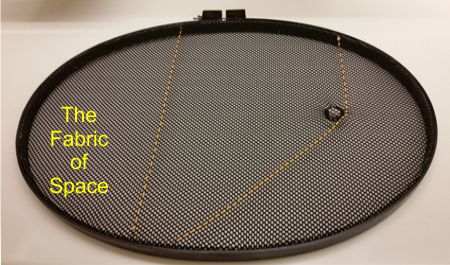


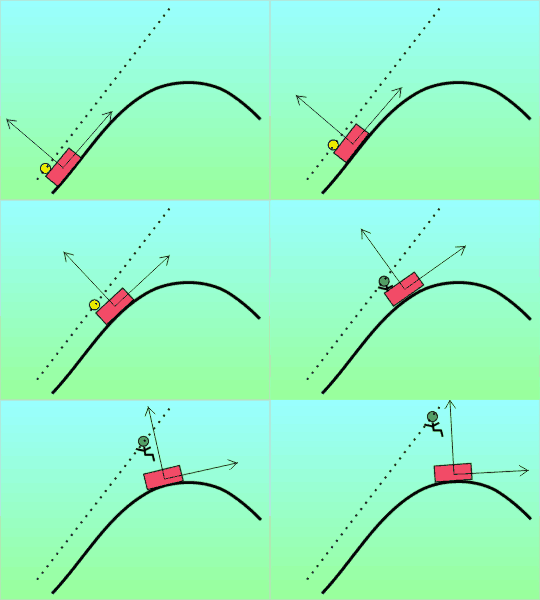 But there are other accelerations that aren’t so easily accounted for. Ever ride in a car going around a curve and find yourself almost flung out of your seat? This little guy wasn’t wearing his seat belt and look what happened. The car accelerated because changing direction is an acceleration due to a lateral force. But the guy followed Newton’s First Law and just kept going in a straight line. Did he accelerate?
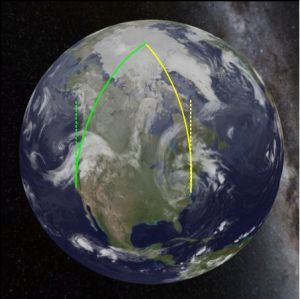 Suppose you’re investigating an object’s motion that appears to arise from a new force you’d like to dub “heterofugal.” If you can find a different frame of reference (one not attached to the object) or otherwise explain the motion without invoking the “new force,” then heterofugalism is a fictitious force.
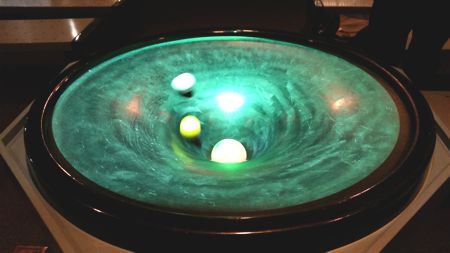


 Sure enough, that’s a straight line (see the chart). Reminds me of how Newton’s Law of Gravity is valid


