Three LIGOs make a Banana Slicer

Ponder for a moment what Space throws at you.  Photons of all sizes, of course —  infra-red ones that warm your skin, visible ones that show you the beach, ultra-violet ones that give you tan and sunburn.  Neutrinos and maybe dark matter particles that pass right through you without even pausing.  All of those act upon you in little bits at little places — gravity pervades you.  You can put up a parasol or step into a cave, but there’s no shielding yourself from gravity.

Gravity’s special character has implications for LIGOs.  A word first about words.  LIGO as a generic noun unwinds to Laser Interferometer Gravitational-Wave Observatory, a class of astronomical instruments. LIGO as a proper noun denotes a project that culminated in the construction of a specific pair of devices that went live in 2002.

That hardware wasn’t sensitive enough to detect the gravitational waves it was created to seek.  To improve the initial LIGO’s power and sensitivity, the LIGO infrastructure and organization morphed into the Advanced LIGO (aLIGO) project.  Concurrently, the LIGO instrument was upgraded and renamed.  No surprise, the instrument’s new name is aLIGO.  An early phase of aLIGO bore uncannily fortunate fruit with the Sept 14 gravitational wave detection.

Four other LIGOs are proposed, under construction or in operation around the world — KARGA in Japan, INDIGO in India, GEO600 in Germany and VIRGO in Italy.  Why so many, and why even consider space-borne LIGOs like LISA Pathfinder and eLISA?

Astronomers ask a series of questions of the Universe:

  • What objects are out there?
  • Where are they?
  • What are they doing?
  • Why are they doing that?

September’s aLIGO incident gave us a gratifyingly unexpected answer to the first question.  To the surprise of theoreticians, the detected event was the collision of two black holes, each of which was in a size range that current theory says shouldn’t be populated.  Even more surprising, such objects are apparently common enough to meet up, form binary pairs and eventually merge.
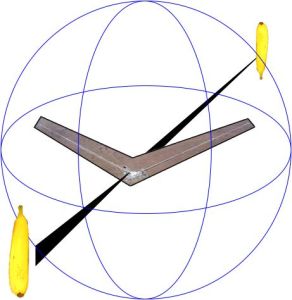
1 LIGO localizationThe second question is harder.  The best the aLIGO team could do was point to a “banana-shaped region” (their words, not mine) that covers about 1% of the sky.  The team marshaled a world-wide collaboration of observatories to scan that area (a huge search field by astronomical standards), looking for electromagnetic activities concurrent with  the event they’d seen.  Nobody saw any.  That was part of the evidence that this collision involved two black holes.  (If one or both of the objects had been something other than a black hole, the collision would have given off all kinds of photons.)

Why such poor localization?  Blame gravity’s pervasive character and Geometry.  With a telescope, any kind of telescope, you know which direction you’re looking.  Telescopes work only with photons that enter through the front; photons aimed at the back of the instrument stop there.
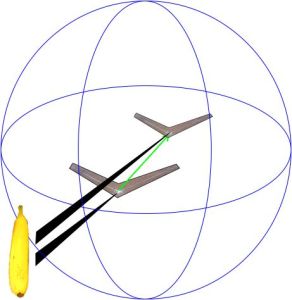
2 LIGO localizationIn contrast, a LIGO facility is (roughly speaking) omni-directional.  When a LIGO installation senses a gravitational pulse, it could be coming down from the visible sky or up through the Earth from the other hemisphere — one signal doesn’t carry the “which way?” information.  The diagram above shows that situation.  (The “chevron” is an image of the LIGO in Hanford WA.)  Models based on the signal from that pair of 4-km arms can narrow the source field to a “banana-shaped region,” but there’s still that 180o ambiguity.

The good news is that the LIGO project built not one but two installations, 2500 miles apart.  With two LIGOs (the second diagram) there’s enough information to resolve the ambiguity.  The two also serve as checks on each other — if one sees a signal that doesn’t show up at the other that’s probably a red herring that can be discarded.

3 LIGO localizationThe great “if only” is that the VIRGO installation in Italy was not recording data when the Hanford WA and Livingston LA saw that September signal.  With three recordings to reconcile, the aLIGO+VIRGO combination would have had enough information to slice that banana and localize the event precisely.

When the European Space Agency puts Evolved LISA (eLISA) in orbit (watch the animation, it’s cool) in 2034, there’ll be a million-kilometer triangle of spacecraft up there, slicing bananas all over the sky.

~~ Rich Olcott
The Shape of π and The Universe

pi
This square pi are rounded.

There’s no better way to celebrate 3/14/16 than chatting about how π is a mess but it’s connected to the shape of the Universe, all  while enjoying a nice piece of pie.  I’ll have a slice of that Neil Gaiman Country Apple, please.

The ancient Greeks didn’t quite know what to do about π.  For the Pythagoreans it transgressed a basic tenet of their religious faith — all numbers are supposed to be  integers or at least ratios of integers.  Alas for the faithful, π misbehaves.  The ratio of the circumference of a circle to its diameter just refuses to match the ratio of any pair of integers.

The best Archimedes could do about 250 BCE was determine that π is somewhere between 22/7 (0.04% too high) and 223/71 (0.024% too low).  These days we know of many different ways to calculate π exactly.  It’s just that each of them would take an infinite number of steps to come to a final result.  Nobody’s willing to wait that long, much less ante up the funding for that much computer time.  After all, most engineers are happy with 3.1416.

pi digitsNonetheless, mathematicians and cryptographers have forged ahead, calculating π to more than a trillion digits.  Here for your enjoyment are the 99 digits that come after digit million….

Why cryptographers ?  No-one has yet been able to prove it, but mathematicians are pretty sure that π’s digits are perfectly random.  If you’re given a starting sequence of decimal digits in π, you’ll be completely unable to predict which of the ten possible digits will be the next one.  Cryptographers love random numbers and they’re in π for the picking.


Another π-problem the Greeks gave us was in Euclid’s Geometry.  Euclid did a great job of demonstrating Geometry as an axiomatic system.  He built his system so well that everyone used it for millennia.  The problem was in his Fifth Postulate.  It claimed that parallel lines never meet, or equivalently, that the angles in every triangle add up to 180o.

Neither “fact” is necessarily true and Euclid knew that — he’d even written a treatise (Phaenomena) that used spherical geometry for astronomical calculations.  On our sweetly spherical Earth, a narwhale can swim a mile straight south from the North Pole, turn left and swim straight east for a mile, then turn left again and swim north a mile to get back to the Pole.  That’s a 90o+90o+90o=270o triangle no problem.  Euclid’s 180o rule works only on a flat plane.

cap areaBack to π.  The Greeks knew that the circumference of a circle (c) divided by its diameter (d) is π.  Furthermore they knew that a circle’s area divided by the square of its radius (r) is also π. Euclid was too smart to try calculating the area of the visible sky in his astronomical work.  He had two reasons — he didn’t know the radius of the horizon, and he didn’t know the height of the sky.  Later geometers worked out the area of such a spherical cap.  I was pleased to learn that π is the ratio of the cap’s area to the square of its chord, s2=r2+h2.

The Greeks never had to worry about that formula while figuring our how many tiles to buy for a circular temple floor.  The Earth’s curvature is so small that h is negligible relative to r.  Plain old πr2 works just fine.

CurvaturesAstrophysicists and cosmologists look at much bigger figures, ones so large that curvature has to be figured in.  There are three possibilities

  • Positive curvature, which you get when there’s more growth at the center than at the edges (balloons and waistlines)
  • Zero curvature, flatness, where things expand at the same rate everywhere
  • Negative curvature, which you get when most of the growth is at the edges (curly-leaf lettuce or a pleated skirt)

Near as the astronomers can measure, the overall curvature of the Universe is at most 10-120.  That positive but miniscule value surprised everyone because on theoretical grounds they’d expected a large positive value.  In 1980 Alan Guth explained the flatness by proposing his Inflationary Universe theory.  Dark energy may well  figure into what’s happening, but that’s another story.

Oh, that was tasty pie.

~~ Rich Olcott

aLIGO and eLISA: Tuning The Instrument

Oh, it’s good to see Big News in hard science get big attention in Big Media.  The LIGO story and Columbia’s Dr Brian Greene even made it to the Stephen Colbert Late Show.  Everyone chuckled at the final “boowee-POP” audio recording (simulation at 7:30 into this clip; get for-real traces and audio from this one).

There’s some serious science in those chirps, not to mention serious trouble for any alien civilization that happened to be too close to the astronomical event giving rise to them.

LIGO trace 3
Adapted from the announcement paper by Abbot et al

The peaks and valleys in the top LIGO traces represent successive spatial compression cycles generated by two massive bodies orbiting each other.  There’s one trace for each of the two LIGO installations.  The spectrograms beneath show relative intensity at each frequency.  Peaks arrived more rapidly in the last 100 milliseconds and the simulated sound rose in pitch because the orbits grew smaller and faster.  The audio’s final POP is what you get from a brief but big disturbance, like the one you hear when you plug a speaker into a live sound system.  This POP announced two black holes merging into one, converting the mass-energy of three suns into a gravitational jolt to the Universe.

Scientists have mentioned in interviews that LIGO has given us “an ear to the Universe.”  That’s true in several different <ahem> senses.  First, we’ve seen in earlier posts that gravitational physics is completely different from the electromagnetism that illuminates every kind of telescope that astronomers have ever used.  Second, black hole collisions generate signals in frequencies that are within our auditory range.  Finally, LIGO was purposely constructed to have peak sensitivity in just that frequency range.

Virtually every kind of phenomenon that physicists study has a characteristic size range and a characteristic frequency/duration range.  Sound waves, for instance, are in the audiophile’s beloved “20 to 20,000” cycles per second (Hz).  Put another way, one cycle of a sound wave will last something between 1/20 and 1/20,000 second (0.05-0.000 05 second).  The speed of sound is roughly 340 meters per second which puts sound’s characteristic wavelength range between 17 meters and 17 millimeters.

No physicist would be surprised to learn that humans evolved to be sensitive to sound-making things in that size range.  We can locate an oncoming predator by its roar or by the snapping twig it stepped on but we have to look around to spot a pesky but tiny mosquito.

So the greenish box in the chart below is all about sound waves.  The yellowish box gathers together the classes of phenomena scientists study using the electromagnetic spectrum.  For instance, we use infra-red light (characteristic time range 10-15-10-12 second) to look at (or cause) molecular vibrations.

RegimesWe can investigate things that take longer than an instrument’s characteristic time by making repeated measurements, but we can’t use the instrument to resolve successive events that happen more quickly than that.  We also can’t resolve events that take place much closer together than the instrument’s characteristic length.
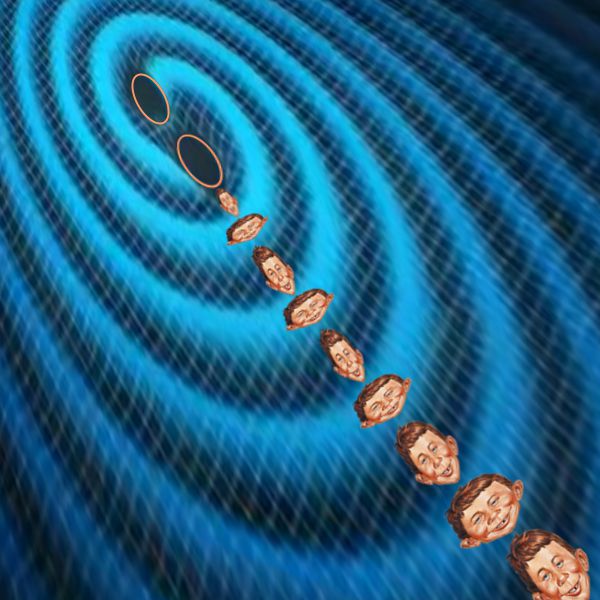
The electromagnetic spectrum serves us well, but it has its limitations.  The most important is that there are classes of objects out there that neither emit nor absorb light in any of its forms.  Black holes, for one.  They’re potentially crucial to the birth and development of galaxies.  However, we have little hard data on them against which to test the plethora of ideas the theoreticians have come up with.

Dark matter is another.  We know it’s subject to gravity, but to our knowledge the only way it interacts with light is by gravitational lensing.  Most scientists working on dark matter wield Occam’s Razor to conclude it’s pretty simple stuff.  Harvard cosmologist Dr Lisa Randall has suggested that there may be two kinds, one of which collects in disks that clothe themselves in galaxies.

That’s where LIGO and its successors in the gray box will help.  Their sensitivity to gravitational effects will be crucial to our understanding of dark objects.  Characteristic times in tens and thousands of seconds are no problem nor are event sizes measured in kilometers, because astronomical bodies are big.

GrWave Detectors
Gravitational instrumentation, from Christopher Berry’s blog and Web page

This is only the beginning, folks, we ain’t seen nothin’ yet.

~~ Rich Olcott

LIGO: Gravity Waves Ain’t Gravitational Waves

Sometimes the media get sloppy.  OK, a lot of times, especially when the reporters don’t know what they’re writing about.  Despite many headlines that “LIGO detected gravity waves,” that’s just not so.  In fact, the LIGO team went to a great deal of trouble to ensure that gravity waves didn’t muck up their search for gravitational waves.

Spring2A wave happens in a system when a driving force and a restoring force take turns overshooting an equilibrium point AND the away-from-equilibrium-ness gets communicated around the system.  The system could be a bunch of springs tied together in a squeaky old bedframe, or labor and capital in an economic system, or the network of water molecules forming the ocean surface, or the fibers in the fabric of space (whatever those turn out to be).

If you  were to build a mathematical model of some wavery system you’d have to include those two forces plus quantitative descriptions of the thingies that do the moving and communicating.  If you don’t add anything else, the model will predict motion that cycles forever.  In reality, of course, there’s always something else that lets the system relax into equilibrium.

The something else could be a third force, maybe someone sitting on the bed, or government regulation in an economy, or reactant depletion for a chemical process.  But usually it’s friction of one sort or another — friction drains away energy of motion and converts it to heat.  Inside a spring, for instance, adjacent crystallites of metal rub against each other.  There appears to be very little friction in space — we can see starlight waves that have traveled for billions of years.

Physicists pay attention to waves because there are some general properties that apply to all of them.  For instance, in 1743 Jean-Baptiste le Rond d’Alembert proved there’s a strict relationship between a wave’s peakiness and its time behavior.  Furthermore, Jean-Baptiste Joseph Fourier (pre-Revolutionary France must have been hip-deep in physicist-mathematicians) showed that a wide variety of more-or-less periodic phenomena could be modeled as the sum of waves of differing frequency and amplitude.

Monsieur Fourier’s insight has had an immeasurable impact on our daily lives.  You can thank him any time you hear the word “frequency.”  From broadcast radio and digitally recorded music to time-series-based business forecasting to the mode-locked lasers in a LIGO device — none would exist without Fourier’s reasoning.

Gravity waves happen when a fluid is disturbed and the restoring force is gravity.  We’re talking physicist fluid here, which could be sea water or the atmosphere or solar plasma, anything where the constituent particles aren’t locked in place. Winds or mountain slopes or nuclear explosions push the fluid upwards, gravity pulls it back, and things wobble until friction dissipates that energy.

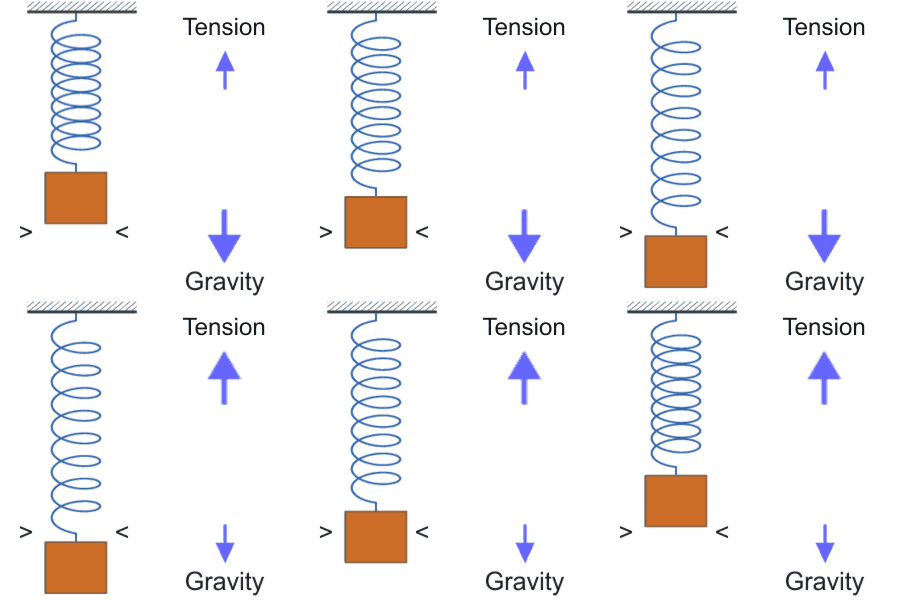
Gravitational waves are wobbles in gravity itself, or rather, wobbles in the shape of space.  According to General Relativity, mass exerts a tension-like force that squeezes together the spacetime immediately around it.  The more mass, the greater the tension.

Binary BH with AENAn isolated black hole is surrounded by an intense gravitational field and a corresponding compression of spacetime.  A pair of black holes orbiting each other sends out an alternating series of tensions, first high, then extremely high, then high…

Along any given direction from the pair you’d feel a pulsing gravitational field that varied above and below the average force attracting you to the pair.  From a distance and looking down at the orbital plane, if you could see the shape of space you’d see it was distorted by four interlocking spirals of high and low compression, all steadily expanding at the speed of light.

The LIGO team was very aware that the signal of a gravitational wave could be covered up by interfering signals from gravity waves — ocean tides, Earth tides, atmospheric disturbances, janitorial footsteps, you name it.  The design team arrayed each LIGO site with hundreds of “seismometers, accelerometers, microphones, magnetometers, radio receivers, power monitors and a cosmic ray detector.”  As the team processed the LIGO trace they accounted for artifacts that could have come from those sources.

So no, the LIGO team didn’t discover gravity waves, we’ve known about them for a century.  But they did detect the really interesting other kind.

~~ Rich Olcott

Would the CIA want a LIGO?

So I was telling a friend about the LIGO announcement, going on about how this new “device” will lead to a whole new kind of astronomy.  He suddenly got a far-away look in his eyes and said, “I wonder how many of these the CIA has.”

The CIA has a forest of antennas, but none of them can do what LIGO does.  That’s because of the physics of how it works, and what it can and cannot detect.  (If you’re new to this topic, please read last week’s post so you’ll be up to speed on what follows.  Oh, and then come back here.)

There are remarkable parallels between electromagnetism and gravity.  The ancients knew about electrostatics — amber rubbed by a piece of cat fur will attract shreds of dry grass.  They certainly knew about gravity, too.  But it wasn’t until 100 years after Newton wrote his Principia that Priestly and then Coulomb found that the electrostatic force law, F = ke·q1·q2 / r2, has the same form as Newton’s Law of Gravity, F = G·m1·m2 / r2. (F is the force between two bodies whose centers are distance r apart, the q‘s are their charges and the m‘s are their masses.)

Jim and AlAlmost a century later, James Clerk Maxwell (the bearded fellow at left) wrote down his electromagnetism equations that explain how light works.  Half a century later, Einstein did the same for gravity.
But interesting as the parallels may be, there are some fundamental differences between the two forces — fundamental enough that not even Einstein was able to tie the two together.

One difference is in their magnitudes.  Consider, for instance, two protons.  Running the numbers, I found that the gravitational force pulling them together is a factor of 1036 smaller than the electrostatic force pushing them apart.  If a physicist wanted to add up all the forces affecting a particular proton, he’d have to get everything else (nuclear strong force, nuclear weak force, electromagnetic, etc.) nailed down to better than one part in 1036 before he could even detect gravity.

But it’s worse — electromagnetism and gravity don’t even have the same shape.

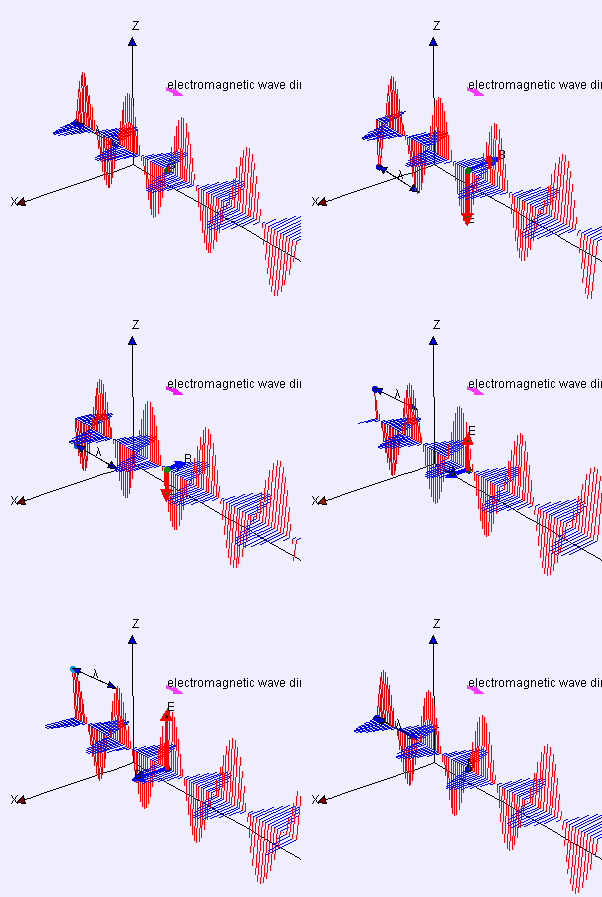
Electromagneticwave3D
Electric (red) and magnetic (blue) fields in a linearly polarized light wave
(graphic from WikiMedia Commons, posted by Lookang and Fu-Kwun Hwang)

A word first about words.  Electrostatics is about pure straight-line-between-centers (longitudinal) attraction and repulsion — that’s Coulomb’s Law.  Electrodynamics is about the cross-wise (transverse) forces exerted by one moving charged particle on the motion of another one.  Those forces are summarized by combining Maxwell’s Equations with the Lorenz Force Law.  A moving charge gives rise to two distinct forces, electric and magnetic, that operate at right angles to each other.  The combined effect is called electromagnetism.

The effect of the electric force is to vibrate a charge along one direction transverse to the wave.  The magnetic force only affects moving charges; it acts to twist their transverse motion to be perpendicular to the wave.  An EM antenna system works by sensing charge flow as electrons move back and forth under the influence of the electric field.

Gravitostatics uses Newton’s Law to calculate longitudinal gravitational interaction between masses.  That works despite gravity’s relative weakness because all the astronomical bodies we know of appear to be electrically neutral — no electrostatic forces get in the way.  A gravimeter senses the strength of the local gravitostatic field.

Maxwell and EinsteinGravitodynamics is completely unlike electrodynamics.  Gravity’s transverse “force” doesn’t act to move a whole mass up and down like Maxwell’s picture at left.  Instead, as shown by Einstein’s picture, gravitational waves stretch and compress while leaving the center of mass in place. I put “force” in quotes because what’s being stretched and compressed is space itself.  See this video for a helpful visualization of a gravitational wave.

LIGO is neither a telescope nor an electromagnetic antenna.  It operates by detecting sudden drastic changes in the disposition of matter within a “small” region.  In LIGO’s Sept 14 observation, 1031 kilograms of black hole suddenly ceased to exist, converted to gravitational waves that spread throughout the Universe.  By comparison, the Hiroshima explosion released the energy of 10-6 kilograms.

Seismometers do a fine job of detecting nuclear explosions.  Hey, CIA, they’re a lot cheaper than LIGO.

~~ Rich Olcott

LIGO, a new kind of astronomy

Like thousands of physics geeks around the world, I was glued to the tube Thursday morning for the big LIGO (Laser Interferometer Gravitational-Wave Observatory) announcement.  As I watched the for-the-public videos (this is a good one), I was puzzled by one aspect of the LIGO setup.  The de-puzzling explanation spotlit just how different gravitational astronomy will be from what we’re used to.

There are two LIGO installations, 2500 miles apart, one near New Orleans and the other near Seattle.  Each one looks like a big L with steel-pipe arms 4 kilometers long.  By the way, both arms are evacuated to eliminate some sources of interference and a modest theoretical consideration.

LIGO3The experiment consists of shooting laser beams out along both arms, then comparing the returned beams.
Some background: Einstein conquered an apparent relativity paradox.  If Ethel on vehicle A is speeding (like, just shy of light-speed speeding) past Fred on vehicle B, Fred sees that Ethel’s yardstick appears to be shorter than his own yardstick.  Meanwhile, Ethel is quite sure that Fred’s yardstick is the shorter one.

Einstein explained that both observations are valid.  Fred and Ethel can agree with each other but only after each takes proper account of their relative motion.  “Proper account” is a calculation called the Lorenz transformation.   What Fred (for instance) should do is divide what he thinks is the length of Ethel’s yardstick by √[1-(v/c)²] to get her “proper” length.  (Her relative velocity is v, and c is the speed of light.)

Suppose Fred’s standing in the lab and Ethel’s riding a laser beam.  Here’s the puzzle: wouldn’t the same Fred/Ethel logic apply to LIGO?  Wouldn’t the same yardstick distortion affect both the interferometer apparatus and the laser beams?

Well, no, for two reasons.  First, the Lorenz effect doesn’t even apply, because the back-and-forth reflected laser beams are standing waves.  That means nothing is actually traveling.  Put another way, if Ethel rode that light wave she’d be standing as still as Fred.

The other reason is that the experiment is less about distance traveled and more about time of flight.

Suppose you’re one of a pair of photons (no, entanglement doesn’t enter into the game) that simultaneously traverse the interferometer’s beam-splitter mirror.  Your buddy goes down one arm, strikes the far-end mirror and comes back to the detector.  You take the same trip, but use the other arm.

The beam lengths are carefully adjusted so that under normal circumstances, when the two of you reach the detector you’re out of step.   You peak when your buddy troughs and vice-versa.  The waves cancel and the detector sees no light.

Now a gravitational wave passes by (red arcs in the diagram).  In general, the wave will affect the two arms differently.  In the optimal case, the wave front hits one arm broadside but cuts across the perpendicular one.  Suppose the wave is in a space-compression phase when it hits.  The broadside arm, beam AND apparatus, is shortened relative to the other one which barely sees the wave at all.

The local speed of light (miles per second) in a vacuum is constant.  Where space is compressed, the miles per second don’t change but the miles get smaller.  The light wave slows down relative to the uncompressed laboratory reference frame.  As a result, your buddy in the compressed arm takes just a leetle longer than you do to complete his trip to the detector.  Now the two of you are in-step.  The detector sees light, there is great rejoicing and Kip Thorne gets his Nobel Prize.

But the other wonderful thing is, LIGO and neutrino astronomy are humanity’s first fundamentally new ways to investigate our off-planet Universe.  Ever since Galileo trained his crude telescope on Jupiter the astronomers have been using electromagnetic radiation for that purpose – first visible light, then infra-red and radio waves.  In 1964 we added microwave astronomy to the list.  Later on we put up satellites that gave us the UV and gamma-ray skies.

The astronomers have been incredibly ingenious in wringing information out of every photon, but when you look back it’s all photons.  Gravitational astronomy offers a whole new path to new phenomena.  Who knows what we’ll see.

~~ Rich Olcott

Smoke and a mirror

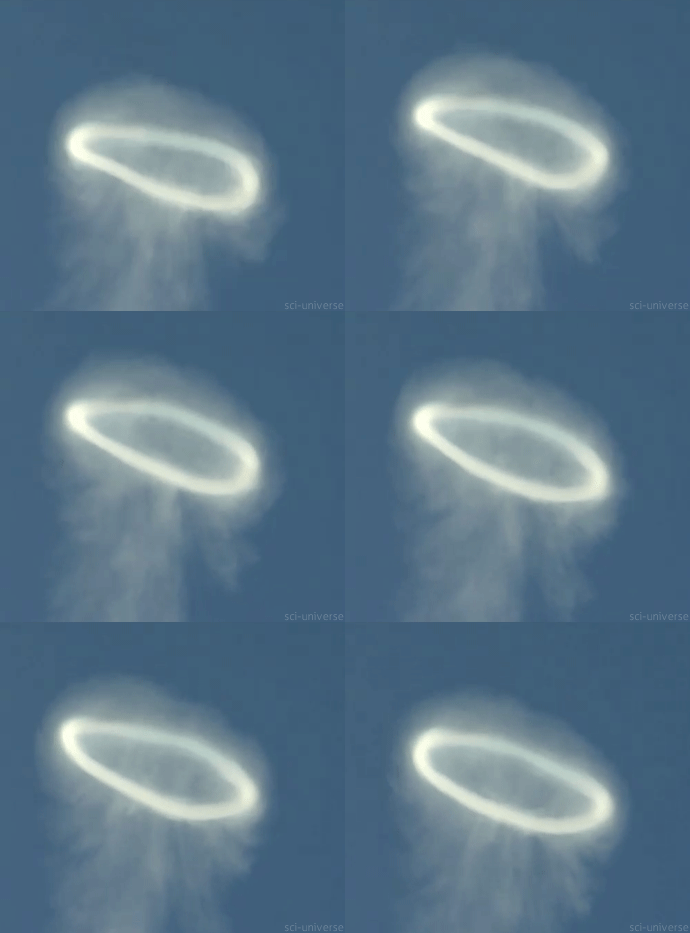
Etna jellyfish pairGrammie always grimaced when Grampie lit up one of his cigars inside the house.  We kids grinned though because he’d soon be blowing smoke rings for us.  Great fun to try poking a finger into the center, but we quickly learned that the ring itself vanished if we touched it.
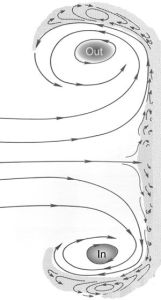
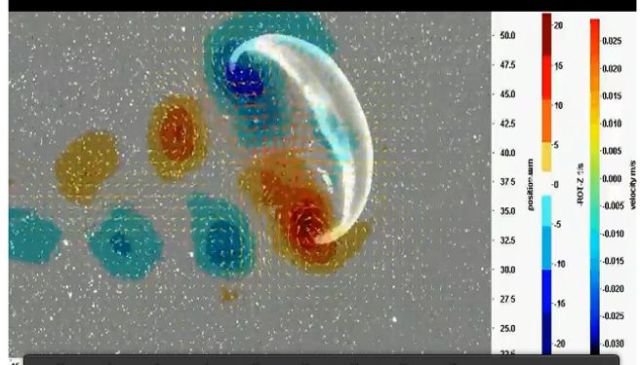
My grandfather can’t take credit for the smoke ring on the left — it was “blown” by Mt Etna.  Looks very like the jellyfish on the right, doesn’t it?  When I see two such similar structures, I always wonder if the resemblance comes from the same physics phenomenon.

This one does — the physics area is Fluid Dynamics, and the phenomenon is a vortex ring. We need to get a little technical and abstract here: to a physicist a fluid is anything that’s composed of particles that don’t have a fixed spatial relationship to each other. Liquid water is a fluid, of course (its molecules can slide past each other) and so is air.  The sun’s ionized protons and electrons comprise a fluid, and so can a mob of people and so can vehicle traffic (if it’s moving at all).  You can use Fluid Dynamics to analyze motion when the individual particles are numerous and small relative to the volume in question.

Ring x-section
Adapted from a NOAA page

You get a vortex whenever you have two distinct fluids in contact but moving at sufficiently different velocities.  (Remember that “velocity” includes both speed and direction.)  When Grampie let out that little puff of air (with some smoke in it), his fast-moving breath collided with the still air around him.  When the still air didn’t get out of the way, his breath curled back toward him.  The smoke collected in the dark gray areas in this diagram.

That curl is the essence of vorticity and turbulence.  The general underlying rule is “faster curls toward slower,” just like that skater video in my previous post.  Suppose fluid is flowing through a pipe.  Layers next to the outside surface move slowly whereas the bulk material near the center moves quickly.  If the bulk is going fast enough, the speed difference will generate many little whorls against the circumference, converting pump energy to turbulence and heat.  The plant operator might complain about “back pressure” because the fluid isn’t flowing as rapidly as expected from the applied pressure.

But Grampie didn’t puff into a pipe (he’s a cigar man, right?), he puffed into the open air.  Those curls weren’t just at the top and bottom of his breath, they formed a complete circle all around his mouth.  If his puff didn’t come out perfectly straight, the smoke had a twist to it and circulated along that circle, the way Etna’s ring seems to be doing (note the words In and Out buried in the diagram’s gray blobs).  When a vortex closes its loop like that, you’ve got a vortex ring.

A vortex ring is a peculiar beast because it seems to have a life of its own, independent of the surrounding medium.  Grampie’s little puff of vortical air usually retained its integrity and carried its smoke particles for several feet before energy loss or little fingers broke up the circulation.

To show just how special vortex rings are, consider the jellyfish.  Until I ran across this article, I’d thought that jellyfish used jet propulsion like octopuses and squids do — squirt water out one way to move the other way.  Not the case.  Jellyfish do something much more sophisticated, something that makes them possibly “the most energy-efficient animals in the world.”

jellyfish vortices

Thanks to a very nice piece of biophysics detective work (read the paper, it’s cool, no equations), we now know that a jellyfish doesn’t just squirt.  Rather, it relaxes its single ring of muscle tissue to open wide.  That motion pulls in a pre-existing vortex ring that pushes against the bell.  On the power stroke, the jellyfish contracts its bell to push water out (OK, that’s a squirt) and create another vortex ring rolling in the opposite direction.  In effect, the jellyfish continually builds and climbs a ladder of vortex rings.

Vortex rings are encapsulated angular momentum, potentially in play at any size in any medium.

~~ Rich Olcott

The Force(s) of Geometry

There’s a lot more to Geometry than congruent triangles.  Geometry can generate hurricanes and slam you to the floor.

It all starts (of course) with Newton.  His three laws boil down to

Effect is to Cause as Change of Motion is to Force.

They successfully account for the physical movement of pretty much everything bigger than an atom.  But sometimes the forces are a bit weird and it takes Geometry to understand them.

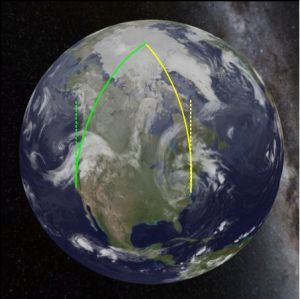
Side forceFor instance, suppose Fred and Ethel collaborate on a narwhale research project.  Fred is based in San Diego CA and Ethel works out of Norfolk VA. They fly to meet their research vessel at the North Pole. Fred’s plane follows the green track, Ethel’s plane follows the yellow one.  At the start of the trip, they’re on parallel paths going straight north (the dotted lines).  After a few hours, though, Ethel notices the two planes pulling closer together.

Ethel calls on her Newton knowledge to explain the phenomenon.  “It can’t be Earth’s gravity moving us together, because that force points down to Earth’s center and this is a sideways motion.  Our planes each weigh about 2000 kilograms and we’re still 2,000 kilometers apart.  By Newton’s F = G m1m2/r2 equation, the gravitational force between us should be (6.7×10⁻¹¹ N m2/kg2) x (2000 kg) x (2000 kg) / (2,000 m)2 = 6.7×10⁻¹¹ newtons, way too small to account for our speed of approach.  Both planes were electrically grounded when we fueled up, so we’re both carrying a neutral electric charge and it can’t be an electrostatic force.  If it were magnetic my compass would be going nuts and it’s not.  Woo-hoo, I’ve discovered a new kind of force!”

See what I did there?  Fred and Ethel would have stayed a constant distance apart if Earth were a cylinder.  Parallel lines running up a cylinder never meet.  But Earth is a sphere, not a cylinder.  Any pair of lines on a sphere must meet, sooner or later.  Ethel’s “sideways force” is a product of Geometry.

Sandy
Images extracted from NOAA’s SOS Explorer app, available from sos.noaa.gov

Hurricanes, too.  This video shows a day in the life of Hurricane Sandy.  Weather geeks will find several interesting details there, but for now just notice the centers of  counter-clockwise rotation (the one off the Florida coast is Sandy).  Storm centers in the Northern Hemisphere virtually always spin counterclockwise.  Funny thing is, in the Southern Hemisphere those centers go clockwise instead.

The difference has to do with angular momentum.  We could get all formal vector math here, but the easy way is to consider how fast the air is moving in different parts of the world.

We’ve all seen at least one ice show act where skaters form a spinning line. The last skater to join up (usually it’s a short girl) has to push like mad to catch the end of that moving line and everyone applauds her success. Meanwhile the tall girl at the center of the line is barely moving except to fend off dizziness.

YellowknifeThe line rotates as a unit — every skater completes a 360o rotation in the same time. Similarly, everywhere on Earth a day lasts for exactly 24 hours.

Skaters at the end of the line must skate faster than those further in because they have to cover a greater distance in the same amount of time.  The same geometry applies to Earth’s atmosphere.  The Earth is 25,000 miles around at the equator but only 12,500 miles around near the latitude of Whitehorse, Canada.  By and large, a blob of air at the equator must move twice as fast as a blob at 60o north.

chain 2Now suppose our speedy skater hits a slushy patch of ice.  Her end of the line is slowed down, so what happens to the rest of the line?  It deforms — there’s a new center of rotation that forces the entire line to curl around towards the slow spot.  Similarly, that blob near the Equator in the split-Earth diagram curls in the direction of the slower-moving air to its north, which is counter-clockwise.

In the Southern hemisphere, “slower” is southward and clockwise.

If not for Geometry (those differing circle sizes), we wouldn’t have hurricanes.  Or gravity — but that’s another story.

~~ Rich Olcott

Smack-dab in the middle

BridgeSee that little guy on the bridge, suspended halfway between all the way down and all the way up?  That’s us on the cosmic size scale.

I suspect there’s a lesson there on how to think about electrons and quantum mechanics.

Let’s start at the big end.  The physicists tell us that light travels at 300,000 km/s, and the astronomers tell us that the Universe is about 13.7 billion years old.  Allowing for leap years, the oldest photons must have taken about 4.3×10¹⁷ seconds to reach us, during which time they must have covered 1.3×1026 meters.  Double that to get the diameter of the visible Universe, 2.6×1026 meters.  The Universe probably is even bigger than that, but far as I can see that’s as far as we can see.

At the small end there’s the Planck length, which takes a little explaining.  Back in 1899, Max Planck published his epochal paper showing that light happens piecewise (we now call them photons).  In that paper, he combined several “universal constants” to derive a convenient (for him) universal unit of length: 1.6×10⁻³⁵ meters.  It’s certainly an inconvenient number for day-to-day measurements (“Gracious, Junior, how you’ve grown!  You’re now 8×1034 Planck-lengths tall.”).  However, theoretical physicists have saved barrels of ink and hours of keyboarding by using Planck-lengths and other such “natural units” in their work instead of explicitly writing down all the constants.

Furthermore, there are theoretical reasons to believe that the smallest possible events in the Universe occur at the scale of Planck lengths.  For instance, some theories suggest that it’s impossible to measure the distance between two points that are closer than a Planck-length apart.  In a sense, then, the resolution limit of the Universe, the ultimate pixel size, is a Planck length.

sizelineSo that’s the size range of the Universe, from 1.6×10⁻³⁵ up to 2.6×1026 meters. What’s a reasonable way to fix a half-way mark between them?

It makes no sense to just add the two numbers together and divide by two the way we’d do for an arithmetic average. That’d be like adding together the dime I owe my grandson and the US national debt — I could owe him 10¢ or $10, but either number just disappears into the trillions.

The best way is to take the geometrical average — multiply the two numbers and take the square root.  I did that.  It’s the X in the sizeline, at 6.5×10⁻⁵ meters, or about the diameter of a fairly large bacterium.  (In the diagram, VSC is the Vega Super Cluster, AG is the Andromeda Galaxy, and the numbers are those exponents of 10.)

That’s worth marveling at.  Sixty orders of magnitude between the size of the Universe and the size of the ultimate pixel.  Yet from blue whales to bacteria, Earth’s life just happens to occupy the half-dozen orders right in the middle of the range.  We think that’s it.

Could this be another case of the geocentric fallacy?  Humans were so certain that Earth was the center of the Universe, before Brahe and Galileo and Newton proved otherwise.  Is there life out there at scales much larger or much smaller than we imagine?

Who knows? But here’s an intriguing physics/quantum angle I’d like to promote.  We know a lot about structures bigger than us — solar systems and binary stars and galaxy clusters on up.  We know a few sizes and structures a bit smaller — viruses and molecules and atoms.  We’re aware of quarks and gluons that reside inside protons and atomic nuclei, but we don’t know their size or structure.

Even a proton is huge on the Planck-length scale.  At 1.8×10⁻¹⁵ meters the proton measures some 1020 Planck-lengths.  There’s as much scale-space between the Planck-length and the proton as there is between the Earth (1.3×10⁷ meters) and the Universe.

It’s hard to believe that Terra infravita’s area has no structure whereas Terra supravita is so … busy.  The Standard Model’s “ultimate particles,” the electrons and photons and neutrinos and quarks and gluons, all operate down there somewhere.   It’s reasonable to suppose that they reflect a deeper architecture somewhere on the way down to the Planck-length foam.

Newton wrote (in Latin), “I do not make hypotheses.”  But golly, it’s tempting.

~~ Rich Olcott

There’s a lot of not much in Space

A while ago I drove from Denver to Fort Worth, and I was impressed. See, there’s a lot of not much in eastern Colorado. It’s pretty much the same in western Oklahoma except there’s less not much because there’s less of Oklahoma – but Texas has way more not much than anybody.

That gives Texas not much to brag about, but they do the best they can, bless their hearts.

What got me started on this rant was a a pair of astronomical factoids Katherine Kornei wrote in the Nov 2014 Discover magazine.

“If galaxies were shrunk to the size of apples, neighboring galaxies would be only a few meters apart….”
“If the stars within galaxies were shrunk to the size of oranges, they would be separated by 4,800 kilometers (3,000 miles).”

Apple orangeSo there’s a lot of not much between galaxies, but a whole lot more not much, relatively speaking, within them. I just measured an apple and an orange in my kitchen. They’re both about the same size, 3 inches in diameter, so I have no idea why she chose different fruits – perhaps she wanted to avoid comparing apples and oranges.

Anyway, if you felt like doing the galaxy visualization you could put two apple galaxies on the floor about 12 feet apart and then line up about 50 apples between them. A fair amount of space for more galaxies.

To see inside a galaxy you could put one orange star in Miami FL, and its on-the-average nearest orange neighbor in Seattle WA. Then you could set out a long skinny row of just about 63 million oranges in between. Oh, and on this scale the nearest galaxy would be about 2 billion miles (or 43 quadrillion oranges) away. Way more not much inside a galaxy than between two neighboring ones.

So if we squeeze all those apples and oranges together we’d get rid of all the empty space, right?

Not by a long shot. Nearly all those stars are balls of very hot gas, which means they’re made up of atoms crossing empty space inside the star to collide with other atoms. Relative to the size of the atoms, how much empty space is there inside the star?

Matryoshkii 1For example, every chemistry student learns that 6×10²³ molecules of any gas take up a volume of 22.4 liters at normal Earth temperature and pressure. For a single-atom gas like helium that works out to about 22 atom-widths between atoms.

Now think about emptiness inside the Sun. If it’s a typical star (which it is) and if all of its atoms are hydrogen (which they mostly are) and if the average density of the Sun (1408 kg/m3) applied all the way down to the center of the Sun (which it doesn’t), and if we believe NASA’s numbers for the Sun (hey, why not?), then the average density works out to about 0.7 atom-widths between neighbors.

So no empty space to squeeze out of the Sun, eh? Well, actually there is quite a lot, because those atoms are mostly empty space, too.

OK, I cheated up there about the Sun, because virtually all of the Sun’s atoms have been dissociated into separated electrons and nuclei. The nucleus is much smaller than than its atom – by a factor of 60,000 or so. Think of a grape seed in the middle of a football field.

To sum it upward, we’ve got a set of Russian matryoshka dolls, one inside the next. At the center is a collection of grape seeds, billions and billions of them, each in their own football field. The football fields are all balled into a stellar orange (or maybe an apple), but there are billions of those crammed into a galactic apple (or maybe an orange) that’s about ten feet away from the nearest other piece of fruit.

As Douglas Adams wrote in Hitchhiker’s Guide to The Galaxy,

“Space … is big. Really big. You just won’t believe how vastly, hugely, mindbogglingly big it is. I mean, you may think it’s a long way down the road to the chemist’s, but that’s just peanuts to space…”

The thing to realize is that the function of all that space is to keep everything from being in the same place. That’s important.

~~ Rich Olcott